Tamilnadu BoardEnglish MediumSTD 11PhysicsKinematics5 Marks
Question
Derive the relation between Tangential acceleration and angular acceleration.
✓
Answer
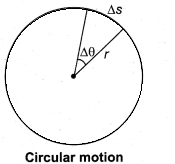
Consider an object moving along a circle of radius $r$. In a time $\Delta t$, the object travels in an arc distance As as shown in figure. The corresponding angle subtended is $\Delta \theta$
The $\Delta s$ can be written in terms of $\Delta \theta$
$
\Delta s = r \Delta \theta
$
in a time $\Delta t$, we have
$
\frac{\Delta s}{\Delta t}= t \frac{\Delta \theta}{\Delta t}
$
¡n the limit $\Delta t -0$, the above equation becomes
$
\frac{d s}{d t}=r \omega
$
Here $\frac{d s}{d t}$ is linear speed (y) which is tangential to the circle and co is angular speed.
So equation (iii) becomes.
$
v_r=r \omega
$
which gives the relation between linear speed and angular speed.
Eq. (iv) is true only for circular motion. In general the relation between linear and angular velocity is given by
$
\vec{v}=\vec{\omega} \times \vec{r}
$
For circular motion eq. (y) reduces to eq. (iv) since $\vec{\omega}$ and $\overrightarrow{ r }$ are perpendicular to each other. Differentiating the eq. (iv) with respect to time, we get (since $r$ is constant)
$
\frac{d v}{d t}=\frac{r d v}{d t}= r \alpha
$
Here $\frac{d v}{d t}$ Is the tangential acceleration and is denoted as $a _{ t }=\frac{d \omega}{d t}$ is the angular acceleration $\alpha$. Then eq. ( $v$ ) becomes
$a_t=r \alpha$
Need a full question paper?
Generate a complete, print-ready paper with questions like this in minutes — across 16+ boards, with answer keys.