Questions

[4 Mark Questions]

🎯

Test yourself on this topic

22 questions · timed · auto-graded

Question 14 Marks
Exercise Problems.

An athlete completes one round of a circular track of diameter 200 m in 40 s. What will be the distance covered and the displacement at the end of 2 m and 20 s?

Answer

Given: Diameter of circular track = 200m
time to complete = 40s
Formula: Circumference of circular track = d. π m
speed $=\frac{\text { distance }}{\text { time }}$
Solution:
Circumference of the track = d.π
= 200 × 3.14 = 628m
speed $=\frac{628 m }{40 s }=15.7 ms ^{-1}$
Distance covered in 2 min 20 s = speed × time
In the given time athlete covers 31/2 rounds = 2198m
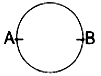
The final position of athlete is as shown in figure (A – initial position, B – final position)
∴ Displacement = Distance × time
= 200 m
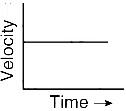
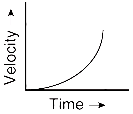
View full question & answer
Question 24 Marks
Sr. No.List I List II
1.Motion of a body covering equal distances in equal interval of timeD.
2.Motion with non uniform accelerationC.
3.Constant retardationA.
4.Uniform accelerationB.
Answer

Given: height = 20 m
acceleration = 10 ms– 2
Formula: For free falling body,

  1. v = gt
  2. s = 1/2 gt2
    Solution:
    time taken to strike the ground
    s = 1/2 gt2
    20m = 1/2 × 10 ms – 2 × t2
    $t ^2=\frac{40 m }{10 ms ^{-2}}=4 s ^2$
    ∴ t = 2s
  3. Velocity of the ball when it strikes ground v = gt
    v = 10ms– 2 × 2s
    v = 20ms– 1
View full question & answer
Question 34 Marks
What remains constant in uniform circular motion? And what changes continuously in uniform circular motion?
Answer
    • Speed remains constant in a uniform circular motion.
    • Velocity changes continuously in a uniform circular motion.
View full question & answer
Question 44 Marks
When a body is said to be in (i) uniform acceleration (ii) non – uniform acceleration?
Answer
  • (i) A body is said to be in uniform acceleration if it travels in a straight line and its velocity increases or decreases by equal amounts in equal time intervals.
    (ii) A body is said to be in non-uniform acceleration if the rate of change of its velocity is not constant i.e. differs in different time intervals.
View full question & answer
Question 54 Marks
Define uniform circular motion and give an example of it. Why is it called accelerated motion?
Answer
  • When an object is moving with a constant speed along a circular path, the change in velocity is only due to the change in direction. Hence it is accelerated motion. Example:
    1. The earth moves around the sun in a uniform circular motion.
    2. The moon moves in uniform circular motion around the earth.
View full question & answer
Question 64 Marks
Distinguish between uniform motion and non
Answer
  • uniform motion.
    1. An object is said to be in uniform motion if it covers equkl distances in equal intervals of time.
    2. example of uniform motion ‘train’
    non-uniform motion.
    1. If a body covers unequal distances in equal interval of time (or) equal distances in a different interval of time
    2. example of non – uniform motion ‘bus’
View full question & answer
Question 74 Marks
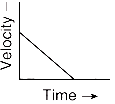
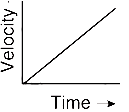
Define acceleration and state its SI unit for motion along a straight line, when do we consider the acceleration to be (i) positive (ii) negative? Give an example of a body in uniform acceleration.
Answer
  • Answer: Acceleration is the rate of change of velocity with respect to time or it is the rate of change of velocity in unit time. It is a vector quantity. The $SI$ unit of acceleration is $ms ^{-2}$
    Acceleration $=$ Change in velocity/time
    $=($ Final velocity - initial velocity $) /$ time
    \[
    a =\frac{v-u}{t}
    \]
    If $v>u$, then ' $a$ ' is positive. If final velocity is greater than initial velocity, the velocity increase with time, the value of acceleration is positive.
    If $v<u$, then a is negative. If final velocity is less than initial velocity
    Example: The motion of a freely falling body and vertically thrown up body are the examples of uniform acceleration.
    The motion of ball rolling down on an inclined plane is another example.
View full question & answer
Question 94 Marks
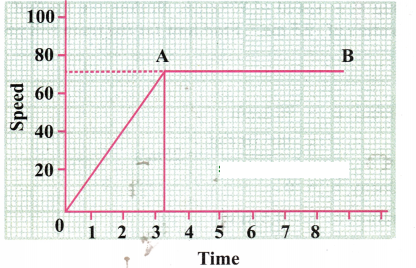
The following graph shows the motion of a car. What do you infer from the graph along with OA and AB? What is the speed of the car along with AB and what time it reached this speed?a) What do you infer from the graph along OÄ and AB What is the speed of the car along AB?What time it reached this speed
Answer
Graph along with OA: The car travels with uniform acceleration and uniform motion.
Graph along with AB : The car travels with constant speed and unaccelerated motion.ImageAlong AB : The speed of the car is constant.
From the graph, it seems the speed along AB is 72 km/hr.It reaches this speed after 3.2 hours, that is, 3 hours, 12 minutes.
View full question & answer
Question 104 Marks
The adjacent diagram shows the velocity-time graph of the body.
a) During what time interval is the motion of the body accelerated?b) Find the acceleration in the time Interval mentioned in part ‘a’.c) What is the distance travelled by the body in the time interval mentioned ¡n part ‘a’?
Answer
At 0 to 4 second$a =\frac{v-u}{t}=\frac{30-0}{4}=7.5 m / s ^2$$\begin{array}{l}=\text { Area of the triangle }=1 / 2 bh \\ =1 / 2 \times 4 \times 30=60 m \end{array}$
View full question & answer
Question 114 Marks
A train travelling at a speed of 90kmph. Brakes are applied so as to produce a uniform acceleration of -0.5 ms-2. Find how far the train will go before it is brought to rest?
Answer
Here we have
Initial velocity , $u =90 km / h$
\[
=\frac{90 \times 1000 m }{60 \times 60 s }=25 m / s
\]
Final velocity, $v=0$
Acceleration, $a =-0.5 m / s ^2$
Thus, distance travelled = ?
We know that, $v^2=u^2+2$ as
\[
\begin{aligned}
\Rightarrow 0 & =25 m / s ^2+2 \times-0.5 m / s ^2 \times s \\
& =625 m ^2 / s ^2-1 m / s ^2 \times s \\
\Rightarrow 1 ms ^{-2} s & =625 m ^2 s^{-2}
\end{aligned}
\]
View full question & answer
Question 124 Marks
During an experiment, a signal from a spaceship reached the ground station in five seconds. What was the distance of the spaceship from the ground station? The signal travels at the speed of light that is $3 \times 10^8 ms ^{-1}$
Answer
Time taken $=5$ seconds.
Speed of signal $u =3 \times 10^8 m / s$ ?
Distance $=$ ?
Speed $=$ Distance $/$ Time
$\therefore$ Distance $=$ Speed $\times$ Time
Distance $=3 \times 10^8 \times 5=15 \times 10^8 m$.
View full question & answer
Question 134 Marks
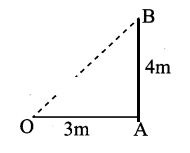
A boy travels a distance of 3m due east and then 4m due north.
(a) How much is the total distance covered?
(b) What is the magnitude of the displacement?
Answer
Image (a) Total distance covered $=3+4=7 m$
(b) Net displacement: $OB ^2= OA ^2+ AB ^2$
\[
\begin{array}{l}
=3^2+4^2 \\
O B^2=25 m^2 \\
\therefore O B=5 m 03 m
\end{array}
\]
Net displacement $=5 m$
View full question & answer
Question 144 Marks
A car moves 30 km in 30 min and the next 30 km in 40 min. Calculate the average speed for the entire journey.
Answer
Total time taken $=30+40=70 min .=\frac{70}{60}$ hour Total distance $=30+30=60 km$ Average speed, $v_{\substack{\text { average } \\ \text }}=\frac{\text { Total distance }}{\text { Time taken }}=\frac{60}{\frac{70}{60}}=\frac{3600}{70}=51.4 km / h$
View full question & answer
Question 154 Marks
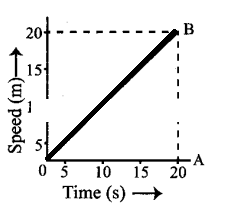
Find the distance covered by a particle during the time interval which the speed-time graph is-shown in figure.
Answer
Image Distance covered in the. time interval 0 to $20 s$ is equal to the area of the triangle OAB.
Area of A OAB. $\frac{1}{2} \times$ base $\times$ height
\[
\frac{1}{2} \times 20 \times 20=200 ms ^{-1}
\]
View full question & answer
Question 164 Marks
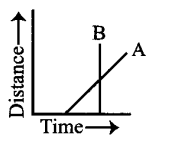
In a distance-time graph of two objects A & B, which object is moving with greater speed when both are moving?
Answer
Object B makes a longer angle with the time – axis. Its slope is greater than the slope of object A. Thus the speed of B is greater than that of A.Image
View full question & answer
Question 174 Marks
Abus from Chennai travels to Trichy passes loo km, 160 km at 10.15 am, 11.15 am respectively. Find the average speed of the bus during 10.15 – 11.15 am.
Answer
The distance coveredbetween 10.l5am& 11.15 am = 160 – 100 = 60km The time interval = 1 h Average speed = 60/1 = 60km/h
View full question & answer
Question 184 Marks
Ram swims in a 80m long swimming pool. He covers 160m in 1 min by swimming from one end to the other and back along the same straight pattern. Find the average speed and average velocity.
Answer
Total distance $=160 m$
Total displacement $=0$
Time taken $( t )=1 min =60 s$
Average speed $\left(s_{\text {average }}\right)=\frac{\text { total distance }}{\text { total time taken }}$
\[
s_{\text {average }}=\frac{160}{60}=2.66 m / s
\]
View full question & answer
Question 194 Marks
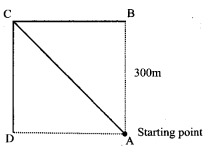
In a long-distance race the athletes were expected to take four rounds of the track such that the line of finish was same as the line of start. Suppose the length of the track was 300m,Image(i) What is the total distance to be covered by the athletes?
What is the total displacement of the athletes when they touch the finish line?
(iii) Is the motion of the athletes uniform or non- D .^starting point uniform?
(iv) Is the displacement & distance moved by an athlete at the end of the race equal?
Answer
(i) Total distance covered = 4 × 300 = 1200 m
(ii) Displacement = 0 [final position – initial position]
(iii) Non – uniform.
∵ the direction of motion is changing while running on the track.
(iv) Both are not equal.
View full question & answer
Question 204 Marks
A train is travelling at a speed of $90 kmh ^{-1}$. Brakes are applied so as to produce a uniform acceleration of$0.5 ms ^{-2}$, find how far the train will go before it is brought to rest.
Answer
$\begin{array}{l}\text { Initial velocity of train }( u )=90 km / h =\frac{90,000 m }{3,600 sec }=25 ms ^{-1} \\ \text { Final velocity }( v )=0 ms ^{-1} \\ \text { Acceleration }( a )=-0.5 ms ^{-2} \\ v ^2= u ^2+2 \text { as } \\ s =\left( v ^2- u ^2\right) / 2 a =\left(0^2-25^2\right) /-(2 \times 0.5) \\ s =-625 /-1=625 m \\ s =625 m \end{array}$
View full question & answer
Question 214 Marks
A car starting from rest moves with uniform acceleration of 0.2 ms-2 for 3 min. Fine the (a) speed acquired (b) the distance travelled.
Answer
Initial speed $( u )=0 m / s$
Acceleration $( a )=0.2 ms ^{-2}$
Time taken $( t )=3 min =3 \times 60=180 s$
Final velocity $( v )=$ ?
Distance covered $( s )=$ ?
\[
\begin{array}{l}
v=u+a t=0+0.2 \times 180=36 m / s \\
v=36 m / s \\
s =u t+1 / 2 a t^2=0+1 / 2 \times 0.2 \times(180)^2 \\
=0.1 \times 32400=3240 m \\
s =3240 m
\end{array}
\]
View full question & answer
Question 224 Marks
A bus speed decreases from 50 km/h to 40 km/h in 3s, find the acceleration of the bus.
Answer
    • $\begin{aligned} \text { Initial speed }(u) & =50 km / h =\frac{50 \times 1000 m }{3600 sec .}=\frac{250}{18} m / s \\ \text { Final speed }(v) & =40 km / h =\frac{40 \times 1000 m }{3600 sec }=\frac{200}{18} m / s \\ \text { Time taken }(t) & =3 s \quad \text } \\ v & =u+a t \\ \therefore a & =\frac{v-t}{t}=\frac{-50}{18 \times 3}=-0.925 ms ^{-2} \\ \text { (Negative) acceleration } & =-0.925 ms ^{-2}\end{aligned}$
View full question & answer
[4 Mark Questions] - Science STD 9 Questions - Vidyadip