Questions

[7 marks Questions]

🎯

Test yourself on this topic

2 questions · timed · auto-graded

Question 17 Marks
Explain different types of motion.
Answer
In physics, motion, can be classified as below.
  1. Linear motion: Motion along a straight line.
  2. Circular motion: Motion along a circular path.
  3. Oscillatory motion: Repetitive to and fro motion of an object at regular interval of time.
  4. Random motion: Motion of the object which does not fall in any of the above categories.
  5. Uniform and Non-uniform motion:
    1. Uniform motion: Consider a car which covers 60 km in the first hour, 60 km in second horn-, and another 60 km in the third hour and so on. The car covers equal distance at equal interval of time. We can say that the motion of the car is uniform. An object is said to be in uniform motion if it covers equal distances in equal intervals of time howsoever big or small these time intervals may be.
    2. Non-uniform motion: Now, consider a bus starting from one stop. It proceeds slowly when it passes through a crowded area of the road. Suppose, it manages to travel merely 100 m in 5 minutes due to heavy traffic and is able to travel about 2 km in 5 minutes when the road is clear. Hence, the motion of the bus is non-uniform i.e. it travels unequal distances in equal intervals of time.
View full question & answer
Question 27 Marks
Derive the equations of motion by graphical method.
Answer
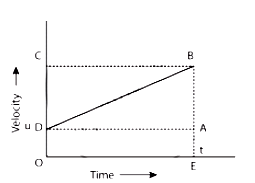
An object is in motion with initial velocity u attains a final velocity v in time t due to acceleration a, with displacement S.
Let us try to derive these equations by graphical method. Equations of motion from velocity – time graph:

Graph shows the change in velocity with time for an uniformly accelerated object. The object starts from the point $D$ in the graph with velocity $u$. Its velocity keeps increasing and after time $t$ it reaches the point B on the graph.
The initial velocity of the object $= u = OD = EA$
The final velocity of the object $=v=O C=E B$
Time $= t = OE = DA$
Also from the graph we know that, $A B=D C$
For First equation of motion
By definition, acceleration $=\frac{\text { change in velocity }}{\text { time }}$
$=\frac{(\text { final velocity }- \text { initial velocity })}{\text { time }}$
$=\frac{(O C-O D)}{O E}=\frac{D C}{O E}$
$a=\frac{D C}{t}$
$DC = AB =$ at
From the graph $E B=E A+A B$
$v=u+a t$
This is first equation of motion.
For Second equation of motion
From the graph the distance covered by the object during time $t$ is given by the area of quadrangle DOEB
$s$ = area of the quadrangle DOEB
$s=$ area of the rectangle DOEA + area of the triangle DAB
$=(A E \times O E)+(1 / 2 \times A B \times D A)$
$s=u t+1 / 2 a t^2 \ldots(2)$
This is second equation of motion.
For Third equation of motion
From the graph the distance covered by the object during time $t$ is given by the area of the quadrangle DOEB. Here DOEB is a trapezium. Then
$
\begin{array}{l}
s=\text { area of trapezium DOEB } \\
=1 / 2 \times \text { sum of length of pa } \\
=1 / 2 \times(O D+B E) \times O E \\
s=1 / 2 \times(u+v) \times t
\end{array}
$
$
=1 / 2 \times \text { sum of length of parallel side } \times \text { distance between parallel sides }
$\
Since $a=$ Since $a=(v-u) /$ tor $t=(v-u) / a$
Therefore $=1 / 2 \times(v+u) \times(v-u) / a$.
$
\text { 2as }=v^2=u^2+2 a s
$
$
v^2=u^2+2 \text { as .........(3) }
$
This is third equation of motion.

 
View full question & answer
[7 marks Questions] - Science STD 9 Questions - Vidyadip