Tamilnadu BoardEnglish MediumSTD 9SciencePHYSICS CH 2 Motion7 Marks
Question
Derive the equations of motion by graphical method.
✓
Answer
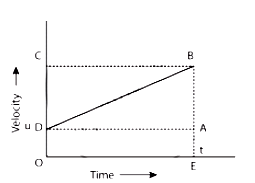
An object is in motion with initial velocity u attains a final velocity v in time t due to acceleration a, with displacement S. Let us try to derive these equations by graphical method. Equations of motion from velocity – time graph: Graph shows the change in velocity with time for an uniformly accelerated object. The object starts from the point $D$ in the graph with velocity $u$. Its velocity keeps increasing and after time $t$ it reaches the point B on the graph. The initial velocity of the object $= u = OD = EA$ The final velocity of the object $=v=O C=E B$ Time $= t = OE = DA$ Also from the graph we know that, $A B=D C$ For First equation of motion By definition, acceleration $=\frac{\text { change in velocity }}{\text { time }}$ $=\frac{(\text { final velocity }- \text { initial velocity })}{\text { time }}$ $=\frac{(\text { final velocity }- \text { initial velocity })}{\text { time }}$ $=\frac{(O C-O D)}{O E}=\frac{D C}{O E}$ $a=\frac{D C}{t}$ $DC = AB =$ at From the graph $E B=E A+A B$ $v=u+a t$ This is first equation of motion. For Second equation of motion From the graph the distance covered by the object during time $t$ is given by the area of quadrangle DOEB $s$ = area of the quadrangle DOEB $s=$ area of the rectangle DOEA + area of the triangle DAB $=(A E \times O E)+(1 / 2 \times A B \times D A)$ $s=u t+1 / 2 a t^2 \ldots(2)$ This is second equation of motion. For Third equation of motion From the graph the distance covered by the object during time $t$ is given by the area of the quadrangle DOEB. Here DOEB is a trapezium. Then $ \begin{array}{l} s=\text { area of trapezium DOEB } \\ =1 / 2 \times \text { sum of length of pa } \\ =1 / 2 \times(O D+B E) \times O E \\ s=1 / 2 \times(u+v) \times t \end{array} $ $ =1 / 2 \times \text { sum of length of parallel side } \times \text { distance between parallel sides } $\ Since $a=$ Since $a=(v-u) /$ tor $t=(v-u) / a$ Therefore $=1 / 2 \times(v+u) \times(v-u) / a$. $ \text { 2as }=v^2=u^2+2 a s $ $ v^2=u^2+2 \text { as .........(3) } $ This is third equation of motion.
Need a full question paper?
Generate a complete, print-ready paper with questions like this in minutes — across 16+ boards, with answer keys.