MCQ 1011 Mark
If two tangents inclined at an angle of $60^\circ$ are drawn to a circle of radius $3\ cm,$ then the length of each tangent is :
AnswerCorrect option: C. $3\sqrt{3}\text{ cm}$
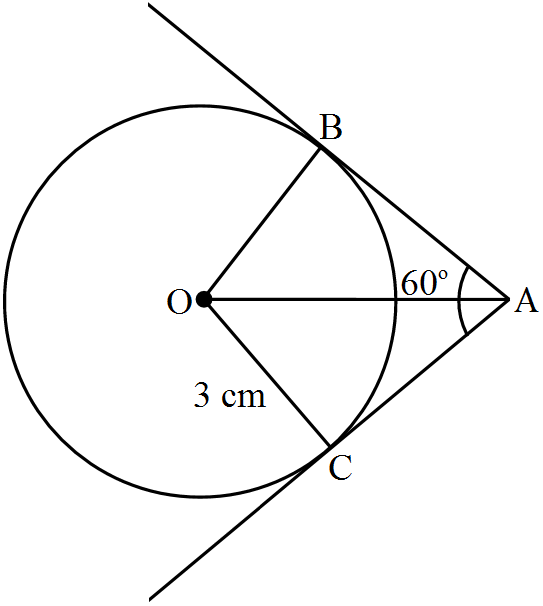
In $\triangle\text{BAO}$ and $\triangle\text{CAO},$
$\angle\text{OBA}=\angle\text{OCA}=90^\circ ....($Since $AB$ and $AC$ are tangent to the circle$)$
$\text{OA}=\text{OA} ....($common side$)$
$\text{OB}=\text{OC} ....($radii of the same circle$)$
$\Rightarrow\triangle\text{BAO}\cong\triangle\text{CAO} ....(\text{RHS}$ congruence criterion$)$
$\angle\text{OAB}=\angle\text{OAC} ....(\text{cpct})$
$\Rightarrow\angle\text{OAB}=\frac{1}{2}\angle\text{BAC}=30^\circ$
So, $\triangle\text{BAO}$ is a $30-60-90$ triangle.
side opposite $30^\circ=\frac{1}{2}$ hypotenuse
$\Rightarrow\text{OB}=\frac{1}{2}$ hypotenuse
$\Rightarrow $ hypotene $= 2OB = 2(3) = 6\ cm$
side opposite $60^\circ=\frac{\sqrt{3}}{2}$ hypotenuse
$\Rightarrow\text{AB}=\frac{\sqrt{3}}{2}(6)=3\sqrt{3}\text{ cm}$
$\text{AB}=\text{AC}=3\sqrt{3}\text{ cm} ....($Since tangents from an external point to the circle are equal$)$
Hence, the length of each tangent is $3\sqrt{3}\text{ cm}.$ View full question & answer→MCQ 1021 Mark
Two concentric circles of radii $3\ cm $ and $5\ cm$ are given. Then length of chord $BC$ which touches the inner circle at $P$ is equal to :
- A
$4\ cm$
- B
$6\ cm$
- ✓
$8\ cm$
- D
$10\ cm$
AnswerCorrect option: C. $8\ cm$
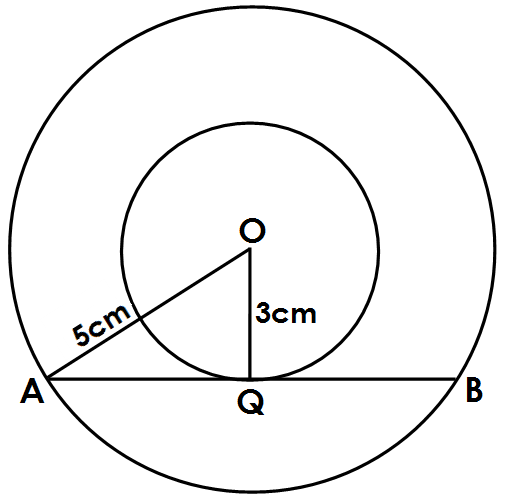
Here, radius $OQ \bot$ to tangent $AB$ then we say,
$\angle\text{OQA}=\angle\text{OQB}=90^\circ$
and $\triangle\text{OQA}$ is right angle triangle then,
$A Q^2=O A^2-O Q^2 $
$ \Rightarrow A Q^2=5^2-3^2 $
$ \Rightarrow A Q^2=25-9$
$\Rightarrow\text{AQ}^2=\sqrt{16}$
$\Rightarrow AQ = 4\ cm$
By property of tangent.
$BQ = BP\ ($tangent from point $B)$
$\because OQ$ bisects $AB$ then $AQ = QB = 4\ cm$
$OP$ bisects $AB$ then $BP = PC = 4\ cm$
Now, we have to find $BC,$
$BC = BP + PC$
$\Rightarrow BC = 4 + 4$
$\Rightarrow BC = 8\ cm.$ View full question & answer→MCQ 1031 Mark
At one end of a diameter $PQ$ of a circle of radius $5\ cm,$ tangent $\text{XPY}$ is drawn to the circle. The length of chord $AB$ parallel to $XY$ and at distance of $8\ cm$ from $P$ is :
- A
$5\ cm$
- B
$6\ cm$
- C
$7\ cm$
- ✓
$8\ cm$
AnswerCorrect option: D. $8\ cm$
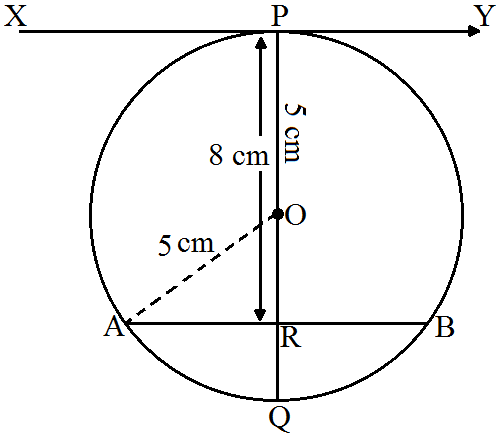
In the figure, $PQ$ is diameter $\text{XPY}$ is tangent to the circle with centre $O$ and radius $5\ cm$
From $P,$ at a distance of $8\ cm AB$ is a chord drawn parallel to $XY.$
To find the length of $AB$ Join $OA$
$XY$ is tangent and $OP$ is the radius.
$OP \perp XY$ or $PQ \perp XY$$AB \| XY$
$OQ$ is $\perp AB$ which meets $AB$ at $R$
Now in right $\triangle\text{OAR}$
$O A^2=O R^2+A R^2 $
$ (5)^2=(3)^2+A R^2 $
$25 = 9 + AR^2$
$\Rightarrow AR^2= 25 – 9 = 16 = (4)^2$
$AR = 4\ cm$
But $R$ is mid $-$ point of $AB$
$AB = 2 AR = 2 x \ \ 4 = 8\ cm$
View full question & answer→MCQ 1041 Mark
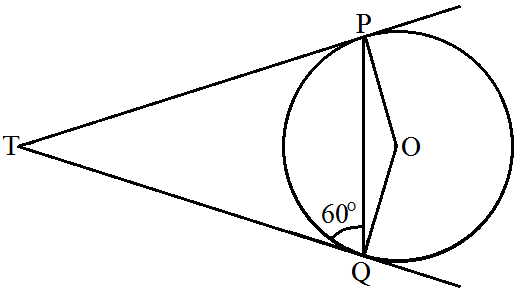
In the figure, if $TP$ and $TQ$ are tangents drawn from an external point $T$ to a circle with centre $O$ such that $\angle\text{TQP}=60^\circ,$ then :
- A
$25^\circ$
- ✓
$30^\circ$
- C
$40^\circ$
- D
$60^\circ$
AnswerCorrect option: B. $30^\circ$
In the figure $, TP$ and $TQ$ are the tangents drawn from $T$ to the circle with centre $O. OP, OQ$ and $PQ$ are joined.$\angle\text{TQP}=60^\circ$
$TP = TQ \ ($Tangents from T to the circle$)$
$\angle\text{TPQ}=\angle\text{TQP}=60^\circ$
$\angle\text{PTQ}=180^\circ-(60^\circ+60^\circ)$
$=180^\circ-120^\circ=60^\circ$
and $\angle\text{PTQ}=180^\circ-(60^\circ+60^\circ)$
$=180^\circ-120^\circ=60^\circ$
But $OP = OQ ($radii of the same circle.$)$
$\angle\text{OPQ}=\angle\text{OQP}$
But $\angle\text{OPQ}+\angle\text{OQP}$
$=180^\circ-120^\circ=60^\circ$
But $\angle\text{OQP}=30^\circ$
View full question & answer→MCQ 1051 Mark
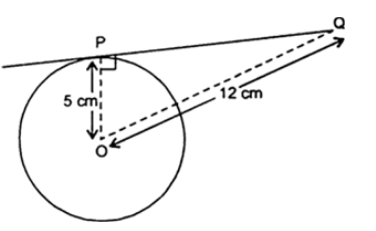
A tangent $PQ$ at a point $P$ of a circle of radius $5 \ cm$ meets a line through the centre $O$ at a point $Q$ so that $OQ = 12 \ cm$. Length $PQ$ is :
- A
$12 \ cm$
- B
$13 \ cm$
- C
$8.5 \ cm$
- ✓
$\sqrt{119} \ cm.$
AnswerCorrect option: D. $\sqrt{119} \ cm.$
$\sqrt{119} \ cm.$
View full question & answer→MCQ 1061 Mark
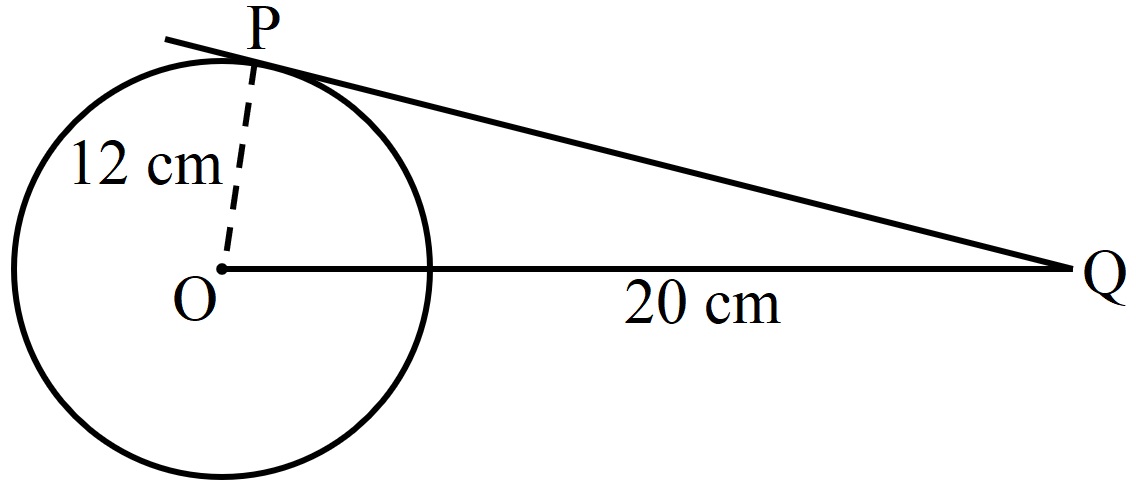
A tangent $PQ$ at point of contact $P$ to a circle of radius $12\ cm$ meets the line through centre $O$ to a point $Q$ such that $OQ = 20\ cm,$ length of tangent $PQ$ is :
- A
$12\ cm$
- B
$13\ cm$
- C
$15\ cm$
- ✓
$16\ cm$
AnswerCorrect option: D. $16\ cm$
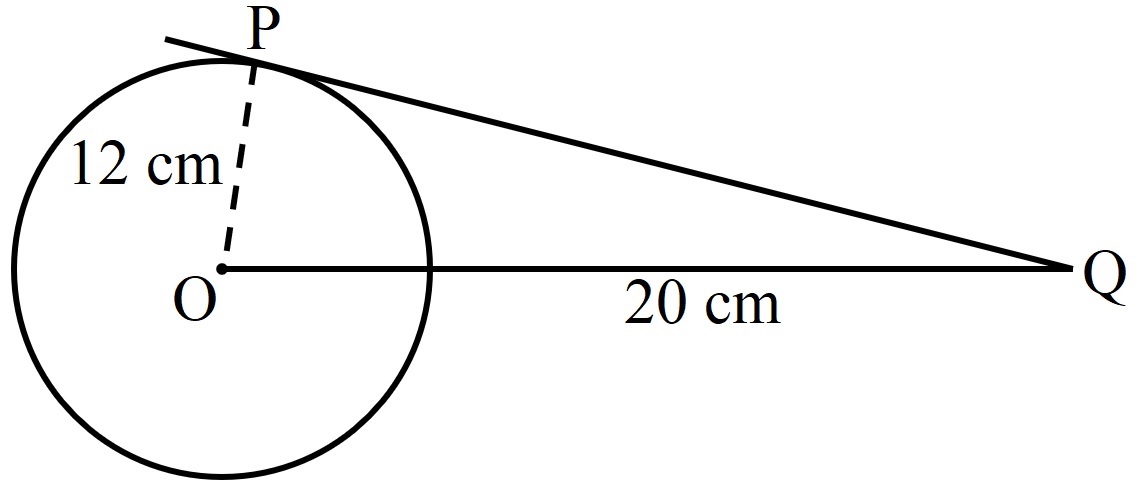
Since op is perpendicular to $PQ,$ the $\angle\text{OPQ}=90^\circ$
Now, in right angled triangle $\text{OPQ},$
$\text{OQ}^2=\text{OP}^2+\text{PQ}^2$
$\Rightarrow(20)^2=(12)^2+\text{PQ}^2$
$\Rightarrow\text{PQ}^2=400-144$
$\Rightarrow\text{PQ}^2=256$
$\Rightarrow\text{PQ}=16\text{ cm}$ View full question & answer→MCQ 1071 Mark
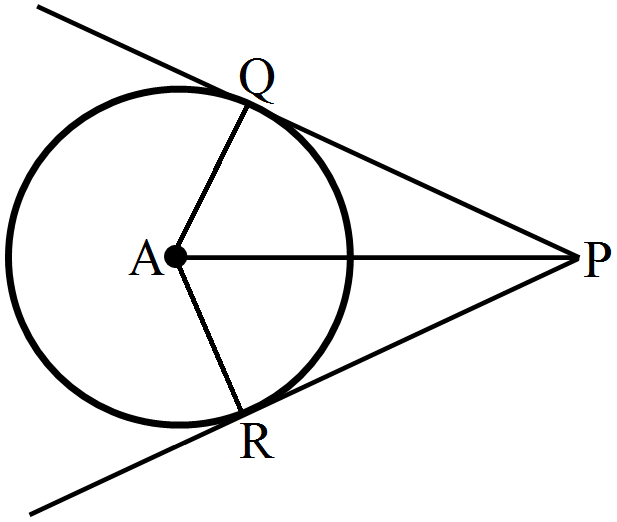
In the given figure $,PQ$ and $PR$ are tangents to a circle with centre $A$. If $\angle\text{QPA}=27^\circ$ then $\angle\text{QAR}$ equals :
- A
$63^\circ$
- B
$117^\circ$
- ✓
$126^\circ$
- D
$153^\circ$
AnswerCorrect option: C. $126^\circ$
In $\triangle\text{PAQ}$ and $\triangle\text{PAR},$
$\angle\text{PQA}=\angle\text{PRA} ....($Since $PQ$ and $PR$ are tangent to the circle$)$
$\text{AP}=\text{AP} ....($common side$)$
$\text{AQ}=\text{AR} ....($radii of the same circle$)$
$\Rightarrow\triangle\text{PAQ}\cong\triangle\text{PAR} ....(\text{RHS}$ congruence criterion$)$
$\angle\text{OAP}=\angle\text{RAP} ....(\text{cpct})$
In $\triangle\text{PAQ},$
$\angle\text{QAP}+\angle\text{PQA}+\angle\text{APQ}=180^\circ ....($Angle Sum property$)$
$\Rightarrow\angle\text{QAP}+90^\circ+27^\circ=180^\circ.....(\angle\text{PQA}=90^\circ,$ since radius is perpendicular to the tangent $)$
$\Rightarrow\angle\text{QAP}=63^\circ$
So, $\angle\text{QAR}=\angle\text{QAP}+\angle\text{RAP}$
$\Rightarrow\angle\text{QAR}=63^\circ+63^\circ$
$\Rightarrow\angle\text{QAR}=126^\circ$
View full question & answer→MCQ 1081 Mark
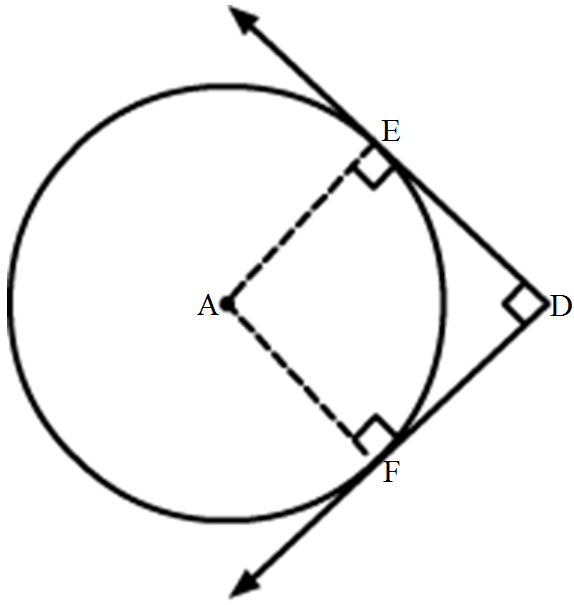
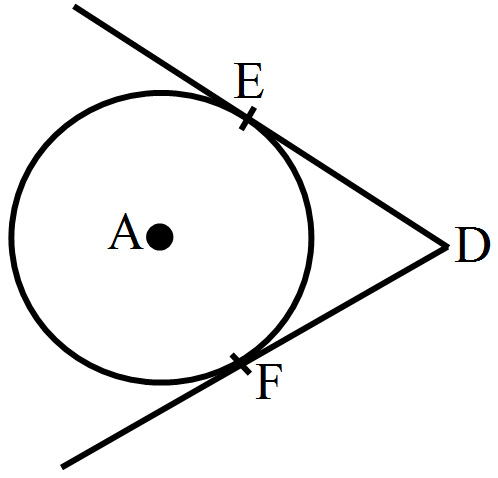
In the given figure $,DE$ and $DF$ are tangents from an external point $D$ to a circle with centre $A$. If $DE = 5\ cm$ and $DE \perp DF,$ then the radius of the circle is :
- A
$3\ cm$
- ✓
$5\ cm$
- C
$4\ cm$
- D
$6\ cm$
AnswerCorrect option: B. $5\ cm$
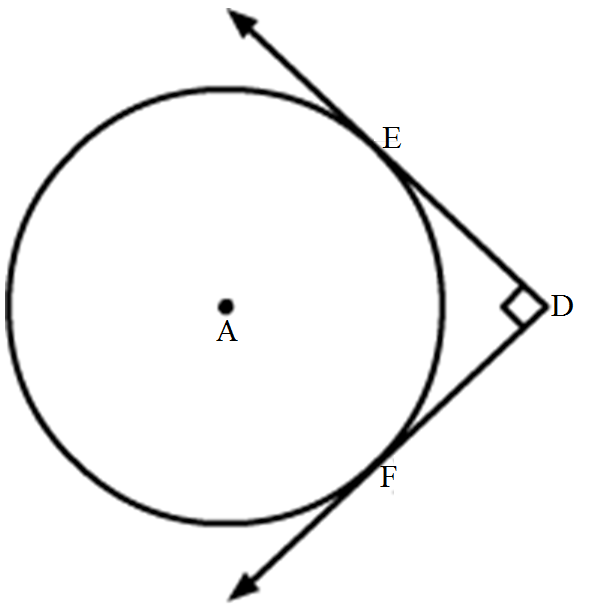
join $AE$ and $AF$.
Now $,DE$ is a tangent at $E$ and $AE$ is the radius through the point of contact $E$.
$\therefore\angle\text{AED}=90^\circ\ ($Tangent at any point of a circle is perpendicular to the radius through the point of contact$)$
Also $,DF$ is a tangent at $F$ and $AF$ is the radius through the point of contct $F.)$
$\therefore\angle\text{AFD}=90^\circ\ ($Tangent at any point of a circle is perpendicular to the radius through the point of contact$)$
$\therefore\angle\text{EDF}=90^\circ\ (\text{DE}\bot\text{DF})$
Also $, DF = DE \ ($length of tangents drawn from an external point to a circle are equal$)$
so $, \text{AEDF}$ is a square.
$\therefore AE = AF = DE = 5\ cm \ ($sides if square are equal$)$
Thus, the radius of the circle is $5\ cm.$ View full question & answer→MCQ 1091 Mark
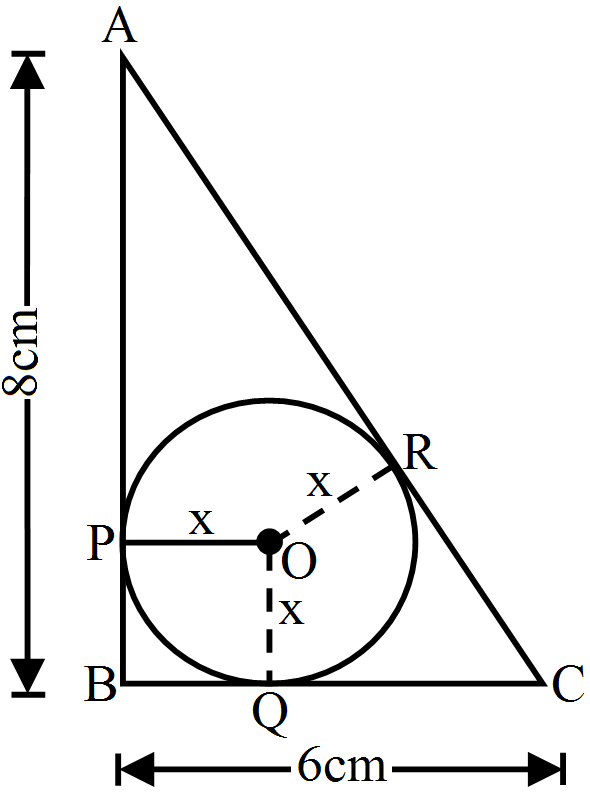
In the given figure,$ \triangle\text{ABC}$ is right $-$ angled at $B,$ such that $BC = 6\ cm$ and $AB = 8\ cm.$ A circle with centre $O$ has been inscribed in the triangle. $\text{OP} \perp \text{AB}, \text{OQ} \perp \text{BC} $ and $\text{OR} \perp \text{AC}.$ If $OP = OQ = OR = x \ cm,$ then $x =?$
- ✓
$2\ cm$
- B
$2.5\ cm$
- C
$3\ cm$
- D
$3.5\ cm$
AnswerCorrect option: A. $2\ cm$
In right $\triangle\text{ABC},$
$\text{AC}^2=\text{AB}^2+\text{BC}^2 ....($By Pythagoras theorem$)$
$\Rightarrow\text{AC}^2=8^2+6^2$
$\Rightarrow\text{AC}^2=64+36$
$\Rightarrow\text{AC}=100$
$\Rightarrow\text{AC}=10\text{ cm}$
We know that tangent from an external poit to the circle are equal.
$\Rightarrow\text{CR}=\text{CQ}=\text{BC}-\text{BQ}=(6-\text{x})\text{ cm}$
$\Rightarrow\text{AR}=\text{AP}=\text{AB}-\text{BP}=(8-\text{x})\text{ cm}$
$\text{AC}=(\text{AR}+\text{CR})=(8-\text{x})+(6-\text{x})=(14-2\text{x})\text{ cm}$
$\Rightarrow14-2\text{x}=10$
$\Rightarrow2\text{x}=4$
$\Rightarrow\text{x}=2$
View full question & answer→MCQ 1101 Mark
A tangent $PQ$ at a point $P$ of a circle of radius $5\ cm$ meets a line through the centre $O$ at a point $Q$ such that $OQ = 12\ cm$. Length $PQ$ is :
- A
$12\ cm$
- B
$13\ cm$
- C
$8.5\ cm$
- ✓
$\sqrt{119}\text{ cm}$
AnswerCorrect option: D. $\sqrt{119}\text{ cm}$
Let us first put the given data in the form of a diagram.
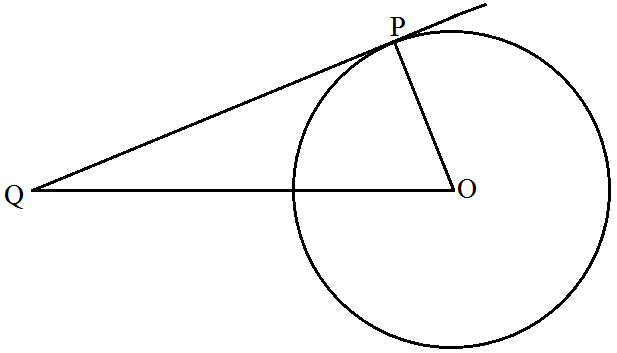
Given data is as follows:
$OQ = 12\ cm$
$OP = 5\ cm$
We have to find the length of $QP.$
We know that the radius of a circle will always be perpendicular to the tangent at the point of contact.
Therefore $,OP$ is perpendicular to $QP$.
We can now use Pythagoras theorem to find the length of $QP$.
$\mathrm{QP}^2=\mathrm{O} \mathrm{Q}^2-\mathrm{OP}^2 $
$ \mathrm{QP}^2=12^2-5^2 $
$ \mathrm{QP}^2=144-25 $
$ \mathrm{QP}^2=119$
$\text{QP}\sqrt{119}$
Therefore the correct answer is choice $(d). View full question & answer→MCQ 1111 Mark
In the given figure $,DE$ and $DF$ are tangents from an external point $D$ to a circle with centre $A$. If $DE = 5\ cm.$ and $\text{DE}\perp\text{DF}$ then the radius of the circle is :
- A
$3\ cm$
- B
$4\ cm$
- ✓
$5\ cm$
- D
$6\ cm$
AnswerCorrect option: C. $5\ cm$
Construction : Join $AE$ and $AF$.
Since $DE$ and $DF$ are tangent to the circle,
$\angle\text{AED}=\angle\text{AFD}=\angle\text{EDF}=90^\circ$
Also, $AE = AF .....($radii of the same circle$)$
and $ED = EF ....($Since tangent drawn from an external point to the circle are equal$)$
So, quadrilateral $\text{AEDF}$ is a square.
Thus $, AE = DF = 5\ cm$
Hence, the length of the radius is $5\ cm.$
View full question & answer→MCQ 1121 Mark
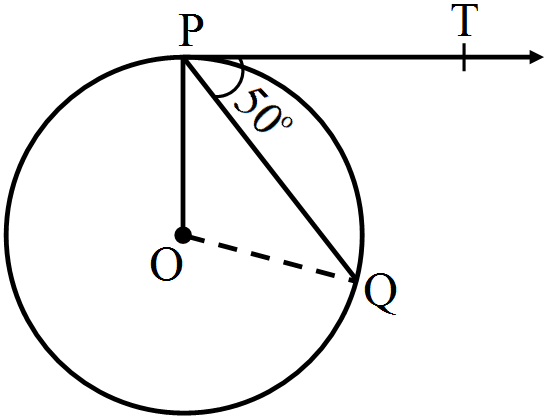
In the given figure, $O$ is the centre of a circle, $PQ$ is a chord and the tangent $PT$ at $P$ makes an angle of $50^\circ$ with $PQ$. Then,$ \angle\text{POQ} = ?$
- A
$130^\circ$
- ✓
$100^\circ$
- C
$90^\circ$
- D
$75^\circ$
AnswerCorrect option: B. $100^\circ$
Since $PT$ is the tangent to the circle.
$\angle\text{OPT}=90^\circ$
$\Rightarrow\angle\text{TPQ}+\angle\text{OPQ}=90^\circ$
$\Rightarrow50^\circ+\angle\text{OPQ}=90^\circ$
$\Rightarrow\angle\text{OPQ}=40^\circ$
In $\triangle\text{OPQ},$
$\text{OP}=\text{OQ} ....($radii of the same circle$)$
$\Rightarrow\angle\text{OPQ}=\angle\text{OQP}=40^\circ....($angles opposite equal sides are equal$)$
Now,
$\angle\text{OPQ}+\angle\text{OQP}+\angle\text{POQ}=180^\circ....($Angle Sum Property$)$
$\Rightarrow40^\circ+40^\circ+\angle\text{POQ}=180^\circ$
$\Rightarrow\angle\text{POQ}=100^\circ$
View full question & answer→MCQ 1131 Mark
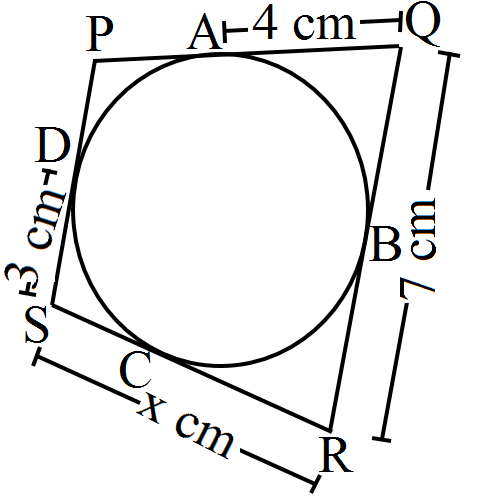
In the given figure, if $AQ = 4\ cm, QR = 7\ cm, DS = 3\ cm,$ then $x$ is equal to :
- ✓
$6\ cm$
- B
$10\ cm$
- C
$11\ cm$
- D
$8\ cm$
AnswerCorrect option: A. $6\ cm$
Here $AQ = 4\ cm$
$\therefore QB = AQ = 4\ cm\ [$Tangents from an external point$]$
$\therefore BR = 7 - 4 = 3\ cm$
$\therefore BR = CR = 3\ cm\ [$Tangents from an external point$]$
Also $SD = SC = 3\ cm\ [$Tangents from an external point$]$
Therefore $, x = CS + CR $
$= 3 + 3 = 6$ units
View full question & answer→MCQ 1141 Mark
Which of the following pairs of lines in a circle cannot be parallel ?
AnswerTwo diameter of the circle always passes through the centre.
This means all the diameters of a given circle will intersect at the centre, and hence they cannot be parallel.
View full question & answer→MCQ 1151 Mark
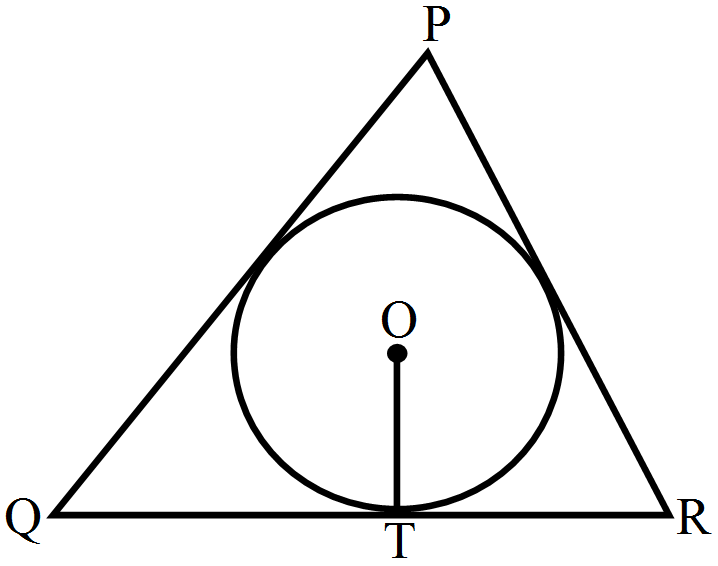
In the given figure, a triangle $\text{PQR}$ is drawn to circumscribe a circle of radius $6\ cm$ such that the segments $QT$ and $TR$ into which $QR$ is divided by the point of contact $T$ are of lengths $12\ cm$ and $9\ cm$ respectively. If the area of $\triangle\text{PQR} = 189 \text{ cm}^2 $ then the length of side $PQ$ is :
- A
$17.5\ cm$
- B
$20\ cm$
- ✓
$22.5\ cm$
- D
$25\ cm$
AnswerCorrect option: C. $22.5\ cm$
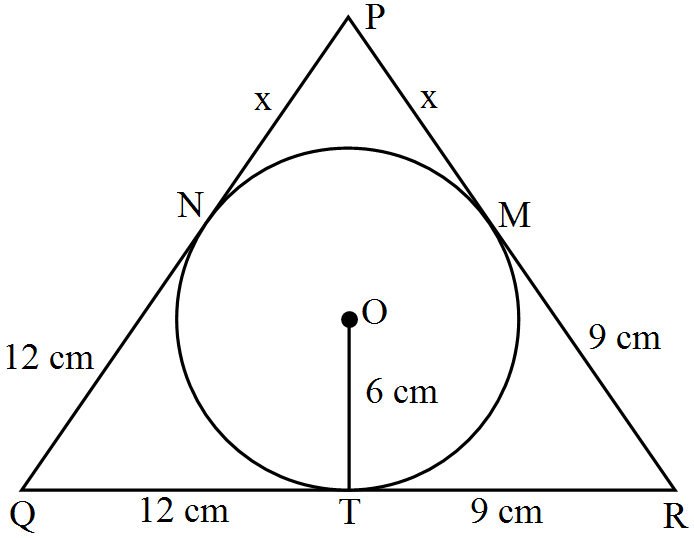
We know that tangent from an external point to the circle are equal.
So,
$QT = QN = 12\ cm$
$TR = RM = 9\ cm$
Now,
$\text{ar}(\triangle\text{PQR})=\frac{1}{2}(\text{Perimeter of }\triangle\text{PQR})\times\text{r}$
$\Rightarrow\text{ar}(\triangle\text{PQR})=\frac{1}{2}(12+12+9+9+\text{x}+\text{x})\times\text{r}$
$\Rightarrow\text{ar}(\triangle\text{PQR})=\frac{1}{2}(42+2\text{x})\times6$
$\Rightarrow189=3(42+2\text{x})$
$\Rightarrow63=42+2\text{x}$
$\Rightarrow2\text{x}=21$
$\Rightarrow\text{x}=10.5$
So $, PQ = 12 + 10.5 = 22.5\ cm$ View full question & answer→MCQ 1161 Mark
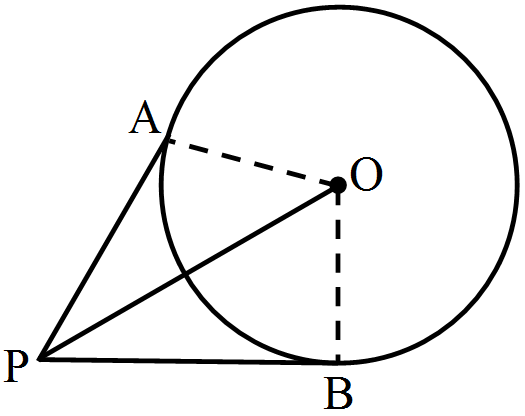
If tangents $PA$ and $PB$ from a point $P$ to a circle with centre $O$ are drawn, so that $\angle\text{APB} = 80^\circ, $ then $\angle\text{POA} = ?$
- A
$40^\circ$
- ✓
$50^\circ$
- C
$80^\circ$
- D
$60^\circ$
AnswerCorrect option: B. $50^\circ$
In $\triangle\text{PAO}$ and $\triangle\text{PBO},$
$\angle\text{PAO}+\angle\text{PBO}=90^\circ....($Since $PQ$ and $PR$ are tangent to the circle$)$
$\text{OP}=\text{OP} ....($Common side$)$
$\text{AO}=\text{OB} ....($radii of the same circle$)$
$\Rightarrow\triangle\text{PAO}\cong\triangle\text{PBO} ....(\text{RHS}$ congruence criterion$)$
$\angle\text{POA}=\angle\text{BOP} ....\text{(cpct)}$
In quad. $\text{AOBP}$
$\angle\text{PAO}+\angle\text{PBO}+\angle\text{AOB}+\angle\text{APB}=360^\circ$
$\Rightarrow90^\circ+90^\circ+\angle\text{AOB}+80^\circ=360^\circ$
$\Rightarrow\angle\text{AOB}=100^\circ$
So, $\angle\text{POA}=50^\circ$
View full question & answer→MCQ 1171 Mark
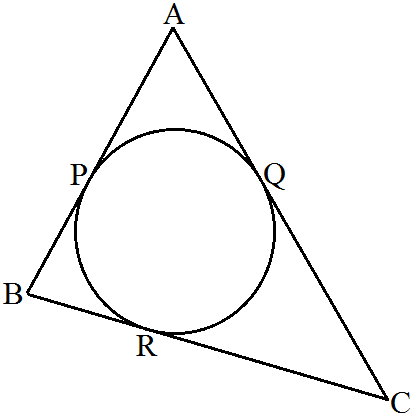
In the figure, if $AP = PB,$ then :
- A
$AC = AB$
- ✓
$AC = BC$
- C
$AQ = QC$
- D
$AB = BC$
AnswerCorrect option: B. $AC = BC$
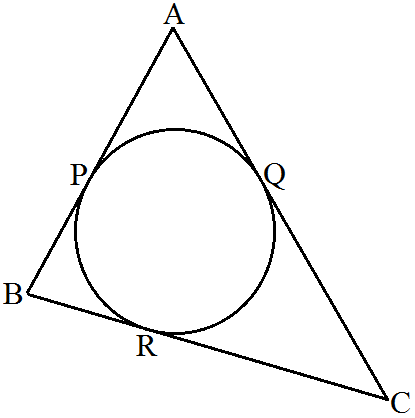
In the figure $, AP = PB$
But $AP$ and $AQ$ are the tangent from $A$ to the circle.
$AP = AQ$ Similarly $PB = BR$
But $AP = PB \ ($given$)$
$AQ = BR ….(i)$
But $CQ$ and $CR$ the tangents drawn from $C$ to the circle
$CQ = CR$
Adding in $(i)$
$AQ + CQ = BR + CR$
$AC = BC$ View full question & answer→MCQ 1181 Mark
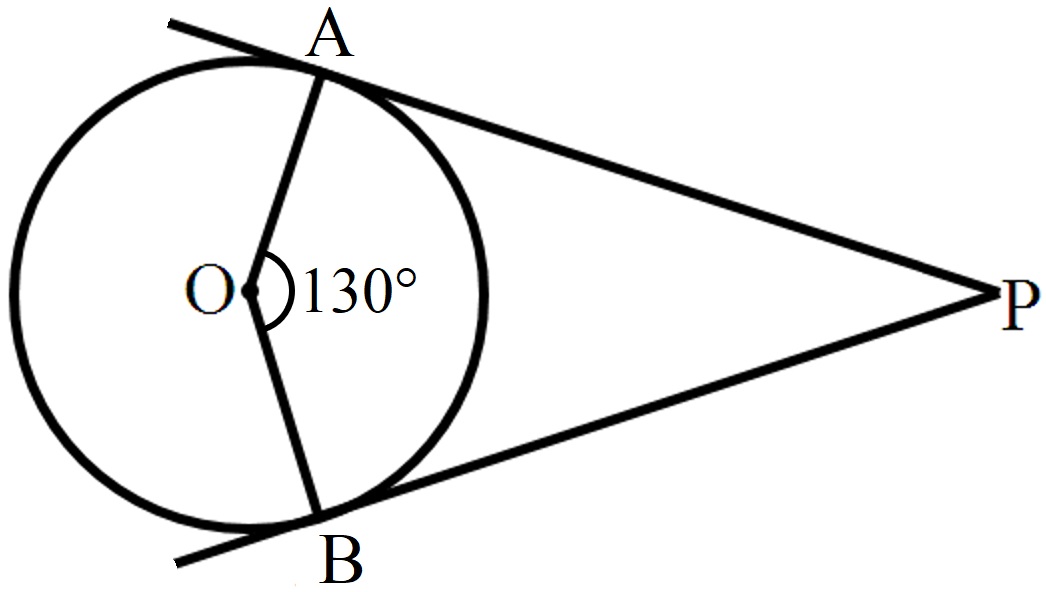
If angle between two radii of a circle is $130^\circ,$ the angle between tangents at ends of radii is :
- A
$60^\circ$
- ✓
$50^\circ$
- C
$90^\circ$
- D
$70^\circ$
AnswerCorrect option: B. $50^\circ$
If the angle between two radii of a circle is $130^\circ$, the angle between tangents at ends of radii is $\angle\text{APB} = 50^\circ$.
Because the angle between the two tangents drawn from an external point to a circle is supplementary of the angle between the radii of the circle through the point of contact.
View full question & answer→MCQ 1191 Mark
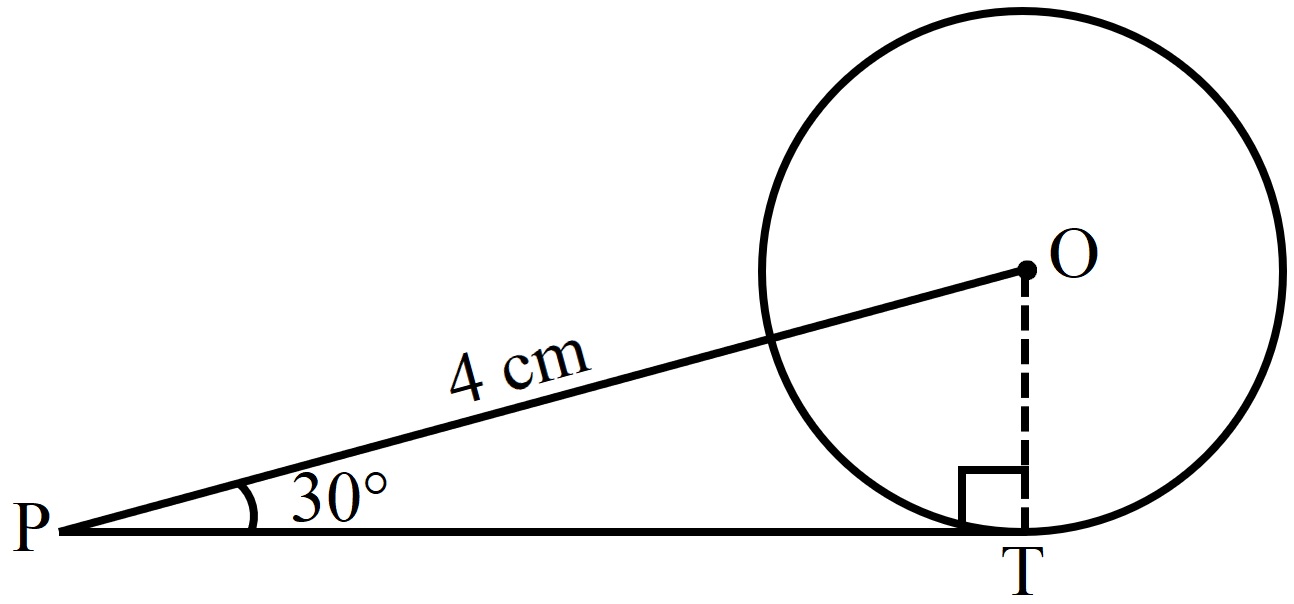
In figure $,PT$ is tangent to the circle with centre $O$ such that $OP$ is $4\ cm$ and $ \angle\text{OPT}=30^\circ$ length of tangent is given by :
- A
$4\sqrt{3}\text{ cm}$
- B
$7\text{ cm}$
- C
$5\text{ cm}$
- ✓
$2\sqrt{3}\text{ cm}$
AnswerCorrect option: D. $2\sqrt{3}\text{ cm}$
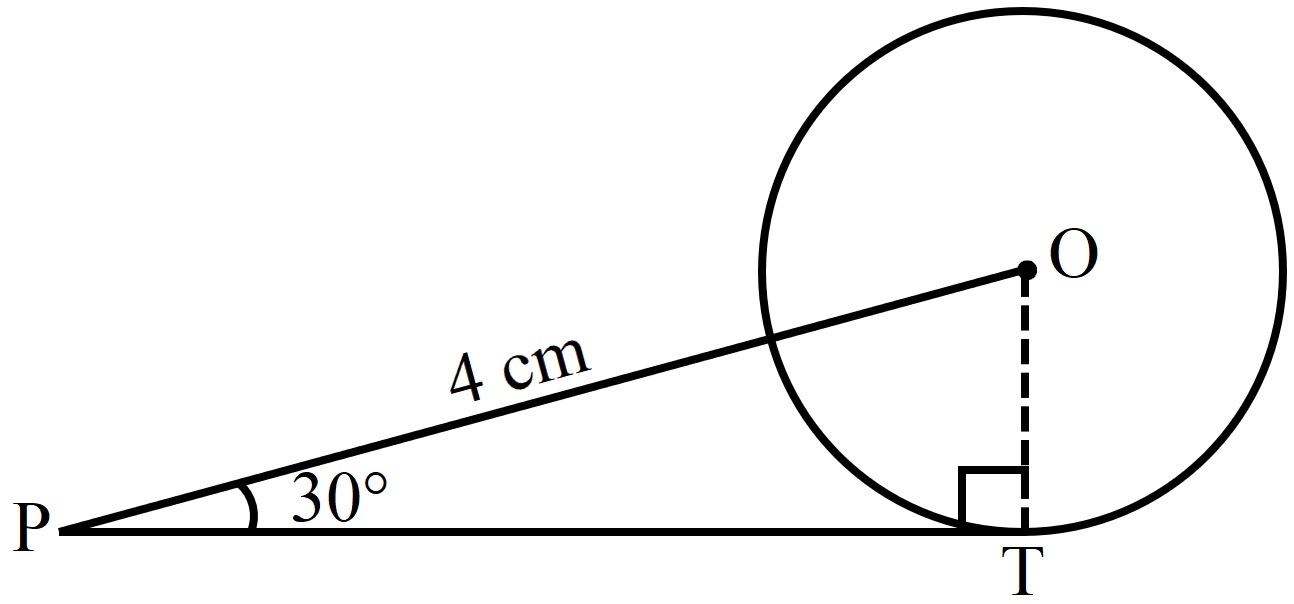
In right angled triangle $OPT,$
$\cos30^\circ=\frac{\text{PT}}{\text{PO}}$
$ \Rightarrow \frac{\sqrt{3}}{2}=\frac{\text{PT}}{4}$
$=\text{PT}=2\sqrt{3\text{ cm}}$ View full question & answer→MCQ 1201 Mark
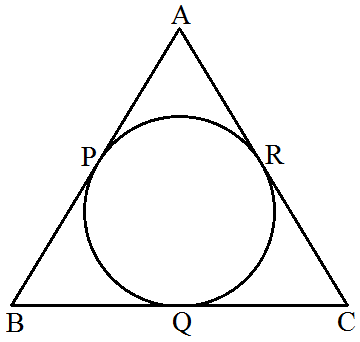
In the given figure, the sides $AB, BC$ and $CA$ of triangle $\text{ABC},$ touch a circle at $P, Q$ and $R$ respectively. If $PA = 4\ cm, BP = 3\ cm$ and $AC = 11\ cm,$ then length of $BC$ is :
- A
$11\ cm$
- ✓
$10\ cm$
- C
$14\ cm$
- D
$15\ cm$
AnswerCorrect option: B. $10\ cm$
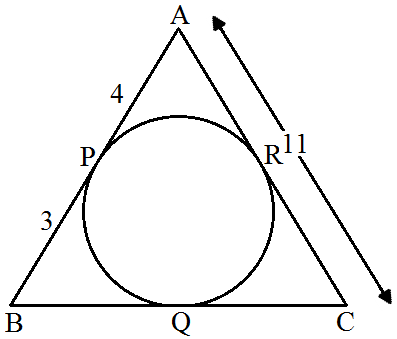
By property of tangent
$AP = AR = 4\ cm\ ($tangent from $A) ...(i)$
$BP = BQ = 3\ cm\ (t$angent from $B) ...(ii)$
$RC = QC\ ($tangent from $C) ...(iii)$
$AC = 11\ cm\ ($given$)$
Now, we have to find $BC$
$BC = BQ + QC$
$\Rightarrow BC = 3 + RC\ [$from eq. $(ii)$ and $(iii)]$
$\Rightarrow BC = 3 + (AC + AR)\ [$from fig$]$
$\Rightarrow BC = 3 + (11 - 4)\ [$from eq. $(i)]$
$\Rightarrow BC = 3 + 7$
$\Rightarrow BC = 10\ cm$ View full question & answer→MCQ 1211 Mark
Quadrilateral $\text{PQRS}$ circumscribes a circle as shown in the figure. The side of the quadrilateral which is equal to $PD + QB$ is :
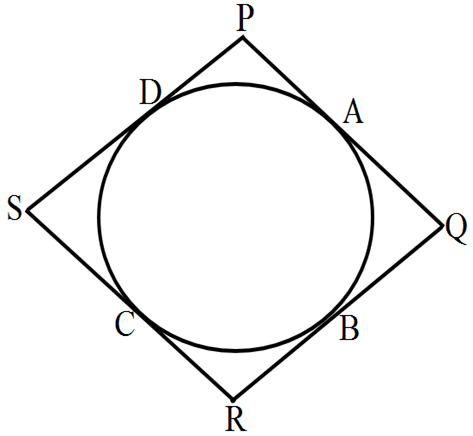
Answer$PD + QB = PA + QA \ [$Tangents from an external point to a circle are equal$]$
$\Rightarrow PD + QB = PQ$
View full question & answer→MCQ 1221 Mark
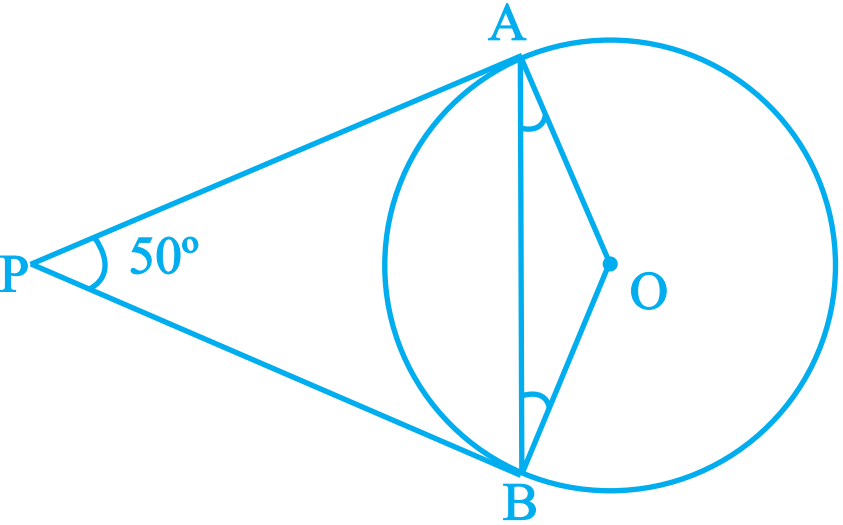
In figure, if $PA$ and $PB$ are tangents to the circle with centre $O$ such that $\angle\text{APB}=50^\circ,$ then $\angle\text{OAB}$ is equal to :
- ✓
$25^\circ$
- B
$30^\circ$
- C
$40^\circ$
- D
$50^\circ$
AnswerCorrect option: A. $25^\circ$
Given, $PA$ and $PB$ are tangent lines.
$\therefore\ \text{PA}=\text{PB}$
$[$since, the length of tangents drawn from an external point to a circle is equal$]$
$\Rightarrow\ \angle\text{PBA}=\angle\text{PAB}=\theta\ \ [\text{say}]$
In $\triangle\text{PAB},\ \angle\text{P}+\angle\text{A}+\angle\text{B}=180^\circ$
$[$since, sum of angles of a triangle $= 180^\circ ]$
$\Rightarrow\ 50^\circ+\theta+\theta=180^\circ$
$\Rightarrow\ 2\theta=180^\circ-50^\circ=130^\circ$
$\Rightarrow\ \theta=65^\circ$
Also, $\text{OA}\perp\text{PA}$
$[$since, tangent at any point of a circle is perpendicular to the radius through the point of contact$]$
$\therefore\ \angle\text{PAO}=90^\circ$
$\Rightarrow\ \angle\text{PAB}+\angle\text{BAO}=90^\circ$
$\Rightarrow\ 65^\circ+\angle\text{BAO}=90^\circ$
$\Rightarrow\ \angle\text{BAO}=90^\circ-65^\circ=25^\circ$
View full question & answer→MCQ 1231 Mark
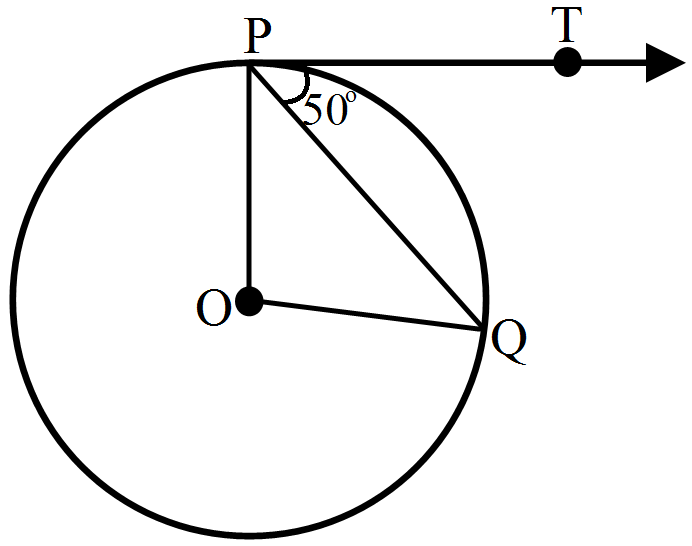
In the given figure, $O$ is the centre of a circle and $PT$ is the tangent to the circle. If $PQ$ is a chord such that $\angle\text{QPT}=50^\circ$ then $\angle\text{POQ}=?$
- ✓
$100^\circ$
- B
$90^\circ$
- C
$80^\circ$
- D
$75^\circ$
AnswerCorrect option: A. $100^\circ$
Since $PT$ is the tangent to the circle,
$\angle\text{TPQ}=90^\circ$
$\Rightarrow\angle\text{TPQ}+\angle\text{OPQ}=90^\circ$
$\Rightarrow50^\circ+\angle\text{OPQ}=90^\circ$
$\Rightarrow\angle\text{OPQ}=40^\circ$
In $\triangle\text{OPQ},$
$\text{OP}=\text{OQ} ....($radii of the same circle$)$
$\Rightarrow\angle\text{OPQ}=\angle\text{OQP}=40^\circ ....($angles opposite equal sides are equal$)$
Now,
$\angle\text{OPQ}+\angle\text{OQP}+\angle\text{POQ}=180^\circ ....($Angle Sum Property$)$
$\Rightarrow40^\circ+40^\circ+\angle\text{POQ}=180^\circ$
$\Rightarrow\angle\text{POQ}=100^\circ$
View full question & answer→MCQ 1241 Mark
$PQ$ is a tangent drawn from a point $P$ to a circle with centre $O$ and $\text{QOR}$ is a diameter of the circle such that $\angle\text{POR}=120^{\circ}$ then $\angle\text{OPQ}$ is :
- A
$60^\circ$
- B
$45^\circ$
- ✓
$30^\circ$
- D
$90^\circ$
AnswerCorrect option: C. $30^\circ$
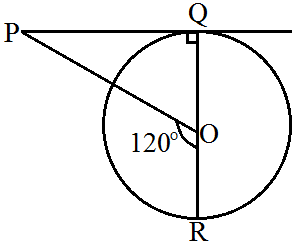
we know, radius always $\bot$ to tangent, then
$\angle\text{PQO}=90^{\circ}(\text{OQ}\bot\text{PQ})$
Given, $\angle\text{POR}=120^{\circ}$
then, $\angle\text{POQ}=\angle\text{QOR}-\angle\text{POR}$
$\Rightarrow\angle\text{POQ}=180^{\circ}-120^{\circ}$
$\Rightarrow\angle\text{POQ}=60^{\circ}$
Now, In $\triangle\text{OPQ}$
Sum of all angles are equal to $180^{\circ}$
then,
$\angle\text{OPQ}+\angle\text{POQ}+\angle\text{PQO}=180^{\circ}$
$\Rightarrow\angle\text{OPQ}+90^{\circ}+60^{\circ}=180^{\circ}$
$\Rightarrow\angle\text{OPQ}+150^{\circ}=180^{\circ}$
$\Rightarrow\angle\text{OPQ}=30^{\circ}$ View full question & answer→MCQ 1251 Mark
$AP$ and $AQ$ are tangents drawn from a point $A$ to a circle with centre $O$ and radius $9\ cm$. If $OA = 15\ cm, $ then $AP + AQ =$
- A
$12\ cm$
- B
$18\ cm$
- ✓
$24\ cm$
- D
$36\ cm$
AnswerCorrect option: C. $24\ cm$
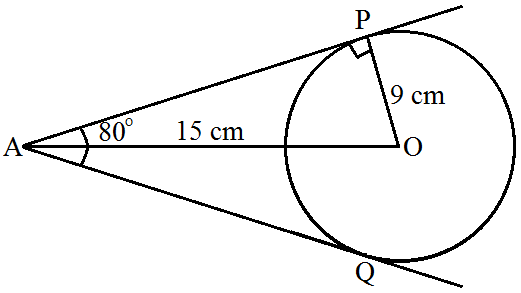
By the property of tangent
$AP = AQ \ ($tangent from $ A)...(i)$
We know, radius always $\bot$ to tangent then $\triangle\text{OPQ}$ is right angle triangle the $\angle\text{OPA}=90^{\circ}$
Now,$A P^2=O A^2-O P^2 $
$ \Rightarrow A P^2=15^2-9^2 $
$ \Rightarrow A P^2=225-81$
$\Rightarrow AP = \sqrt{144}$
$\Rightarrow AP = 12\ cm$
we have to find $AP + AQ = 12 + 12 = 24\ cm\ [$from $(i)]$ View full question & answer→MCQ 1261 Mark
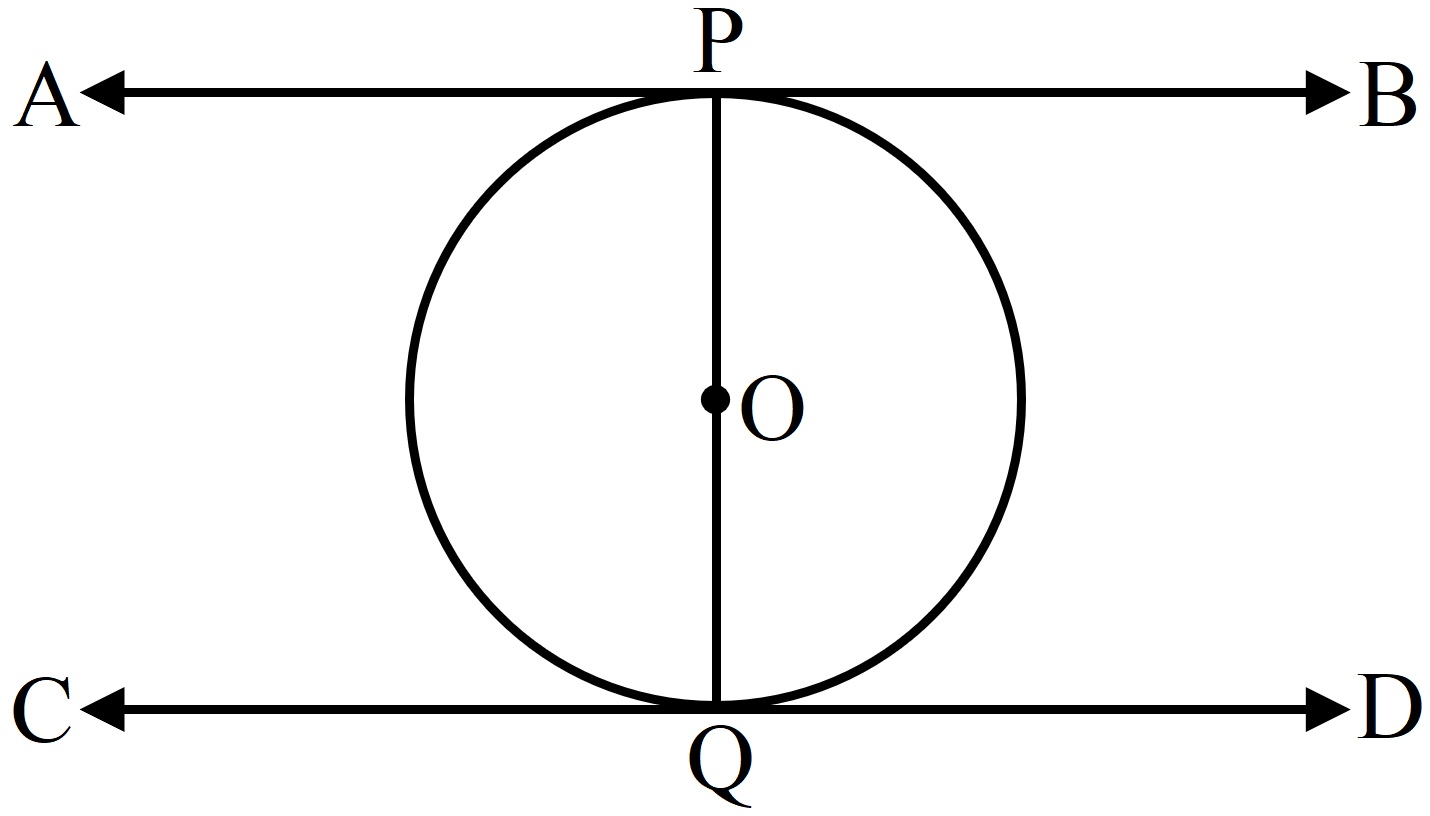
The distance between two parallel tangents of a circle of radius $3\ cm$ is :
- ✓
$6\ cm$
- B
$4.5\ cm$
- C
$12\ cm$
- D
$3\ cm$
AnswerCorrect option: A. $6\ cm$
Since the distance between two parallel tangents of a circle is equal to the diameter of the circle.
Given : Radius $(OP) = 3\ cm$
$\therefore$ Diameter $= 2 \times \text{Radius} $
$= 2 \times 3 = 6\ cm$
View full question & answer→MCQ 1271 Mark
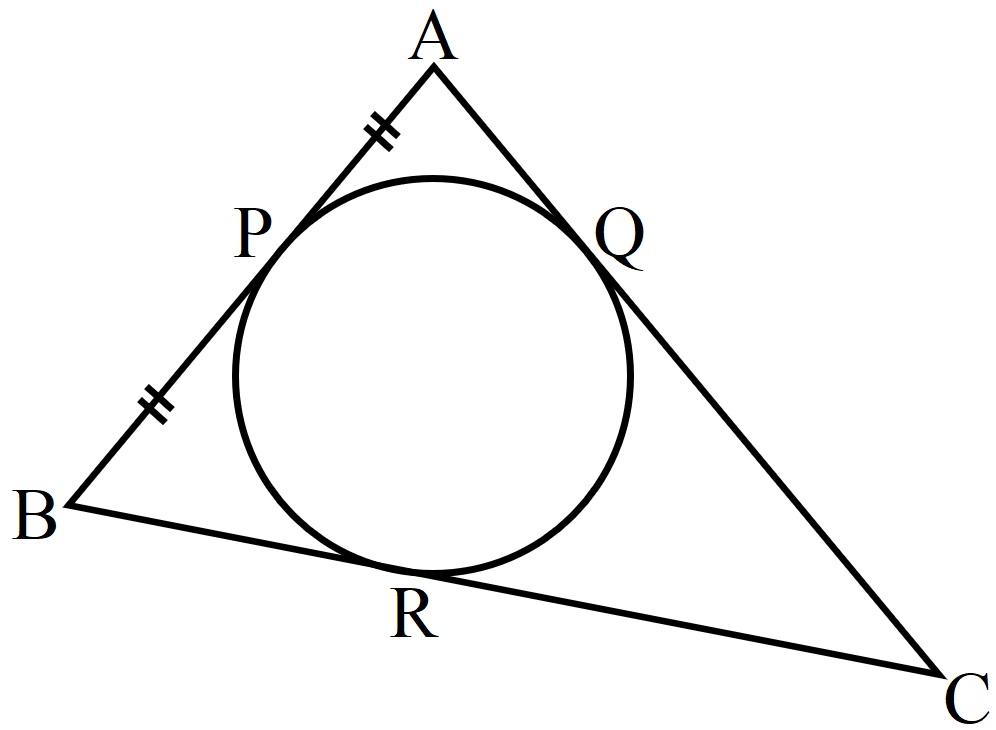
In the given figure, if $AP = PB,$ then $AC =$
- ✓
$AC = BC$
- B
$AB = BC$
- C
$AQ = QC$
- D
$AC = AB$
AnswerCorrect option: A. $AC = BC$
Since Tangents from an external point to a circle are equal
$\therefore PB = BR …(i)$
$PA = AQ …(ii)$
$CQ = CR ...(iii)$
Adding eq. $(i)$ and $(iii),$ we get
$PB + CQ = BR + CR$
$\Rightarrow AP + CQ = BC \ [$Given : $PB = AP]$
$\Rightarrow AQ + CQ = BC\ [$From eq. $(ii) \ AP = AQ]$
$\Rightarrow AC = BC$
View full question & answer→MCQ 1281 Mark
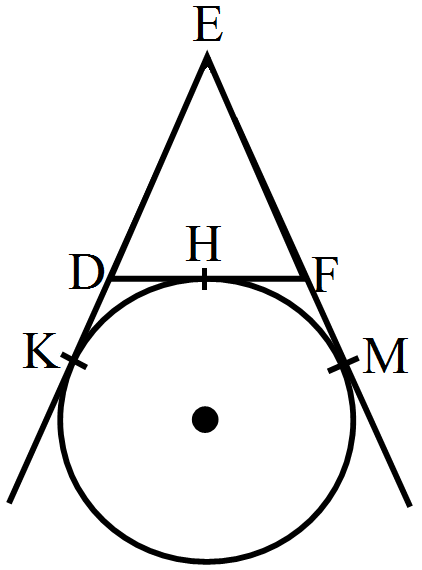
In the given figure, a circle touches the side $DF$ of $\triangle\text{EDF}$ at $H$ and touches $ED$ and $EF$ produced at $K$ and $M$ respectively. If $EK = 9\ cm$ then the perimeter of $\triangle\text{EDF}$ is :
- A
$9\ cm$
- B
$12\ cm$
- C
$13.5\ cm$
- ✓
$18\ cm$
AnswerCorrect option: D. $18\ cm$
We know that tangents from an external point to the circle are equal.
So,
$EK = EM = 9\ cm$
$DK = DH$
$FH = FM$
perimeter of $\triangle\text{EDF}$
$= ED + EF + DF$
$= ED + EF + DH + HF$
$= (ED + DH) + (EF + HF)$
$= (ED + DK) + (EF + FM)$
$= EK + EM$
$= 9 + 9$
$= 18\ cm.$
View full question & answer→MCQ 1291 Mark
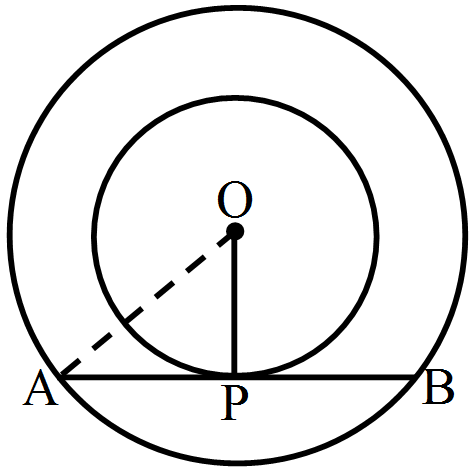
In the given figure, $O$ is the centre of two concentric circles of radii $6\ cm$ and $10\ cm. AB$ is a chord of outer circle which touches the inner circle. The length of $AB$ is :
- A
$8\ cm$
- B
$14\ cm$
- ✓
$16\ cm$
- D
$\sqrt{136}\text{ cm}$
AnswerCorrect option: C. $16\ cm$
Since $AB$ is a tangent to the circle.
$\angle\text{OPA}=90^\circ ....($tangent is perpendicular to the radius of a circle$)$
$AB$ is a chord of the outer circle
We know that of the perpendicular drawn from the centre to a chord of a circle of a circle, bisects the chord.
In $\triangle\text{OPA},$
$A O^2=O P^2+A P^2 $
$ \Rightarrow 10^2=6^2+A P^2 $
$\Rightarrow A P^2=10^2-6^2 $
$ \Rightarrow P A^2=64 $
$\Rightarrow PA = 8\ cm$
$AB = 2AP$
$ = 2(8) = 16\ cm.$
View full question & answer→MCQ 1301 Mark
At one end $A$ of a diameter $AB$ of a circle of radius $5\ cm,$ tangent $\text{XAY}$ is drawn to the circle. The length of the chord $CD$ parallel to $XY$ and at a distance $8\ cm$ from $A$ is :
- A
$4\ cm$
- B
$5\ cm$
- C
$6\ cm$
- ✓
$8\ cm$
AnswerCorrect option: D. $8\ cm$
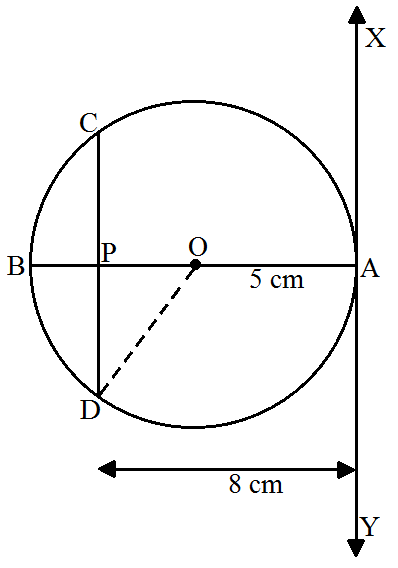
$XY$ is the tangent to the circle with centre $O$.
$CD$ is the chord.
$OA = OB = OD = 5\ cm\ ($radii$)$
$PA = 8\ cm$
$PO = 3\ cm$
In $\triangle\text{POD},$
$\Rightarrow P D^2+P O^2=O D^2$
$\Rightarrow 3^2+P D^2=5^2 $
$ \Rightarrow P D^2=25-9=16 $
$\Rightarrow PD = 4\ cm$
Hence $, CD = CP + PD $
$= 4 + 4 = 8\ cm.$ View full question & answer→MCQ 1311 Mark
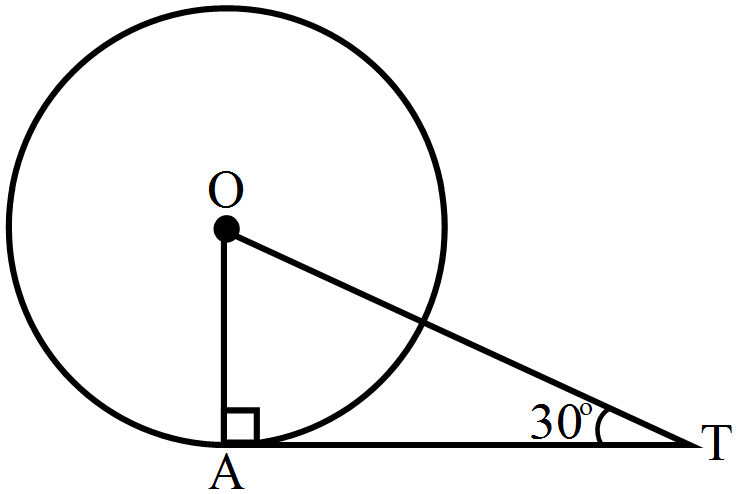
In the given figure $, AT$ is a tangent to the circle with centre $O,$ such that $OT = 4\ cm$ and $\angle\text{OTA} = 30^\circ. $ Then $, AT =?$
- A
$4\text{ cm}$
- B
$2\text{ cm}$
- ✓
$2\sqrt{3}\text{ cm}$
- D
$4\sqrt{3}\text{ cm}$
AnswerCorrect option: C. $2\sqrt{3}\text{ cm}$
Since $\angle\text{OAT}=90^\circ$ and $\angle\text{OTQ}=30^\circ$
Clearly, $\angle\text{AOT}=60^\circ$
So, $\triangle\text{AOT}$ is a $30^\circ - 60^\circ - 90^\circ $ triangle.
Side opposite $60^\circ=\frac{\sqrt{3}}{2}$ hypotenuse
$\Rightarrow\text{AT}=\frac{\sqrt{3}}{2}(\text{OT})$
$\Rightarrow\text{AT}=\frac{\sqrt{3}}{2}(4)$
$\Rightarrow\text{AT}=2\sqrt{3}\text{ cm}$
View full question & answer→MCQ 1321 Mark
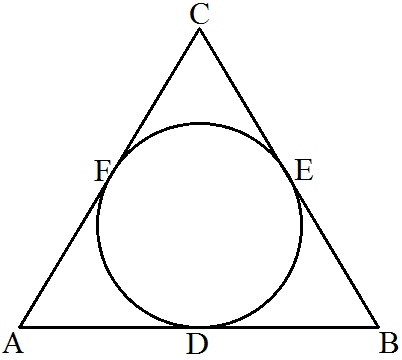
In the adjacent figure, if $AB = 12\ cm, BC = 8\ cm $ and $AC = 10\ cm,$ then $AD =$
- A
$5\ cm$
- B
$4\ cm$
- C
$6\ cm$
- ✓
$7\ cm$
AnswerCorrect option: D. $7\ cm$
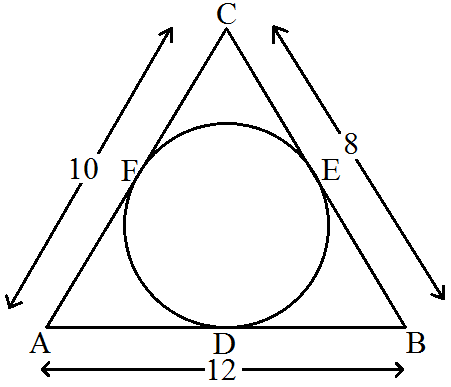
Given,
$AB = AD + DB = 12\ cm...(i)$
$BC = BE + EC = 8\ cm...(ii)$
$CA + CF + FA = 10\ cm...(iii)$
from the property of tangent
$AD = AF \ ($ tangent from $A ) ...(iv)$
$DB = BE \ ($ tangent from $A ) ...(v)$
$CF = CE \ ($ tangent from $A ) ...(vi)$
Now, we have to find $AD$
By substracting eq. $(ii)$ from eq. $(i),$ then
$\Rightarrow AD + DB - (BE + EC) = 12 - 8$
$\Rightarrow AD + BE - BE - CF = 4 [$ from eq.$(v) ]$
$\Rightarrow AD - CF = 4$
$\Rightarrow AD - (10 - AF) = 4 [$ from eq $,(iii) ]$
$\Rightarrow AD - 10 + AF = 4$
$\Rightarrow AD - 10 + AD = 4$
$\Rightarrow 2AD = 14$
$\Rightarrow AD = 7$ View full question & answer→MCQ 1331 Mark
Which of the following statements is not true?
- A
A tangent to a circle intersects the circle exactly at one point.
- B
The point common to a circle and its tangent is called the point of contact.
- C
The tangent at any point of a circle is perpendicular to the radius of the circle through the point of contact.
- ✓
A straight line can meet a circle at one point only.
AnswerCorrect option: D. A straight line can meet a circle at one point only.
Options $(a), (b)$ and $(c)$ are all true.
However, Option $(d)$ is false since a straight line can meet a circle at two points even as shown below.
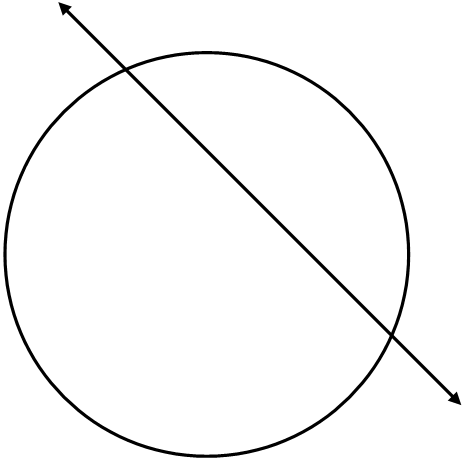
View full question & answer→MCQ 1341 Mark
Directions : In the following questions, a statement of assertion $(A)$ is followed by a statement of reason $(R).$ Mark the correct choice as:
Assertion : The length of tangents drawn from an external point to a circle are not always equal in length.
Reason : The tangent is always perpendicular to the radius through the point of contact.
- A
Assertion and Reason both are correct statements and Reason is the correct explanation of Assertion.
- B
Assertion and Reason both are correct statements but Reason is not the correct explanation of Assertion.
- C
Assertion is correct statement but Reason is wrong statement.
- ✓
Assertion is wrong statement but Reason is correct statement.
AnswerCorrect option: D. Assertion is wrong statement but Reason is correct statement.
Assertion is wrong as length of tangents drawn from an external point to a circle are always equal.
But Reason is correct.
View full question & answer→MCQ 1351 Mark
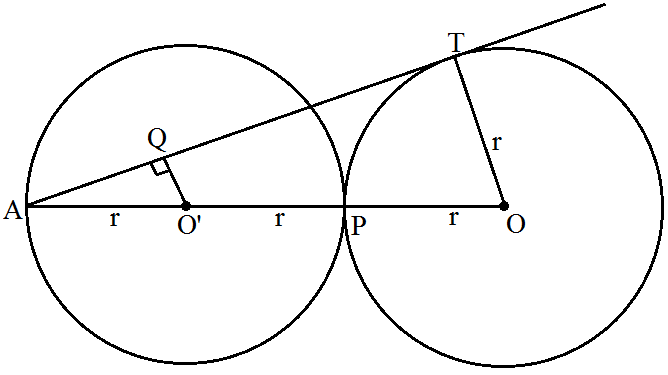
Two circles of same radii r and centres $O$ and $O'$ touch each other at $P$ as shown in. If $O O'$ is produced to meet the circle $C (O', r)$ at $A$ and $AT$ is a tangent to the circle $C (O,r)$ such that $O'Q \perp AT$. Then $AO: AO' =$
Answer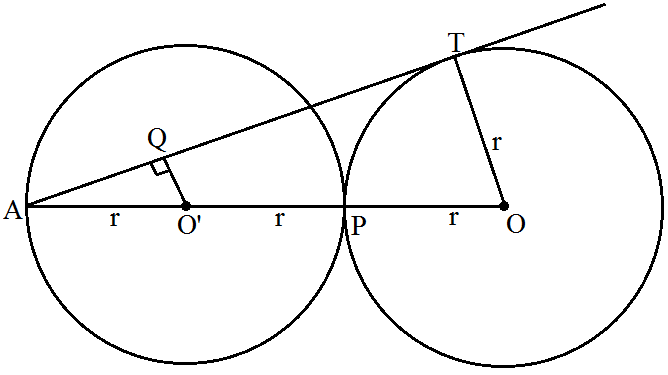
From the given figure we have,
$AO = r + r + r$
$AO = 3r$
$AO’ = r$
Therefore,
$\frac{\text{AO}}{\text{AO'}}=\frac{3\text{r}}{\text{r}}$
$\frac{\text{AO}}{\text{AO'}}=3$
Also as $\text{O'Q}\parallel\text{OT}$
therefore $\frac{\text{AT}}{\text{AQ}}=\frac{\text{AO}}{\text{AO'}}$ View full question & answer→MCQ 1361 Mark
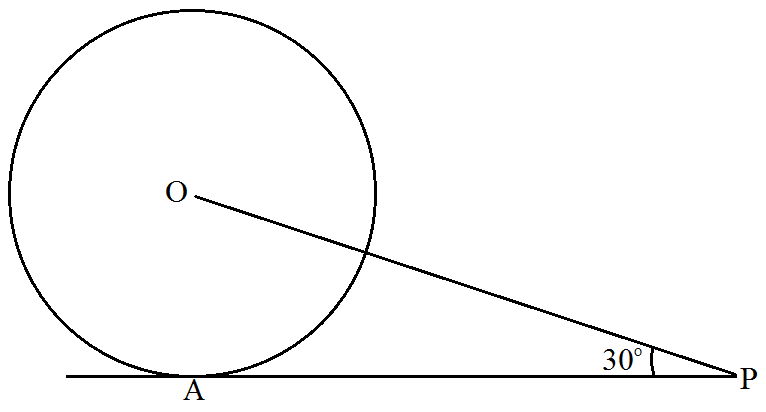
In the figure $,AP$ is a tangent to the circle with centre $O$ such that $OP = 4\ cm$ and $\angle\text{OPA}=30^{\circ}$. Then $,AP =$
- A
$2\sqrt{2}\text{ cm}$
- B
$2\text{ cm}$
- ✓
$2\sqrt{3}\text{ cm}$
- D
$3\sqrt{2}\text{ cm}$
AnswerCorrect option: C. $2\sqrt{3}\text{ cm}$
In the figure $,AP$ is the tangent to the circle with centre $O$ such that $OP = 4\ cm,$
$\angle\text{OPA}=30^{\circ}$
Join $OA,$ let $AP = x$
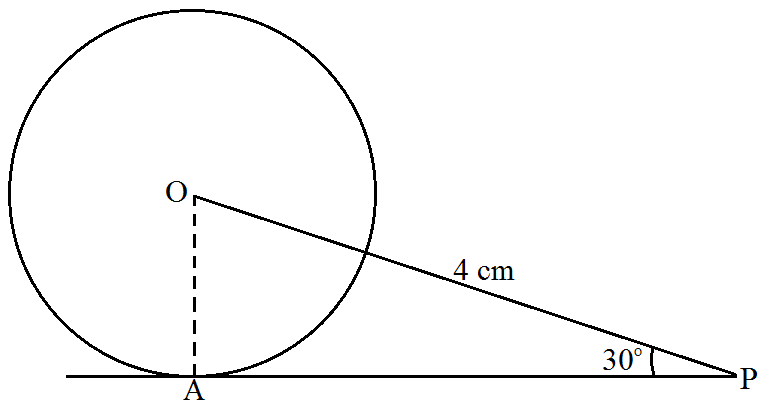
$\cos30^{\circ}=\frac{\text{AP}}{\text{OP}}$
$\Rightarrow\frac{\sqrt{3}}{2}=\frac{\text{x}}{4}$
$\Rightarrow\text{x}=\frac{4\times\sqrt{3}}{2}$
$=2\sqrt{3}\text{ cm}$ View full question & answer→MCQ 1371 Mark
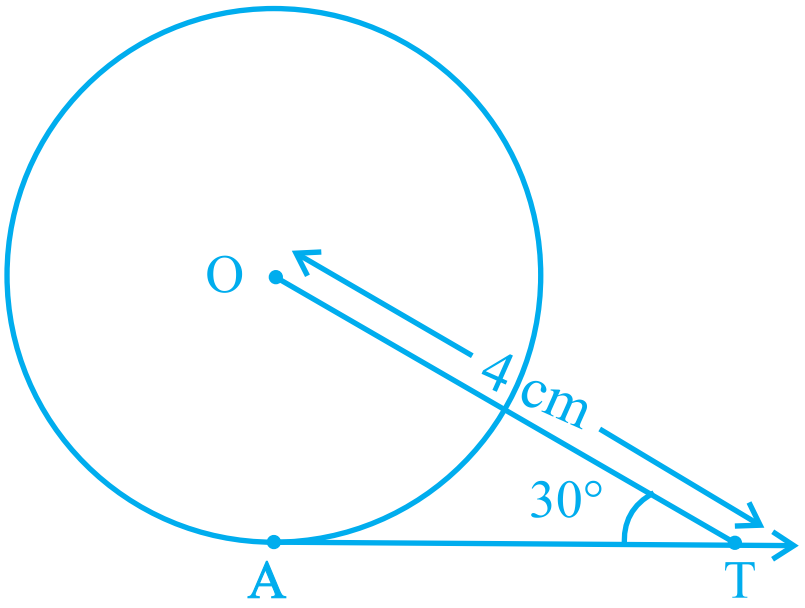
In figure, $AT$ is a tangent to the circle with centre $O$ such that $OT = 4\ cm$ and $\angle\text{OTA}=30^\circ.$ Then $AT$ is equal to :
- A
$4\text{ cm}$
- B
$2\text{ cm}$
- ✓
$2\sqrt{3}\text{ cm}$
- D
$4\sqrt{3}\text{ cm}$
AnswerCorrect option: C. $2\sqrt{3}\text{ cm}$
Join $OA$
We know that, the tangent at any point of a circle is perpendicular to the radius through the point of contact.
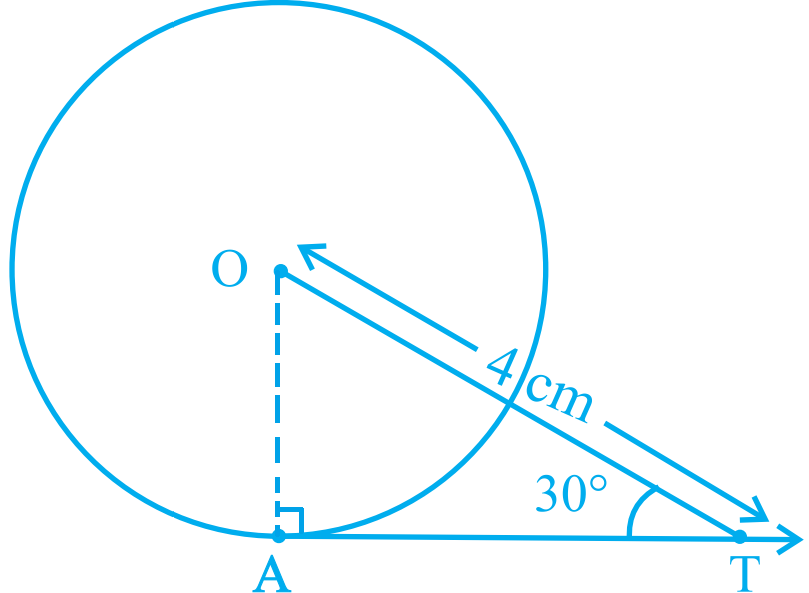
$\therefore\ \angle\text{OAT}=90^\circ$
In $\triangle\text{OAT},\ \cos30^\circ=\frac{\text{AT}}{\text{OT}}$
$\Rightarrow\ \frac{\sqrt{3}}{2}=\frac{\text{AT}}{4}$
$\Rightarrow\ \text{AT}=2\sqrt{3}\text{ cm}.$ View full question & answer→MCQ 1381 Mark
Quadrilateral $\text{ABCD}$ is circumscribed to a circle. If $AB = 6\ cm, BC = 7\ cm$ and $CD = 4\ cm,$ then the length of $AD$ is :
- ✓
$3\ cm$
- B
$4\ cm$
- C
$6\ cm$
- D
$7\ cm$
AnswerCorrect option: A. $3\ cm$
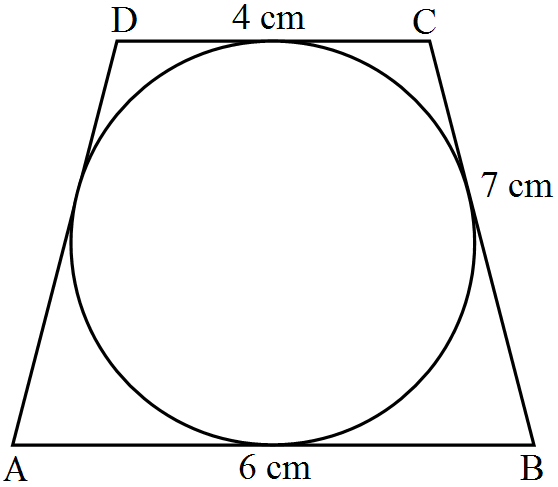
Using the property, tangent from an external point to the circle are equal.
We can say $, AB + CD = AD + BC$
$\Rightarrow AD = AB + CD - BC$
$\Rightarrow AD = 6 + 4 - 7$
$\Rightarrow AD = 3\ cm$ View full question & answer→MCQ 1391 Mark
The chord of a circle of radius $10\ cm$ subtends a right angle at its centre. The length of the chord $($in $cm)$ is :
AnswerCorrect option: C. $10\sqrt{2}\text{ cm}$
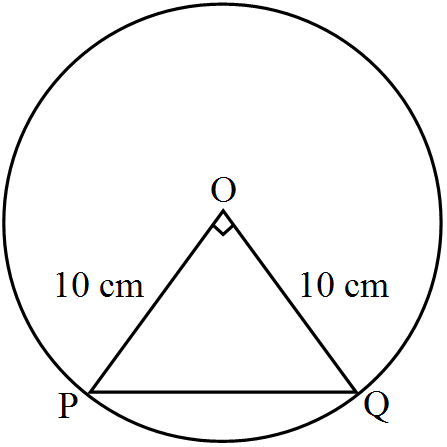
In $\triangle\text{POQ},$
By using Pythagoras theorem,
$P Q^2=P O^2+O Q^2 $
$ \Rightarrow P Q^2=10^2+10^2 $
$ \Rightarrow P Q^2=100+100 $
$ \Rightarrow P Q^2=200 $
$ \Rightarrow P Q^2=200 $
$\Rightarrow\text{PQ}=10\sqrt{2}\text{ cm}$
So, the length of the chord is $10\sqrt{2}\text{ cm}$ View full question & answer→MCQ 1401 Mark
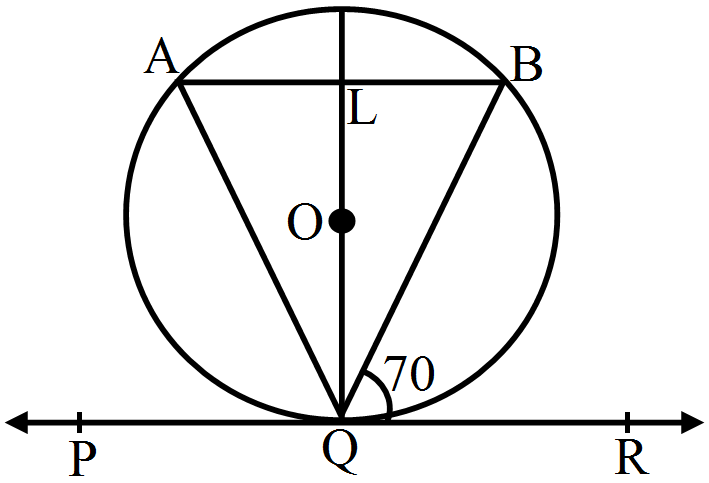
In the given figure $, \text{PQR}$ is a tangent to the circle at $Q,$ whose centre is $O$ and $AB$ is a chord parallel to $PR,$ such that$ \angle\text{BQR} = 70^\circ.$ Then, $\angle\text{AQB}=?$
- A
$20^\circ$
- B
$35^\circ$
- ✓
$40^\circ$
- D
$45^\circ$
AnswerCorrect option: C. $40^\circ$
Since $AB \| PQ$
$\angle\text{BQR}=\angle\text{ABQ}=70^\circ ....($alternate angles$)$
and $\angle\text{PQA}=\angle\text{BAQ}=70^\circ....($alternate angles$)$
In $\triangle\text{ABQ},$
$\angle\text{ABQ}+\angle\text{BAQ}+\angle\text{AQB}=180^\circ....($angle Sum Property$)$
$\Rightarrow70^\circ+70^\circ+\angle\text{AQB}=180^\circ$
$\Rightarrow\angle\text{AQB}=40^\circ$
View full question & answer→MCQ 1411 Mark
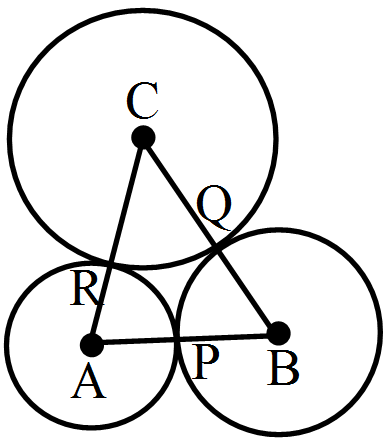
In the given figure, three circles with centres $A, B, C,$ respectively, touch each other externally. If $AB = 5\ cm, BC = 7\ cm$ and $CA = 6\ cm, $ the radius of the circle with centre $A$ is :
- A
$1.5\ cm$
- ✓
$2\ cm$
- C
$2.5\ cm$
- D
$3\ cm$
AnswerCorrect option: B. $2\ cm$
Let the radii of the circle with centres $A, B$ and $C$ be $x, y,$ and $z$ respectively.
We know that radii of the same circle are equal.
$x + y = 5$
$y + z = 7$
$z + x = 6$
Adding the three equation, we get
$2(x + y + z) = 18$
$\Rightarrow x + y + z = 9$
$\Rightarrow x = 2$
So, the radius of the circle with centre $A$ is $2\ cm.$
View full question & answer→MCQ 1421 Mark
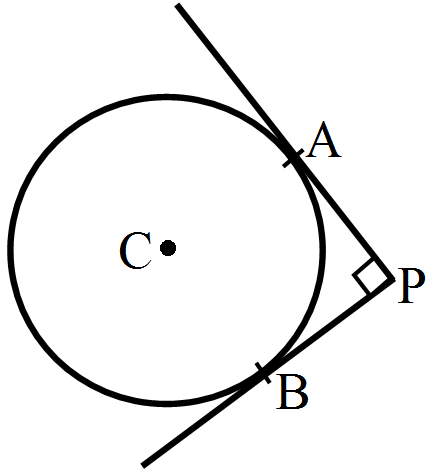
In the given figure $,PA$ and $PB$ are two tangents drawn from an external point $P$ to a circle with centre $C$ and radius $4\ cm$. If $\text{PA}\perp \text{PB}$ then the length of each tangent.
- A
$3\ cm$
- ✓
$4\ cm$
- C
$5\ cm$
- D
$6\ cm$
AnswerCorrect option: B. $4\ cm$
Construction : Join $CA$ and $CB$.
Since $AP$ and $PB$ are tangent to the circle,
$\angle\text{CAP}=\angle\text{CBA}=90^\circ$
Given that $\angle\text{APB}=90^\circ$
We know that tangents drawn from an external point to the circle are equal.
$\Rightarrow\text{AP}=\text{PB}$
Also, $\text{CA}=\text{CB} ....($radii of the same circle$)$
So, quadrilateral $\text{APBC}$ is a square.
Thus $, AP = PB = CA = CB = 4\ cm.$
View full question & answer→MCQ 1431 Mark
If a chord $AB$ subtends an angle of $60^\circ$ at the centre of a circle, then the angle between the tangents to the circle drawn from $A$ and $B$ is :
- A
$30^\circ$
- B
$60^\circ$
- C
$90^\circ$
- ✓
$120^\circ$
AnswerCorrect option: D. $120^\circ$
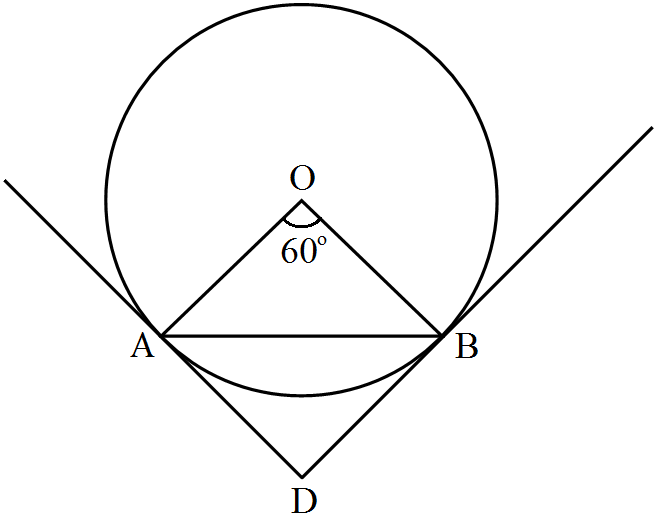
Since $AD$ and $DB$ are the tangent to the circle.
$\angle\text{OAD}=\angle\text{OBD}=90^\circ....($tangent is perpendicular to the radius of a circle$)$
In $\text{ABOD}$
$\angle\text{OAD}+\angle\text{ADB}+\angle\text{OBD}+\angle\text{AOB}=360^\circ$
$\Rightarrow90^\circ+\angle\text{ADB}+90^\circ+60^\circ=360^\circ$
$\Rightarrow\angle\text{ADB}=120^\circ$ View full question & answer→MCQ 1441 Mark
In the figure, two equal circles touch each other at $T,$ if $QP = 4.5\ cm$, then $QR =$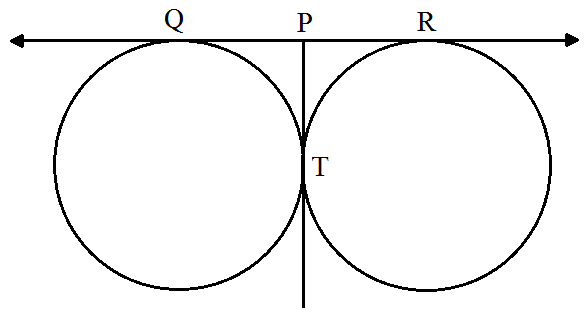
- ✓
$9\ cm$
- B
$18\ cm$
- C
$15\ cm$
- D
$13.5\ cm$
AnswerCorrect option: A. $9\ cm$
$9\ cm$
View full question & answer→MCQ 1451 Mark
$\text{ABC}$ is a right angled triangle, right angled at $B$ such that $BC = 6\ cm$ and $AB = 8\ cm. A$ circle with centre $O$ is inscribed in $\triangle ABC$. The radius of the circle is :
- A
$1\ cm$
- ✓
$2\ cm$
- C
$3\ cm$
- D
$4\ cm$
AnswerCorrect option: B. $2\ cm$
In a right $\triangle\text{ABC},$
$\angle\text{B}=90^{\circ}$
$BC = 6\ cm, AB = 8\ cm$
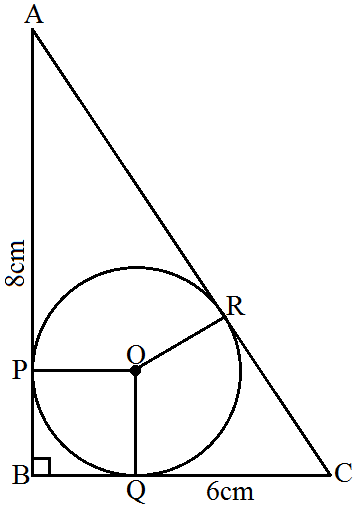
$A C^2=A B^2+B C^2 \ ($Pythagoras Theorem$)$
$=(8)^2+(6)^2=64+36=100=(10)^2$$AC = 10\ cm$
An incircle is drawn with centre 0 which touches the sides of the triangle $\text{ABC}$ at $P, Q$ and $\text{ROP}, OQ$ and $OR$ are radii and $AB, BC$ an $CA$ are the tangents to the circle.
$OP \perp AB, OQ \perp BC$ and $OR \perp CA$
$\text{OPBQ}$ is a square.
Let $r$ be the radius of the incircle.
$PB = BQ = r$
$AR = AP = 8 – r,$
$CQ = CR = 6 – r$
$AC = AR + CR$
$\Rightarrow 10 = 8 – r + 6 – r$
$\Rightarrow 10 = 14 – 2r$
$\Rightarrow 2r = 14 – 10 = 4$
$\Rightarrow r = 2$
Radius of the incircle $= 2\ cm$.
View full question & answer→MCQ 1461 Mark
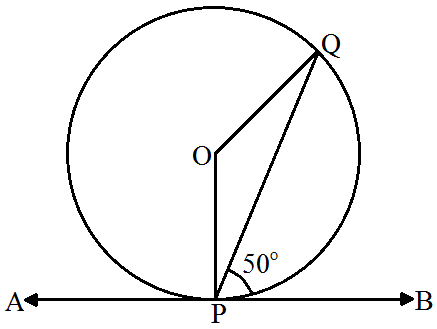
In the figure, $\text{APB}$ is a tangent to a circle with centre $O$ at point $P$. If $\angle\text{QPB}=50^\circ$ then the measure of $\angle\text{POQ}$ is :
- ✓
$100^\circ$
- B
$120^\circ$
- C
$140^\circ$
- D
$150^\circ$
AnswerCorrect option: A. $100^\circ$
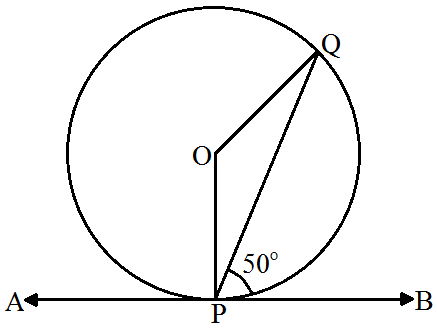
In the figure $, \text{APB}$ is a tangent to the circle with centre $O$.
$\angle\text{QPB}=50^\circ$
$OP$ is radius and $\text{APB}$ is a tangent.
$OP \perp AB$
$\Rightarrow\text{OPB}=90^\circ$
$\Rightarrow\angle\text{OPQ}+\angle\text{QPB}=90^\circ$
$\angle\text{OPQ}+50^\circ=90^\circ$
$\Rightarrow\angle\text{OPQ}=90^\circ-50^\circ=40^{\circ}$
But $OP = OQ$
$\angle\text{OPQ}=\angle\text{OQP}=40^{\circ}$
$\angle\text{POQ}=180^{\circ}-(40^{\circ}+40^{\circ})$
$=180^{\circ}-80^{\circ}=100^{\circ}$
View full question & answer→MCQ 1471 Mark
From a point $Q,$ the length of tangent to a circle is $24\ cm$ and the distance of $Q$ from the centre is $25\ cm,$ radius of circle is :
- A
$10\ cm$
- B
$8\ cm$
- C
$6\ cm$
- ✓
$7\ cm$
AnswerCorrect option: D. $7\ cm$
Here $\angle\text{OPQ} = 90^\circ$
$ [$Tangent makes right angle with the radius at the point of contact$]$
In right angled triangle $\text{OPQ}$
$\therefore O Q^2=O P^2+P Q^2 $
$\Rightarrow(25)^2=O P^2+(24)^2 $
$ \Rightarrow O P^2=625-576 $
$\Rightarrow OP = 7\ cm$
Therefore, the radius of the circle is $7\ cm$.
View full question & answer→MCQ 1481 Mark
If radii of two concentric circles are $4\ cm$ and $5\ cm,$ then the length of each chord of one circle which is tangent to the other circle is :
- A
$3\ cm$
- ✓
$6\ cm$
- C
$9\ cm$
- D
$1\ cm$
AnswerCorrect option: B. $6\ cm$
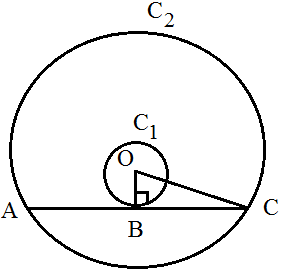
Let $O$ be the centre of two concentric circles $C_2$ and $C_2,$
whose radil are $r_1= 4\ cm$ and $r_2= 5\ cm.$
Now, we draw a chord AC of circle $C_2$, which touches the circle $C_1$ at $B$.
Also, join $OB,$ which is perpendicular to $AC. $
$[$Tangent at any point of circle is perpendicular to radius throughly the point of contact$]$
Now, in right angled $\triangle\text{OBC},$ by using pythagoras theorem,
$OC^2= BC^2+ BO^2$
$[\because \mathrm{(hypotenuse)^2= (base)^2+ (perpendicular)^2}]$
$\Rightarrow 5^2= BC^2+ 4^2$
$\Rightarrow BC^2= 25 - 16 = 9$
$\Rightarrow BC = 3\ cm$
$\because$ Length of chord $AC = 2BC = 2 \times 3 = 6\ cm.$ View full question & answer→MCQ 1491 Mark
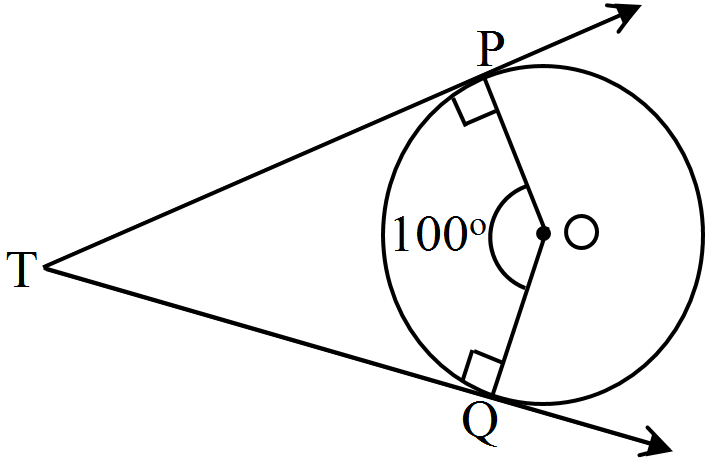
In the adjacent figure, if $TP$ and $TQ$ are two tangents to a circle with centre $O,$ so that $\angle\text{POQ}=100^\circ,$ then $\angle\text{PTQ}$ is equal to :
- A
$60^\circ$
- B
$40^\circ$
- ✓
$80^\circ$
- D
$90^\circ$
AnswerCorrect option: C. $80^\circ$
Since the angle between the two tangents drawn from an external point to a circle in supplementary of the angle between the radii of the circle through the points of contact.
$\therefore \angle \text{PTQ} = 180^\circ- 100^\circ= 80^\circ$
View full question & answer→MCQ 1501 Mark
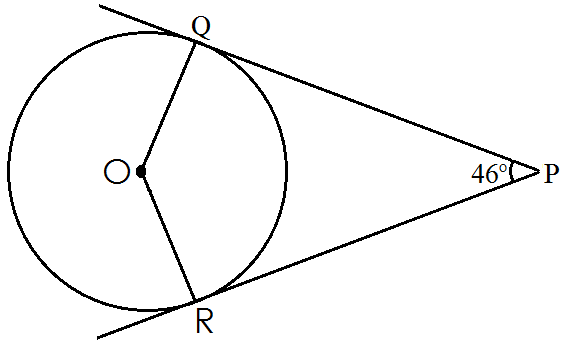
In the figure $,PQ$ and $PR$ are two tangents to a circle with centre $O$. If $\angle\text{QPR}=46^\circ$ then $\angle\text{QOR}$ equals :
- A
$67^\circ$
- ✓
$134^\circ$
- C
$44^\circ$
- D
$46^\circ$
AnswerCorrect option: B. $134^\circ$
$\angle\text{OQP}=90^\circ \ [$Tangent is $\perp$ to the radius through the point of contact$]$
$\angle\text{ORP}=90^\circ$
$\angle\text{OQP}+\angle\text{QPR}+\angle\text{ORP}+\angle\text{QOR}=360^\circ \ [$Angle sum property of a quad.$]$
$90^\circ+46^\circ+90^\circ+\angle\text{QOR}=360^\circ$
$\angle\text{QOR}=360^\circ-90^\circ-46^\circ-90^\circ=134^\circ$
View full question & answer→