Questions · Page 4 of 5

M.C.Q (1 Marks)

MCQ 1511 Mark
In a right triangle $\text{ABC},$ right angled at $B, BC = 12\ cm$ and $AB = 5\ cm$. The radius of the circle inscribed in the triangle is :
  • A
    $1\ cm$
  • $2\ cm$
  • C
    $3\ cm$
  • D
    $4\ cm$
Answer
Correct option: B.
$2\ cm$
In right $\triangle\text{ABC},$
$\text{AC}^2=\text{AB}^2+\text{BC}^2 ....($By Pythagoras theorem$)$
$\Rightarrow\text{AC}^2=5^2+12^2$
$\Rightarrow\text{AC}^2=169$
$\Rightarrow\text{AC}=13\text{ cm}$
We know that,
$\text{ar}(\triangle\text{ABC})=\frac{1}{2}\times(\text{perimeter of }\triangle\text{ABC})\times\text{r}$
$\Rightarrow\frac{1}{2}\times\text{base}\times\text{height}=\frac{1}{2}\times(\text{perimeter of }\triangle\text{ABC})\times\text{r}$
$\Rightarrow\frac{1}{2}\times12\times5=\frac{1}{2}\times(5+12)\times\text{r}$
$\Rightarrow\frac12\times5=30\times\text{r}$
$\Rightarrow\text{r}=2\text{ cm}$
View full question & answer
MCQ 1521 Mark
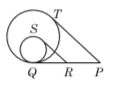
In the given figure if $QP = 4.5\ cm,$ then the measure of $QR$ is equal to :
  • A
    $13.5\ cm$
  • B
    $18\ cm$
  • C
    $15\ cm$
  • $9\ cm$
Answer
Correct option: D.
$9\ cm$
Here $QP = PT = 4.5\ cm \ [$Tangents to a circle from an external point $P]$
Also $PT = PR = 4.5\ cm\ [$Tangents to a circle from an external point $P]$
$\therefore QR = QP + PQ $
$= 4.5 + 4.5 = 9\ cm$
View full question & answer
MCQ 1531 Mark
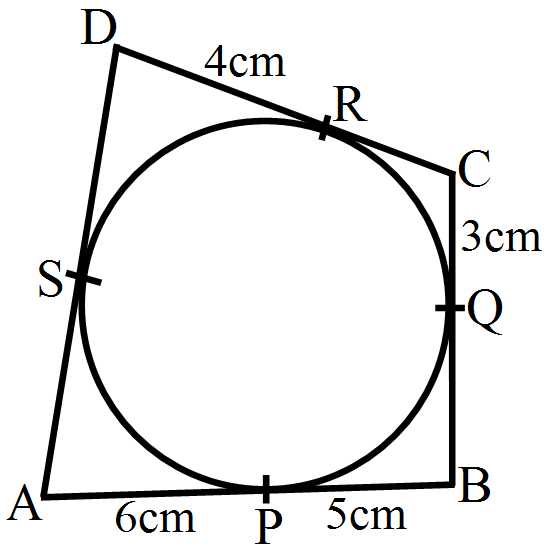
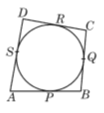
In the given figure, quadrilateral $\text{ABCD}$ is circumscribed, touching the circle at $P, Q, R$ and $S$. If $AP = 6\ cm, BP = 5\ cm, CQ = 3\ cm$ and $DR = 4\ cm,$ then the perimeter of quadrilateral $\text{ABCD}$ is :
  • A
    $18\ cm$
  • B
    $27\ cm$
  • $36\ cm$
  • D
    $32\ cm$
Answer
Correct option: C.
$36\ cm$
We know that tangent from an external point to the circle are equal.
$RC = QC = 3\ cm$
$PB = BQ = 5\ cm$
$AP = AS = 6\ cm$
$SD = DR = 4\ cm$
Perimeter of quad. $\text{ABCD}$
$= AB + BC + CD + AD$
$= (AP + PB) + (BQ + CQ) + (CR + DR) + (AS + SD)$
$= (6 + 5) + (5 + 3) + (3 + 4) + (6 + 4)$
$= 36\ cm$
View full question & answer
MCQ 1541 Mark
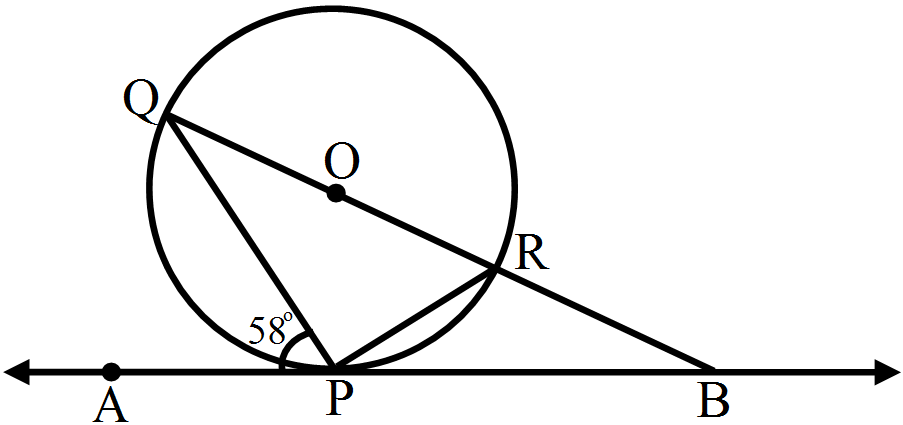
In the given figure $,O$ is the centre of the circle. $AB$ is the tangent to the circle at the point $P$. If $\angle\text{APQ}=58^\circ$ then the measure of $\angle\text{PQB}$ is :​​​​​​​
  • $32^\circ$
  • B
    $58^\circ$
  • C
    $122^\circ$
  • D
    $132^\circ$
Answer
Correct option: A.
$32^\circ$
$\angle\text{APQ}=58^\circ$
$\angle\text{QPR}=90^\circ ....($angle inscribed a semicircle$)$
Since $\text{APB}$ is a straight line,
$\angle\text{APQ}+\angle\text{QPR}+\angle\text{RPB}=180^\circ$
$\Rightarrow58^\circ+90^\circ+\angle\text{RPB}=180^\circ$
$\Rightarrow\angle\text{RPB}=32^\circ$
We know that angle that subtend the same arc are equal.
So, $\angle\text{RPB}=\angle\text{RPB}=32^\circ$
View full question & answer
MCQ 1551 Mark
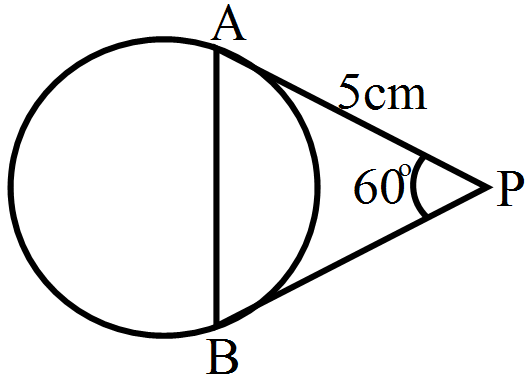
In the given figure, $PA$ and $PB$ are tangents to the given circle, such that $PA = 5\ cm$ and $\angle\text{APB} = 60^\circ.$ The length of chord $AB$ is :​​​​​​​
  • A
    $5\sqrt{2}\text{ cm}$
  • $5\text{ cm}$
  • C
    $5\sqrt{3}\text{ cm}$
  • D
    $7.5\text{ cm}$
Answer
Correct option: B.
$5\text{ cm}$
We know that tangents from an external point to the circle are equal.
$\text{PA}=\text{PB}$
$\Rightarrow\angle\text{PBA}=\angle\text{PAB}=\text{x}^\circ$
In $\triangle\text{PAB},$
$\angle\text{PBA}+\angle\text{PAB}+\angle\text{APB}=180^\circ....($Angle Sum Property$)$
$\Rightarrow\angle\text{PAB}+\angle\text{PAB}+60^\circ=180^\circ$
$\Rightarrow2\angle\text{PAB}=120^\circ$
$\Rightarrow\angle\text{PAB}=60^\circ=\angle\text{PBA}$
So, $\triangle\text{PAB}$ is an equilateral triangle.
thus $, AB = PA = 5\ cm.$
View full question & answer
MCQ 1561 Mark
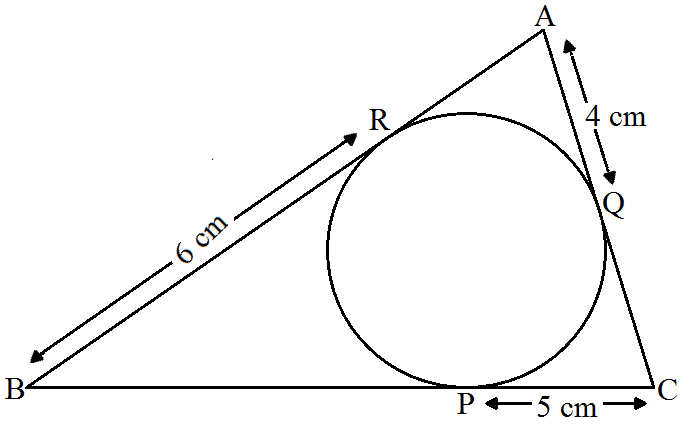
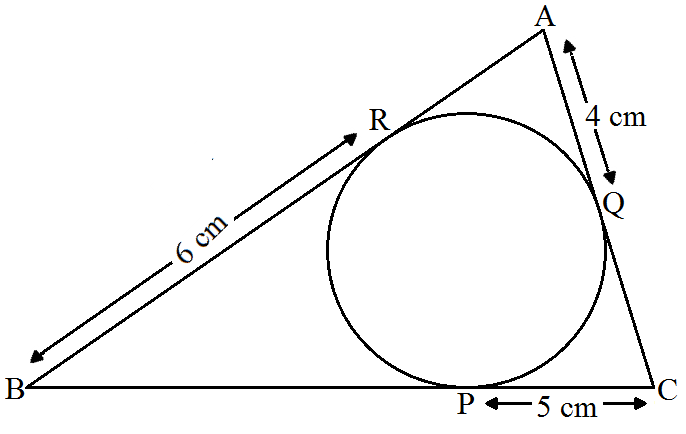
In the figure, the perimeter of $\triangle\text{ABC}$ is :
  • $30\ cm$
  • B
    $60\ cm$
  • C
    $45\ cm$
  • D
    $15\ cm$
Answer
Correct option: A.
$30\ cm$

By the property of tangent
$AO = AR = 4\ cm\ ($tangent from $A)$
$BR = BP = 6\ cm\ ($tangent from $B)$
$PC = CQ = 5\ cm\ ($tangent from $C)$
Perimeter of $\triangle\text{ABC} = AB + BC + CA$
Perimeter of $\triangle\text{ABC} = AR + BR + BP + PC + CQ + QA$
Perimeter of $\triangle\text{ABC} = 4 + 6 + 6 + 5 + 5 + 4$
Perimeter of $\triangle\text{ABC} = 30\ cm$
View full question & answer
MCQ 1571 Mark
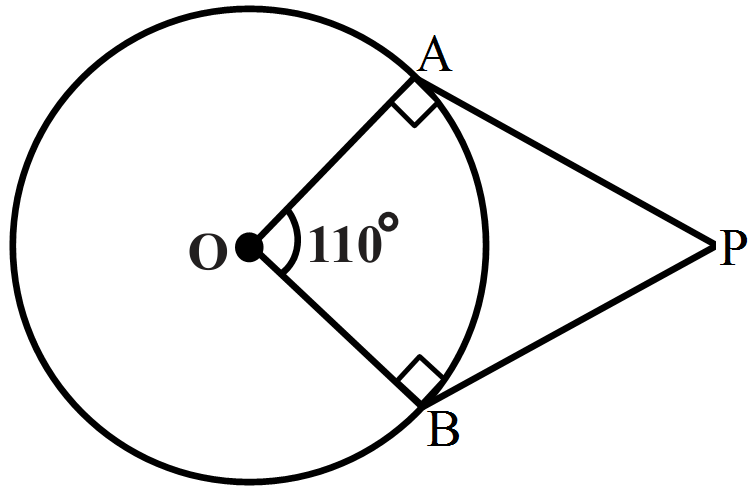
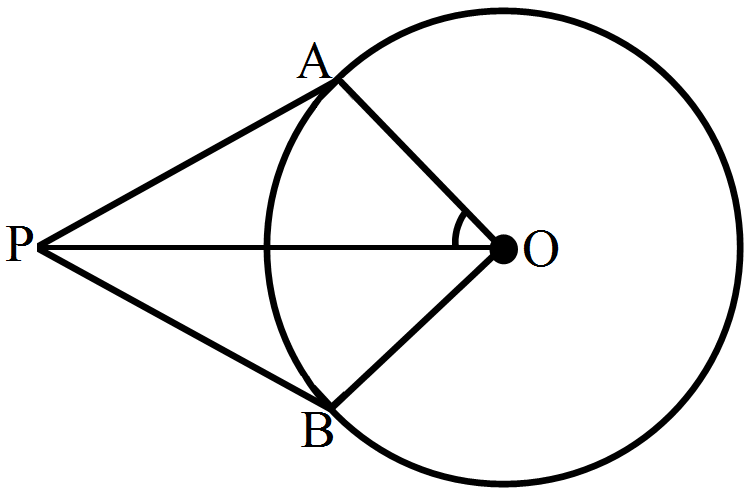
If $PA$ and $PB$ are two tangents to a circle with centre $O,$ such that $\angle\text{AOB} = 110^\circ,$ find $ \angle\text{APB}$ is equal to​​​​​​​
  • A
    $55^\circ$
  • B
    $60^\circ$
  • $70^\circ$
  • D
    $90^\circ$
Answer
Correct option: C.
$70^\circ$
Since $PA$ and $PB$ are the tangent to the circle.
$\angle\text{OAP}=\angle\text{OBP}=90^\circ ...($tangent is perpendicular to the radius of a circle$)$
In $\text{AOBP},$
$\angle\text{OAP}+\angle\text{APB}+\angle\text{OBP}+\angle\text{AOB}=360^\circ$
$\Rightarrow90^\circ+\angle\text{APB}+90^\circ+110^\circ=360^\circ$
$\Rightarrow\angle\text{APB}=70^\circ$
View full question & answer
MCQ 1581 Mark
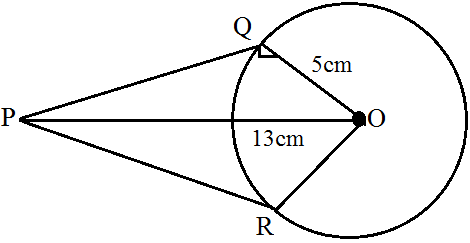
From a point $P$ which is at a distance of $13\ cm$ from the centre $O$ of a circle of radius $5\ cm,$ the pair of tangents $PQ$ and $PR$ to the circle are drawn. Then the area of the quadrilateral $\text{PQOR}$ is :
  • $60 \mathrm{~cm}^2 $
  • B
    $ 65 \mathrm{~cm}^2 $
  • C
    $ 30 \mathrm{~cm}^2 $
  • D
    $ 32.5 \mathrm{~cm}^2 $
Answer
Correct option: A.
$60 \mathrm{~cm}^2 $

Firstly, draw a circle of radius $5\ cm$ having centre $O.P$ is a point at a distance of $13\ cm$ from $O$.
A pair of tangents $PQ$ and $PR$ are drawn.
Thus, quadrilateral $\text{POOR}$ is formed.
$\because\ \text{OQ}\perp\text{QP}\ [$since $,AP$ is a tangent line$]$
In right angled $\triangle\text{PQO},\ \text{OP}^2=\text{OQ}^2+\text{QP}^2$
$\Rightarrow\ 13^2=5^2+\text{QP}^2$
$\Rightarrow\ \text{QP}^2=169-25=144$
$\Rightarrow\ \text{QP}=12\text{ cm}$
Now, area of $\triangle\text{OQP}=\frac{1}{2}\times\text{QP}\times\text{QO}$
$=\frac{1}{2}\times12\times5=30\text{ cm}^2$
$\therefore$ Area of quadrilateral $\text{QORP}=2\triangle\text{OQP}$
$= 2 \times 30 = 60\mathrm{~cm}^2 $
View full question & answer
MCQ 1591 Mark
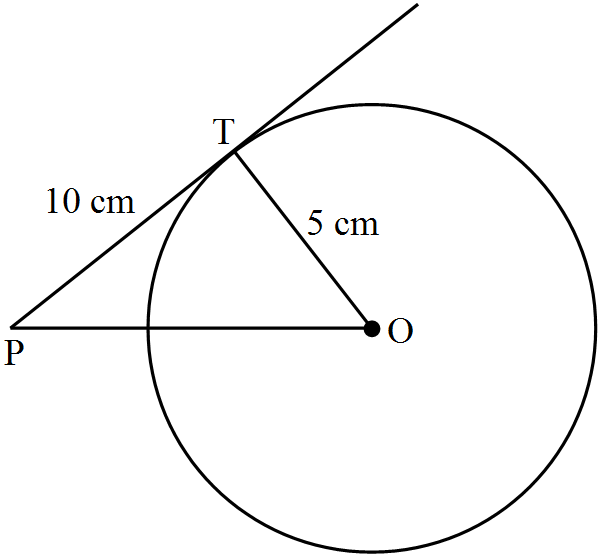
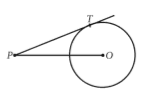
The length of the tangent from an external point $P$ to a circle of radius $5\ cm$ is $10\ cm$. The distance of the point from the centre of the circle is :
  • A
    $8\text{ cm}$
  • B
    $\sqrt{104}\text{ cm}$
  • C
    $12\text{ cm}$
  • $\sqrt{125}\text{ cm}$
Answer
Correct option: D.
$\sqrt{125}\text{ cm}$
In $\triangle\text{PTO}$
By Pythagoras theorem,
$\text{OP}^2=\text{PT}^2+\text{OT}^2$
$\Rightarrow\text{OP}^2=10^2+5^2$
$\Rightarrow\text{OP}^2=100+25$
$\Rightarrow\text{OP}=\sqrt{125}\text{ cm}$
Hence, the distance of the point from the centre of the circle is $\sqrt{125}\text{ cm}.$
View full question & answer
MCQ 1601 Mark
If $PA$ and $PB$ are two tangent to a circle with centre $O$ such that $\angle\text{APB}=80^\circ.$ Then, $\angle\text{AOP}=?$
  • A
    $40^\circ$
  • $50^\circ$
  • C
    $60^\circ$
  • D
    $70^\circ$
Answer
Correct option: B.
$50^\circ$
Construction : Join $CA$ and $CB$.
In $\triangle\text{PAO}$ and $\triangle\text{PBO},$
$\angle\text{OAP}=\angle\text{OBP}=90^\circ....($Since $AP$ and $PB$ are tangent to the circle$)$
$\text{OP}=\text{OP} ....($common side$)$
$\text{AO}=\text{BO} ....($radii of the same circle$)$
$\Rightarrow\triangle\text{PAO}\cong\triangle\text{PBO} ....(\text{RHS}$ congruence criterion$)$
$\angle\text{OPA}=\angle\text{OPB} ....(\text{cpct})$
$\Rightarrow\angle\text{OPA}=\frac{1}{2}\angle\text{APB}=40^\circ$
In $\triangle\text{PAO},$
$\angle\text{OPA}+\angle\text{PAO}+\angle\text{AOP}=180^\circ ....($Angle Sum Property$)$
$\Rightarrow40^\circ+90^\circ+\angle\text{AOP}=180^\circ$
$\Rightarrow\angle\text{AOP}=50^\circ$
View full question & answer
MCQ 1611 Mark
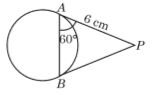
In the following figure, find the length of the chord $A B$ if $P A=6 cm$ and $\angle P A B=60^{\circ}$.
Image
Answer
Correct option: C.
(c) : $P B=P A=6 cm \quad[\because$ Tangents drawn from an external point to a circle are equal in length]
$
\therefore \quad \angle P B A=\angle P A B=60^{\circ}
$
(Angles opposite to sides are equal)
$
\therefore \quad \angle A P B=180^{\circ}-60^{\circ}-60^{\circ}=60^{\circ}
$
[Angle sum property of a triangle]
$\therefore \quad \triangle A P B$ is an equilateral triangle.
$
\therefore \quad A B=P A=P B=6 cm
$
View full question & answer
MCQ 1621 Mark
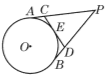
From an external point $P$, tangents $P A$ and $P B$ are drawn to a circle with centre $O$. If $C D$ is the tangent to the circle at a point $E$ and $P A=14 \ cm$, find the perimeter of $\triangle \text{P C D}$.
Image
  • A
    $26 \ cm$
  • $14 \ cm$
  • C
    $28 \ cm$
  • D
    $21 \ cm$
Answer
Correct option: B.
$14 \ cm$
Since the tangents drawn from an external point to a circle are equal.
$\therefore P A=P B, C A=C E$ and $D B=D E$
Perimeter of $\triangle P C D=P C+C D+P D$
$=(P A-C A)+(C E+D E)+(P B-D B)$
$=(P A-C E)+(C E+D E)+(P B-D E)$
$=P A+P B=2 P A=(2 \times 14) \ cm =28 \ cm$
View full question & answer
MCQ 1631 Mark
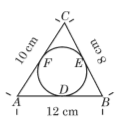
A circle is inscribed in a $\triangle A B C$ having sides $8 cm , 10 cm$ and $12 cm$ as shown in given figure. The length of $A D, B E$ and $C F$ (in $cm$ ) respectively are
Image
  • $2,8,4$
  • B
    $7,5,3$
  • C
    $8,4,2$
  • D
    $6,6,4$
Answer
Correct option: A.
$2,8,4$
(a) : Let $A D=x cm$
Then $A F=x cm$
$
\begin{aligned}
\therefore \quad F C & =A C-A F=(10-x) cm \\
\text { and } C E & =F C=(10-x) cm \\
E B & =B C-C E=8-(10-x)=8-10+x=(x-2) cm \\
D B & =A B-A D=(12-x) cm
\end{aligned}
$
Now, $D B=E B \Rightarrow 12-x=x-2 \Rightarrow x=7$
$
\therefore A D=7 cm , B E=7-2=5 cm \text { and } C F=10-7=3 cm
$
View full question & answer
MCQ 1641 Mark
In the given figure, $P Q$ is the common tangent to both the circles. $S R$ and $P T$ are also tangents. If $S R=4 cm , P T=7 cm$, then find $R P$.
Image
  • $2 cm$
  • B
    $3 cm$
  • C
    $5 cm$
  • D
    $3.5 cm$
Answer
Correct option: A.
$2 cm$
(a) : Since tangents drawn from an external point to a circle are equal in length.
$
\therefore P Q=P T=7 cm \text { and } R Q=R S=4 cm
$
Now, $R P=P Q-R Q=(7-4) cm =3 cm$
View full question & answer
MCQ 1651 Mark
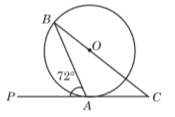
In the adjoining figure, if $P C$ is the tangent at $A$ of the circle with $\angle P A B$ $=72^{\circ}$ and $\angle A O B=132^{\circ}$, then $\angle A B C=$
Image
  • A
    can't be determined
  • $18^{\circ}$
  • C
    $30^{\circ}$
  • D
    $60^{\circ}$
Answer
Correct option: B.
$18^{\circ}$
(b) : Here, $\angle P A B=72^{\circ}$
$
\therefore \angle O A B=90^{\circ}-72^{\circ}=18^{\circ}
$Also, $\angle A O B=132^{\circ}$
[Given]
Now, in $\triangle O A B, \angle A B C=180^{\circ}-132^{\circ}-18^{\circ}=30^{\circ}$
View full question & answer
MCQ 1661 Mark
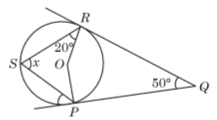
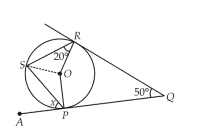
In the diagram, $P Q$ and $Q R$ are tangents to the circle with centre $O$. Find the value of $x$.
Image
  • A
    $55^{\circ}$
  • B
    $25^{\circ}$
  • $35^{\circ}$
  • D
    $65^{\circ}$
Answer
Correct option: C.
$35^{\circ}$
(c) : $\angle P O R+\angle P Q R=180^{\circ}$
$
\angle O P Q=\angle O R Q=90^{\circ}
$
$
\therefore \angle P O R=180^{\circ}-50^{\circ}=130^{\circ}
$Also, $\angle P S R=\frac{1}{2} \angle P O R$
Image
$[\because$ Angle made by an arc at the centre of a circle is twice the angle subtended by the same arc at any point on the remaining part of the circle]
$
\therefore \quad \angle P S R=\frac{1}{2} \times 130^{\circ}=65^{\circ}
$
View full question & answer
MCQ 1671 Mark
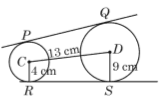
In the given diagram, $P Q$ and $R S$ are common tangents to the two circles with centres $C$ and $D$. The value of $R S$ is
Image
  • A
    $12 \ cm$
  • B
    $9 \ cm$
  • C
    $5 \ cm$
  • $15 \ cm$
Answer
Correct option: D.
$15 \ cm$
We have $C R=4 \ cm$,
$D S=9 \ cm$ and $C D=13 \ cm
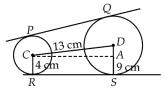
$Draw $A C \| R S$
Image
$\therefore D A=D S-S A[S A=C R]$
$=9-4=5 \ cm$
In $\triangle C A D$, right angled at $D$
$C A^2=C D^2-D A^2=13^2-5^2=144$
$\Rightarrow C A=\sqrt{144}=12 \ cm$
$\Rightarrow C A=R S=12 \ cm$
View full question & answer
MCQ 1681 Mark
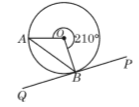
If $\text{AB}$ is chord of a circle with centre $O$ and $\text{PQ}$ is a tangent to the circle at $B$ with reflex $\angle \text{AOB}=210^{\circ}$, then $\angle \text{OBA}=$
Image
  • $15^{\circ}$
  • B
    $75^{\circ}$
  • C
    $150^{\circ}$
  • D
    $210^{\circ}$
Answer
Correct option: A.
$15^{\circ}$
Since, angle about a point is $360^{\circ}$.
$\therefore \angle \text{AOB}=360^{\circ}-\text { reflex } \angle \text{AOB}=360^{\circ}-210^{\circ}=150^{\circ}$
In $\triangle \text{AOB,} \angle \text{OAB} +\angle \text{ABO}+\angle \text{AOB}=180^{\circ}$
$\Rightarrow \angle \text{ABO} +\angle \text{ABO}=180^{\circ}-150^{\circ}$
$\left.\Rightarrow 2 \angle \text{OBA}=30^{\circ} [\angle OAB=\angle OBA \text { and } \angle \text{AOB}=150^{\circ}\right]$
$\Rightarrow 2 \text{OBA}=15^{\circ}$
View full question & answer
MCQ 1691 Mark
If four sides of a quadrilateral $\text{A B C D}$ are tangent to a circle, then
Image
  • A
    $\text{A C+A D=B C+D B}$
  • B
    $\text{A C+A D=B D+C D}$
  • $\text{A B+C D=B C+A D}$
  • D
    $\text{A B+C D=A C+B C}$
Answer
Correct option: C.
$\text{A B+C D=B C+A D}$
Since the lengths of tangents to a circle from an external point are equal.
Image
$\therefore A P=A S$
$B P=B Q$
$C R=C Q$
$D R=D S$
Adding $(i), (ii), (iii)$ and $(iv),$ we get
$(A P+B P)+(C R+D R)=A S+B Q+C Q+D S$
$\Rightarrow A B+C D=B C+A D$
View full question & answer
MCQ 1701 Mark
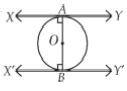
Two parallel lines touch the circle at points $A$ and $B$. If area of the circle is $16 \pi \ cm ^2$, then $A B$ is equal to
  • A
    $16 \ cm$
  • $5 \ cm$
  • C
    $8 \ cm$
  • D
    $10 \ cm$
Answer
Correct option: B.
$5 \ cm$
$[$Given$]$ Let the radius of the circle be $r \ cm$.
Image
Area of circle $=16 \pi$
$\Rightarrow \pi r^2=16 \pi$
$\Rightarrow r^2=16$
$ \Rightarrow r=4$
$\therefore A B=2 O A=2 r=8 \ cm$
View full question & answer
MCQ 1711 Mark
Two tangents $BC$ and $BD$ are drawn to a circle with centre $O$ such that $\angle \text{CBD}=120^{\circ}$. Then $OB=$
Image
  • $BC / 2$
  • B
    $2 B C$
  • C
    $B C$
  • D
    $3 B C$
Answer
Correct option: A.
$BC / 2$
Since, tangents from an external point $B$ to a circle are equally inclined to $O B$
$\therefore \angle \text{CBO}=\frac{1}{2} \angle \text{CBD}$
$=\frac{1}{2} \times 120^{\circ}=60^{\circ}$
Also, $\angle \text{OCB}=90^{\circ}[\because OC \perp CB]$
In $\triangle \text{OCB,} \frac{BC}{OB}=\cos 60^{\circ}=\frac{1}{2}$
$\Rightarrow \text{OB=2BC}$
View full question & answer
MCQ 1721 Mark
In the given figure, a quadrilateral $A B C D$ is drawn to circumscribe a circle such that its sides $A B, B C, C D$ and $A D$ touch the circle at $P, Q, R$ and $S$ respectively. If $A B=x cm$, $B C=7 cm , C R=3 cm$ and $A S=5 cm$, find $x$.
Image
  • A
    $7 cm$
  • $10 cm$
  • C
    $9 cm$
  • D
    $8 cm$
Answer
Correct option: B.
$10 cm$
(b) : $A P=A S, B P=B Q, C Q=C R, D R=D S$
[Tangents drawn from an external point to the circle are equal in Length]
So, $C R=C Q \Rightarrow C Q=3 cm$
Now, $B C=7 cm \Rightarrow C Q+B Q=7 cm$
$\Rightarrow B Q=(7-3) cm =4 cm$
Also, $B Q=B P \Rightarrow B P=4 cm$
Also, $A S=A P$ and $A S=5 cm \Rightarrow A P=5 cm$
$
\therefore \quad A B=A P+P B=(5+4) cm =9 cm
$So, $x=9$
View full question & answer
MCQ 1731 Mark
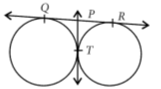
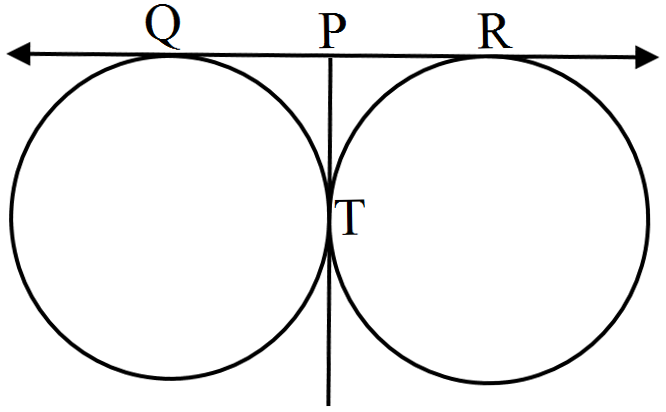
In the given figure, $Q R$ is a common tangent to the given circles, touching externally at the point $T$. The tangent at $T$ meets $Q R$ at $P$. If $P T=3.8 cm$, then the length of $Q R($ in $cm )$ is
Image
  • A
    1.9
  • 3.8
  • C
    7.6
  • D
    5.7
Answer
Correct option: B.
3.8
(b) : It is known that the length of the tangents drawn from an external point to a circle are equal.
$\therefore \quad Q P=P T=3.8 cm$ and $P R=P T=3.8 cm$
Now, $Q R=Q P+P R=3.8 cm +3.8 cm =7.6 cm$
View full question & answer
MCQ 1741 Mark
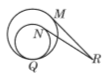
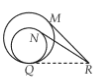
Two circles touch internally at point $Q$. From an external point $R$, two tangents $R M$ and $R N$ are drawn to the two circles. Then,
Image
  • cannot be determined
  • B
    $R M=R N$
  • C
    $R M>R N$
  • D
Answer
Correct option: A.
cannot be determined
(a) : Join RQ.Since tangents drawn from an external point to a circle are equal in length.
Image
$
\therefore R Q=R N
$
$
\text { (i) and } R Q=R M
$
$
\Rightarrow R N=R M
$
View full question & answer
MCQ 1751 Mark
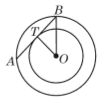
There are two concentric circles with centre $O$ and of diameters $10 cm$ and $6 cm$ respectively. $A B$, a chord of outer circle touches the inner circle at $T$. The length of $B T$ is
Image
  • A
    $6 cm$
  • B
    $7 cm$
  • $4 cm$
  • D
    $10 cm$
Answer
Correct option: C.
$4 cm$
(c) : In $\triangle O B T, \angle O T B=90^{\circ}$
[Tangent of a circle is perpendicular to the radius]
$\therefore \quad O B^2=O T^2+B T^2$
[By Pythagoras theorem]
$
\Rightarrow\left(\frac{10}{2}\right)^2=\left(\frac{6}{2}\right)^2+B T^2 \Rightarrow 25=9+B T^2
$
$
\Rightarrow B T^2=16 \Rightarrow B T=4 cm
$
View full question & answer
MCQ 1761 Mark
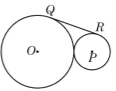
Two circles with centres $O$ and $P$, and radii $8 \ cm$ and $4 \ cm$ touch each other externally. Find the length of their common tangent $Q R$.
Image
  • A
    $16 \ cm$
  • $8 \sqrt{2} \ cm$
  • C
    $4 \ cm$
  • D
    $4 \sqrt{2} \ cm$
Answer
Correct option: B.
$8 \sqrt{2} \ cm$
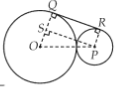
As $\text{S P=Q R}$, as they are opposite sides of rectangle $\text{P R Q S}$.
Image
$O P=8 \ cm +4 \ cm =12 \ cm$
$O S=8 \ cm -4 \ cm =4 \ cm$
Now, in $\triangle \text{O S P, O P}^2=O S^2+S P^2$
$\Rightarrow Q R=S P=\sqrt{O P^2-O S^2}=\sqrt{12^2-4^2} \ cm =8 \sqrt{2} \ cm$
View full question & answer
MCQ 1771 Mark
How many tangents can a circle have from a point lying inside the circle ?
  • A
    2
  • B
    infinitely many
  • C
    1
  • None of these
Answer
Correct option: D.
None of these
(d) : There is no tangent to a circle passing through a point lying inside the circle.
View full question & answer
MCQ 1781 Mark
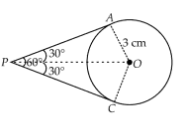
If two tangents inclined at an angle $60^{\circ}$ are drawn to a circle of radius $3 cm$, then length of each tangent is equal to
  • A
    $\frac{3}{2} \sqrt{3} cm$
  • B
    $6 cm$
  • C
    $3 cm$
  • $3 \sqrt{3} cm$
Answer
Correct option: D.
$3 \sqrt{3} cm$
(d) : As $O P$ is a bisector of $\angle A P C$.
Image
$
\therefore \angle A P O=\angle C P O=30^{\circ}
$Also, $O A \perp A P$
$[\because$ Tangent at any point of a circle is perpendicular to the radius through the point of contact.]
$
\therefore \angle O A P=90^{\circ}
$
In right angled $\triangle O A P, \tan 30^{\circ}=\frac{O A}{A P}=\frac{3}{A P}$
$\Rightarrow \frac{1}{\sqrt{3}}=\frac{3}{A P} \Rightarrow$ Length of tangent $A P=3 \sqrt{3} cm$
View full question & answer
MCQ 1791 Mark
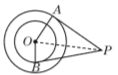
In the given figure, $O$ is the centre of two concentric circles of radii $5 \ cm$ and $3 \ cm$. From an external point $P$, tangents $PA$ and $PB$ are drawn to these circles. If $PA=12 \ cm$, then $PB=$
Image
  • A
    $5 \sqrt{2} \ cm$
  • B
    $3 \sqrt{5} \ cm$
  • $4 \sqrt{10} \ cm$
  • D
    $5 \sqrt{10} \ cm$
Answer
Correct option: C.
$4 \sqrt{10} \ cm$
In right $\triangle \text{PAO, PA}=12 \ cm$ and $OA=5 \ cm$.
$\therefore$ By Pythagoras theorem,
$\ce{OP^2=OA^2 + PA^2}=5^2+(12)^2=25+144=169$
$\Rightarrow \text{OP}=\sqrt{169}=13 \ cm$ In right $\triangle \ce{PBO, PB^2=OP^2 - OB^2}$
$=13^2-3^2=169-9=160$
$\Rightarrow \text{PB}=\sqrt{160} \ cm =4 \sqrt{10} \ cm$
View full question & answer
MCQ 1801 Mark
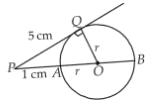
$O$ is the centre of the circle. $P Q$ is tangent to the circle and secant $P A B$ passes through the centre $O$. If $P Q=5 cm$ and $P A=1 cm$, then radius of the circle is
  • A
    $8 cm$
  • $12 cm$
  • C
    $10 cm$
  • D
    $6 cm$
Answer
Correct option: B.
$12 cm$
(b) : $O Q=O A=r$
[radii of circle]In
$\triangle O P Q, \angle Q=90^{\circ}$
$O P^2=O Q^2+P Q^2$
$(r+1)^2=r^2+(5)^2$
$\Rightarrow r^2+2 r+1=r^2+25$
$\Rightarrow 2 r=24 \Rightarrow r=12 cm$
Image
View full question & answer
MCQ 1811 Mark
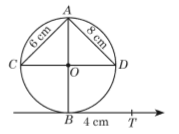
In the given figure, $A D=8 cm , A C=6 cm$ and $T B$ is the tangent at $B$ to the circle with centre $O$. Find $O T$, if $B T$ is $4 cm$.
Image
  • $\sqrt{41} cm$
  • B
    $\sqrt{43} cm$
  • C
    $\sqrt{39} cm$
  • D
    $\sqrt{47} cm$
Answer
Correct option: A.
$\sqrt{41} cm$
(a): Clearly, $\angle C A D=90^{\circ}$ [angle in a semi-circle]
$
\therefore \text { In } \triangle A C D, C D^2=A C^2+A D^2=36+64=100
$
[by Pythagoras theorem]
$
\Rightarrow C D=10 cm
$Therefore, $O C=O D=O B=\frac{10}{2} cm =5 cm$
So, in right $\triangle O B T, O T^2=O B^2+B T^2=25+16=41$
[by Pythagoras theorem]
$
\Rightarrow O T=\sqrt{41} cm
$
View full question & answer
MCQ 1821 Mark
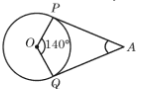
If the angle between two radii of a circle is $140^{\circ}$, then the angle between the tangents at the ends of the radii is
  • A
    $90^{\circ}$
  • B
    $50^{\circ}$
  • C
    $70^{\circ}$
  • $40^{\circ}$
Answer
Correct option: D.
$40^{\circ}$

Image
$\angle \text{OPA}=90^{\circ}$ and $\angle \text{OQA}=90^{\circ}$
$[\because$ Angle between tangent and radius through the point of contact is $90^{\circ} ]$ In quadrilateral $\text{OPAQ}$,
$\angle \ce{OQ + \angle OPA + \angle OQA + \angle PAQ}=360^{\circ}$
$[$Angle sum property of a quadrilateral$]$
$\Rightarrow 140^{\circ}+90^{\circ}+90^{\circ}+\angle\text{PAQ}=360^{\circ}$
$\Rightarrow \angle \text{PAQ}=360^{\circ}-320^{\circ}=40^{\circ}$
View full question & answer
MCQ 1831 Mark
A tangent to a circle is a line that touches the circle at exactly
  • A
    two points
  • B
    three points
  • one point
  • D
    None of these
Answer
Correct option: C.
one point
(c) : A tangent to a circle is a line that intersects or touches the circle at exactly one point.
View full question & answer
MCQ 1841 Mark
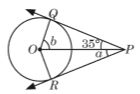
In the given figure, $P Q$ and $P R$ are tangents drawn from point $P$ to a circle with centre $O$. If $\angle O P Q=35^{\circ}$, then value of $a$ and $b$ are
Image
  • A
    $30^{\circ}, 60^{\circ}$
  • $35^{\circ}, 55^{\circ}$
  • C
    $40^{\circ}, 50^{\circ}$
  • D
    $55^{\circ}, 45^{\circ}$
Answer
Correct option: B.
$35^{\circ}, 55^{\circ}$
(b) : Since $P Q$ is a tangent.
$
\therefore \angle O Q P=90^{\circ}
$In $\triangle P Q O, \angle O Q P+\angle O P Q+\angle Q O P=180^{\circ}$
[By angle sum property]
$
\Rightarrow 90^{\circ}+35^{\circ}+b=180^{\circ} \Rightarrow b=180^{\circ}-125^{\circ}=55^{\circ}
$
Since the tangents from an external point $P$ to the circle are equally inclined to $O P$.
$
\therefore \quad \angle R P O=\angle O P Q \Rightarrow a=35^{\circ}
$
View full question & answer
MCQ 1851 Mark
In the given figure, three circles with centres $A, B, C$ respectively touch each other externally. If $A B=5 cm , B C=7 cm$ and $C A=6 cm$, then the radius of the circle with centre $A$ is
Image
  • A
    $1.5 cm$
  • $2 cm$
  • C
    $2.5 cm$
  • D
    $3 cm$
Answer
Correct option: B.
$2 cm$
(b) : Let the radii of the three circles with centre $A$, $B$ and $C$ be $x, y, z$ respectively. Then,
$
x+y=5, y+z=7 \text { and } z+x=6
$Adding all three equations, we get
$
\begin{aligned}
& 2(x+y+z)=18 \Rightarrow x+y+z=9 \\
\therefore \quad & x=(x+y+z)-(y+z)=(9-7)=2 cm
\end{aligned}
$
View full question & answer
MCQ 1861 Mark
Two tangents, drawn at the end points of diameter of a given circle are always
  • parallel
  • B
    perpendicular
  • C
    intersect each other
  • D
    None of these
Answer
Correct option: A.
parallel
(a): Two tangents drawn at the end points of diameter are always parallel.
View full question & answer
MCQ 1871 Mark
What is the distance between two parallel tangents of a circle of radius $4 cm$ ?
  • A
    $2 cm$
  • $8 cm$
  • C
    $6 cm$
  • D
    None of these
Answer
Correct option: B.
$8 cm$
(b)
View full question & answer
MCQ 1881 Mark
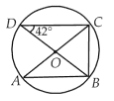
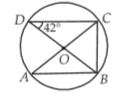
In the given circle, $O$ is a centre and $\angle B D C=42^{\circ}$, then $\angle A C B$ is equal to
Image
  • A
    $42^{\circ}$
  • B
    $45^{\circ}$
  • $48^{\circ}$
  • D
    $60^{\circ}$
Answer
Correct option: C.
$48^{\circ}$
(c) : $B D$ is a diameter of circle
$
\therefore \angle B C D=90^{\circ}
$
[angle in a semicircle]
In $\triangle O C D$,
$
O D=O C
$
[radii of circle]
$\angle O D C=\angle O C D=42^{\circ}$
Now, $\angle O C D+\angle O C B=90^{\circ}$
$\Rightarrow \angle O C B=90^{\circ}-42^{\circ}=48^{\circ}$
$\Rightarrow \angle A C B=\angle O C B=48^{\circ}$
Image
View full question & answer
MCQ 1891 Mark
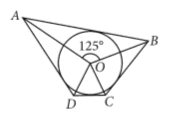
In figure, if $\angle \text{A O B} =125^{\circ}$, then $\angle \text{C O D}$ is equal to
Image
  • A
    $62.5^{\circ}$
  • B
    $45^{\circ}$
  • C
    $35^{\circ}$
  • $55^{\circ}$
Answer
Correct option: D.
$55^{\circ}$
We know that the opposite sides of a quadrilateral circumscribing a circle subtend supplementary angles at the centre of the circle.
$\Rightarrow \angle A O B+\angle C O D=180^{\circ}$
$\Rightarrow \angle C O D=180^{\circ}-\angle A O B=180^{\circ}-125^{\circ}=55^{\circ}$
View full question & answer
MCQ 1901 Mark
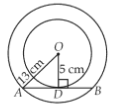
Two concentric circles of radii $13 cm$ and $5 cm$ are given. The length of the chord of the larger circle which touches the smaller circle is
  • A
    $16 cm$
  • B
    $4 cm$
  • C
    $24 cm$
  • D
    $10 cm$
View full question & answer
MCQ 1911 Mark
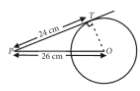
In the given figure, point $P$ is $26 cm$ away from the centre $O$ of a circle and the length PT of the tangent drawn from $P$ to the circle is $24 cm$. Then the radius of the circle is
Image
  • A
    $25 cm$
  • B
    $26 cm$
  • C
    $24 cm$
  • $10 cm$
Answer
Correct option: D.
$10 cm$
(d) : Let us join $O T$
We have, $O P=26 cm , P T=24 cm$
Since, radius is perpendicular to the tangent at the point of contact.
Image
$
\therefore \angle P T O=90^{\circ}
$In right $\triangle P T O$, using Pythagoras theorem, we get
$
\begin{aligned}
& O P^2=P T^2+O T^2 \\
\Rightarrow & (26)^2=(24)^2+O T^2 \\
\Rightarrow & O T^2=676-576=100 \\
\Rightarrow & O T=10 cm
\end{aligned}
$
Hence, radius of the circle is $10 cm$.
View full question & answer
MCQ 1921 Mark
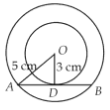
Two concentric circles are of radii $5 cm$ and $3 cm$. Find the length of the chord of the larger circle which touches the smaller circle.
  • $8 cm$
  • B
    $4 cm$
  • C
    $10 cm$
  • D
    $6 cm$
Answer
Correct option: A.
$8 cm$
(a): Here, $O A^2=O D^2+A D^2$
$
\Rightarrow A D=\sqrt{25-9}=4 cm
$As $O D$ bisects $A B$, then
$
A B=2 A D=2 \times 4=8 cm
$
Image
View full question & answer
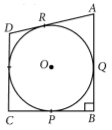
MCQ 1931 Mark
  • 11
  • B
    18
  • C
    6
  • D
    15
Answer
Correct option: A.
11
(a): We know that the length of the tangents drawn from an external point to a circle are equal.
$
\begin{aligned}
\therefore \quad & A Q=A R, D R=D S, B Q=B P, C S=C P \\
& S o, D S=D R=5 cm \\
& A Q=A R=A D-D R=23-5=18 cm \\
& B P=Q B=A B-A Q=29-18=11 cm
\end{aligned}
$
Since, $O Q B P$ is a square
$\Rightarrow$ Radius of circle $(O P)=11 cm$.
View full question & answer
MCQ 1941 Mark
In the given figure, $A P, A Q$ and $B C$ are tangents to the circle. If $A B=5 \ cm , A C=6 \ cm$ and $B C=4 \ cm,$ then the length of $A P ($in $cm)$ is
Image
  • $7.5$
  • B
    $15$
  • C
    $10$
  • D
    $9$
Answer
Correct option: A.
$7.5$
As, length of tangents drawn from an external point to a circle are equal.
$\therefore A P=A Q \ldots \text { (i), } P B=B R \ldots \text { (ii), } C Q=C R \ldots \text { (iii) }$
Now $, 2 A P=A P+A P$
$\Rightarrow 2 A P=A P+A Q$
$\Rightarrow 2 A P=(A B+P B)+(A C+C Q)$
$\Rightarrow 2 A P=(A B+B R)+(A C+C R) \ [$Using $(ii)$ and $(iii)]$
$\Rightarrow 2 A P=A B+B C+A C=5+4+6$
$\Rightarrow A P=7.5 \ cm$
$[$Using $(i)]$
View full question & answer
MCQ 1951 Mark
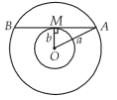
Two concentric circles of radii $a$ and $b$ where $a>b$, are given, the length of a chord of the larger circle which touches the other circle is
  • A
    $\sqrt{a^2-b^2}$
  • $2 \sqrt{a^2-b^2}$
  • C
    $\sqrt{a^2+b^2}$
  • D
    $2 \sqrt{a^2+b^2}$
Answer
Correct option: B.
$2 \sqrt{a^2-b^2}$
(b) : Radius of larger circle $=a$Radius of smaller circle $=b$
$\because \quad$ In $\triangle O A M$, we have
$
\begin{aligned}
& O A^2=O M^2+A M^2 \\
\Rightarrow & a^2=b^2+A M^2 \\
\Rightarrow & A M^2=a^2-b^2 \\
\Rightarrow & A M=\sqrt{a^2-b^2}
\end{aligned}
$
Now, length of chord of larger circle is $A B=2 A M$
$
=2 \sqrt{a^2-b^2}
$
Image
View full question & answer
MCQ 1961 Mark
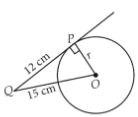
From a point $Q$, the length of the tangent to a circle is $12 cm$ and the distance of $Q$ from the centre is $15 cm$. The radius of the circle is
  • $9 cm$
  • B
    $12 cm$
  • C
    $15 cm$
  • D
    $24.5 cm$
Answer
Correct option: A.
$9 cm$
(a) : $Q P$ is a tangent at $P$
$
\therefore \angle P=90^{\circ}
$In $\triangle O P Q$, by Phythagoras theorem
$
\begin{aligned}
& O Q^2=O P^2+P Q^2 \\
\Rightarrow & (15)^2=O P^2+12^2 \\
\Rightarrow & O P^2=225-144=81 \Rightarrow O P=9 cm
\end{aligned}
$
Image
View full question & answer
MCQ 1971 Mark
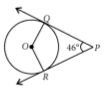
In the given figure, $P Q$ and $P R$ are two tangents to a circle with centre $O$. If $\angle Q P R=46^{\circ},$ then $\angle Q O R$ equals
Image
  • A
    $67^{\circ}$
  • $134^{\circ}$
  • C
    $44^{\circ}$
  • D
    $46^{\circ}$
Answer
Correct option: B.
$134^{\circ}$
Given, $\angle Q P R=46^{\circ}$
We have, $O Q \perp P Q$ and $O R \perp R P$
$[\because$ Radius is perpendicular to the tangent through the point of contact$]$
$\Rightarrow \angle O Q P=\angle O R P=90^{\circ}$
In quadrilateral $\text{PQOR},$ we have
$\angle O Q P+\angle Q P R+\angle P R O+\angle R O Q=360^{\circ}$
$\Rightarrow 90^{\circ}+46^{\circ}+90^{\circ}+\angle R O Q=360^{\circ}$
$\Rightarrow \angle R O Q=360^{\circ}-226^{\circ}=134^{\circ}$
View full question & answer
MCQ 1981 Mark
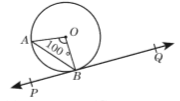
In figure, $P Q$ is tangent to the circle with centre at $O$, at the point $B$. If $\angle A O B=100^{\circ},$ then $\angle A B P$ is equal to
Image
  • $50^{\circ}$
  • B
    $40^{\circ}$
  • C
    $60^{\circ}$
  • D
    $80^{\circ}$
Answer
Correct option: A.
$50^{\circ}$
In $\triangle O A B, O A=O B$
$(\because$ Radii of same circle$)$
$\therefore \angle O A B=\angle O B A$
$(\because$ Angles opposite to equal sides are equal$)$
Now, by applying angle sum property in $\triangle O A B$
$\angle O A B+\angle A B O+\angle A O B=180^{\circ}$
$\Rightarrow \angle A B O=40^{\circ}$
Here, $\angle O B P=90^{\circ}$
$($Radius is perpendicular to tangent at point of contact$)$
$\Rightarrow \angle O B A+\angle A B P=90^{\circ}$
$\Rightarrow 40^{\circ}+\angle A B P=90^{\circ} $
$\Rightarrow \angle A B P=90^{\circ}-40^{\circ}=50^{\circ}$
View full question & answer
MCQ 1991 Mark
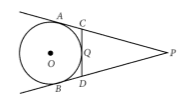
In the given figure, $P A$ and $P B$ are tangents to the circle from an external point $P . C D$ is another tangent touching the circle at $Q$. If $P A=12 cm , Q C=Q D=3 cm$ then the value of $P C$ is
Image
  • A
    $6 cm$
  • $9 cm$
  • C
    $12 cm$
  • D
    $3 cm$
Answer
Correct option: B.
$9 cm$
(b) : As we know that tangents drawn from an external point are equal in length.
$
\therefore \quad Q C=C A ; Q D=B D \text { and } P A=P B
$
Since $Q C=Q D=3 cm$
(Given)
$
\Rightarrow C A=B D=3 cm
$
Also, $P C=P A-A C=(12-3) cm =9 cm$
View full question & answer
MCQ 2001 Mark
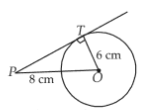
The length of the tangent drawn from a point $8 cm$ away from the centre of circle of radius $6 cm$ is
  • A
    $\sqrt{7} cm$
  • $2 \sqrt{7} cm$
  • C
    $10 cm$
  • D
    $5 cm$
Answer
Correct option: B.
$2 \sqrt{7} cm$
(b) : Since tangent to a circle is perpendicular to the radius through the point of contact.
$
\therefore \angle O T P=90^{\circ}
$
In $\triangle O T P$, by Phthagoras theorem, we have
$
\begin{aligned}
& O P^2=O T^2+P T^2 \\
\Rightarrow & (8)^2=(6)^2+P T^2 \\
\Rightarrow & P T^2=64-36=28 \\
\Rightarrow & P T=\sqrt{28}=2 \sqrt{7} cm
\end{aligned}
$
Image
View full question & answer
M.C.Q (1 Marks) - Page 4 - MATHS STD 10 Questions - Vidyadip