Questions

case /data -based (4 Marks)

🎯

Test yourself on this topic

16 questions · timed · auto-graded

Question 14 Marks
Chronic Kidney Disease (CKD) is a condition characterized by a gradual loss of kidney function over time. CKD is also known as chronic renal disease. With increasing life expectancy and prevalence of life style diseases, US has seen a $30 \%$ increase in prevalence of Chronic Kidney Disease (CKD) in the last decade. Unfortunately, from India there is no longitudinal study and limited data on the prevalence of CKD.
In western countries, diabetes and hypertension account for over $2 / 3^{\text {rd }}$ of the cases of CKD. In India too, diabetes and hypertension today account for 40-60\% cases of CKD. As per recent Indian Council of Medical Research data, prevalence of diabetes in Indian adult population has risen to $7.1 \%$, (varying from $5.8 \%$ in Jharkhand to $13.5 \%$ in Chandigarh) and in urban population (over the age of 40 years) the prevalence is as high as $28 \%$. Likewise, the reported prevalence of hypertension in the adult population today is $17 \%$ (14.8\% from rural and $21.4 \%$ from urban belt). A similar prevalence of $17.4 \%$ has been reported by Panesar et al. (in the age group of 20-59 years) even from slum-resettlement colony of Delhi. With rising prevalence of these diseases in India, prevalence of CKD is expected to rise and obviously, this is the key target population to address.
A study published in this issue is from a rural belt of Karnataka. The population had a mean age of $39.88$ ± $15.87$ years with $3.82 \%$ prevalence of diabetes and $33.62 \%$ of hypertension. Authors found $6.3 \%$ prevalence of CKD stage 3; which is the highest reported till date by any Indian worker. It is disturbing to note, the high prevalence of hypertension in a rural setting where over $75 \%$ population had normal or low body mass index.
In comparison to most other published studies from India, the present study population is younger and even the prevalence of diabetes is low but surprisingly despite that prevalence of stage 3 CKD is reported to be higher $(6.3 \%)$. It is disturbing to see the rising prevalence of hypertension and CKD in rural belts. Possibly, with shifting population the difference between urban and rural areas is getting blurred. Undoubtedly, we need more Indian data to validate these findings.
(i) What is CKD ?
(ii) What are the major causes of CKD ?
(iii) In which segment of society is CKD more prevalent?
or
(iv) What is the highest percentage of CKD reported?
Answer
(i) It is a condition characterized by a gradual loss of kidney function over time.
(ii) Diabetes and hypertension
(iii) Rural
or
(iv) $6.3 \%$
View full question & answer
Question 24 Marks
Read the following and answer any three questions from (i) to (iv).Sex determination is the method by which distinction between males and females is established in a species. The sex of an individual is determined by specific chromosomes. These chromosomes are called sex chromosomes or allosomes. X and Y chromosomes are called sex chromosomes. The normal chromosomes other than the sex chromosomes of an individual are known as autosomes.
  1. What are sex chromosomes?
     
  2. A couple has six daughters. What is the possibility of their having a girl next time?
     
  3. Write number of autosomes present in liver cells of a human female?
    OR
  4. Write examples of XX-XO type of sex determination and XX-XY type of sex determination?
     
Answer
  1. (b) Males produce two different types of gametes.
Explanation:

ln XX-XO type and XX-XY type of sex determining mechanisms, males produce two different types of gametes, either with or without X-chromosome (XO type), or some gametes with X-chromosome and some with Y-chromosome (XY type). Such type of sex determination mechanism is designated to be the example of male heterogamety. In both, females are homogametic and produce X type of gametes in both the cases and have XX genotype.
  1. (b) 50%
Explanation:

The possibility of having a girl or boy child is equal i.e., 50%, as 50% male gametes are Y type and 50% are X type. Fusion of egg with X type sperm will produce a girl child.
  1. (b) 22 pairs.
Explanation:

ln humans, number of autosomes are 2n = 44 or 22 pairs regardless of the sex.
  1. (a) Male heterogamety.
  1. (b) Female fruitfly is heterogametic.
Explanation:

Male fruitflyis heterogametic whereas female fruitfly is homogametic.
View full question & answer
Question 34 Marks
Read the following and answer any three questions from (i) to (iv).In human, the allele for brown eyes (B) is dominant over that for blue eyes (b). A brown eyed woman marries a blue eyed man, and they have six children. Four of the children are brown eyed and two of them are blue eyed.
  1. What is the genotype of blue eyed offspring?
     
  2. What is the woman's genotype?
     
  3. a) The ovum, produced by the mother carries the gene regarding eye colour?
    b) What is the gene carried by of the man's spenn regarding the eye colour?

    OR
     
  4. The ratio of brown eyed children to blue eyed children in this family is 2 : I, which deviates from typical phenotypic ratios for monohybrid inheritance. What might be the reason?
     
Answer
  1. (c) bb
  1. (b) Bb
Explanation:

According to the given passage some children show recessive trait, i.e., homozygous. So, the woman must be heterozygous.
  1. (c) B or b
Explanation:

Human ova are haploid, hence they only contain one copy of each gene. Since the woman has a Bb genotype her ova would contain either B orb allele.
  1. (d) The actual ratio differs from the expected ratio because the sample size is too small.
Explanation:

According to the given passage, within a single family, the sample size of offspring in each generation is very small. Hence, the actual phenotypic and genotypic ratios often deviate from expected ratios. It is only when sample sizes of offspring is large that actual ratios approach theoretical or expected ratios more closely.
  1. (c) b only
Explanation:

Human sperm is haploid, hence they only contain one copy of each gene. Since the man has a bb genotype, his sperm would contain allele b only.
View full question & answer
Question 44 Marks
Read the following and answer any three questions from (i) to (iv).ln fruit flies, the gene for wing shape has two alleles, an unusual allele for curled wings (c) and the normal allele for straight wings (C). The given phenotypes are observed for each genotype.
Genotype
Phenotype
CC
Normal, straight wings
Cc
Wings curled up at the ends, has difficulty flying
cc
Unable to hatch from egg
  1. Which crosses would produce live offspring from 50% of the eggs?
     
  2. Which crosses would be able to produce offspring that would fly normally from 50% of the egg?
     
  3. A) Two curly winged flies are crossed, and they produce 150 eggs. What is the proportion of straight-winged flies expected among the live offspring?

    B) Normal straight winged flies are self crossed and they produce 120 eggs. What is the proportion of curly winged flies expected among the live offspring?

    OR
     
  4. Which crosses would be able to produce offspring that has curled wings only?
Answer
  1. (d) Cc × cc
  1. (a) CC × Cc
  1. (a) 25%
Explanation:

25% of the total number of eggs will not hatch (genotype cc). 50% of the offspring will be curly winged (Cc) and 25% of the offspring are straight winged (CC).
  1. (c) 0%
  1. (b) CC × cc
View full question & answer
Question 54 Marks

Reproduction in human beings is by sexual reproduction where both the male and female gametes fertilise to give rise to an embryo. The fertilization of the human embryo occurs inside the body of the female.

(i) Name the part of the male reproductive system where the formation of sperms takes place.
(ii) What is the placenta?
(iii) What is the other name of the oviduct?
or
(iv) Define the term implantation.
Answer
COMING SOON
View full question & answer
Question 64 Marks
Question numbers i - iv are based on the table given below. Study the table and answer the following questions.

S. No.GenerationPhenotypic ratio
1.F_(1) generation23 pairs
2.F_(2) generation22 pairs

(i) State the law of dominance.

(ii) What is the dominant allele?

(iii) Define the term phenotype.

(iv) What is the meaning of genotype ?

Answer
(i) According to the law of dominance, the parent contains two alleles out of which one is the dominant allele while the other is the recessive allele.

(ii) The allele that expresses itself and reduces the expression of other alleles is termed as the dominant allele.

(iii) The set of the morphological characteristics of an organism that are resulted from the interactions of the genes is known as the phenotype of the individual. For example, in pea plants, tallness is a phenotypic trait.

or

(iv) The set of the alleles in DNA that carries the information for the expression of a trait in an individual is known as its genotype. For example, genotype 'TT' expresses the tallness in plants.

View full question & answer
Question 74 Marks
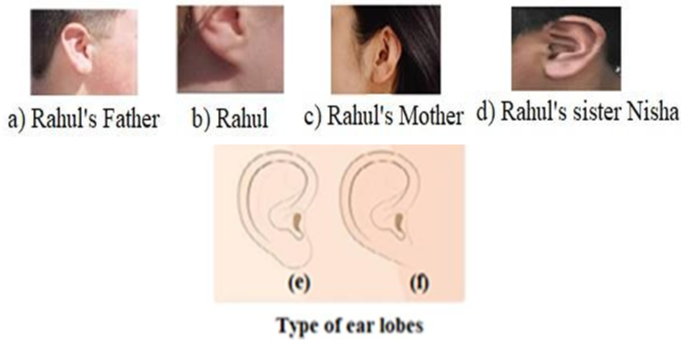
Figures (a) to (d) given below represent the type of ear lobes present in a family consisting of 2 children – Rahul, Nisha and their parents.
Image

Excited by his observation of different types of ear lobes present in his family, Rahul conducted a survey of the type of ear lobes found {Figure (e) and (f)} in his classmates. He found two types of ear lobes in his classmates as per the frequency given below:
Sex Free Attached
Male 36 14
Female 31 19
On the basis of above data answer the following questions.
a) Which of the two characteristics - 'free ear lobe' or 'attached ear lobe' appears to be dominant in this case? Why?
b) Is the inheritance of the free ear lobe linked with sex of the individual? Give reason for your answer.
c) What type of ear lobe is present in father, mother, Rahul and his sister Nisha? Write the genetic constitution of each of these family members which explains the inheritance of this character in this family?
(Gene for Free ear lobe is represented by $F$ and gene for attached ear lobe is represented by $f$ for writing the genetic constitution).
OR
Suresh's parents have attached earl obes. What type of ear lobe can be seen in Suresh and his sister Siya? Explain by giving the genetic composition of all.
Answer
a) Free ear lobe is dominant because it is found in a large majority of the population. (1)
b) No. It is not sex linked. As per the data of the family as well as the class, it is indicated that free ear lobe is present in males as well as in females. (1)
c) Father - Ff (free ear lobe), Mother - Ff (free ear lobe), Rahul - ff (attached ear lobe) and
Nisha - Ff (free ear lobe) $(1 / 2 \times 4=2)$
OR
Suresh's father - ff (attached ear lobe), mother - ff (attached ear lobe), Suresh - ff (attached ear lobe), Siya - ff (attached ear lobe). If both parents have recessive character, then all the children can have recessive character only.
View full question & answer
Question 84 Marks
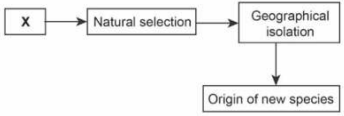
The two birds once belonged to the same species.
The following sequence of events is likely to have caused the origin of the two different species.

Image
9. What is the biological event X?
A. Evolution
B. Speciation
C. Changes in DNA
D. Sexual reproduction
10. Which of the following statements is correct?
Circle ‘Yes’ or ‘No’ to mark your responses.

Is this statement correct?

Yes or No

Natural selection provides an advantage to organisms.

Yes/No

Genes mix with each other to produce new traits

Yes/No

All chromosomes in human cells are found in pairs.

Yes/No

Answer
9. C. Changes in DNA
10. Mentions all three responses correctly
Yes
No
No
View full question & answer
Question 94 Marks
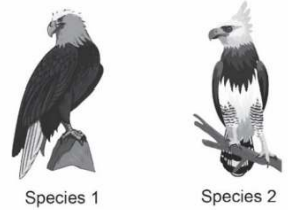
The picture shows two species of birds living in different regions.

Image
8. Which of the following is the correct genotype of the mother and the father?
A. They cannot interbreed.
B. They are not similar in shape.
C. They live in different geographical areas.
D. They have different mutations in their genes.

Answer
8. A. They cannot interbreed.
View full question & answer
Question 104 Marks
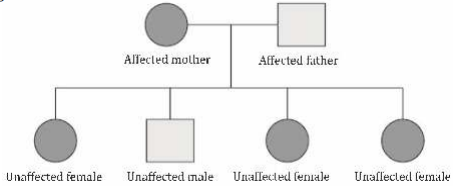
The picture shows the inheritance of an X chromosome-linked trait in a family. There are two
variations of the trait - X and x. The trait is recessive, and affected individuals carry two copies of the recessive gene.

Image
6. Which of the following is the correct genotype of the mother and the father?

Mother

Father

A.

XX

XY

B.

xx

XY

C.

Xx

xY

D.

xx

xY

7. Which of these traits is acquired by a human population in response to the environment?
A. Short hair
B. Body mass
C. Tall height
D. Brown eyes

Answer
6. B. Mother xx/Father XY
7. A. Short hair
View full question & answer
Question 114 Marks
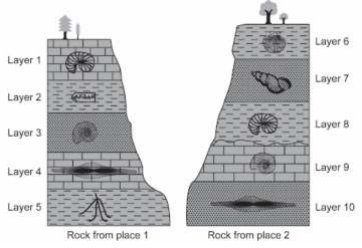
The picture shows different layers of rocks with fossils dug out from two different places.

Image
4. Which layer of rocks contains the youngest fossil?
A. Layer 1
B. Layer 5
C. Layer 6
D. Layer 10
5. Which layers of rocks must have formed during the same time period?
A. Layer 1 and Layer 6
B. Layer 3 and Layer 9
C. Layer 4 and Layer 8
D. Layer 5 and Layer 10

Answer
4. C. Layer 6
5. B. Layer 3 and Layer 9
View full question & answer
Question 124 Marks
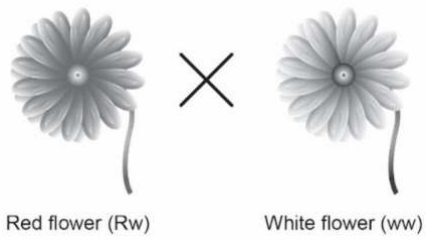
A plant with red lower (Rw) is cross bred with a plant with white lower (ww).
There are two variations of the gene controlling the colour of the lower.
The gene for red lower (R) is dominant over that for white lower (w).

Image

The Punnett square shows the result of the cross.

w

w

R

Rw

Rw

w

ww

ww

1. What percentage of the plants is likely to produce white lowers?
A. 25%
B. 50%
C. 75%
D. 100%
2. A red lower plant (RR) was cross bred with a white lower plant (ww).
What will be the colour of the lower of the next generation plants?
3. What would have caused the variation in the gene for lower colour?
A. Mutation
B. Pollination
C. Speciation
D. Adaption

Answer
1. B. 50%
2. Mentions that all lowers in the next generation would be red as R is the dominant trait, the lowers will inherit Rw set of genes
For example:
● All lowers would be red as R is dominant
● All lowers would be red as they would have Rw set in the first generation.
3. A. Mutation
View full question & answer
Question 134 Marks
Read the following and answer any four questions from (i) to (v).
Mendel crossed tall and dwarf pea plants to study the inheritance of one gene. He collected the seeds produced as a result of this cross and grew them to generate plants of the first hybrid generation which is called the first filial progeny or $F_1$. Mendel then self pollinated the tall $F_1$ plants and he obtained $F_2$ generation.
  1. ln garden pea, round shape of seeds is dominant over wrinkled shape. A pea plant heterozygous for round shape of seed is selfed and 1600 seeds produced during the cross are subsequently germinated. How many seedlings would have non-parental phenotype?
  1. 1600
  2. 1200
  3. 400
  4. 800
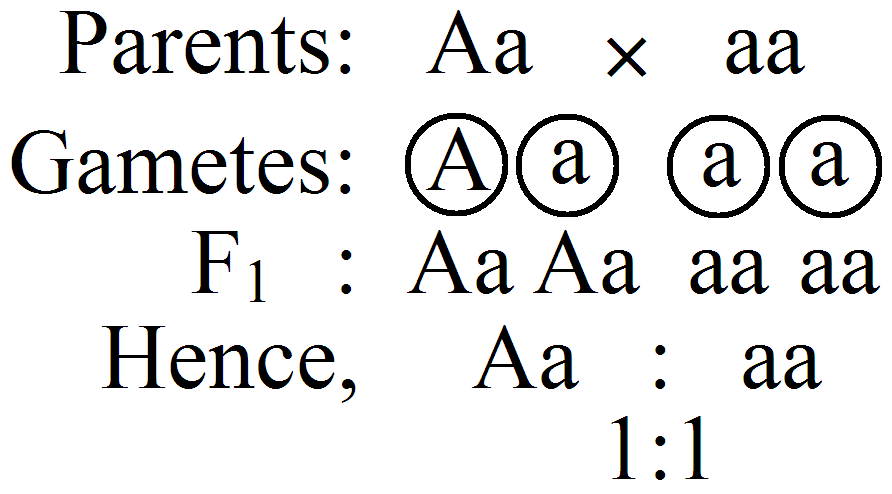
  1. If 'A' represents the dominant gene and 'a' represents its recessive allele, which of the following would be the most likely result in the first generation offspring when Aa is crossed with aa?
  1. All will exhibit dominant phenotype.
  2. All wi II exhibit recessive phenotype.
  3. Dominant and recessive phenotypes will be 50% each.
  4. Dominant phenotype will be 75%.
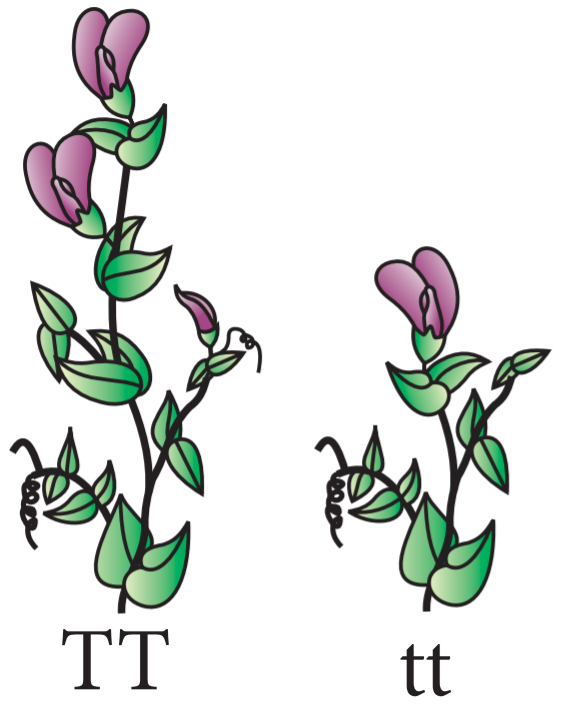
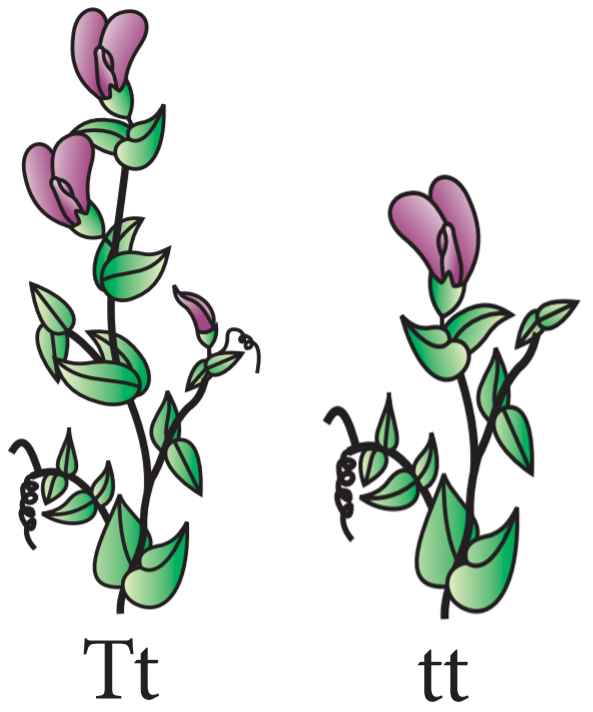
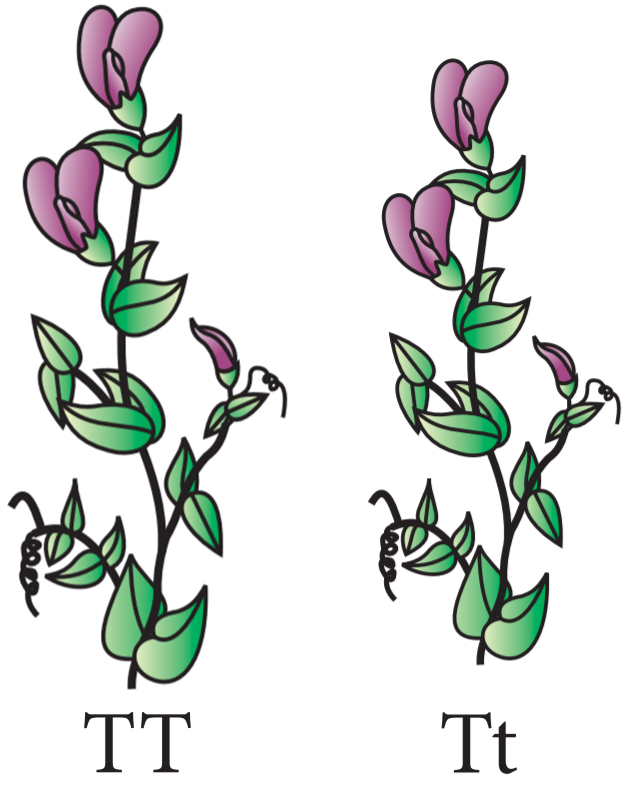
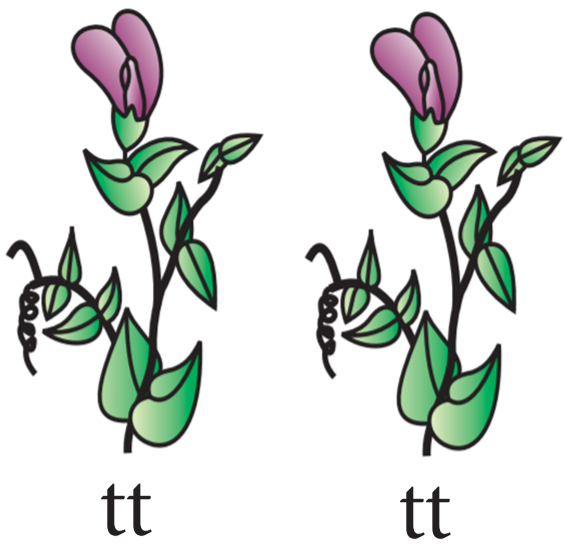
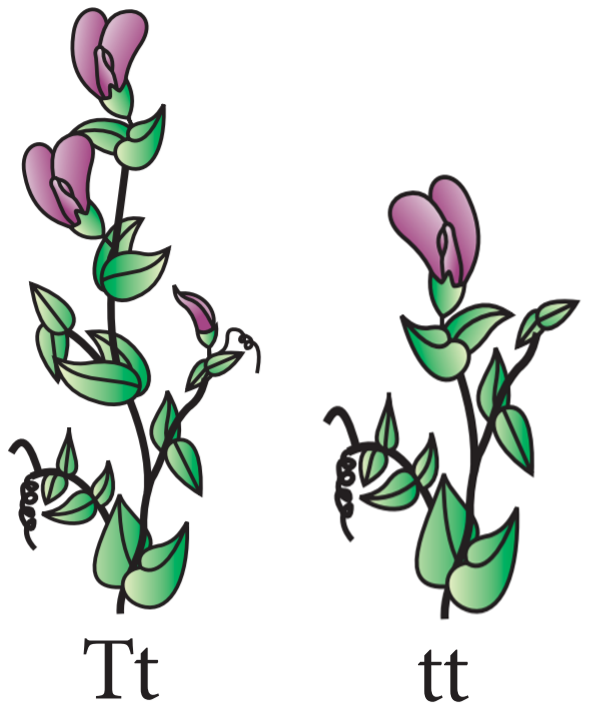
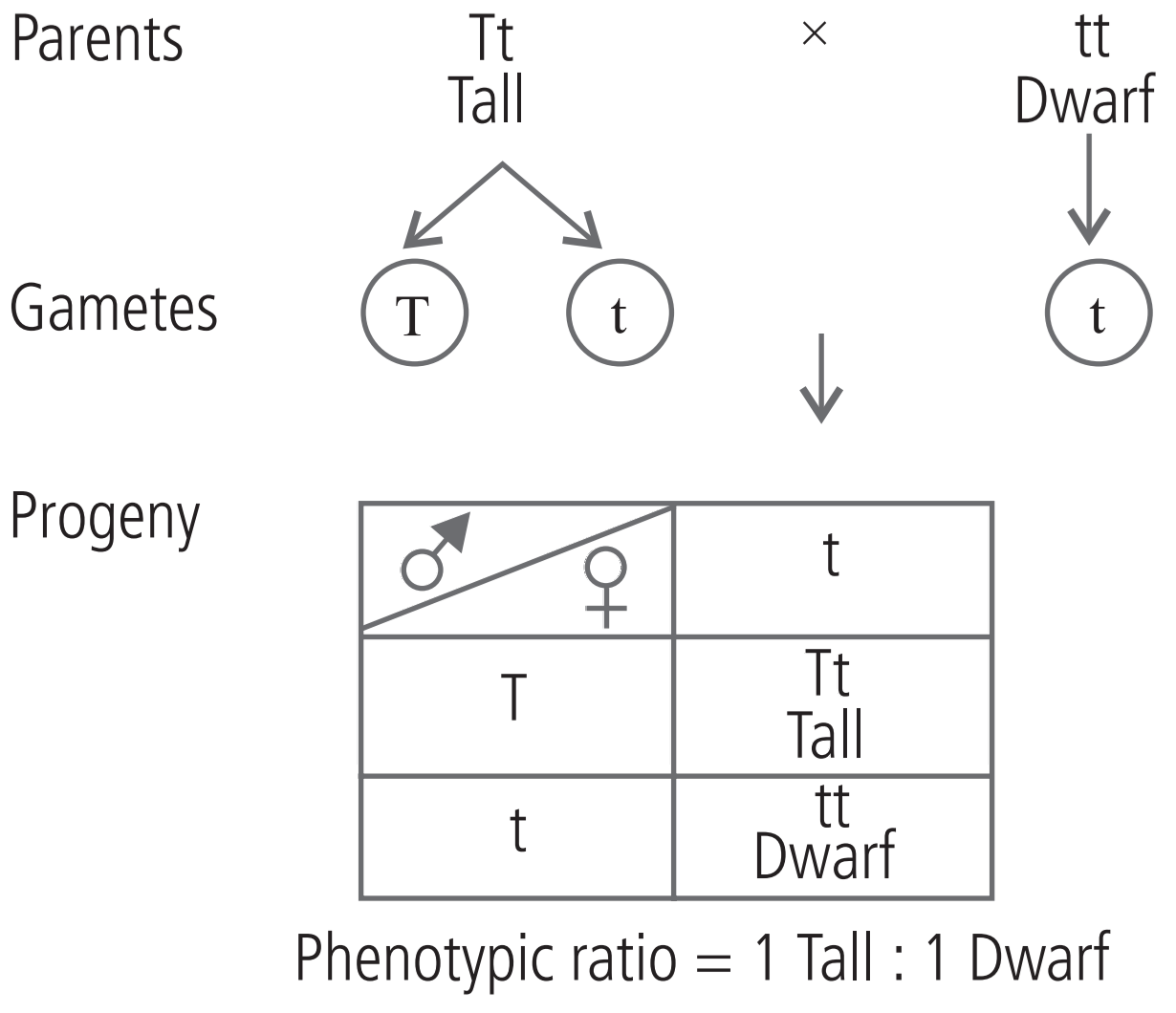
  1. Which of the following crosses will give tall and dwarf pea plants in same proportions?
  1.  
  1.  
  1.  
  1.  
  1. What result Mendel would have got, if he self pollinated a homozygous tall $F_2$ plant?
  1. TT and Tt
  2. All Tt
  3. All TT
  4. All tt
  1. ln plant, tall phenotype is dominant over dwarf phenotype, and the alleles are designated as T and t, respectively. Upon crossing one tall and one dwarf plant, total 250 plants were obtained, out of which 124 displayed tall phenotype and rest were dwarf. Thus, the genotype of the parent plants were.
  1. TT × TT
  2. TT × tt
  3. Tt × Tt
  4. Tt × tt
Answer
  1. (c) 400
Explanation:

Since this pea plant is heterozygous for round shape, its genotype would be Rr.

Parents: $\text{Rr}\ \ \ \times\ \ \ \text{Rr}\\\ \ \ \ \ \ \ \ \downarrow(\text{selfing})$

Progeny: RR Rr Rr rr

Phenotypically, the ratio will be 3 : 1, i.e., only rr seedlings will show wrinkled seed phenotype, rest will show round seed shape.

1200 → Round shape (RR, Rr)

400 → Wrinkled (rr)
  1. (c) Dominant and recessive phenotypes will be 50% each.
Explanation:

'A' represents the dominant gene and 'a represents its recessive allele. The most likely result in the first generation offspring when Aa is crossed with aa is:

  1. (b)
Explanation:

This is an example of a test cross in which a cross is made between heterozygous tall and homozygous dwarf individuals and tall and dwarf plants are obtained in same proportion.

  1. (c) All TT
Explanation:

Self pollination of homozygous tall $F_2$ plant (TT) will give rise to all individuals of genotype TT.
  1. (d) Tt × tt
View full question & answer
Question 144 Marks

Read the following and answer any four questions from (i) to (v).
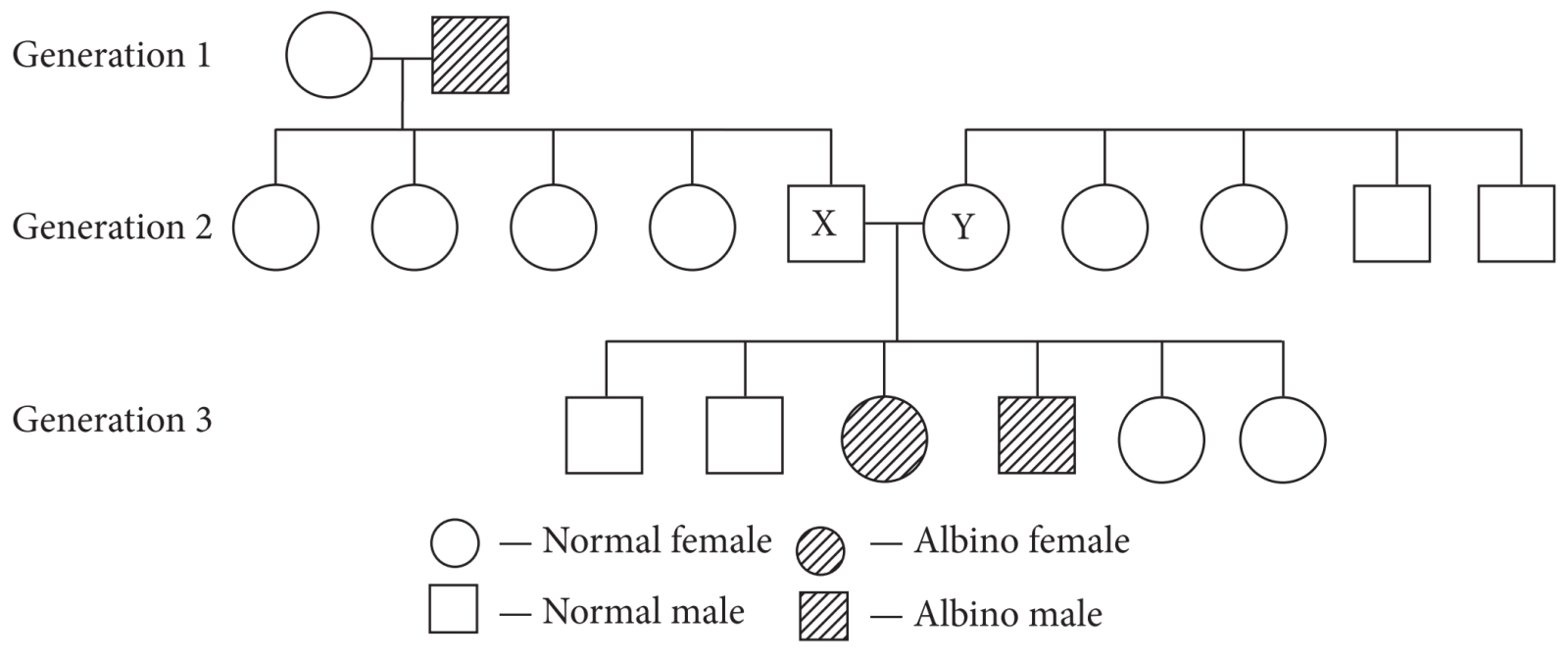
Refer to the schematic representation of the albinism that is an inherited condition caused by recessive allele (a). 'A' is the dominant allele for the normal condition. The inheritance of certain genetic traits for two or more generations is represented in a pedigree or family tree. Study the given pedigree chart and answer the following questions.
  1. Which of the following could be the genotypes of X and Y?
 
X
Y
(a)
AA
AA
(b)
AA
Aa
(c)
Aa
Aa
(d)
aa
aa
  1. Which of the following could be the genotype of generation - 1 male and female?
 
Male
Female
(a)
AA
aa
(b)
aa
AA
(c)
Aa
aa
(d)
AA
AA
  1. If X married an albino female, then what is the probability that their children would be albino?
  1. 0
  2. 0.125
  3. 0.25
  4. 0.5
  1. If Y married a normal homozygous male, then what is the probability that their children would be albino?
  1. 0
  2. 0.125
  3. 0.25
  4. 0.5
  1. Which of the following could be the genotype of offsprings produced by cross of X and Y?
  1. AA, Aa, aa
  2. aa, aa
  3. Aa, Aa
  4. AA, AA
Answer
  1. (c)
     
    X
    Y
    (c) Aa Aa
Explanation:
X and Y parents must have 'a' allele (recessive) that is respective for albinism, the genotype of both X and Y individuals would be Aa and Aa as they are normal and 3rd generation, normal and albino male and female is fanned in 3 : 1 ratio.
  1. (b)
     
    X
    Y
    (b) aa AA
Explanation:
Albinism is caused by the recessive allele. The children of generation-I, male and female all are normal (Aa). So, in generation-I, the genotype of female must be AA as she is normal and genotype of male is aa as he is albino male.
  1. (d) 0.5
Explanation:
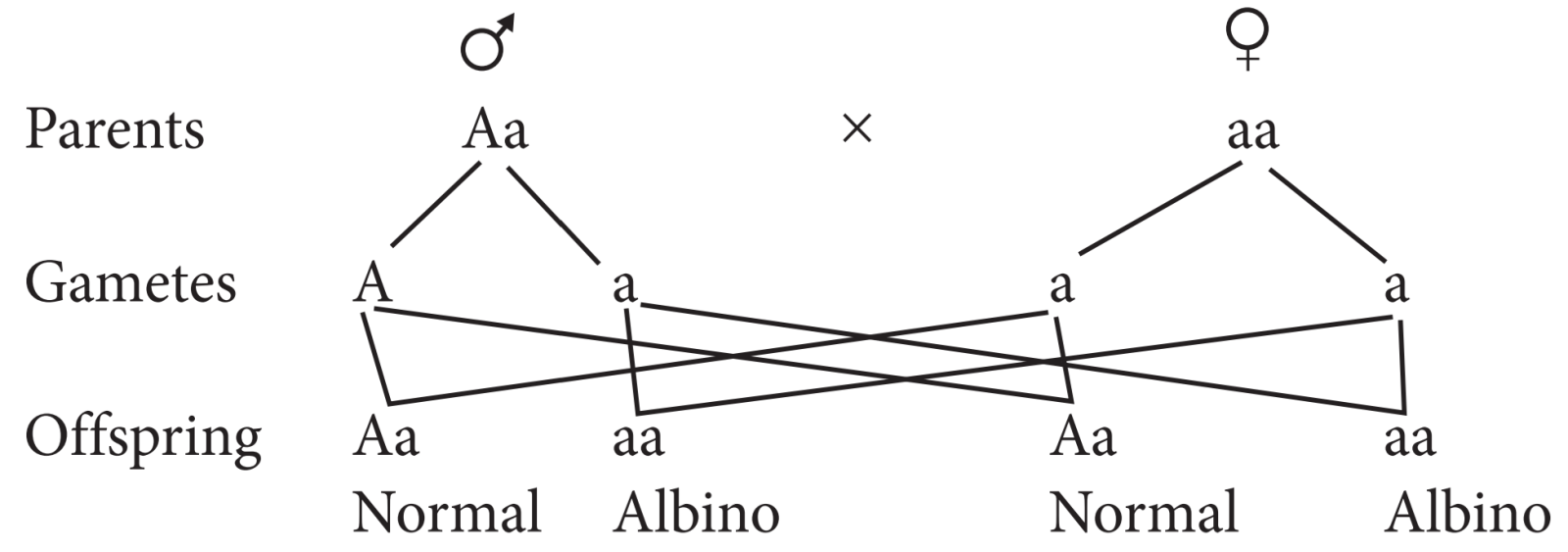
Albinism is caused by the recessive allele and father of X is albino male so, the genotype of X is Aa and genotype of albino female is aa. So, the probability that their children would be albino is 50%.
  1. (a) 0
  1. (a) AA, Aa, aa
View full question & answer
Question 154 Marks

Read the following and answer any four questions from (i) to (v).
Gregor Mendel conducted hybridisation experiments on garden peas for seven years and proposed the laws of inheritance in living organisms. He investigated characters in the garden pea plant that were manifested as two opposing traits, e.g., tall or dwarf plants, yellow and green seeds, etc.
  1. Among the seven pairs of contrasting traits in pea plant as studied by Mendel, the number of traits related to flower, pod and seed respectively were.
  1. 2, 2, 2
  2. 2, 2, 1
  3. 1, 2, 2
  4. 1, 1, 2
  1. Tile colour based contrasting traits in seven contrasting pairs, studied by Mendel in pea plant were.
  1. 1
  2. 2
  3. 3
  4. 4
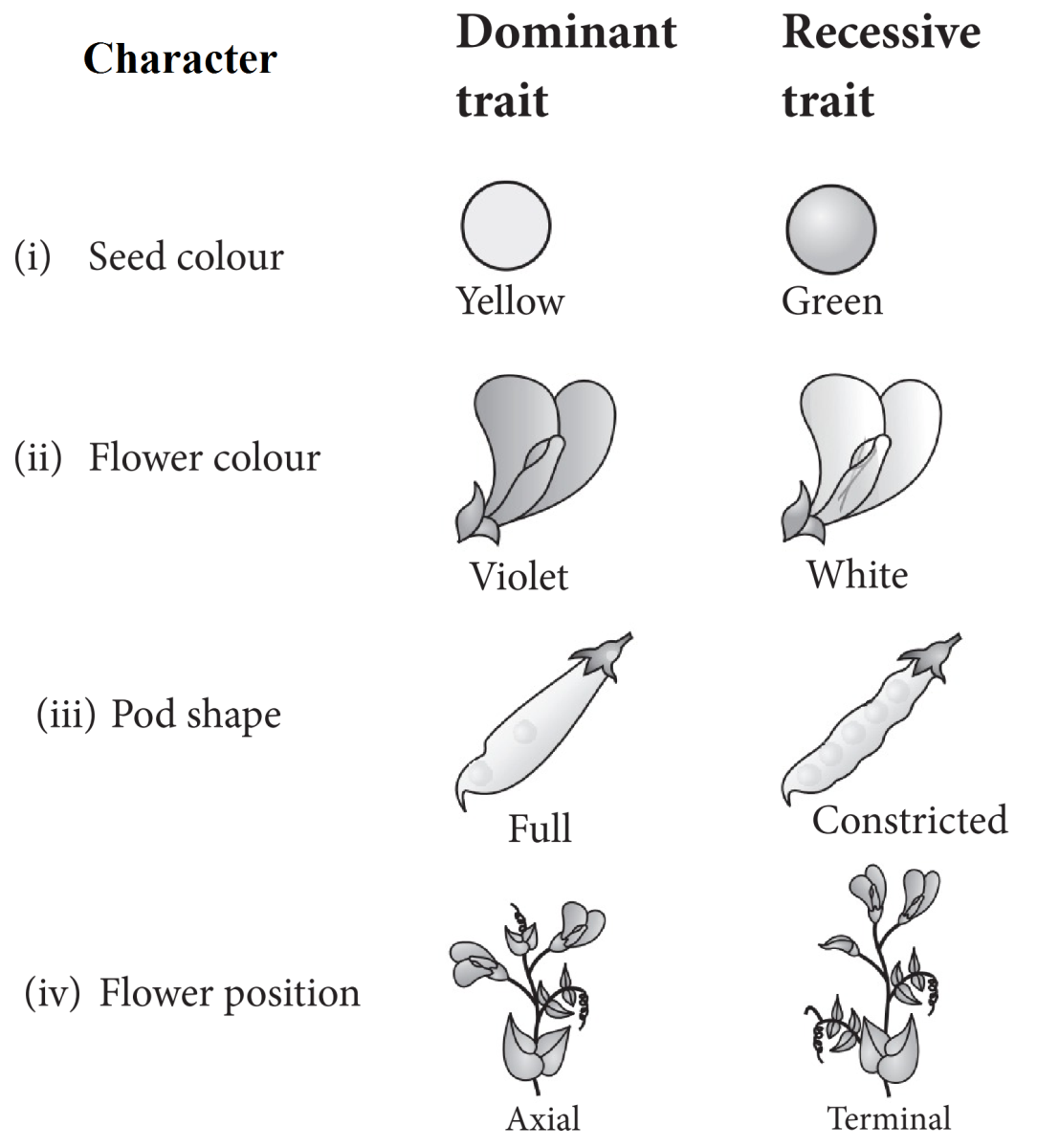
  1. Refer to the given table of contrasting traits in pea plants studied by Mendel.

Which of the given traits is correctly placed?
  1. (i), (ii) and (iii) only
  2. (ii), (iii) and (iv) only
  3. (ii) and (iii) only
  4. (i), (ii), (iii) and (iv)
  1. Some of the dominant traits studied by Mendel were.
  1. Round seed shape, green seed colour and axial flower position.
  2. Terminal flower position, green pod colour and inflated pod shape.
  3. Violet flower colour, green pod colour and round seed shape.
  4. Wrinkled seed shape, yellow pod colour and axial flower position.
  1. Which of the following characters was not chosen by Mendel?
  1. Pod shape.
  2. Pod colour.
  3. Position of flower.
  4. Position of pod.
Answer
Characters studied by Mendel are as follows:
 
Trait studied
Dominant
Recessive
1.
Plant height
Tall (T)
Dwarf (t)
2.
Flower position
Axial (A)
Terminal (a)
3.
Flower colour
Violet (V) or (W)
White (v) or (W)
4.
Pod shape
Full or Inflated (I) or (C)
Constricted (i) or (c)
5.
Pod colour
Green (G) or (Y)
Yellow (g) or (y)
6.
Seed shape
Round (R) or (W)
Wrinkled (r) or (W)
7.
Seed colour
Yellow (Y) or (G)
Green (y) or (g)
  1. (a) 2, 2, 2
  1. (c) 3
  1. (d) (i), (ii), (iii) and (iv).
  1. (c) Violet flower colour, green pod colour and round seed shape.
  1. (d) Position of pod.
View full question & answer
Question 164 Marks
Read the following and answer any four questions from (i) to (v).
Refer to the given table regarding results of $F_2$ generation of Mendelian cross.
Plants with round and yellow coloured seeds (P) 315
Plants with round and green coloured seeds (Q) 108
Plants with wrinkled and yellow coloured seeds (R) 101
Plants with wrinkled and green coloured seeds (S) 32
  1. Which of the following would be the phenotype of $F_1$ generation regarding given data of $F_2$ generation?
  1. Plants with round and yellow coloured seeds.
  2. Plants with round and green coloured seeds.
  3. Plants with wrinkled and yellow coloured seeds.
  4. Plants with wrinkled and green coloured seeds.
  1. Which of the following would be the genotype of parental generation regarding given result of $F_2$ generation?
  1. YYRR and yyrr
  2. YYRR and YYRR
  3. YYRR and YyRr
  4. YyRr and YyRr
  1. If plant with wrinkled and green coloured seeds (S) is crossed with plant having wrinkled and yellow If plant with wrinkled and yellow coloured seeds (R), what will be the probable phenotype of offsprings?
  1. All plants with wrinkled and yellow coloured seeds.
  2. 50% plants with wrinkled and yellow coloured seeds and 50% plants with wrinkled and green coloured seeds.
  3. All plants with wrinkled and green coloured seeds.
  4. Both (a) and (b).
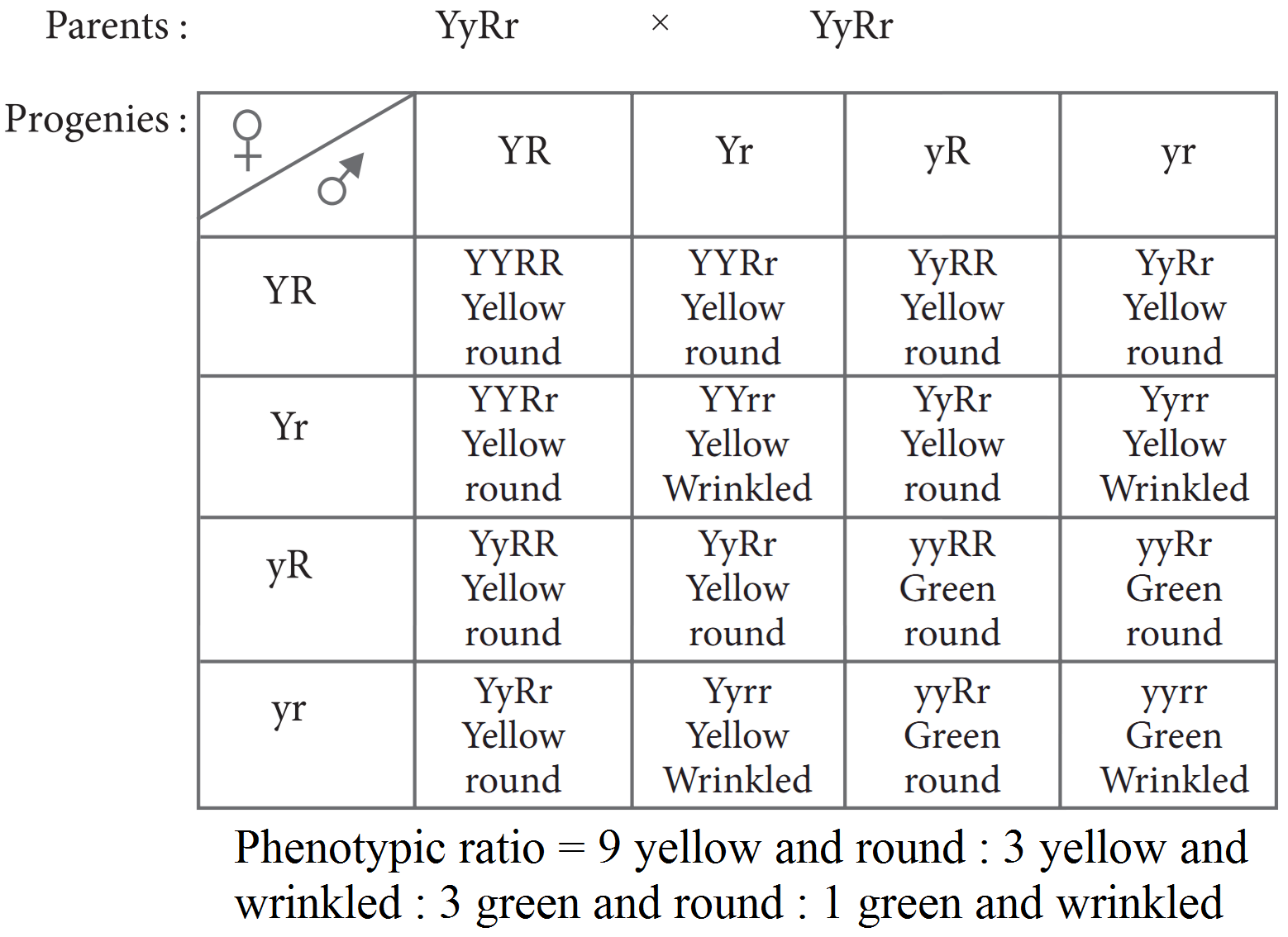
  1. Which of the following will result when plant YyRr is self-pollinated?
  1. 9 : 3 : 3 : 1 ratio of phenotypes only.
  2. 9 : 3 : 3 : 1 ratio of genotypes only.
  3. 1 : 1 : 1 : 1 ratio of phenotypes only.
  4. 1 : 1 : 1 : 1 ratio of phenotypes and genotypes.
  1. The percentage of yR gamete produced by YyRR parent will be:
  1. 25%
  2. 50%
  3. 75%
  4. 12.5%
Answer
  1. (a) Plants with round and yellow coloured seeds.
  1. (a) YYRR and yyrr
  1. (d) Both (a) and (b).
Explanation:

Plant with wrinkled and green coloured seeds (S) (genotype rryy) is crossed with plant with wrinkled and yellow coloured seeds (R) (genotype rrYY or rrYr). If plant with wrinkled and green coloured seeds (rryy) is crossed with plant having wrinkled and yellow coloured seeds of genotype rrYY then all plants produced with wrinkled and yellow coloured seeds whereas if plant with wrinkled and green coloured seeds (rryy) is crossed with plant having wrinkled and yellow coloured seeds that has genotype rrYy then 50% plants with wrinkled and yellow coloured seeds and 50% plants with wrinkled and green coloured seeds are produced.
  1. (a) 9: 3 : 3 : 1 ratio of phenotypes only.
Explanation:

When plant YyRr is self pollinated, 9: 3: 3: 1 ratio of phenotypes will be observed. This can be explained as follows:

  1. (b) 50%
Explanation:

Gametes produced by YyRR parent would be 50% YR and 50% yR.
View full question & answer