Questions

5 Marks Questions

Take a timed test

7 questions · self-marked practice — reveal the answer and mark yourself.

Question 15 Marks
A resistor of resistance $100\Omega$ is connected to an AC source $\in=(12\text{V})\sin(250\pi\text{s}^{-1})\text{t}.$ Find the energy dissipated as heat during $\text{t}=0$ to $\text{t}=1.0\text{ms}.$
Answer
$\text{H}=\frac{\text{V}^2}{\text{R}}\text{T},\ \text{E}_0=12\text{V},\ \omega=250\pi,\ \text{R}=100\Omega$$\text{H}=\int\limits_0^\text{H}=\int\frac{\text{E}_0\sin^2\omega\text{t}}{\text{R}}\text{dt}$
$=\frac{144}{100}\int\sin^2\omega\text{t}\text{ dt}=1.44\int\Big(\frac{1-\cos2\omega\text{t}}{2}\Big)\text{dt}$
$=\frac{1.44}{2}\Big[\int\limits_0^{10^{-3}}\text{dt}-\int\limits_0^{10^{-3}}\cos2\omega\text{t}\text{ dt}$
$=0.72\Bigg[10^{-3}-\Big(\frac{\sin2\omega\text{t}}{2\omega}\Big)_0^{10^{-3}}\Bigg]$
$=0.72\Big[\frac{1}{1000}-\frac{1}{500\pi}\Big]$
$=\frac{(\pi-2)}{1000\pi}\times0.72=0.0002614$
$=2.61\times10^{-4}{\text{J}}$
View full question & answer
Question 25 Marks
A capacitor of capacitance $10\mu\text{F}$ is connected to an oscillator with output voltage $\in=(10\text{V})\sin\omega\text{t}.$ Find the peak currents in the circuit for $\omega=10\text{s}^{-1},100\text{s}^{-1},500\text{s}^{-1},1000\text{s}^{-1}.$
Answer
$\text{C}=10\mu\text{F}=10\times10^{-6}\text{F}=10^{-5}\text{F}$$\text{E}=(10\text{V})=\sin\omega\text{t}$
  1. $\text{I}=\frac{\text{E}_0}{\text{X}_\text{C}}=\frac{\text{E}_0}{\Big(\frac{1}{\omega\text{C}}\Big)}$
$=\frac{10}{\Big(\frac{1}{10\times10^{-5}}\Big)}=1\times10^{-3}\text{A}$
  1. $\omega=100\text{s}^{-1}$
$\text{I}=\frac{\text{E}_0}{\Big(\frac{1}{\omega\text{C}}\Big)}$
$=\frac{10}{\Big(\frac{1}{100\times10^{-5}}\Big)}=1\times10^{-2}\text{A}=0.01\text{A}$
  1. $\omega=500\text{s}^{-1}$
$\text{I}=\frac{\text{E}_0}{\Big(\frac{1}{\omega\text{C}}\Big)}$
$=\frac{10}{\Big(\frac{1}{500\times10^{-5}}\Big)}=5\times10^{-2}\text{A}=0.05\text{A}$
  1. $\omega=1000\text{s}^{-1}$
$\text{I}=\frac{\text{E}_0}{\Big(\frac{1}{\omega\text{C}}\Big)}$
$=\frac{10}{\Big(\frac{1}{1000\times10^{-5}}\Big)}=1\times10^{-1}\text{A}=0.1\text{A}$
View full question & answer
Question 35 Marks
A coil has a resistance of $10\Omega$ and an inductance of 0.4 henry. It is connected to an AC source of $6.5\text{V},\frac{30}{\pi}\ \text{Hz}$ Find the average power consumed in the circuit.
Answer
$\text{R}=10\Omega,\text{L}=0.4\text{ henry}$$\text{E}=6.5\text{V},\text{f}=\frac{30}{\pi}\text{Hz}$
$\text{Z}=\sqrt{\text{R}^2+{\text{X}_\text{L}}^{2}}=\sqrt{\text{R}^2+(2\pi\text{fL})^2}$
$\text{Power}=\text{V}_\text{rms}\text{I}_\text{rms}\cos\phi$
$=6.5\times\frac{6.5}{\text{Z}}\times\frac{\text{R}}{\text{Z}}$
$=\frac{6.5\times6.5\times10}{\Big[\sqrt{\text{R}^2+(2\pi\text{f})^2}\Big]}$
$=\frac{6.5\times6.5\times10}{10^2+\Big(2\pi\times\frac{30}{\pi}\times0.4\Big)^2}$
$=\frac{6.5\times6.5\times10}{100+576}=0.625=\frac{5}{8}\omega$
View full question & answer
Question 45 Marks
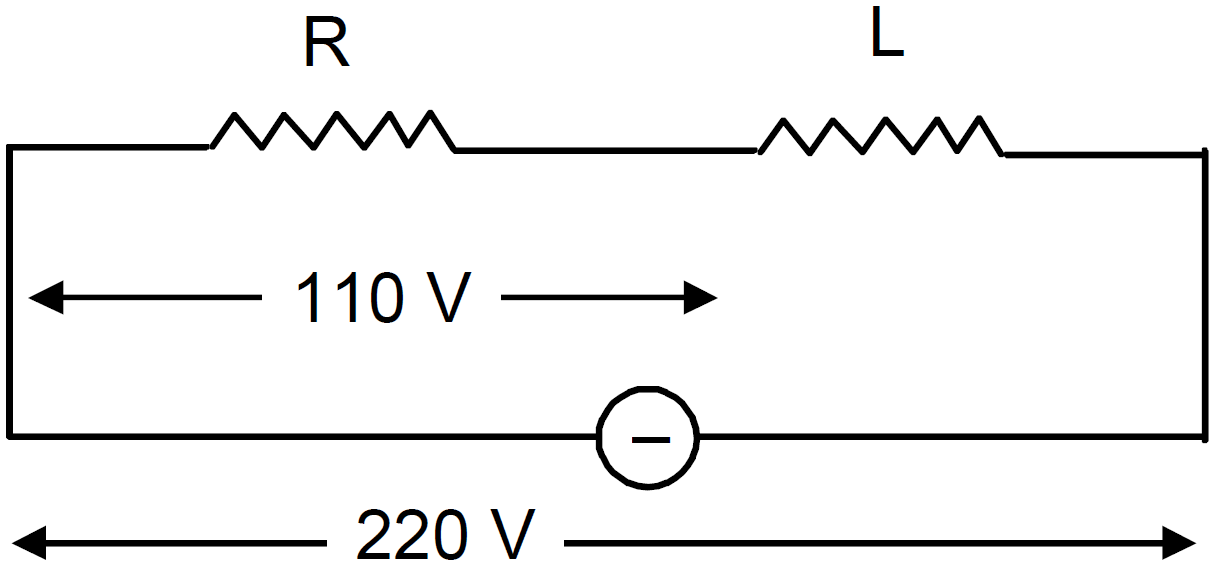
An electric bulb is designed to consume 55W when operated at 110 volts. It is connected to a 220V, 50Hz line through a choke coil in series. What should be the inductance of the coil for which the bulb gets correct voltage?
Answer
Power = 55W, Voltage = 110V Resistance $=\frac{\text{V}^2}{\text{P}}=\frac{110\times110}{55}=220\Omega$ frequency $(\text{f})=50\text{Hz}$ Current in the circuit $=\frac{\text{V}}{\text{Z}}=\frac{\text{V}}{\sqrt{\text{R}^2+(\omega\text{L})^2}}$ Voltage drop across the resistor $=\text{ir}=\frac{\text{VR}}{\sqrt{\text{R}^2+(\omega\text{L})^2}}$$=\frac{220\times220}{\sqrt{(220)^2+(100\pi\text{L})^2}}=110$
$\Rightarrow\ 220\times2=\sqrt{(220)^2+(100\pi\text{L})^2}$
$\Rightarrow\ (220)^2+(100\pi\text{L})^2=(440)^2$
$\Rightarrow\ 48400+10^4\pi^2\text{L}^2=193600$
$\Rightarrow\ 10^4\pi^2\text{L}^2=193600-48400$
$\Rightarrow\ \text{L}^2=\frac{142500}{\pi^2\times10^4}=1.4726$
$\Rightarrow\ \text{L}=1.2135\approx1.2\text{Hz}$
View full question & answer
Question 55 Marks
An inductance of 2.0H, a capacitance of $18\mu\text{F}$ and a resistance of $10\text{K}\Omega$ are connected to an AC source of 20V with adjustable frequency.
  1. What frequency should be chosen to maximise the current in the circuit?
  2. What is the value of this maximum current?
Answer
  1. For current to be maximum in a circuit.
$\text{X}_\text{L}=\text{X}_\text{C}$ (Resonant Condition)

$\Rightarrow\ \omega\text{L}=\frac{1}{\omega\text{C}}$

$\Rightarrow\ \omega^2=\frac{1}{\text{LC}}$

$=\frac{1}{2\times18\times10^{-6}}=\frac{10^6}{36}$

$\Rightarrow\ \omega=\frac{10^3}{6}$

$\Rightarrow\ 2\pi\text{f}=\frac{10^3}{6}$

$\Rightarrow\ \text{f}=\frac{1000}{6\times2\pi}$

$=26.537\approx27\text{Hz}$
  1. Maximum Current $=\frac{\text{E}}{\text{R}}$ (in resonance)
$=\frac{20}{10\times10^3}=\frac{2}{10^3\text{A}}=2\text{mA}$
View full question & answer
Question 65 Marks
In a series RC circuit with an AC source, $\text{R}=300\Omega,\text{C}=25\mu\text{F},\in_0=50\text{V}$ and $\nu=\frac{50}{\pi}\text{Hz}.$ Find the peak current and the average power dissipated in the circuit.
Answer
$\text{R}=300\Omega,\text{C}=25\mu\text{F}=25\times10^{-6}\text{F}$$\in_0=50\text{V},\nu=\frac{50}{\pi}\text{Hz}$
$\text{X}_\text{C}=\frac{1}{\omega\text{C}}$
$=\frac{1}{\frac{50}{\pi}\times2\pi\times25\times10^{-6}}=\frac{10^4}{25}$
$\text{Z}=\sqrt{\text{R}^2+{\text{X}_\text{C}}^{2}}$
$=\sqrt{(300)^2+\Big(\frac{10^4}{25}\Big)^2}$
$=\sqrt{(300)^2+(400)^2}=500$
  1. Peak current $=\frac{\text{E}_0}{\text{Z}}=\frac{50}{500}=0.1\text{A}$
  2. Average Power dissipitated $=\text{E}_\text{rms}\text{I}_\text{rms}\cos\phi$
$=\frac{\text{E}_0}{\sqrt{2}}\times\frac{\text{E}_0}{\sqrt{2}\text{Z}}\times\frac{\text{R}}{\text{Z}}=\frac{\text{E}_0{^2}}{2\text{Z}^2}$
$=\frac{50\times50\times300}{2\times500\times500}=\frac{3}{2}=1.5\omega$
View full question & answer
Question 75 Marks
In a series LCR circuit with an AC source, $\text{R}=300\Omega,\text{C}=20\mu\text{F},\text{L}=1.0\text{ henry},\in_0=50\text{V}$ and $\nu=\frac{50}{\pi}\text{Hz}.$ Find:
  1. The rms current in the circuit.
  2. The rms potential difference across the capacitor, the resistor and the inductor. Note that the sum of the rms potential differences across the three elements is greater than the rms voltage of the source.
Answer
$\text{R}=300\Omega,\text{C}=20\mu\text{F}=20\times10^{-6}\text{F}$$\text{L}=1\text{ henry},\text{E}=50\text{V},\nu=\frac{50}{\pi}\text{Hz}$
  1. $\text{I}_0=\frac{\text{E}_0}{\text{Z}}$
$\text{Z}=\sqrt{\text{R}^2+(\text{X}_\text{C}-{\text{X}_\text{L})}^{2}}$
$=\sqrt{(300)^2+\Big(\frac{1}{2\pi\text{fC}}-2\pi\text{fL}\Big)^2}$
$=\sqrt{(300)^2+\bigg(\frac{1}{2\pi\times\frac{50}{\pi}\times20\times10^{-6}}-2\pi\times\frac{50}{\pi}\times1\bigg)^2}$
$=\sqrt{(300)^2+\Big(\frac{10^4}{20}-100\Big)^2}=500$
$\text{I}_0=\frac{\text{E}_0}{\text{Z}}=\frac{50}{500}=0.1\text{A}$
b. Potential across the capacitor $=i_0 \times X_C=0.1 \times 500=50 \mathrm{~V}$.

Potential difference across the resistor $=i_0 \times R=0.1 \times 300=30 \mathrm{~V}$.
Potential difference across the inductor $=i_0 \times \mathrm{X}_{\mathrm{L}}=0.1 \times 100=10 \mathrm{~V}$.
Rms. potential $=50 \mathrm{~V}$.
Net sum of all potential drops $=50 \mathrm{~V}+30 \mathrm{~V}+10 \mathrm{~V}=90 \mathrm{~V}$.
Sum or potential drops $>$ R.M.S potential applied.
View full question & answer