Questions

5 Marks Questions

Take a timed test

14 questions · self-marked practice — reveal the answer and mark yourself.

Question 15 Marks
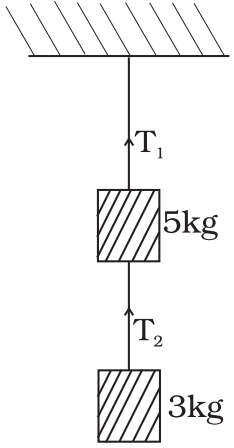
Two masses of $5kg$ and $3kg$ are suspended with help of massless inextensible strings as shown in Calculate $T_1$ and $T_2$ when whole system is going upwards with acceleration = $2m s^2$(use $g = 9.8m s^{–2}$).
Answer
As the whole system is going up with acceleration = $a = 2ms-2\text{m}_1=5\text{kg}\ \text{m}_2=3\text{kg}\ \text{g}=9.8\text{m/ s}^2$
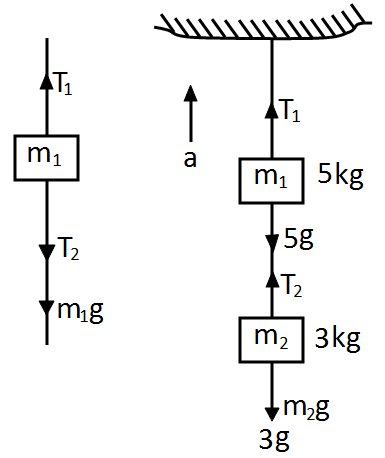
Tension in a string is equal and opposite in all parts of a string.
Forces on mass $m_1$
$\text{T}_1-\text{T}_2-\text{m}_1\text{g}=\text{m}_1\text{a}$
$\text{T}_1-\text{T}_2-5\text{g}+5\text{a}$
$\text{T}_1-\text{T}_2=5\text{g}+5\text{a}$
$\text{T}_1-\text{T}_2=5(9.8+2)$
$=5\times11.8$
$\text{T}_1-\text{T}_2=59.0\ \text{N}$
Forces on mass $m_2$
$\text{T}_2-\text{m}_2\text{g}=\text{m}_2\text{a}$
$\text{T}_2=\text{m}(\text{g}+\text{a})=3(9.8+2)=3\times11.8$
$\text{T}_2=35.4$
$\text{T}_1=\text{T}_2+59.0\Rightarrow\text{T}_1=53.4+59.0=94.4\ \text{N}$
View full question & answer
Question 25 Marks
The velocity of a body of mass 2kg as a function of t is given by $\text{v}(\text{t})=2\text{t}\hat{\text{i}}+\text{t}^2\hat{\text{j.}}$ Find the momentum and the force acting on it, at time $\text{t}=2\text{s}.$
Answer
$\text{m}=2\text{kg}$$\vec{\text{v}}\text{(t)}=2\text{t}\hat{\text{i}}+\text{t}^2\hat{\text{j.}}$
$\vec{\text{v}}\ \text{at}2\sec,\vec{\text{v}}(2)=2(2)\hat{\text{i}}+(2)^2\hat{\text{j}},\text{v}(2)=4\hat{\text{i}}+4\hat{\text{j}}$
Momentum $\vec{\text{p}}(2)=\text{m}\vec{\text{v}}(2)$
$\vec{\text{p}}(2)=2\Big[4 \hat{\text{i}}+4\hat{\text{j}}\Big],\text{p}(2)=8\hat{\text{i}}+8\hat{\text{j}}\text{kg}\ \text{ms}^{-1}$
$\vec{\text{F}}=\text{m}\vec{\text{a}}$
$\vec{\text{F}}(2)=\text{m}\vec{\text{a}}(2)$
$\vec{\text{v}}\text{(t)}=2\text{t}\hat{\text{i}}+\text{t}^2\hat{\text{j}}$
$\hat{\text{a}}\text{(t)}=\frac{\text{d}\vec{\text{v}\text{(t)}}}{\text{dt}}=2\hat{\text{i}}+2\text{t}\hat{\text{j}}$
$\hat{\text{a}}(2)=2\hat{\text{i}}+2(2)\hat{\text{j}}=2\hat{\text{i}}+4\hat{\text{j}}$
$\therefore\vec{\text{F}}(2)=2(2\hat{\text{i}}+4\hat{\text{j}}=4\hat{\text{i}}+8\hat{\text{j}}\text{N}$
View full question & answer
Question 35 Marks
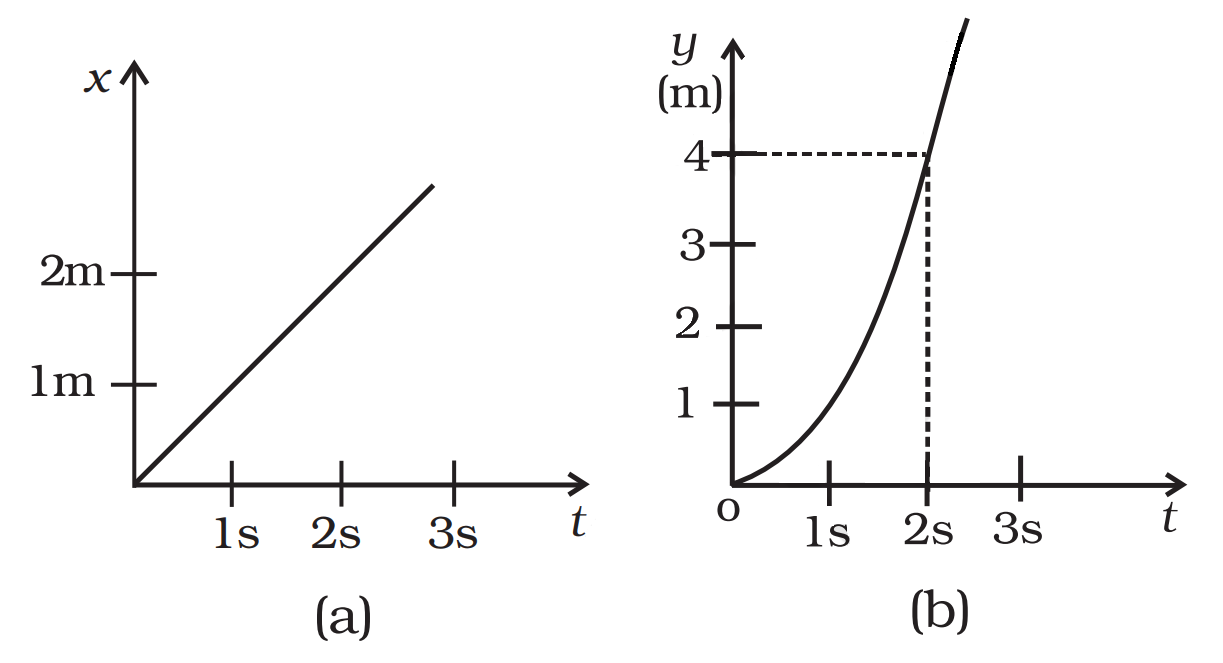
shows (x, t), (y, t) diagram of a particle moving in 2-dimensions.
If the particle has a mass of 500g, find the force (direction and magnitude) acting on the particle.
Answer
From graph (a)$\text{v}_\text{x}=\frac{\text{dx}}{\text{dt}}=\frac{2}{2}=1\text{ms}^{-1}$
$\text{a}_\text{x}=\frac{\text{d}^2\text{x}}{\text{dt}^2}=\frac{\text{dv}_\text{x}}{\text{dt}}=0$
From figure (b) $\text{y}=\text{t}^2$$\text{v}_\text{y}=\frac{\text{dy}}{\text{dt}}=2\text{t}$
$\text{a}_\text{y}=\frac{\text{dv}_\text{y}}{\text{dt}}=2$
$\therefore\text{F}_\text{y}=\text{ma}_\text{y}\ \text{m}=500\text{g}=.5\text{kg}$
$\text{F}_\text{y}=.5\times2=1\text{N}$ toward $\text{Y}-\text{axis}$
$\text{F}_\text{x}=.5\times0=0\text{N}$
$\text{F}=\sqrt{\text{F}_\text{x}^2+\text{F}_\text{y}^2}=\sqrt{0^2+1^2}$
F = N toward Y-axis.
View full question & answer
Question 45 Marks
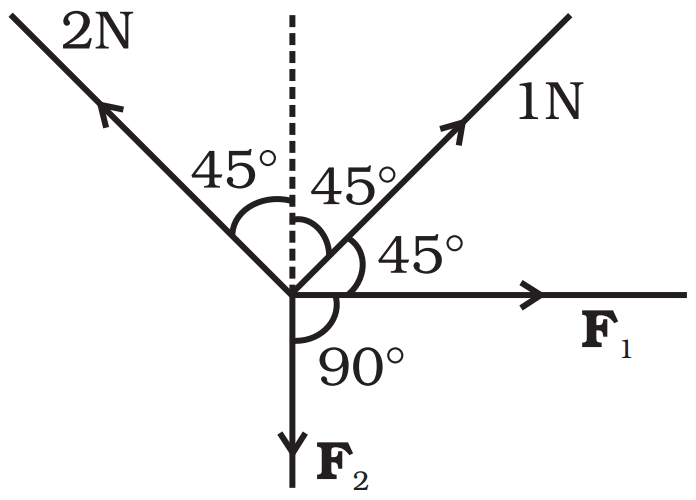
There are four forces acting at a point P produced by strings as shown in which is at rest. Find the forces $F_1$ and $F_2$.
Answer
As the particle is rest or a = 0. So resultant force due to all forces will be zero.$\therefore$ Net components along X and Y-axis will be zero.
Resolving all forces along X-axis$\text{F}_\text{x}=0$
$\text{F}_1+1\cos45^\circ-2\cos45^\circ=0$ or $\text{F}_1-1\cos45^\circ=0$
$\text{F}_1=\cos45^\circ=\frac{1}{\sqrt{2}}\frac{\sqrt{2}}{\sqrt{2}}=\frac{\sqrt{2}}{2}=\frac{1.414}{2}=0.707\text{N}$
Resolving all forces along Y-axis$\text{F}_\text{y}=0$
$-\text{F}_2+1\cos45^\circ+2\cos45%\circ=0$
$-\text{F}_2=-3\cos45^\circ$
$\text{F}_2=3.\frac{1}{\sqrt{2}}=\frac{3\sqrt{2}}{2}=\frac{3\times1.414}{2}=3\times0.707=2.121\text{N.}$
View full question & answer
Question 55 Marks
There are three forces $F_1, F_2$ and $F_3$ acting on a body, all acting on a point P on the body. The body is found to move with uniform speed.
  1. Show that the forces are coplanar.
  2. Show that the torque acting on the body about any point due to these three forces is zero.
Answer
  1. As the body is moving with uniform speed after the action of three forces $\vec{\text{F}}_1\vec{\text{F}}_2$ and $\vec{\text{F}}_3$ on a point on body, so the acceleration of body is zero (as no circular motion)
$\therefore$ F = ma, so the resultant force due to $\vec{\text{F}}_1+\vec{\text{F}}_2+\vec{\text{F}}_3=0$
$\vec{\text{F}}_1+\vec{\text{F}}_2=-\vec{\text{F}}_3$ or $\vec{\text{F}}_3=-(\vec{\text{F}}_1+\vec{\text{F}}_2)$
Consider the forces $\vec{\text{F}}_1$ or $\vec{\text{F}}_2$ are in the plane of the paper, the resultant of $\vec{\text{F}}_1$ and $\vec{\text{F}}_2$ will also be on the same plane of the paper, in $\Big[-(\vec{\text{F}}_1+\vec{\text{F}}_2)\Big]$ only direction is reverse on the same plane. As $\vec{\text{F}}_3=-(\vec{\text{F}}_1+\vec{\text{F}}_2).$ so $\vec{\text{F}}_3$ will be in the same plane i.e., $\vec{\text{F}}_1, \vec{\text{F}}_2$ and $\vec{\text{F}}_3$ are coplanar.
  1. As the resultant of $\vec{\text{F}}_1,\ \vec{\text{F}}_2$ and $\vec{\text{F}}_3$ is zero and Torque $\text{r}\times\vec{\text{F}}=0$
as $\vec{\text{F}}=\vec{\text{F}}_1+\vec{\text{F}}_2+\vec{\text{F}}_3=0$
So torque acting on a body at any point will be always zero.
View full question & answer
Question 65 Marks
The displacement vector of a particle of mass m is given by $\text{r}\text{(t})=\hat{\text{i}}\text{A}\cos\omega\text{t}+\hat{\text{j}}\text{B}\sin\omega\text{t}.$Show that $\text{F}=-\text{m}\omega^2\text{r}.$
Answer
The Main concept used: To plot the graph (r - t) or trajectory we relate x and y coordinates.$\text{x}=\text{A}\cos\omega\text{t}$ (Given)
$\Rightarrow\text{v}_\text{x}=\frac{\text{dx}}{\text{dt}}=-\text{A}\omega\sin\omega\text{t}$
$\Rightarrow\text{a}_\text{x}=\frac{\text{dv}_\text{z}}{\text{dt}}=-\text{A}\omega^2\cos\omega\text{t}$
And $\text{y}\text{B}\sin\omega\text{t}$ (Given)$\Rightarrow\text{v}_\text{y}=\frac{\text{dy}}{\text{dt}}=\text{B}\omega\cos\omega\text{t}$
$\text{a}_\text{y}=\frac{\text{dy}_\text{y}}{\text{dt}}=-\text{B}\omega^2\sin\omega\text{t}$
$\text{a}=\text{a}_\text{x}\hat{\text{i}}+\text{a}_\text{y}\hat{\text{j}}$
$=-\hat{\text{i}}\text{A}\text{w}^2\cos\text{w}\text{t}-\hat{\text{j}}\text{B}\omega^2\sin\omega\text{t}$
$=-\omega^2[\hat{\text{i}}\text{A}\cos\omega\text{t}+\hat{\text{j}}\text{B}\sin\omega\text{t}]$
$\text{a}=\omega^2\text{r}(\text{t})$
$\therefore$ Force acting on particle =ma = - m $\omega^2\vec{\text{r}}-(\text{t})$
View full question & answer
Question 75 Marks
A girl riding a bicycle along a straight road with a speed of $5m s^{–1}$ throws a stone of mass $0.5kg$ which has a speed of $15m s^{–1}$ with respect to the ground along her direction of motion. The mass of the girl and bicycle is $50kg$. Does the speed of the bicycle change after the stone is thrown? What is the change in speed, if so?
Answer
Girl and cycle Body$\text{m}_1=50\text{kg}\ \ \ \text{m}_2=0.5\text{kg}$
$\mu_1=5\text{m/ s}$ forward $\mu_2=5\ \text{m/ s}$ forward
$\text{v}_1=?\ \ \text{v}_2=15\text{m/ s}$ forward
According to the law of conservation of momentum. Initial momentum (Girl, cycle, body) = Final momentum (cycle + Girl) and body$(\text{m}_1+\text{m}_2)\mu_1=\text{m}_1\text{v}_1+\text{m}_2\text{v}_2$
$(50+0.5)\times5+50\times\text{v}_1+0.5\times15$
$50.5\times5-7.5=50\text{v}_1$
$50\text{v}_1=252.5-7.5=245.0$
$\text{v}_1\frac{245.0}{50}=4.9\text{m/ s}$
Hence, the speed of cycle and girl decreased by 5 - 4.9 = 0.1m/ s
View full question & answer
Question 85 Marks
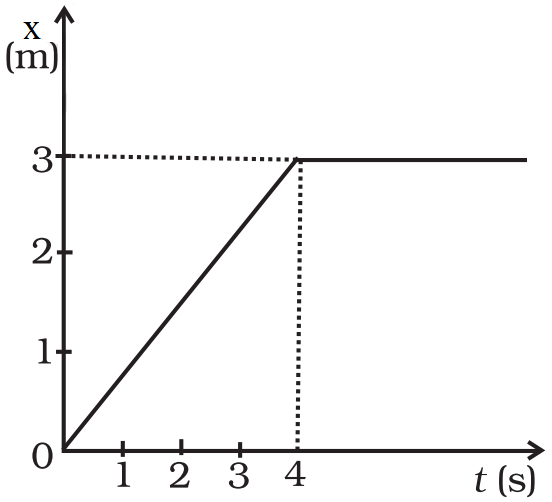
The position time graph of a body of mass $2kg$ is as given in What is the impulse on the body at $t = 0 s$ and $t = 4s$.
Answer
Mass of body $(m)=2 \mathrm{~kg}$ at $t=0$.. Initial velocity $\left(v_1\right)$ is zero, $V_1=0$ fromt $\geq 0$ tot $\leq 4,(x-t)$ graph is straight line.
So the velocity ( v ) of body is constant.
$\mathrm{v}_2=\tan \theta=\frac{3}{4}=0.75 \mathrm{~m} / 1$
At $t \geq 4$ the slope of the graph is zero so velocity $\mathrm{v}_3=0$
Impulse $=\overrightarrow{\mathrm{F}} \cdot \mathrm{t}=\frac{\overrightarrow{\mathrm{dp}}}{\mathrm{dt}} \cdot \mathrm{dt}=\overrightarrow{\mathrm{dp}}$ Impulse $=$ Change in momentum Impulse at $\mathrm{t}=0:=2[0.75-0]=1.50 \mathrm{~kg} \mathrm{~ms}^{-1}$
(increased) Impulse at $\mathrm{t}=4:=\mathrm{m}\left(\mathrm{v}_3-\mathrm{v}_2\right)=2[0-0.75]$ Impulse at $\mathrm{t}=4:=-1.50 \mathrm{~kg} \mathrm{~ms}^{-1}$ So impulse at $\mathrm{t}=0$ increases by $+1.5 \mathrm{~kg} \mathrm{~ms}^{-1}$ and at $\mathrm{t}=4$ it decreased by $\left(-1.5 \mathrm{~kg} \mathrm{~ms}^{-1}\right)$.
View full question & answer
Question 95 Marks
A helicopter of mass 2000kg rises with a vertical acceleration of $15m s^{–2}$​​​​​​​. The total mass of the crew and passengers is 500kg. Give the magnitude and direction of the $(g = 10m s^{–2})​​​​​​​$​​​​​​​
  1. Force on the floor of the helicopter by the crew and passengers.
  2. Action of the rotor of the helicopter on the surrounding air.
  3. Force on the helicopter due to the surrounding air.
Answer
Mass $(M)$ of helicopter $=M=2000 kg$ Mass of the crew and passengers $=m=500 kg$. Acceleration of helicopter along with crew and passengers $=15 ms^{-2}$
a. Force on floor of helicopter by crew and passenger will be equal to apparent weight (left)
$m(g+a)=500(10+15)$
$F_1=500 \times 25=12500 N \text { downward }$
b. The action of the rotor of the helicopter on surrounding air will be equal to the reaction force by Newton's third law due to which helicopter along with crew and passenger rises up with acceleration on $15 ms^{-1}( M + m )$ $(g+a)$ So the action by rotor on surrounding air $=(2000+500)(g+a)$
$F_2=2500 \times(10+15)=2500 \times 25=62500 N \text { downward. }$
c. Force (F) acting on the helicopter by the reaction force by surrounding air.
so $F_3=-$ Action force (by Newton's third law)
$=-62500 N$ downward
or $F _3=+62500 N$ upward
View full question & answer
Question 105 Marks
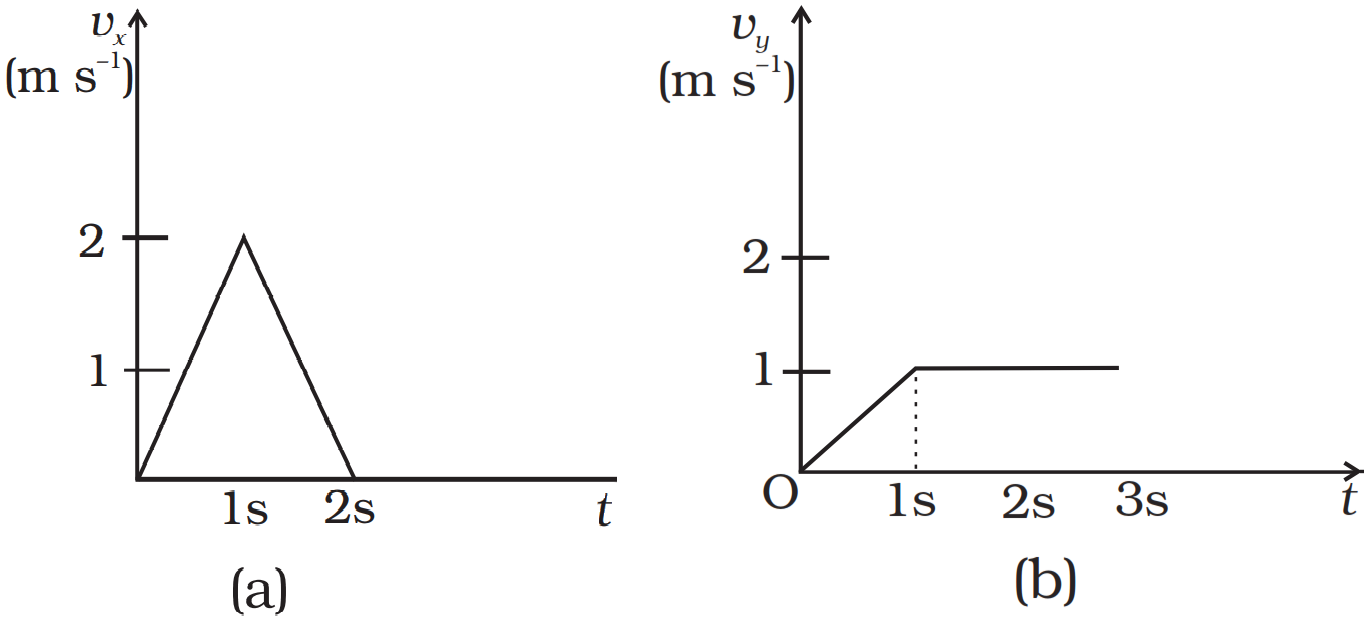
$(v_{x,} t),$ and $(v_{y,} t)$ diagrams for a body of unit mass. Find the force as a function of time.
Answer
Consider Figure (a)$\text{v}_\text{x}=2\text{t}$ for $0<\text{t}<1\text{s}$
$\text{a}_\text{x}=\frac{2}{1}=2$ For $0<\text{t}<1\text{s}$
$\text{v}_\text{x}=2(2-\text{t})$ For $1<\text{t}<2\text{s}$
$\text{a}_\text{x}=\frac{-2}{1}=-2$ For $1<\text{t}<2\text{s}$
$\therefore\ \text{F}_\text{x}=\text{ma}$ and m=1 unit(Given)
$\therefore\ \text{F}_\text{x}=1\times2=2$ unit for $0<\text{t}<1\text{s}$
And $\text{F}_\text{x}=1\times(-2)=-2$ unit for $1<\text{t}<1$ From figure (b)$\text{a}_\text{y}=\frac{1}{1}\text{ms}^{-2}0<\text{t}<1$
$\text{F}_\text{y}=\text{ma}=1.1=1$ Unit for $0=<\text{t}<1$
$\text{a}_\text{y}=0$ For $1<\text{t}$
$\vec{\text{F}}_\text{y}=1\times0=0$ Unit for $1<\text{t}<2\text{s}$
$\overrightarrow{\text{F}}=\overrightarrow{\text{F}}_{\text{x}}\hat{\text{i}}+\text{F}_\text{y}\hat{\text{j}}$
$\vec{\text{F}}=2\hat{\text{i}}+1\hat{\text{j}}$ For $0<\text{t}<1\text{s}$
$\overrightarrow{\text{F}}=-2\hat{\text{i}}+0\hat{\text{j}}$ For $1<\text{t}<2\text{s}$
$\therefore\ \vec{\text{F}}=-2\hat{\text{i}}$ For $1<\text{t}<2\text{s}$
For more than 2 sec $\text{a}_\text{y}=0,\ \text{a}_\text{x}=0\big\}\ \therefore\vec{\text{F}}=0$
View full question & answer
Question 115 Marks
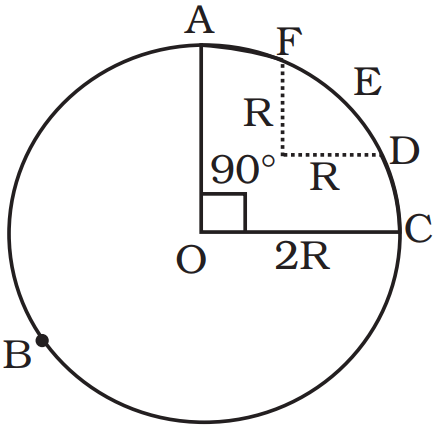
A racing car travels on a track (without banking) ABCDEFA ABC is a circular arc of radius 2 R. CD and FA are straight paths of length R and DEF is a circular arc of radius $R = 100 m$. The co-effecient of friction on the road is $\mu = 0.1.$ The maximum speed of the car is $50m s^{–1}$. Find the minimum time for completing one round.
Answer
The main concept used: The centripetal force to keep the car in circular motion is provided by frictional force inward to centre O.
Explanation:
  1. Time taken from $\text{A}\rightarrow\text{B}\rightarrow\text{C}$
$\text{s}_1=$ length of path $=\frac{3}{4}2\pi(2\text{R})=\frac{3}{4}\times4\pi\times100=300\pi\text{m}$
$\text{v}_1=$ the maximum speed of car along the circular path
$\sqrt{\mu\text{r}\text{g}}=\sqrt{0.1\times2\text{R}\times\text{g}}$
$\text{v}_1=\sqrt{0.1\times2\times100\times10}=\sqrt{200}=10\times\sqrt{2\text{m/ s}}=14.14\text{m/}\sec$
$\therefore\ \text{t}_1=\frac{\text{s}_1}{\text{v}_1}=\frac{300\pi}{14.14}=\frac{300\times3.14}{14.14}=66.62\text{s}$
  1. Time from $\text{c}\rightarrow\text{D}$ and $\text{F}\rightarrow\text{A}$
$\text{s}_2=\text{CD}+\text{FA}=\text{R+R}=100+100=200\text{m}$
As path CD and FA are in straight so car will travel with it’s maximum speed $=\text{v}_2=50\text{m/ s}$
$\therefore\ \text{t}_2=\frac{\text{s}_2}{\text{v}_2}=\frac{200}{50}=4\sec$
  1. Time for path $\text{D}\rightarrow\text{E}\rightarrow\text{F}$ is
$\text{s}_3=\frac{1}{4}2\pi\text{R}=\frac{1}{4}\times2\pi\times100=50\pi$
$\text{v}_3=\sqrt{\mu}\text{r}\text{g}=\sqrt{0.1\times\text{R}\times\text{g}}=\sqrt{0.1\times100\times10}=\text{m/ s}$
$\text{t}_3=\frac{\text{s}_3}{\text{v}_3}=\frac{50\pi}{10}=5\sec=5\times3.14=154.70\text{s}$
Total time taken by car $\text{t}_1+\text{t}_2+\text{t}_3$
$\therefore\text{t}=66.62+4+15.70=86.32\sec.$
View full question & answer
Question 125 Marks
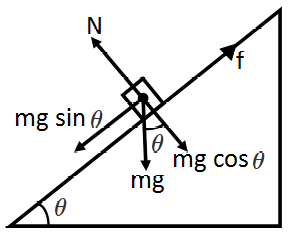
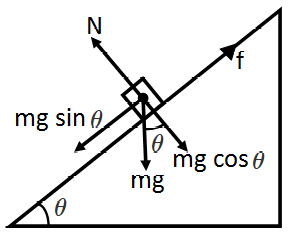
A rectangular box lies on a rough inclined surface. The coefficient of friction between the surface and the box is $\mu$. Let the mass of the box be m.
  1. At what angle of inclination $\theta$ of the plane to the horizontal will the box just start to slide down the plane?
  2. What is the force acting on the box down the plane, if the angle of inclination of the plane is increased to a $\theta>$?
  3. What is the force needed to be applied upwards along the plane to make the box either remain stationary or just move up with uniform speed?
  4. What is the force needed to be applied upwards along the plane to make the box move up the plane with acceleration a?
Answer
  1. As the box just start to slide down the plane then $\mu=\tan\theta$ (by angle of repose) $\theta-\tan^{-1}(\mu)$
  2. If angle$\alpha>\theta$ the angle of inclination of the plane with horizontal it will slide down (f upward) as $\theta$ is the angle of repose. So net force downward
$\text{F}_1=\text{mg}\sin\alpha-\text{f}=\text{mg}\sin\alpha-\mu\text{N}.$
$=\text{mg}\sin\alpha-\mu\ \text{mg}\cos\alpha$
$\text{F}_1=\text{mg}[\sin\alpha-\mu\cos\alpha]$
  1. To keep the box either stationary or just move it up with uniform velocity (1 =0)upward (f downward)
$\text{F}_2-\text{mg}\sin\alpha-\text{f}=\text{ma}$
or $\text{F}_2-\text{mg}\sin\alpha-\mu\text{N}=0(\because\text{a}=0)$
$\text{F}_2=\text{mg}\sin\alpha-\mu\text{N}=0$
$\text{F}_2=\text{mg}(\sin\alpha-\mu\cos\alpha)$
  1. The force applied $\text{F}_2$ to move the box upward with acceleration a
$\text{F}_3-\text{mg}\sin\alpha-\mu\cos\alpha=\text{ma}$
$\therefore\text{F}_3=\text{mg}(\sin\alpha+\mu\cos\alpha)+\text{ma}$
View full question & answer
Question 135 Marks
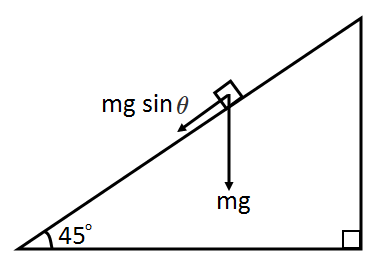
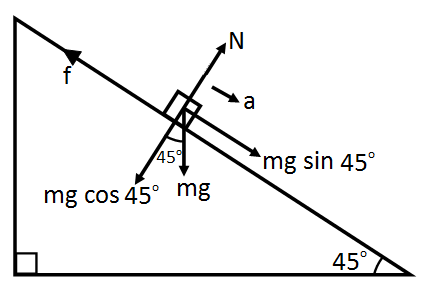
When a body slides down from rest along a smooth inclined plane making an angle of 45° with the horizontal, it takes time T. When the same body slides down from rest along a rough inclined plane making the same angle and through the same distance, it is seen to take time pT, where p is some number greater than 1. Calculate the co-efficient of friction between the body and the rough plane.
Answer
As the body slides down from rest along a smooth plane inclined at angle 45° in Time U = 0, s = s, t = T$\text{a}=\text{g}\sin45^\circ=\frac{\text{g}}{\sqrt{2}}$
$\text{s}=\text{ut}+\frac{1}{2}\text{at}^2$
$\text{s}=0+\frac{1}{2}\frac{\text{g}}{\sqrt{2}}\text{T}^2$
$\text{s}=\frac{\text{g}\text{T}^2}{2\sqrt{2}}$

Motion of body along rough inclined plane $\text{U}=0,\ \text{s}=\frac{\text{g}\text{T}^2}{2\sqrt{2}}\ ...(\text{i})$
$= \text{ma}=\sin45^\circ-\text{f}$
$\text{mg}\frac{1}{\sqrt{2}}-\mu\text{N}$
$=\frac{\text{mg}}{\sqrt{2}}-\mu\text{mg}\cos45^\circ=\text{mg}\Big[\frac{1}{\sqrt{2}}-\frac{\mu}{\sqrt{2}}\Big]$
$\text{ma}=\frac{\text{mg}}{\sqrt{2}}[1-\mu]\Rightarrow\text{a}=\frac{\text{g}}{\sqrt{2}}(1-\mu)$
$\text{t}=\text{p}\text{T},\ \text{s}=\text{s,}\ \text{a}=\frac{\text{g}}{\sqrt{2}}(1-\mu)$
$\text{s}=\text{ut}+\frac{1}{2}\text{at}^2=0+\frac{1}{2}.\frac{\text{g}}{\sqrt{2}}(1-\mu)(\text{pT})^2$
$\text{s}=\frac{\text{g}}{2\sqrt{2}}(1-\mu)\text{p}^2\text{T}^2\ ...(\text{ii})$
Distances in both cases are equal (given)
$\frac{\text{g}\text{T}^2}{2\sqrt{2}}=\frac{\text{g}}{2\sqrt{2}}(1-\mu)\text{p}^2\text{T}^2$
$1=(1-\mu)\text{p}^2\Rightarrow1=\text{p}^2-\mu\text{p}^2$
$\mu\text{p}^2=\text{p}^2-1$
$\mu=\Big[1-\frac{1}{\text{p}^2}\Big]$
View full question & answer
Question 145 Marks
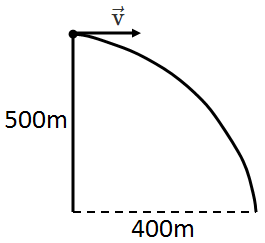
A $100kg$ gun fires a ball of $1kg$ horizontally from a cliff of height $500m$. It falls on the ground at a distance of $400m$ from the bottom of the cliff. Find the recoil velocity of the gun. (acceleration due to gravity $= 10m s^{–2}$)
Answer


Main concept used: Speed of recoil of the gun can be find out by the velocity of the ball by projectiles formulae.
Solution: Let the horizontal speed of the ball is $\mu\text{ms}^{-1}$ its vertical component will be zero. Consider the motion of ball vertically downward
$\mu=0,\ \text{s}=\text{h}=500\text{m},\ \text{g}=10\text{sm}^{-2}$
$\text{s}=\mu\text{t}+\frac{1}{2}\text{at}^2$
$500=\text{a}\times\text{t}+\frac{1}{2}\times10\text{t}^2\Rightarrow\text{t}^2=\frac{500}{5}=100$
$\text{t}=\sqrt{100}=10\sec$
Horizontal range $=\mu\times10$
$400=\text{u}\times10\Rightarrow\text{u}=40\text{m/ sec}$
By the law of conservation of momentum
$\text{m}_\text{b}\text{u}_\text{b}+\text{M}_\text{G}\text{u}_\text{g}=\text{m}_\text{b}\text{v}_\text{b}+\text{M}_\text{G}\text{v}_\text{G}$ [Here $m_b$ = mass of ball, $M_g$ = Mass of gun, $u_b$ = initial velocity of ball, $v_b$ = final velocity of ball, $v_g$ = final velocity of gun]
$\Rightarrow\text{m}_\text{b}\times0+\text{M}_\text{G}\times0=1\times40+100\text{v}_\text{G}$
$100\text{v}_\text{G}=-40$
Recoil velocity of Gun $=\frac{-40}{100}\text{ms}^{-1}=\frac{-2}{5}\text{ms}^{-1}=-0.4\text{ms}^{-1}$ i.e opposite to the speed of ball.
View full question & answer