Questions

5 Marks Questions

Take a timed test

22 questions · self-marked practice — reveal the answer and mark yourself.

Question 15 Marks
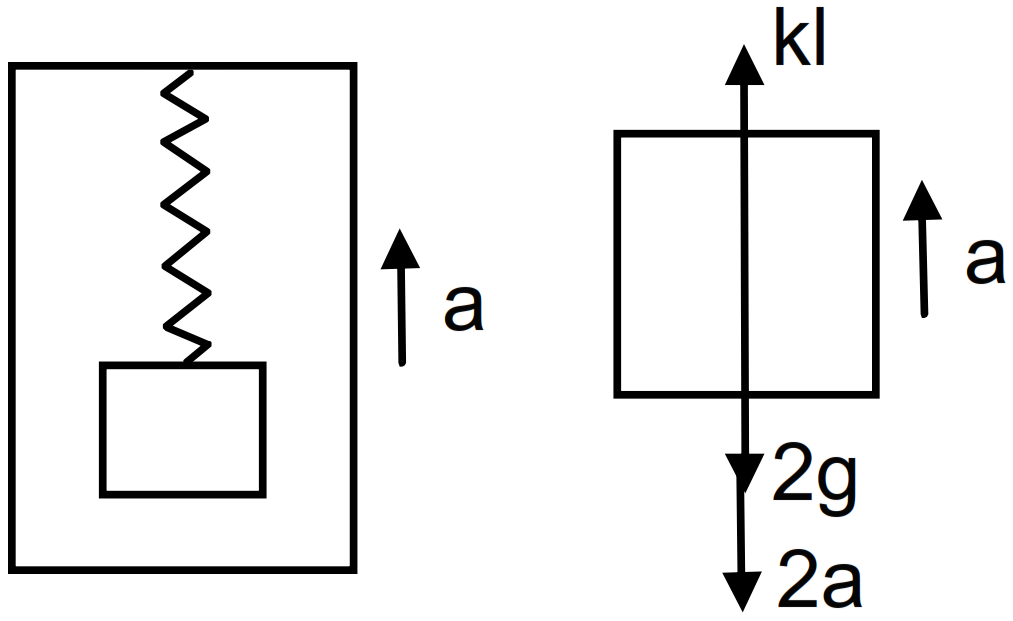
Suppose the ceiling in the previous problem is that of an elevator which is going up with an acceleration of $2.0m/s^2$. Find the elongations.
Answer
$a = 2m/s^2 kl - (2g + 2a) = 0 \Rightarrow kl = 2g + 2a = 2 \times 9.8 + 2 \times 2 = 19.6 + 4 = 23.6$$\Rightarrow\text{I}=\frac{23.6}{100}=0.236\text{m}=0.24\text{m}$
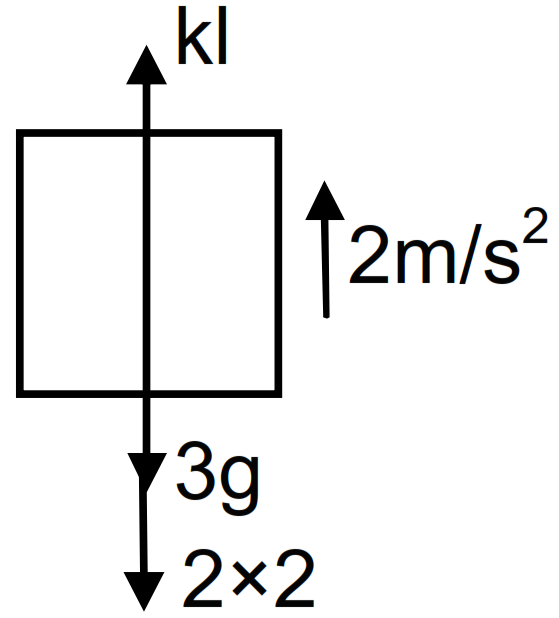
 When 1kg body is added total mass (2 + 1)kg = 3kg. elongation be $l_1 kl_1 = 3g + 3a = 3 \times 9.8 + 6 = 33.4$
$\Rightarrow\text{I}_1=\frac{33.4}{100}=0.0334=0.36$
Further elongation = $l_1 - l = 0.36 - 0.24 = 0.12m$.
View full question & answer
Question 25 Marks
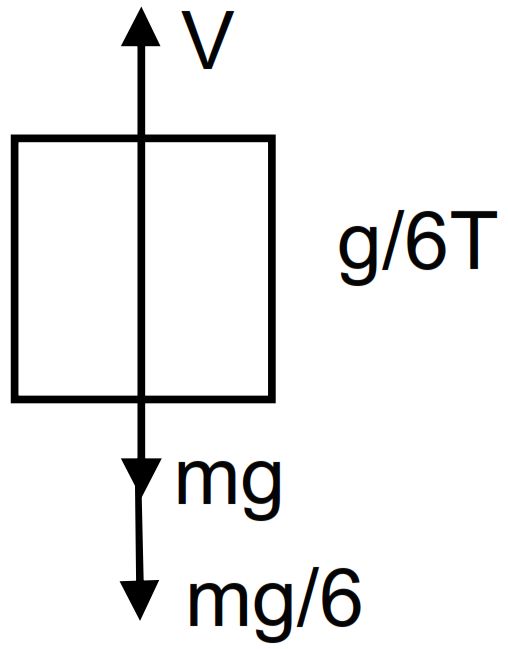
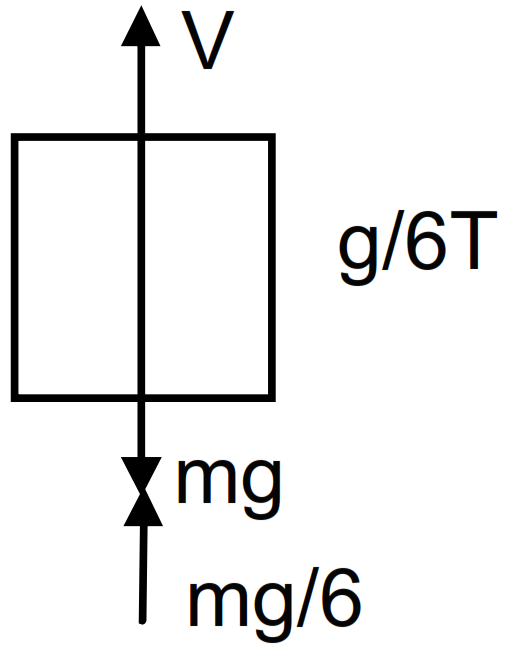
An empty plastic box of mass m is found to accelerate up at the rate of $\frac{\text{g}}{6}$ when placed deep inside water. How much sand should be put inside the box so that it may accelerate down at the rate of $\frac{\text{g}}{6}?$
Answer
When the box is accelerating upward,
$\text{U}-\text{mg}-\text{m}\Big(\frac{\text{g}}{6}\Big)=0$
$\Rightarrow\text{U}=\text{mg}+\frac{\text{mg}}{6}=\text{m}\Big\{\text{g}+\Big(\frac{\text{g}}{6}\Big)\Big\}=7\frac{\text{mg}}{7} \ ...(\text{i})$
$\Rightarrow\text{m}=\frac{6\text{U}}{7\text{g}}.$
When it is accelerating downward, let the required mass be M.$\text{U}-\text{Mg}+\frac{\text{Mg}}{6}=0$
$\Rightarrow\text{U}=\frac{6\text{Mg}-\text{Mg}}{6}=\frac{5\text{Mg}}{6}\Rightarrow\text{M}=\frac{6\text{U}}{5\text{g}}$
Mass to be added $=\text{M}-\text{m}=\frac{6\text{U}}{5\text{g}}-\frac{6\text{U}}{7\text{g}}=\frac{6\text{U}}{\text{g}}\Big(\frac{1}{5}-\frac{1}{7}\Big)$
$=\frac{6\text{U}}{\text{g}}\Big(\frac{2}{35}\Big)=\frac{12}{35}\Big(\frac{\text{U}}{\text{g}}\Big)$
$=\frac{12}{35}\Big(\frac{7\text{mg}}{6}\times\frac{1}{\text{g}}\Big)$ from (i)
$=\frac{2}{5}\text{m}.$
$\therefore$ The mass to be added is $\frac{2\text{m}}{5}.$
View full question & answer
Question 35 Marks
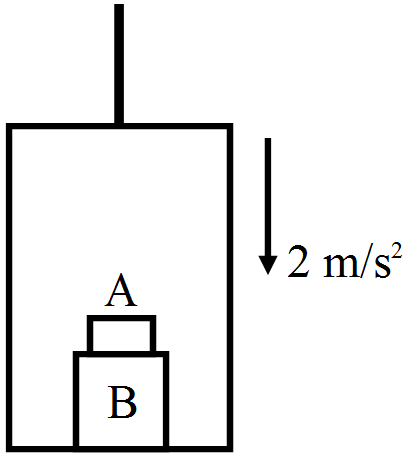
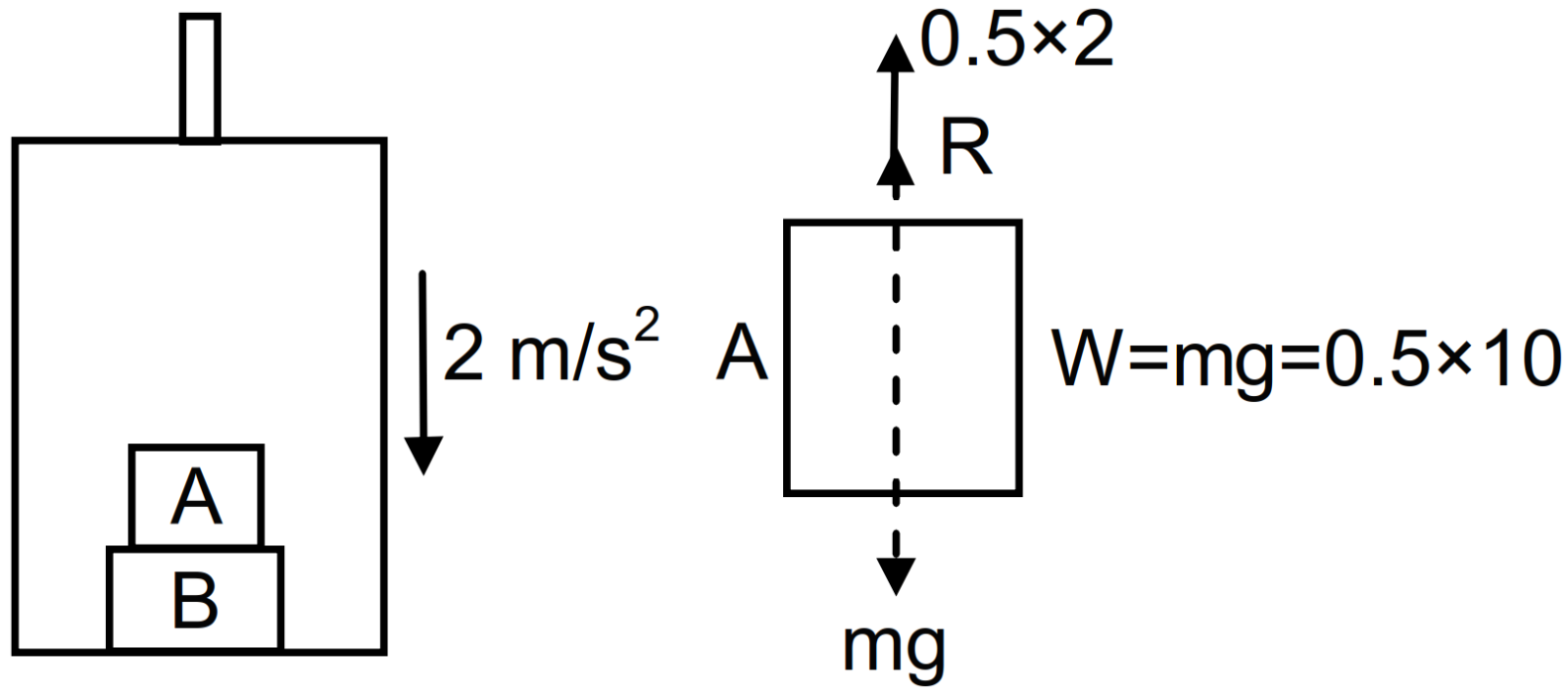
The elevator shown in figure is descending with an acceleration of $2m/s^2$. The mass of the block A is 0.5kg. What force is exerted by the block A on the block B?
Answer
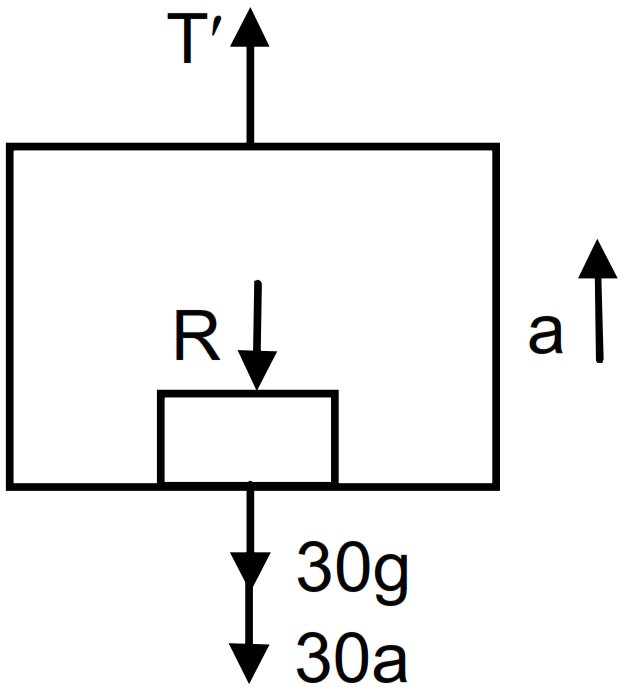
From the free body diagram$\therefore$ R + 0.5 × 2 - w = 0
⇒ R = w - 0.5 × 2 ⇒ 0.5 (10 - 2) = 4N. So, the force exerted by the block A on the block B, is 4N.
View full question & answer
Question 45 Marks
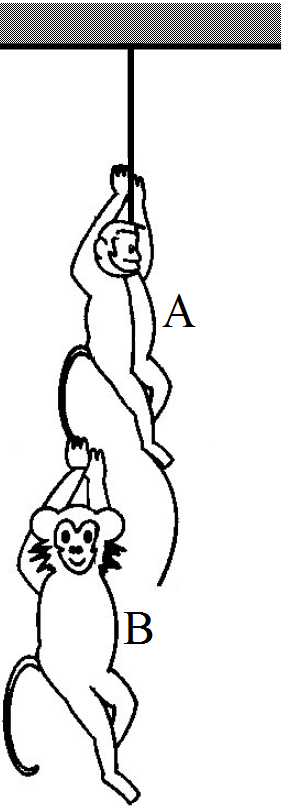
The monkey B shown in figure is holding on to the tail of the monkey A which is climbing up a rope. The masses of the monkeys A and B are 5kg and 2kg respectively. If A can tolerate a tension of 30N in its tail, what force should it apply on the rope in order to carry the monkey B with it? Take $g = 10m/s^2$​​​​​​​
Answer
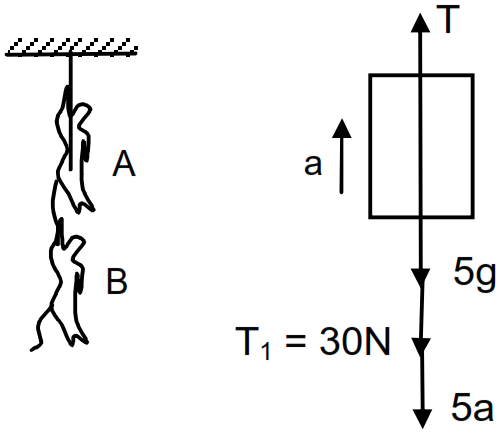
Suppose A move upward with acceleration a, such that in the tail of A maximum tension 30N produced.

$T - 5g - 30 - 5a = 0 ...(i)$
$\Rightarrow T = 50 + 30 + (5 \times 5)$
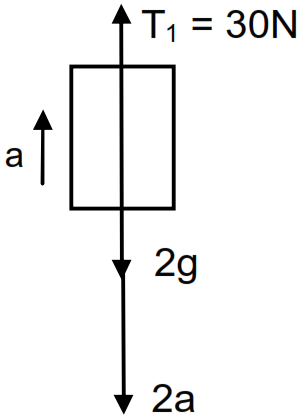
$= 105N (max) 30 - 2g - 2a = 0 ...(ii)$
$\Rightarrow 30 - 20 - 2a = 0$
$\Rightarrow a = 5m/s^2$​​​​​​​
So, A can apply a maximum force of 105N in the rope to carry the monkey B with it. For minimum force there is no acceleration of monkey ‘A’ and B.
⇒ a = 0 Now equation $(ii) is T'_1 - 2g = 0$
$\Rightarrow T'_1 = 20N$ (wt. of monkey B) Equation (i)
is $T - 5g - 20 = 0 [As T'_1 = 20N]$
$\Rightarrow T = 5g + 20 = 50 + 20 = 70N.$
$\therefore$ The monkey A should apply force between 70N and 105N to carry the monkey B with it.
View full question & answer
Question 55 Marks
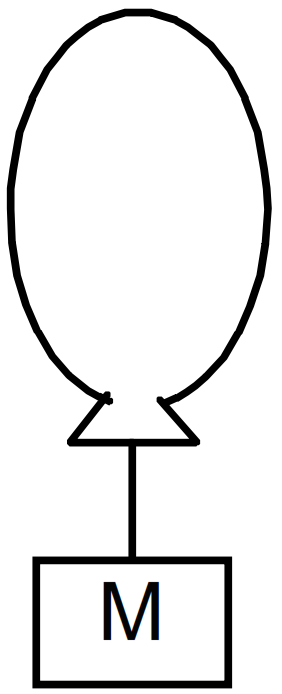
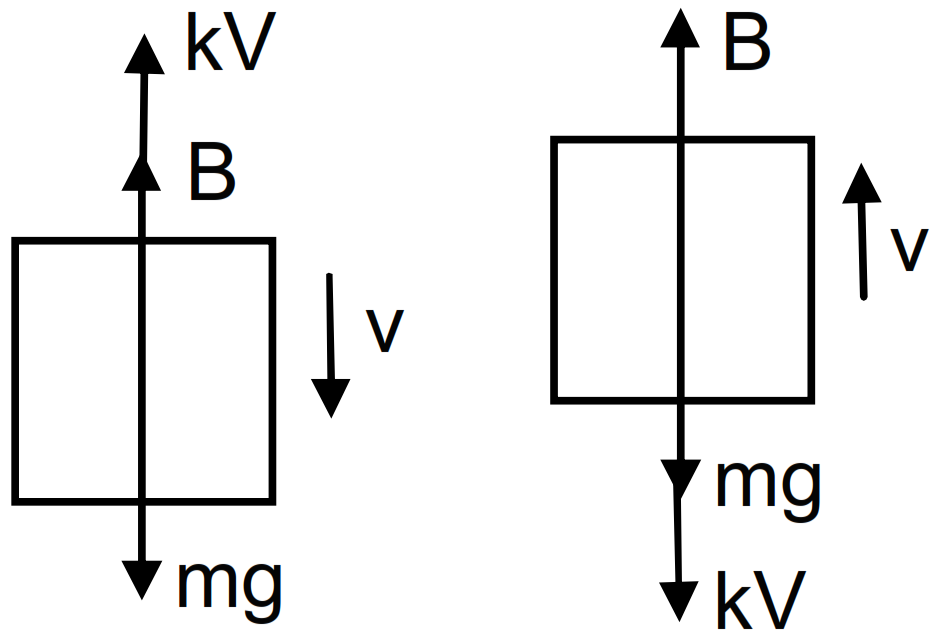
The force of buoyancy exerted by the atmosphere on a balloon is B in the upward direction and remains constant. The force of air resistance on the balloon acts opposite to the direction of velocity and is proportional to it. The balloon carries a mass M and is found to fall down near the earth's surface with a constant velocity v. How much mass should be removed from the balloon so that it may rise with a constant velocity v?
Answer
Let, the air resistance force is F and Buoyant force is B. Given that$\text{F}_{\text{a}}\propto\text{v},$ v where → velocity
⇒ Fa = kv, where k → proportionality constant.
When the balloon is moving downward, B + kv = mg …(i)$\Rightarrow\text{M}=\frac{\text{B + kv}}{\text{g}}$
For the balloon to rise with a constant velocity v, (upward) let the mass be m Here, B - (mg + kv) = 0 …(ii) ⇒ B = mg + kv$\Rightarrow\text{m}=\frac{\text{B}-\text{kw}}{\text{g}}$
So, amount of mass that should be removed = M - m.$=\frac{\text{B + kv}}{\text{g}}-\frac{\text{B}-\text{kv}}{\text{g}}=\frac{\text{B + kv}-\text{B + kv}}{\text{g}}=\frac{2\text{kv}}{\text{g}}\\=\frac{2(\text{Mg}-\text{B})}{\text{G}}=2\Big\{\text{M}-\Big(\frac{\text{B}}{\text{g}}\Big)\Big\}$
View full question & answer
Question 65 Marks
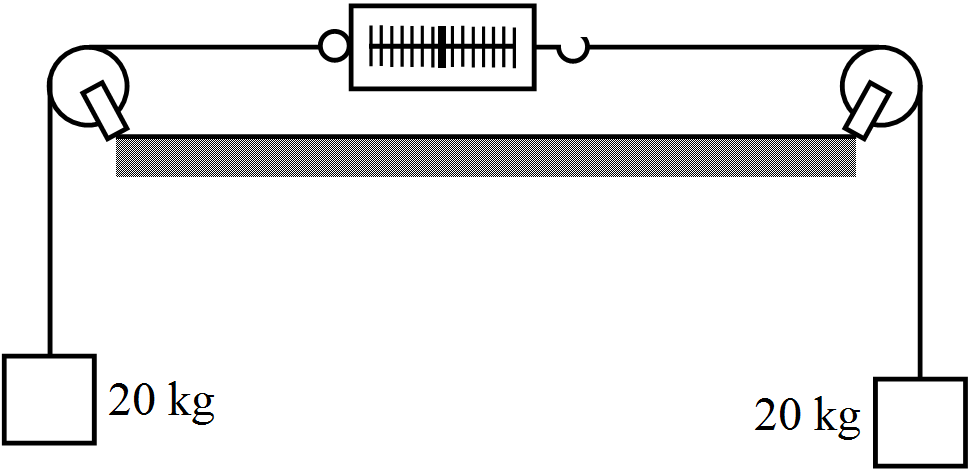
Figure shows a light spring balance connected to two blocks of mass 20kg each. The graduations in the balance measure the tension in the spring.
  1. What is the reading of the balance?
  2. Will the reading change if the balance is heavy, say 2.0kg?
  3. What will happen if the spring is light but the blocks have unequal masses?
Answer
  1.  

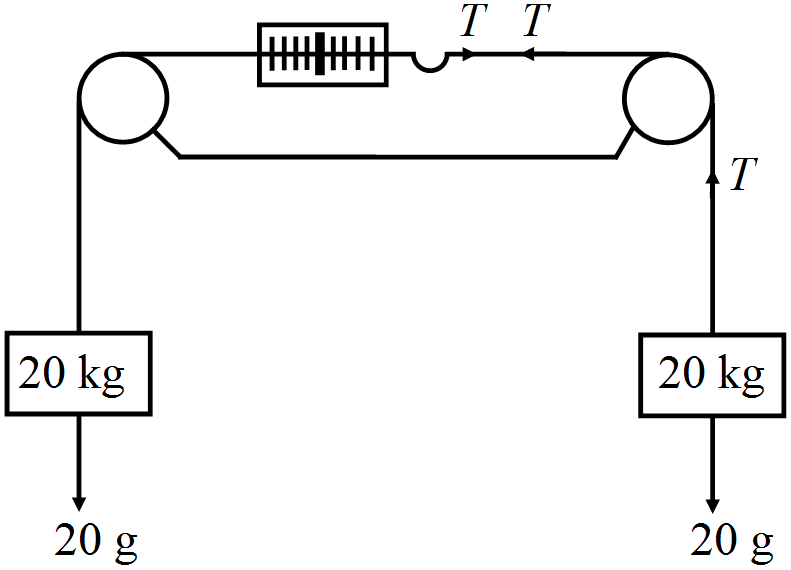
The reading of the balance = Tension in the string
And tension in the string = 20g
So, the reading of the balance = 20g = 200N
  1. If the balance is heavy, the reading will not change because the weight of spring balance does not affect the tension in the string.
  2. If the blocks have unequal masses, the spring balance will accelerate towards the heavy block with an acceleration a. Then the reading will be equal to the tension in the string.
Suppose $m_1 > m_2$.
Then tension in the string,
$\text{T}=\frac{2\text{m}_1\text{m}_2\text{g}}{\text{m}_1+\text{m}_2}$
View full question & answer
Question 75 Marks
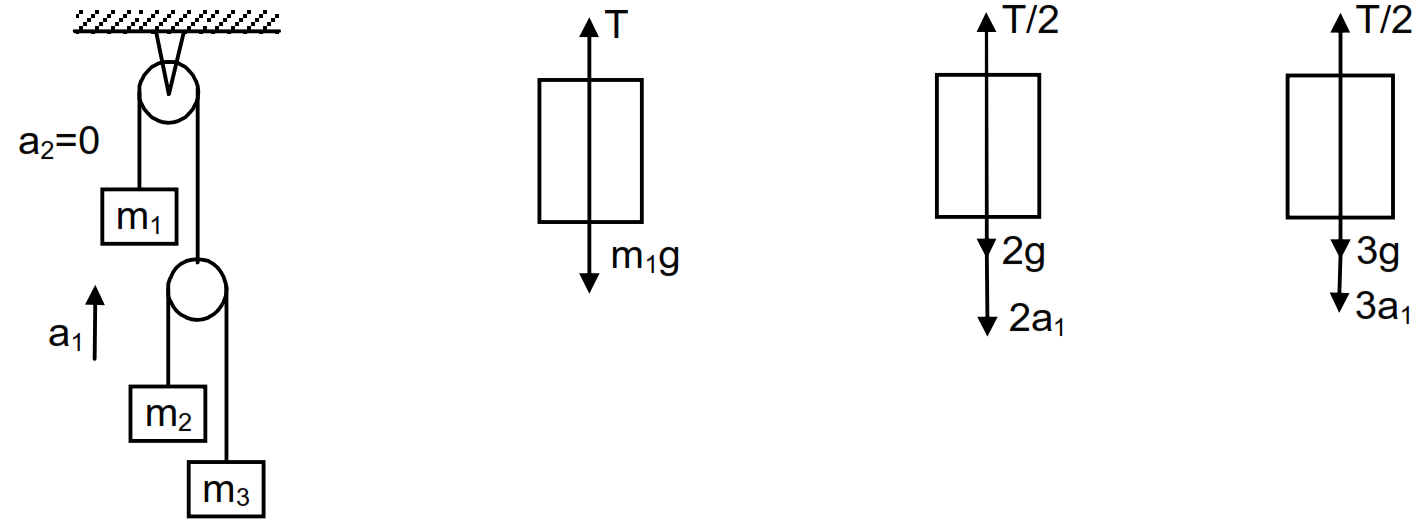
In the previous problem, suppose $m_2 = 2.0kg$ and $m_3 = 3.0kg$. What should be the mass m so that it remains at rest?
Answer


$m_1$ should be at rest.
$\text{T}-\text{m}_1\text{g}=0$
$\Rightarrow\text{T}=\text{m}_1\text{g} \ ...(\text{i})$
$\frac{\text{T}}{2}-2\text{g}-2\text{a}_1=0$
$\Rightarrow\text{T}-4\text{g}-4\text{a}_1=0 \ ...(\text{ii})$
$\frac{\text{T}}{2}-3\text{g}-3\text{a}_1=0$
$\Rightarrow\text{T}=6\text{g}-6\text{a}_1 \ ...(\text{iii})$
From eqn (ii) & (iii) we get
$3\text{T}-12\text{g}=12\text{g}-2\text{T}\Rightarrow\text{T}=\frac{24\text{g}}{5}=408\text{g}.$
Putting yhe value of T eqn (i) we get, $m_1 = 4.8kg$.
View full question & answer
Question 85 Marks
Consider the Atwood machine of the previous problem. The larger mass is stopped for a moment $2.0s$ after the system is set into motion. Find the time elapsed before the string is tight again.
Answer
$a = 3.26m/s^2 T = 3.9N$ After 2sec mass $m_1$_ the velocity $V = u + at = 0 + 3.26 \times 2 = 6.52m/s$ upward. At this time $m_2$_ is moving 6.52m/s downward. At time 2sec, $m_2$_ stops for a moment. But $m_1$​​​​​​​ is moving upward with velocity $6.52m/s$. It will continue to move till final velocity (at highest point) because zero. Here,$ v = 0; u = 6.52 A = -g = -9.8m/s^2$​​​​​​​^ [moving up ward $m_1] V = u + at \Rightarrow 0 = 6.52 + (-9.8)t$$\Rightarrow\text{t}=\frac{6.52}{9.8}=0.66=\frac{2}{3}\text{sec}.$
During this period $\frac{2}{3}$sec, $m_2$ mass also starts moving downward. So the string becomes tight again after a time of $\frac{2}{3}$sec.​​​​​​​
View full question & answer
Question 95 Marks
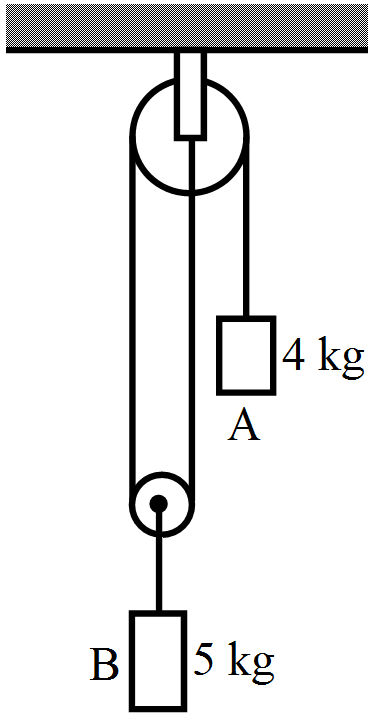
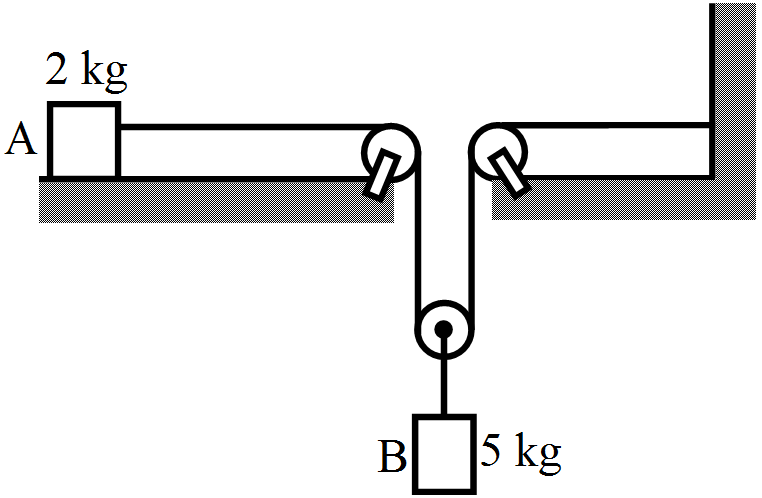
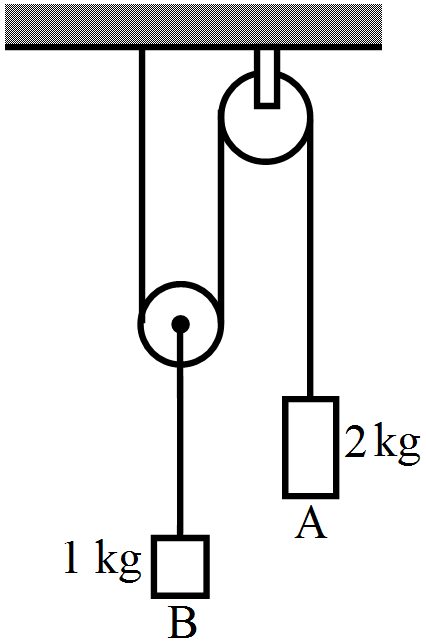
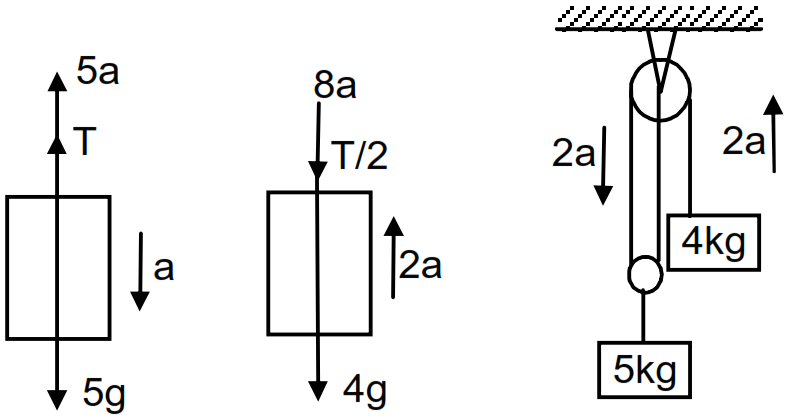
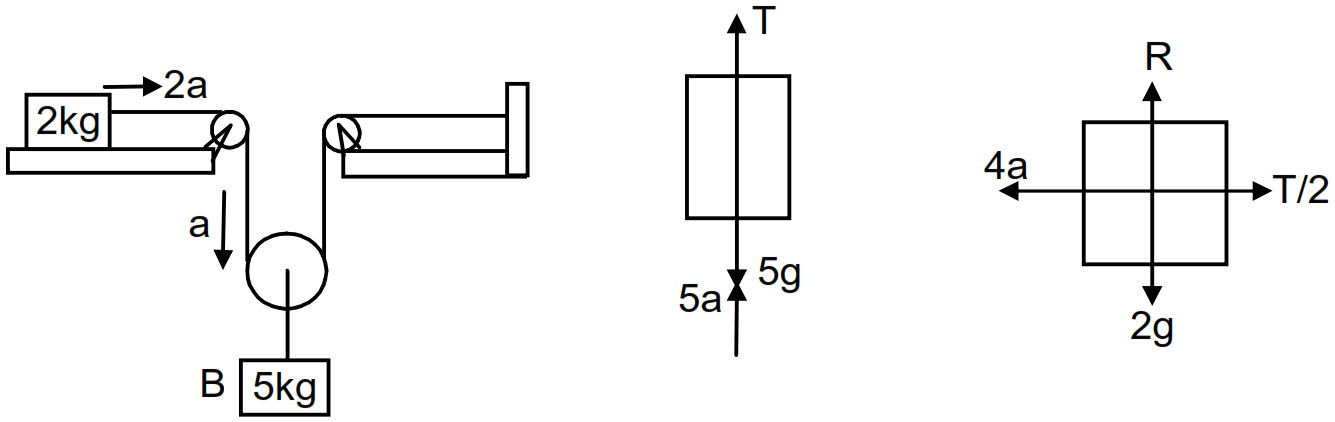
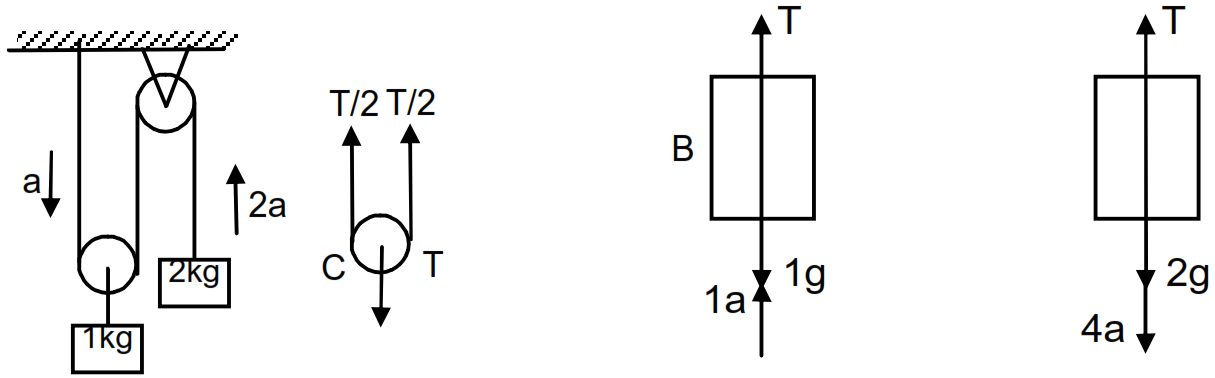
Find the acceleration of the blocks A and B in the three situations shown in figure.


Answer

  1. $5\text{a + T}-5\text{g}=0\Rightarrow\text{T}=5\text{g}-5\text{a} \ ...(\text{i})$ (From FBD - 1)
Again $\Big(\frac{1}{2}\Big)-4\text{g}-8\text{a}=0\Rightarrow\text{T}=8\text{g}-16\text{a} \ ...(\text{ii})$ (From FBD - 2)

From equn (i) and (ii), we get

$\text{5g}-5\text{a}=8\text{g}+16\text{a}\Rightarrow21\text{a}=-3\text{g}\Rightarrow\text{a}=-\frac{1}{7}\text{g}$

So, acceleration of 5kg mass is $\frac{\text{g}}{7}$ upward and that of 4kg mass is $2\text{a}=\frac{2\text{g}}{7}$ (downward).
  1.  


$4\text{a}-\frac{\text{t}}{2}=0\Rightarrow8\text{a}-\text{T}=0\Rightarrow\text{T = 8a} \ ...(\text{ii})$ [from FBD - 4]

Again, $\text{T + 5a}-5\text{g}=0\Rightarrow8\text{a + 5a}-5\text{g}=0$

$\Rightarrow13\text{a}-5\text{g}=0\Rightarrow\text{a =}\frac{5\text{g}}{13}$ downward. (from FBD - 3)

Acceleration of mass
  1. $\text{kg is 2a}=\frac{10}{13}(\text{g}) \ \& \ 5\text{kg}$
  2. is $\frac{5\text{g}}{13}.$
  1.  


$\text{T + 1a}-1\text{g}=0\Rightarrow\text{T = 1g}-1\text{a} \ ...(\text{i})$ [From FBD - 5]

Again, $\frac{\text{T}}{2}-2\text{g}-4\text{a}=0\Rightarrow\text{T}-4\text{g}-8\text{a}=0 \ ...(\text{ii})$ [From FBD - 6]

$\Rightarrow1\text{g}-1\text{a}-4\text{g}-8\text{a}=0$ [From (i)]

$\Rightarrow\text{a}=-\Big(\frac{\text{g}}{3}\Big)$ downward.

Acceleration of mass 1kg(b) is $\frac{\text{g}}{3}\text{(up)}$

Acceleration of mass 2kg(A) is $\frac{2\text{g}}{3}$ (downward).
View full question & answer
Question 105 Marks
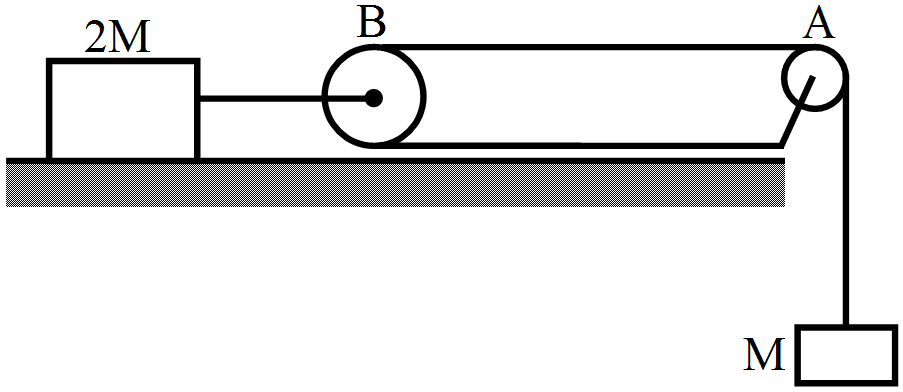
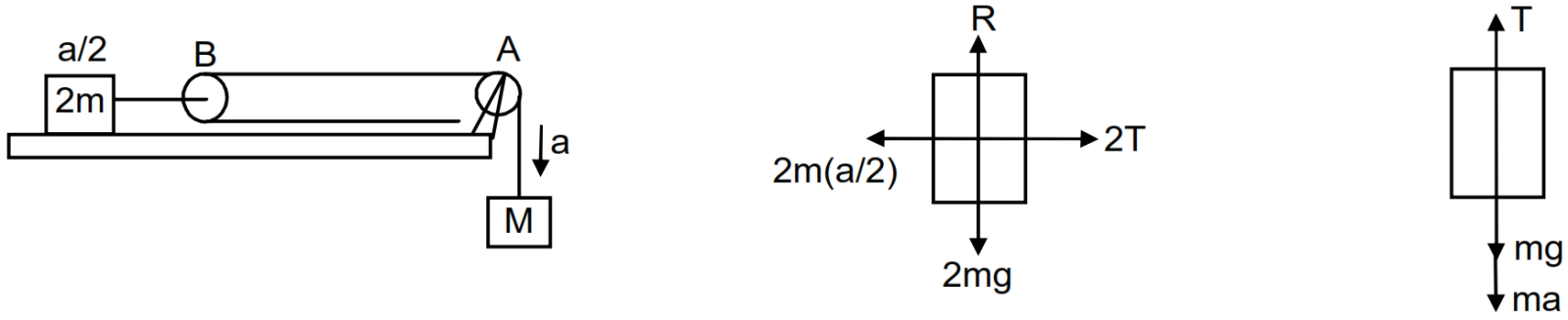
Consider the situation shown in figure. Both the pulleys and the string are light and all the surfaces are frictionless.
  1. Find the acceleration of the mass M.
  2. Find the tension in the string.
  3. Calculate the force exerted by the clamp on the pulley A in the figure.
Answer


$\text{Ma}-2\text{T}=0$
$\Rightarrow\text{Ma = 2T}\Rightarrow\text{T} = \frac{\text{Ma}}{2}.$
$\text{T + Ma}-\text{Mg}=0$
$\Rightarrow\frac{\text{Ma}}{2}+\text{ma = Mg}.$ $\Big(\text{because = T}=\frac{\text{Ma}}{2}\Big)$
$\Rightarrow3\text{Ma = 2Mg}\Rightarrow\text{a}=\frac{2\text{g}}{3}$
  1. acceleration of mass M is $\frac{2\text{g}}{3}.$
  2. Tension $\text{T}=\frac{\text{Ma}}{2}=\frac{\text{M}}{2}=\frac{2\text{g}}{3}=\frac{\text{Mg}}{3}$
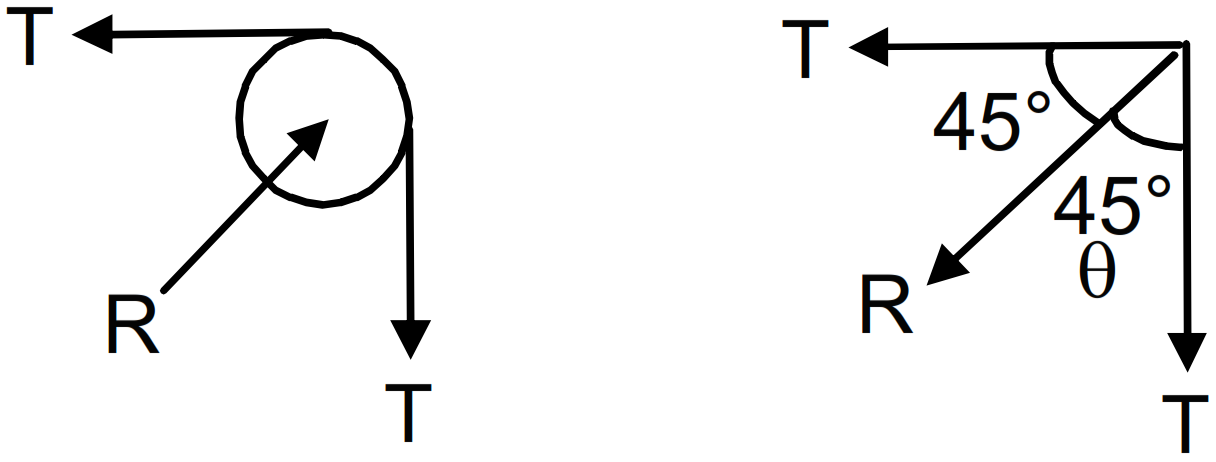
  3. Let, $R^1$ = resultant of tensions = force exerted by the clamp on the pulley


$\text{R}^1=\sqrt{\text{T}^2+\text{T}^2}=\sqrt{2}\text{T}$
$\therefore\text{R}=\sqrt{2}\text{T}=\sqrt{2}\frac{\text{Mg}}{3}=\frac{\sqrt{2}\text{Mg}}{3}$
Again, $\tan\theta=\frac{\text{T}}{\text{T}}=1\Rightarrow\theta=45^{\circ}.$
So, it is $\frac{\sqrt{2}\text{Mg}}{3}$ at an angle of 45° with horizontal.
View full question & answer
Question 115 Marks
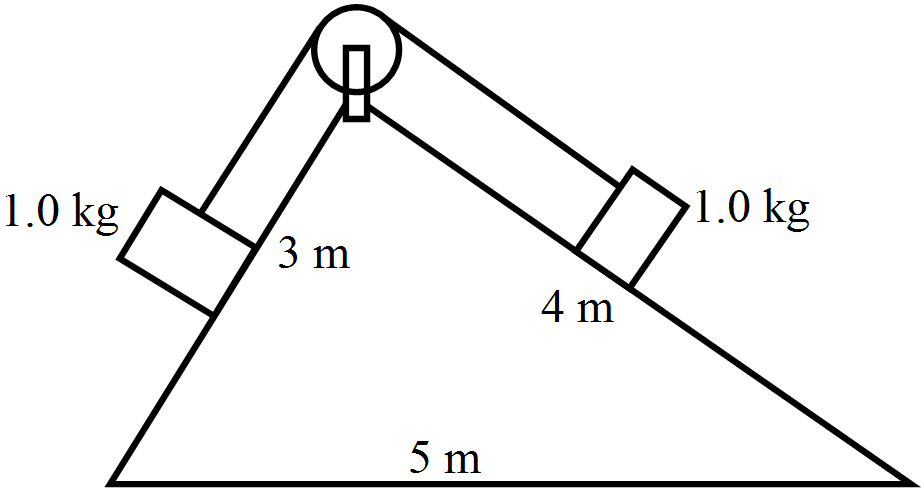
Consider the situation shown in figure. All the surfaces are frictionless and the string and the pulley are light. Find the magnitude of the acceleration of the two blocks.
Answer

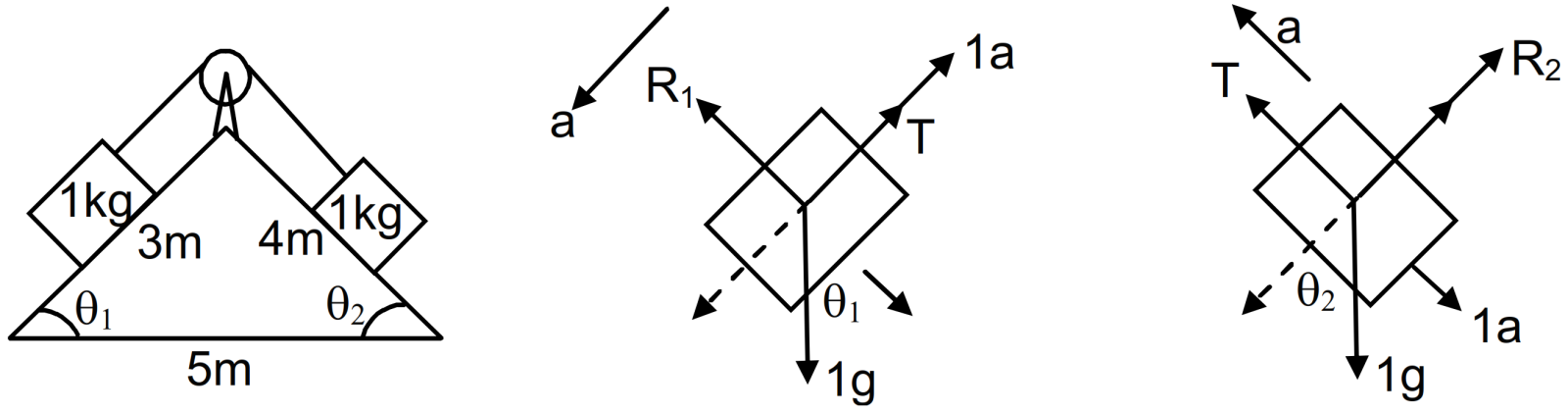
$\sin\theta_1=\frac{4}{5}$
$\sin\theta_2=\frac{3}{5}$
$\text{g}\sin\theta_1-(\text{a + T})=0$
$\Rightarrow\text{g}\sin\theta_1=\text{a + T} \ ...(\text{i})$
$\Rightarrow\text{T + a}-\text{g}\sin\theta_1=0$
$\text{T}-\text{g}\sin\theta_2-\text{a}=0$
$\Rightarrow\text{T = g}\sin\theta_2+\text{a} \ ...(\text{ii})$
$\Rightarrow\text{T + a}-\text{g}\sin\theta_1=0$
From eqn (i) and (ii)
$\text{g}\sin\theta_2+\text{a + a}-\text{g}\sin\theta_1=0$
$\Rightarrow2\text{a = g}\sin\theta_1-\text{g}\sin\theta_2=\text{g}\Big(\frac{4}{5}-\frac{3}{5}\Big)=\frac{\text{g}}{5}$
$\Rightarrow\text{a}=\frac{\text{g}}{5}\times\frac{1}{2}=\frac{\text{g}}{10}$
View full question & answer
Question 125 Marks
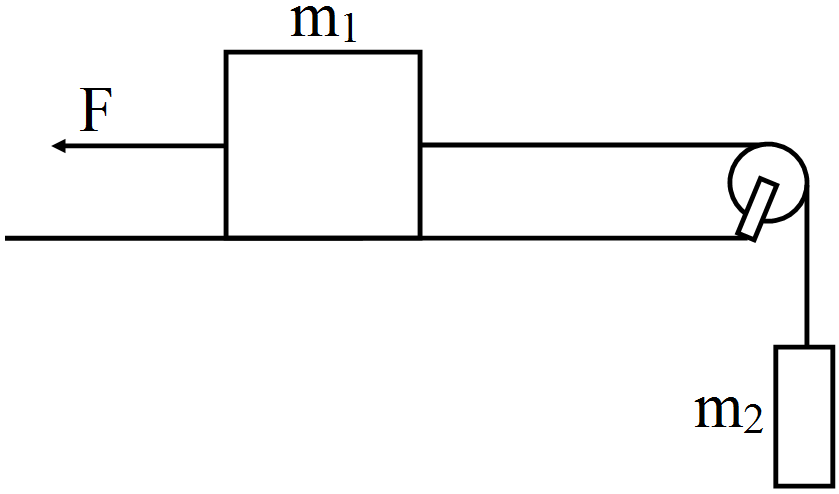
A constant force $\text{F}=\frac{\text{m}_2\text{g}}{2}$ is applied on the block of mass $m_1$ as shown in figure. The string and the pulley are light and the surface of the table is smooth. Find the acceleration of $m_1$.
Answer


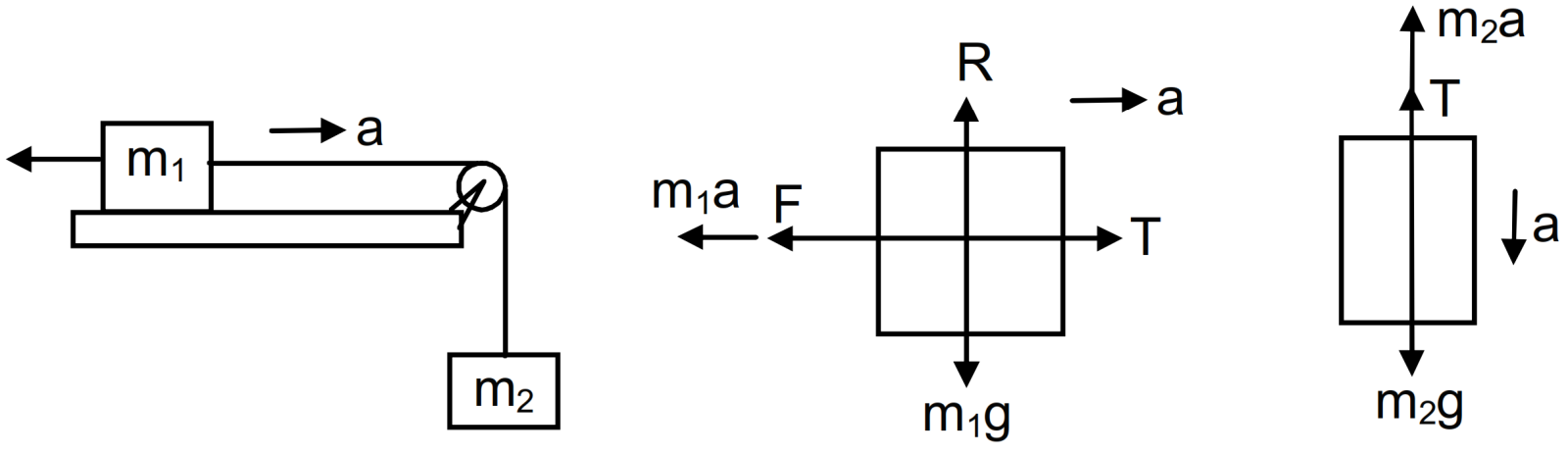
From the above Free body diagram
$\text{M}_1\text{a + F}-\text{T}=0\Rightarrow\text{T = m}_1\text{a + F} \ ...(\text{i})$
From the above Free body diagram
$\text{m}_2\text{a + T}-\text{m}_2\text{g}= 0 \ ...(\text{ii})$
$\Rightarrow\text{m}_2\text{a}+\text{m}_1\text{a}+\text{F}-\text{m}_2\text{g}=0$ (from (i))
$\Rightarrow\text{a(m}_1+\text{m}_2)+\frac{\text{m}_2\text{g}}{2}-\text{m}_2\text{g}=0$ $\Big\{\text{because f }=\frac{\text{m}^2\text{g}}{2}\Big\}$
$\Rightarrow\text{a}(\text{m}_1+\text{m}_2)-\text{m}_2\text{g}=0$
$\Rightarrow\text{a}(\text{m}_1+\text{m}_2)=\frac{\text{m}_2\text{g}}{2}\Rightarrow\text{a}\frac{\text{m}_2\text{g}}{2(\text{m}_1=\text{m}_2)}$
Acceleration of mass $m_1$ is $\frac{\text{m}_2\text{g}}{2(\text{m}_1 = \text{ m}_2)}$ towards right.
View full question & answer
Question 135 Marks
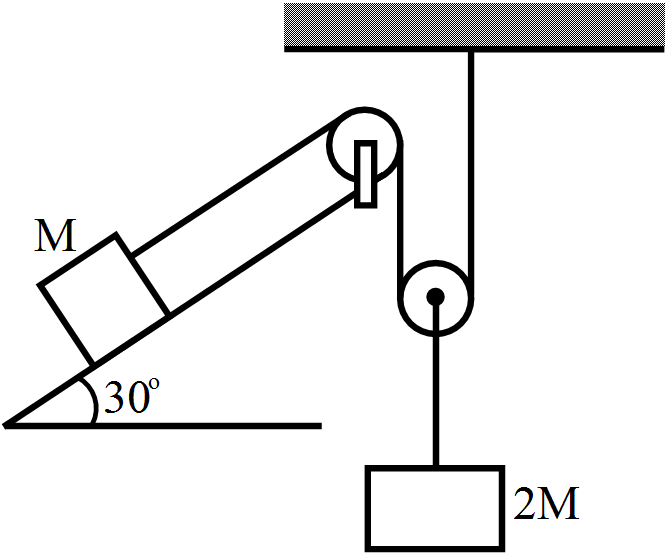
Find the acceleration of the block of mass M in the situation shown in figure. All the surfaces are frictionless and the pulleys and the string are light.
Answer

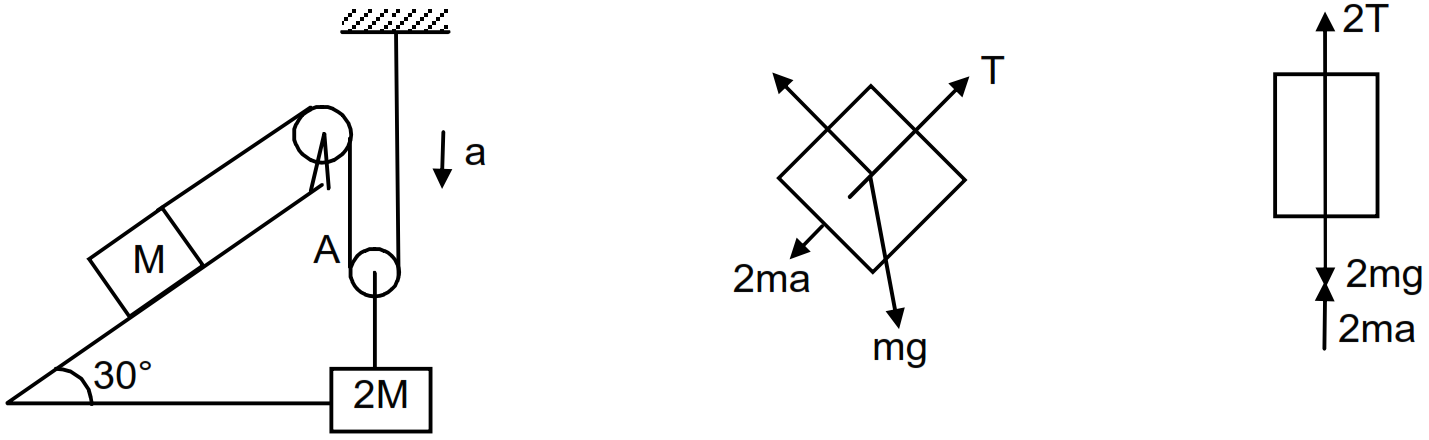
$2\text{Ma + Mg }\sin\theta-\text{T}=0$
$\Rightarrow\text{T = 2Ma + Mg }\sin\theta \ ...(\text{i})$
$2\text{T + 2Ma}-12\text{Mg}=0$
$\Rightarrow2(2\text{Ma + Mg}\sin\theta)+2\text{Ma}-2\text{Mg}=0$ [From (i)]
$\Rightarrow4\text{Ma + 2Mg }\sin\theta+2\text{Ma}-2\text{Mg}=0$
$\Rightarrow6\text{Ma}+2\text{Mg }\sin30^{\circ}-2\text{Mg}=0$
$\Rightarrow6\text{Ma = Mg}\Rightarrow\text{a}=\frac{\text{g}}{6}.$
Acceleration of mass M is $2\text{a = s}\times\frac{\text{g}}{6}=\frac{\text{g}}{3}$ up the plane.
View full question & answer
Question 145 Marks
A pendulum bob of mass $50g$ is suspended from the ceiling of an elevator. Find the tension in the string if the elevator:
  1. Goes up with acceleration $1.2m/s^2$.
  2. Goes up with deceleration $1.2m/s^2$.
  3. Goes up with uniform velocity.
  4. Goes down with acceleration $1.2m/s^2$.
  5. Goes down with deceleration $1.2m/s^2$.
  6. Goes down with uniform velocity.
Answer
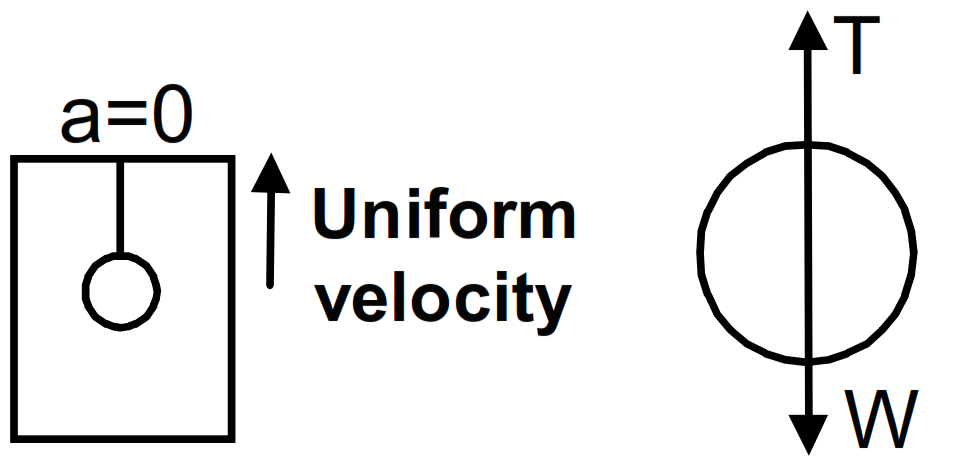
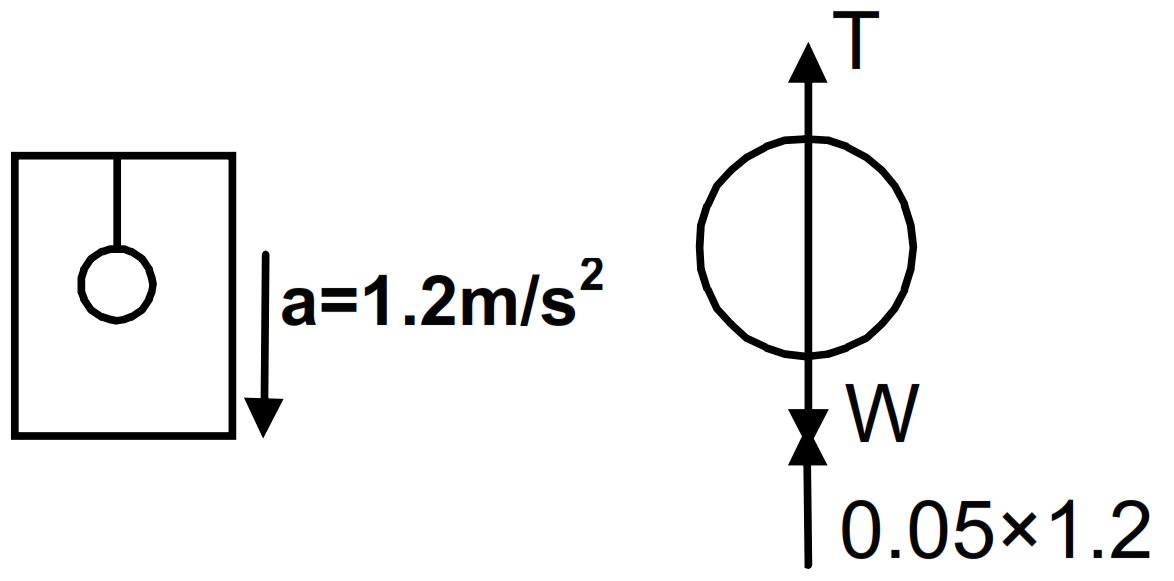
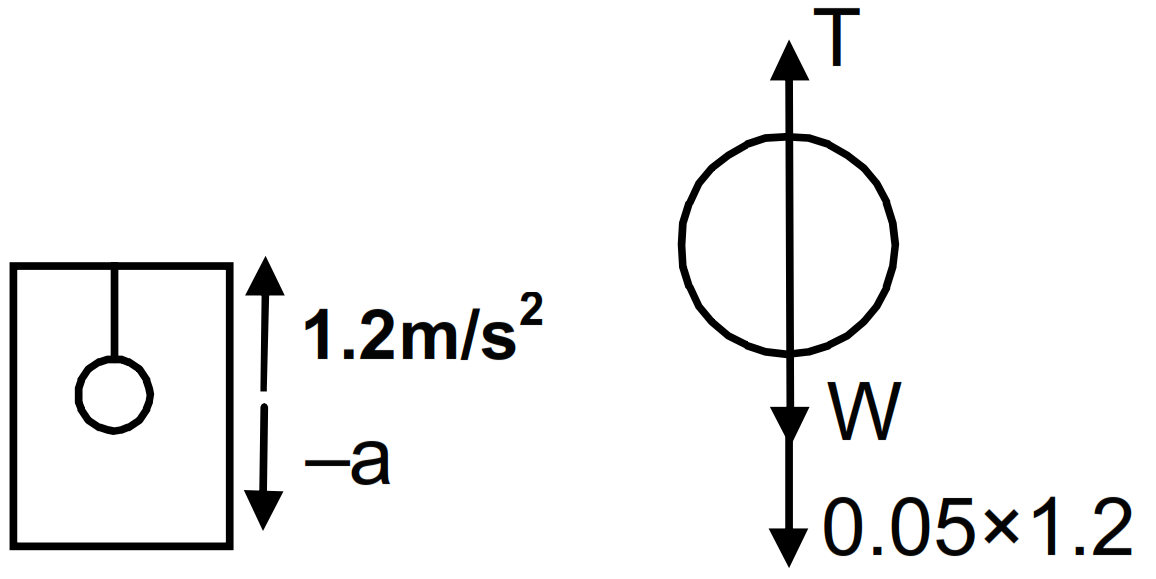
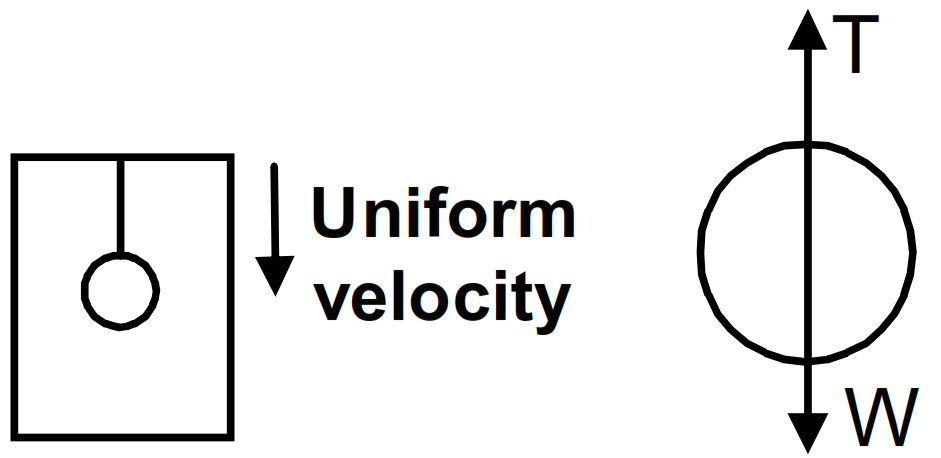
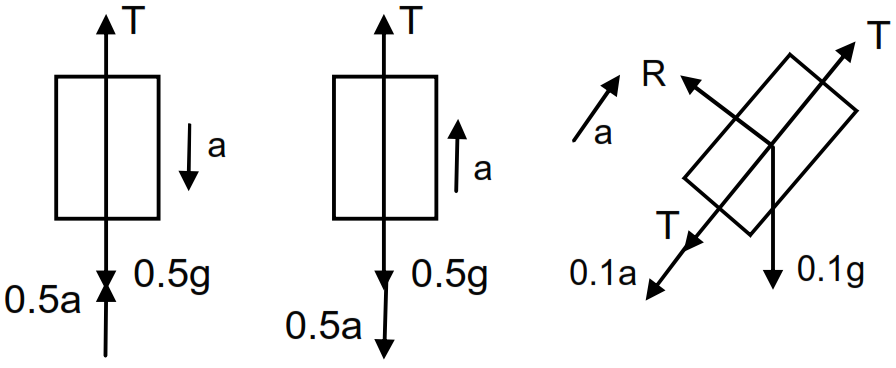
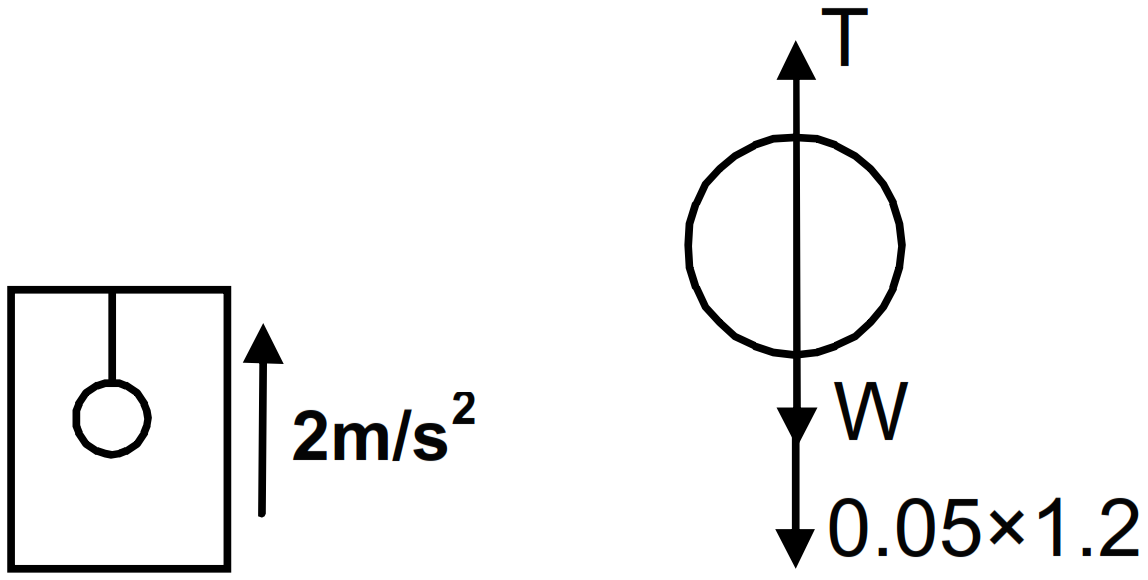
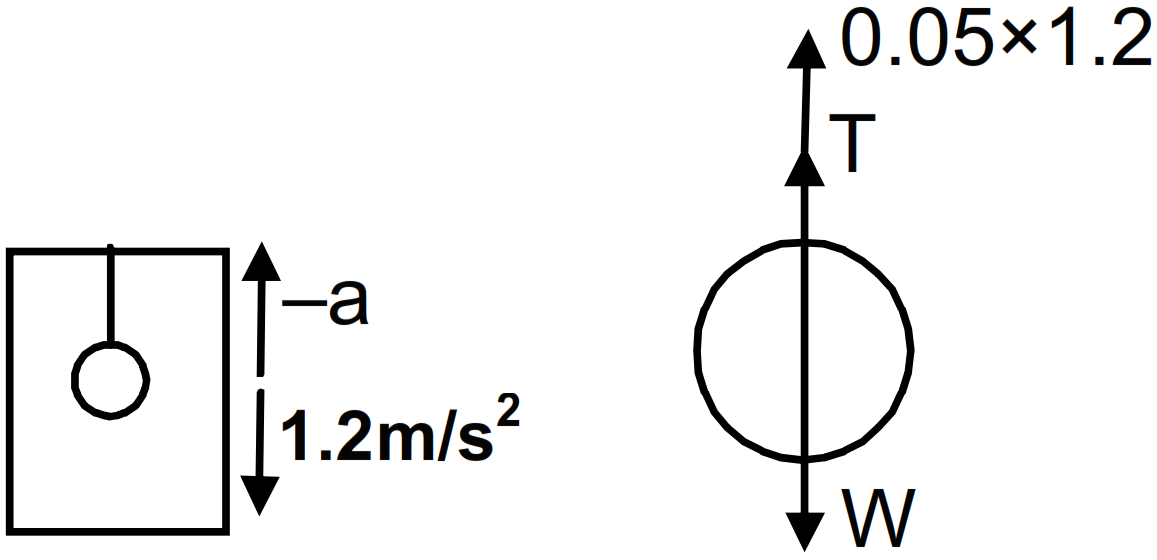
  1. The tension in the string is found out for the different conditions from the free body diagram as shown below.
T - (W + 0.06 × 1.2) = 0

⇒ T = 0.05 × 9.8 + 0.05 × 1.2

= 0.55N.

  1. $\therefore$ T + 0.05 × 1.2 - 0.05 × 9.8 = 0
⇒ T = 0.05 × 9.8 - 0.05 × 1.2

= 0.43N.

  1. When the elevator makes uniform motion
T - W = 0

⇒ T = W = 0.05 × 9.8

= 0.49N

  1. T + 0.05 × 1.2 - W = 0
⇒ T = W - 0.05 × 1.2

= 0.43N.

  1. T - (W + 0.05 × 1.2) = 0
⇒ T = W + 0.05 × 1.2

= 0.55N

  1. When the elevator goes down with uniform velocity acceleration = 0
T - W = 0

⇒ T = W = 0.05 × 9.8

= 0.49N.

View full question & answer
Question 155 Marks
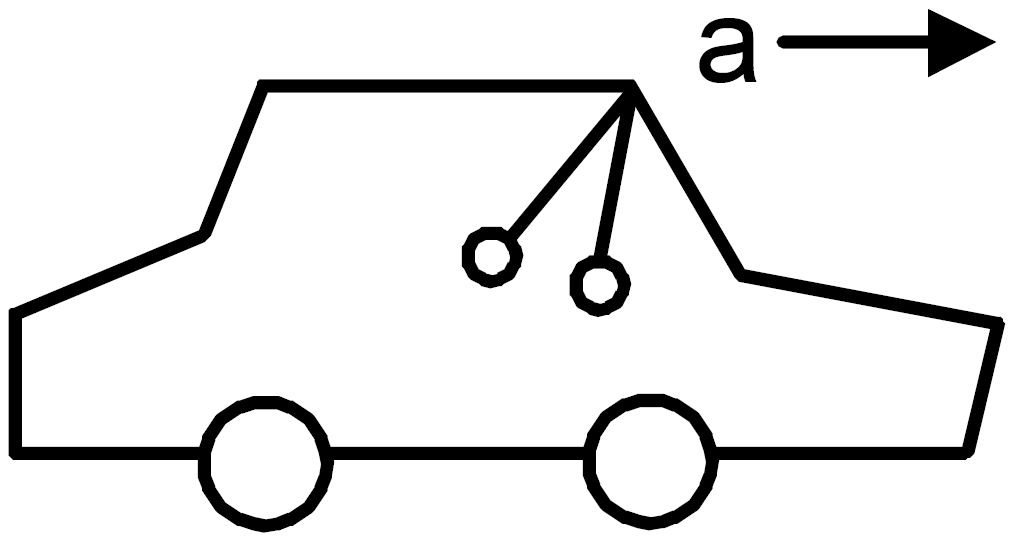
A car is speeding up on a horizontal road with an acceleration a. Consider the following situations in the car.
  1. A ball is suspended from the ceiling through a string and is maintaining a constant angle with the vertical. Find this angle.
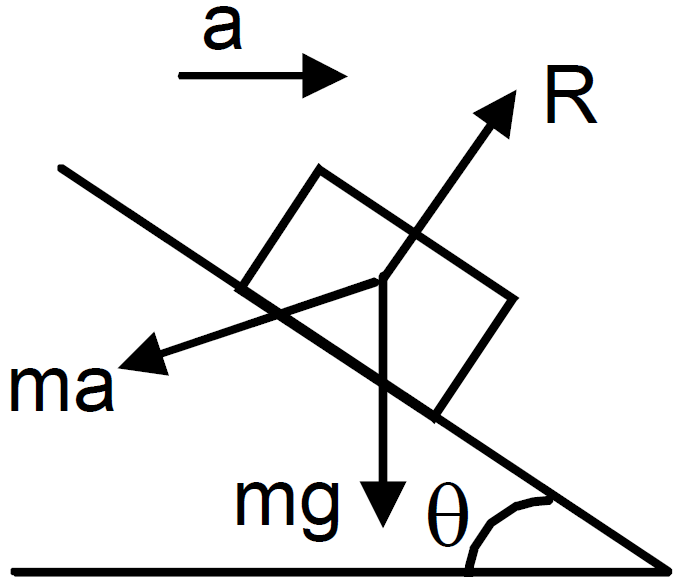
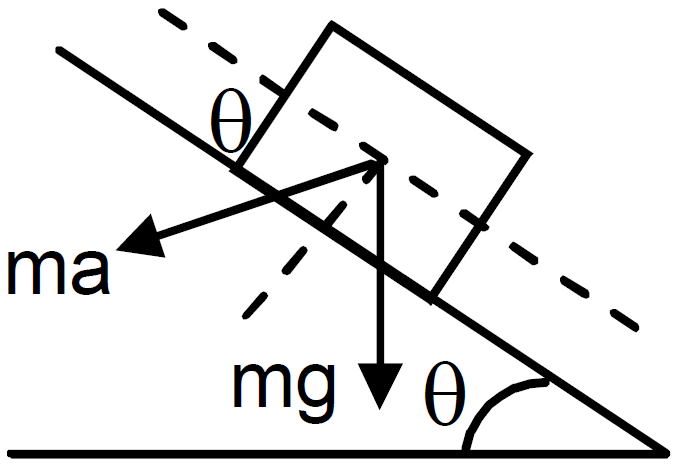
  2. A block is kept on a smooth incline and does not slip on the incline. Find the angle of the incline with the horizontal.
Answer
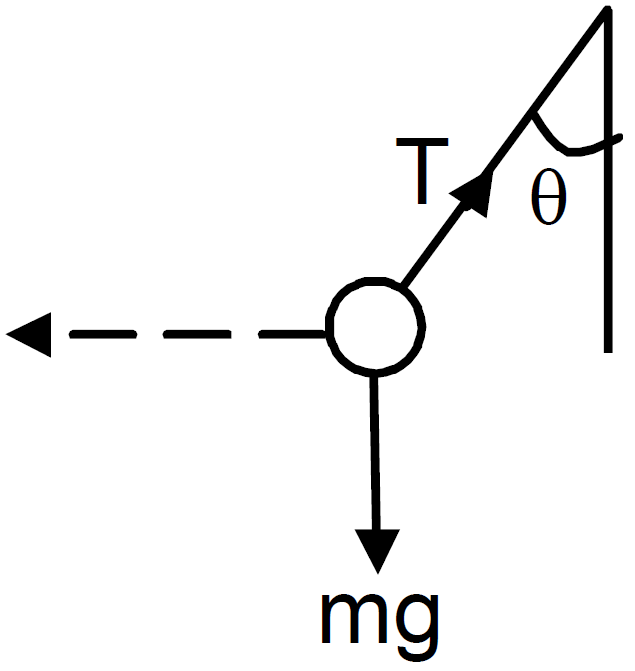
Suppose pendulum makes $\theta$ angle with the vertical. Let, m = mass of the pendulum. From the free body diagram
$\text{T}\cos\theta-\text{mg}=0$
$\Rightarrow\text{T}\cos\theta=\text{mg}$
$\Rightarrow\text{T}=\frac{\text{mg}}{\cos\theta} \ ..(\text{i})$

$\text{ma}-\text{T}\sin\theta=0$
$\Rightarrow\text{ma = T}\sin\theta$
$\Rightarrow\text{t}=\frac{\text{ma}}{\sin\theta}\ ...(\text{ii})$
From (i) and (ii) $\frac{\text{mg}}{\cos\theta}=\frac{\text{ma}}{\sin\theta}\Rightarrow\tan\theta=\frac{\text{a}}{\text{g}}\Rightarrow\theta=\tan^{-1}\frac{\text{a}}{\text{g}}$
The angle is $\tan^{-1}\Big(\frac{\text{a}}{\text{g}}\Big)$ with vertical. m → mass of block. Suppose the angle of incline is $'\theta'$
From the diagram$\text{ma}\cos\theta-\text{mg}\sin\theta=0$
$\Rightarrow\text{ma}\cos\theta=\text{mg}\sin\theta\Rightarrow\frac{\sin\theta}{\cos\theta}=\frac{\text{a}}{\text{g}}$
$\Rightarrow\tan\theta=\frac{\text{a}}{\text{g}}\Rightarrow\theta=\tan^{-1}\Big(\frac{\text{a}}{\text{g}}\Big).$
View full question & answer
Question 165 Marks
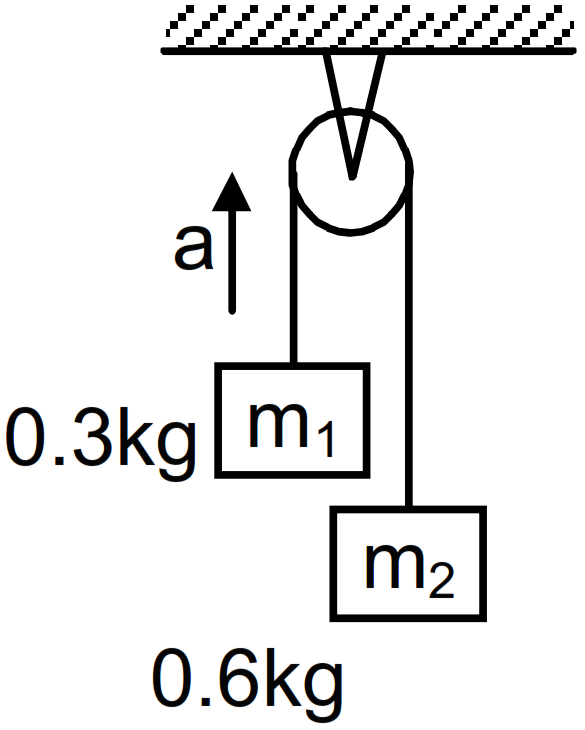
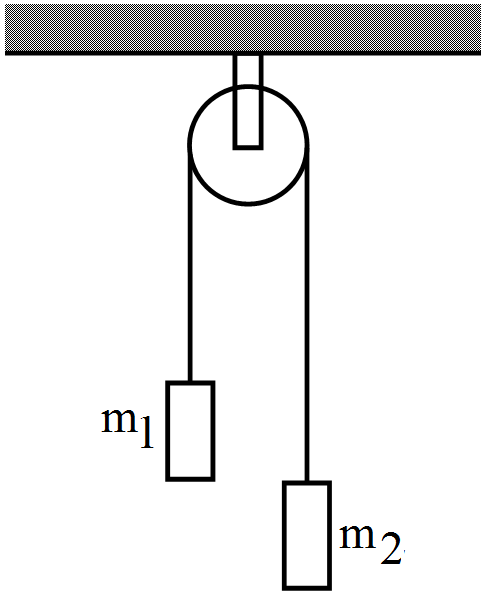
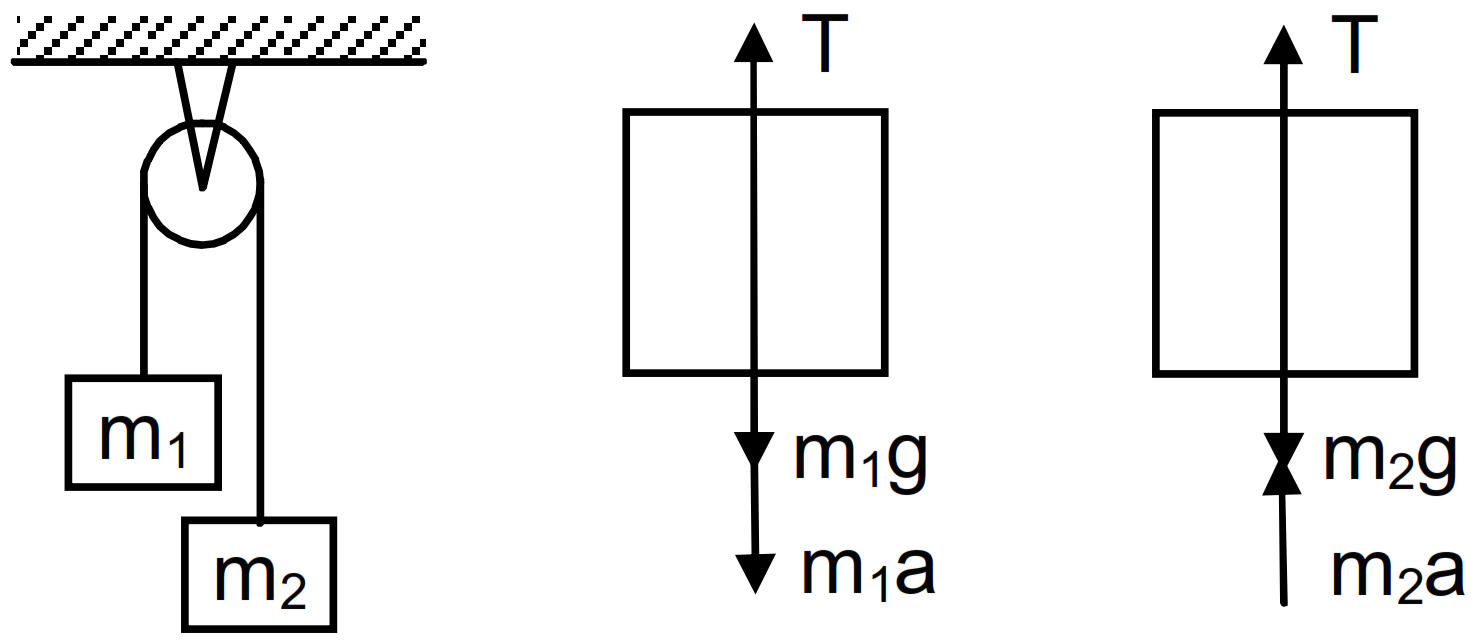
In a simple Atwood machine, two unequal masses $m_1$ and $m_2$ are connected by a string going over a clamped light smooth pulley. In a typical arrangement $m_1 = 300g$ and $m_2 = 600g$. The system is released from rest.
  1. Find the distance travelled by the first block in the first two seconds.
  2. Find the tension in the string.
  3. Find the force exerted by the clamp on the pulley.
Answer


$m_1 = 0.3kg, m_2 = 0.6kg$
$T - (m_1g + m_1a) = 0 …(i)$
$\Rightarrow T = m_1g + m_1a$
$T + m_2a - m_2g = 0 …(ii)$
$\Rightarrow T = m_2g - m_2a$
From equation (i) and equation (ii)
$m_1g + m_1a + m_2a - m_2g = 0$, from (i)
$\Rightarrow a(m_1 + m_2) = g(m_2 - m_1)$
$\Rightarrow\text{a = f}\Big(\frac{\text{m}_2-\text{m}_1}{\text{m}_1-\text{m}_2}\Big)=9.8\Big(\frac{0.6-0.3}{0.6+0.3}\Big)=3.266\text{ms}^{-2}.$
  1. t = 2 sec acceleration $= 3.266 ms^{-2}$​​​​​​​
Initial velocity u = 0
So, distance travelled by the body is,
$\text{S = ut}+\frac{1}{2}\text{at}^2\Rightarrow0+\frac{1}{2}(3.266)2^2=6.5\text{m}$
  1. From $(i) T = m_1(g + a) = 0.3(9.8 + 3.26) = 3.9N$
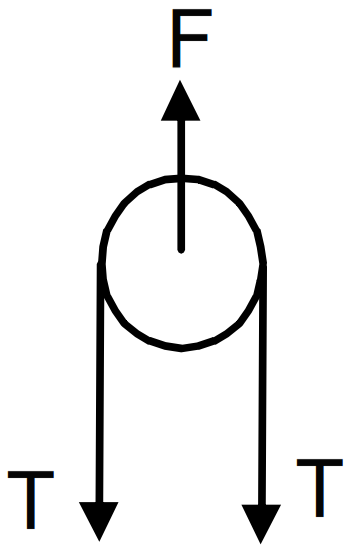
  2. The force exerted by the clamp on the pully is given by
$F - 2T = 0$
$F = 2T = 2 \times 3.9 = 7.8N$.
View full question & answer
Question 175 Marks
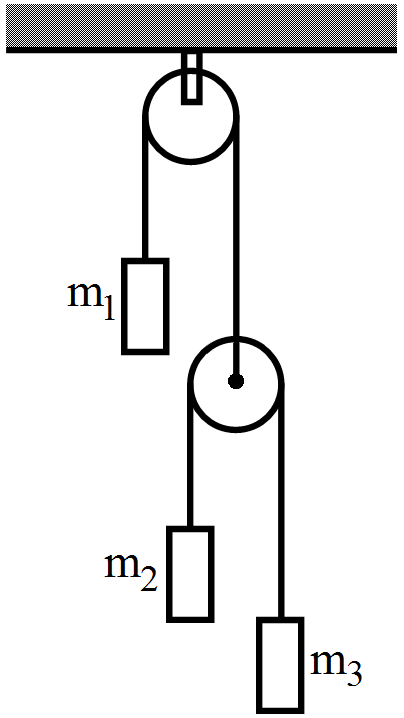
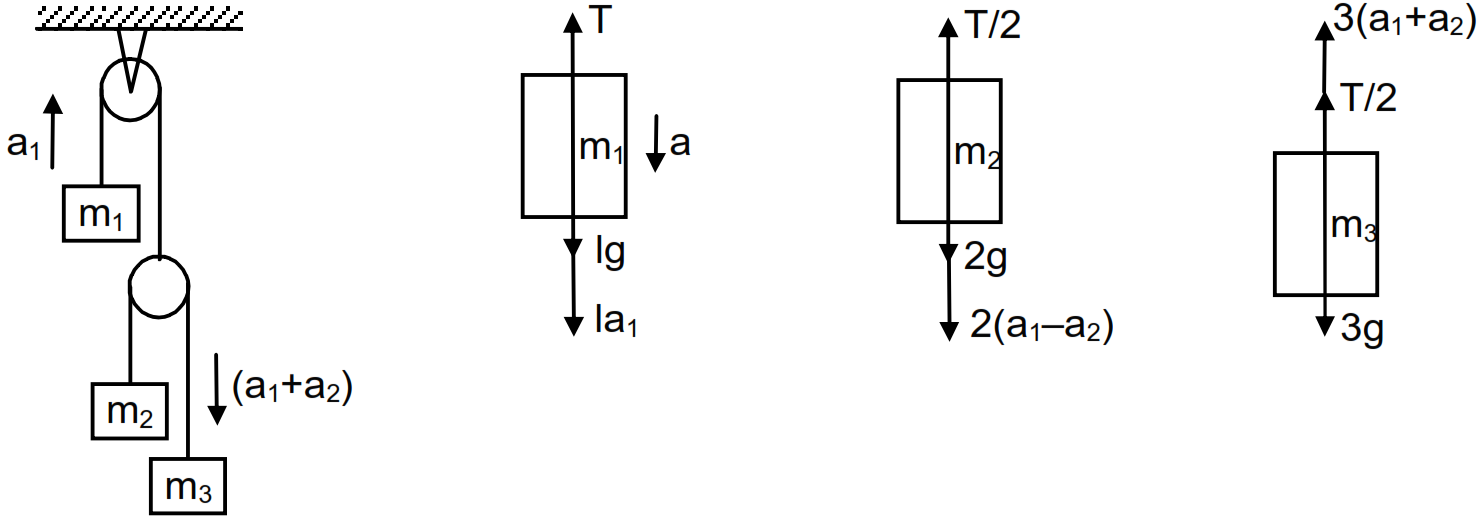
Let $m_1 = 1kg, m_2 = 2kg$ and $m_3 = 3kg$ in figure. Find the accelerations of $m_1, m_2$ and $m_3$. The string from the upper pulley to $m_1$​​​​​​​ is $20cm$ when the system is released from rest. How long will it take before m, strikes the pulley?
Answer


Let the block m+1+ moves upward with acceleration a, and the two blocks $m_2$ an $m_3$ have relative acceleration $a_2$ due to the difference of weight between them. So, the actual acceleration at the blocks $m_1, m_2$ and $m_3$ will be $a_1$.
$(a_1 - a_2)$ and $(a_1 + a_2)$ as shown
$T = 1g - 1a_2 = 0 ...(i)$ from fig. (2)
$\frac{\text{T}}{2}-2\text{g}-2(\text{a}_1-\text{a}_2)=0 \ ...(\text{ii})$ from fig. (3)
$\frac{\text{T}}{2}-3\text{g}-3(\text{a}_1+\text{a}_2)=0 \ ...(\text{iii})$ from fig. (4)
From eqn (i) and eqn (ii), eliminating T
we get, $1g + 1a_2 = 4g + 4(a_1 + a_2) \Rightarrow 5a_2 - 4a_1 = 3g (iv)$
From eqn (ii) and eqn (iii),
we get $2g + 2(a_1 - a_2) = 3g - 3(a_1 - a_2) \Rightarrow 5a_1 + a_2 = (v)$
Solving (iv) and (v) $\text{a}_1=\frac{2\text{g}}{29}$ and $\text{a}_2=\text{g}-5\text{a}_1=\text{g}-\frac{10\text{g}}{29}=\frac{19\text{g}}{29}$
So, $\text{a}_1-\text{a}_2=\frac{2\text{g}}{29}-\frac{19\text{g}}{29}=-\frac{17\text{g}}{29}$
$\text{a}_1+\text{a}_2=\frac{2\text{g}}{29}+\frac{19\text{g}}{29}=\frac{21\text{g}}{29}$ acceleration of $m_1, m_2, m_3$ ae $\frac{19\text{g}}{29}\text{(up)}\frac{17\text{g}}{29}(\text{down})\frac{21\text{g}}{29}(\text{down})$ respectively.
Again, for $m_1, u = 0, s = 20cm = 0.2m$ and $\text{a}_2=\frac{19}{29}\text{g} [g = 10m/s^2]$
$\therefore\text{S = ut}+\frac{1}{2}\text{at}^2=0.2=\frac{1}{2}\times\frac{19}{29}\text{gt}^2\Rightarrow\text{t}=0.25\sec.$
View full question & answer
Question 185 Marks
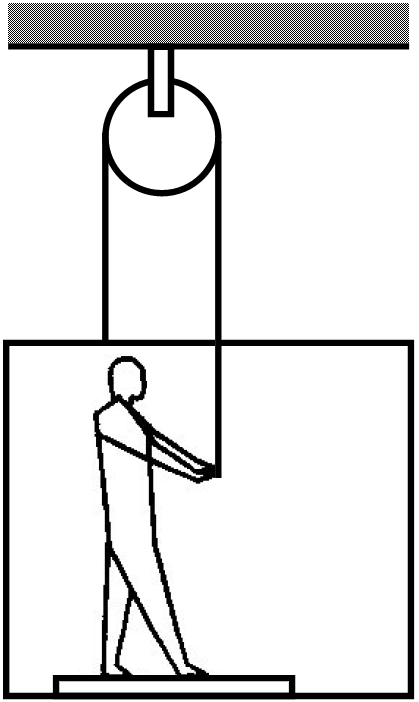
Figure shows a man of mass $60kg$ standing on a light weighing machine kept in a box of mass $30kg$. The box is hanging from a pulley fixed to the ceiling through a light rope, the other end of which is held by the man himself. If the man manages to keep the box at rest, what is the weight shown by the machine? What force should he exert on the rope to get his correct weight on the machine?
Answer


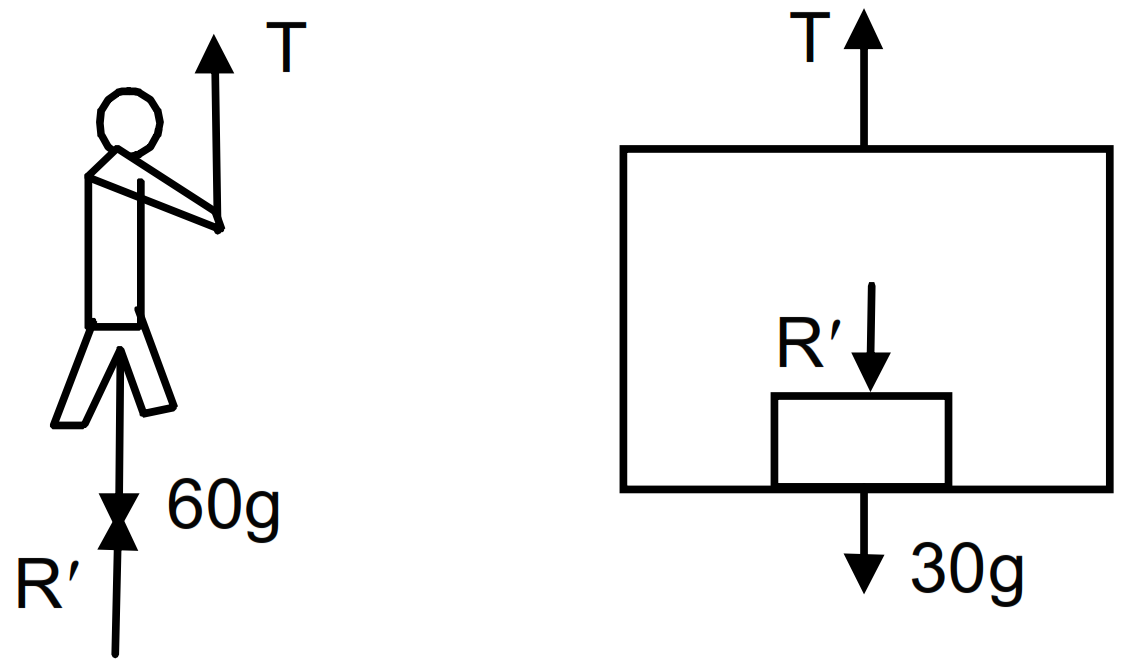
i. Given, Mass of man $=60 kg$.
Let $R^{\prime}=$ apparent weight of man in this case.
Now, R' $+ T -60 g=0$ [From FBD of man]
$\Rightarrow T=60 g-R^{\prime} \ldots \text { (i) }$
$T-R^{\prime}-30 g=0 \ldots \text { (ii) [From FBD of box] }$
$\Rightarrow 60 g-R^{\prime}-R^{\prime}-30 g=0[\text { From (i)] }$
$\Rightarrow R^{\prime}=15 g$ The weight shown by the machine is 15 kg .
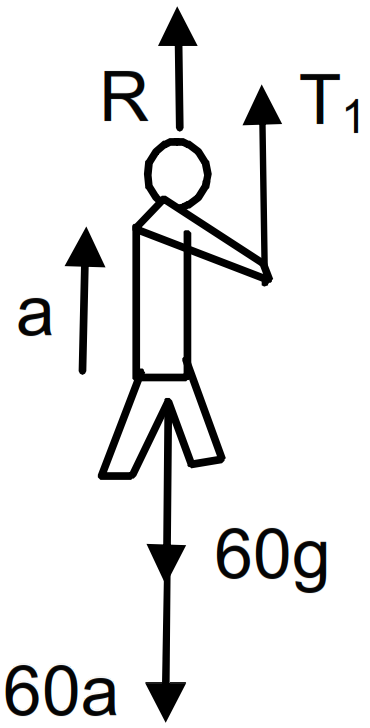
ii. To get his correct weight suppose the applied force is ' $T$ ' and so, acclerates upward with ' $a$ '. In this case, given that correct weight $=R=60 g$, where $g =10$ due to gravity

From the FBD of the man
$T^1 + R - 60g - 60a = 0$
$\Rightarrow T^1 - 60a = 0$ [$\therefore$ R = 60g]
$\Rightarrow T^1 = 60a ...(i)​​​​​​​$​​​​​​​

From the FBD of the box
$T_1 - R - 30g - 30a = 0$
$\Rightarrow T^1_- 60g - 30g - 30a = 0$
$\Rightarrow T^1 - 30a = 90g = 900$
$\Rightarrow T^1^= 30a - 900 ...(ii)$
From eqn (i) and eqn (ii) we get
$T^1 = 2T^1 - 1800$
$​​​​​​​\Rightarrow T^1 = 1800N.$
$\therefore$ So, he should exert 1800N force on the rope to get correct reading.
View full question & answer
Question 195 Marks
Find the reading of the spring balance shown in figure. The elevator is going up with an acceleration of $\frac{\text{g}}{10},$ the pulley and the string are light and the pulley is smooth.
Answer
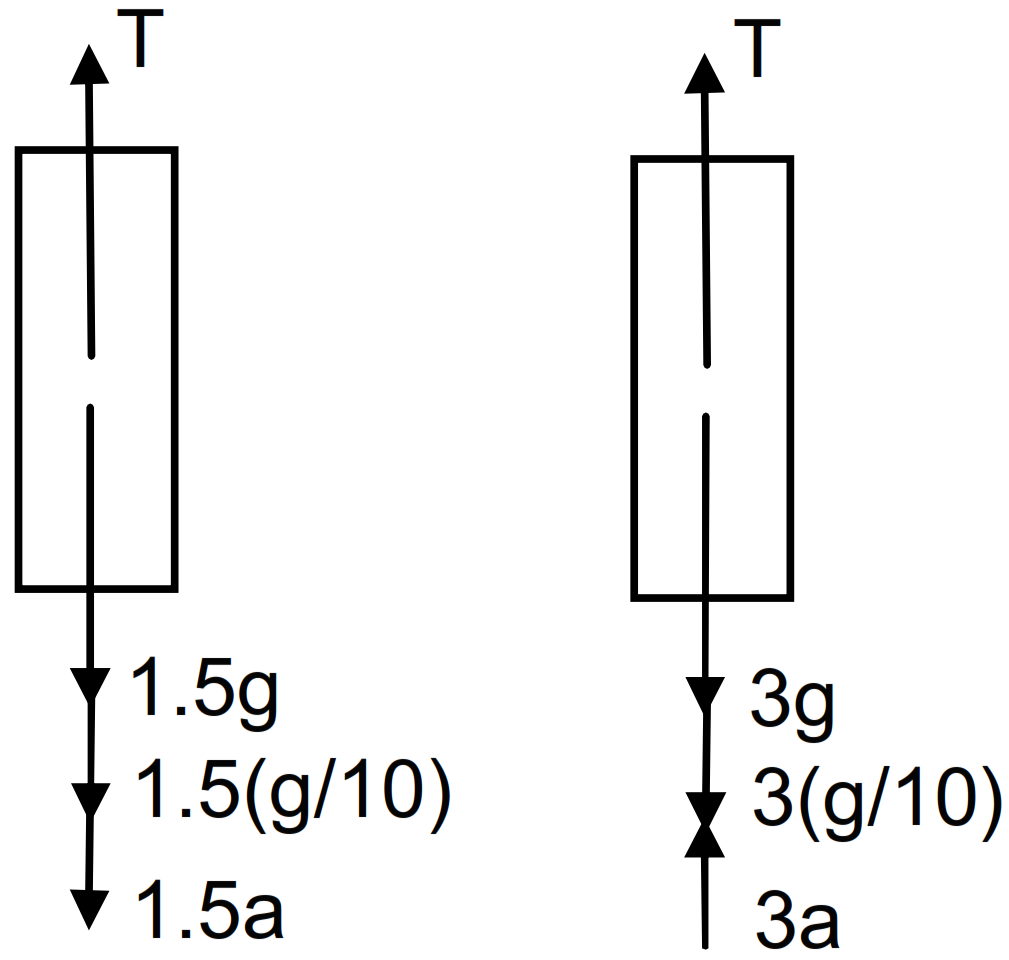
Let the acceleration of the 3kg mass relative to the elevator is ‘a’ in the downward direction.

 As, shown in the free body diagram$\text{T}-1.5\text{g}-1.5\Big(\frac{\text{g}}{10}\Big)-1.5\text{a}=0$ from figure (1)
and, $\text{T}-3\text{g}-3\Big(\frac{\text{g}}{10}\Big)+3\text{a}=0$ from figure (2)$\Rightarrow\text{T}=1.5\text{g}+1.5\Big(\frac{\text{g}}{10}\Big)+1.5\text{a}\ ...(\text{i})$
And $\text{T}=3\text{g}+3\Big(\frac{\text{g}}{10}\Big)-3\text{a} \ ...(\text{ii})$ Equation (i) × 2 $\Rightarrow3\text{g}+3\Big(\frac{\text{g}}{10}\Big)+3\text{a}=2\text{T}$ Equation (ii) × 1 $\Rightarrow3\text{g}+3\Big(\frac{\text{g}}{10}\Big)-3\text{a}=\text{T}$ Subtracting the above two equations we get, T = 6a Subtracting T = 6a in equation (ii)$6\text{a}=3\text{g}+3\Big(\frac{\text{g}}{10}\Big)-3\text{a}$
$\Rightarrow9\text{a}=\frac{33\text{g}}{10}\Rightarrow\text{a}=\frac{(9.8)33}{10}=32.34$
$\Rightarrow\text{a}=3.59$
$\therefore\text{T}=6\text{a}=6\times3.59=21.55$
$\text{T}^1=2\text{T}=2\times21.55=43.1\text{N}$ cut is $T_1$ shown in spring.
$\text{Mass}=\frac{\text{wt}}{\text{g}}=\frac{43.1}{9.8}=4.39=4.4\text{kg}$
View full question & answer
Question 205 Marks
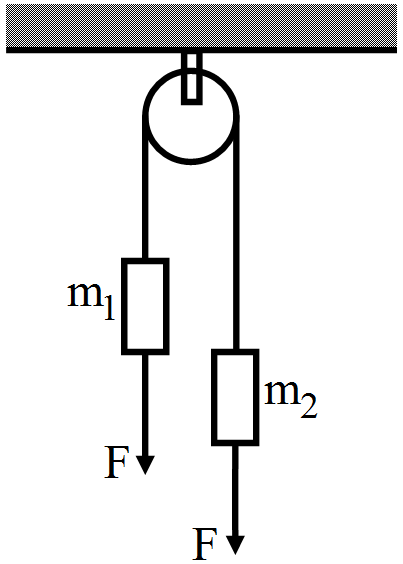
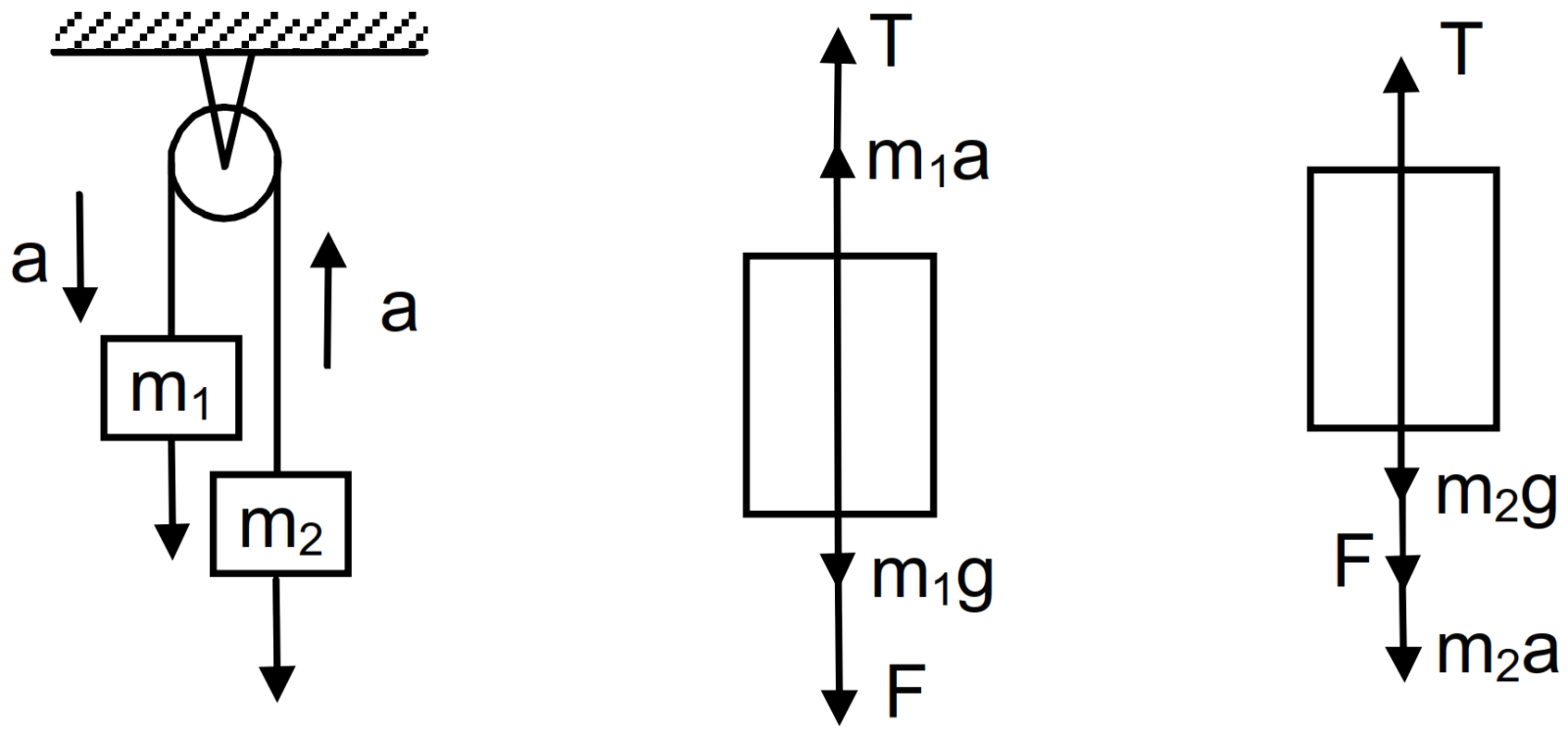
In figure $m_1 = 5kg, m_1 = 2kg$ and $F = 1N$. Find the acceleration of either block. Describe the motion of $m_1$ if the string breaks but F continues to act.
Answer

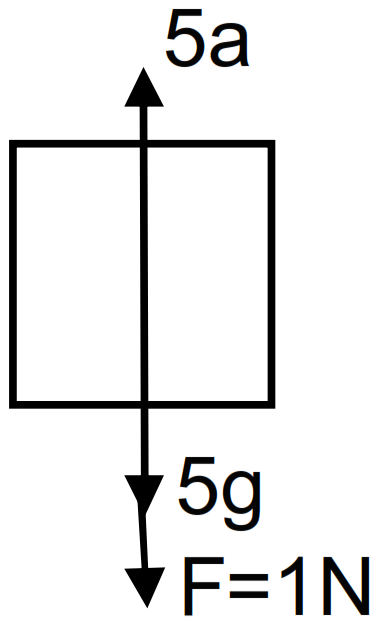
From the above free body diagram $T + m_1a - m(m_1g + F ) = 0$ From the free body diagram $T - (m_2g + F + m_2a) = 0$ $\Rightarrow T = m_1g + F - m_1a $
$\Rightarrow T = 5g + 1 - 5a$ …(i)
$\Rightarrow T = m_2g + F + m_2a$
$\Rightarrow T = 2g + 1 + 2a$ …(ii) From the eqn (i) and eqn (ii)
$5g + 1 - 5a = 2g + 1 + 2a$
$\Rightarrow 3g - 7a = 0$
$\Rightarrow 7a = 3g$
$\Rightarrow\text{a}=\frac{3\text{g}}{7}=\frac{29.4}{7}=4.2\text{m/s}^2 [g = 9.8m/s^2$]
  1. Acceleration of block is $4.2m/s^2$
  2. After the string breaks $m_1$​​​​​​​ move downward with force F acting down ward.
$m_1a = F + m_1g = (1 + 5g) = 5(g + 0.2)$
Force = 1N, acceleration $=\frac{1}{5}=0.2\text{m/s.}$
So, acceleration $=\frac{\text{Force}}{\text{mass}}=\frac{5(\text{g}+0.2)}{5}=(\text{g}+0.2)\text{m/s}^2$
View full question & answer
Question 215 Marks
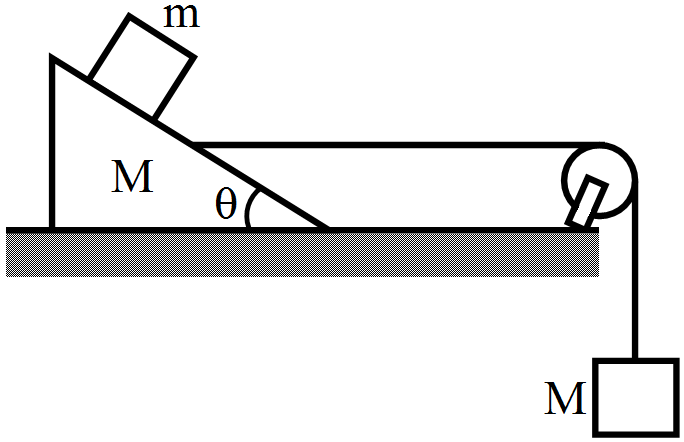
Find the mass M of the hanging block in figure which will prevent the smaller block from slipping over the triangular block. All the surfaces are frictionless and the strings and the pulleys are light.
Answer

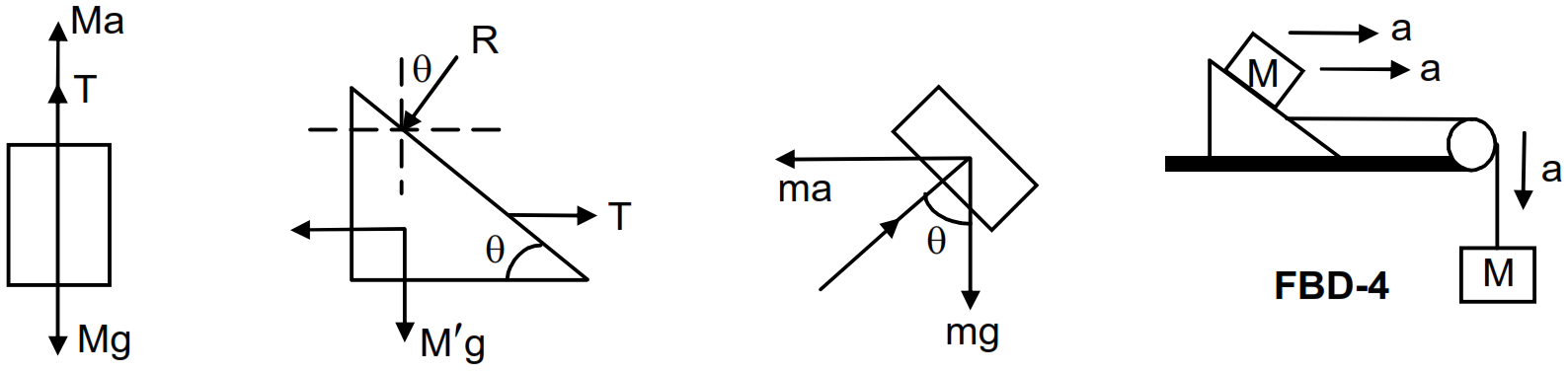
As the block ‘m’ does not slinover M', ct will have same acceleration as that of M' From the freebody diagrams.
$\text{T + Ma}-\text{Mg}=0 \ ...(\text{i})$ (From FBD - 1)
$\text{T}-\text{M}'\text{a}-\text{R}\sin\theta=0 \ ...(\text{ii})$ (From FBD - 2)
$\text{R}\sin\theta-\text{ma}=0 \ ...(\text{iii})$ (From FBD - 3)
$\text{R}\cos\theta-\text{mg}=0 \ ...(\text{iv})$ (From FBD - 4)
Eliminating T, R and a from the above equation, we get $\text{M}=\frac{\text{M}'+\text{m}}{\cot\theta-1}$
View full question & answer
Question 225 Marks
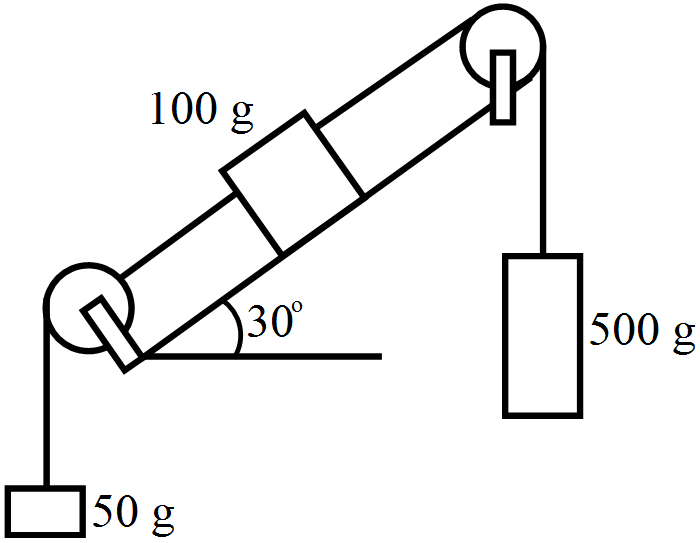
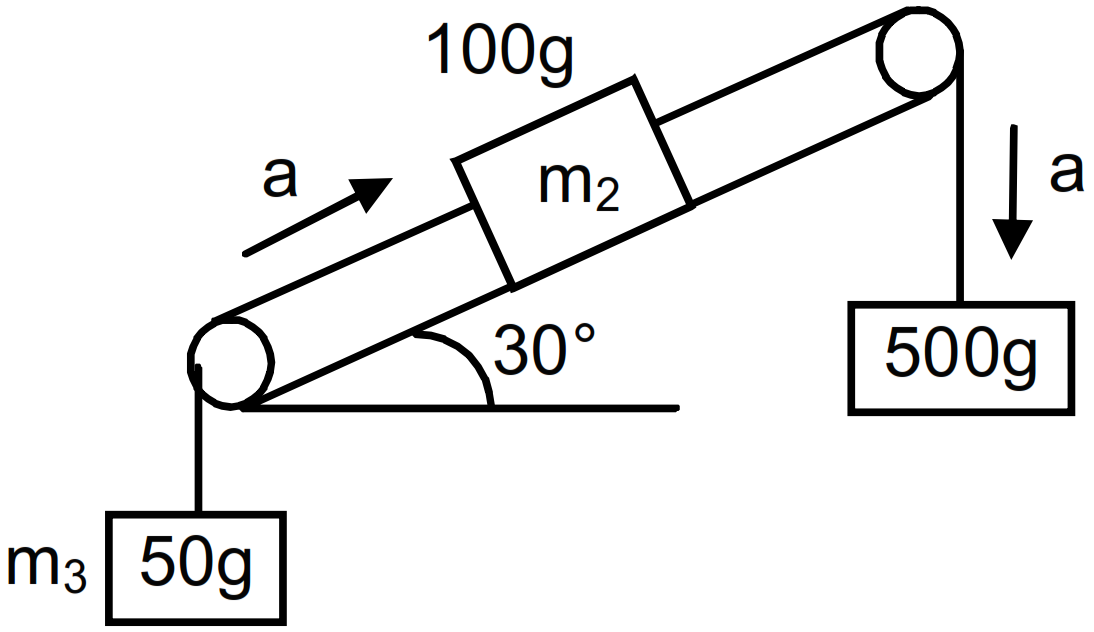
Find the acceleration of the $500\ g$ block in figure.
Answer


$m_1 = 100g = 0.1kg$
$m_2 = 500g = 0.5kg$
$m_3 = 50g = 0.05kg.$
$T + 0.5a - 0.5g = 0 ...(i)$
$T_1- 0.5a - 0.05g = a ...(ii)$
$T_1 + 0.1a - T + 0.05g = 0 ...(iii)$
From equn $(ii) T_1 = 0.05g + 0.05a ...(iv)$
From equn $(i) T_1 = 0.5g - 0.5a ...(v)$
Equn $(iii)$ becomes $T_1 + 0.1a - T + 0.05g = 0$​​​​​​​

$\Rightarrow 0.05g + 0.05a + 0.1a - 0.5g + 0.5a + 0.05g = 0$ [From (iv) and (v)]
$\Rightarrow0.65\text{a}=0.4\text{g}\Rightarrow\text{a}=\frac{0.4}{0.65}=\frac{40}{65}\text{g}=\frac{8}{13}\text{g}$ downward
Acceleration of 500gm block is $\frac{8\text{g}}{13\text{g}}$ downward
View full question & answer