Question 12 Marks
The piston in the cylinder head of a locomotive has a stroke (twice the amplitude) of 1.0m. If the piston moves with simple harmonic motion with an angular frequency of 200rad/min, what is its maximum speed?
AnswerAngular frequency of the piston, $\omega=200 \mathrm{rad} / \mathrm{min}$. Stroke $=1.0 \mathrm{~m}$ Amplitude, $\mathrm{A}=1.0 / 2=0.5 \mathrm{~m}$ The maximum speed $\left(v_{\max }\right)$ of piston is given by the relation: $\mathrm{v}_{\max }=\mathbf{A} \boldsymbol{\omega}=200 \times 0.5=100 \mathrm{~m} / \mathrm{min}$.
View full question & answer→Question 22 Marks
In Exercise, let us take the position of mass when the spring is unstreched as x = 0, and the direction from left to right as the positive direction of x-axis. Give x as a function of time t for the oscillating mass if at the moment we start the stopwatch (t = 0), the mass is:At the maximum stretched position.
In what way do these functions for SHM differ from each other, in frequency, in amplitude or the initial phase?
AnswerDistance travelled by the mass sideways, a = 2.0cm Angular frequency of oscillation: $\omega=\sqrt{\frac{\text{k}}{\text{m}}}$ $=\sqrt{\frac{1200}{3}}=\sqrt{400}=20\text{ rad s}^{-1}$At maximum stretched position, the body is at the extreme right position, with an intial phase of $\frac{\pi}{2}$ rad. Then,
$\text{x}=\text{a}\sin\Big(\omega\text{t}+\frac{\pi}{2}\Big)=\text{a}\cos\omega\text{t}=2\cos20\text{t}$
View full question & answer→Question 32 Marks
In Exercise, let us take the position of mass when the spring is unstreched as x = 0, and the direction from left to right as the positive direction of x-axis. Give x as a function of time t for the oscillating mass if at the moment we start the stopwatch (t = 0), the mass is: At the mean position. In what way do these functions for SHM differ from each other, in frequency, in amplitude or the initial phase?
AnswerDistance travelled by the mass sideways, a = 2.0cm Angular frequency of oscillation: $\omega=\sqrt{\frac{\text{k}}{\text{m}}}$ $=\sqrt{\frac{1200}{3}}=\sqrt{400}=20\text{ rad s}^{-1}$As time is noted from the mean position, hence using
$\text{x}=\text{a}\sin\omega\text{t},$ we have $\text{x}=2\sin20\text{t}$
View full question & answer→Question 42 Marks
Answer the following questions:A man with a wristwatch on his hand falls from the top of a tower. Does the watch give correcttime during the free fall?
AnswerThe time shown by the wristwatch of a man falling from the top of a tower is not affected by the fall. Since a wristwatch does not work on the principle of a simple pendulum, it is not affected by the acceleration due to gravity during free fall. Its working depends on spring action.
View full question & answer→Question 52 Marks
Which of the following functions of time represent (a) simple harmonic, (b) periodic but not simple harmonic, and (c) non-periodic motion? Give period for each case of periodic motion ($\omega$ is any positive constant): $\sin\omega\text{t}-\cos\omega\text{t}$
Answer SHM The given function is: $\sin\omega\text{t}-\cos\omega\text{t}$ $=\sqrt{2}\Big[\frac{1}{\sqrt{2}}\sin\omega\text{t}-\frac{1}{\sqrt{2}}\cos\omega\text{t}\Big]$ $=\sqrt{2}\Big[\sin\omega\text{t}\times\cos\frac{\pi}{4}-\cos\omega\text{t}\times\sin\frac{\pi}{4}\Big]$ $=\sqrt{2}\sin\Big(\omega\text{t}-\frac{\pi}{4}\Big)$This function represents SHM as it can be written in the form:
$\text{a}\sin(\omega\text{t}+\phi)$ Its period is: $\frac{2\pi}{\omega}.$
View full question & answer→Question 62 Marks
Which of the following functions of time represent (a) simple harmonic, (b) periodic but not simple harmonic, and (c) non-periodic motion? Give period for each case of periodic motion ($\omega$ is any positive constant): $\cos\omega\text{t}+\cos3\omega\text{t}+\cos5\omega\text{t}$
Answer Periodic, but not SHM The given function is $\cos\omega\text{t}+\cos3\omega\text{t}+\cos5\omega\text{t}.$ Each individual cosine function represents SHM. However, the superposition of three simple harmonic motions is periodic, but not simple harmonic.
View full question & answer→Question 72 Marks
Which of the following functions of time represent (a) simple harmonic, (b) periodic but not simple harmonic, and (c) non-periodic motion? Give period for each case of periodic motion ($\omega$ is any positive constant): $3\cos\Big(\frac{\pi}{4}-2\omega\text{t}\Big)$
AnswerSHM The given function is: $3\cos\Big[\frac{\pi}{4}-2\omega\text{t}\Big]$ $=3\cos\Big[2\omega\text{t}-\frac{\pi}{4}\Big]$ This function represents simple harmonic motion because it can be written in the form: $\text{a}\cos(\omega\text{t}+\phi)$ Its period is: $\frac{2\pi}{2\omega}=\frac{\pi}{\omega}$
View full question & answer→Question 82 Marks
In Exercise, let us take the position of mass when the spring is unstreched as x = 0, and the direction from left to right as the positive direction of x-axis. Give x as a function of time t for the oscillating mass if at the moment we start the stopwatch (t = 0), the mass is:At the maximum compressed position.
In what way do these functions for SHM differ from each other, in frequency, in amplitude or the initial phase?
AnswerDistance travelled by the mass sideways, a = 2.0cm Angular frequency of oscillation: $\omega=\sqrt{\frac{\text{k}}{\text{m}}}$ $=\sqrt{\frac{1200}{3}}=\sqrt{400}=20\text{ rad s}^{-1}$At maximum compressed position, the body is at left position, with an intial phase of $\frac{3\pi}{2}$ rad. Then,
$\text{x}=\text{a}\sin\Big(\omega\text{t}+\frac{3\pi}{2}\Big)=-\text{a}\cos\omega\text{t}=-2\cos20\text{ t}$The functions neither differ in amplitude nor in frequency. They differ in intial phase.
View full question & answer→Question 92 Marks
Answer the following questions:Time period of a particle in SHM depends on the force constant k and mass m of the particle: $\text{T}=2\pi\sqrt{\frac{\text{m}}{\text{k}}}.$ A simple pendulum executes SHM approximately. Why then is the time period of a pendulum independent of the mass of the pendulum?
AnswerThe time period of a simple pendulum, $\text{T}=2\pi\sqrt{\frac{\text{m}}{\text{k}}}$For a simple pendulum, k is expressed in terms of mass m, as:
$\text{k}\propto\text{m}$ $\frac{\text{m}}{\text{k}}=\text{Constant}$Hence, the time period T, of a simple pendulum is independent of the mass of the bob.
View full question & answer→Question 102 Marks
Which of the following functions of time represent (a) simple harmonic, (b) periodic but not simple harmonic, and (c) non-periodic motion? Give period for each case of periodic motion ($\omega$ is any positive constant): $\sin^3\omega\text{t}$
AnswerPeriodic, but not SHM The given function is: $\sin^3\omega\text{t}$ $=\frac{1}{2}[3\sin\omega\text{t}-\sin3\omega\text{t}]$The terms $\sin\omega\text{t}$ and $\sin\omega\text{t}$ individually represent simple harmonic motion (SHM).
However, the superposition of two SHM is periodic and not simple harmonic.
View full question & answer→Question 112 Marks
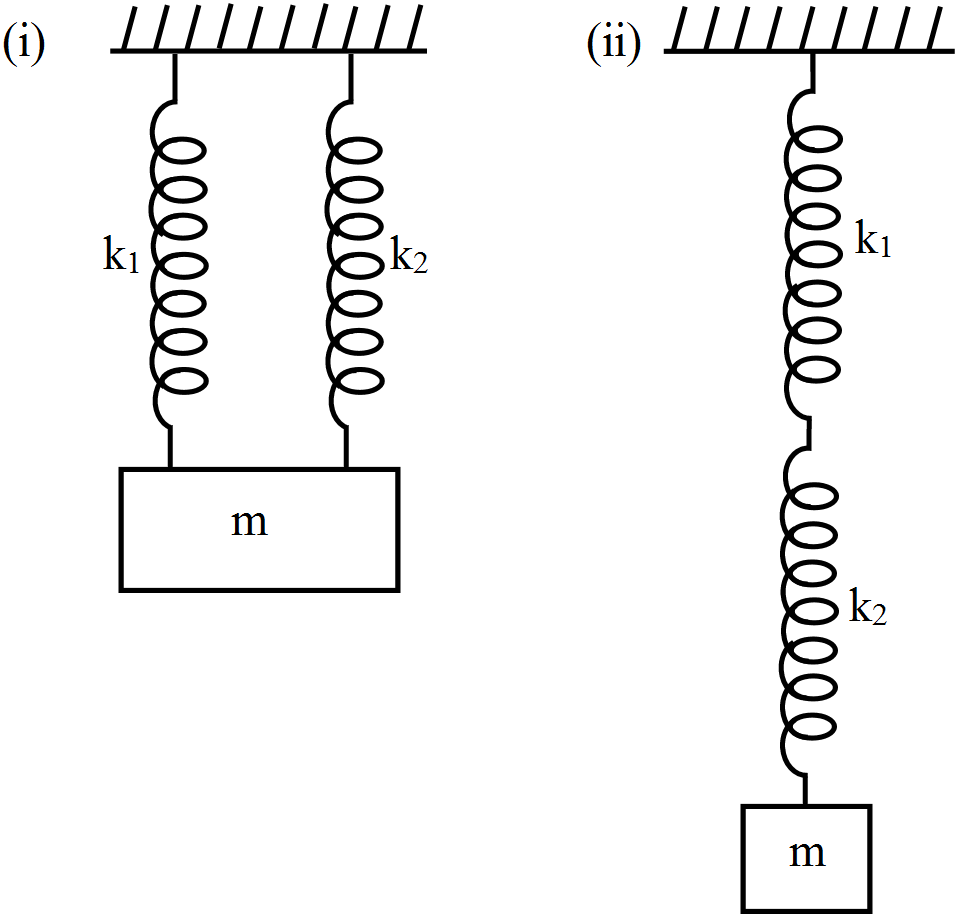
Find the ratio of the frequencies in the cases given below:
Answer
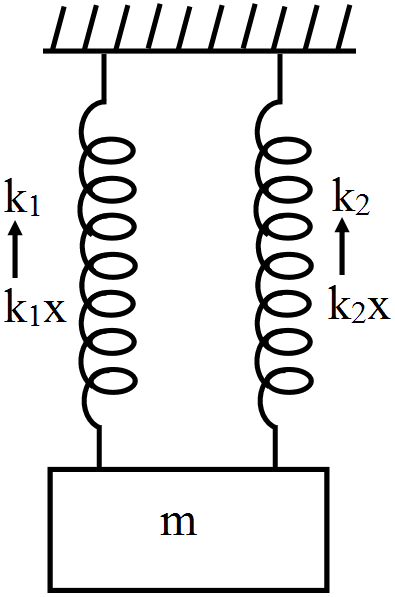
- Restoring force in the springs will be in the same direction and the displacement is same in both.
$\therefore$ Restoring force
$=-\text{k}_1\text{x}-\text{k}_2\text{x}$
$\text{k}_{\text{eq}}=\text{k}_1+\text{k}_2$
$\therefore\text{f}=\frac{1}{2\pi}\sqrt{\frac{\text{k}_1+\text{k}_2}{\text{m}}}$
- Restoring force is in same direction but the extensions are different even though the force is same.
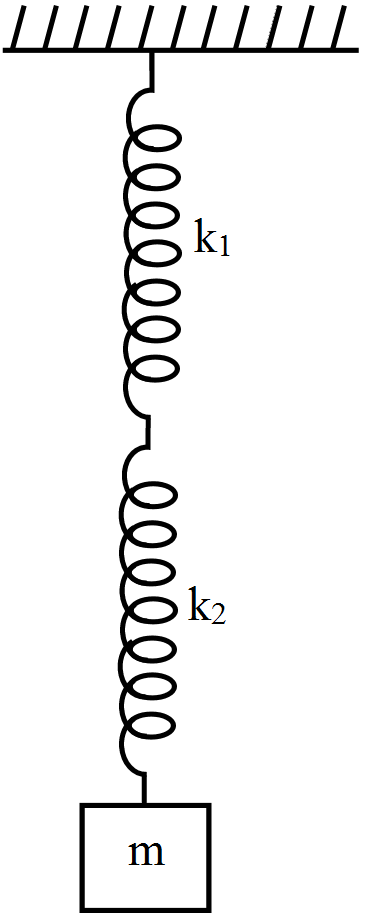
$\therefore\text{x = x}_1+\text{x}_2$
$\frac{1}{\text{k}_{\text{eq}}}=\frac{1}{\text{k}_1}+\frac{1}{\text{k}_2}$
$\frac{1}{\text{k}_{\text{eq}}}=\frac{\text{k}_2+\text{k}_1}{\text{k}_1\text{k}_2}$
$\text{f}=\frac{1}{2\pi}\sqrt{\frac{\text{k}_1\text{k}_2}{\text{m}(\text{k}_1+\text{k}_2)}}$
Amplitude of $\text{x}_1=10$ View full question & answer→Question 122 Marks
The piston in the cylinder head of a locomotive has a stroke (twice the amplitude) of 1.0m. If the piston moves with simple harmonic motion with an angular frequency of 200rad/min, what is its maximum speed?
AnswerAngular frequency of the piston, $\omega=200 \mathrm{rad} / \mathrm{min}$. Stroke $=1.0 \mathrm{~m}$ Amplitude, $\mathrm{A}=1.0 / 2=0.5 \mathrm{~m}$ The maximum speed $\left(v_{\max }\right)$ of piston is given by the relation: $v_{\max }=A \omega=200 \times 0.5=100 \mathrm{~m} / \mathrm{min}$.
View full question & answer→Question 132 Marks
Two springs of force constants K and 2K are connected to a block of m as shown below. What is the frequency of oscillation of this block?
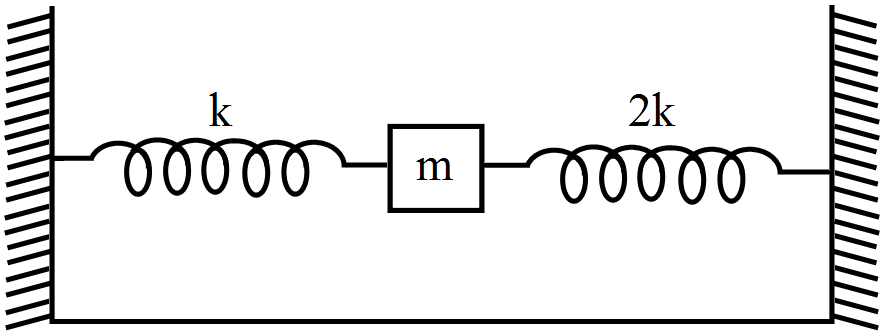
AnswerForce constants of two springs K and 2K are connected to a block of mass 'm'.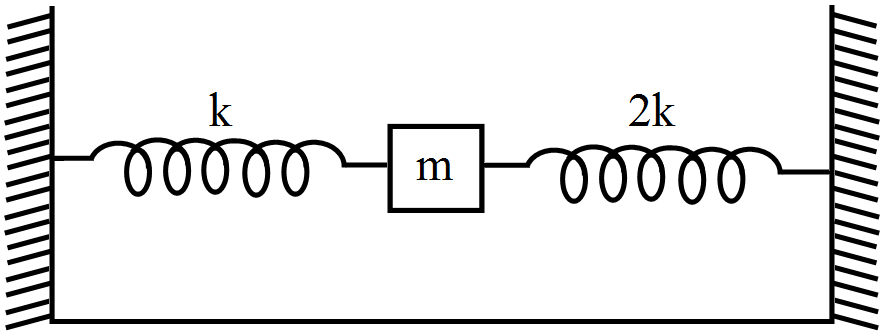
Springs are in parallel combinations. So equivalent$\text{K}'=\text{K + 2K = 3K}$
In simple harmonic motion, Frequency $(\text{f})=\frac{1}{2\pi}\sqrt{\frac{\text{K}'}{\text{m}}}=\frac{1}{2\pi}\sqrt{\frac{3\text{K}}{\text{m}}}$ Hence, the frequency of the oscillation ofthe block$=\frac{1}{2\pi}\sqrt{\frac{3\text{K}}{\text{m}}}$ View full question & answer→Question 142 Marks
The frequency of oscillations of a mass m suspended by a spring is ‘$\text{v}_1$'. If the length of spring is cut to one half, the same mass oscillates with frequency ‘$\text{v}_2$'. Determine the value of $\frac{\text{v}_2}{\text{v}_1}.$
AnswerFrequency of oscillation of mass m suspended by a spring of constant t is,$\text{v}_1=\frac{1}{2\pi}\sqrt{\frac{\text{k}}{\text{m}}}$
If the length is cut into one half, the force constant will becomes 2k for each portion. The frequency with same mass m is,$\text{v}_2=\frac{1}{2\pi}\sqrt{\frac{2\text{k}}{\text{m}}}$ $\because\frac{\text{v}_2}{\text{v}_1}=\frac{\sqrt{2}}{1}$
View full question & answer→Question 152 Marks
A particle executes S.H.M. of period 8 sec. After what time of its passing through the mean position will the energy be half kinetic and half potential?
AnswerGiven $\text{P.E. = K.E.}$$\frac{1}{2}\text{m}\omega^2\text{y}^2=\frac{1}{2}\text{m}\omega^2(\text{a}^2-\text{y}^2)$
$\text{y}^2=\text{a}^2-\text{y}^2$
i.e. $\text{y}=\frac{\text{a}}{\sqrt{2}}$ Now $\text{y = a}\sin\omega\text{t}$ or $\text{y = a}\sin\Big(\frac{2\pi}{\text{T}}\Big)\text{t}$$\frac{\text{a}}{\sqrt{2}}\text{a}\sin\Big(\frac{2\pi}{8}\Big)\text{t}\ ....(\text{T = 8 sec}.)$
$\sin\frac{\pi\text{t}}{4}=\frac{1}{\sqrt{2}}=\sin^{-1}\Big(\frac{1}{\sqrt{2}}\Big)$
$\frac{\pi\text{t}}{4}=\frac{\pi}{4}$
$\text{t = 1 sec}.$
View full question & answer→Question 162 Marks
Consider a pair of identical pendulums, which oscillate with equal amplitude independently such that when one pendulum is at its extreme position making an angle of 2° to the right with the vertical, the other pendulum makes an angle of 1° to the left of the vertical. What is the phase difference between the pendulums?
Answer$\theta_1=\theta_0\sin(\omega\text{t}+\delta_1)$$\theta_2=\theta_0\sin(\omega\text{t}+\delta_2)$
For the first, $\theta=2^\circ,\therefore\sin(\omega\text{t}+\delta_1)=1$
For the 2nd, $\theta=-1^\circ,\ \therefore\sin(\omega\text{t}+\delta_2)=-1$
$\therefore\omega\text{t}+\delta_1=90^\circ,\omega\text{t}+\delta_2=-30^\circ$
$\therefore\delta_1-\delta_2=120^\circ$
View full question & answer→Question 172 Marks
A girl is swinging in the sitting position. How will the period of the swing be changed if she stands up?
AnswerThis can be explained using the concept of a simple pendulum. We know that the time period of a simple pendulum is given by $\text{T}=2\pi\sqrt{\frac{\text{l}}{\text{g}}} $ i.e., $\text{T}\propto\sqrt{\text{l}}$. When the girl stands up, the distance between the point of suspension and the centre of mass of the swinging body decreases i.e., l decreases, so T will also decrease.
View full question & answer→Question 182 Marks
What are isochronous vibrations?
Answer When the time period is independent of amplitude, the oscillation is called isochronous.
View full question & answer→Question 192 Marks
Justify the following statements:
- The motion of an artificial satellite around the earth cannot be taken as $\text{SHM}.$
- The time period of a simple pendulum will get doubled if its length is increased four times.
Answer
- The motion of an artificial satellite around the earth is periodic as it repeats after a regular interval of time. But it cannot be taken as $\text{SHM}$ because it is not a to and fro motion about any fixed point that is, mean position.
- Time period of simple pendulum.
$\text{T}=2\pi\sqrt{\frac{\text{l}}{\text{g}}}$
i.e. $=\text{T}\propto\sqrt{\text{l}}$
Clearly, if the length is increased four times, the time period gets doubles. View full question & answer→Question 202 Marks
A mass m is dropped in a tunnel along the diameter of earth from a height $h (< < R)$ above the surface of earth. Find the time period of motion, is the motion simple harmonic?
AnswerWhen a ball is dropped from a height h, it gains velocity due to gravity pull. The body will enter the tunnel of earth with velocity, $\text{v}=\sqrt{2\text{gh}};$ after a time,
View full question & answer→Question 212 Marks
With the help of examples differentiate between free oscillations and forced oscillations.
AnswerIn the absence of air resistance, a pendulum oscillates freely but another pendulum dipped in a liquid oscillates only when external force exists. Oscillations which exist by the use of an external force overcoming any loss of energy are called forced oscillations.
View full question & answer→Question 222 Marks
Define $\text{S.H.M.}$ what are its characteristics? At what distance from the mean position in $\text{S.H.M.}$ of amplitude $'r\ '$, the energy is half kinetic and half potential?
Answer$\text{S.H.M.}$ is the projection of uniform circular motion on a diameter of a circle of a circle. Characteristics of $\text{S.H.M.}$ are:
- Motion is always directed towards a fixed point or equilibrium point.
- Acceleration is directly proportional to negative of displacement.
Amplitude $= r$
Displacement from the mean position, where the energy is half kinetic and half potential
$\frac{\text{k}}{2}=\frac{\text{U}}{2}$
$\text{K.E. = P.E.}$
$\frac{1}{2}\text{kx}^2=\frac{1}{2}\text{k}(\text{A}^2-\text{x}^2)=\pm\frac{\text{A}}{\sqrt{2}}.$ View full question & answer→Question 232 Marks
The amplitude of an oscillating simple Pendulum is doubled. What will be its effect on the $(i)$ Periodic time; $(ii)$ Total energy; $(iii)$ Maximum velocity?
Answer
- Time period is independent of amplitude. So no change in $T$ with amplitude.
- Total energy $=\frac{1}{2}\text{m}\omega^2\text{A}^2$
If A is doubled, total energy becomes four times.
- Maximum velocity $\text{v}=\omega\text{A}$
If $A$ is doubled, maximum velocity becomes double. View full question & answer→Question 242 Marks
A man with a wrist watch on his hand falls from the top of a tower. Does the watch give correct time during the free fall?
AnswerSince time period of the wrist watch working on oscillation of spring is independent of acceleration due to gravity, it will give correct time during free fall also.
View full question & answer→Question 252 Marks
Show that the function of time $\text{y}=(\sin\omega\text{t}-\cos\omega\text{t})$ represents simple harmonic motion.
AnswerWe have $\text{y}=\sin\omega\text{t}-\cos\omega\text{t}$$=\sqrt{2}\Big(\sin\omega\text{t}\times\frac{1}{\sqrt{2}}-\cos\omega\text{t}\times\frac{1}{\sqrt{2}}\Big)$
$=\sqrt{2}\Big(\sin\omega\text{t}\cos\frac{\pi}{4}-\cos\omega\text{t}\sin\frac{\pi}{4}\Big)$ $\Big[\because\cos\frac{\pi}{4}=\frac{1}{\sqrt{2}}\text{ and}\sin\frac{\pi}{4}=\frac{1}{\sqrt{2}}\Big]$
$=\sqrt{2}\sin\Big(\omega\text{t}+\frac{\pi}{4}\Big)$ $[\because\sin(\text{A}-\text{B})=\sin\text{A}\cos\text{B}-\cos\text{A}\sin\text{B}]$
Moreover, $\text{y}\Big(\text{t}+\frac{2\pi}{\omega}\Big)=\sqrt{2}\Big(\omega\text{t}+2\pi-\frac{\pi}{4}\Big)=\text{y(t)}$ Hence. it represents simple harmonic motion.
View full question & answer→Question 262 Marks
We know, T $=2\pi\sqrt{\frac{\text{Displacement}}{\text{Acceleration}}}.$ Does T depend on the displacement? Give reason.
AnswerNo. Since acceleration is proportional to negative of displacement. Time period is independent of displacement.
View full question & answer→Question 272 Marks
In Exercise, let us take the position of mass when the spring is unstreched as x = 0, and the direction from left to right as the positive direction of x-axis. Give x as a function of time t for the oscillating mass if at the moment we start the stopwatch (t = 0), the mass is:At the maximum stretched position.
In what way do these functions for SHM differ from each other, in frequency, in amplitude or the initial phase?
AnswerDistance travelled by the mass sideways, a = 2.0cm Angular frequency of oscillation:$\omega=\sqrt{\frac{\text{k}}{\text{m}}}$
$=\sqrt{\frac{1200}{3}}=\sqrt{400}=20\text{ rad s}^{-1}$
At maximum stretched position, the body is at the extreme right position, with an intial phase of $\frac{\pi}{2}$ rad. Then,
$\text{x}=\text{a}\sin\Big(\omega\text{t}+\frac{\pi}{2}\Big)=\text{a}\cos\omega\text{t}=2\cos20\text{t}$
View full question & answer→Question 282 Marks
In Exercise, let us take the position of mass when the spring is unstreched as x = 0, and the direction from left to right as the positive direction of x-axis. Give x as a function of time t for the oscillating mass if at the moment we start the stopwatch (t = 0), the mass is:
At the mean position.
In what way do these functions for SHM differ from each other, in frequency, in amplitude or the initial phase?
AnswerDistance travelled by the mass sideways, a = 2.0cm Angular frequency of oscillation:$\omega=\sqrt{\frac{\text{k}}{\text{m}}}$
$=\sqrt{\frac{1200}{3}}=\sqrt{400}=20\text{ rad s}^{-1}$
As time is noted from the mean position, hence using
$\text{x}=\text{a}\sin\omega\text{t},$ we have $\text{x}=2\sin20\text{t}$
View full question & answer→Question 292 Marks
In case of an oscillating simple pendulum what will be the direction of acceleration of the bob at:
- The mean position.
- The end points?
Answer
- The direction of acceleration of the bob at its mean position is radial i.e. towards the point of suspension.
- At extreme points, however, the acceleration is tangential towards the mean position. the mean position.
View full question & answer→Question 302 Marks
Answer the following questions:A man with a wristwatch on his hand falls from the top of a tower. Does the watch give correcttime during the free fall?
AnswerThe time shown by the wristwatch of a man falling from the top of a tower is not affected by the fall. Since a wristwatch does not work on the principle of a simple pendulum, it is not affected by the acceleration due to gravity during free fall. Its working depends on spring action.
View full question & answer→Question 312 Marks
Show that for small oscillations the motion of a simple pendulum is simple harmonic. Derive an expression for its time period. Does it depend on the mass of the bob?
AnswerExpression for time period:
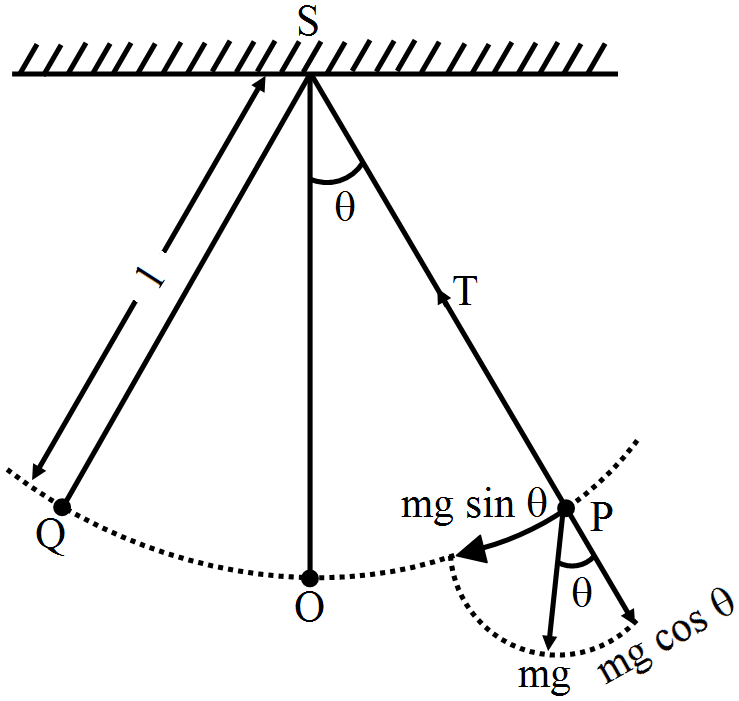
Let $m =$ Mass of the bob $l =$ Length of the simple pendulum $OP = x$ When the bob is displaced to point $P$ through small angle $\theta.$Two forces acting on the bob are:
- Weight $mg$ of the bob acting vertically downward.
- Tension $T$ in string along $PS$, resolving mg into two components.
- $\text{mg}\cos\theta$ opposite to tension $T$
- $\text{mg}\sin\theta$ directed towards $O.$
Tension in the string, $T =\text{mg}\cos\theta$
The force $mg \sin$ tends to bring back the bob to its mean position $O.$
$\therefore$ Restoring force acting on bob is $\text{F}=-\text{mg}\sin\theta-\text{ve}$ sign shows force is directed towards mean position: If $\theta$ is small, then
$\sin\theta=\theta\frac{(\text{arc OP})}{\text{l}}=\frac{\text{x}}{\text{l}}$
$\text{F = -mg}\theta=-\text{mg}\frac{\text{x}}{\text{l}}$
$\text{F}\propto$ displacement $(x)$ and $F$ is directed towards mean position $O$.
In $\text{S.H.M}$., Restoring force $\text{F}=-\text{kx} \ ...(\text{ii})$
Comparing $(i)$ and $(ii)\text{k}=\frac{\text{mg}}{\text{l}}$
Inertia factor $=$ Mass of bob $= m\text{T}=2\pi\sqrt{\frac{\text{Inertia factor}}{\text{Spring factor}}}$
$=2\pi\sqrt{\frac{\text{m}}{\frac{\text{mg}}{\text{l}}}}=2\pi\sqrt{\frac{\text{l}}{\text{g}}}$
$\text{T}=2\pi\sqrt{\frac{\text{l}}{\text{g}}}$
No. $T$ does not depend on the mass of the bob. View full question & answer→Question 322 Marks
Which of the following functions of time represent (a) simple harmonic, (b) periodic but not simple harmonic, and (c) non-periodic motion? Give period for each case of periodic motion ($\omega$ is any positive constant):$\sin\omega\text{t}-\cos\omega\text{t}$
AnswerSHM The given function is:$\sin\omega\text{t}-\cos\omega\text{t}$
$=\sqrt{2}\Big[\frac{1}{\sqrt{2}}\sin\omega\text{t}-\frac{1}{\sqrt{2}}\cos\omega\text{t}\Big]$
$=\sqrt{2}\Big[\sin\omega\text{t}\times\cos\frac{\pi}{4}-\cos\omega\text{t}\times\sin\frac{\pi}{4}\Big]$
$=\sqrt{2}\sin\Big(\omega\text{t}-\frac{\pi}{4}\Big)$
This function represents SHM as it can be written in the form:
$\text{a}\sin(\omega\text{t}+\phi)$
Its period is: $\frac{2\pi}{\omega}.$
View full question & answer→Question 332 Marks
Which of the following functions of time represent (a) simple harmonic, (b) periodic but not simple harmonic, and (c) non-periodic motion? Give period for each case of periodic motion ($\omega$ is any positive constant):$\cos\omega\text{t}+\cos3\omega\text{t}+\cos5\omega\text{t}$
AnswerPeriodic, but not SHM
The given function is $\cos\omega\text{t}+\cos3\omega\text{t}+\cos5\omega\text{t}.$ Each individual cosine function represents SHM. However, the superposition of three simple harmonic motions is periodic, but not simple harmonic.
View full question & answer→Question 342 Marks
What are the two basic characteristics of a simple harmonic motion?
AnswerThe two basic characteristics of a simple harmonic motion:
- Acceleration is directly proportional to displacement.
- The direction of acceleration is always towards the mean position, that is opposite to displacement.
View full question & answer→Question 352 Marks
The kinetic energy of a particle vibrating in S.H.M. is 4J when it passes the mean position. If the mass of the body is 2kg and the amplitude is 1m, calculate its time period.
AnswerIn its mean position, the kinetic energy of the particle is maximum,$\text{E}_{\text{Kmax}}=\frac{1}{2}\text{m}\omega^2\text{A}^2$
Given: $\text{E}_{\text{Kmax}}=4\text{J};\text{m}=2\text{kg};\text{A}=1\text{m}$$4\text{J}=\frac{1}{2}\times2\times\omega^2\times\text{l}$
$\omega=2,\text{T}=\frac{2\pi}{\omega}=\pi\text{s}$
View full question & answer→Question 362 Marks
A spring attached with a mass m oscillates with a frequency f. What will be the frequency when the same is taken to the moon? Why?
AnswerFrequency of a mass attached to a spring is $\text{f}=\frac{1}{2\pi}\sqrt{\frac{\text{k}}{\text{m}}}.$
It is independent of acceleration due to gravity. So, the frequency is not affected on the surface of moon.
View full question & answer→Question 372 Marks
Which of the following functions of time represent (a) simple harmonic, (b) periodic but not simple harmonic, and (c) non-periodic motion? Give period for each case of periodic motion ($\omega$ is any positive constant):$3\cos\Big(\frac{\pi}{4}-2\omega\text{t}\Big)$
AnswerSHM The given function is:$3\cos\Big[\frac{\pi}{4}-2\omega\text{t}\Big]$
$=3\cos\Big[2\omega\text{t}-\frac{\pi}{4}\Big]$
This function represents simple harmonic motion because it can be written in the form: $\text{a}\cos(\omega\text{t}+\phi)$ Its period is: $\frac{2\pi}{2\omega}=\frac{\pi}{\omega}$
View full question & answer→Question 382 Marks
The bob of a vibrating simple pendulum is made of ice. How will the period of swing change when the ice starts melting?
AnswerAs ice melts the centre of gravity raises. So, the time period reduces. As complete ice melts, the centre of gravity retains its original position. So, time period decreases and increases back to the same value.
View full question & answer→Question 392 Marks
A simple pendulum of a length l and having a bob of mass M is suspended in a car. The car is moving on a circular track of radius R with a uniform speed v. If the pendulum makes small oscillations in a radial direction about its equilibrium position, what will be its time period?
AnswerThe acceleration associated with the bob, hung in a car moving on a circular track is, $\text{a}_{\text{N}}=\sqrt{\text{g}^2+\Big(\frac{\text{v}^2}{\text{r}}\Big)^2}$ since centripetal acceleration will be experienced besides the force of gravity.$\therefore\text{T}=2\pi\sqrt{\frac{\text{l}}{\text{a}_{\text{N}}}}=2\pi\sqrt{\frac{\text{l}}{\sqrt{\text{g}^2+\frac{\text{v}^4}{\text{r}^2}}}}$
View full question & answer→Question 402 Marks
A body is executing S.H.M. of amplitude 1m. Its velocity while passing through the mean position, is $10ms^{-1}$ Find its frequency.
AnswerHere, $a = 1m, v_{max} = 10ms^{-1}, v = ?$ A body executing S.H.M. while passing through the mean position has maximum velociry given by $\text{v}_{\text{max}}=\text{a}\omega=2\pi\text{va}.$$\therefore\text{v}=\frac{\text{v}_{\text{max}}}{2\pi\text{a}}=\frac{10\times7}{2\times22\times1}=1.592\text{Hz}$
View full question & answer→Question 412 Marks
How much is KE for displacement equal to half the amplitude?
Answer$\because\text{x}=\frac{\text{A}}{2}$ so,$\text{KE}=\frac{1}{2}\text{m}\omega^2(\text{A}^2-\text{x}^2)$
$\frac{1}{2}\text{m}\omega^2[\text{A}^2-(\frac{\text{A}}{2})^2]$
$=\frac{1}{2}\times\frac{3}{4}[\text{m}\omega^2\text{A}^2]$
$=\frac{3}{4}(\text{KE})_\text{max}$
It is $\frac{3}{4}\text{th}$ of maximum KE.
View full question & answer→Question 422 Marks
Two exactly identical pendulums are oscillating with amplitudes 2cm and 6cm. Calculate the ratio of their energies of oscillation.
AnswerTotal energy $=\frac{1}{2}\text{m}\omega^2\text{A}^2,$ since amplitudes are 2cm and 6cm, the ratio is 1 : 3.$\therefore$ Ratio of total energy = 1 : 9
View full question & answer→Question 432 Marks
Estimate the time taken by the oscillating pendulum to shift from x = 0 to $\text{x}=\frac{\text{A}}{2}$ where A is the amplitude.
AnswerSince initial position at t = 0 is x = 0 We represent S.H.M. by $\text{x = A}\sin\omega\text{t}$ When $\text{x}=\frac{\text{A}}{2},\frac{\text{A}}{2}=\text{A}\sin\omega\text{t}$$\therefore\omega\text{t}=\frac{\pi}{6},\text{t}=\frac{\text{T}}{12}$
View full question & answer→Question 442 Marks
List any two characteristics of simple harmonic motion.
Answer
- Motion is always directed towards a fixed point or equilibrium point.
- Acceleration is directly proportional to negative of displacement.
View full question & answer→Question 452 Marks
If $\text{y}=\frac{1}{\sqrt{\text{a}}}\sin\omega\text{t}-\frac{1}{\sqrt{\text{b}}}\cos\omega\text{t},$ find the amplitude of motion.
AnswerAmplitude of the displacement $=\sqrt{\Big(\frac{1}{\sqrt{\text{a}}}\Big)^2+\Big(\frac{1}{\sqrt{\text{b}}}\Big)^2},$ since phase difference between the two portions is $\frac{\pi}{2}.$
View full question & answer→Question 462 Marks
What is the length of a simple pendulum, which ticks seconds?
Answer$\text{T}=2\pi\sqrt{\frac{\text{l}}{\text{g}}}$So, $\text{l}=\frac{\text{gT}^2}{4\pi^2}=\frac{9.8\times(2)^2}{4\times\frac{22}{7}\times\frac{22}{7}}=1\text{m}$
View full question & answer→Question 472 Marks
A particle is executing SHM according to the equation $\text{x}=5\sin\pi\text{t}$ where x is in cm. How long will the particle take to move from the position of equilibrium to the position of maximum displacement?
AnswerThe displacement of the particle varies with time according to the equation. $5=5\sin\pi\text{t}$ Maximum displacement = amplitude = 5cm At time t = 0, x = 0 (equilibrium position). Hence time t taken by the particle to move from x = 0 to x = 5cm is given by$5=5\sin\pi\text{t}$
$=1=\sin\pi\text{t}$
$=\sin\pi\text{t}$ $\pi\text{t}\frac{\pi}{2}$
$\Rightarrow\text{t}=0.5\text{s}$
View full question & answer→Question 482 Marks
If the length of a simple pendulum is increased by 25%, then what is the change in its time period?
Answer$\because$ Time period, $\text{T}=2\pi\sqrt{\frac{\text{l}}{\text{g}}}$$=\text{T}\propto\sqrt{\text{l}}$
$\therefore$ % increase in time period
$=\frac{\Delta\text{T}}{\text{T}}\times100$
$=\frac{1}{2}\frac{\Delta\text{l}}{\text{l}}\times100$
$=\frac{1}{2}\times25$
$=125\%$
View full question & answer→Question 492 Marks
A simple pendulum performs S.H.M. about x = 0 with an amplitude a and time period T. What is the speed of the pendulum at $\text{x}=\frac{\text{A}}{2}?$
AnswerVelocity of oscillating body $=\text{v}=\omega\sqrt{\text{A}^2-\text{x}^2}$$\text{x}=\frac{\text{A}}{2}$
$\text{v}=\omega\sqrt{\text{A}^2-\Big(\frac{\text{A}^2}{4}\Big)}$
$=\frac{\sqrt{3}\text{A}\omega}{2}=\frac{\sqrt{3}\text{A}\pi}{\text{T}}$
View full question & answer→Question 502 Marks
In Exercise, let us take the position of mass when the spring is unstreched as x = 0, and the direction from left to right as the positive direction of x-axis. Give x as a function of time t for the oscillating mass if at the moment we start the stopwatch (t = 0), the mass is:At the maximum compressed position.
In what way do these functions for SHM differ from each other, in frequency, in amplitude or the initial phase?
AnswerDistance travelled by the mass sideways, a = 2.0cm Angular frequency of oscillation:$\omega=\sqrt{\frac{\text{k}}{\text{m}}}$
$=\sqrt{\frac{1200}{3}}=\sqrt{400}=20\text{ rad s}^{-1}$
At maximum compressed position, the body is at left position, with an intial phase of $\frac{3\pi}{2}$ rad. Then,
$\text{x}=\text{a}\sin\Big(\omega\text{t}+\frac{3\pi}{2}\Big)=-\text{a}\cos\omega\text{t}=-2\cos20\text{ t}$
The functions neither differ in amplitude nor in frequency. They differ in intial phase.
View full question & answer→Question 512 Marks
Answer the following questions:Time period of a particle in SHM depends on the force constant k and mass m of the particle: $\text{T}=2\pi\sqrt{\frac{\text{m}}{\text{k}}}.$ A simple pendulum executes SHM approximately. Why then is the time period of a pendulum independent of the mass of the pendulum?
AnswerThe time period of a simple pendulum, $\text{T}=2\pi\sqrt{\frac{\text{m}}{\text{k}}}$For a simple pendulum, k is expressed in terms of mass m, as:
$\text{k}\propto\text{m}$
$\frac{\text{m}}{\text{k}}=\text{Constant}$
Hence, the time period T, of a simple pendulum is independent of the mass of the bob.
View full question & answer→Question 522 Marks
Why can't we use a pendulum to work as a clock in a satellite?
AnswerTime period of an oscillating pendulum changes with acceleration due to gravity. It is zero in a satellite. So, only clocks with spring can be used.
View full question & answer→Question 532 Marks
A vertical U-tube of uniform cross-section contains water upto a height of 20cm. Calculate the time period of the oscillation of water when it is disturbed.
AnswerThe length of the liquid column, L = 2 × 20 = 40cm Time period of oscillation,$\text{T}=2\pi\sqrt{\frac{\text{L}}{2\text{g}}}=2\pi\sqrt{\frac{40}{2\times980}}=\frac{2\pi}{7}$
$=0.9\text{s}$
View full question & answer→Question 542 Marks
Which of the following functions of time represent (a) simple harmonic, (b) periodic but not simple harmonic, and (c) non-periodic motion? Give period for each case of periodic motion ($\omega$ is any positive constant):$\sin^3\omega\text{t}$
AnswerPeriodic, but not SHM The given function is:$\sin^3\omega\text{t}$
$=\frac{1}{2}[3\sin\omega\text{t}-\sin3\omega\text{t}]$
The terms $\sin\omega\text{t}$ and $\sin\omega\text{t}$ individually represent simple harmonic motion (SHM).
However, the superposition of two SHM is periodic and not simple harmonic.
View full question & answer→Question 552 Marks
The maximum acceleration of a simple harmonic oscillator is $\text{a}_0$ and the maximum velocity is $\text{v}_0$. What is the displacement amplitude?
AnswerLet A be the displacement amplitude and $\omega$ be the angular frequency of the simple harmonic oscillator. Then, $\text{a}_0=\omega^2\text{A}$$\text{v}_0=\omega\text{A}$
On dividing $\frac{\text{v}_0^2}{\text{a}_0}=\frac{\omega^2\text{A}^2}{\omega^2\text{A}}=\text{A}$$\text{A}=\frac{\text{v}_0^2}{\text{a}_0}$
View full question & answer→Question 562 Marks
What is the length of a simple pendulum, which ticks seconds ?
AnswerFrom Eq. (13.26), the time period of a simple pendulum is given by,
$
T=2 \pi \sqrt{\frac{L}{g}}
$
From this relation one gets,
$
L=\frac{g T^2}{4 \pi^2}
$
The time period of a simple pendulum, which ticks seconds, is $2 s$. Therefore, for $g=9.8 m s ^{-2}$
$
\text { and } \begin{aligned}
T & =2 s , L \text { is } \\
& =\frac{9.8\left( m s ^{-2}\right) \times 4\left( s ^2\right)}{4 \pi^2} \\
& =1 m
\end{aligned}
$
View full question & answer→Question 572 Marks
Which of the following functions of time represent $(a)$ simple harmonic motion and $(b)$ periodic but not simple harmonic? Give the period for each case.
$(1) \sin \omega t-\cos \omega t$
$(2) \sin ^2 \omega t$
Answer$(a)\sin \omega t-\cos \omega t$
$= \sin \omega t-\sin (\pi / 2-\omega t)$
$= 2 \cos (\pi / 4) \sin (\omega t-\pi / 4)$
$= \sqrt{2} \sin (\omega t-\pi / 4)$
This function represents a simple harmonic motion having a period $T=2 \pi / \omega$ and a phase angle $(-\pi / 4)$ or $(7 \pi / 4)$
$(b)\sin ^2 \omega t$
$=1 / 2-1 / 2 \cos 2 \omega t$
The function is periodic having a period $T=\pi / \omega$.
It also represents a harmonic motion with the point of equilibrium occurring at $1 / 2$ instead of zero.
View full question & answer→