Questions

3 Marks Question

Take a timed test

22 questions · self-marked practice — reveal the answer and mark yourself.

Question 13 Marks
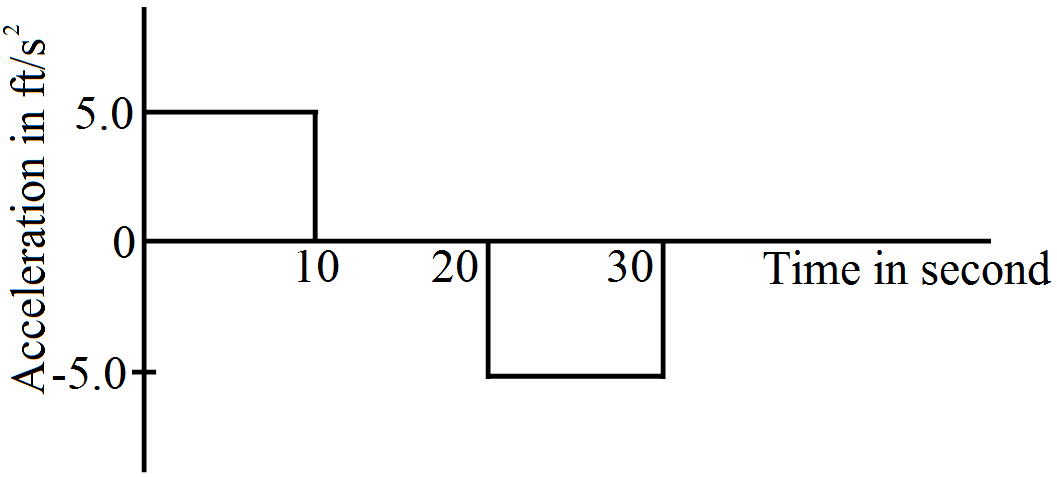
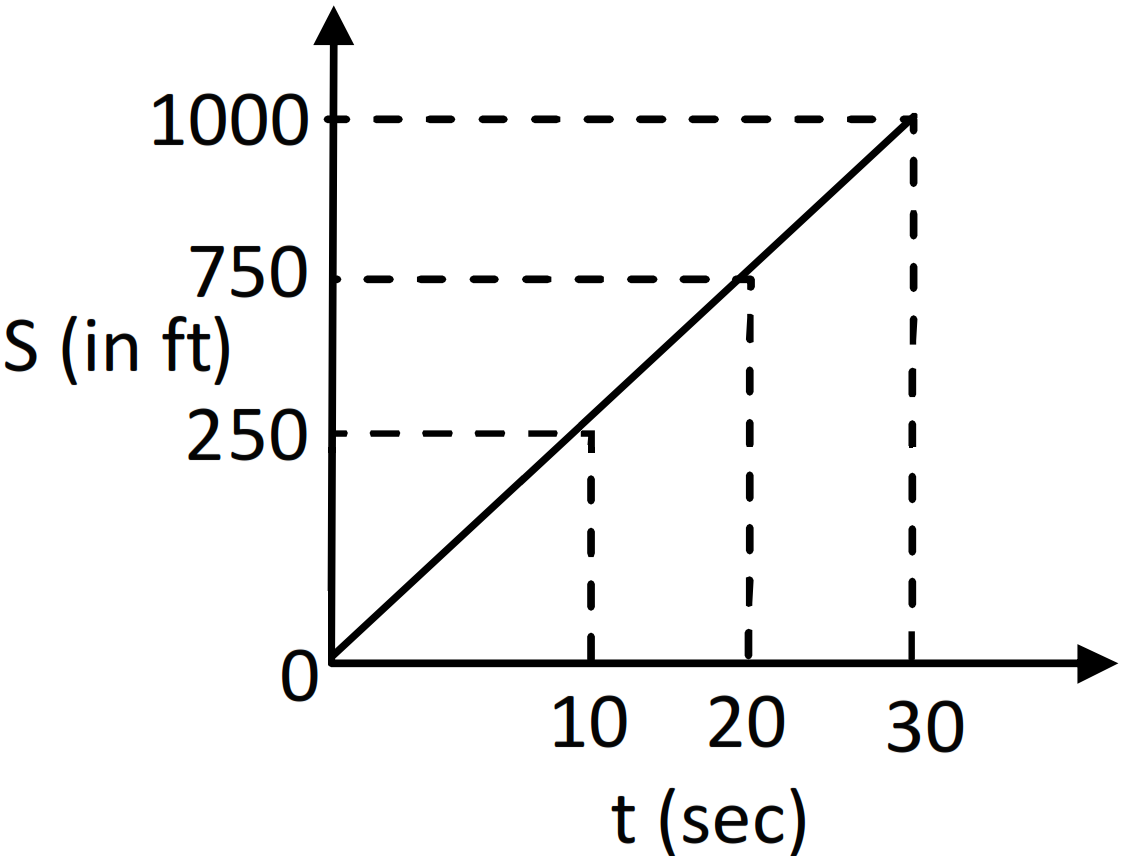
The acceleration of a cart started at $t = 0$, varies with time as shown in figure. Find the distance travelled in $30$ seconds and draw the position-time graph.
Answer
In $1^{\text {st }}$ seconds, $\mathrm{S}_1=$ ut $+\frac{1}{2}$ at $^2=0+\frac{1}{2} \times 5 \times 10^2=250 \mathrm{ft}$.
At $\mathrm{t}=10 \mathrm{~s}, \mathrm{v}=\mathrm{u}+\mathrm{at}=0+5 \times 10=50 \mathrm{ft} / \mathrm{s} .$
$ \therefore$ From 10 to 20 seconds $(\Delta \mathrm{t}=20-10=10 \mathrm{sec}) \mathrm{moves}$ with uniform velocity $50 \mathrm{ft} / \mathrm{sec}$,
Distance $\mathrm{S}_2=50 \times 10=500 \mathrm{ft}$ Between 20 sec to 30 sec acceleration is constant i.e. $-5 \mathrm{ft} / \mathrm{s}^2$. At 20 sec velocity is $50 \mathrm{ft} / \mathrm{sec} . \mathrm{t}=30-20=10 \mathrm{~s} \mathrm{~S}_3=\mathrm{ut}+\frac{1}{2} \mathrm{at}^2=50 \times 10+\frac{1}{2}(-5) 10^2$
$\mathrm{S}_3=500-250=250 \mathrm{ft}$
Total distance travelled is $30 \mathrm{~s}: S_1+S_2+S_3=250+500+250=1000 \mathrm{ft}$ The position-time graph:
View full question & answer
Question 23 Marks
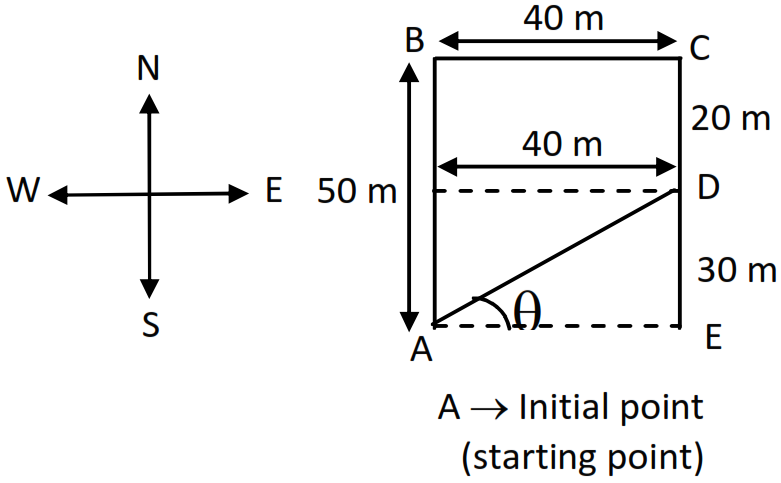
A man has to go $50m$ due north, $40m$ due east and $20m$ due south to reach a field.
  1. What distance he has to walk to reach the field?
  2. What is his displacement from his house to the field?
Answer
  1. Distance travelled $= 50 + 40 + 20 = 110m$
  2. $\text{AF = AB - BF = AB - DC = 50 - 20 = 30m}$
His displacement is $AD$
$\text{AD}=\sqrt{\text{AF}^2-\text{DF}^2}=\sqrt{30^2+40^2}=50\text{m}$
In $\triangle\text{AED}$
$\Rightarrow\tan\theta=\frac{\text{DE}}{\text{AE}}=\frac{30}{40}=\frac{3}{4}$
$\Rightarrow\theta=\tan^{-1}\Big(\frac{3}{4}\Big)$
His displacement from his house to the field is $50m$, $\tan^{-1}\Big(\frac{3}{4}\Big)$ north to east.
View full question & answer
Question 33 Marks
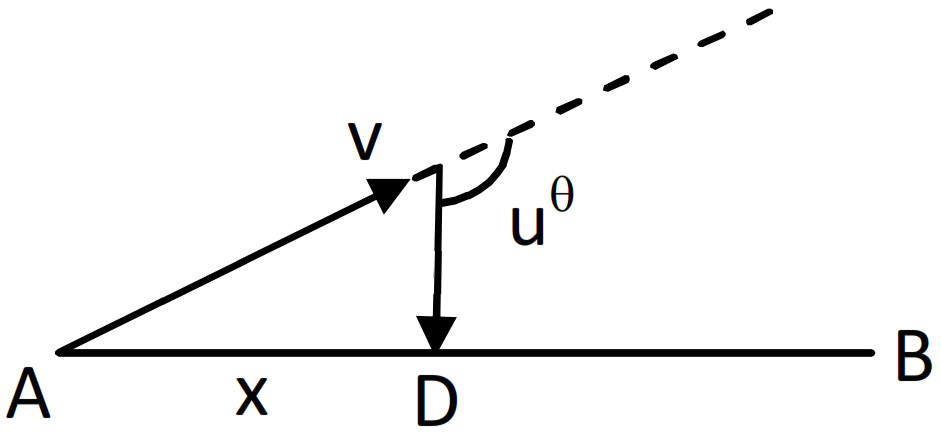
Suppose A and B in the previous problem change their positions in such a way that the line joining them becomes perpendicular to the direction of wind while maintaining the separation x. What will be the time lag B finds between seeing and hearing the drum beating by A?
Answer
Velocity of sound v, velocity of air u Velocity of sound be in direction AC so it can reach B with resultant velocity AD. Angle between v and u is $\theta>\frac{\pi}{2}.$ Resultant $\overrightarrow{\text{AD}}=\sqrt{(\text{v}^2-\text{u}^2)}$ Here time taken by light to reach B is neglected. So time lag between seeing and hearing = time to here the drum sound.$\text{t}=\frac{\text{Displacement}}{\text{velocity}}$
$=\frac{\text{x}}{\sqrt{\text{v}^2-\text{u}^2}}$
$=\frac{\text{x}}{\sqrt{(\text{v + u})(\text{v}-\text{u})}}=\frac{\text{x}}{\sqrt{\big(\frac{\text{x}}{\text{t}_1}\big)\big(\frac{\text{x}}{\text{t}_2}\big)}}$
$=\sqrt{\text{t}_1\text{t}_2}.$
View full question & answer
Question 43 Marks
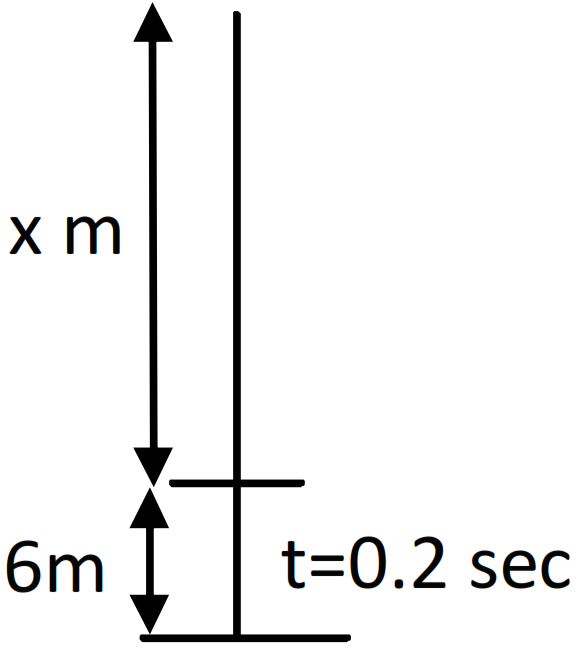
A ball is dropped from a height. If it takes $0.200s$ to cross the last $6.00m$ before hitting the ground, find the height from which it was dropped. Take $g = 10m/s^2$.
Answer
For last 6m distance travelled $s = 6m, u = ? t = 0.2 \sec, a = g = 9.8m/s^2$
$\text{S = ut}+\frac{1}{2}\text{at}^2$
$\Rightarrow6=\text{u}(0.2)+4.9\times0.04$
$\Rightarrow\text{u}=\frac{5.8}{0.2}=29\text{m/s}.$
For distance $x, u = 0, v = 29m/s, a = g = 9.8m/s^2 \text{S}=\frac{\text{v}^2-\text{u}^2}{2\text{a}}=\frac{29^2-0^2}{2\times9.8}=42.05\text{m}$
Total distance = 42.05 + 6 = 48.05 = 48m.
View full question & answer
Question 53 Marks
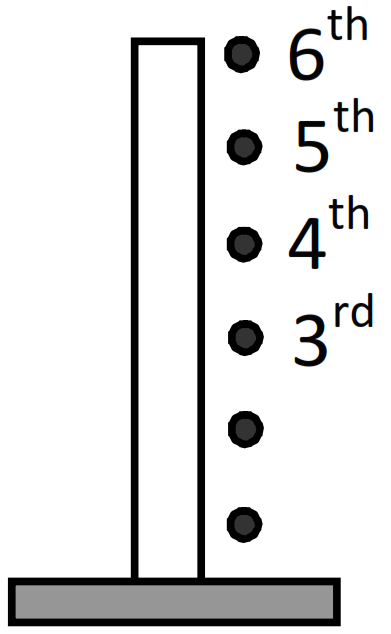
A person sitting on the top of a tall building is dropping balls at regular intervals of one second. Find the positions of the $3^{rd}, 4^{th}$ and $5^{th}$ ball when the $6^{th}$ ball is being dropped.
Answer
For every ball, $u = 0, a = g = 9.8m/s^2$
$\therefore 4^{th}$ ball move for $2 \sec$, $5^{th}$ ball $1 \sec$ and $3^{rd}$ ball $3 \sec$ when $6^{th}$ ball is being dropped.
For $3^{rd}$ ball t = 3 sec$\text{S}_3=\text{ut}+\frac{1}{2}\text{at}^2=0+\frac{1}{2}(9.8)3^2=4.9\text{m}$ below the top.
For $4^{th}$ ball, t = 2 sec$\text{S}_2=0+\frac{1}{2}\text{ gt}^2=\frac{1}{2}(9.8)2^2=19.6\text{m}$ below the top (u = 0)
For $5^{th}$ ball, t = 1 sec$\text{S}_3=\text{ut}+\frac{1}{2}\text{at}^2=0+\frac{1}{2}(9.8)\text{t}^2=4.98\text{m}$ below the top.
View full question & answer
Question 63 Marks
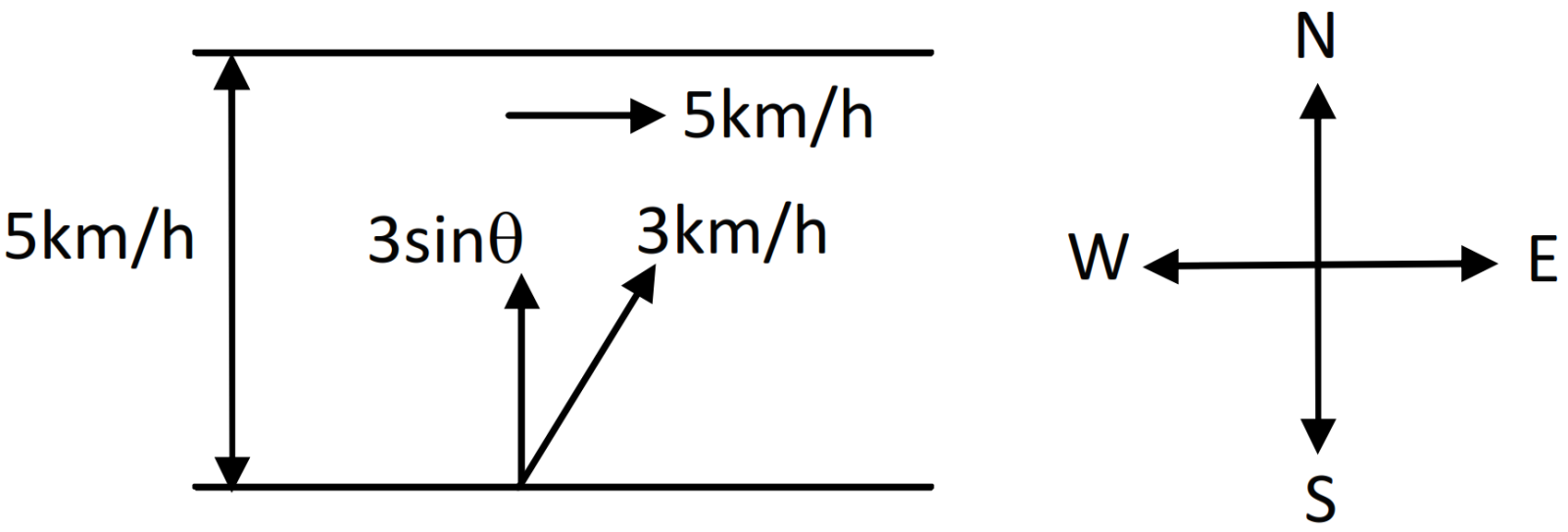
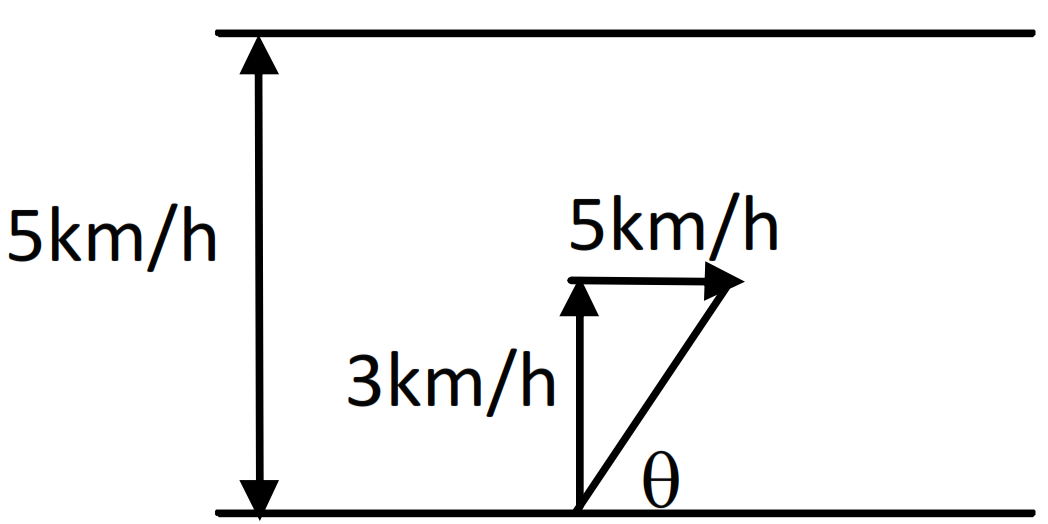
A swimmer wishes to cross a $500m$ wide river flowing at $5\ km/h$. His speed with respect to water is $3\ km/h.$
  1. If he heads in a direction making an angle $0$ with the flow, find the time he takes to cross the river.
  2. Find the shortest possible time to cross the river.
Answer
  1. The vertical component $3\sin\theta$ takes him to opposite side.
Distance $= 0.5\ km, $
velocity $= 3\sin\theta\text{km/h}$
$\text{Time}=\frac{\text{Distance}}{\text{Velocity}}$
$=\frac{0.5}{3\sin\theta}\text{hr}$
$=\frac{10}{\sin\theta}\text{min}.$
  1. Here vertical component of velocity i.e. $3\ km/hr$ takes him to opposite side.
$\text{Time}=\frac{\text{Distance}}{\text{Velocity}}$
$=\frac{0.5}{3}=0.16\text{hr}$
$\therefore0.16\text{hr}=60\times0.16=9.6=10\text{ minute.}$
View full question & answer
Question 73 Marks
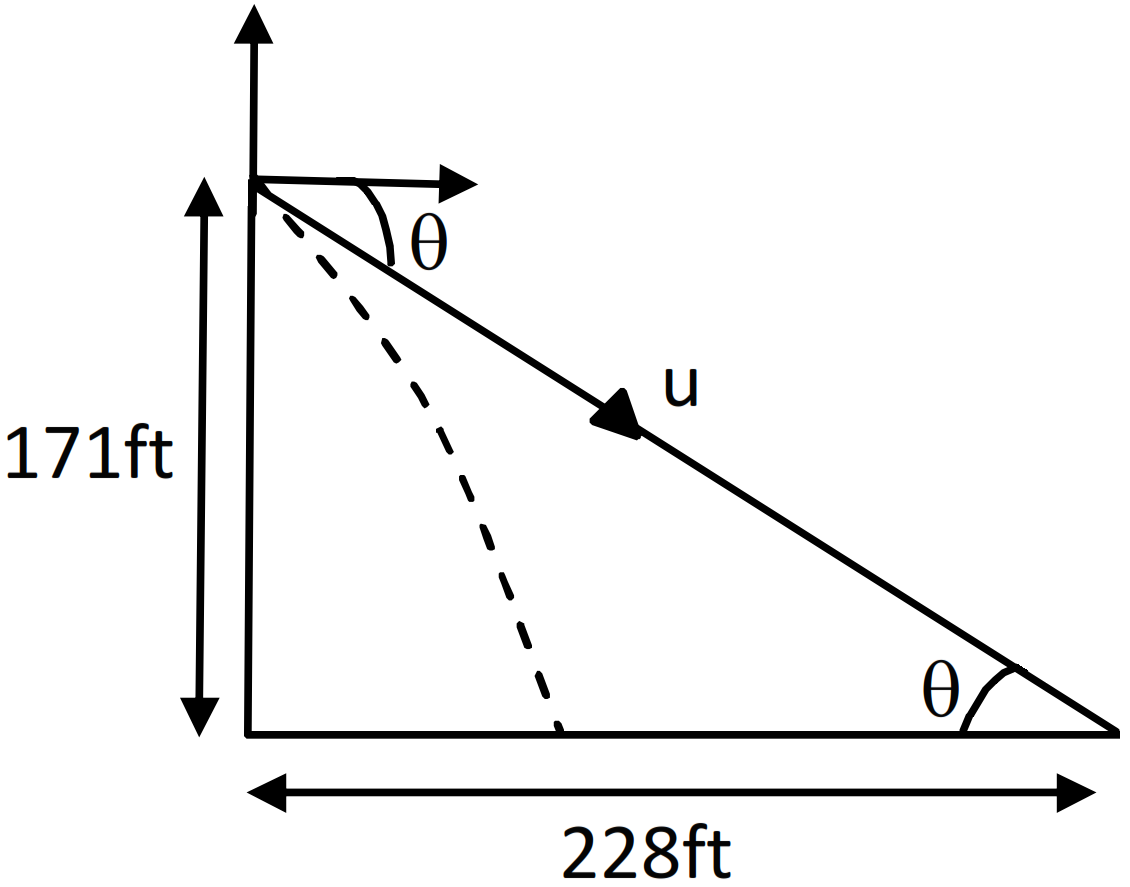
A person standing on the top of a cliff $171ft$ high has to throw a packet to his friend standing on the ground $228ft$ horizontally away. If he throws the packet directly aiming at the friend with a speed of $15.0ft/s$, how short will the packet fall?
Answer
$\tan\theta=\frac{171}{228}$$\Rightarrow\theta=\tan^{-1}\Big(\frac{171}{228}\Big)$
The motion of projectile (i.e. the packed) is from A. Taken reference axis at A.
$\therefore\theta=-37^{\circ}$ as u is below x-axis.
$u = 15ft/s, g = 32.2ft/s^2, y = -171ft$
$\text{y = x}\tan\theta-\frac{\text{x}^2\text{g}\sec^2\theta}{2\text{u}^2}$
$\therefore-171=-\text{x}(0.7536)-\frac{\text{x}^2\text{g}(1.568)}{2(225)}$
$\Rightarrow0.1125\text{x}^2+0.7536\text{x}-171=0$
$\text{}=35.78\text{ft}$
Horizontal range covered by the packet is 35.78ft.
So, the packet will fall 228 - 35.78 = 192ft short of his friend.
View full question & answer
Question 83 Marks
A ball is dropped from a balloon going up at a speed of $7m/s$. If the balloon was at a height $60m$ at the time of dropping the ball, how long will the ball take in reaching the ground?
Answer
Initially the ball is going upward $u = -7m/s, s = 60m, a = g = 10m/s^2\text{s = ut}+\frac{1}{2}\text{at}^2$
$\Rightarrow60=-7\text{t}+\frac{1}{2}10\text{t}^2$
$\Rightarrow5\text{t}^2-7\text{t}-60=0$
$\text{t}=\frac{7\pm\sqrt{49-4.5(-60)}}{2\times5}=\frac{7\pm35.34}{10}$
taking positive sign $\text{t}=\frac{7+35.34}{10}=4.2\sec$ $(\therefore\text{t}\neq-\text{ve})$ Therefore, the ball will take 4.2 sec to reach the ground.
View full question & answer
Question 93 Marks
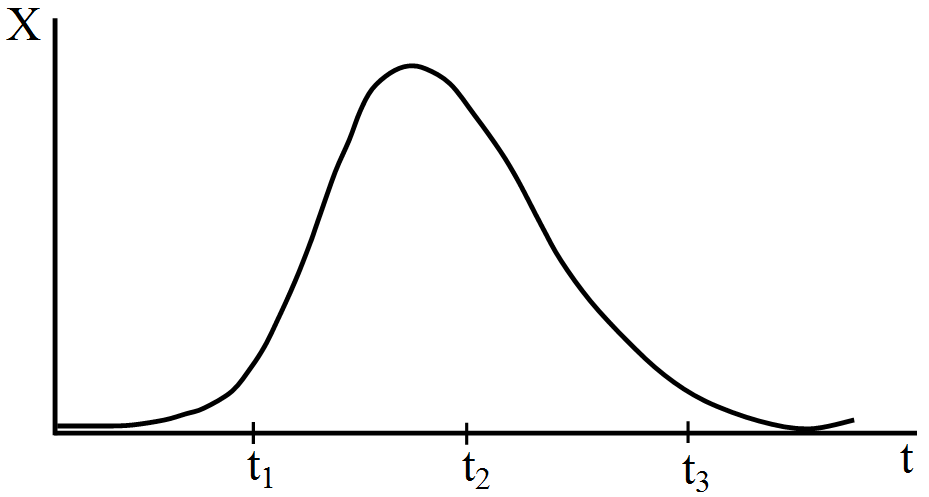
Figure shows the $x$ coordinate of a particle as a function of time. Find the signs of $v_x$ and $a_x$ at $t = t_1, t = t_2$ and $t = t_3$.
Answer
  1. As slope is positive velocity is positive.
As slope is increasing acceleration is positive.
  1. As slope is zero velocity is zero.
As slope is decreasing acceleration is negative.
  1. As slope is negative velocity is negative.
As slope is increasing acceleration is positive.
View full question & answer
Question 103 Marks
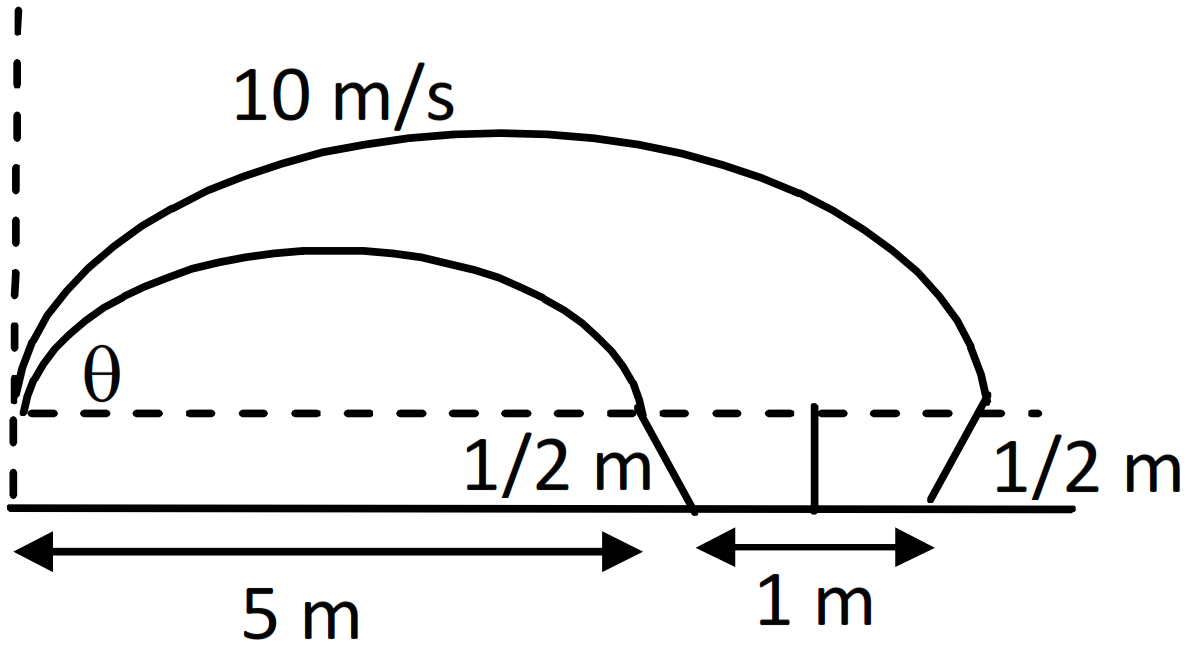
A man is sitting on the shore of a river. He is in the line of a $1.0m$ long boat and is $5.5m$ away from the centre of the boat. He wishes to throw an apple into the boat. If he can throw the apple only with a speed of $10m/s$, find the minimum and maximum angles of projection for successful shot. Assume that the point of projection and the edge of the boat are in the same horizontal level.
Answer
When the apple just touches the end B of the boat. $x = 5m, u = 10m/s, g = 10m/s^2, \theta$ = ?$\text{x}=\frac{\text{u}^2\sin2\theta}{\text{g}}$
$\Rightarrow5=\frac{10^2\sin2\theta}{10}$
$\Rightarrow5=10\sin2\theta$
$\Rightarrow\sin2\theta=\frac{1}{2}$
$\Rightarrow\sin30^{\circ} $ or $\sin150^{\circ}$
$\Rightarrow\theta=15^{\circ}$ or $75^\circ$
Similarly for end C, x = 6m Then $2\theta_1=\sin^{-1}\Big(\frac{\text{gx}}{\text{u}^2}\Big)=\sin^{-1}(0.6)=182^{\circ}$ or $71^{\circ}.$ So, for a successful shot, $\theta$ may very from 15° to 18° or 71° to 75°.
View full question & answer
Question 113 Marks
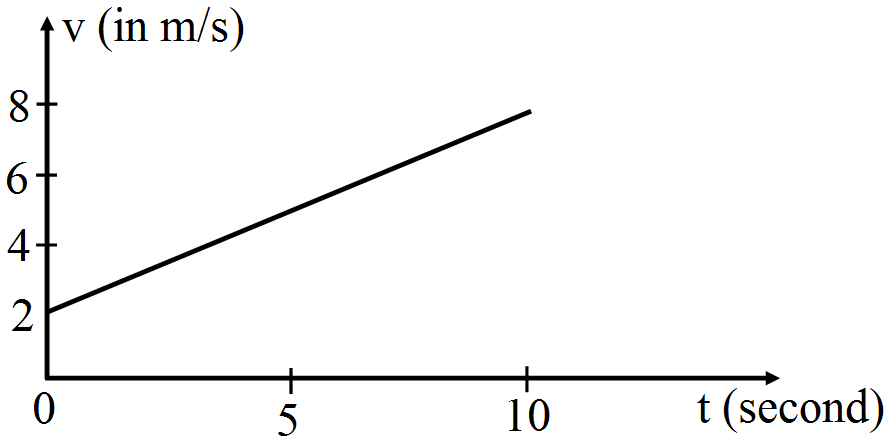
Figure shows the graph of velocity versus time for a particle going along the $X-$axis. Find:
  1. The acceleration.
  2. The distance travelled in $0$ to $10s.$
  3. The displacement in $0$ to $10s$.
Answer
  1. Initial velocity $u = 2m/s.$
final velocity $v = 8m/s$
time $= 10 sec,$
acceleration $=\frac{\text{v}-\text{u}}{\text{ta}}=\frac{8-2}{10}=0.6\text{m/s}^2$
  1. $v^2 - u^2 = 2aS$
$\Rightarrow\text{Distance S}=\frac{\text{v}^2-\text{u}^2}{2\text{a}}=\frac{8^2-2^2}{2\times0.6}=50\text{m}.$
  1. Displacement is same as distance travelled.
Displacement $= 50m.$
View full question & answer
Question 123 Marks
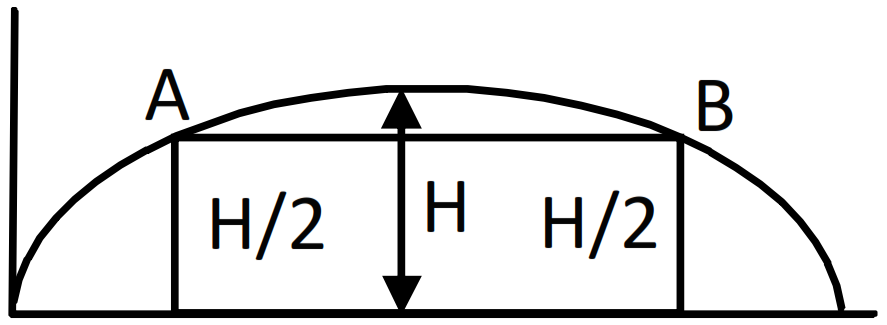
Find the average velocity of a projectile between the instants it crosses half the maximum height. It is projected with a speed u at an angle $\theta$ with the horizontal.
Answer
Total of flight $\text{T}=\frac{2\text{u}\sin\theta}{\text{g}}$
Average velocity $=\frac{\text{change in displacement}}{\text{time}}$
From the figure, it can be said AB is horizontal. So there is no effect of vertical component of the velocity during this displacement.
So because the body moves at a constant speed of $'\text{u}\cos\theta'$ in horizontal direction.
The average velocity during this displacement will be $\text{u}\cos\theta$ in the horizontal direction.
View full question & answer
Question 133 Marks
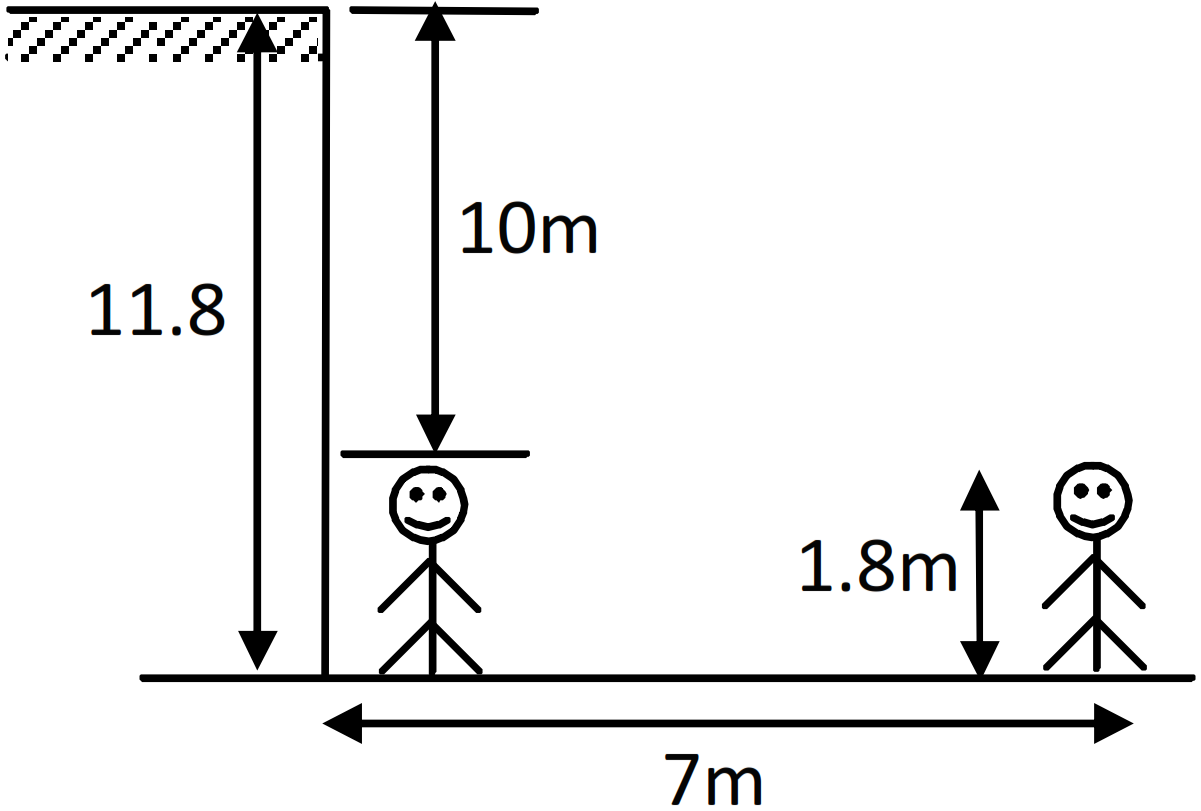
A healthy youngman standing at a distance of $7m$ from a $11.8m$ high building sees a kid slipping from the top floor. With what speed (assumed uniform) should he run to catch the kid at the arms height $(1.8m)$?
Answer
At point B (i.e. over 1.8m from ground) the kid should be catched. For kid initial velocity u = 0 Acceleration = $9.8m/s^2$​​​​​​​ Distance S = 11.8 - 1.8 = 10m$\text{S = ut}+\frac{1}{2}\text{at}^2$
$\Rightarrow10=0+\frac{1}{2}(9.8)\text{t}^2$
$\Rightarrow\text{t}^2=2.04$
$\Rightarrow\text{t}=1.42$
In this time the man has to reach at the bottom of the building. Velocity $\frac{\text{s}}{\text{t}}=\frac{7}{1.42}=4.9\text{m/s}.$
View full question & answer
Question 143 Marks
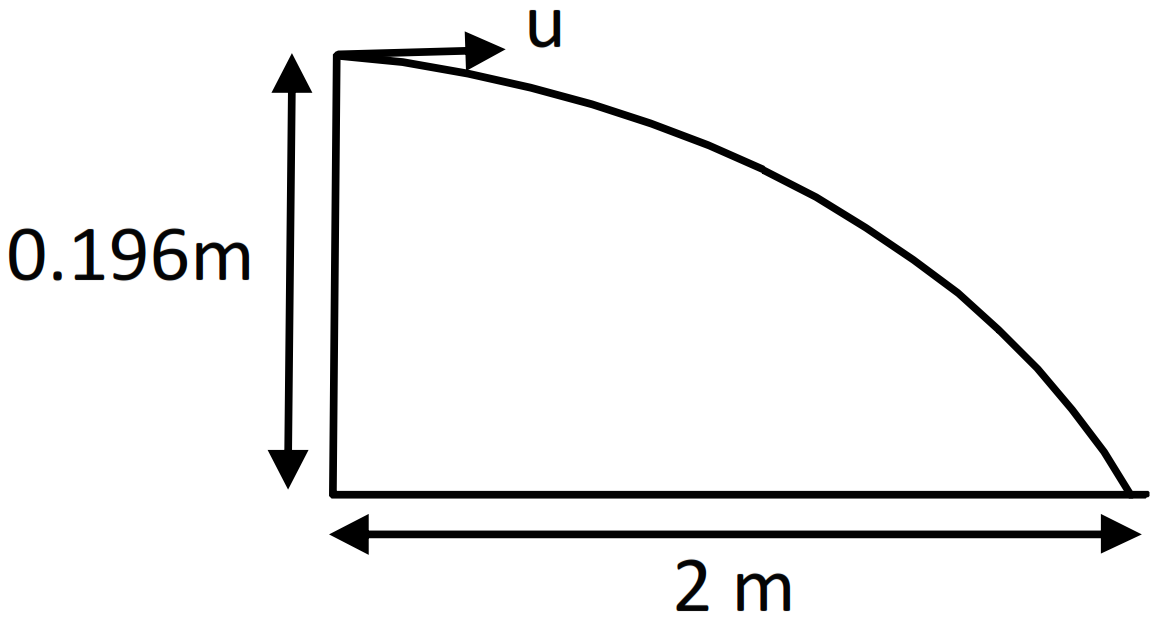
popular game in Indian villages is goli which is played with small glass balls called golis. The goli of one player is situated at a distance of $2.0m$ from the goli of the second player. This second player has to project his goli by keeping the thumb of the left hand at the place of his goli, holding the goli between his two middle fingers and making the throw. If the projected goli hits the goli of the first player, the second player wins. If the height from which the goli is projected is $19.6cm$ from the ground and the goli is to be projected horizontally, with what speed should it be projected so that it directly hits the stationary goli without falling on the ground earlier?
Answer
The goli move like a projectile. Here h = 0.196m Horizontal distance X = 2m Acceleration $g = 9.8m/s^2$. Time to reach the ground i.e.$\text{t}=\sqrt{\frac{2\text{h}}{\text{g}}}=\sqrt{\frac{2\times0.196}{9.8}}=0.2\sec$
Horizontal velocity with which it is projected be u.$\therefore\text{x = ut}$
$\Rightarrow\text{u}=\frac{\text{x}}{\text{t}}=\frac{2}{0.2}=10\text{m/s}.$
View full question & answer
Question 153 Marks
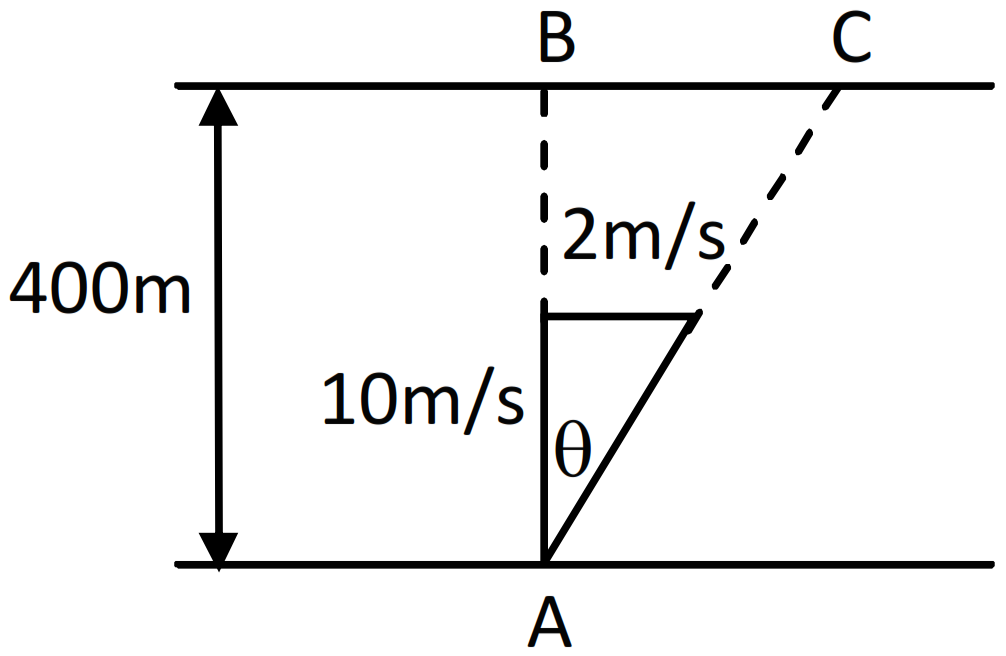
A river 400m wide is flowing at a rate of $2.0m/s$. A boat is sailing at a velocity of $10m/s$ with respect to the water, in a direction perpendicular to the river.
  1. Find the time taken by the boat to reach the opposite bank.
  2. How far from the point directly opposite to the starting point does the boat reach the opposite bank
Answer
  1. Here the boat moves with the resultant velocity $R$. But the vertical component $10m/s$ takes him to the opposite shore.
$\tan\theta=\frac{2}{10}=\frac{1}{5}$
Velocity $= 10m/s$
distance $= 400m$
$\text{Time}=\frac{400}{10}=40\sec.$
  1. The boat will reach at point $C.$
In $\triangle\text{ABC},\tan\theta=\frac{\text{BC}}{\text{AB}}=\frac{\text{BC}}{400}=\frac{1}{5}$
$\Rightarrow\text{BC}=\frac{400}{5}=80\text{m}$
View full question & answer
Question 163 Marks
Six particles situated at the corners of a regular hexagon of side a move at a constant speed v. Each particle maintains a direction towards the particle at the next corner. Calculate the time the particles will take to meet each other.
Answer
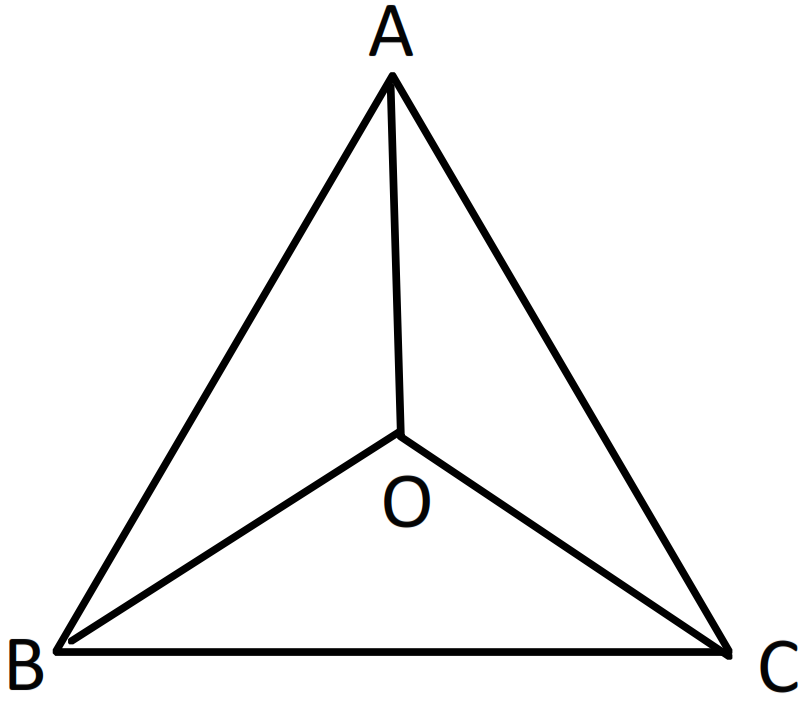
The particles meet at the centroid O of the triangle. At any instant the particles will form an equilateral $\triangle\text{ABC}$ with the same centroid. Consider the motion of particle A. At any instant its velocity makes angle 30°. This component is the rate of decrease of the distance AO. Initially AO $=\frac{2}{3}\sqrt{\text{a}^2-\Big(\frac{\text{a}}{2}\Big)^2}=\frac{\text{a}}{\sqrt{3}}$ Therefore, the time taken for AO to become zero.$=\frac{\frac{\text{a}}{\sqrt{3}}}{\text{v}\cos30^{\circ}}=\frac{2\text{a}}{\sqrt{3}\text{v}\times\sqrt{3}}=\frac{2\text{a}}{3\text{v}}$
View full question & answer
Question 173 Marks
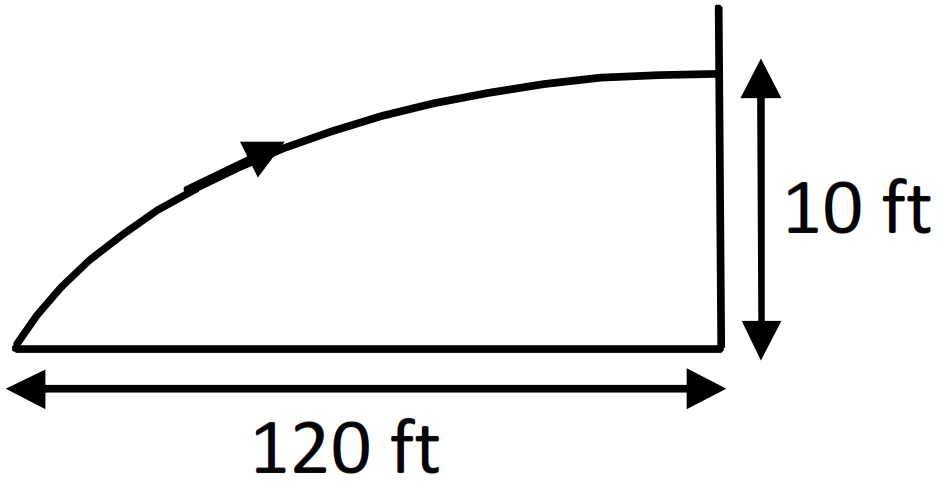
In a soccer practice session the football is kept at the centre of the field $40$ yards from the $10ft$ high goalposts. A goal is attempted by kicking the football at a speed of $64ft/s$ at an angle of $45°$ to the horizontal. Will the ball reach the goal post?
Answer
$g = 9.8m/s^2, 32.2ft/s^2 ; 40yd = 120ft$ horizontal range $\text{x}=120\text{ft, u}=64\text{ft/s},\theta=45^{\circ}$ We know that horizontal range $\text{x = u}\cos\theta\text{t}$$\Rightarrow\text{t}=\frac{\text{x}}{\text{u}\cos\theta}=\frac{120}{64\cos45^{\circ}}=2.65\sec.$
$\text{y = u}\sin\theta(\text{t})-\frac{1}{2}\text{gt}^2=64\frac{1}{\sqrt{2}(2.65)}-\frac{1}{2}(32.2)(2.65)^2$
= 7.08ft which is less than the height of goal post. In time 2.65, the ball travels horizontal distance 120ft (40yd) and vertical height 7.08ft which is less than 10ft. The ball will reach the goal post.
View full question & answer
Question 183 Marks
A ball is thrown at a speed of $40\ m/s$ at an angle of $60^\circ$ with the horizontal. Find:
  1. The maximum height reached.
  2. The range of the ball. Take $g = 10\ m/s^2$.
Answer
$u = 40m/s, a = g= 9.8m/s^2$, $\theta = 60^\circ$ Angle of projection.
  1. Maximum height $h =\frac{\text{u}^2\sin^2\theta}{2\text{g}}=\frac{40^2(\sin60^{\circ})^2}{2\times10}=60\text{m}$
  2. Horizontal range $X =\frac{(\text{u}^2\sin2\theta)}{\text{g}}$
$=\frac{(40^2\sin2(60^{\circ}))}{10}$
​​​​​​​$=80\sqrt{3}\text{m}.$
View full question & answer
Question 193 Marks
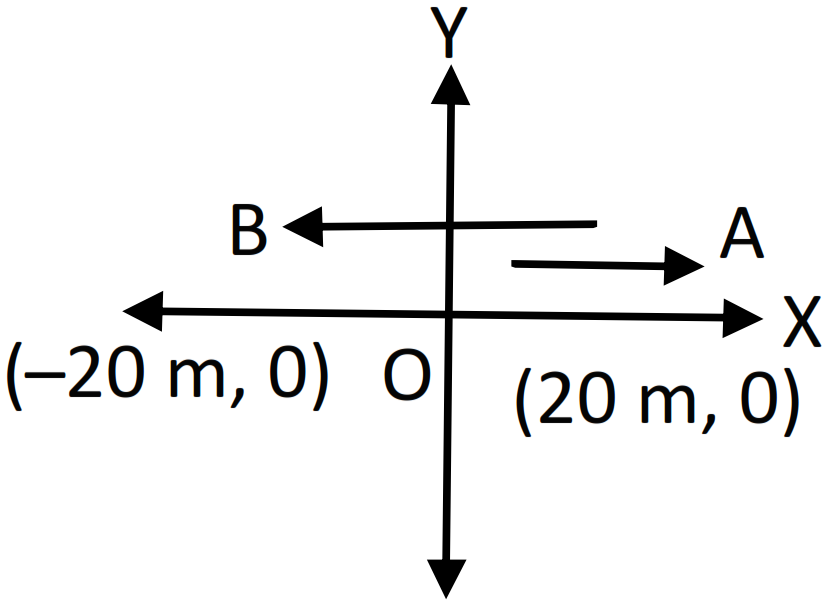
A particle starts from the origin, goes along the $X-$axis to the point $(20m, 0)$ and then returns along the same line to the point $(-20m, 0)$. Find the distance and displacement of the particle during the trip.
Answer
$O \rightarrow$ Starting point origin.
  1. Distance travelled $= 20 + 20 + 20 = 60m$
  2. Displacement is only $OB = 20m$ in the negative direction.
Displacement $\rightarrow$ Distance between final and initial position.
View full question & answer
Question 203 Marks
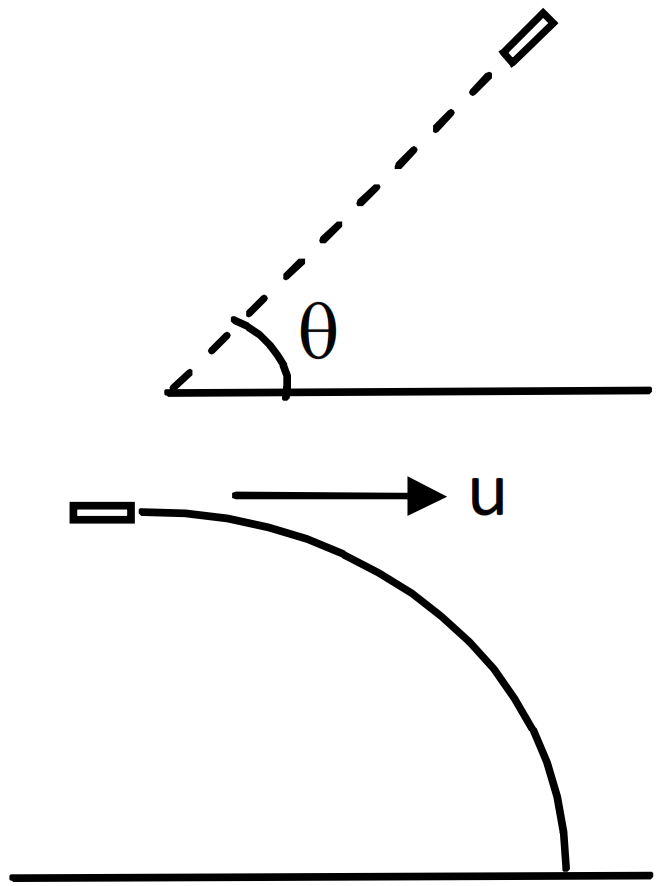
A bomb is dropped from a plane flying horizontally with uniform speed. Show that the bomb will explode vertically below the plane. Is the statement true if the plane flies with uniform speed but not horizontally?
Answer
During the motion of bomb its horizontal velocity u remains constant and is same as that of aeroplane at every point of its path. Suppose the bomb explode i.e. reach the ground in time t. Distance travelled in horizontal direction by bomb = ut = the distance travelled by aeroplane. So bomb explode vertically below the aeroplane.
Suppose the aeroplane move making angle $\theta$ with horizontal. For both bomb and aeroplane, horizontal distance is $\text{u}\cos\theta\text{t}.$ t is time for bomb to reach the ground. So in this case also, the bomb will explode vertically below aeroplane.
View full question & answer
Question 213 Marks
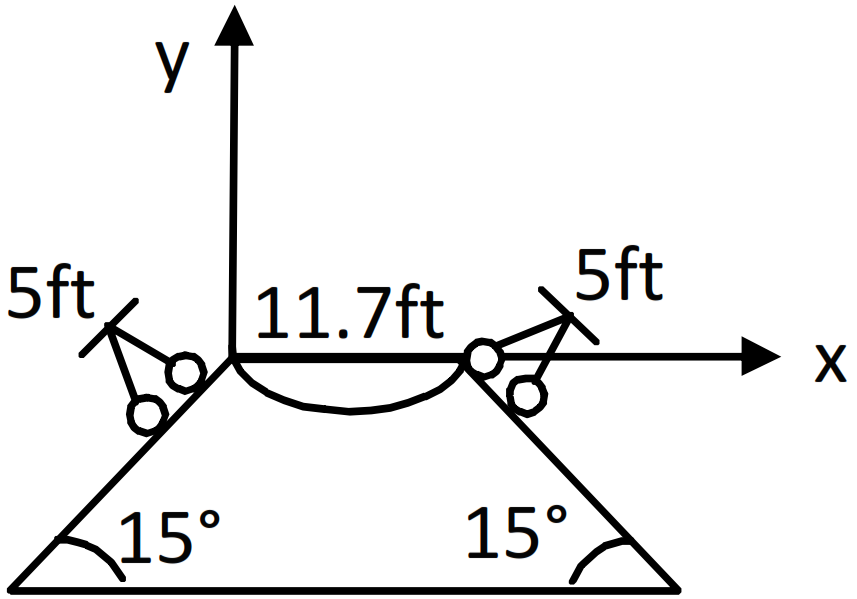
Figure shows a $11.7ft$ wide ditch with the approach roads at an angle of $15°$ with the horizontal. With what minimum speed should a motorbike be moving on the road so that it safely crosses the ditch?
Assume that the length of the bike is $5ft$, and it leaves the road when the front part runs out of the approach road.
Answer
Horizontal range X = 11.7 + 5 = 16.7ft covered by te bike. $g = 9.8m/s^2 = 32.2ft/s^2$. y = x$\tan\theta-\frac{\text{gx}^2\sec^2\theta}{2\text{u}^2}$
To find, minimum speed for just crossing, the ditch y = 0 ($\therefore$ A is on the x axis)$\Rightarrow\text{x}\tan\theta=\frac{\text{gx}^2\sec^2\theta}{2\text{u}^2}$
$\Rightarrow\text{u}^2=\frac{\text{gx}^2\sec^2\theta}{2\text{x}\tan\theta}=\frac{\text{gx}}{2\sin\theta\cos\theta}=\frac{\text{gx}}{\sin2\theta}$
$\Rightarrow\text{u}=\sqrt{\frac{(32.2)(16.7)}{\frac{1}{2}}}$ $\Big(\because\sin30^{\circ}=\frac{1}{2}\Big)$
⇒ u = 32.79ft/s = 32ft/s.
View full question & answer
Question 223 Marks
A ball is projected vertically upward with a speed of $50m/s$. Find:
  1. The maximum height.
  2. The time to reach the maximum height.
  3. The speed at half the maximum height. Take $g = 10m/s^2$.
Answer
$u = 50m/s, g = -10m/s^2$ when moving upward, $v = 0 ($at highest point$).$
  1. $\text{S}=\frac{\text{v}^2-\text{u}^2}{2\text{a}}=\frac{0-15}{2(-10)}=125\text{m}$
maximum height reached $= 125m$​​​​​​​
  1. $\text{t}=\frac{(\text{v}-\text{u})}{\text{a}}=\frac{(0-50)}{-10}=5\text{ sec}.$
  2. $\text{s}'=\frac{125}{2}=62.5\text{m},\text{u}=50\text{m/s, a}=-10\text{m/s}^2,$
$\text{v}^2-\text{u}^2=2\text{as}$
$\Rightarrow\text{v}=\sqrt{(\text{u}^2+2\text{as})}$
$=\sqrt{50^2+(-10)(62.5)}$
​​​​​​​$=35\text{m/s}.$
View full question & answer