Questions

[5 Marks Each] QUE-ANS

🎯

Test yourself on this topic

8 questions · timed · auto-graded

Question 15 Marks
Explain the process of rooftop rain water harvesting with the help of a suitable diagram.
Answer
The process of rooftop rainwater harvesting is as follows:
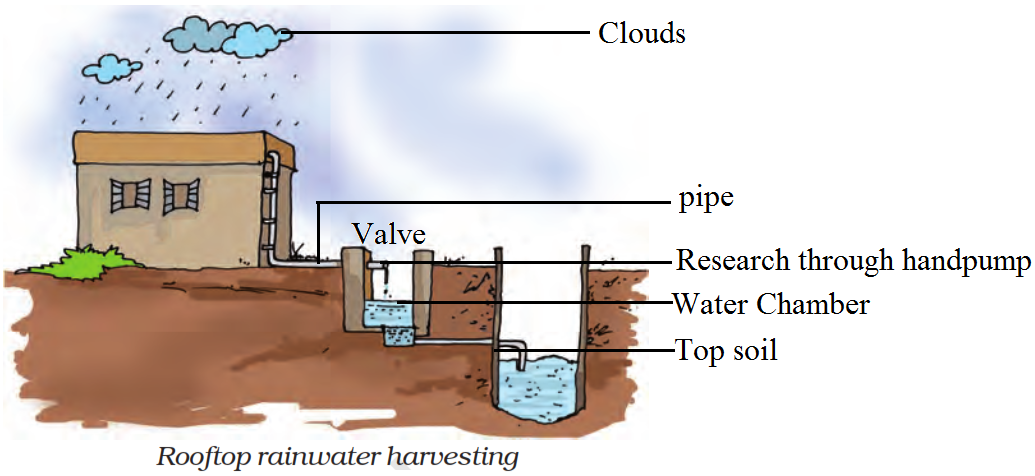
  1. In this process, the rainwater is collected on the rooftop.
  2. This collected rainwater in allowed to pass through pipes into a storage tank at the ground level.
  3. The collected water is filtered and used when required.
​​​​​​​
View full question & answer
Question 25 Marks
What is precipitation? Does precipitation in atmosphere always result in rain?
Answer
We think of rain or snow when clouds appear in the sky. But, many a times, it does not rain even though the sky may be covered with clouds. We now know that clouds carry small droplets of water in them. It may so happen that:
  • Many droplets of water come together to form larger sized drops of water. Such drops of water may become so heavy that they begin to fall. Falling of water drops is called precipitation. If the water during precipitation remains liquid till it reaches the surface of the earth, we have rains.
  • Sometimes precipitation may be in the form of hail or snow. Water in a hail or snow is in its frozen or solid form.
Many a times, especially during winter nights, the air near the surface becomes Questionuite cool. As a result, the water vapour present in it condenses to form water droplets. These water droplets appear as dew, which you might have observed on leaves or flowers in the morning during winters.
View full question & answer
Question 35 Marks
Explain the role of plants in adding water vapours into atmosphere.
Answer
There is yet another process through which water vapour gets transferred into the air. This process involves plants. All plants need water to grow. Plants get this water from the soil, which is absorbed from it by their roots. A part of this water is used by them to prepare their food. Some water is retained by different parts of the plants like roots, stem, leaves, flowers and fruits. However, a large part of this water is released by the plants into air as its vapour. Most of the water lost by the plants in this process is through their leaves. This process is known as transpiration.
Every plant whether it is in a crop field, a forest, on the roadside or in a kitchen garden transpires to give off water vapour. The amount of water vapour that goes into the air through the process of transpiration is very huge. To give an idea, let us consider an example. Suppose a crop of corn has been sown in a plot which is $100$ metre long and $100$ metre wide. The amount of water that this crop of corn would lose through transpiration during one season would be roughly equestionual to water in a $90$ centimetre high tank spread over the plot of land.Water lost through transpiration by wheat plants that give us one kilogram of wheat is roughly $25$ large sized buckets full of water, i.e., nearly $500$ litres.Thus, we can see that water vapours get continuously added to air by the plants during the process of transpiration.
View full question & answer
Question 45 Marks
Write two ways of water harvesting in Delhi. Discuss in brief.
Answer
Ways of water harvesting in Delhi:
  1. Collecting water from the rooftops of houses, flats and other buildings: Rainwater that falls on the rooftops is brought down through pipes and collected in pits. The sides of these pits are lined with concrete. Their bases, howgver, are unlined and have layers of stone chips, sand and coal tar. These layers sieve the water as it slowly, seeps through into the ground. This raises the level of the groundwater. The groundwater can be used in the future by bringing it up with hand pumps and borings.
  2. Collecting water at street corners: Rainwater that falls on tarred roads is completely wasted as it does not seep into the ground. This water can be collected by making holes in the pavement at street comers. The rainwater can then be collected in pits under the pavement and slowly seeped into the ground. Jamia Hamdard University in Delhi has already started using this way of water harvesting.
You will be surprised to learn that even in our city, rainwater is being collected above the ground for direct use. For example, the prisoners of Delhi jail have built a j large cemented pond to collect rainwater. The prisoners use the rainwater collected in this pond for their daily needs. Similarly there is a bus depot that collects and stores rainwater to use for washing buses. Provisions are being made under the flyover at the Dhaula Kuan crossing to harvest the rainwater that collects there and to send this water underground through pipes.
View full question & answer
Question 55 Marks
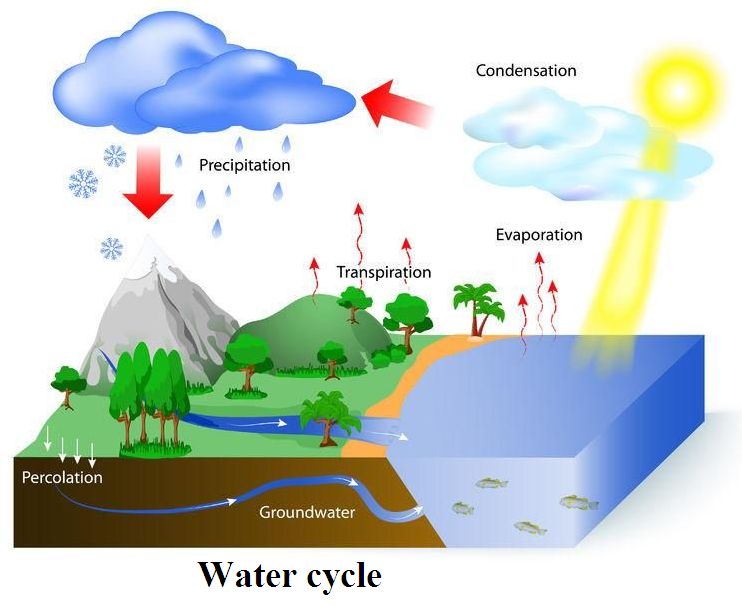
Briefly describe the water cycle. Also explain its importance.
Answer
Water on heating turns into water vapour. Water vapour on cooling gives water again. The change of water from one form to other form over and over again makes the water cycle in nature.
The sun heats up and evaporates the water from oceans, .ponds, lakes and rivers. This water vapour being lighter is carried up by the air. This water vapour gets cooled at height and water droplets are formed. These water droplets form a cloud. When these water droplets in the cloud come close together, they form drops of water. These drops of water may fall on the earth as rain.
The rain is absorbed by the soil. A part of rain water collected in the rivers flows into the sea, where again the evaporation occurs. This completes the water cycle.
Thus, now we know how water gets circulated between the oceans and land through evaporation, transpiration, precipitation and its downhill flow by different routes. This process of circulation of water is known as water cycles. Water cycle helps in maintaining continuous supply of fresh water to all living things on land. No life on land would have been possible without water cycle.
View full question & answer
Question 65 Marks
Explain various paths by which water that falls on land as rain goes back to oceans.
Answer
Water that falls on the land as rain and snow sooner or later goes back to the ocean This happens in many ways.
Almost all land surfaces are above the level of oceans. When rain falls on the land, the water flows down towards the ocean This flow of water is often in the form of rivers and streams. Sometimes, the water gets trapped in large craters and natural basins on its way to the ocean The rainwater fills up the craters or basins to form lakes. If the lakes or basins have an outlet like a river, the water again begins to flow towards oceans
A part of the rainwater gets absorbed by the ground and seems to disappear in the soil. Some of this water is brought back to the air by the process of evaporation and transpiration. Rest of it continues to seep deeper and deeper under the ground until it is stopped by layers of rock that do not allow water to pass through them. This water is known as groundwater. However, this water may seep through those rocks that let the water to pass through. The water then appears as a spring. Many lakes, ponds and wells are fed by such springs.
Water deposited in the form of snow in mountains also finds its way to an ocean or a sea. Water in rivers, like Ganga and Yamuna, is due to the melting of snow in the lower regions of the Himalayan mountains. All these rivers ultimately terminate in the sea.
View full question & answer
Question 75 Marks
Explain water cycle.
Answer
The Water Cycle is the journey of water from the land to the sky and back again. There are six important processes that make up the water cycle.
  1. Condensation: The opposite of evaporation. Condensation occurs when a gas is changed into a liquid.
  2. Infiltration: Infiltration is an important process where rain water soaks into the ground, through the soil and underlying rock layers.
  3. Runoff: Much of the water that returns to Earth as precipitation runs off the surface of the land, and flows down hill into streams, rivers, ponds and lakes.
  4. Evaporation: the process where a liquid, in this case water, changes from its liquid state to a gaseous state.
  5. Precipitation: When the temperature and atmospheric pressure are right, the small droplets of water in clouds form larger droplets and precipitation occurs. The raindrops fall to Earth.
  6. Transpiration: As plants absorb water from the soil, the water moves from the roots through the stems to the leaves. Once the water reaches the leaves, some of it evaporates from the leaves, adding to the amount of water vapour in the air. This process of evaporation through plant leaves is called transpiration.
View full question & answer
Question 85 Marks
The process of condensation plays an important role in bringing water back to the surface of earth. Explain how?
Answer
The Water Cycle is the journey of water from the land to the sky and back again. There are six important processes that make up the water cycle.
  1. Condensation: The opposite of evaporation. Condensation occurs when a gas is changed into a liquid.
  2. Infiltration: Infiltration is an important process where rain water soaks into the ground, through the soil and underlying rock layers.
  3. Runoff: Much of the water that returns to Earth as precipitation runs off the surface of the land, and flows down hill into streams, rivers, ponds and lakes.
  4. Evaporation: The process where a liquid, in this case water, changes from its liquid state to a gaseous state.
  5. Precipitation: When the temperature and atmospheric pressure are right, the small droplets of water in clouds form larger droplets and precipitation occurs. The raindrops fall to Earth.
  6. Transpiration: As plants absorb water from the soil, the water moves from the roots through the stems to the leaves. Once the water reaches the leaves, some of it evaporates from the leaves, adding to the amount of water vapour in the air. This process of evaporation through plant leaves is called transpiration.
View full question & answer