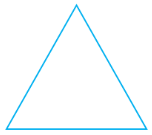
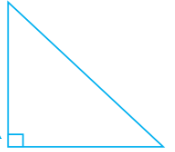
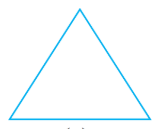
MCQ 511 Mark
The mid point of the base of a triangle is equidistant from all the vertices. The triangle is.
AnswerThe midpoint of the hypotenuse of a right angled triangle is equidistant from all three vertices. Hence the triangle is a right angled triangle with the hypotenuse at the base.
View full question & answer→MCQ 521 Mark
The triangle whose lengths of sides are $3\ cm, 4\ cm, 5\ cm$ is $..$
- A
Obtuse$-$angled triangle
- ✓
Right$-$angled triangle
- C
Acute$-$angled triangle
- D
AnswerCorrect option: B. Right$-$angled triangle
Right$-$angled triangle
View full question & answer→MCQ 531 Mark
In Figure. M is the mid-point of both $AC$ and $BD$. Then:
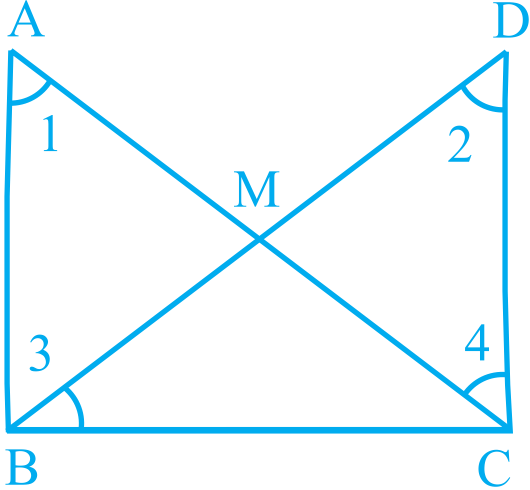
- A
$\angle\text{1}=\angle\text{2}$
- ✓
$\angle\text{1}=\angle\text{4}$
- C
$\angle\text{2}=\angle\text{4}$
- D
$\angle\text{1}=\angle\text{3}$
AnswerCorrect option: B. $\angle\text{1}=\angle\text{4}$
In $\triangle\text{AMB}$ and $\triangle\text{CMD},$ $AM = CM [M$ is the mid-point]
$BM = DM [M$ is the mid-point]
$\angle\text{AMB}=\angle\text{CMD}$ [vertically opposite angles]
By sas congruence criterion.
$\angle\text{AMB}\cong\angle\text{CMD}$
$\therefore \ \angle1=\angle4$ [by $CPCT]$
View full question & answer→MCQ 541 Mark
The angles of a triangle are in the ratio $2 : 3 : 7$. The measure of the largest angle is:
- A
$84^\circ$
- B
$91^\circ$
- ✓
$105^\circ$
- D
$98^\circ$
AnswerCorrect option: C. $105^\circ$
Let the angles of the triangle be $2x, 3x$ and $7x.$
Now, $2x + 3x + 7x = 180^\circ$ [Angle sum property of triangle]
$\Rightarrow 12x = 180^\circ$
$\Rightarrow x = 15^\circ$
$\therefore$ Largest angle $= 7x = 7 \times 15^\circ $
$= 105^\circ $
Hence, the correct answer is option $(c).$
View full question & answer→MCQ 551 Mark
How many medians can a triangle have?
AnswerA triangle has $3$ medians. The perpendicular line segment from a vertex of a triangle to its opposite side is called an altitude of the triangle. A triangle has $3$ altitudes.
View full question & answer→MCQ 561 Mark
In $\triangle\text{ABC}, AD$ is the bisector of $\angle\text{A}$ meeting $BC$ at $D, CF \bot AB$ and $E$ is the mid-point of $AC$. Then median of the triangle is:
AnswerAs we know, median of a triangle bisects the opposite sides.
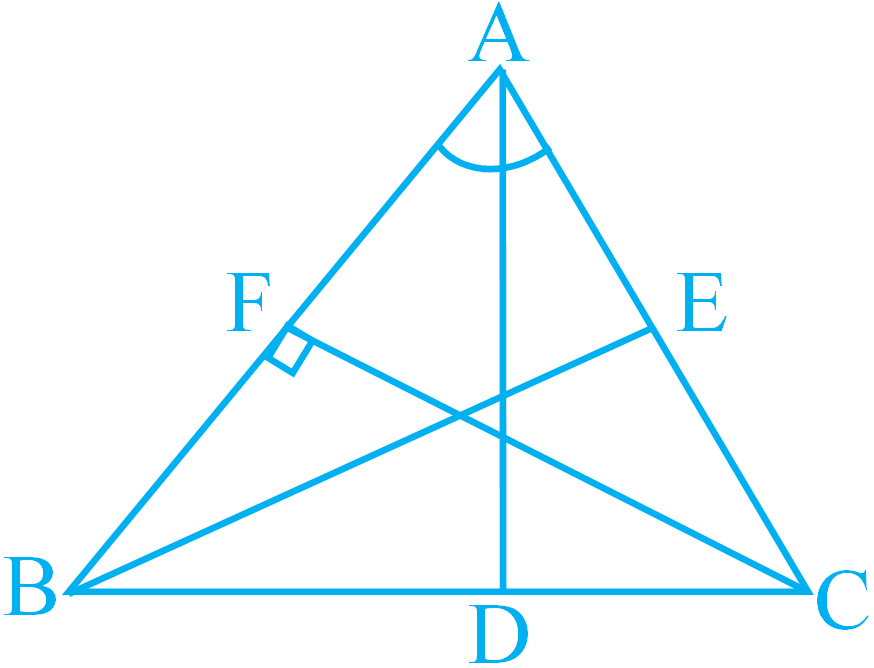
Hence, the median is $BE$ as $AE = EC.$
View full question & answer→MCQ 571 Mark
Which is the longest side of a right triangle?
MCQ 581 Mark
How many elements are there in a triangle?
MCQ 591 Mark
If one angle of a triangle measures $90^\circ $, the triangle is called:
- A
Acute$-$angled
- B
Obtuse$-$angled
- ✓
Right$-$angled
- D
AnswerCorrect option: C. Right$-$angled
A triangle one of whose angles is $90$ degree is called right angled triangle.
View full question & answer→MCQ 601 Mark
The measure of three angles of a triangle are in the ratio $5 : 3 : 1$. find the measure of this angles.
- ✓
$100^\circ , 60^\circ , 20^\circ$
- B
$80^\circ , 30^\circ , 45^\circ$
- C
$120^\circ , 150^\circ , 30^\circ$
- D
$90^\circ , 90^\circ , 67^\circ$
AnswerCorrect option: A. $100^\circ , 60^\circ , 20^\circ$
$100^\circ , 60^\circ , 20^\circ$
View full question & answer→MCQ 611 Mark
In a right triangle, if hypotenuse is $H$, perpendicular is $P$ and base is $B$ then.
- A
$B^2 = H^2 + P^2$
- ✓
$H^2 = P^2 + B^2$
- C
$H^2 = P^2 - B^2$
- D
$P^2 = B^2 + H^2$
AnswerCorrect option: B. $H^2 = P^2 + B^2$
$H^2 = P^2 + B^2$
View full question & answer→MCQ 621 Mark
In Figure. if $AB | | CD$, then:
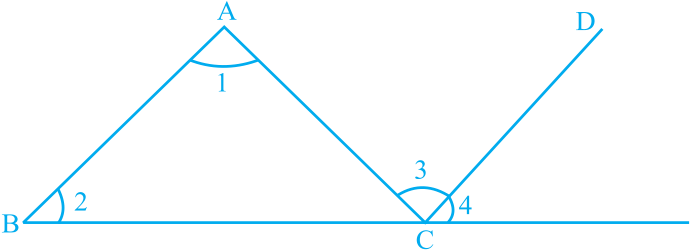
AnswerCorrect option: D. $\angle1+\angle2=\angle3+\angle4$
Given, $AB | | CD$ and $AC$ is the transversal.
So, $\angle1=\angle3$
Also, in $\triangle\text{ABC},$ $\angle3+\angle4=\angle1+\angle2$
$[\because$ exterior angle = sum of two opposite interior angles$]$
View full question & answer→MCQ 631 Mark
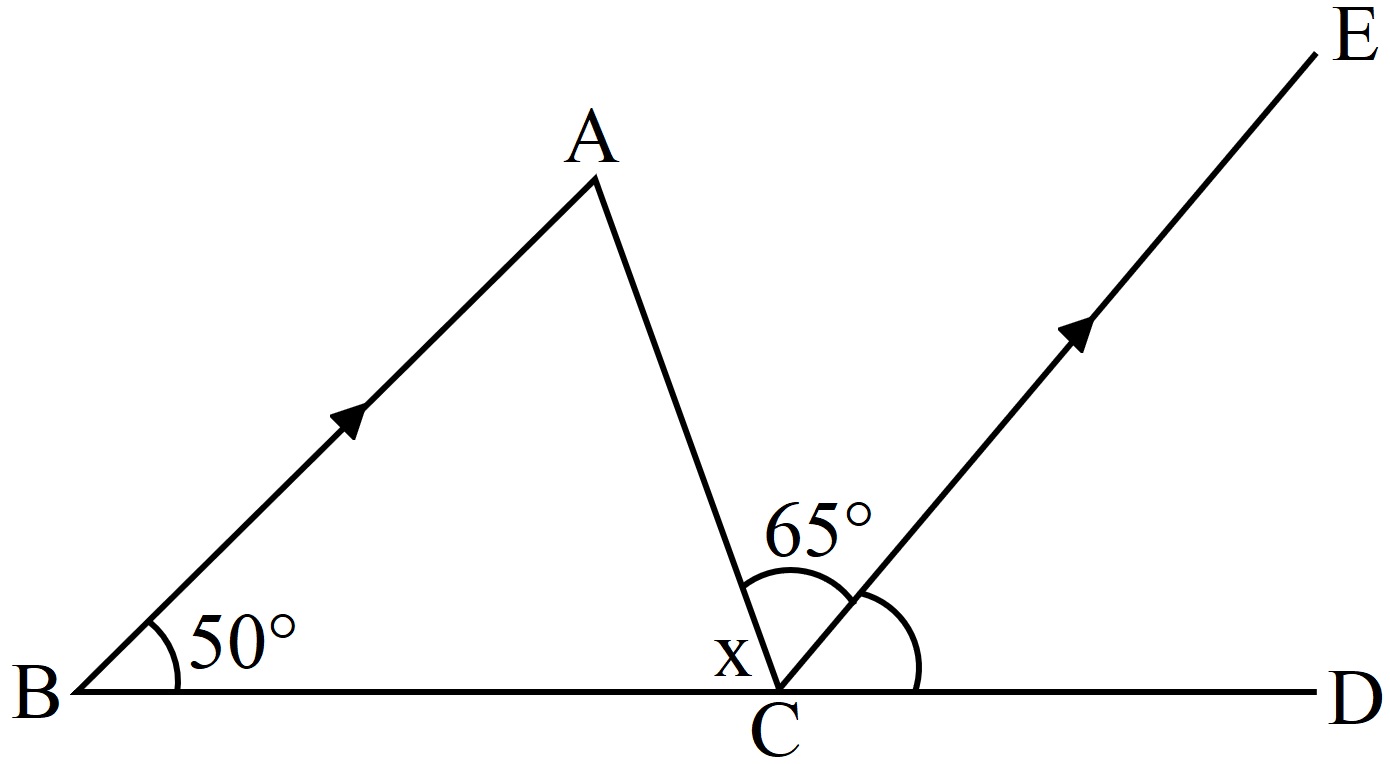
In the following figure, find x if $\text{BA}\parallel\text{CE.}$
- A
$60^\circ$
- B
$40^\circ$
- C
$45^\circ$
- ✓
$65^\circ$
AnswerCorrect option: D. $65^\circ$
$\angle\text{ECD}=\angle\text{ABC}=50^\circ$
$\therefore\text{x}=180^\circ-(65^\circ+50^\circ)$
$=65^\circ$
View full question & answer→MCQ 641 Mark
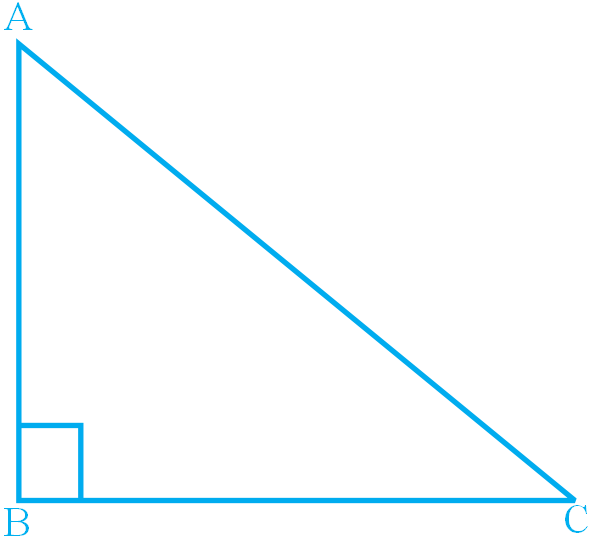
In a right$-$angled triangle $\ce{ABC},$ if angle $B = 90^\circ ,$ then which of the following is true?
- A
$\ce{AB^2 = BC^2 + AC^2}$
- ✓
$\ce{AC^2 = AB^2 + BC^2}$
- C
$\ce{AB^2 = BC^2 + AC^2}$
- D
$\ce{AC = AB + BC}$
AnswerCorrect option: B. $\ce{AC^2 = AB^2 + BC^2}$
$($Hypotenuse$)^2 = ($perpendiculer$)^2 + ($Base$)^2$
$\Rightarrow \ce{AC^2 = AB^2 + BC^2}$
View full question & answer→MCQ 651 Mark
Two triangles are congruent, if two angles and the side included between them in one of the triangles are equal to the two angles and the side included between them of the other triangle. This is known as the:
- A
$RHS$ congruence criterion.
- ✓
$ASA$ congruence criterion.
- C
$SAS$ congruence criterion.
- D
$AAA$ congruence criterion.
AnswerCorrect option: B. $ASA$ congruence criterion.
Under $ASA$ congruence criterion, two triangles are congruent, if two angles and the side included between them in one of the triangles are equal to the two angles and the side included between them of the other triangle.
View full question & answer→MCQ 661 Mark
In Fig. the value of $x$ is:
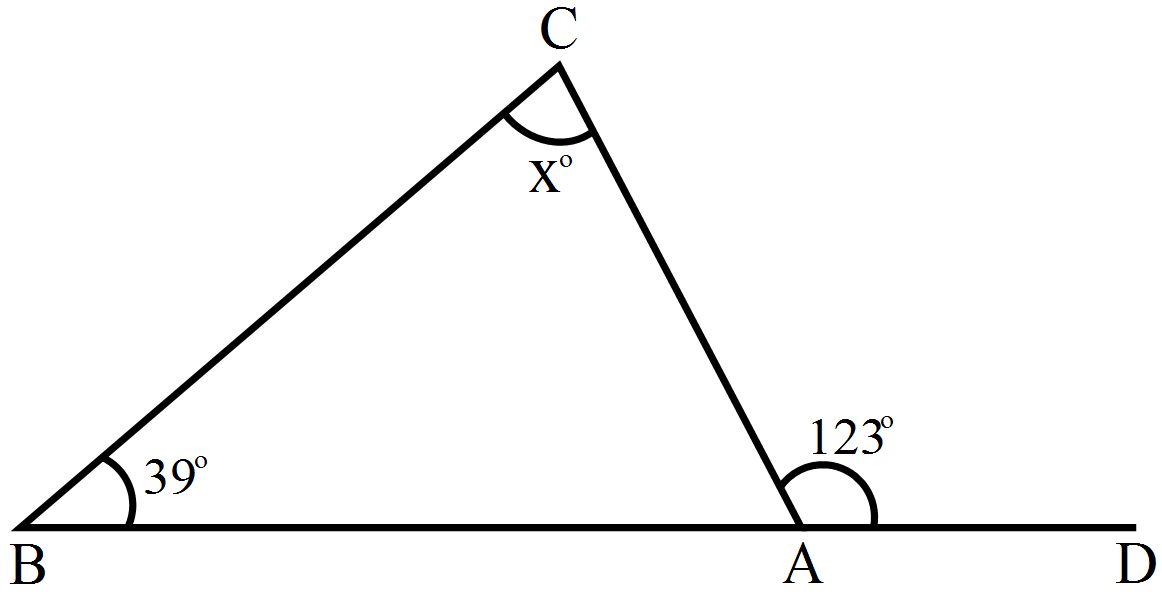
Answer$\angle \text{CAD}=\angle \text{ABC}+\angle \text{ACB}$ [Exterior angle property]
$\Rightarrow 123^\circ = 39^\circ + \text{x}^\circ$
$\Rightarrow 84^\circ = \text{x}^\circ$
$\Rightarrow \text{x} = 84$
Hence, the correct answer is option $(a).$
View full question & answer→MCQ 671 Mark
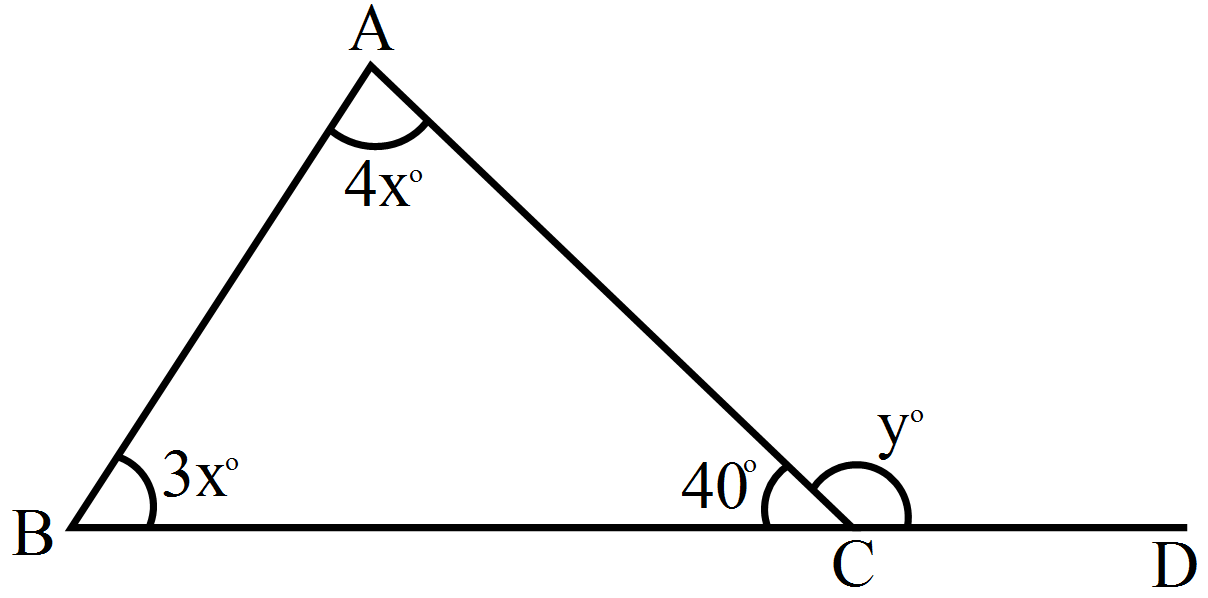
In Fig. the values of $x$ and $y$ are:
- A
$x = 20, y = 130$
- B
$x = 20, y = 140$
- ✓
$x = 40, y = 140$
- D
$x = 15, y = 140$
AnswerCorrect option: C. $x = 40, y = 140$
$\angle \text{ACB}+\angle \text{ACD}=180^\circ$
$\Rightarrow 40^\circ + \text{y}^\circ = 180^\circ$
$\Rightarrow \text{y}^\circ = 140^\circ$
$\Rightarrow \text{y} = 140$
Now, $\angle \text{ACD}=\angle \text{ABC}+\angle \text{BAC}$ [Exterior angle property]
$\Rightarrow 3\text{x}^\circ + 4\text{x}^\circ = \text{y}^\circ$
$\Rightarrow 7\text{x}^\circ = 140^\circ$
$\Rightarrow \text{x} = 20$
Hence, the correct answer is option $(c).$
View full question & answer→MCQ 681 Mark
The hypotenuse of a right triangle is $26\ cm$ long. If one of the remaining two sides is $10\ cm$ long, the length of the other side is:
- A
$25\ cm$
- B
$23\ cm$
- ✓
$24\ cm$
- D
$22\ cm$
AnswerCorrect option: C. $24\ cm$
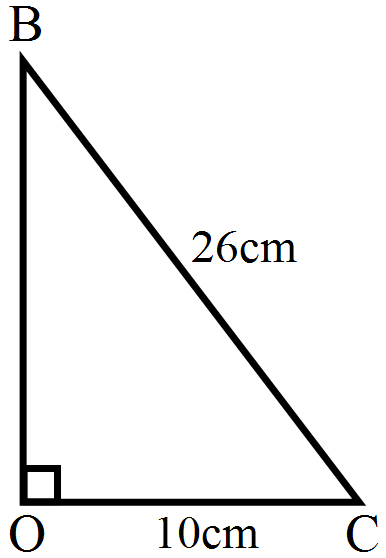
In right traingle $\ce{BOC},$
$\ce{BC^2= OC^2 + OB^2 }$
$\Rightarrow(26)^2=(10)^2+ OB ^2 $
$\Rightarrow 676=100+ OB ^2 $
$\Rightarrow OB ^2=576 $
$\Rightarrow OB ^2=(24)^2 $
$\Rightarrow OB =24 \ cm$
Hence, the correct answer is option $(c).$ View full question & answer→MCQ 691 Mark
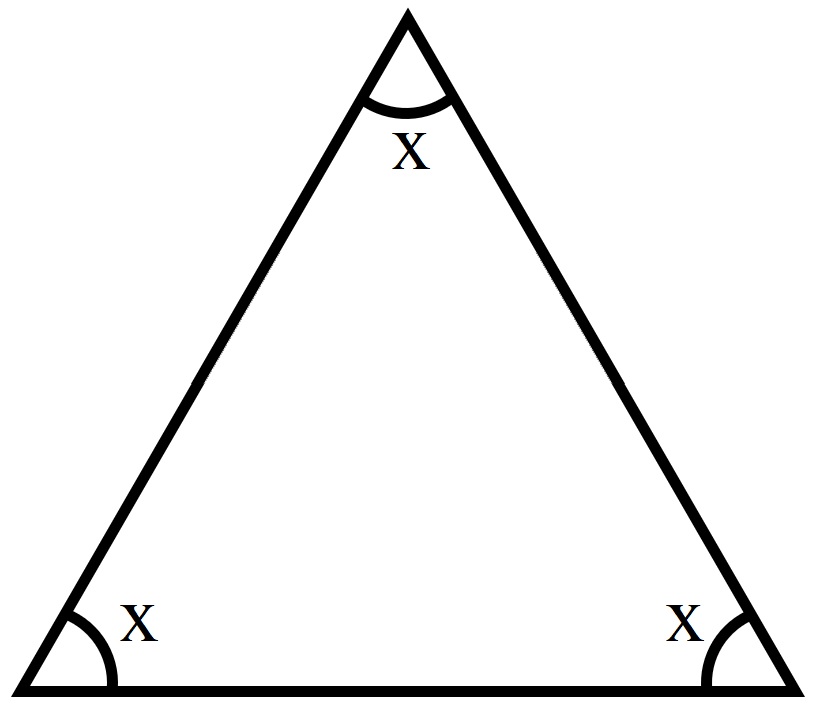
Find the value of $x$ in this figure.
- A
$50^\circ$
- ✓
$60^\circ$
- C
$55^\circ$
- D
AnswerCorrect option: B. $60^\circ$
$60^\circ$
View full question & answer→MCQ 701 Mark
The altitude and median be same for a which triangle?
MCQ 711 Mark
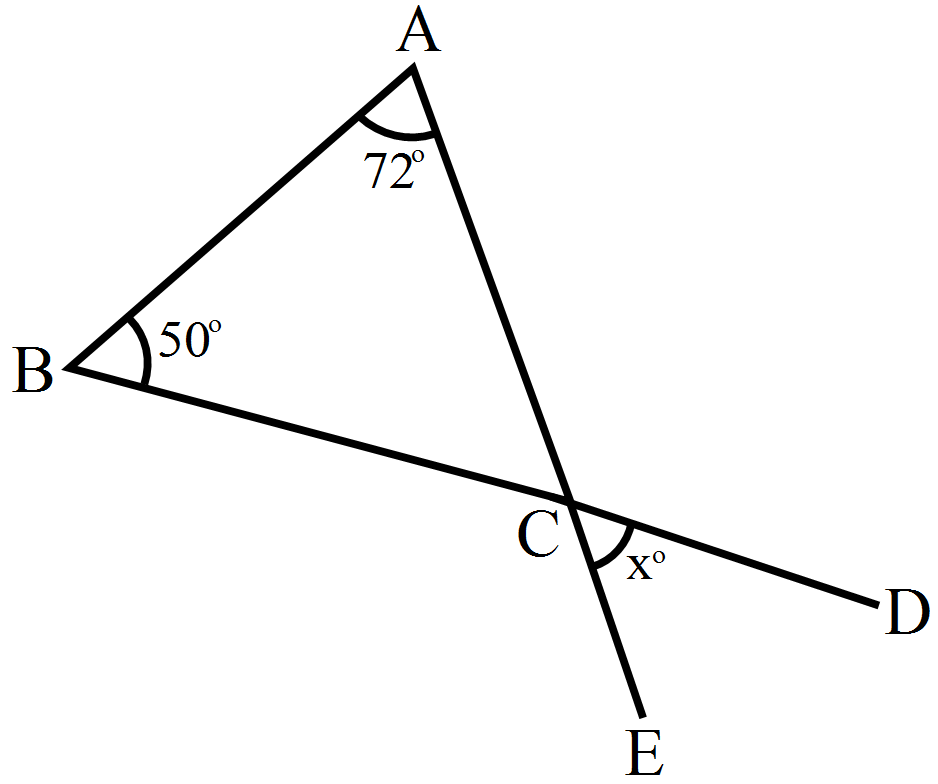
In Fig. the value of $x$ is:
- A
$72^\circ$
- B
$50$
- ✓
$58$
- D
$48$
Answer$\angle \text{A}+\angle \text{B}+\angle \text{C}=180^\circ$ [Angle sum property of triangle]
$ \Rightarrow 50^\circ+72^\circ+\angle \text{C}=180^\circ$
$\Rightarrow \angle \text{C}+122^\circ=180^\circ$
$\Rightarrow \angle \text{C}=58^\circ$
Now, $\text{x}^\circ=\angle\text{C}$ [Vertically opposite angles]
$\Rightarrow \text{x}^\circ= 58^\circ$
$\Rightarrow \text{x}=58$
Hence, the correct answer is option $(c).$
View full question & answer→MCQ 721 Mark
A triangle with one right angle and two acute angles is called:
AnswerA triangle with a right angle and two acute angles is called right angled triangle.
View full question & answer→MCQ 731 Mark
The measures of three angles of a triangle are in the ratio $1 : 2 : 3$ Then the triangle is.
AnswerAngles are in the ratio $= 1 : 2 : 3$
Let the angles be $x, 2x, 3x$
Sum of angles $= 180$
$x + 2x + 3x = 180$
$6x = 180$
$x = 30^\circ$
Hence, the angles are $30^\circ, 60^\circ, 90^\circ$
The triangle is a right angled triangle.
View full question & answer→MCQ 741 Mark
If one angle of a triangle is equal to the sum of the other two angles, the triangle is:
AnswerLet $A, B$ and $C$ be the angles of the triangle.
Then, one angle of a triangle is equal to the sum of the other two angles.
i.e. $\angle\text{A}+\angle\text{B}+\angle\text{C}.....(\text{i})$
As we know,
$\angle\text{A}+\angle\text{B}+\angle\text{C}=180^{\circ} [$angle sum property of a triangle$]$
$\Rightarrow \angle\text{A}+\angle\text{A}=180^{\circ}$
$\Rightarrow 2\angle\text{A}=180^{\circ}$
$\angle\text{A}=\frac{180^{\circ}}{2}$
$\Rightarrow \angle=90^{\circ}$
Hence, the triangle is right angled.
View full question & answer→MCQ 751 Mark
$\triangle\text{ABC}$ is a right triangle right angled at $C$, then the value of $\text{cosec}^2\text{A}-\text{sec}^2\text{B}$ is:
AnswerIn $\triangle \text{ABC}$
$\angle \text{A}+\angle\text{B}+\angle\text{C}=180^\circ$
$\angle\text{A}+\angle\text{B}+90^\circ=180^\circ$
$\angle\text{B}=90^\circ-\angle\text{A}$
$\text{csc}^2\text{A}-\text{sec}^2\text{B}$
$\text{csc}^2\text{A}-\text{sec}^2(90^\circ-\angle\text{A})$
$(\therefore\text{sec}(90^\circ-\angle\text{A})=\text{csc A})$
$\text{csc}^2\text{A}-\text{csc}^2\text{A}$
$=0$
View full question & answer→MCQ 761 Mark
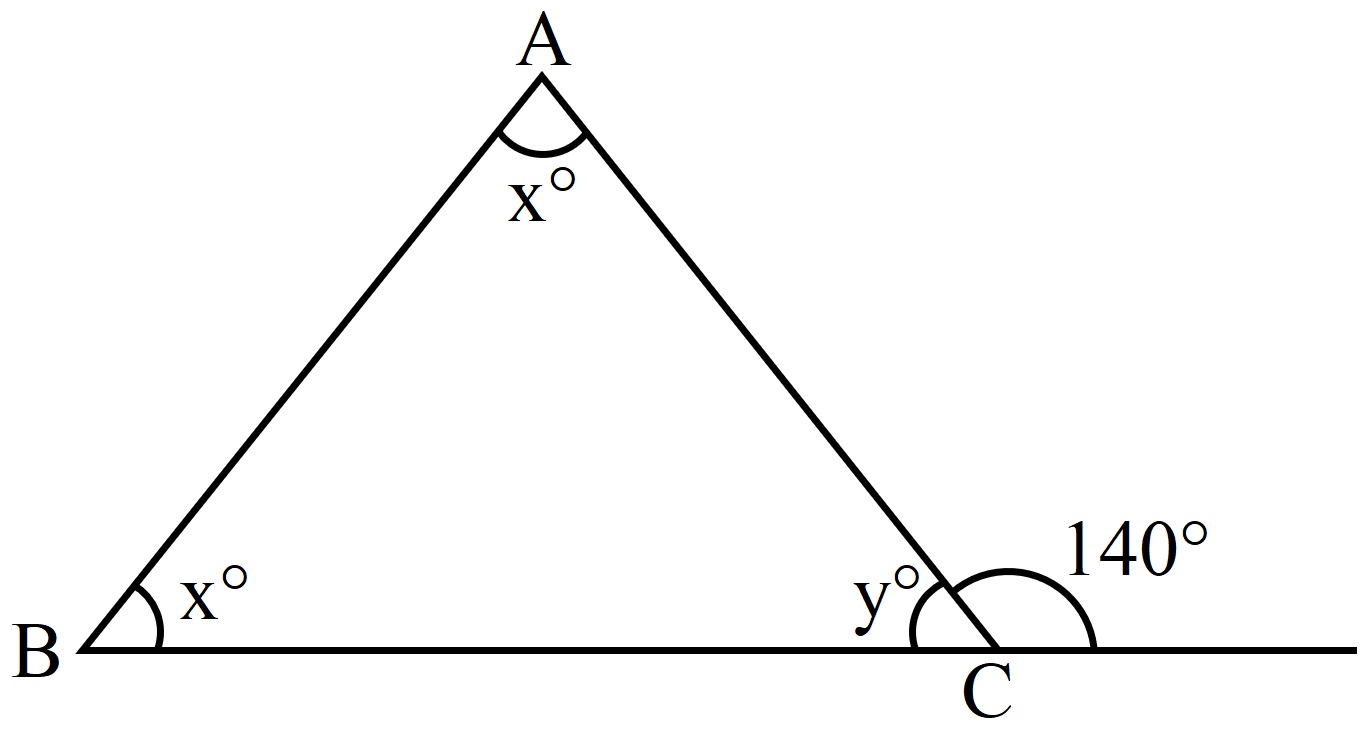
In the given figure, find $‘x’$
- A
$60^\circ$
- ✓
$70^\circ$
- C
$80^\circ$
- D
$75^\circ$
AnswerCorrect option: B. $70^\circ$
$70^\circ$
View full question & answer→MCQ 771 Mark
Side opposite to the vertex $\text{Q}$ of $\triangle\text{PQR}$ is.
View full question & answer→MCQ 781 Mark
Which of the following statements is true?
AnswerCorrect option: A. A triangle can have all the three angles equal to $60^\circ$
A triangle can have all the three angles equal to $60^\circ$
View full question & answer→MCQ 791 Mark
The measure of each angle of an equilateral triangle is:
- A
$30^\circ$
- B
$45^\circ$
- C
$90^\circ$
- ✓
$60^\circ$
AnswerCorrect option: D. $60^\circ$
$x^\circ + x^\circ + x^\circ = 180^\circ$
$\Rightarrow x^\circ = 60^\circ .$
View full question & answer→MCQ 801 Mark
A triangle in which two sides are of equal length is called $........$ triangle.
AnswerTriangle having all sides equal is the Equilateral triangle.
Triangle having two sides equal is an isosceles triangle.
Triangle having all sides of different length is a scalene triangle.
View full question & answer→MCQ 811 Mark
In a $\triangle \text{ABC},$ if $\angle \text{A}-\angle \text{B}=33^\circ$ and $\angle \text{B}-\angle \text{C}=10^\circ,$ then $\angle \text{B} =$
- A
$35^\circ$
- B
$45^\circ$
- C
$55^\circ$
- ✓
$25^\circ$
AnswerCorrect option: D. $25^\circ$
$\angle \text{A}-\angle \text{B}=33^\circ$ and $\angle \text{B}-\angle \text{C}=18^\circ$
$\Rightarrow \angle \text{A}=\angle \text{B}+33^\circ$ and $\angle \text{C}=\angle \text{B}-18^\circ$
Now, $\angle \text{A}+\angle \text{B}+\angle \text{C}=180^\circ$ [Angle sum property of triangle]
$\Rightarrow \angle \text{B}+33^\circ+\angle \text{B}+\angle \text{B}-18^\circ=180^\circ$
$\Rightarrow 3\angle \text{B}+15^\circ=180^\circ$
$\Rightarrow 3\angle \text{B}=165^\circ$
$\Rightarrow \angle \text{B}=55^\circ$
Hence, the correct answer is option $(d).$
View full question & answer→MCQ 821 Mark
$\text{In} \ \triangle\text{ABC},$
- ✓
$AB + BC > AC$
- B
$AB + BC < AC$
- C
$AB + AC < BC$
- D
$AC + BC < AB$
AnswerCorrect option: A. $AB + BC > AC$
As we know, sum of any two sides in a triangle is always greater than the third side.
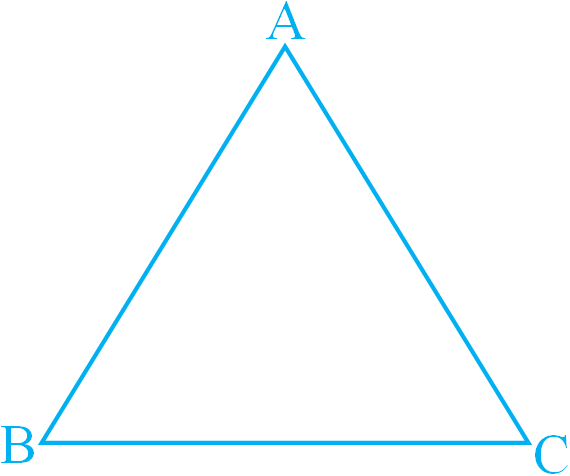
$\text{In} \ \triangle\text{ABC},$
$\text{AB}+\text{BC}>\text{AC}$
View full question & answer→MCQ 831 Mark
Two angles of a triangle measure $90^\circ $ and $30^\circ $. The measure of the third angle is.
- A
$90^\circ$
- B
$30^\circ$
- ✓
$60^\circ$
- D
$120^\circ$
AnswerCorrect option: C. $60^\circ$
Third angle $= 180^\circ - (90^\circ + 30^\circ )$
$= 60^\circ .$
View full question & answer→MCQ 841 Mark
How many angles are there in a triangle?
MCQ 851 Mark
How many medians a triangle can have?
AnswerA median of a triangle is a line segment joining a vertex to the midpoint of the opposing side.
Every triangle has exactly three medians, one from each vertex and they all intersect each other at the triangle's centroid.
View full question & answer→MCQ 861 Mark
A triangle with the sides measuring $5\ cm, 6\ cm$ and $4\ cm$ is called:
AnswerA triangle with three unequal sides is called scalene triangle.
View full question & answer→MCQ 871 Mark
Which of the following figures will have it’s altitude outside the triangle?
Answer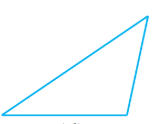
As we know, the perpendicular line segment from a vertex of a triangle to its opposite side is called an altitude of the triangle.
View full question & answer→MCQ 881 Mark
If all the three sides of a triangle are equal, the triangle is called:
AnswerA triangle with all sides equal is called an equilateral triangle, and a triangle with no sides equal is called a scalene triangle. An equilateral triangle is therefore a special case of an isosceles triangle having not just two, but all three sides and angles equal.
View full question & answer→MCQ 891 Mark
The sides of a right triangle containing the right angle are $(5x)cm$ and $(3x - 1)cm.$ If area of triangle be $60cm^2,$ calculate the length of the sides of the triangle.
- ✓
$15cm, 8cm, 17cm$
- B
$16cm, 8cm, 17cm$
- C
$16cm, 8cm, 19cm$
- D
$18cm, 8cm, 14cm$
AnswerCorrect option: A. $15cm, 8cm, 17cm$
A. $15cm, 8cm, 17cm$
Solution:
Given: In a right angled triangle, Perpendicular $=5 x$ and Base $=3 x-1$
Area $=60 cm^2$
Area of triangle $=\frac{1}{2}$ (base)(height)
$60=\frac{1}{2}(5 x)(3 x-1)$
$120=15 x^2-5 x$
$24=3 x^2-x$
$3 x^2-x-24=0$
$3 x^2-9 x+8 x-24=0$
$3 x(x-3)+8(x-3)=0$
$(3 x+8)(x-3)=0$
$x =3, \frac{-8}{3}$
Neglect the nagative value, $x=3$
Thus, perpendicular $=15 cm$ and base $=8 cm$
Now, from Pythagoras theorem,
$H^2=P^2+B^2 $
$H^2=15^2+8^2$
$H^2=225+64$
$H^2=289$
View full question & answer→MCQ 901 Mark
Which of the following statements is true?
AnswerCorrect option: C. A triangle can have two acute angles
A triangle can have two acute angles
View full question & answer→MCQ 911 Mark
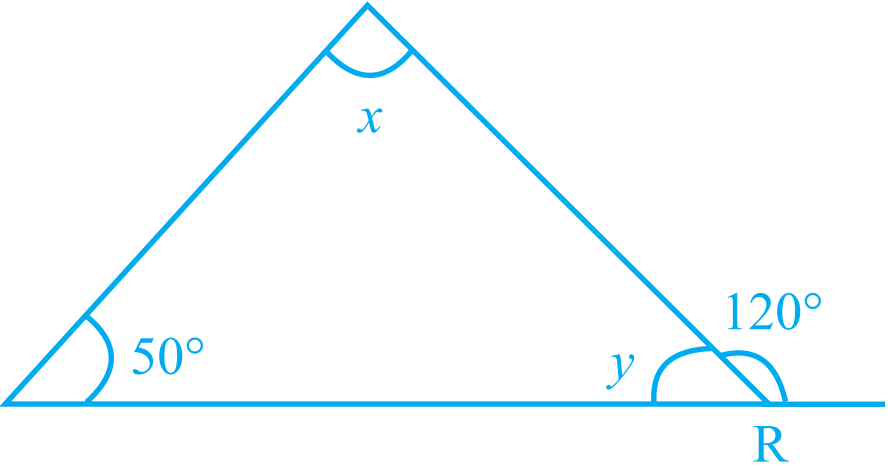
The measures of $\angle\text{x}$ and $\angle\text{y}$ in Figure. are respectively:
- A
$30^\circ , 60^\circ$
- B
$40^\circ , 40^\circ$
- C
$70^\circ , 70^\circ$
- ✓
$70^\circ , 60^\circ$
AnswerCorrect option: D. $70^\circ , 60^\circ$
As we know,
Measure of exterior angle = Sum of the opposite interior angles.
$\Rightarrow \ \angle\text{R}=\angle\text{P}+\angle\text{Q}$
$\Rightarrow \ 120^{0}=\text{x}+50^{0}$ $[\because \angle\text{R}=120^{0}]$
$\Rightarrow \ \text{x}=120^{0}-50^{0}$
$\Rightarrow \ \text{x}=70^{0}$
Now, the sum of the interior angles of a triangles is 180°.
$\therefore x + y + 50^\circ = 180^\circ $
$\Rightarrow 70^\circ + y + 50^\circ = 180^\circ $
$\Rightarrow 120^\circ + y = 180^\circ $
$\Rightarrow y = 180^\circ - 120^\circ $
$\Rightarrow y = 60^\circ $
View full question & answer→MCQ 921 Mark
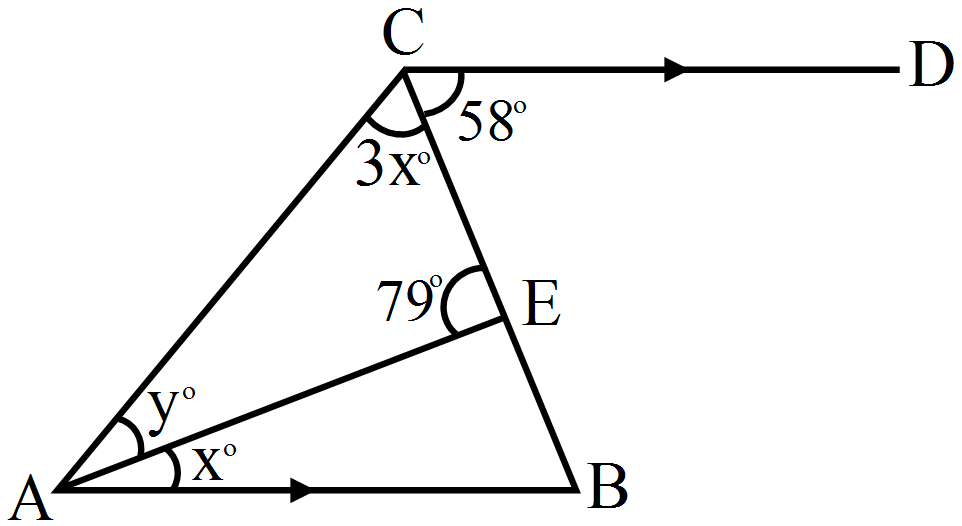
In Fig. if $AB || CD$, the values of $x$ and $y$ are:
- A
$x = 21, y = 28$
- ✓
$x = 21, y = 38$
- C
$x = 38, y = 21$
- D
$x = 22, y = 38$
AnswerCorrect option: B. $x = 21, y = 38$
$\angle \text{AEC}+\angle \text{AEB}=180^\circ$ [Linear angles]
$\Rightarrow 79^\circ+\angle \text{AEB}=180^\circ$
$\Rightarrow \angle \text{AEB}=101^\circ$
Since, $AB || CD$
$\angle \text{ABE}=\angle \text{ECD}=58^\circ$ [Alternate angles]
Now, In $\triangle \text{AEB}$
$\angle \text{AEB}+\angle \text{EAB}+\angle \text{ABE}=180^\circ$ [Angle sum property of triangle]
$\Rightarrow 101^\circ+58^\circ+\text{x}^\circ=180^\circ$
$\Rightarrow \text{x}^\circ=21^\circ$
$\Rightarrow \text{x}=21$
Now, In $\triangle \text{AEB}$
$\angle \text{AEC}+\angle \text{CAE}+\angle \text{CEA}=180^\circ$ [Angle sum property of triangle]
$\Rightarrow 79^\circ+\text{y}^\circ+3\text{x}^\circ=180^\circ$
$\Rightarrow 79^\circ+\text{y}^\circ+3(21)^\circ=180^\circ$
$\Rightarrow 79^\circ+\text{y}^\circ+63^\circ=180^\circ$
$\Rightarrow \text{y}^\circ=38^\circ$
$\Rightarrow \text{y}=38$
Hence, the correct answer is option $(b).$
View full question & answer→MCQ 931 Mark
In an isosceles triangle, one angle is $70^\circ $. The other two angles are of:
$i. 55^\circ $ and $55^\circ $
$ii. 70^\circ $ and $40^\circ $
$iii.$ any measure
In the given option$(s)$ which of the above statement$(s)$ are true?
- A
$(i)$ Only
- B
$(ii)$ Only
- C
$(iii)$ Only
- ✓
$(i)$ And $(ii) $
AnswerCorrect option: D. $(i)$ And $(ii) $
As we know, the sum of the interior angles of a triangles is $180^\circ .$
According to the qustion,
$70^\circ +55^\circ + 55^\circ = 180^\circ $
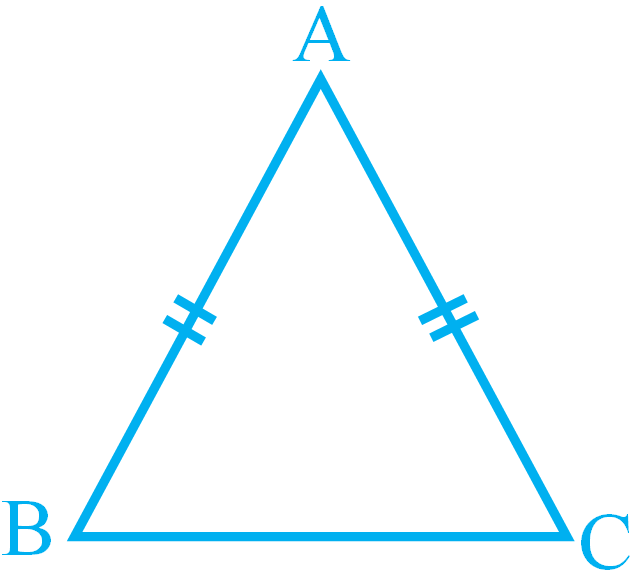
According to the question,
$70^\circ + 70^\circ + 40^\circ = 180^\circ$
Not possible, because two angles must be equal in an isosceles triangle.
So, $(i)$ and $(ii)$ can be possible. View full question & answer→MCQ 941 Mark
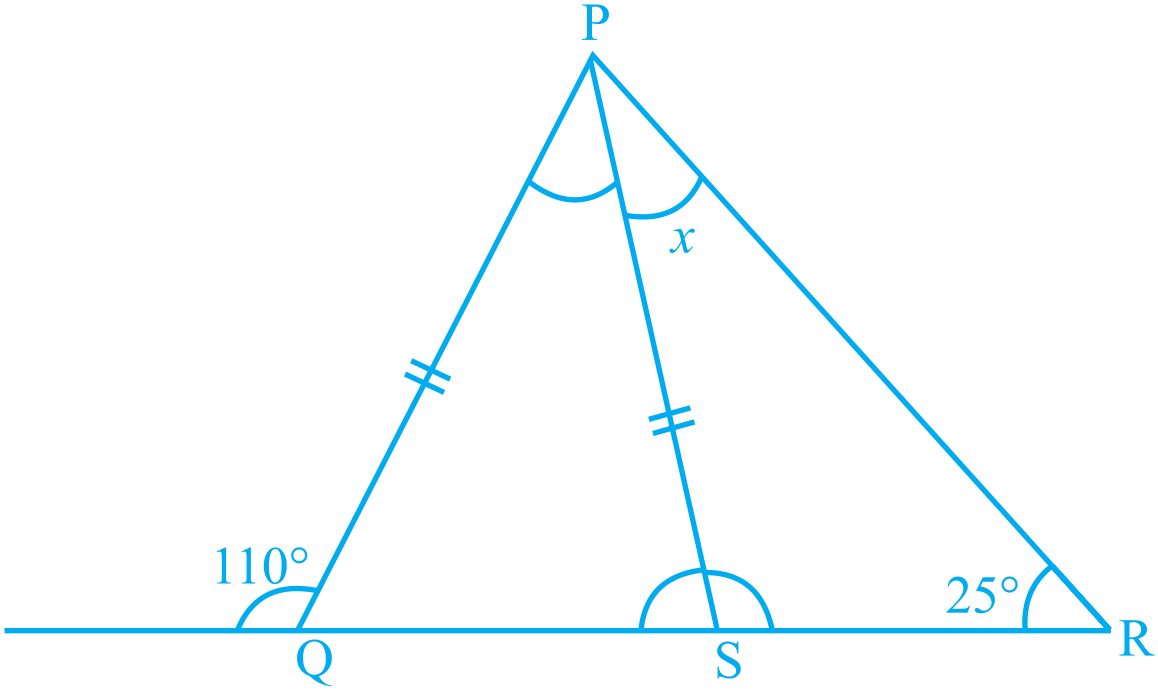
In Figure. $PB = PD.$ The value of $x$ is:
- A
$85^\circ$
- B
$90^\circ$
- ✓
$25^\circ$
- D
$35^\circ$
AnswerCorrect option: C. $25^\circ$
$\text{In} \ \triangle\text{PBD},$ $\angle1+120^{\circ}=180^{\circ}$ $[\text{linear pair}]$
$\angle1=180^{\circ}-120^{\circ}=60^{\circ}$
Also, $\angle1=\angle2=60^{\circ}$ $[\because\text{PB}=\text{PD}]$
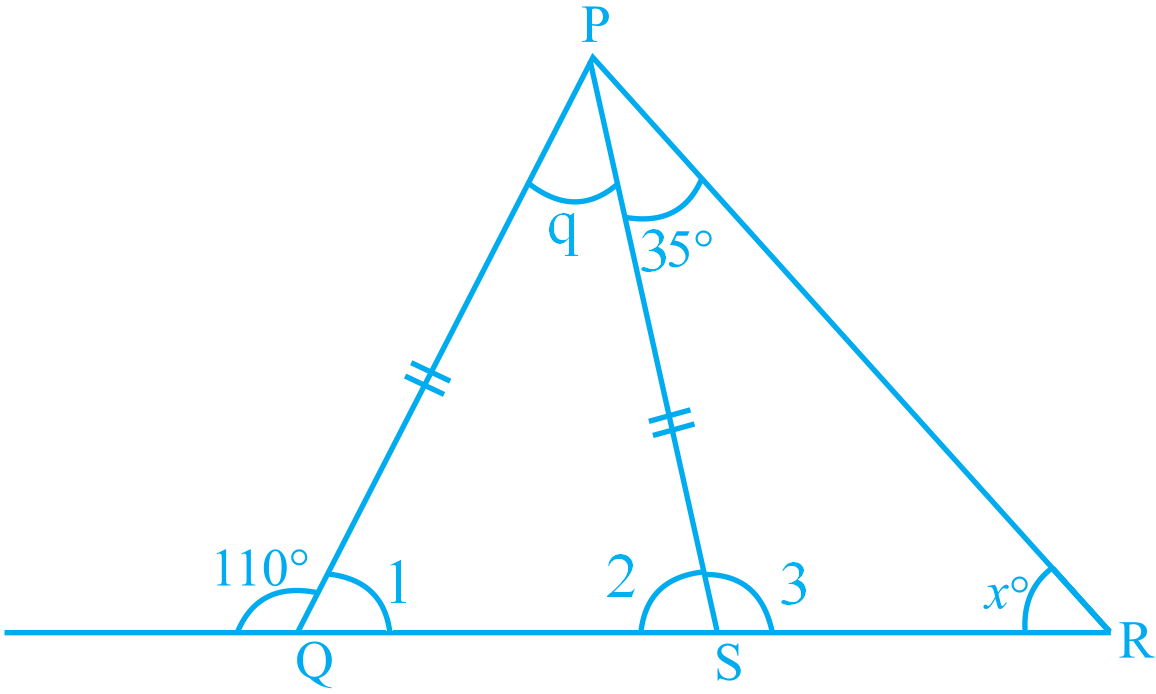
Also, $\angle2+\angle3=180^{\circ}$ $[\text{linear pair}]$
$\Rightarrow60^{\circ}+\angle3=180^{\circ} \ \Rightarrow \ \angle3=180^{\circ}-60^{\circ}$
$\Rightarrow\angle3=120^{\circ}$
$\text{In} \ \triangle\text{PDC},$ $35^{\circ}+\angle3+\text{x}^{\circ}=180^{\circ}$ [angle sum property of a triangle]
$\Rightarrow \ 35^{\circ}+120^{\circ}+\text{x}^{\circ}=180^{\circ}$
$\Rightarrow \ 155^{\circ}+\text{x}^{\circ}=180^{\circ}\Rightarrow \ \text{x}^{\circ}=180^{\circ}-155^{\circ}$
$\Rightarrow \ \text{x}=25^{\circ}$ View full question & answer→MCQ 951 Mark
In Pythagoras theorem the right angled triangle is also called a:
AnswerA scalene angled triangle has no sides or angles that are the same. For
Eg: The sides of a triangle are in the ratio $6 : 8 : 10$
So triangle with different sides or angles is called Scalene Angled Triangle.
View full question & answer→MCQ 961 Mark
Lengths of sides of a triangle are $3\ cm, 4\ cm$ and $5\ cm.$ The triangle is:
- A
- B
- ✓
- D
An Isosceles right triangle.
AnswerSince, these sides satisfy the Pythagoras theorem, therefore it is right angled triangle. Lengths of the sides of a triangle are $3cm, 4cm$ and $5cm.$
According to Pythagoras theorem,
$3^2 + 4^2 = 5^2$
$\Rightarrow 9 +16 = 25$
$\Rightarrow 25 = 25$ (satisfied)
Note: the area of the square built upon the hypotenuse of a right angled triangled.
View full question & answer→MCQ 971 Mark
In a right$-$angled triangle, the angles other than the right angle are:
AnswerIn right angled $\triangle\text{ABC}, \angle\text{B}=90^{\circ} [$angle sum property of a triangle$]$
$\angle\text{A}+\angle\text{B}+\angle\text{C}=180^{\circ}$
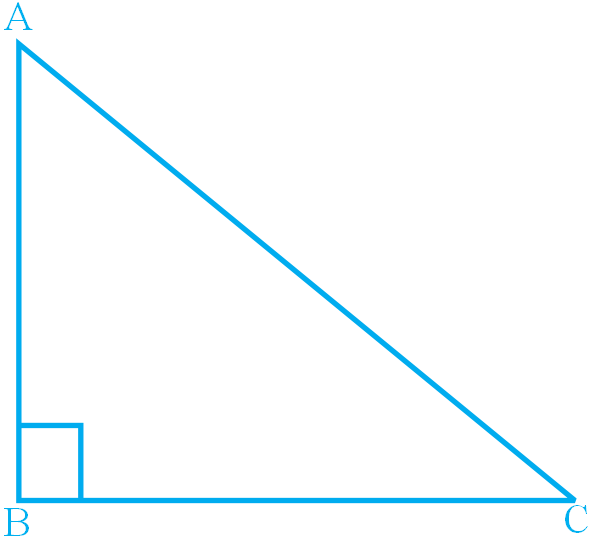
$\Rightarrow \angle\text{A}+90^{\circ}+\angle\text{C}=180^{\circ}$
$\Rightarrow \angle\text{A}+\angle\text{C}=180^{\circ}-90^{\circ}=90^{\circ}$
Hence, in a right angled triangle, the angles other than the right angle are acute. View full question & answer→MCQ 981 Mark
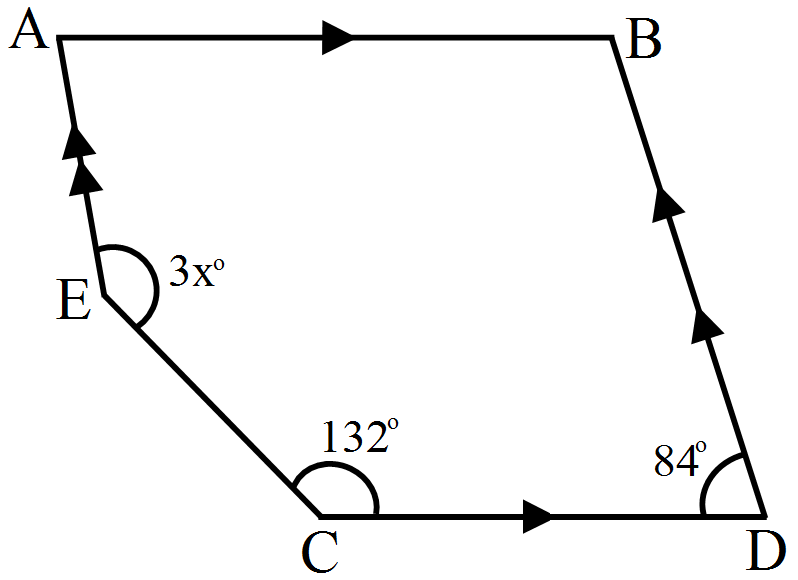
In Fig. if $AB || CD$ and $AE || BD$, then the value of $x$ is:
View full question & answer→MCQ 991 Mark
If the measures of the angles of a triangle are $(2\text{x}-5)^\circ,\Big(3\text{x}-\frac{1}{2}\Big)$ and $\Big(30-\frac{\text{x}}{2}\Big)^\circ,$ then $x =$
- ✓
$\frac{311}{9}$
- B
$\frac{309}{11}$
- C
$\frac{310}{9}$
- D
$\frac{301}{9}$
AnswerCorrect option: A. $\frac{311}{9}$
$(2\text{x}-5)^\circ,\Big(3\text{x}-\frac{1}{2}\Big)+\Big(30-\frac{\text{x}}{2}\Big)^\circ=180^\circ$ [Angle sum property of triangle]
$\Rightarrow 2\text{x}-5+3\text{x}-\frac{1}{2}+30-\frac{\text{x}}{2}=180$
$\Rightarrow 2\text{x}+3\text{x}-\frac{\text{x}}{2}-5-\frac{1}{2}+30=180$
$\Rightarrow 4\text{x}+6\text{x}-\text{x}-10-1+60=180\times2$
$\Rightarrow 9\text{x}+49=360$
$\Rightarrow \text{x}=\frac{311}{9}$
Hence, the correct answer is option $(a).$
View full question & answer→MCQ 1001 Mark
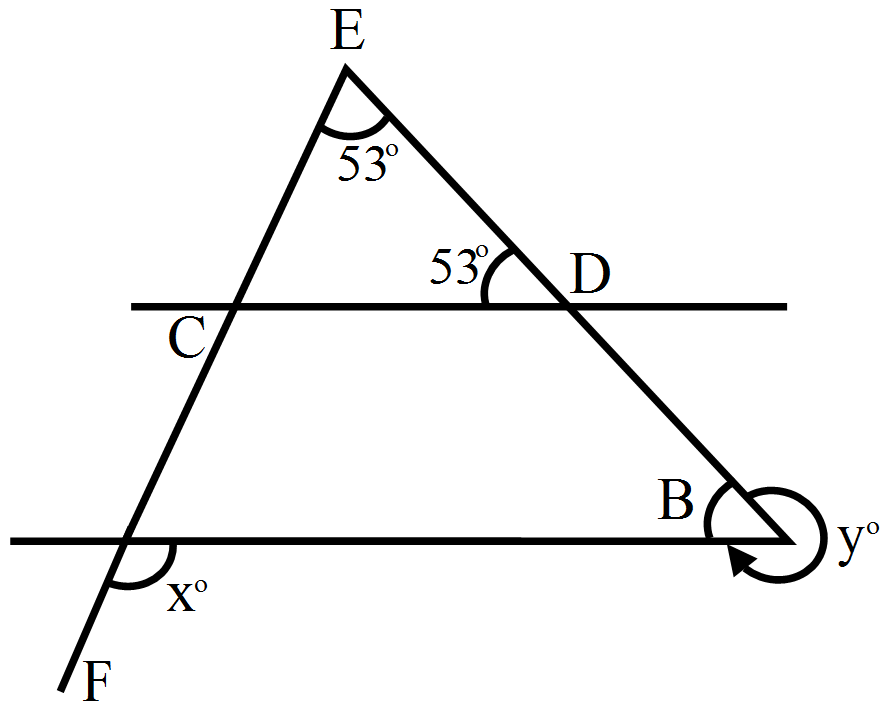
In Fig. if $AB \| CD$, then the values of $x$ and $y$ are:
- ✓
$x = 106, y = 307$
- B
$x = 307, y = 106$
- C
$x =107, y = 306$
- D
$x = 105, y = 308$
AnswerCorrect option: A. $x = 106, y = 307$
In $\triangle \text{CDE}$
$\angle \text{CDE}+\angle \text{CED}+\angle \text{ECD}=180^\circ$ [Angle sum property of triangle]
$\Rightarrow 53^\circ+53^\circ+\angle \text{ECD}=180^\circ$
$\Rightarrow \angle \text{ECD}=74^\circ$
Since, $AB \| CD$
$\therefore \angle \text{ECD}=\angle \text{CGB}=74^\circ$ [Corresponding angles]
Now, $\angle \text{CGB}+\angle \text{BGF}=180^\circ$ [Linear pair angles]
$\Rightarrow 74^\circ+\text{x}^\circ=180^\circ$
$\Rightarrow \text{x}=106$
Now, In $\triangle \text{EGB},$
$\angle \text{EGB}+\angle \text{BEG}+\angle \text{EBG}=180^\circ$ [Angle sum property of triangle]
$\Rightarrow 74^\circ+53^\circ+\angle \text{EBG}=180^\circ$
$\Rightarrow \angle \text{EBG}=53^\circ$
Now, $\angle \text{EBG}+\text{Reflex }\angle \text{EBG}=360^\circ$ [Complete angle]
$\Rightarrow 53^\circ+\text{y}^\circ=360^\circ$
$\Rightarrow \text{y}=307$
Hence, the correct answer is option $(a).$
View full question & answer→