Question 13 Marks
The area of a trapezium is $1586\ cm^2$ and the distance between the parallel sides is $26\ cm$. If one of the parallel sides is $38 \ cm,$ find the other.
AnswerArea of the trapezium $= 1586\ cm^2$
Distance between the parallel sides $(h) = 26$
$\therefore$ Sum of parallel sides $=\frac{\text{Area}\times2}{\text{h}}$
$=\frac{1586\times2}{26}=122\text{cm}$
$\therefore$ Second side $= 122 - 38 = 84\ cm$
View full question & answer→Question 23 Marks
Top surface of a table is trapezium in shape. Find its area if its parallel sides are $1\ m$ and $1.2\ m$ and perpendicular distance between them is $0.8\ m.$
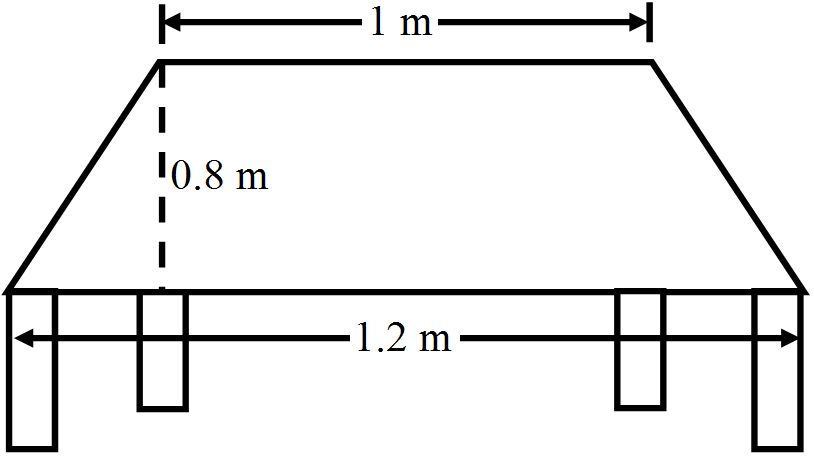
AnswerTop of table of trpezium in shape whose paraller sides are $1\ m$ and $12\ m$ distance between them $(h) = 0.8\ m$
Area of trapezium $=\frac{1}{2} ($Sum of parallel sides$)\ ×$ height
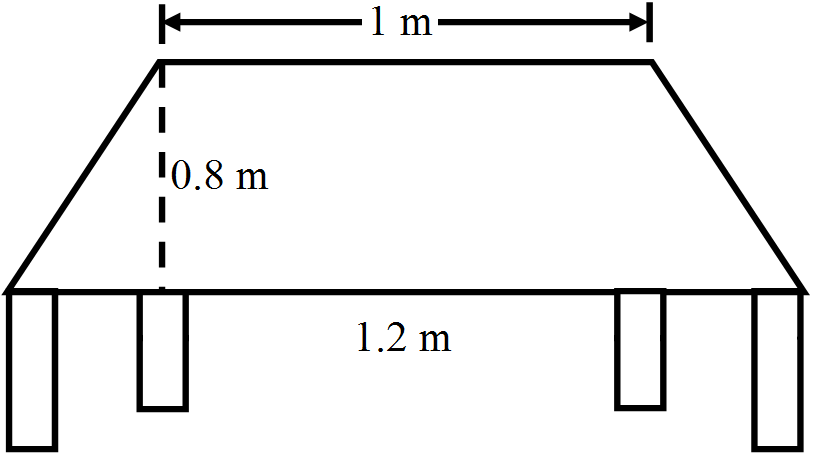
$=\frac{1}{2}(1+1.2)\times0.8\text{m}^2$
$=\frac{1}{2}(2.2)\times0.8\text{m}^2=1.1\times0.8\text{m}^2$
$=0.88\text{m}^2$ View full question & answer→Question 33 Marks
Find the altitude of a trapezium whose area is $65\ cm^2$ and whose bases are $13\ cm$ and $26\ cm.$
AnswerArea of trapezium = $65\ cm^2$
Bases are $13\ cm$ and $26\ cm$
i.e. $b_1 = 13\ cm, b_2 = 26\ cm$
$\text{Height (h)}=\frac{\text{Area}\times2}{\text{Sum of bases}}=\frac{65\times2}{(13+26)}$
$=\frac{65\times2}{39}\text{cm}=\frac{10}{3}\text{cm}$
View full question & answer→Question 43 Marks
A plot is in the form of a rectangle $ABCD$ having semi-circle on $BC$ as shown in Fig. If $AB = 60m$ and $BC = 28m,$ find the area of the plot.
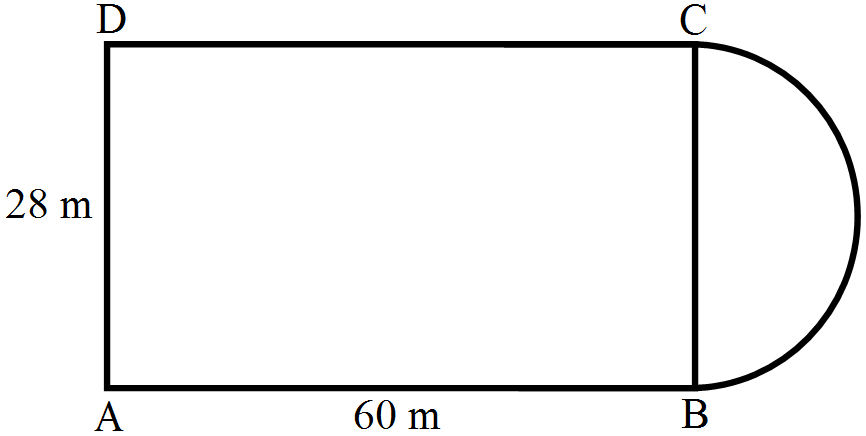
AnswerLength of rectangular portion $(l) = 60\ m$
and breadth $(b) = 28\ m$
Area of the rectangular plot $ = l × b= 60 × 28\ m^2 = 1680\ m^2$
Radius of semicircular portion $ (r) =\frac{\text{b}}{2}=\frac{28}{2}=14\text{m}$
Area $=\frac{1}{2}\pi\text{r}^2$
$=\frac{1}{2}\times\frac{22}{7}\times14\times14\text{m}^2$
$=308\text{m}^2$
Total area of the plot $= 1680 + 308 = 1988\ m^2$
View full question & answer→Question 53 Marks
The area of a rhombus is equal to the area of a triangle whose base and the corresponding altitude are $24.8\ cm$ and $16.5\ cm$ respectively. If one of the diagonals of the rhombus is $22\ cm,$ find the length of the other diagonal.
AnswerBase of triangle $(b) = 24.8\ cm.$
Altiude $(h) = 16.5\ cm$
Area of triangle $=\frac{1}{2}\times\text{base}\times\text{height}$
$=\frac{1}{2}\times\text{bh}=\frac{1}{2}\times24.8\times16.5\text{cm}^2=204.6\text{cm}^2$
Area of rhombus $= 204.6\ cm^2$
Length of one diagona l$(d_1) = 22\ cm$
Second diagonal $(d_2)$
$\frac{\text{Area}\times2}{\text{d} _1}=\frac{204.6\times2}{22}=18.6\text{cm}$
View full question & answer→Question 63 Marks
Find the area, in square metres, of the trapezium whose bases and altitudes are as under:
bases $= 150\ cm$ and $30\ dm,$ altitude $= 9\ dm.$
Answer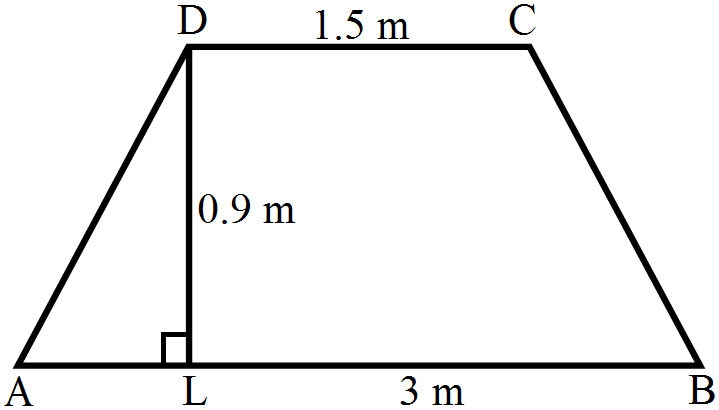
In a trapzium,
Base $(b_1) = 150\ cm =\frac{150}{100}=1.5\text{m}$
Base $(b_2) = 30\ dm =\frac{30}{10}=3\text{m}$
Altitude $(h) = 9\ dm =\frac{9}{10}=0.9\text{m}$
$\therefore\text{Area}=\frac{1}{2}(\text{b}_1+\text{b}_2)\times\text{h}$
$=\frac{1}{2}(1.5+3.0)\times0.9\text{m}^2$
$=\frac{1}{2}\times4.5\times0.9\text{m}^2=2.025\text{m}^2$ View full question & answer→Question 73 Marks
If the area of a trapezium is $28\ cm^2$ and one of its parallel sides is $6\ cm,$ find the other parallel side if its altitude is $4\ cm.$
AnswerArea of trapezium $= 28\ cm^2$
Altitude $(h) = 4\ cm$
$\therefore$ Sum of parallel sides $=\frac{\text{Area}\times2}{\text{height}}$
$=\frac{28\times2}{4}=14\text{cm}$
One of the parallel side $= 6\ cm$
Second parallel side $= 14 - 6 = 8\ cm$
View full question & answer→Question 83 Marks
Find the area, in square metres, of the trapezium whose bases and altitudes are as under:
bases $= 28\ cm$ and $3\ dm,$ altitude $= 25\ cm$
Answer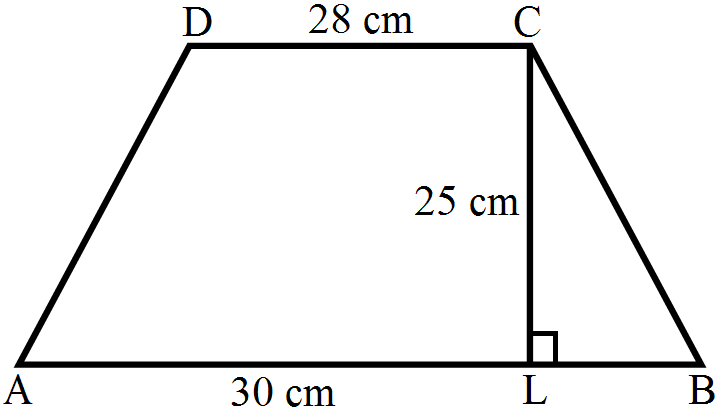
In a trapezium,
Base $(b_1) = 28\ cm$
Base $(b_2)$
$3\ dm = 30\ cm$
Altitude $(h) = 25\ cm$
$\therefore\text{Area}=\frac{1}{2}(\text{b}_1+\text{b}_2)\times\text{h}$
$=\frac{1}{2}(28+30)\times25\text{cm}^2$
$=\frac{1}{2}\times58\times25=725\text{cm}^2=\frac{725}{1000}\text{m}^2$
$=0.725\text{m}^2$ View full question & answer→Question 93 Marks
Find the height of a trapezium, the sum of the lengths of whose bases (parallel sides) is $60\ cm$ and whose area is $600\ cm^2$.
AnswerSum of parallei sides $(b_1 + b_2)= 60\ cm$
Area of trapezium $= 600\ cm^2$
$\therefore\text{Height (h)}=\frac{\text{Area}\times2}{\text{Sum of paralle sides}}$
$=\frac{600\times2}{60}=20\text{cm}$
View full question & answer→Question 103 Marks
A flooring tile has the shape of a parallelogram whose base is $24\ cm$ and the corresponding height is $10\ cm.$ How many such tiles are required to cover a floor of area $1080\ m^2$?
AnswerArea of floor $=1080\ m^2$
Base of parallelogram shaped tile $(b) =24\ cm$
and corresponding height $(h)=10\ cm$
Area of one tile $= b \times h =24 \times 10=240\ cm^2$ $=\frac{240}{10000}=\frac{24}{100} m^2$
$\therefore$ Number of tiles required $=\frac{\frac{1080}{24}}{1000}$
$=2080 \times \frac{1000}{0}=45000$
View full question & answer→Question 113 Marks
In Fig. a parallelogram is drawn in a trapezium, the area of the parallelogram is $80\ cm^2$, find the area of the trapezium.
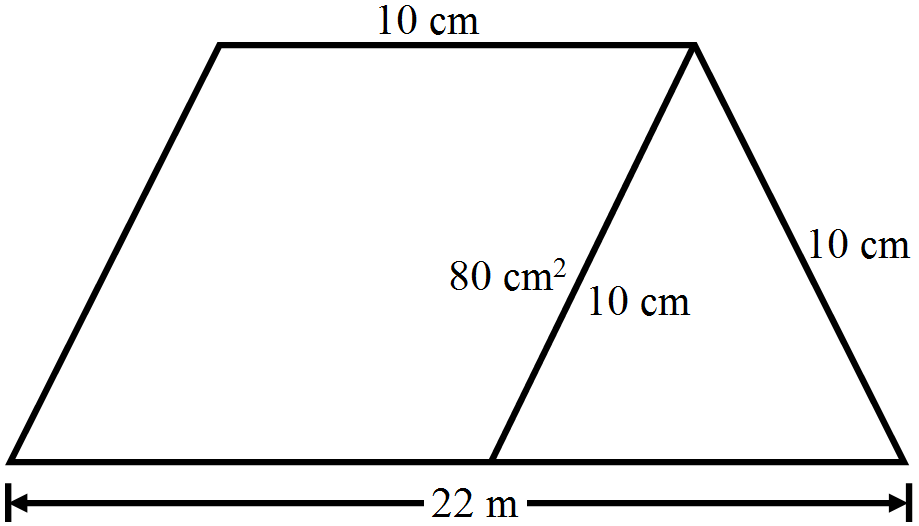
AnswerArea of parallelogram $ (AECD) =80\ cm^2$
Side $AE (b) = 10\ cm$
$\therefore$ Height $CL (h)$
$=\frac{\text{Area}}{\text{Base}}$
$=\frac{80}{10}=8\text{cm}$
Now, area of trapezium
$=\frac{1}{2}($Sum of parallel sides$)\ ×$ height
$=\frac{1}{2}(10+22)\times8\text{cm}^2$
$=\frac{1}{2}\times32\times8=128\text{cm}^2$
View full question & answer→Question 123 Marks
Find the area, in square metres, of the trapezium whose bases and altitudes are as under:
bases $= 12\ dm$ and $20\ dm,$ altitude $= 10\ dm$
Answer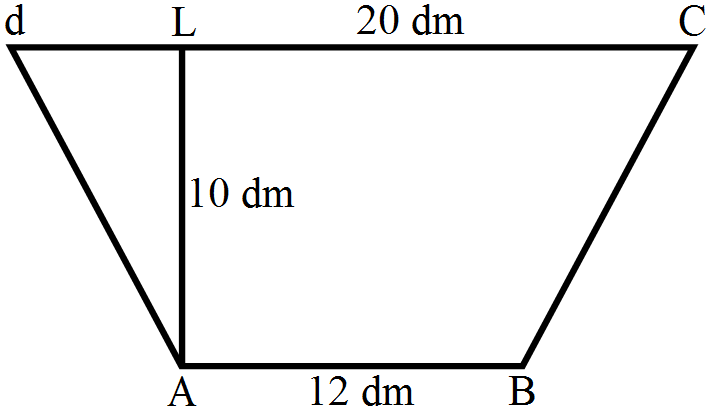
In a trapezium,
Base $(b_1) = 12\ dm$
Base $(b_2) = 20\ dm$
Altitude $(h) = 10 \ dm$
$\therefore\text{Area}=\frac{1}{2}(\text{b}_1+\text{b}_2)\times\text{h}$
$=\frac{1}{2}(12+20)\times10\text{dm}^2$
$=\frac{1}{2}\times32\times10=160\text{dm}^2=\frac{160}{10\times10}\text{m}^2$
$ =1.6\text{m}^2$ View full question & answer→Question 133 Marks
Find the area of trapezium with base $15\ cm$ and height $8\ cm,$ if the side parallel to the given base is $9\ cm$ long.
Answer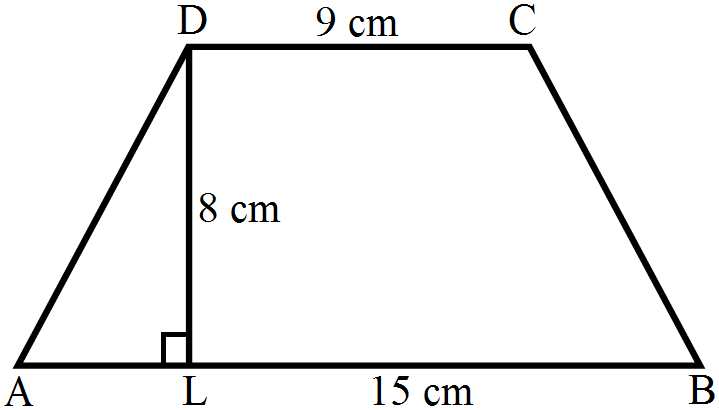
In the trapezium $ABCD,$
Base $AB = 15\ cm$
and $DC = 9\ cm$
height $DL = 8 \ cm$
$\therefore\text{Area}=\frac{1}{2}(\text{sum of bases})\times\text{height}$
$=\frac{1}{2}(\text{AB+BC})\times\text{DL}$
$=\frac{1}{2}(15+9)\times8\text{cm}^2$
$\frac{1}{2}\times24\times9=96\text{cm}^2$ View full question & answer→Question 143 Marks
Find the area of a trapezium whose parallel sides are of length $16\ dm$ and $22\ dm$ and whose height is $12\ dm.$
Answer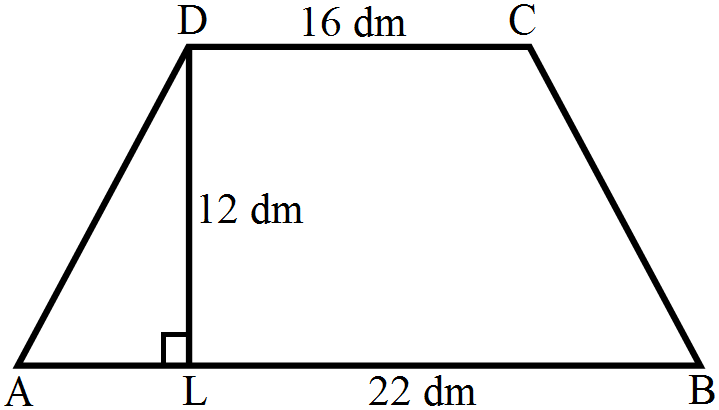
Length of parailel sides of a trapezium are $16\ dm$ and $22\ dm$ i.e.
$b_1 =16\ dm, b_2 = 22\ dm$
and heigth $(h) = 12\ dm$
$\therefore$ Area of trapezium $=\frac{1}{2}(\text{b}_1+\text{b}_2)\times\text{h}$
$=\frac{1}{2}(16+22)\times12\text{dm}^2$
$=\frac{1}{2}\times38\times12\text{dm}^2=228\text{dm}^2$ View full question & answer→Question 153 Marks
The area of a trapezium is $960\ cm^2$. If the parallel sides are $34\ cm$ and $46\ cm$, find the distance between them.
AnswerArea of trapezium = $960\ cm^2$
Parallel sides are $34\ cm$ and $46\ cm$
$b_1 + b_2 = 34 + 46 = 80\ cm$
$\therefore\text{h}=\frac{\text{Area}\times2}{\text{b}_1+\text{b}_2}=\frac{960\times2}{80}=24\text{cm}$
Distance between parallel sides $= 24\ cm$
View full question & answer→Question 163 Marks
Find the sum of the lengths of the bases of a trapezium whose area is $4.2\ m^2$ and whose height is $280\ cm.$
AnswerArea of trapezium = $42\ m^2$
Bases are $13\ cm$ and $26\ cm$
Height $(h) = 280 \ cm = 238\ m.$
$\therefore\text{Sum of bases} = \frac{\text{Area}\times2}{\text{Height}}$
$=\frac{4.2\times2}{2.8}\text{m}=\frac{42\times2\times10}{10\times28}=3\text{m}$
View full question & answer→Question 173 Marks
The area of a trapezium is $384\ cm^2$. Its parallel sides are in the ratio $3 : 5$ and the perpendicular distance between them is $12\ cm.$ Find the length of each one of the parallel sides.
AnswerArea of trapezium = $384\ cm^2$
Perpendicular distance $(h) = 12\ cm$
Sum of parallel sides
$=\frac{\text{Area}\times2}{\text{height}}=\frac{384\times2}{12}=64\text{cm}$
Ratio in parpallel sides $= 3 : 5$
Let first side $= 3x$
Then, second side $= 5x$
$\therefore3\text{x}+5\text{x}=64\text{cm}$
$\Rightarrow8\text{x}=64\text{cm}$
$\Rightarrow\text{x}=\frac{64}{8}=8\text{cm}$
First parallel side $= 8 × 3 = 24\ cm$
Second side $= 8 × 5 = 40\ cm$
View full question & answer→Question 183 Marks
Find the area, in square metres, of the trapezium whose bases and altitudes are as under:
bases $= 8\ m$ and $60\ dm,$ altitude $= 40\ dm$
Answer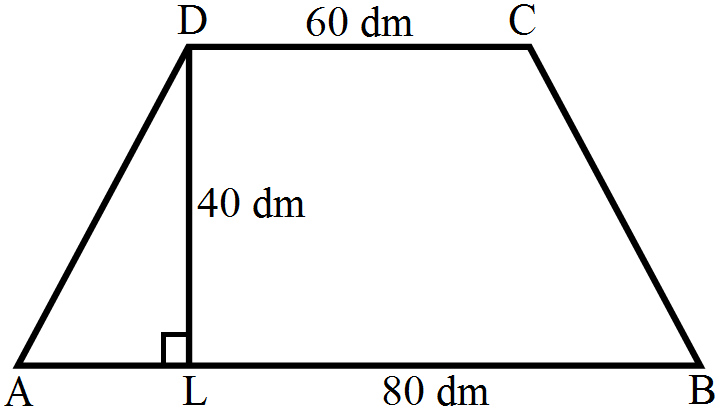
In a trapzium,
Base $(b_1)$
$= 8 \ m = 80\ dm$
Base $(b_2) = 60\ dm$
Altitude $(h) = 40\ dm$
$\therefore\text{Area}=\frac{1}{2}(\text{b}_1+\text{b}_2)\times\text{h}$
$=\frac{1}{2}(80+60)\times40\text{dm}^2$
$=\frac{1}{2}\times140\times40\text{dm}^2=2800\text{dm}^2$
$=\frac{2800}{100}\text{dm}^2=28\text{m} ^2$ View full question & answer→Question 193 Marks
The cross-section of a canal is a trapezium in shape. If the canal is $10\ m$ wide at the top $6\ m$ wide at the bottom and the area of cross-section is $72\ m^2$ determine its depth.
AnswerArea of cross-section = $72\ m^2$
Parallel sides of the trpezium $= 10\ m$ and $6\ m$
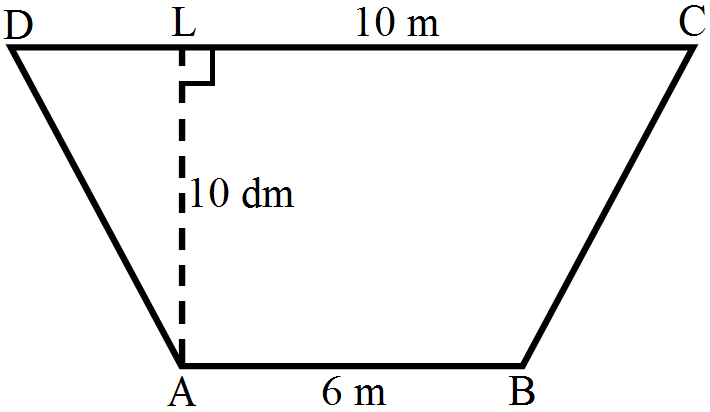
Let $h$ be depth of the canal
$\therefore\text{Area}=\frac{1}{2} ($Sum of parallel sides$)\ ×$ depth
$\Rightarrow72=\frac{1}{2}(10+6)\text{h}$
$\Rightarrow72\frac{1}{2}\times16\text{h}$
$\Rightarrow8\text{h}=72$
$\Rightarrow\text{h}=\frac{72}{8}=9\text{m}$
$\therefore$ Depth of the canal $= 9\ m$ View full question & answer→