Questions

3 Marks Question

🎯

Test yourself on this topic

17 questions · timed · auto-graded

Question 13 Marks
Find the smallest square number that is divisible by each of the numbers $4, 9$ and $10.$
Answer
The least number divisible by each one of $4, 9$ and $10$ is their $L.C.M.$
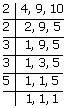
The $L.C.M.$ of $4, 9$ and $10$ is $2 \times 2 \times 3 \times 3 \times 5 = 180$
Now prime factorisation of $180$ is $180 = 2 \times 2 \times 3 \times 3 \times 5$
The prime factor $5$ is not in pair. Therefore $180$ is not a perfect square.
In order to get a perfect square, each factor of $180$ must be paired. So we need to make pair of $5.$
Therefore $180$ should be multiplied by $5.$
Hence, the required number is $180 \times 5 = 900.$
View full question & answer
Question 23 Marks
$2025$ plants are to be planted in a garden in such a way that each row contains as many plants as the number of rows. Find the number of rows and the number of plants in each row.
Answer
Let the number of rows be $x.$
Then number of plants in each row $= x$
$\therefore$ Number of plants in $x$ rows $= x \times x = x^2$
But $2025$ plants are to be planted in a garden.
$\therefore$ $x^2= 2025$
$\therefore x = \sqrt {2025} $
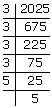
The prime factorisation of $2025$ is

$2025 = 3 \times 3 \times 3 \times 3 \times 5 \times 5$
$\therefore x = \sqrt {\underline {3 \times 3} \times \underline {3 \times 3} \times \underline {5 \times 5} } $
$\therefore x = 3 \times 3 \times 5$
$\therefore x = 45$
Hence, the number of rows is $45$ and the number of plants in each row is $45.$
View full question & answer
Question 33 Marks
The students of Class $VIII$ of a school donated ₹ $2401$ for Prime Minister's National Relief Fund. Each student donated as many rupees as the number of students in the class. Find the number of students in the class.
Answer
Let the number of students in the class be $x.$
Then rupees donated by each students $= ₹ x.$
\therefore Rupees denoted by x students $= ₹ x \times x$
$= Rs x^2 $
$ \because$ The students of class VIII of a school donated ₹ $2401$ for Prime Minister's National Relief Fund.
$\therefore x^2= 2401 $
$ \therefore x = \sqrt {2401}$
The prime factorisation of $2401$ is

$2401 = 7 \times 7 \times 7 \times 7$
$ x = \sqrt {\underline {7 \times 7} \times \underline {7 \times 7} } $
$ \therefore x = 7 \times 7 = 49$
Hence, the number of students in the class is $49.$
View full question & answer
Question 43 Marks
Find the square root of $100$ by the method of repeated subtraction.
Answer
$100$
$100 – 1 = 99$
$99 – 3 = 96$
$96 – 5 = 91$
$91 – 7 = 84$
$84 – 9 = 75$
$75 – 11 = 64$
$64 – 13 = 51$
$51 – 15 = 36$
$36 – 17 = 19$
$19 – 19 = 0$
Since from $100$ we subtracted successive odd numbers starting from $1$ and obtained $0$ at the $10th$ step. Therefore, $\sqrt {100} = 10.$
View full question & answer
Question 53 Marks
Find the square root of $169$ by the method of repeated subtraction.
Answer
$169 – 1 = 168$
$168 – 3 = 165$
$165 – 5 = 160$
$160 – 7 = 153$
$153 – 9 = 144$
$144 – 11 = 133$
$133 – 13 = 120$
$120 – 15 = 105$
$105 – 17 = 88$
$88 – 19 = 69$
$69 – 21 = 48$
$48 – 23 = 25$
$25 – 25 = 0$
Since from $169$ we subtracted successive odd numbers starting from $1$ and obtained $0$ at the $13th$ step, therefore, $\sqrt {169} = 13.$
View full question & answer
Question 63 Marks
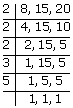
Find the smallest square number that is divisible by each of the numbers $8, 15$ and $20.$
Answer
The least number divisible by each one of $8, 15$ and $20$ is their $L.C.M.$

The $L.C.M$. of $8, 15$ and $20$ is $2 \times 2 \times 2 \times 3 \times 5 = 120$
Now prime factorisation of $120$ is $120 = 2 \times 2 \times 2 \times 3 \times 5$
The prime factors $2, 3$ and $5$are not in pairs. Therefore $120$ is not a perfect square.
In order to get a perfect square, each factor of $120$ must be paired. So, we need to make pairs of $2, 3$ and $5$. Therefore $120$ should be multiplied by $2 \times 3 \times 5$ ; i.e. $30.$
Hence, the required number is $120 \times 30 = 3600.$
View full question & answer
Question 73 Marks
Write a Pythagorean triplet whose one number is $18$
Answer
Here, $2m = 18$
$\therefore m = \frac{{18}}{2} = 9$
$ \therefore m^2-1=9^2-1=81-1=80 $
and, $ m^2+1=9^2+1=81+1=82 $
So, a Pythagorean triplet, whose one member is $18$, is $18, 80, 82.$
View full question & answer
Question 83 Marks
Write a Pythagorean triplet whose one number is $16$
Answer
Here, $2m = 16$
$\therefore$ $m = \frac{{16}}{2} = 8$
$\therefore$ $m^2- 1 = 8^2- 1 = 64 - 1 = 63$
and, $m^2+ 1 = 8^2+ 1 = 64 + 1 = 65$
So, a Pythagorean triplet, whose one member is $16$ is $16, 63, 65.$
View full question & answer
Question 93 Marks
Write a Pythagorean triplet whose one number is $6$
Answer
$2m = 6$
$\therefore m = \frac{6}{2} = 3$
$m^2– 1 = 3^2– 1 = 9 – 1 = 8$
and $m^2+ 1 = 3^2+ 1 = 9 + 1 = 10$
So, a Pythagorean triplet, whose one member is $6$, is $6, 8, 10.$
View full question & answer
Question 103 Marks
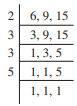
Find the smallest square number which is divisible by each of the numbers $6, 9$ and $15.$
Answer

This has to be done in two steps.
First find the smallest common multiple and then find the square number needed.
The least number divisible by each one of $6, 9$ and $15$ is their $LCM.$
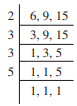
The $LCM$ of $6, 9$ and $15$ is $2 × 3 × 3 × 5 = 90$.
Prime factorisation of $90$ is $90 = 2 × 3 × 3 × 5$.
We see that prime factors $2$ and $5$ are not in pairs. Therefore $90$ is not a perfect square.
In order to get a perfect square, each factor of $90$ must be paired.
So we need to make pairs of $2$ and $5$.
Therefore, $90$ should be multiplied by $2 × 5$,
i.e., $10$. Hence, the required square number is $90 × 10 = 900$.
View full question & answer
Question 113 Marks
Find the smallest number by which $9408$ must be divided so that the quotient is a perfect square. Find the square root of the quotient.
Answer
We have, $9408 = 2 \times 2 \times 2 \times 2 \times 2 \times 2 \times 3 \times 7 \times 7$
If we divide $9408$ by the factor $3$, then
$9408 \div 3 = 3136 = 2 \times 2 \times 2 \times 2 \times 2 \times 2 \times 7 \times 7$ which is a perfect square.
Therefore, the required smallest number by which $9408$ must be divided so that the quotient is a perfect square is $3.$
Thus, the quotient is $3136.$
So, $\sqrt{3136} = 2 \times 2 \times 2 \times 7 = 56$
View full question & answer
Question 123 Marks
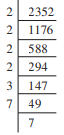
Is $2352$ a perfect square? If not, find the smallest multiple of $2352$ which is a perfect square. Find the square root of the new number.
Answer


We have $2352 = 2 \times 2 \times 2 \times 2 \times 3 \times 7 \times 7$
As the prime factor $3$ has no pair, $2352$ is not a perfect square. If $3$ gets a pair then the number will become perfect square.
So, we multiply $2352$ by $3$ to get,
$2352 \times 3 = 2 \times 2 \times 2 \times 2 \times 3 \times 3 \times 7 \times 7$
Now each prime factor is in a pair. Therefore, $2352 \times 3 = 7056$ is a perfect square. Thus the required smallest multiple of $2352$ is 7056 which is a perfect square.
And, $\sqrt{7056} = 2 \times 2 \times 3 \times 7 = 84$
View full question & answer
Question 133 Marks
Find a Pythagorean triplet in which one member is $12.$
Answer
If we take $m^2– 1 = 12$
Then,$ m^2= 12 + 1 = 13$
Then the value of $m$ will not be an integer.
So, we try to take $m^2+ 1 = 12$. Again $m^2= 11$ will not give an integer value for $m.$
So, let us take $2m = 12$
then $m = 6$
Thus, $m^2– 1 = 36 – 1 = 35$ and $m^2+ 1 = 36 + 1 = 37$
Therefore, the required triplet is $12, 35, 37.$
View full question & answer
Question 143 Marks
Write a Pythagorean triplet whose smallest member is $8.$
Answer
We can get Pythagorean triplets by using general form $2m, m^2– 1, m^2+ 1.$
Let us first take $m^2– 1 = 8$
So, $m^2= 8 + 1 = 9$
which gives $m = 3$
Therefore, $2m = 6$ and $m^2+ 1 = 10$
The triplet is thus $6, 8, 10.$ But $8$ is not the smallest member of this.
So, let us try $2m = 8$
then $m = 4$
We get $m^2– 1 = 16 – 1 = 15$
and $m^2+ 1 = 16 + 1 = 17$
The triplet is $8, 15, 17$ with $8$ as the smallest member.
View full question & answer
Question 153 Marks
There are $2401$ students in a school. $P.T.$ teacher wants them to stand in rows and columns such that the number of rows is equal to the number of columns. Find the number of rows.
Answer
Let the number of rows be $x$
So, the number of columns $= x$
Therefore, number of students $= x × x = x ^{2}$
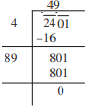
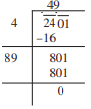
Thus, $x^2= 2401$ gives $x = \sqrt {2401}$
Finding $\sqrt {2401}$ by long division method.

So, the number of rows $= 49$
View full question & answer
Question 163 Marks
Find the smallest square number which is divisible by each of the numbers 6,9 and 15.
Answer

Image
This has to be done in two steps. First find the smallest common multiple and then find the square number needed. The least number divisible by each one of 6,9 and 15 is their LCM. The LCM of 6,9 and 15 is $2 \times 3 \times 3 \times 5=90$.
Prime factorisation of 90 is $90=2 \times \underline{3 \times 3} \times 5$.
We see that prime factors 2 and 5 are not in pairs. Therefore 90 is not a perfect square.
In order to get a perfect square, each factor of 90 must be paired. So we need to make pairs of 2 and 5 . Therefore, 90 should be multiplied by $2 \times 5$, i.e., 10 . Hence, the required square number is $90 \times 10=900$.
View full question & answer
Question 173 Marks
There are 2401 students in a school. P.T. teacher wants them to stand in rows and columns such that the number of rows is equal to the number of columns. Find the number of rows.
Answer

Image
Let the number of rows be $x$ So, the number of columns $=x$
Therefore, number of students $=x \times x=x^2$
Thus, $x^2=2401$ gives $x=\sqrt{2401}=49$
The number of rows $=49$.
View full question & answer