MCQ 11 Mark
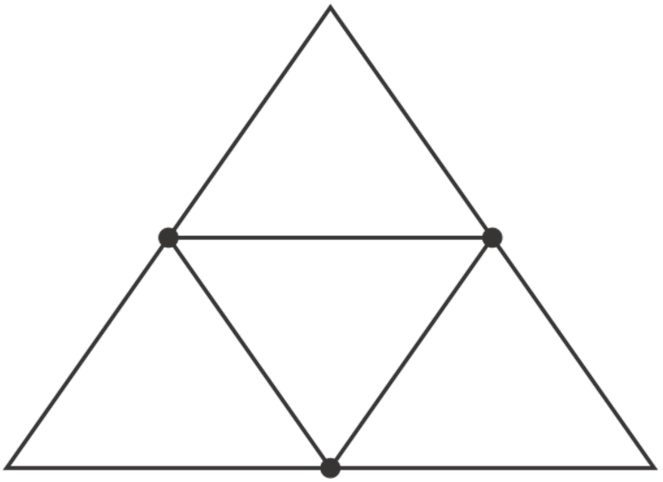
If the diagonals of a quadrilateral bisect each other at right angles then the figure is a:
AnswerRhombus is the correct answer. As we know that from all the quadrilaterals given in other options the diagonals of rhombus bisect each other at right angles.
View full question & answer→MCQ 21 Mark
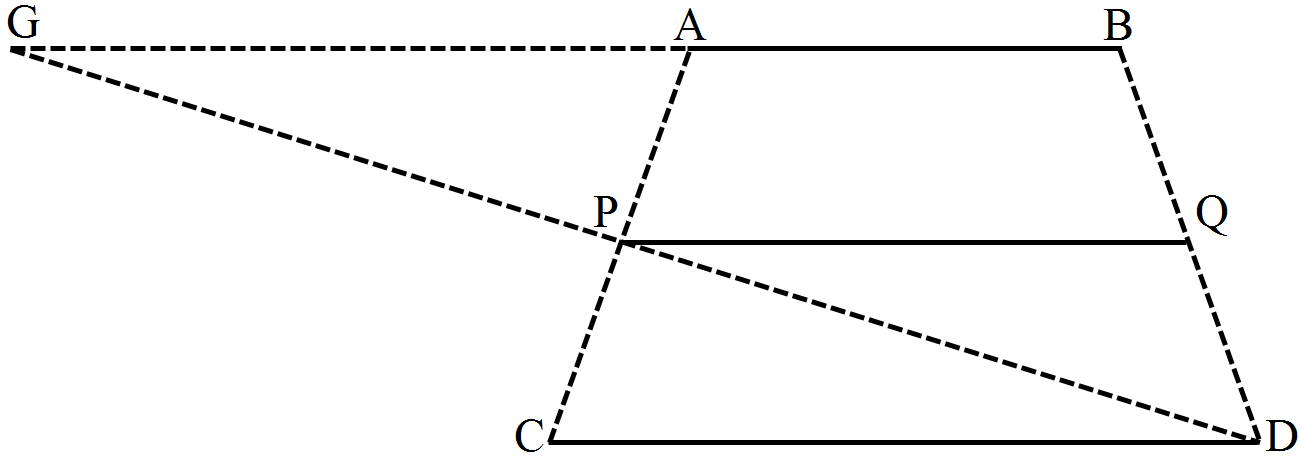
What is the length of $PQ$ in a trapezium $ABCD$ in which $\text{AB || DC}$ and P and Q are mid-points on $AD$ and $BC$ respectively?
AnswerCorrect option: B. $\frac{1}{2}(\text{AB + CD})$
Join $PD$ and Produce it to meet $BA$ at $G.$
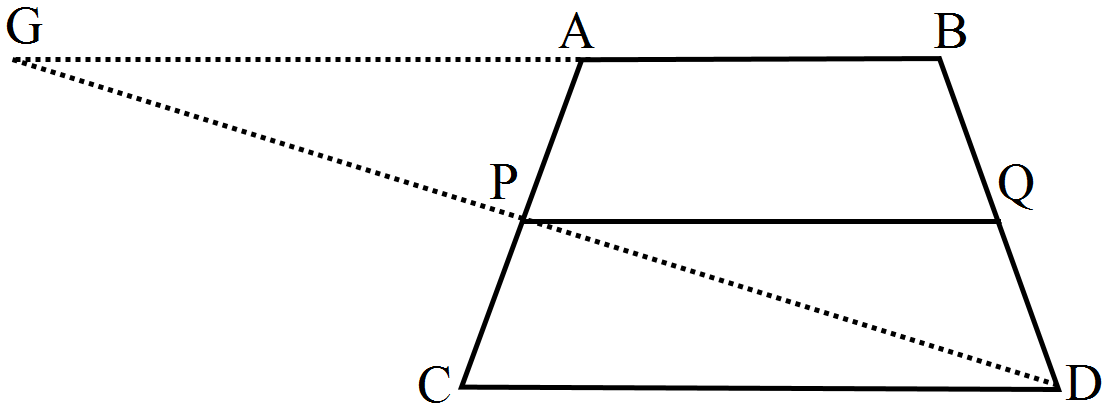
ln $\triangle\text{PCD}$ and $\triangle\text{APG},$
$\angle\text{DPC}= \angle\text{GPA},$
$\angle\text{PDC}= \angle\text{AGP},$
$\therefore\triangle\text{PDC}\cong\triangle\text{AGP}$
$CD = AG$ and $PD = PG$
ln $\triangle\text{BGD},$
$P$ is the mid-point of $GD$
$Q$ is the mid-point of $BD$
Therefore, By mid-point theorem, $\text{PQ || AB}$
and $\text{PQ} = \frac{1}{2}\text{(GB)}$
but $GB = GA + AB = CD + AB$
$\therefore\text{PQ}=\frac{1}{2}(\text{AB + CD})$
View full question & answer→MCQ 31 Mark
Write the correct answer in the following: $ABCD$ is a rhombus such that $\angle\text{ACB}=40^\circ.$ then $\angle\text{ADB}$ is:
- A
$40^\circ$
- B
$45^\circ$
- ✓
$50^\circ$
- D
$60^\circ$
AnswerCorrect option: C. $50^\circ$
$ABCD$ is a rhombus such thet $\angle\text{ACB}=40^\circ.$
We know that diagonnals of rhombus bisect each other right angles.
In right $\Delta\text{BOC},$ we have
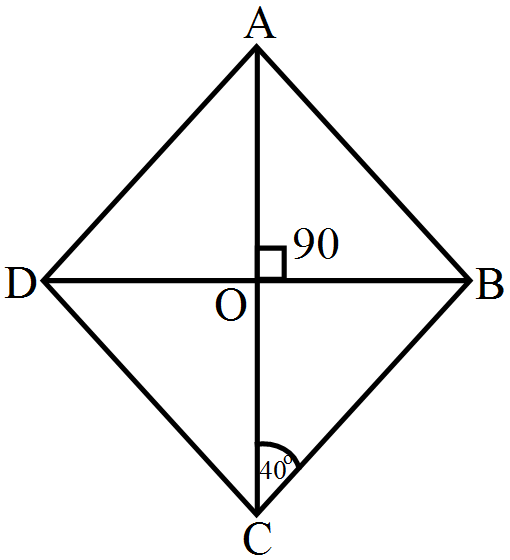
$\angle\text{OBC}=180^\circ-(\angle\text{BOC}+\angle\text{BCO})$ (angle sum property)
$=180^\circ-(90^\circ+40^\circ)=50^\circ$
$\therefore\ \angle\text{DBC}=\angle\text{OBC}=50^\circ$
Now,
$\angle\text{ADB}=\angle\text{DBC}$ [Alt. int. $\angle\text{s}$ ]
$\therefore\ \angle\text{ADB}=50^\circ[\therefore\angle\text{DBC}=50^\circ]$
Hence, $(c)$ is the correct answer. View full question & answer→MCQ 41 Mark
Three angles of a quadrilateral are in the ratio $3 : 4 : 5 : 6.$ The smallest of these angles is:
- ✓
$60^\circ$
- B
$80^\circ$
- C
$45^\circ$
- D
$48^\circ$
AnswerCorrect option: A. $60^\circ$
Let the angles be $3x, 4x, 5x$ and $6x$
$3x + 4x + 5x + 6x = 360^\circ $ (Sum of angles of a quadrilateral)
$18x = 360^\circ $
$\text{x}=\frac{360}{18}$
$x = 20^\circ $
$\therefore $ Angles of the quadrilateral are: $3x = 3 \times 20^\circ = 60^\circ $
$4x = 4 \times 20^\circ = 80^\circ $
$5x = 5 \times 20^\circ = 100^\circ $
$6x = 6 \times 20^\circ = 120^\circ $
Hence, the smallest angle is $60^\circ .$
View full question & answer→MCQ 51 Mark
Three statements are given below:
$i.$ In a rectangle $\text{ABCD}$, the diagonal $AC$ bisects $\angle\text{A}$ as well as $\angle\text{C}.$
$ii.$ In a square $\text{ABCD}$, the diagonal $AC$ bisects $\angle\text{A}$ as well as $\angle\text{C}.$
$iii.$ In a rhombus $\text{ABCD}$, the diagonal $AC$ bisects $\angle\text{A}$ as well as $\angle\text{C}.$
Which is true?
- A
$I$ only
- ✓
$II$ and $III$
- C
$I$ and $III$
- D
$I$ and $II$
AnswerCorrect option: B. $II$ and $III$
Consider $I.$
We know that, in a rectangle the diagonals are not bisectors of each other, since the adjacent side.
Thus, $I$ is false.
Consider $II.$
We know that, in a square the diagonals bisect the opposite angles.
So, in a square $\text{ABCD}$, the diagonals $AC$ bisects $\angle\text{A}$ as well as $\angle\text{C}.$
Thus, $II$ is true.
Consider $III$.
We know that, in a rhombus the diagonals bisect the opposite angles.
So, in a rhombus $\text{ABCD}$, the diagonals $AC$ bisects $\angle\text{A}$ as well as $\angle\text{C}.$
Thus, $III$ is true.
View full question & answer→MCQ 61 Mark
In Quadrilateral $ABCD$, $\angle\text{A}+\angle\text{C}=140^\circ, \ \angle\text{A}:\angle\text{C}=1:3$ and $\angle\text{B}:\angle\text{D}=5:6.$ Find the values of $\angle\text{A}, \ \angle\text{B}, \ \angle\text{C}$ and $\angle\text{D}\ ?$ 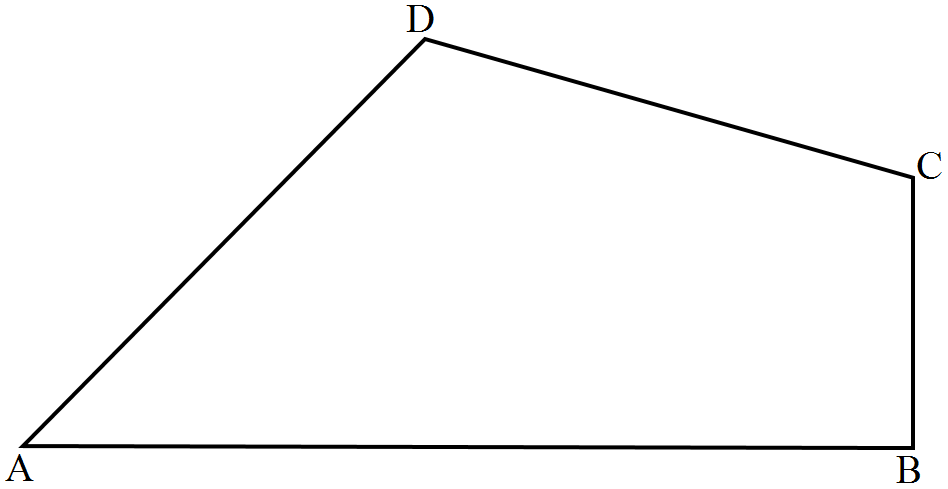
- ✓
$35^\circ , 100^\circ , 105^\circ , 120^\circ$
- B
$100^\circ , 102^\circ , 120^\circ , 10^\circ$
- C
$10^\circ , 20^\circ , 100^\circ , 260^\circ$
- D
$90^\circ , 90^\circ , 100^\circ , 80^\circ$
AnswerCorrect option: A. $35^\circ , 100^\circ , 105^\circ , 120^\circ$
Given $\angle\text{A}+ \angle\text{C}=140^\circ$And $\angle\text{A}: \angle\text{C} = 1:3$
And $\angle\text{B}:\angle\text{D}=5:6$
$\Rightarrow\ \angle\text{A} = \frac{1}{4}×1400=35^\circ$
$\Rightarrow\ \angle\text{C} = \frac{3}{4}×1400=105^\circ$
Now according to angle sum property of quadrilateral,
$\angle\text{A} +\angle\text{B}+ \angle\text{C}+ \angle\text{D} = 360^\circ$
$\Rightarrow\ 350^\circ+\angle\text{B}+ 1050^\circ +\angle\text{D} = 360^\circ$
$\Rightarrow\ \angle\text{B}+\angle\text{D} = 360^\circ−140^\circ=220^\circ$
$\Rightarrow\ 5\text{x} + 6\text{x} = 220^\circ$
$\Rightarrow\ \text{x} = 20^\circ$
So, $\angle\text{B} = 5×20^\circ=100^\circ$
And $\angle\text{D}=6×20^\circ=120^\circ$
View full question & answer→MCQ 71 Mark
In each of the questions one question is followed by two statements $I$ and $II$. Choose the correct option.Is quadrilateral $\text{ABCD}$ a rhombus?
$i$.Quadrilateral $\text{ABCD}$ is a $\|gm.$
$ii$.Diagonals $AC$ and $BD$ are perpendicular to each other.
- A
If the question can be answered by one of the given statements alone and not by the other.
- ✓
If the question can be answered by both the statements together but not by any one of the two.
- C
If the question cannot be answered by using both the statements together.
- D
If the question can be answered by either statement alone.
AnswerCorrect option: B. If the question can be answered by both the statements together but not by any one of the two.
Here, we can observe that neither $I$ not $II$ can alone justify the answer to the given question.
But if we consider both $I$ and $II$ together then they completely satisfies the answer.
So the question can be answered by both the statement together but not by any one of the two.
View full question & answer→MCQ 81 Mark
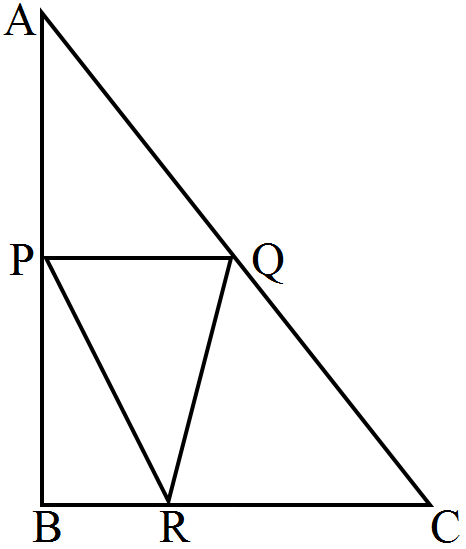
$P, Q, R$ are the mid-points of $AB, BC, AC$ res, If $AB = 10\ cm, BC = 8\ cm, AC = 12\ cm$, Find the perimeter of $\triangle\text{PQR}.$
- A
$15.5\ cm$
- B
$14\ cm$
- ✓
$15\ cm$
- D
$13\ cm$
AnswerCorrect option: C. $15\ cm$
In triangle $ABC, P, Q$ and $R$ are the midpoints.
By midpoint theorem, $PQ$ is parallel to $BC$ and $\text{PQ} = \frac{1}{2}$ of $BC$
$QR$ is parallel to $AB$ and $\text{QR} = \frac{1}{2}$ of $AB$
$PR$ is parallel to $AC$ and $\text{PR} = \frac{1}{2}$ of $AC.$
So, perimeter of triangle $\text{PQR} = \text{PQ} + \text{QR} + \text{PR} = \frac{1}{2}$ of $\text{(AB + BC + AC)}$
$= \frac{1}{2}$ of $(10 + 8 + 12) =\frac{1}{2} $ of $30=15.$
View full question & answer→MCQ 91 Mark
$ABCD$ is a parallelogram and $E$ is the mid-point of $BC. DE$ and $AB$ when produced meet at $F$. Then, $AF =$
- A
$\frac{3}{2}\text{AB}$
- ✓
$2\text{AB}$
- C
$3\text{AB}$
- D
$\frac{5}{4}\text{AB}$
AnswerCorrect option: B. $2\text{AB}$
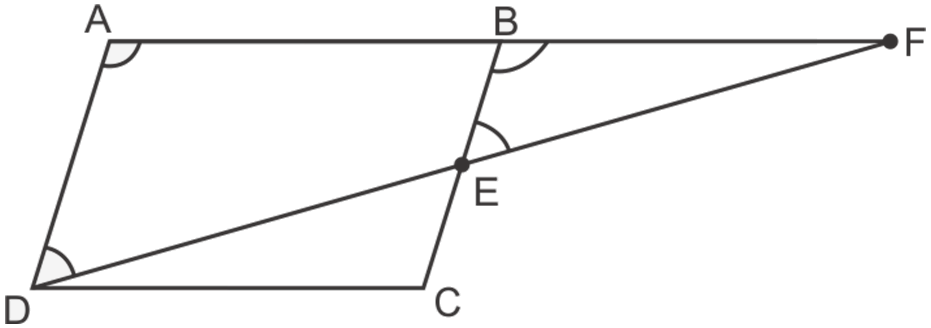
$BE \| AD$
$\Rightarrow BE \| AD$
Now, consider $\triangle\text{FAD}$
$BE \| AD$
Also $\frac{\text{BE}}{\text{AD}}=\frac{1}{2}$
In $\triangle\text{FBE}$ and $\triangle\text{FAD},$
$\angle\text{FAD}=\angle\text{FBE}$ {Corresponding angles}
$\angle\text{ADF}=\angle\text{BEF}$ {Corresponding angles}
$\angle\text{F} =\angle\text{F}$ {Common}
Hence, $\triangle\text{FBE}\sim\triangle\text{FAD}$
$\Rightarrow\frac{\text{BF}}{\text{AF}}=\frac{\text{BE}}{\text{AD}}=\frac{1}{2}$
$\Rightarrow1-\frac{\text{BF}}{\text{AF}}=1-\frac{1}{2}$
$\Rightarrow\frac{\text{AF}-\text{BF}}{\text{AF}}=\frac{1}{2}$
$\Rightarrow\frac{\text{AB}}{\text{AF}}=\frac{1}{2}$
$\Rightarrow\text{AF}=\text{2AB}$ View full question & answer→MCQ 101 Mark
In $\triangle\text{ABC},$ $E$ is the mid-point of median $AD$ such that $BE$ produced meets $AC$ at $F$. If $\text{AC} = 10.5\text{cm},$ then $AF = ?$
- A
$5\ cm$
- B
$3\ cm$
- C
$2.5\ cm$
- ✓
$3.5\ cm$
AnswerCorrect option: D. $3.5\ cm$
Given,
In $\triangle\text{ABC},$
$E$ is mid point of median $AD$
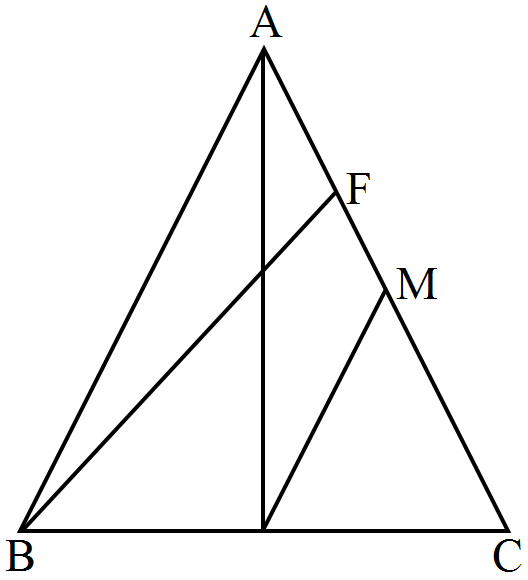
$AC = 10.5cm$
Draw $\text{DM || EF}$
$\because $ E is mid-point of $AD$ so $F$ is mid point of $AM$
$AF = FM ...(i)$
In $\triangle\text{BFC}$
$\text{EF || DM}$
So,$ FM = MC ...(ii)$
From $(i) \& (ii)$
$AF = MC ...(iii)$
$AC = AF + MC + FM$
$\Rightarrow AC = AF + AF + AF$ From $(i) (ii) \& (iii)$
$AC = 3AF$ View full question & answer→MCQ 111 Mark
In fig $D$ is mid-point of $AB$ and $\text{DE || BC}$ then $AE$ is equal to:
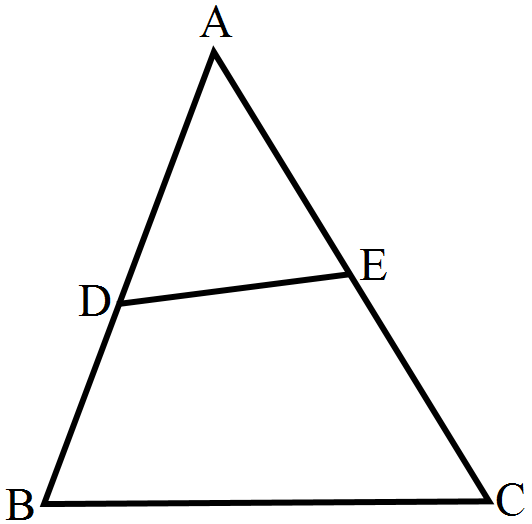
AnswerBy mid-point theorem of a triangle $E$ is the midpoint of $AC,$
Hence $AE = EC$
View full question & answer→MCQ 121 Mark
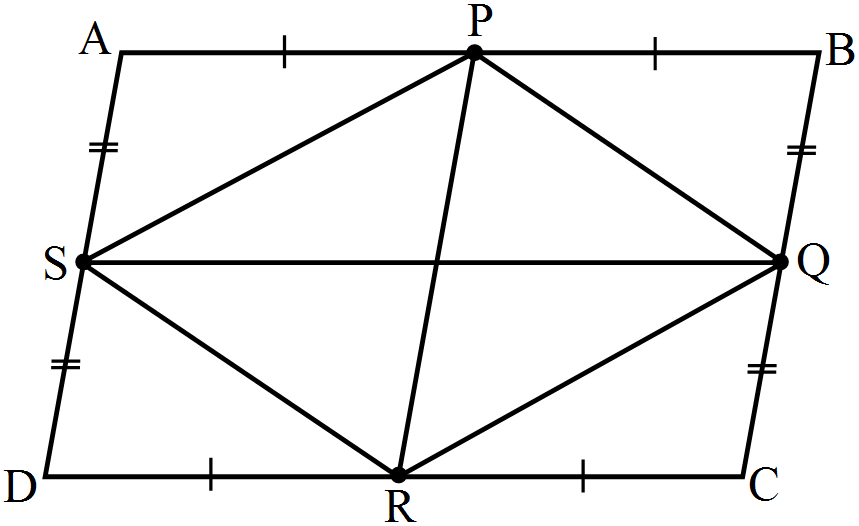
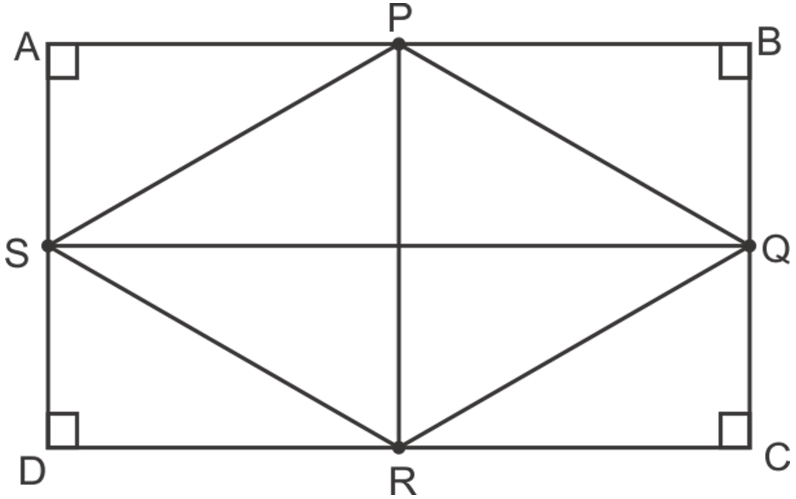
Given Rectangle $ABCD$ and $P, Q, R$ and $S$ are the mid-points of the sides $AB, BC, CD$ and $DA$ respectively. If length of a diagonal of Rectangle is 8cm, then the quadrilateral $PQRS$ is a:
- ✓
Rhombus with each side $4\ cm.$
- B
Rectangle with one side $4\ cm.$
- C
Parallelogram with one side $4\ cm.$
- D
Square with each side $4\ cm.$
AnswerCorrect option: A. Rhombus with each side $4\ cm.$
A quadrilateral formed by joining midpoints of the sides of the rectangle is a Rhombus.
In Rhombus, all sides are equal.
In triangle $ABC, P$ and $Q$ are midpoints of the sides $AB$ and $BC$ respectively. By midpoint theorem, $PQ$ is parallel to $AC$ and $PQ$ is half of the $AC.$
Let diagonal $AC = 8cm. So, PQ = 4cm.$
Therefore, $PQRS$ is a rhombus which all sides equal to $4\ cm.$
View full question & answer→MCQ 131 Mark
In fig $ABCD$ is a parallelogram. If $\angle\text{DAB} = 60^\circ$ and $\angle\text{DBC} = 80^\circ$ then $\angle\text{CDB}$ is: 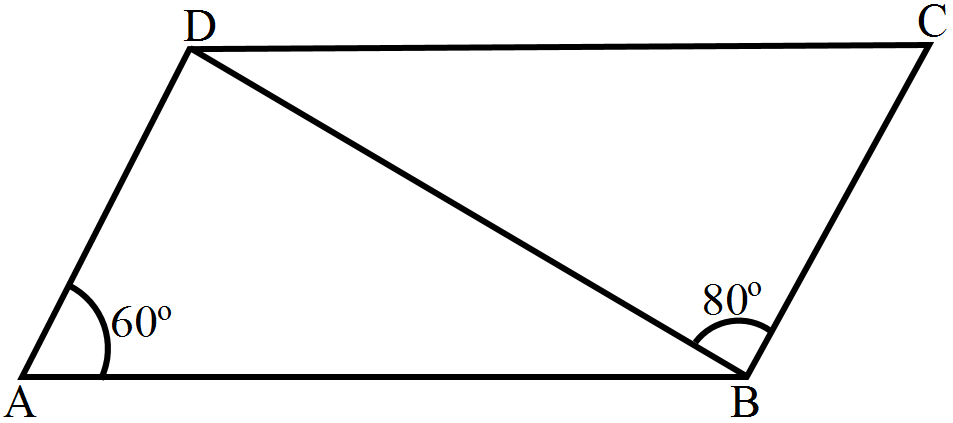
- A
$60^\circ$
- ✓
$40^\circ$
- C
$60^\circ$
- D
$80^\circ$
AnswerCorrect option: B. $40^\circ$
$40^\circ, \ \angle\text{C} = 60^\circ$ as opposite angles of a parallelogram are equal and $\angle\text{COB} = 40^\circ$ angle sum property of a triangle. [In $\triangle\text{COB}, \ \angle\text{C} + \angle\text{COB} + \angle\text{OBC} = 180^\circ$]
View full question & answer→MCQ 141 Mark
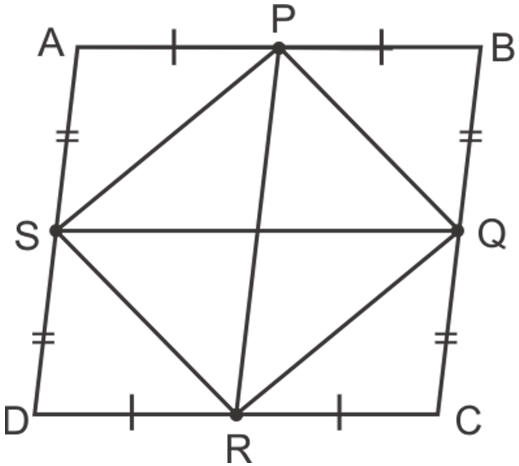
The figure formed by joining the mid-points of the adjacent sides of a parallelogram is a:
Answer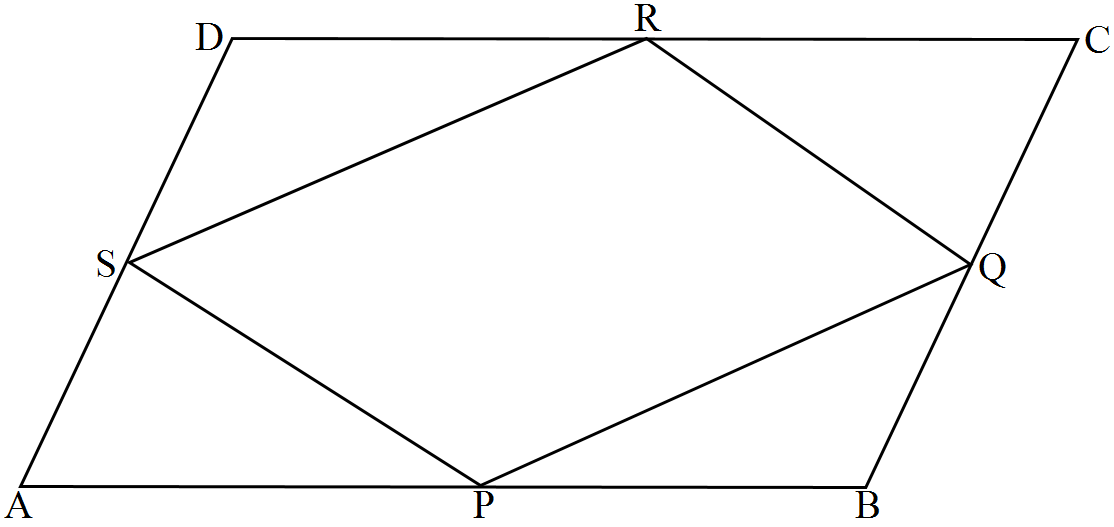
Let $ABCD$ be any quadrilateral.
Join $A$ and $C$.
Let $P$ and $Q$ be midpoints of sides $AB$ and $BC$
In $\triangle\text{ABC},$
$\text{PQ || AC}$ and $\text{PQ}=\frac{1}{2}\text{AC}\ ...\ \text{(i)}$ [By mid-point theorem]
S and R be the mid-points of AD and DC respectively
In $\triangle\text{ACD},$
$\text{SR || AC}$ and $\text{SR}=\frac{1}{2}\text{AC}\ ...\ \text{(ii)}$ [By mid-point theorem]
From $(i)$ and $(ii),$
$\text{PQ || SR}$ and $PQ = SR.$
$∵$ One pair of opposite sides are parallel and equal
$∴ ABCD$ is a parallelogram.
View full question & answer→MCQ 151 Mark
Opposite angles of a Quadrilateral $ABCD$ are equal. If $AB = 4\ cm$, find the length of $CD.$
- ✓
$4\ cm$
- B
$2\ cm$
- C
$3\ cm$
- D
$5\ cm$
AnswerCorrect option: A. $4\ cm$
A quadrilateral with both pair of opposite angles equal is a parallelogram.
In a parallelogram, opposite sides are equal.
So, $AB = CD = 4cm$
View full question & answer→MCQ 161 Mark
The figure formed by joining the mid-points of the adjacent sides of a rhombus is a:
AnswerThe figure formed by joining the mid points of the adjacent sides of a rhombus is a rectangle.
View full question & answer→MCQ 171 Mark
Three statements are given below:
$I$.In a Rectangle $\text{ABCD}$, the diagonals $AC$ bisects $\angle\text{A}$ as well as $\angle\text{C}.$
$II$.In a Square $\text{ABCD}$, the diagonals $AC$ bisects $\angle\text{A}$ as well as $\angle\text{C}.$
$III$.In rhombus $\text{ABCD}$, the diagonals $AC$ bisects $\angle\text{A}$ as well as $\angle\text{C}.$
Which is True?
- ✓
$II$ and $III$
- B
Only $II$
- C
$I$
- D
Only $III$
AnswerCorrect option: A. $II$ and $III$
In square and rhombus, all sides are equal.
By joining the points $A$ and $C$ diagonal $AC$ formed.
we get two triangles $A B C$ and $A D C$ which are congruent $(\text{SAS}$ congruence$).$
Also, opposite sides are parallel.
So, by using alternate angle property we can prove that $\angle BAC =\angle DCA$ and $\angle DAC =\angle ACB$.
But by $\text{CPCT} \angle DAC =\angle BAC$.
So, all four angles made by diagonal $A C$ with end points $A$ and $C$ are equal which proves that diagonal $A C$ bisects $\angle A$ and $\angle C$ both.
View full question & answer→MCQ 181 Mark
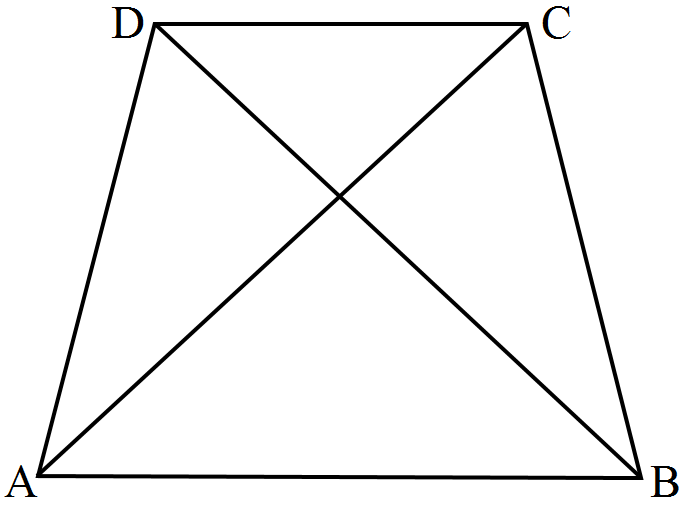
In a Trapezium $ABCD$, if $\text{AB || CD},$ then ($AC^2$ + BD^2) = ?$
- ✓
$\mathrm{BC}^2+\mathrm{AD}^2+2 \mathrm{AB} \cdot C D$
- B
$B C^2+A D^2+2 B C \cdot A D$
- C
$\mathrm{AB}^2+\mathrm{CD}^2+2 \mathrm{AD} \cdot \mathrm{BC}$
- D
$\mathrm{AB}^2+\mathrm{CD}^2+2 \mathrm{AB} \cdot \mathrm{CD}$
AnswerCorrect option: A. $\mathrm{BC}^2+\mathrm{AD}^2+2 \mathrm{AB} \cdot C D$
Given: $ABCD$ is a trapezium with $\text{AB || CD}$
Construction: Draw $DE$ and $CF \perp $ to $AB$
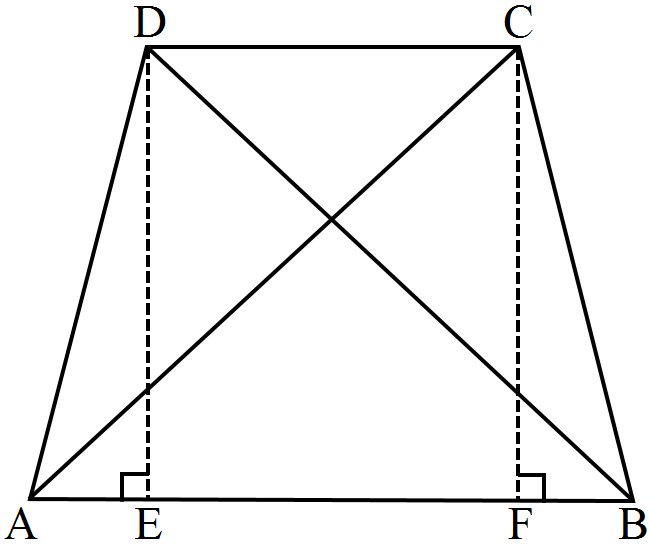
Then in $\triangle\text{ABC}$
$\angle\text{BAC}$ is acute
$\therefore \mathrm{BC}^2=\mathrm{AC}^2+\mathrm{AB}^2-2 \mathrm{AF}: \mathrm{AB} \ldots(1)$
and In $\triangle\text{BDA}$
$\angle\text{DBA}$ is acute
$\therefore \mathrm{AD}^2=\mathrm{BD}^2+\mathrm{AB}^2-2 \mathrm{BE} \cdot \mathrm{AB} \ldots(2)$
Adding $(1)$ and $(2)$ we get
$B C^2+A D^2=A C^2+B D^2+2 A B^2-2 A F \cdot A B-2 B E \cdot A B$
$\Rightarrow A C^2+B D^2=B C^2+A D^2-2 A B[A B-A F-B E]$
$=B C^2+A D^2-2 A B[A B-(A E+E F)-(B F+E F)]$
$=B C^2+A D^2-2 A B[A B-(A E+E F+B F+E F)]$
$=B C^2+A D^2-2 A B[A B-(A B+C D)](\$ \therefore S E F=D C)$
$=B C^2+A D^2-2 A B[(-C D)]$
$=A D^2+B C^2+2 A B \times C D$
View full question & answer→MCQ 191 Mark
The consecutive sides of a quadrilateral have.
- A
- ✓
- C
Infinitely many common points.
- D
View full question & answer→MCQ 201 Mark
In a parallelogram $ABCD$, if $\angle\text{DAB}=75^\circ$ and $\angle\text{DBC}=60^\circ,$ then $\angle\text{BDC}=$
- A
$75^\circ$
- B
$60^\circ$
- ✓
$45^\circ$
- D
$55^\circ$
AnswerCorrect option: C. $45^\circ$
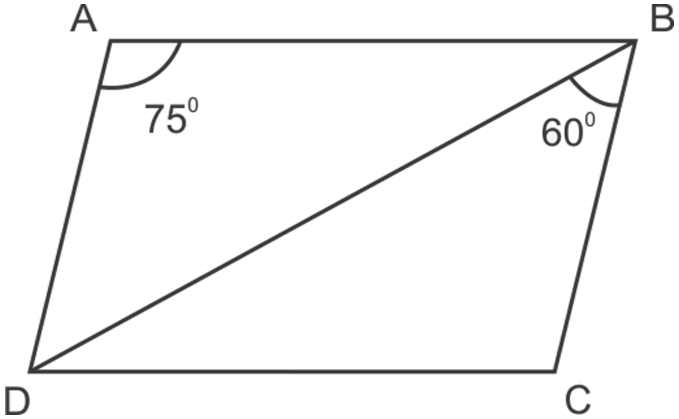
In parallelogram $ABCD,$
$\angle\text{A}+\angle\text{D}=180^\circ$
$\Rightarrow\angle\text{D}=180^\circ-75^\circ=105^\circ$
$\angle\text{ADB}=\angle\text{DBC}$ (Alternate angles)
$\Rightarrow\angle\text{ADB}=60^\circ$
$\angle\text{BDC}=\angle\text{ADC}-\angle\text{ADB}=105^\circ-60^\circ=45^\circ$
View full question & answer→MCQ 211 Mark
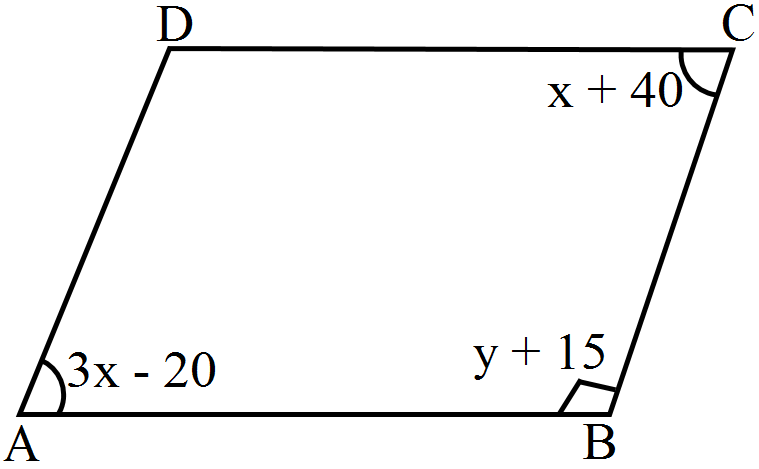
In a parallelogram $ABCD$ if angle $A = (3x - 20)$, angle $B = (Y + 15)$, angle $C = (x + 40)$ then find the value of $x$ and $y?$
- A
$x = 38^\circ $ and $y = 85^\circ $
- B
$x = 30^\circ $ and $y = 65^\circ $
- C
$x = 32^\circ $ and $y = 95^\circ $
- ✓
$x = 30^\circ $ and $y = 95^\circ $
AnswerCorrect option: D. $x = 30^\circ $ and $y = 95^\circ $
Given, $ABCD$ is a parallelogram.
So,
$\angle\text{A} = \angle\text{C}$ (Opposite angles of parallelogram are equal in size)
$\Rightarrow 3x − 20 = x + 40$
$\Rightarrow 3x − x = 40 + 20$
$\Rightarrow 2x = 60$
$\Rightarrow x = 30^\circ $
Thus, $\angle\text{A} = 3 \times 30 − 20 = 90 − 20 = 70^\circ$
Now, $\angle\text{A} + \angle\text{B} = 180^\circ$ (Sum of interior angles of parallelogram is $180^\circ )$
$\Rightarrow 70^\circ + \angle\text{B} = 180^\circ$
$\Rightarrow \angle\text{B} = 180^\circ − 70^\circ$
$\Rightarrow \angle\text{B} = 110^\circ$
$\Rightarrow \text{y} + 15 = 110^\circ$
$\Rightarrow \text{y} = 95^\circ$
Hence, $x = 30^\circ $ and $y = 95^\circ $
View full question & answer→MCQ 221 Mark
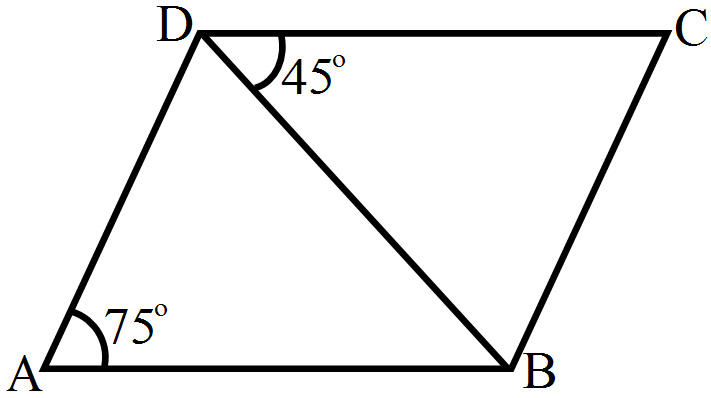
In the given figure, $ABCD$ is a parallelogram in which $\angle\text{BDC}=45^{\circ}$ and $\angle\text{BAD}=75^{\circ}.$ Then, $\angle\text{CBD}=?$
- A
$45^\circ$
- B
$55^\circ$
- ✓
$60^\circ$
- D
$75^\circ$
AnswerCorrect option: C. $60^\circ$
Since $ABCD$ is a parallelogram, $AB \| CD$ since opposite angles of a parallelogram are equal.
$\Rightarrow\angle\text{ABD}=\angle\text{BCD}=45^{\circ}$ ...(Alternate angles)
In $\triangle\text{ADB},$
$\angle\text{ABD}+\angle\text{BDA}+\angle\text{DAB}=180^{\circ}$ ...(Angle sum property)
$\Rightarrow45+\angle\text{BDA}+75=180$
$\Rightarrow\angle\text{BDA}+120=180$
$\Rightarrow\angle\text{BDA}=60^{\circ}$
$\Rightarrow\angle\text{CBD}=\angle\text{BDA}=60^{\circ}$ ...(Alternate angles)
$\Rightarrow\angle\text{CBD}=60^{\circ}$
View full question & answer→MCQ 231 Mark
Given $4$ points $A, B, C, D$ such that $3$ Points $A, B, C$ are collinear. By joining these points in order, we get
AnswerIf three or more points lie on same line then they are called collinear points. $A, B$ and $C$ are collinear means they form a line. Point $D$ is outside the line. Point $D$ can be join with the end points of the line formed by points $A, B$, and $C$. For this we need total three lines to form a closed figure. A closed figure with three sides is called triangle.
View full question & answer→MCQ 241 Mark
The figure formed by joining the mid-points of the adjacent sides of a quadrilateral is a:
Answer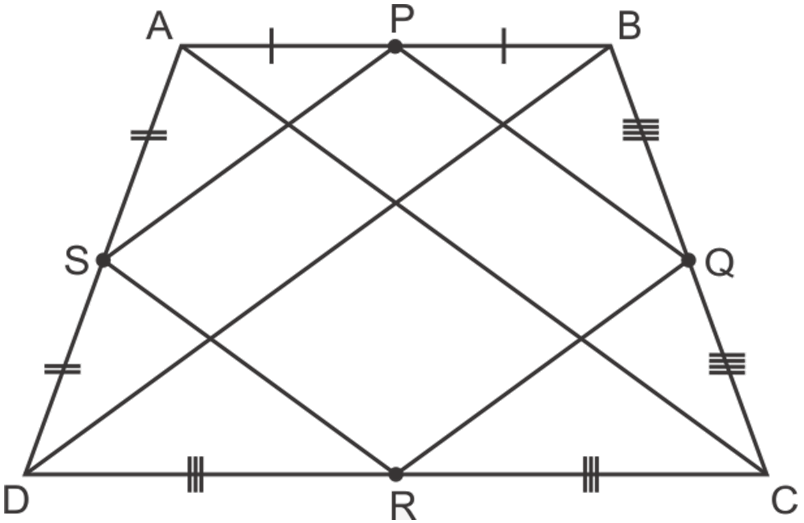
$P, Q, R \& S$ are the mid-points of $AB, BC, CD \& AD$ respectively.
Consider $\triangle\text{ADB},$
If in a triangle, the mid-points of two sides are joint by a line then the line is parallel to the third side.
$\Rightarrow\text{PS}||\text{DB}$ in $\triangle\text{ADB}$
Similarly in $\triangle\text{CDB},$
$RQ \| DB$
Hence $PS \| RQ ...(1)$
Similarly in $\triangle\text{ABC}$ and $\triangle\text{ADC}$
$S R\|A C, P Q\| A C$
$\Rightarrow S R \| P Q \ldots(2)$
From eq. $(1)$ and $(2), PQRS$ is a parallelogram.
View full question & answer→MCQ 251 Mark
Three statements are given below:
$i.$ In a $\| gm$, the angle bisectors of two adjacent angles enclose a right angle.
$ii.$ The angle bisectors of a $\| gm$ form a rectangle.
$iii.$ The triangle formed by joining the mid$-$points of the sides of an isosceles triangle is not necessarily an isosceles triangle.
Which is true?
- A
$I$ only
- B
$II$ only
- ✓
$I$ and $II$
- D
$II$ and $III$
AnswerCorrect option: C. $I$ and $II$
However, the triangle formed by joining the mid$-$point of the sides of an isosceles triangle is surely an isosceles triangle.
So, $III$ is false
Thus, $I$ and $II$ are true.
View full question & answer→MCQ 261 Mark
In a rhombus $ABCD$, if $\angle\text{ACB}=40^\circ,$ then $\angle\text{ADB}=$
- A
$70^\circ$
- B
$45^\circ$
- ✓
$50^\circ$
- D
$60^\circ$
AnswerCorrect option: C. $50^\circ$
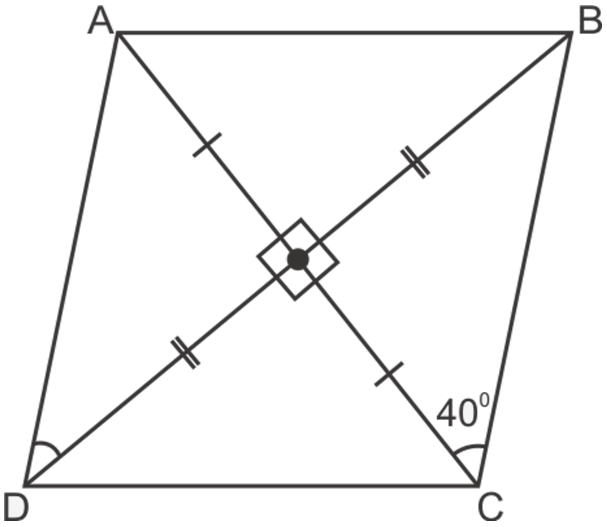
Consider $\triangle\text{AOD} \ \&\ \triangle\text{COB}$ $$
$\angle\text{AOD}=\angle\text{COB}=90^\circ$
$AD = BC$ (Sides of Rhombus)
$AO = CO$ (Diagonals bisects each other)
So by RHS property, $\triangle\text{AOD}\cong\triangle\text{COB}$
$\Rightarrow\angle\text{OAD}=\angle\text{OCB}=40^\circ$
$\angle\text{ADB}=\angle\text{ADO}=180^\circ-90^\circ-40^\circ=50^\circ$
View full question & answer→MCQ 271 Mark
Diagonals necessarily bisect opposite angles in a:
AnswerFrom the given choices, only in a square the diagonals bisect the opposite angles.
Let us prove it.
Take the following square $ABCD$ with diagonal $AD.$
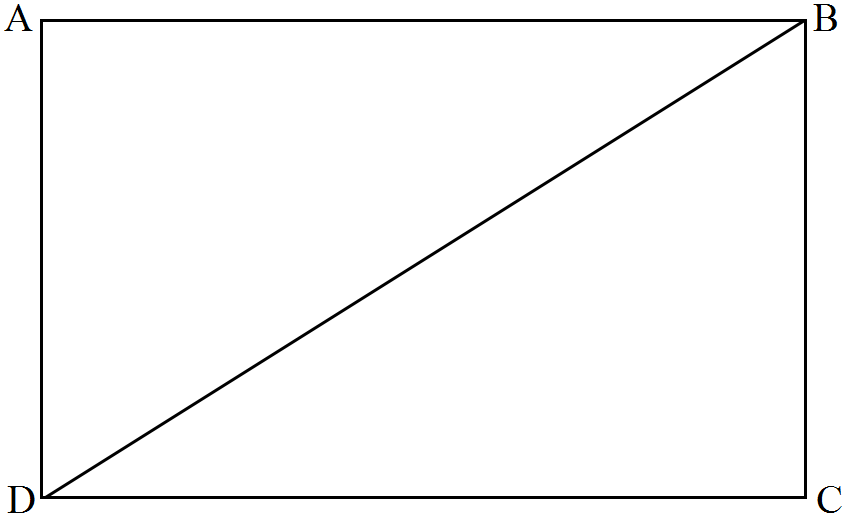
In $\triangle\text{ABD}$ and $\triangle\text{CBD},$
$AD = BC$ (Opposite sides of a square are equal.)
$BD = BD$ (Common)
$AB = DC$ (Opposite sides of a square are equal.)
Thus.
$\triangle\text{ABD≅ΔCBD}$ (By $SSS$ Congruence Rule)
By Corresponging parts of congruent triangle property,
we have:
$\angle\text{ABD} =\angle\text{CBD}$
$\angle\text{ADB} =\angle\text{CDB}$
Therefore, in a square the diagonals bisect the opposite angles.
View full question & answer→MCQ 281 Mark
Three angles of a quadrilateral are $80^\circ , 95^\circ $ and $112^\circ $. Its fourth angle is:
- A
$100^\circ$
- ✓
$73^\circ$
- C
$85^\circ$
- D
$78^\circ$
AnswerCorrect option: B. $73^\circ$
Let the fourth angle be $x$
$80^\circ + 95^\circ + 112^\circ + x^\circ = 360^\circ $ (Sum of angles of quadrilateral)
$287^\circ + x^\circ = 360^\circ$
$x = 360^\circ – 287^\circ$
$= 73^\circ$
Hence, $73^\circ $ is correct.
View full question & answer→MCQ 291 Mark
What is the length of $PQ$ in a trapezium $ABCD$ in which $\text{AB || DC}$ and $P$ and $Q$ are mid-points on $AD$ and $BC$ respectively?
AnswerCorrect option: A. $\frac{1}{2}\text{(AB + CD)}$
In $\triangle\text{PCD}$ and $\triangle\text{APG},$
$\angle\text{DPC} = \angle\text{GPA},$
$\angle\text{PDC} = \angle\text{AGP}$
$∴\triangle\text{PCD}≅\triangle\text{APG}$
$CD = AG$ and $PD = PG$
In $\triangle\text{BGD},$
$P$ is the mid-point of $GD$
$Q$ is the mid-point of $BD$
Therefore, By mid-point theorem, $\text{PQ || AB}$
and $\text{PQ} = \frac{1}{2}\text{(GB)}$
but $GB = GA + AB = CD + AB$
$∴\text{PQ}=\big(\frac{1}{2}\big)\text{(AB + CD)}$
View full question & answer→MCQ 301 Mark
The angle between two altitudes of a Parallelogram through the vertex of an obtuse angle of the Parallelogram of $60^\circ $. Find the angles of the Parallelogram.
- A
$110^\circ , 50^\circ , 105^\circ , 105^\circ$
- B
$150^\circ , 150^\circ , 30^\circ , 30^\circ$
- ✓
$120^\circ , 60^\circ , 120^\circ , 60^\circ$
- D
$200^\circ , 100^\circ , 30^\circ , 30^\circ$
AnswerCorrect option: C. $120^\circ , 60^\circ , 120^\circ , 60^\circ$
Let $ABCD$ be a parallelogram and $AP$ and $CQ$ are the altitudes drawn from vertex $A$ on sides $DC$ and $BC.$
In quadrilateral $APCQ$, sum of the all angles $= 360^\circ $
So, $60^\circ + 90^\circ + \angle\text{C} + 90^\circ = 360^\circ$
$\angle\text{C} = 360^\circ - 240^\circ = 120^\circ$
$\angle\text{C} + \angle\text{B} = 180^\circ$ (co-interior angles)
$\angle\text{B} = 180^\circ - 120^\circ = 60^\circ$
In parallelogram, opposite angles are equal.
So, $\angle\text{A} = \angle\text{C} = 120^\circ$ and $\angle\text{B} = \angle\text{D} = 60^\circ$
View full question & answer→MCQ 311 Mark
We get a rhombus by joining the mid-points of the sides of a:
MCQ 321 Mark
In Quadrilateral $ABCD$, $\angle\text{A} = 110^\circ, \ \angle\text{B} = 75^\circ$ and $\angle\text{C} = 35^\circ.$ Find $\angle\text{D}=\ ?$
- A
$50^\circ$
- B
$145^\circ$
- C
$110^\circ$
- ✓
$140^\circ$
AnswerCorrect option: D. $140^\circ$
$\angle\text{A} + \angle\text{B} + \angle\text{C} + \angle\text{D} = 360^\circ$ (angle sum property of quadrilateral).
$110 + 75^\circ + 35^\circ + \angle\text{D} = 360^\circ$
$\angle\text{D} = 360^\circ - 220^\circ = 140^\circ$
View full question & answer→MCQ 331 Mark
If area of $a \|$ gm with sides $a$ and $b$ is $A$ and that of a rectangle with sides $a$ and $b$ is $B$, then:
- A
$A > B$
- B
$A = B$
- ✓
$A < B$
- D
$A ≥ B$
AnswerCorrect option: C. $A < B$
Let h be the heigth of the parallelogram.
Then, $h < b.$
We konw that, area of a parallelogram $=$ base $\times $ height
If a is the base of the parallelogram, then area of a parallelogram $= a \times h$
$\Rightarrow A = a \times h$
We know that, area of a rectangle $=$ length $\times $ breadth
$\Rightarrow A = a \times b$
So, $a \times h < a \times b$
Hence, $A < B.$
View full question & answer→MCQ 341 Mark
The diagonal $AC$ and $BD$ of quadrilateral $ABCD$ are equal and are perpendicular bisector of each other then quadrilateral $ABCD$ is a:
AnswerThe triangles formed by the perpendicular bisectors are congruent to each other by $SAS$ congruence. so the sides are equal hence it is a square.
View full question & answer→MCQ 351 Mark
Angles of a quadrilateral are in the ratio $3 : 4 : 4 : 7$. Find all the angles of the quadrilateral.
- A
$60^\circ , 120^\circ , 80^\circ , 140^\circ$
- B
$70^\circ , 70^\circ , 100^\circ , 100^\circ$
- ✓
$60^\circ , 80^\circ , 80^\circ , 140^\circ$
- D
$60^\circ , 80^\circ , 100^\circ , 90^\circ$
AnswerCorrect option: C. $60^\circ , 80^\circ , 80^\circ , 140^\circ$
Let $ABCD$ be a quadrilateral with $\angle\text{A} = 3\text{x},\ \angle\text{B} = 4\text{x} ,\ \angle\text{C} = 4\text{x}$ and $\angle\text{D} = 7\text{x}$
$\angle\text{A} + \angle\text{B} + \angle\text{C} + \angle\text{D} = 360^\circ$ (angle sum property)
$3\text{x} + 4\text{x} + 4\text{x} + 7\text{x} = 360^\circ$
$18\text{x} = 360^\circ$
$\text{x} = 20^\circ$
$\angle\text{A} = 3 (20^\circ) = 60^\circ$
$\angle\text{B} = \angle\text{C} = 4 (20^\circ) = 80^\circ$
$\angle\text{D} = 7 (20^\circ) = 140^\circ$
View full question & answer→MCQ 361 Mark
$ABCD$ is a Trapezium in which $\text{AB || DC}$ and $\angle\text{A}=\angle\text{B} = 45^\circ.$ Find $\angle\text{C}$ and $\angle\text{D}$ of the Trapezium.
- ✓
$135^\circ , 135^\circ$
- B
$120^\circ , 120^\circ$
- C
$150^\circ , 150^\circ$
- D
$200^\circ , 50^\circ$
AnswerCorrect option: A. $135^\circ , 135^\circ$
$AB$ is parallel to $DC.$
$\angle\text{A} + \angle\text{D} = 180^\circ$ (co-interior angle)
$\angle\text{D} = 180^\circ - 45^\circ = 135^\circ$
Similarly by following same argument, $\angle\text{C} = 135^\circ.$
View full question & answer→MCQ 371 Mark
In fig if $DE= 8\ cm$, $\text{DE || BC}$ and $D$ is the mid-Point of $AB$, then the true statement is: 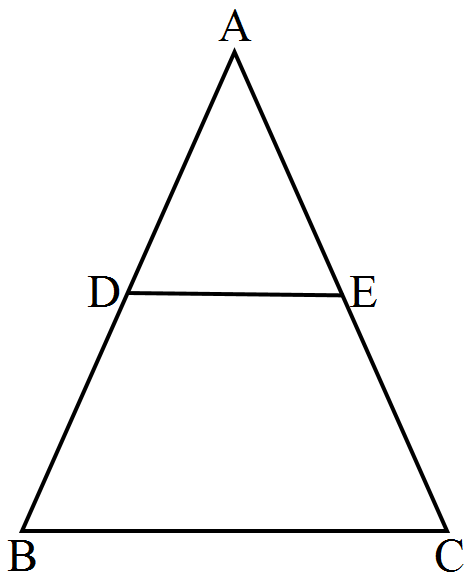
AnswerCorrect option: A. $E$ is the mid-Point of $AC.$
By the converse of Mid-Point Theorem, which states that," If a line segment is drawn passing through the midpoint of any one side of a triangle and parallel to another side, then the line segment bisects the remaining third side.
View full question & answer→MCQ 381 Mark
If the diagonals of a rhombus are $18\ cm$ and $24\ cm$ respectively, then its side is equal to:
- A
$17\ cm$
- B
$20\ cm$
- C
$16\ cm$
- ✓
$15\ cm$
AnswerCorrect option: D. $15\ cm$
Given,
$ABCD$ is a rhombus
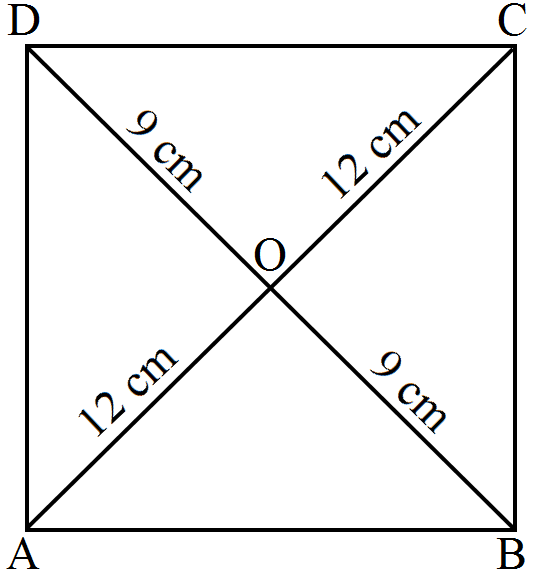
$AC = 24\ cm, BD = 18\ cm$
$AB = BC = CD = DA$ [side of rhombus]
We know that diagonals of rhombus bisect each other at $90^{\circ}$.
In right $\triangle\text{AOB}$
$AB^2 = BO^2 + AO^2$
$AB^2 = 122 + 92 = 144 + 81 = 225$
$\text{AB} = \sqrt{225}$
$= 15cm$
Side of rhombus $= 15cm$
View full question & answer→MCQ 391 Mark
In a trapezium $ABCD$, if $E$ and $F$ be the mid-point of the diagonals $AC$ and $BD$ respectively. Then, $EF = ?$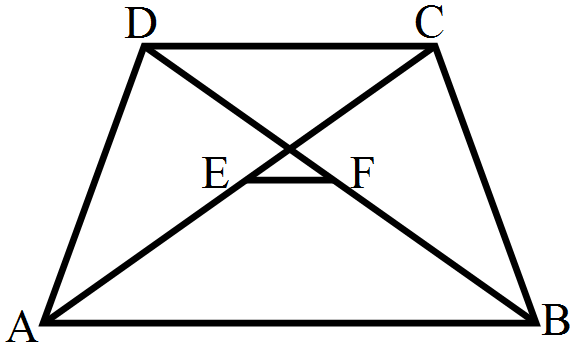
AnswerCorrect option: D. $\frac{1}{2}(\text{AB}-\text{CD})$
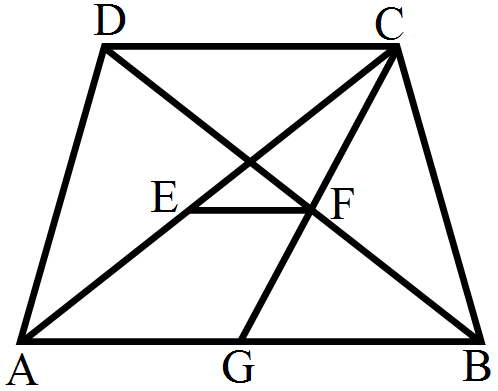
Construction: join $CF$ and extend it to meet $AB$ at $G.$
In $\triangle\text{CDF}$ and $\triangle\text{GFB},$
$\angle\text{CDF}=\angle\text{GFB}$ ...(Vertically opposite angles)
$\text{AB || CD},$
So, $\angle\text{DCF}=\angle\text{GFB,}$ ...(alternate angles)
$\text{DF = FB}$ $...(F$ is the mid-point of $BD)$
$\Rightarrow\triangle\text{CDF}\cong\triangle\text{GFB}$ $...(ASA$ congruence criterion)
So, $\text{CD = GB}$ and $\text{CF = GF}$ $...(C.P.C.T.)$
Since $E$ and $F$ are the mid-points of $CA$ and $CG$ respectively,
we have $\text{EF}=\frac{1}{2}\text{AG}$
$=\frac{1}{2}(\text{AB}-\text{GB})$
$=\frac{1}{2}(\text{AB}-\text{CD})$
View full question & answer→MCQ 401 Mark
The bisectors of any two adjacent angles of a parallelogram intersect at:
- A
$30^\circ$
- B
$45^\circ$
- C
$60^\circ$
- ✓
$90^\circ$
AnswerCorrect option: D. $90^\circ$
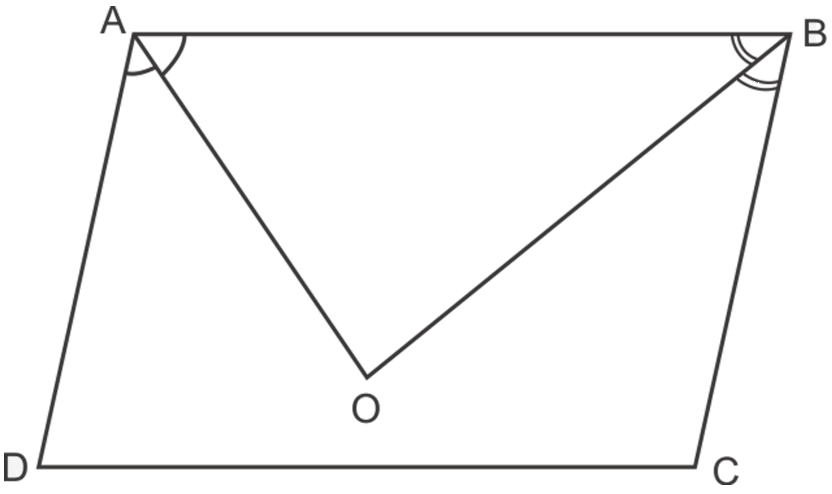
In a parallelogram, sum of adjacent angles =$ 180^\circ $
$\Rightarrow \angle \text{A}+\angle\text{B}=180^\circ$
$\Rightarrow\frac{\angle\text{A}}{2}+\frac{\angle\text{B}}{2}=90^\circ\ ...(1)$
$\Rightarrow\angle\text{OAB}=\frac{\angle\text{A}}{2}$ and $\angle\text{OBA}=\frac{\angle\text{B}}{2}$
Thus, $\angle\text{OAB}+\angle\text{OBA}=90^\circ$ [From eq $(1)]$
$\Rightarrow\angle\text{AOB}=180^\circ-(\angle\text{OAB}+\angle\text{OBA})=180^\circ-90^\circ$
$\Rightarrow\angle\text{AOB}=90^\circ$
View full question & answer→MCQ 411 Mark
The figure formed by joining the mid-points of the adjacent sides of a rectangle is a:
Answer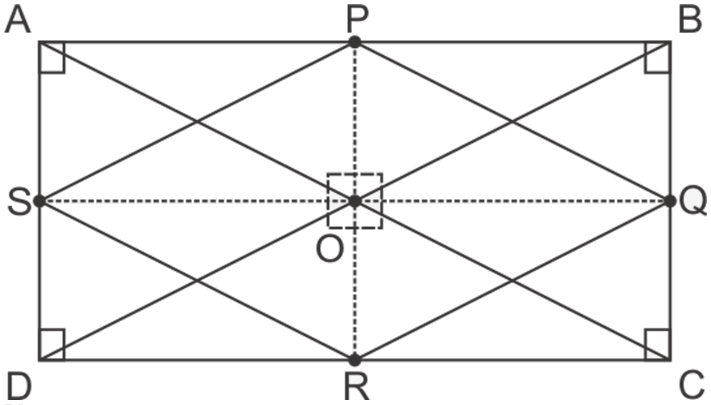
$PQ || AC$ (since in $\triangle\text{ABC}$ mid-points of $AB \& BC$ are meeting by $PQ)$
Similarly, $SR || AC$
$\Rightarrow PQ || SR$
Now in $\triangle\text{ABD}$ and $\triangle\text{CBD},$
$PS || BD$ and $QR || BD$
$\Rightarrow PS || QR$
Hence, PQRS is a parallelogram.
But $\text{PR }\bot \text{ QS}$
$\Rightarrow $ Diagonals cut at $90^\circ $
$\Rightarrow PQRS$ is a Rhomus.
View full question & answer→MCQ 421 Mark
If $APB$ and $CQD$ are two parallel lines, then the bisectors of the angles $APQ, BPQ, CQP$ and $PQD$ form.
Answer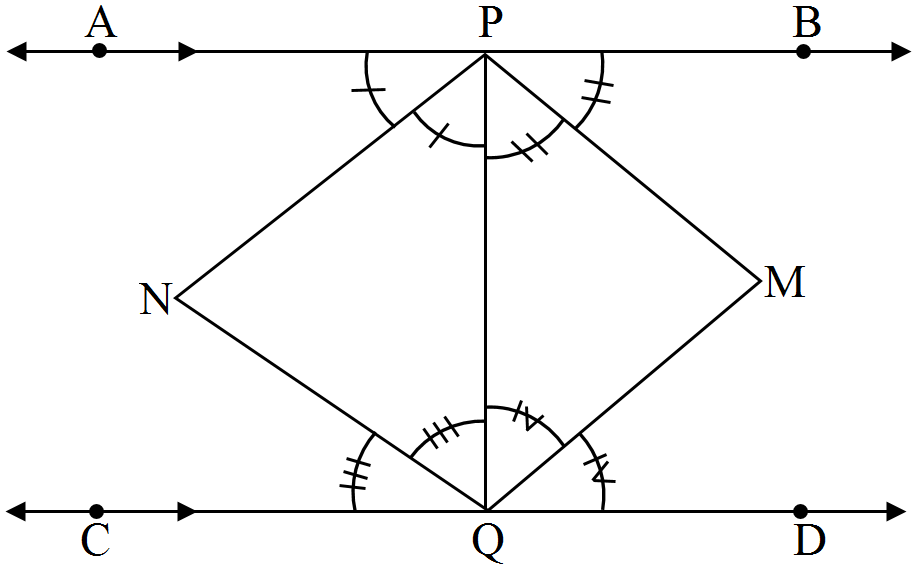
$PNQM$ is a rectangle. View full question & answer→MCQ 431 Mark
One Angle of a quadrilateral is of $108^\circ $ and the remaining three angles are equal. Find each of the three equal angles.
- ✓
$84^\circ , 84^\circ , 84^\circ$
- B
$90^\circ , 84^\circ , 90^\circ$
- C
$90^\circ , 90^\circ , 84^\circ$
- D
$84^\circ , 90^\circ , 90^\circ$
AnswerCorrect option: A. $84^\circ , 84^\circ , 84^\circ$
Let $ABCD$ be a quadrilateral with $\angle\text{A} = 108^\circ$ and $\angle\text{B} = \angle\text{C} = \angle\text{D} = \text{x}$
$\angle\text{A} + \angle\text{B} + \angle\text{C} + \angle\text{D} = 360^\circ$ (angle sum property)
$108^\circ + x + x + x = 360^\circ$
$3x = 360^\circ - 108^\circ$
$3x = 252^\circ$
$x = 84^\circ$
View full question & answer→MCQ 441 Mark
In the given figure, $ABCD$ is a Rectangle. Find the values of $x$ and $y?$
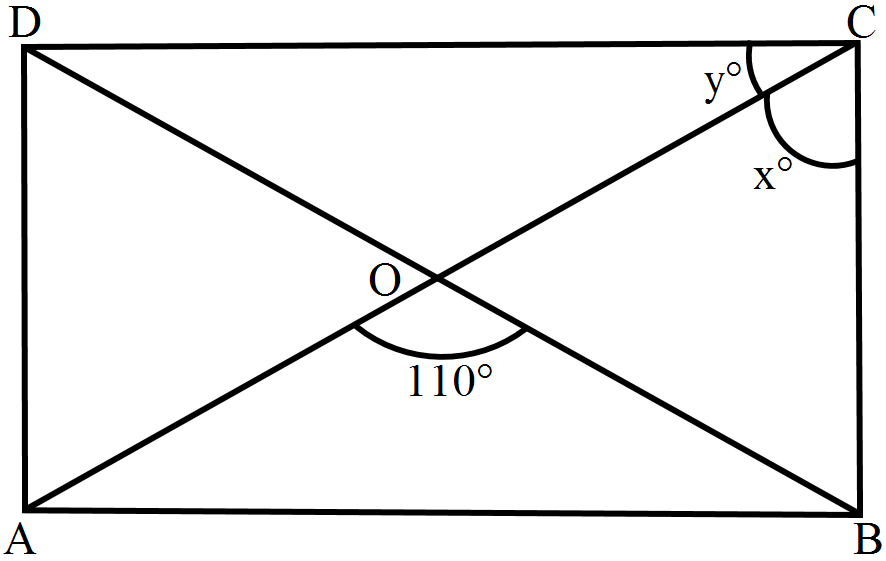
- A
$x = 50^{\circ}$ and $y = 60^{\circ}$
- B
$x = 120^{\circ}$ and $y = 120^{\circ}$
- C
$x = 60^{\circ}$ and $y = 70^{\circ}$
- ✓
$x = 55^{\circ}$ and $y = 35^{\circ}$
AnswerCorrect option: D. $x = 55^{\circ}$ and $y = 35^{\circ}$
Given $\angle\text{AOB}=110^\circ$
$\Rightarrow \angle\text{DOC}=110^\circ$ vertically opposite angles
$\triangle\text{DOC}$ we have:
$DO = OC$
Now, $\angle\text{ODC} = \angle\text{OCD} = \text{y}$
now in $\triangle\text{ODC}$
$y+y+110^{\circ}=180^{\circ} \text { (angle sum property of triangle) }$
$\Rightarrow 2 y=180^{\circ}-110^{\circ}=70^{\circ}$
$\Rightarrow y=35^{\circ}$
Also, $x=90^{\circ}-y$
$x=90^{\circ}-35^{\circ}=55^{\circ}$
Hence, $x=55^{\circ}$ and $y=35^{\circ}$
View full question & answer→MCQ 451 Mark
$D$ and $E$ are the mid-points of the sides $AB$ and $AC$ res. Of $\triangle\text{ABC}. DE$ is produced to $F$. To prove that $CF$ is equal and parallel to $DA$, we need an additional information which is:
AnswerCorrect option: B. $\text{DE = EF}$
If $DE = EF$ then triangle $AED$ becomes congruent to triangle $CEF$ by $SSS$ congruence rule.
By $\text{CPCT}, \ \angle\text{ECF} = \angle\text{EAD}$ which forms a pair of alternate angles.
Which proves that $AD$ is parallel to $CF.$
View full question & answer→MCQ 461 Mark
The consecutive sides of a quadrilateral have:
- A
- ✓
- C
- D
Infinitely many common points.
Answer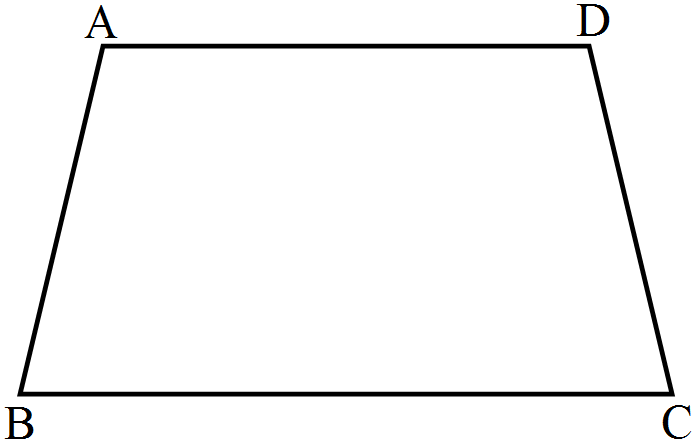
Consecutive sides of a Quadrilateral $ABCD$ are
$AB$ and $BC,$
$BC$ and $CD,$
$CD$ and $AD,$
$AD$ and $AB,$
Which have only one point in common
i.e the joint point of their ends.
View full question & answer→MCQ 471 Mark
The figure formed by joining the mid-points of the adjacent sides of a parallelogram is a:
Answer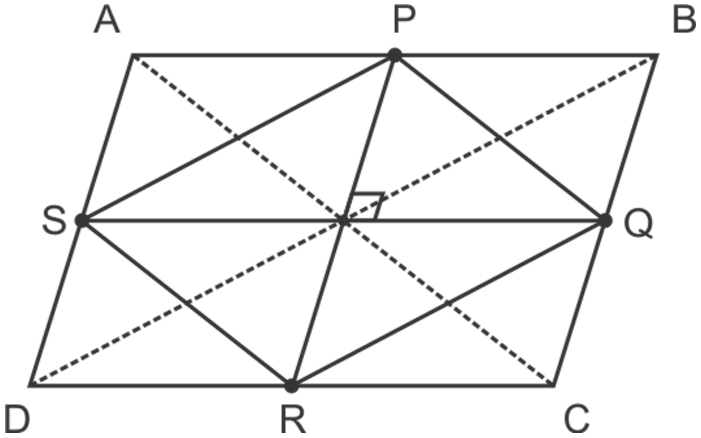
$PQ \| SR \| AC$
$QR \| PS \| BD$
{Because line joining the mid-points of two sides of triangle is $\|$ to third side}
Now because $AC$ is not prependicular to $BD$ in parallelogram,
$\Rightarrow SR$ is not perpendicular to $QR$
Also $\triangle\text{ASP}\not\cong\triangle\text{DRS}$
$\Rightarrow \text{PS} \neq \text{SR}$
$\Rightarrow PQRS$ is just a parallelogram.
View full question & answer→MCQ 481 Mark
If the diagonals of a quadrilateral bisect each other, and opposite sides are parallel and equal, then the quadrilateral must be.
AnswerBy theorm diagonals of quadrilateral bisect each other if and only if it is a parallelogram.For a quadrilateral to be parallelogram some other properties are required: Opposite sides are equal and parallel. Opposite angles are equal. Sum of any adjacent angles is $180.$
View full question & answer→MCQ 491 Mark
In fig $D$ is mid-point of $AB$ and $\text{DE || BC}$ then AE is equal to:
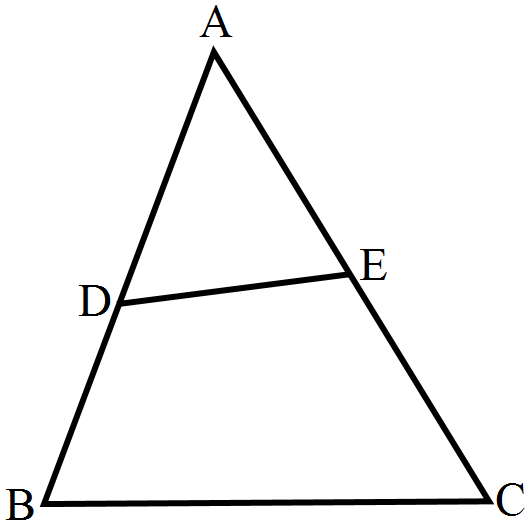
AnswerBy mid-point theorem of a triangle $E$ is the midpoint of $AC$, hence $AE = EC.$
View full question & answer→MCQ 501 Mark
If one angle of a parallelogram is $24^\circ $ less than twice the smallest angle, then the measure of the largest angle of the parallelogram is:
- ✓
$112^\circ$
- B
$176^\circ$
- C
$68^\circ$
- D
$102^\circ$
AnswerCorrect option: A. $112^\circ$
Let angles of parallelogram are $\angle\text{A}, \angle\text{B}, \angle\text{C}, \angle\text{D}$
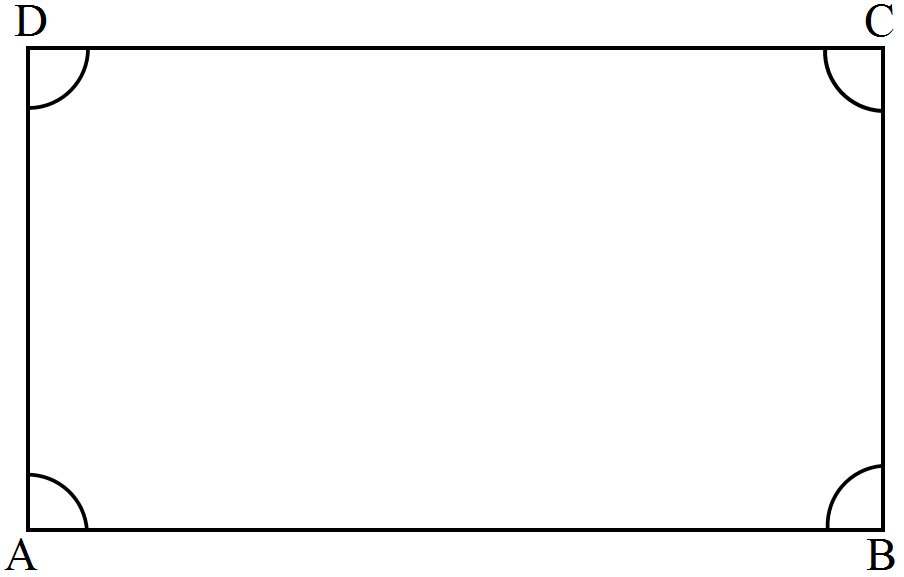
Let smallest angle $= \angle\text{A}$
Let largest angle $= \angle\text{B}$
$= \angle\text{B} = 2\angle\text{A} – 24^\circ ...\text{(i)}$
$\angle\text{A} + \angle\text{B} = 180^\circ$ [adjacent angle of parallelogram]
So, $\angle\text{A} + 2\angle\text{A} -24^\circ = 180^\circ$
$= 3\angle\text{A} = 180^\circ + 24^\circ = 204^\circ$
$=\angle\text{A}=\frac{204^\circ}{3}=68^\circ$
View full question & answer→