MCQ 511 Mark
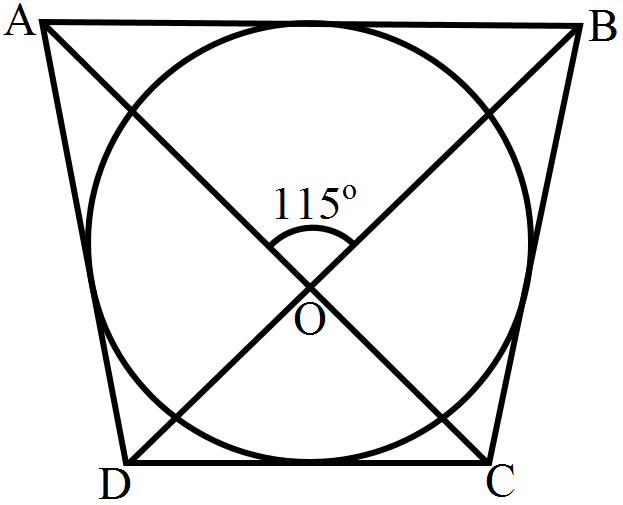
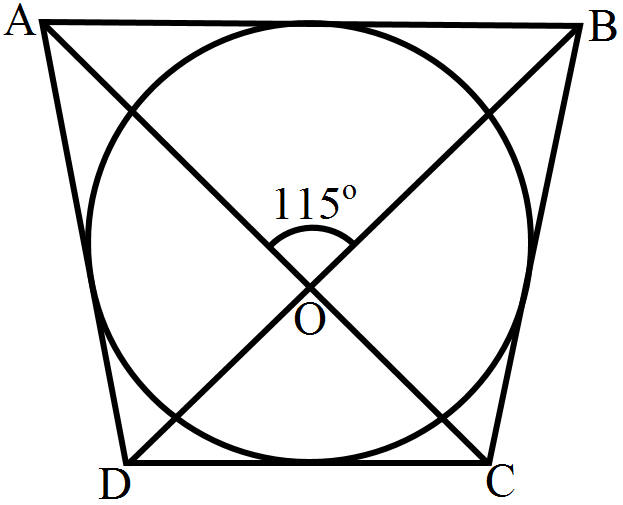
In Fig. the quadrilateral $ABCD$ circumscribes a circle with centre $O$. If $\angle\text{AOB} = 115^\circ,$ then find $\angle\text{COD}.$
- A
$23^\circ$
- B
$24^\circ$
- C
$127^\circ$
- ✓
$115^\circ$
AnswerCorrect option: D. $115^\circ$
$\therefore \angle\text{AOB} = \angle\text{COD}$ (vertically opposite angle)
$\therefore \angle\text{COD}=115^\circ$
View full question & answer→MCQ 521 Mark
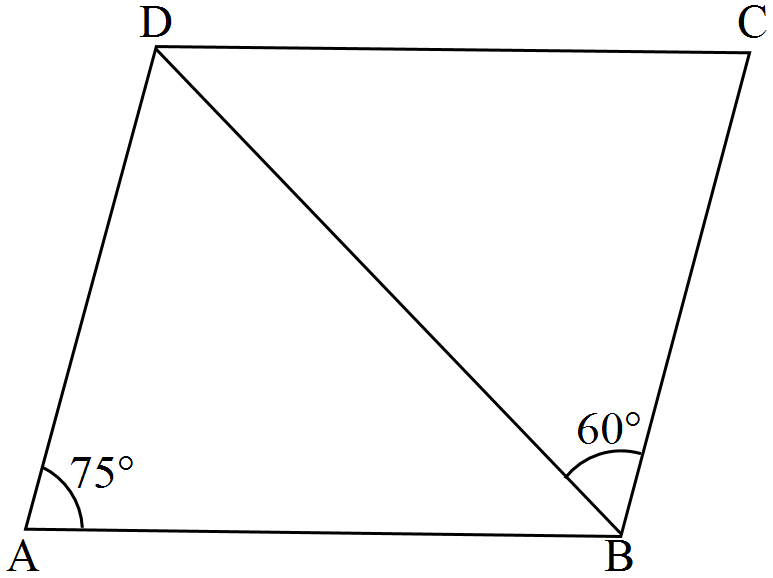
In the given figure, $ABCD$ is a parallelogram in which $\angle\text{BAD} = 75^\circ$ and $\angle\text{CBD} = 60^\circ.$ Then, $\angle\text{BDC} =\ ?$
- ✓
$45^\circ$
- B
$75^\circ$
- C
$50^\circ$
- D
$60^\circ$
AnswerCorrect option: A. $45^\circ$
It is given in the question that,
In parallelogram $ABCD$: $\angle\text{BAD} = 75^\circ, \ \angle\text{CBD} = 60^\circ$
Now, $\angle\text{DAB} = \angle\text{DCB} = 75^\circ$ (Opposite angles)
Also, in triangle DBC we know that sum of angles of a triangle is $180^\circ $
$\angle\text{DBC} + \angle\text{BDC} + \angle\text{DCB} = 180^\circ$
$60^\circ + \angle\text{BDC} + 75^\circ= 180^\circ$
$135^\circ + \angle\text{BDC} = 180^\circ$
$\angle\text{BDC} = 180^\circ – 135^\circ$
$\angle\text{BDC} = 45^\circ$
Hence, $45^\circ $ is correct.
View full question & answer→MCQ 531 Mark
A quadrilateral $ABCD$ is a parallelogram if:
AnswerCorrect option: A. $\angle\text{A} = 60^\circ, \ \angle\text{C} = 60^\circ,\ \angle\text{B} = 120^\circ$
$\angle\text{A} = 60^\circ, \ \angle\text{C} = 60^\circ,\ \angle\text{B} = 120^\circ$
Opposite angles are equal and sum of adjacent angles are supplementary.
View full question & answer→MCQ 541 Mark
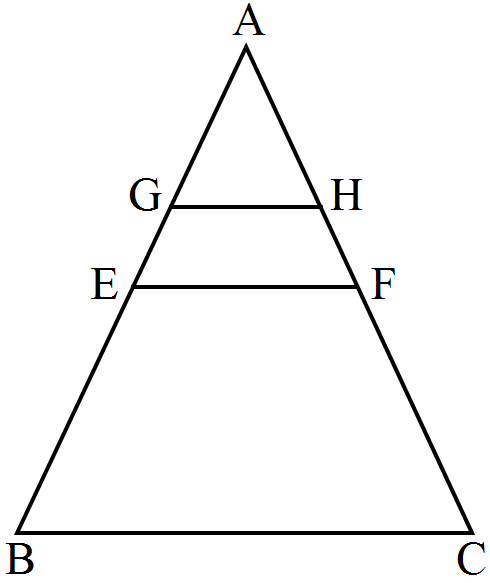
$E$ and $F$ are the mid-points of sides $AB$ and $AC$ res. Of the $\triangle\text{ABC},$ $G$ and $H$ are the mid-points of the sides AE and $AF$ res. Of the $\triangle\text{AEF}.$ If $GH = 1.8cm$, Find $BC = ?$
- A
$6.5\ cm$
- B
$6\ cm$
- ✓
$7.2\ cm$
- D
$7.5\ cm$
AnswerCorrect option: C. $7.2\ cm$
$BC = 4 \times 1.8 = 7.2\ cm.$
View full question & answer→MCQ 551 Mark
The Quadrilateral forms by joining the mid-points of the sides of a Quadrilateral $PQRS$, taken in order, is a Rhombus if:
AnswerCorrect option: C. Diagonals of $PQRS$ are equal.
A quadrilateral formed by joining the mid points of the sides of the Rectangle is a rhombus. In rectangle, diagonals are equal.
View full question & answer→MCQ 561 Mark
Digonals necessarily bisect opposite angles in a:
AnswerDiagonals necessarily bisect opposite angles in a square.
View full question & answer→MCQ 571 Mark
The length of each side of a rhombus is $10\ cm$ and one if its diagonals is of length $16\ cm$. The length of the other diagonal is:
- A
$13\ cm$
- ✓
$12\ cm$
- C
$2\sqrt{39}\text{cm}$
- D
$6\ cm$
AnswerCorrect option: B. $12\ cm$
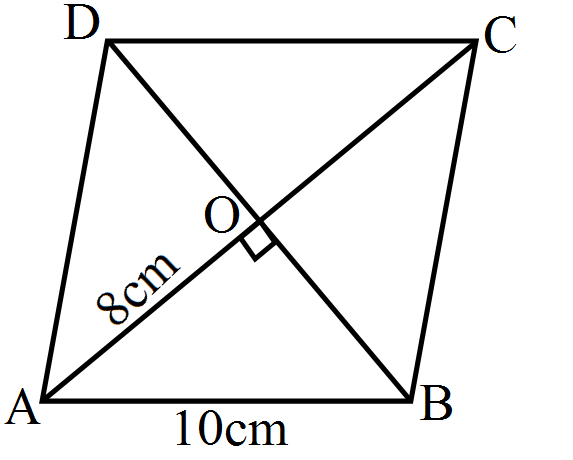
Let $ABCD$ be the rhombus with diagonals $AB = 10\ cm$ and $Ac = 16\ cm.$
Since the diagonals of a rhombus are perpendicular bisectors of each other,
$\Rightarrow\text{OA}=8\text{cm},\text{BD = 2OB}$ and $\angle\text{AOB}=90^{\circ}$
In right $\triangle\text{AOB},$
By Pythagoras theorem,
$\text{AB}^2=\text{OA}^2+\text{OB}^2$
$\Rightarrow(10)^{2}=(8)^2+\text{OB}^2$
$\Rightarrow100=64+\text{OB}^2$
$\Rightarrow\text{OB}^2=36$
$\Rightarrow\text{OB}=\sqrt{36}$
$\Rightarrow\text{OB}=6\text{cm}$
$\Rightarrow\text{BD}=2\times\text{OB}$
$\Rightarrow\text{BD}=2\times6$
$\Rightarrow\text{BD}=12\text{cm}$
Hence, the lenght of the other diagonal is $12\ cm.$
View full question & answer→MCQ 581 Mark
E Divides $AB$ in the ratio $1 : 3$ and also, $F$ divides $AC$ in the ratio $1 : 3. EF = 2.8cm$, Find $BC = ?$
- ✓
$11.2\ cm$
- B
$12\ cm$
- C
$11.5\ cm$
- D
$11\ cm$
AnswerCorrect option: A. $11.2\ cm$
Let $AE = x$ and $EB = 3x, AF = y$ and $FC = 3y.$
$EF = 2.8cm$
$AE + AF = 2.8$ implies $x + y = 2.8$
$BC = CF + FA + AE + EB$
$= 3y + y + x + 3x$
$= 4(x + y) = 4(2.8) = 11.2cm$
View full question & answer→MCQ 591 Mark
In a quadrilateral $ABCD, AO$ and $BO$ are the bisectors of $\angle\text{A}$ and $\angle\text{B}$ respectively, $\angle\text{C} = 70^\circ$ and $\angle\text{D} = 30^\circ.$ Then, $\angle\text{AOB} =\ ?$
- ✓
$50^\circ$
- B
$40^\circ$
- C
$100^\circ$
- D
$80^\circ$
AnswerCorrect option: A. $50^\circ$
It is given in the question that, $ABCD$ is a quadrilateral where $AO$ and $BO$ are the bisectors of $\angle\text{A}$ and $\angle\text{B}.$
We know that, sum of all angles of a quadrilateral is equal to $360^\circ $
$∴ \angle\text{A} + \angle\text{B} + \angle\text{C} + \angle\text{D} = 360^\circ$
$\angle\text{A} + \angle\text{B} + 70^\circ + 30^\circ = 360^\circ$
$\angle\text{A} + \angle\text{B} = 360^\circ - 100^\circ$
$\angle\text{A} + \angle\text{B} = 260^\circ$
$=\frac{1}{2}(\angle\text{A}+\angle\text{B})=\frac{1}{2}\times260^\circ$
$=\frac{1}{2}(\angle\text{A}+\angle\text{B})=160^\circ$
Now, in triangle $AOB$
$=\frac{1}{2}(\angle\text{A}+\angle\text{B})+\angle\text{AOB}=160^\circ$
$130^\circ + \angle\text{AOB} = 180^\circ$
$\angle\text{AOB} = 180^\circ - 130^\circ$
$\angle\text{AOB} = 50^\circ$
View full question & answer→MCQ 601 Mark
$ABCD$ is a trapezium in which $\text{AB || DC}.$ $M$ and $N$ are the mid-points of $AD$ and $BC$ respectively. If $AB = 12\ cm, MN = 14\ cm$, then $CD = ?$
- ✓
$16\ cm$
- B
$12\ cm$
- C
$10\ cm$
- D
$14\ cm$
AnswerCorrect option: A. $16\ cm$
Given,
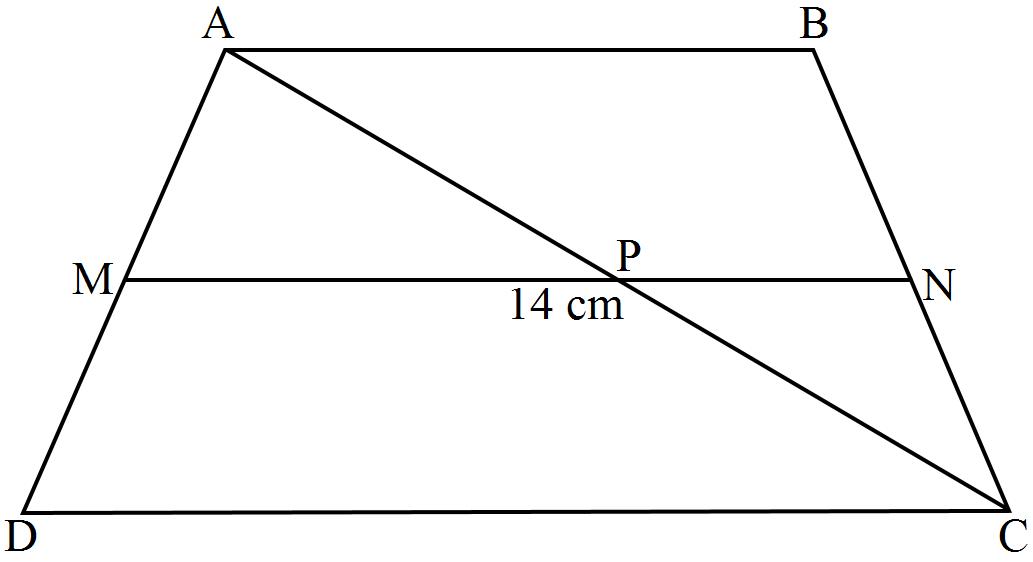
$ABCD$ is a trapezium,
$\text{AB || DC}$
M, N are mid-points of $AD \& BC$
$AB = 12cm, MN = 14cm$
$∵ \text{AB || MN || CD}$ [$M, N$ are mid points of $AD \& BC]$
$MP = NP$
By mid-point theorem,
$\text{MP}=\frac{1}{2}\text{CD}$ and $\text{NP}=\frac{1}{2}\text{AB}$
$\therefore\ \text{MN}=\frac{1}{2}(\text{AB + CD})$
$\Rightarrow\ 14=\frac{1}{2}(12\ +\ \text{CD})$
$\Rightarrow \text{CD}=28\ -\ 12=16\text{cm}$
View full question & answer→MCQ 611 Mark
P is the mid-point of side $BC$ of a parallelogram $ABCD$ such that $\angle\text{BAP}=\angle\text{DAP}.$ If $AD = 10\ cm,$ then $CD =$
- ✓
$5\ cm.$
- B
$6\ cm.$
- C
$8\ cm.$
- D
$10\ cm.$
AnswerCorrect option: A. $5\ cm.$
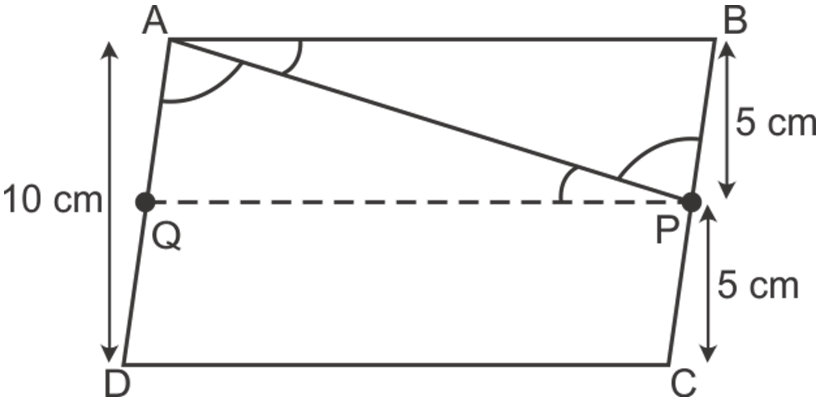
Let a line parallel to $AB$ is drawn from $P$ to meet $AD$ at $Q$.
$PQ || AB || DC$
$Q$ is also mid-point of $AD.$
Now, consider parallelogram$ ABPQ$.
$\angle\text{PAQ}=\angle\text{APB}$ (Alternate angles)
Also $\angle\text{PAQ}=\angle\text{BAP}$ (Given)
$\Rightarrow\angle\text{APB}=\angle\text{BAP}$
So $\triangle\text{ABP}$ is isoseceles triangle.
$\Rightarrow\text{BP}=\text{AB}$
i.e. $\text{AB}=\frac{10}{2}=5\text{cm}$ View full question & answer→MCQ 621 Mark
If $ABCD$ is a Parallelogram with 2 Adjacent angles $\angle\text{A}=\angle\text{B},$ then the parallelogram is a:
AnswerThe sum of the adjacent angles of a parallelogram is $180^\circ $. Opposite sides of a parallelogram are equal. Hence it is a rectangle.
View full question & answer→MCQ 631 Mark
A quadrilateral is a _________, if its opposite sides are equal:
AnswerBy $SSS$ congruence condition.
Alternate angles are equal by $CPCT$, hence opposite sides are parallel.
View full question & answer→MCQ 641 Mark
In a Quadrilateral ABCD, $\angle\text{A} = 90^\circ$ and $AB = BC = CD = DA$, Then $ABCD$ is a:
AnswerA quadrilateral with pair of opposite sides equal and having one right angle is called Rectangle and a rectangle with all sides equal is called Square. So, $ABCD$ is a Square.
View full question & answer→MCQ 651 Mark
E Divides $AB$ in the ratio $1 : 3$ and also, $F$ divides $AC$ in the ratio $1 : 3. EF = 2.8\ cm$, Find $BC =?$
- ✓
$11.2\ cm$
- B
$11\ cm$
- C
$11.5\ cm$
- D
$12\ cm$
AnswerCorrect option: A. $11.2\ cm$
Let $AE = x$ and $EB = 3x, AF = y$ and $FC = 3y.$
$EF = 2.8cm$
$AE + AF= 2.8$ implies $x + y = 2.8$
$BC = CF + FA + AE + EB$
$= 3y + y + x + 3x$
$= 4(x + y) = 4(2.8) =$
$= 11.2cm$
View full question & answer→MCQ 661 Mark
If one angle of a parallelogram is 24$^{\circ}$ less than twice the smallest angle, then the measure of the largest angle of the largest angle of the parallelogram is:
- A
$176^{\circ}$
- B
$68^{\circ}$
- ✓
$112^{\circ}$
- D
$102^{\circ}$
AnswerCorrect option: C. $112^{\circ}$
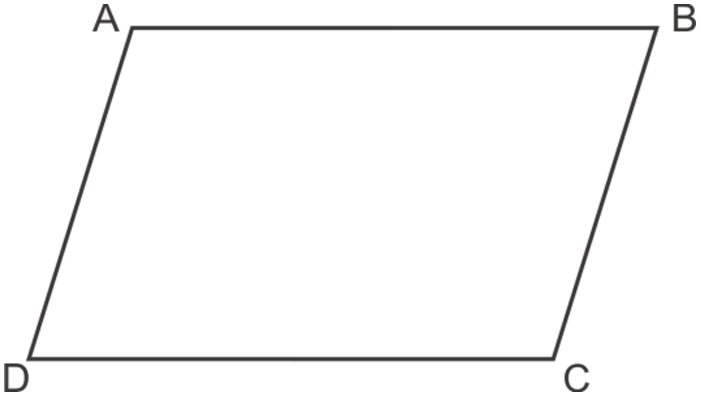
Let the smallest angle $=\angle\text{ADC}=\text{x}^\circ$
Other angle $\angle\text{BCD}$
$\Rightarrow\angle\text{BCD}=2\text{x}^\circ-24^\circ$
Also, $\angle\text{ACD}+\angle\text{BCD}=180^\circ$ (Sum of adjacent angles in ||$^{gram}$ = 180$^{\circ}$)
$\Rightarrow\text{x}^\circ+2\text{x}^\circ-24^\circ=180^\circ$
$\Rightarrow3\text{x}^\circ=204^\circ$
$\Rightarrow\text{x}=68^\circ$
⇒ Largest angle $=\angle\text{BCD}=2\times68^\circ-24^\circ=112^\circ$
View full question & answer→MCQ 671 Mark
Write the correct answer in the following: A diagonal of a rectangle is inclined to one side of the rectangle at $25^\circ $. The acute angle between the diagonals is:
- A
$55^\circ$
- ✓
$50^\circ$
- C
$40^\circ$
- D
$25^\circ$
AnswerCorrect option: B. $50^\circ$
We know that, digonals of a rectangle are equal in length.
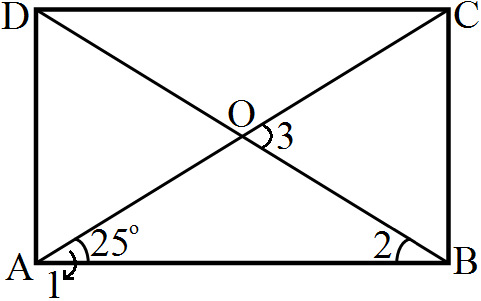
$\therefore\ \text{AD}=\text{BD}$
$\Rightarrow\ \frac{1}{2}\text{AC}=\frac{1}{2}\text{BD}$ [dividing both sides by 2]
$\Rightarrow\ \text{OA}=\text{OB}$ [since, O is the mid-point of AC and BD]
$\Rightarrow\ \angle2=\angle1$ [angles opposite to equal sides are equal]
$=25^\circ$
$\therefore\ \angle3=\angle1+\angle2$
[exterior angle is equal to the sum of two opposite intersite interior angles]
$=25^\circ+25^\circ=50^\circ$
Hence, the acute angle between the diagonals is $50^\circ$ View full question & answer→MCQ 681 Mark
If an angle of a parallelogram is two-third of its adjacent angle, the smallest angle of the parallelogram is:
- A
$108^{\circ}$
- B
$81^{\circ}$
- C
$54^{\circ}$
- ✓
$72^{\circ}$
AnswerCorrect option: D. $72^{\circ}$
Let $x$ be one angle. Then $\text{x}+\frac{2}{3\text{x}}+23\text{x} =180$ {sum of the adjacent angles of a parallelogram is $180^{\circ}$}
$x = 108$, adjacent angle $= 180 - 108 = 72^{\circ}$
View full question & answer→MCQ 691 Mark
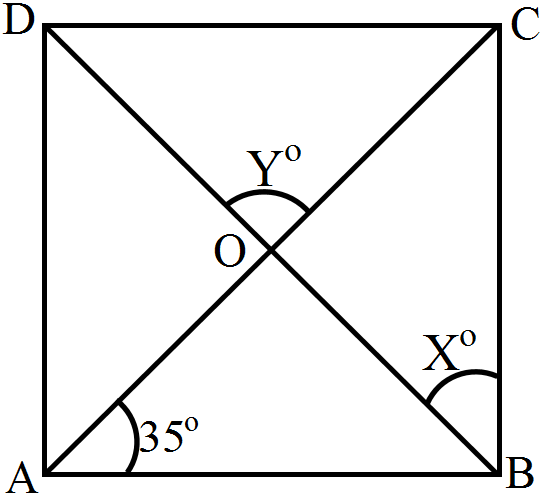
In the figure, $ABCD$ is a Rectangle. Find the values of $x$ and $y?$
- A
$x = 100^\circ $ and $y = 100^\circ $
- B
$x = 60^\circ $ and $y = 120^\circ $
- ✓
$x = 55^\circ $ and $y = 110^\circ $
- D
$x = 50^\circ $ and $y = 100^\circ $
AnswerCorrect option: C. $x = 55^\circ $ and $y = 110^\circ $
$ABCD$ is a rectangle
The diagonals of a rectangle are congruent and bisect each other. Therefore, in $\triangle\text{AOB},$
we have:
$OA = OB$
$\angle\text{OAB} = \angle\text{OBA} = 35^\circ$
$\text{x} = 90^\circ – 35^\circ = 55^\circ$ and $\angle\text{AOB} = 180^\circ – (35^\circ + 35^\circ) = 110^\circ$
$\text{y} = \angle\text{AOB} = 110^\circ$ [Vertically opposite angles]
Hence, $x = 55^\circ $ and $y = 110^\circ $
View full question & answer→MCQ 701 Mark
In $E$ is the mid-point of median $AD$ such that $BE$ produced meets $AC$ at $F$. If $AC = 10.5\ cm$, then $AF =$
- A
$3\ cm.$
- ✓
$3.5\ cm.$
- C
$2.5\ cm.$
- D
$5\ cm.$
AnswerCorrect option: B. $3.5\ cm.$
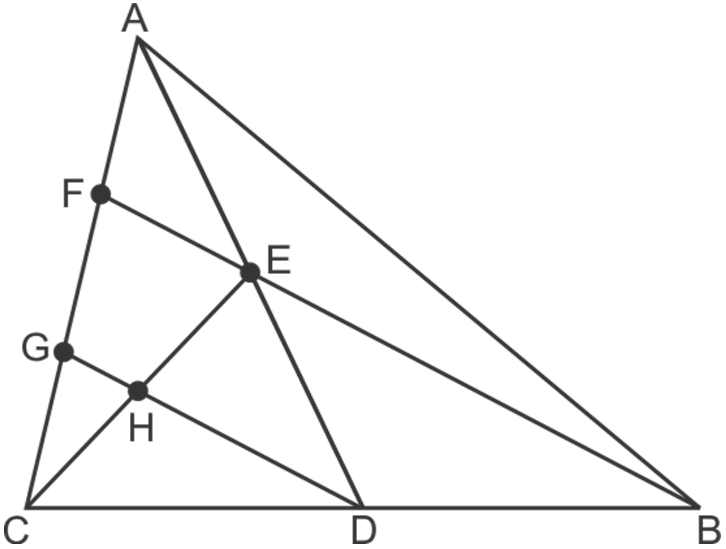
A line $DG$ is drawn parallel to $E F$ to meet $A C$.
$FE \| DG$ and $FE \| GH$
Now, consider $\triangle ADG$.
$E$ is the mid-point of $A D$ and $E F$ is line from $E \|$ to Base $DG.$
So by property, it will meet $AG$ at its midpoint
i.e. $F$ is midpoint of $A G$.
$\Rightarrow A F=F G \ldots(1)$
Now, consider $\triangle\text{FBC}\ \&\ \triangle\text{GDC}$
$FE \| GH$ and $FE \| GD$
$D$ is mid-point of $BC$.
$\Rightarrow\frac{\text{DC}}{\text{BC}}=\frac{1}{2}\dots(2)$
Because $\triangle\text{FBC}\sim\triangle\text{GDC},$
$\Rightarrow\frac{\text{GC}}{\text{FC}}=\frac{1}{2}$
$\Rightarrow FC = 2GC$
or $FG = GC ...(3)$
From equation $(1)$ and $(3)$
$AF = FG = GC$
$\Rightarrow\text{AF}=\frac{\text{AC}}{3}=\frac{10.5}{3}=3.5\text{cm}$
View full question & answer→MCQ 711 Mark
The figure formed by joining the mid-points of the adjacent sides of a parallelogram is a:
AnswerThe figure formed by joining the mid points of the adjacent sides of a parallelogram is a parallelogram.
View full question & answer→MCQ 721 Mark
The figure forms by joining the mid-points of the sides of a Rhombus, taken in order are:
AnswerIn rhombus, diagonals bisect each other at right angles. Which proves that all the angles of quadrilateral formed by joining the mid points of rhombus is equal to 90. A quadrilateral with both pair of opposite angles equal is a parallelogram.
A parallelogram having one right angle is a rectangle.
View full question & answer→MCQ 731 Mark
The diagonals $AC$ and $BD$ of a rectangle $ABCD$ intersect each other at $P$. If $\angle\text{ABD}=50^\circ,$ then $\angle\text{DPC}=$
- A
$70^\circ$
- B
$90^\circ$
- ✓
$80^\circ$
- D
$100^\circ$
AnswerCorrect option: C. $80^\circ$
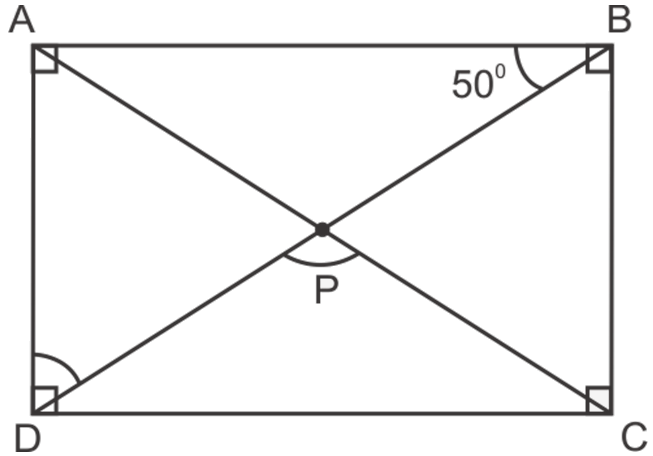
In $\triangle\text{ABD},$
$\angle\text{BDA}+\angle\text{ABD}+\angle\text{DAB}=180^\circ$
$\angle\text{ABD}=50^\circ$ and $\angle\text{DAB}=90^\circ$
$\Rightarrow\angle\text{BDA}=180^\circ-90^\circ-50^\circ=40^\circ$
Consider $\triangle\text{ABD}\ \&\ \triangle\text{BAC}$
$\text{AD}=\text{BC},\ \angle\text{DAB}=\angle\text{ABC}=90^\circ,\text{BD}=\text{AC}$
Hence, by RHS property $\triangle\text{ABD}\cong\triangle\text{BAC}$
$\Rightarrow\angle\text{ABD}=\angle\text{BAC}=50^\circ$
Now, consider $\triangle\text{ABP}$
$\angle\text{PAB}+\angle\text{PBA}+\angle\text{APB}=180^\circ$
$\angle\text{PAB}=\angle\text{BAC}=50^\circ$
$\angle\text{PAB}=\angle\text{ABD}=50^\circ$
$\Rightarrow\angle\text{APB}=180^\circ-50^\circ-50^\circ=80^\circ$
Now, $\angle\text{APB}=\angle\text{DPC}$ (Opposite angles)
$\Rightarrow\angle\text{DPC}=80^\circ$
View full question & answer→MCQ 741 Mark
$ABCD$ is a Parallelogram in which $\angle\text{BAO}=35^\circ, \ \angle\text{DAO}=40^\circ$ and $\angle\text{COD}=105^\circ.$ Find $\angle\text{ABO}=\ ?$
- A
$45^\circ$
- B
$30^\circ$
- C
$20^\circ$
- ✓
$40^\circ$
AnswerCorrect option: D. $40^\circ$
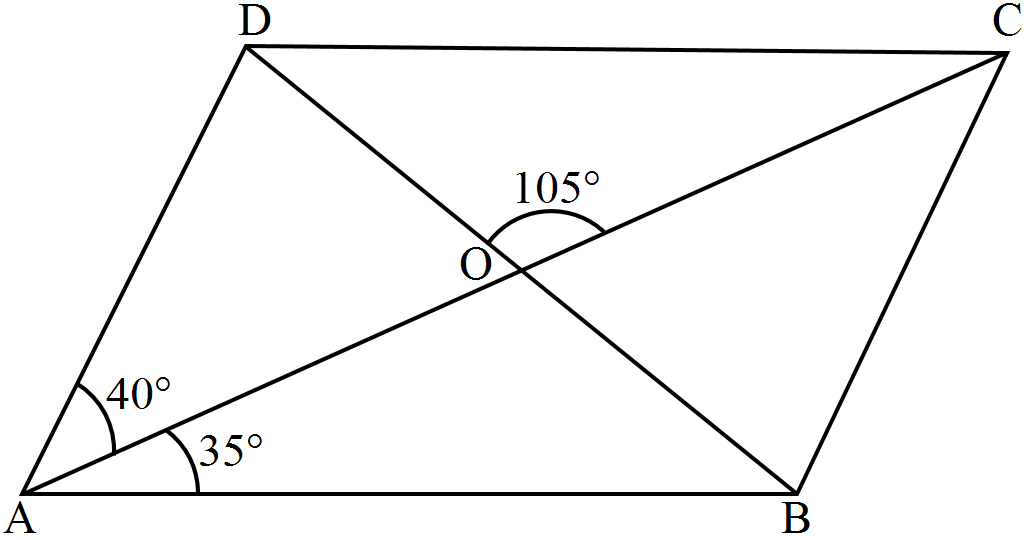
Given, $ABCD$ is a parallelogram having $\angle\text{BAO}=35^\circ, \ \angle\text{DAO}=40^\circ$ and $\angle\text{COD}=105^\circ.$
Now, $\angle\text{COD} = \angle\text{AOB} = 105^\circ$ [vertically opposite angles]
In $\angle\text{ABO},$ by angle sum property of triangle,
$\Rightarrow \angle\text{AOB} + \angle\text{OAB} + \angle\text{ABO} = 180^\circ$
$\Rightarrow 105^\circ + 35^\circ + \angle\text{ABO} = 180^\circ$
$\Rightarrow \angle\text{ABO} = 40^\circ$
View full question & answer→MCQ 751 Mark
If $APB$ and $CQD$ are two parallel lines, then the bisectors of $\angle\text{APQ},\angle\text{BPQ},\angle\text{CQP}$and $\angle\text{PQD}$ enclose a:
AnswerThe bisectors of $\angle\text{APQ},\angle\text{BPQ},\angle\text{CQP}$ and $\angle\text{PQD}$ enclose a rectengle.
View full question & answer→MCQ 761 Mark
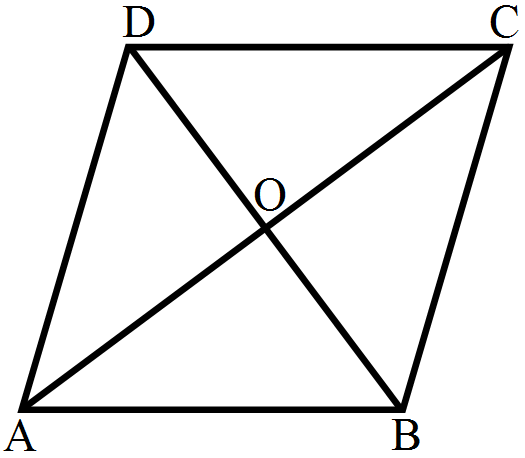
In the given figure, $ABCD$ is a rhombus. Then:
- A
$\mathrm{AC}^2+\mathrm{BD}^2=\mathrm{AB}^2$
- B
$\mathrm{AC}^2+\mathrm{BD}^2=2 \mathrm{AB}^2$
- ✓
$\mathrm{AC}^2+\mathrm{BD}^2=4 \mathrm{AB}^2$
- D
$2\left(A C^2+B D^2\right)=3 A B^2$
AnswerCorrect option: C. $\mathrm{AC}^2+\mathrm{BD}^2=4 \mathrm{AB}^2$
The diagonals of a rhombus bisect each other at right angles.
$\Rightarrow\text{OA}=\frac{1}{2}\text{AC}$ and $\text{OB}=\frac{1}{2}\text{BD}$
Also, $\angle\text{AOB}=90^{\circ}$
In right $\triangle\text{AOB},$
$\therefore\text{AB}^2=\text{OA}^2+\text{OB}^2$ ...(By Pythagoras theorem)
$\Rightarrow\text{AB}^2=\frac{1}{4}\text{AC}^2+\frac{1}{4}\text{BD}^2$
$\Rightarrow\text{AC}^2+\text{BD}^2=4\text{AB}^2$
View full question & answer→MCQ 771 Mark
$PQRS$ is a quadrilateral. $PR$ and $QS$ intersect each other at $O$. In which of the following cases, $PQRS$ is a parallelogram?
- ✓
$\angle\text{P} = 100^\circ, \angle\text{Q} = 80^\circ, \angle\text{R} = 100^\circ$
- B
$\text{PQ} = 7\text{cm}, \ \text{QR} = 7\text{cm},\ \text{RS} = 8\text{cm},\ \text{SP} = 8\text{cm}$
- C
$\text{OP} = 6.5\text{cm},\ \text{OQ} = 6.5\text{cm}, \ \text{OR} = 5.2\text{cm},\ \text{OS} = 5.2\text{cm}$
- D
$\angle\text{P} = 85^\circ,\ \angle\text{Q} = 85^\circ, \ \angle\text{R} = 95^\circ$
AnswerCorrect option: A. $\angle\text{P} = 100^\circ, \angle\text{Q} = 80^\circ, \angle\text{R} = 100^\circ$
$\angle\text{P} = 100^\circ, \angle\text{Q} = 80^\circ, \angle\text{R} = 100^\circ$
Since, sum of all the internal angles of a quadrilateral is 360, we have
$\angle\text{P} + \angle\text{Q} + \angle\text{R} + \angle\text{S} = 360$
$\Rightarrow 100 + 80 + 100 + \angle\text{S} = 360$
$\Rightarrow 280 + \angle\text{S} = 360$
$\Rightarrow \angle\text{S} = 80$
So, it follows that opposite angles of the quadrilateral are equal.
Hence it is a parallelogram.
View full question & answer→MCQ 781 Mark
The Parallel sides of a trapezium are $‘a’$ and $‘b’$ resp. The line joining the mid-points of its non-parallel sides will be.
- A
$\text{None of these}$
- ✓
$\frac{1}{2}(\text{a + b})$
- C
$\frac{1}{2}(\text{a} - \text{b})$
- D
$\frac{2\text{ab}}{(\text{a+b})}$
AnswerCorrect option: B. $\frac{1}{2}(\text{a + b})$
Join one of the diagonals which intersects the line joining mid points of the non parallel sides. This point of intersection become midpoint of the diagonal by using converse of midpoint theorem and we know that by mid point theorem that the line joining midpoints of any two sides of triangle measures half of the third side.so, by combining the results of two triangles we get above result.
View full question & answer→MCQ 791 Mark
If angles $A, B, C$ and $D$ of the quadrilateral $ABCD$, taken in order, are in the ratio $3 : 7 : 6 : 4$, then $ABCD$ is a:
AnswerLet the angles be $3x, 7x, 6x, 4x$
then $3x + 7x + 6x + 4x = 360$
$\text{x}=\frac{360}{20}=18$
So angles are,
$54^\circ , 126^\circ , 108^\circ \& 72^\circ $
Hence it is a trapezium.
View full question & answer→MCQ 801 Mark
The figure formed by joining the midpoints of the sides of a quadrilateral $ABCD$, taken in order, is a square, only if:
- A
$ABCD$ is a rhombus.
- B
Diagonals of $ABCD$ are equal.
- C
Diagonals of $ABCD$ are perpendicular.
- ✓
Diagonals of $ABCD$ are equal and perpendicular.
AnswerCorrect option: D. Diagonals of $ABCD$ are equal and perpendicular.
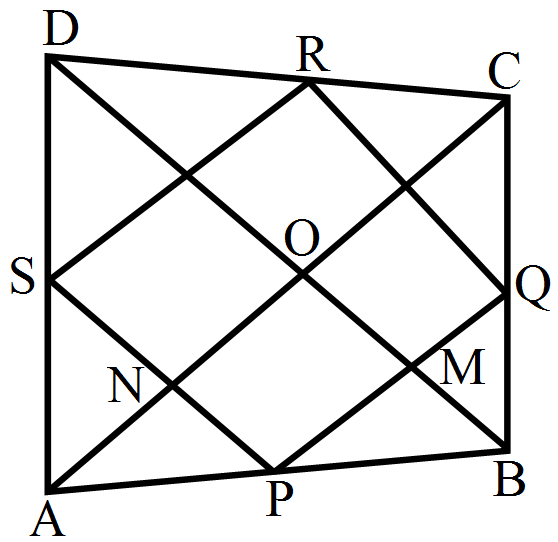
In $\triangle\text{ABC},$ P and $Q$ are the mid-points of sides $AB$ and $BC$ respectively.
$\therefore\text{PQ || AC}$ and $\text{PQ}=\frac{1}{2}\text{AC ...(i)}$
In $\triangle\text{BCD},$ Q and R are the mid-points of sides $BC$ and $CD$ respectively.
$\therefore\text{QR || BD}$ and $\text{QR}=\frac{1}{2}\text{BD ...(ii)}$
In $\triangle\text{ADC},$ S and R are the mid-points of sides $AD$ and $CD$ respectively.
$\therefore\text{RS || AC}$ and $\text{RS}=\frac{1}{2}\text{AC ...(iii)}$
In $\triangle\text{ABD},$ P and S are the mid-points of sides $AB$ and $AD$ respectively.
$\therefore\text{SP || BD}$ and $\text{SP}=\frac{1}{2}\text{BD ...(iv)}$
$\Rightarrow\text{PQ || RS}$ and $\text{QR || SP }$ [From $(i), (ii), (iii)$ and $(iv)]$
Thus, PQRS is a parallelogram.
Now, $\text{AC = BD}$ (given)
$\Rightarrow\frac{1}{2}\text{AC}=\frac{1}{2}\text{BD}$
$\Rightarrow\text{PQ = QR = RS = SP}$ [From $(i), (ii), (iii)$ and $(iv)]$
Let the diagonals AC and BD intersect at $O.$
Now,
$\text{PS || BD}$
$\Rightarrow\text{PN || MO}$
Also, from (i), $\text{PQ || AC}$
$\Rightarrow\text{PM || NO}$
Thus, in quadrilateral PMON, $\text{PM || NO}$ and $\text{PN || MO}$
$\Rightarrow\text{PMON}$ is a parallelogram.
$\Rightarrow\angle\text{MPN}=\angle\text{MON}$ (opposite angles of a parallelogram are equal)
$\Rightarrow\angle\text{MPN}=\angle\text{BOA}$ $(\text{Since }\angle\text{BOA}=\angle\text{MON})$
$\Rightarrow\angle\text{MPN}=90^{\circ}$ $(\text{Since }\text{AC}\perp\text{BD},\angle\text{BOA}=90^{\circ})$
$\Rightarrow\angle\text{QPS}=90^{\circ}$
Thus, PQRS is a parallelogram such that $PQ = QR = RS = SP$ and $\angle\text{QPS}=90^{\circ}.$
Hence, $PQRS$ is a square if diagonals of $ABCD$ are equal and perpendicular. View full question & answer→MCQ 811 Mark
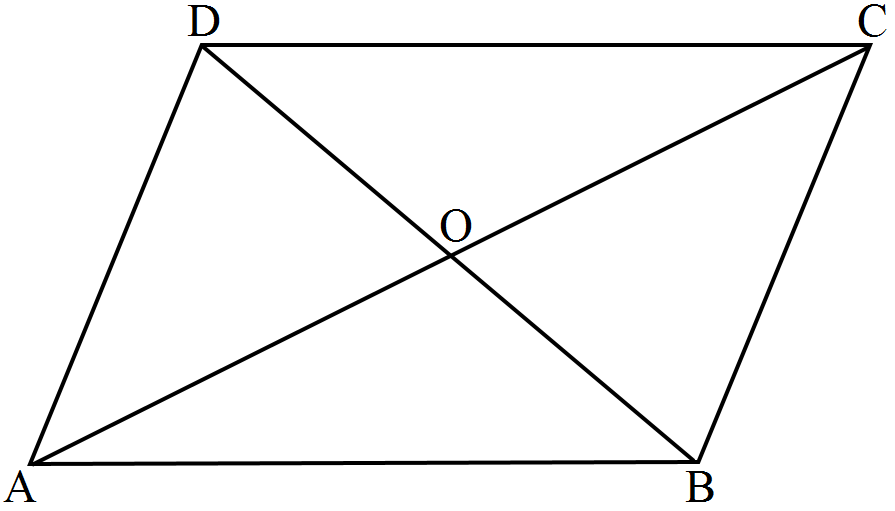
In the given figure, $ABCD$ is a Rhombus. Then,
- A
$A C^2+B D^2=2 A B^2$
- B
$\left(A C^2+B D^2\right)=3 A B^2$
- C
$\mathrm{AC}^2+\mathrm{BD}^2=\mathrm{AB}^2$
- ✓
$\mathrm{AC}^2+\mathrm{BD}^2=4 \mathrm{AB}^2$
AnswerCorrect option: D. $\mathrm{AC}^2+\mathrm{BD}^2=4 \mathrm{AB}^2$
$A B C D$ is a rhombus.
$A B=B C=C D=D A$
In Rhombus, diagonals bisect each other at right angles.
$\text { So, } AO=CO \text { and } BO=DO$
In triangle $\mathrm{AOB}, \mathrm{AO}^2+\mathrm{BO}^2=\mathrm{AB}^2$ (Pythagoras theorem)
$\Big(\frac{1}{2} \text{AC}\Big)^2 + \Big(\frac{1}{2} \text{BD}\Big)^2 = \text{AB}^2$
$\frac{\text{AC}^2}{4} + \frac{\text{BD}^2}{4} = \text{AB}^2$
$\text{AC}^2 + \text{BD}^2 = 4\text{AB}^2$
View full question & answer→MCQ 821 Mark
In a Quadrilateral $ABCD$, $\angle\text{A} = \angle\text{C},\ \angle\text{B} = 2\angle\text{A}, \ \angle\text{D} = \frac{1}{21}\angle\text{A}.$ Then $\angle\text{A}, \ \angle\text{B}, \ \angle\text{C} $ and $\angle\text{D}$ respectively are:
- ✓
$80^\circ,\ 160^\circ,\ 80^\circ,\ \text{and}\ 40^\circ$
- B
$20^\circ,\ 30^\circ,\ 160^\circ,\ \text{and}\ 160^\circ$
- C
$100^\circ,\ 100^\circ,\ 80^\circ,\ \text{and}\ 80^\circ$
- D
$90^\circ,\ 90^\circ,\ 90^\circ,\ \text{and}\ 90^\circ$
AnswerCorrect option: A. $80^\circ,\ 160^\circ,\ 80^\circ,\ \text{and}\ 40^\circ$
$\angle\text{A} + \angle\text{B} + \angle\text{C} + \angle\text{D} = 360^\circ$ (angle sum property)
$\angle\text{A} + 2\angle\text{A} + \angle\text{A} + \frac{1}{2}$ of $\angle\text{A} = 360^\circ$
$\frac{9}{2}$ of $\angle\text{A} = 360^\circ$
$\angle\text{A} = 80^\circ$
So, $\angle\text{B}=2(80^\circ)=160^\circ,\ \angle\text{C}=80^\circ$ and $\angle\text{D} = \frac{1}{2}$ of $80^\circ=40^\circ$
View full question & answer→MCQ 831 Mark
If bisectors of $\angle\text{A}$ and $\angle\text{B}$ of a quadrilateral ABCD intersect each other at $P$, of $\angle\text{B}$ and $\angle\text{C}$ at $Q$, of $\angle\text{C}$ and $\angle\text{D}$ at $R$ and of $\angle\text{D}$ and $\angle\text{A}$ at S then $PQRS$ is a:
- A
- B
- C
- ✓
Quadrilateral whose opposite angles are supplementary.
AnswerCorrect option: D. Quadrilateral whose opposite angles are supplementary.
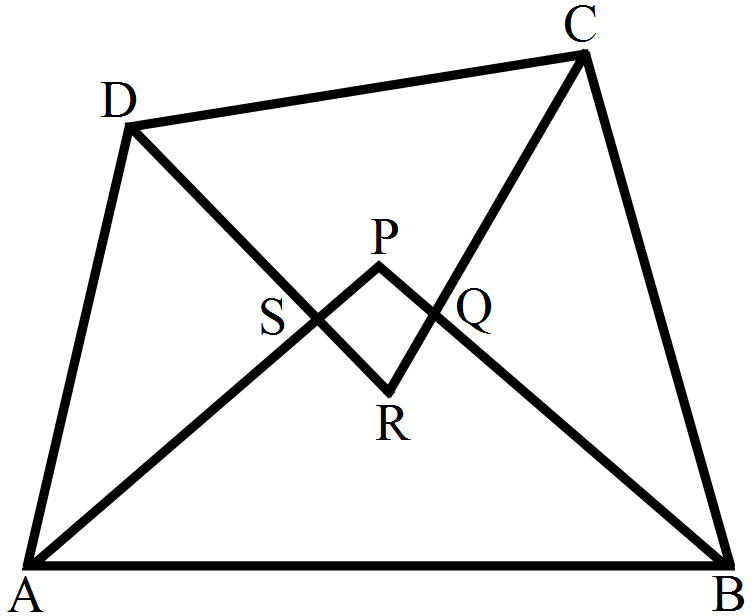
In $\triangle\text{APB},$ by angle sum property,
$\angle\text{APB}+\angle\text{PAB}+\angle\text{PBA}=180^{\circ}$
$\Rightarrow\angle\text{APB}+\frac{1}{2}\angle\text{A}+\frac{1}{2}\angle\text{B}=180^{\circ}$
$\Rightarrow\angle\text{APB}=180^{\circ}-\Big(\frac{1}{2}\angle\text{A}+\frac{1}{2}\angle\text{B}\Big)$
In $\triangle\text{CRD},$ by angle sum property,
$\angle\text{CRD}+\angle\text{RDC}+\angle\text{RCD}=180^{\circ}$
$\Rightarrow\angle\text{CRD}+\frac{1}{2}\angle\text{D}+\frac{1}{2}\angle\text{C}=180^{\circ}$
$\Rightarrow\angle\text{CRD}=180^{\circ}-\Big(\frac{1}{2}\angle\text{D}+\frac{1}{2}\angle\text{C}\Big)$
Now, $\angle\text{SPQ}+\angle\text{SRQ}=\angle\text{APB}+\angle\text{CRD}$
$=360^{\circ}-\Big(\frac{1}{2}\angle\text{A}+\frac{1}{2}\angle\text{B}+\frac{1}{2}\angle\text{C}+\frac{1}{2}\angle\text{D}\Big)$
$=360^{\circ}=\frac{1}{2}(\angle\text{A}+\angle\text{B}+\angle\text{C}+\angle\text{D})$
$=360^{\circ}-\frac{1}{2}\times360^{\circ}$
$=360^{\circ}-180^{\circ}$
$=180^{\circ}$
Now, $\angle\text{PSR}+\angle\text{PQR}=360^{\circ}-(\angle\text{SPQ}+\angle\text{SRQ})$
$=360^{\circ}-180^{\circ}$
$=180^{\circ}$
Hence, $PQRS$ is a quadrilateral whose opposite angles are supplementary.
View full question & answer→MCQ 841 Mark
Rhombus is a quadrilateral.
AnswerCorrect option: D. In which diagonals bisect opposite angles.
Let $ABCD$ be a rhombus.
Join $BD$ which forms two triangles $ABD$ and $DCB$. In $\triangle\text{ABD, AB = AD}.$
So, $\angle\text{ADB} = \angle\text{ABD}$ (angles opposite to equal sides are equal) $...(i)$
But, $\angle\text{ABD} = \angle\text{BDC}$ and $\angle\text{ADB} = \angle\text{CBD}$ (alternate angles)$ ...(ii)$
So, from $(i)$ and $(ii)$
$\angle\text{ADB} = \angle\text{ABD}=\angle\text{BDC} = \angle\text{CBD}$
$\therefore$ diagonal $BD$ bisects $\angle\text{B}$ and $\angle\text{D}.$
View full question & answer→MCQ 851 Mark
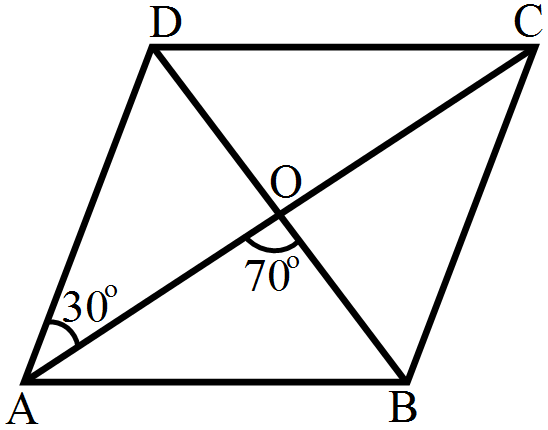
The diagonals $AC$ and $BD$ of a parallelogram $ABCD$ intersect each other at the point Osuch that $\angle\text{DAC}=30^{\circ}$ and $\angle\text{AOB}=70^{\circ}.$ Then, $\angle\text{DBC}=?$
- ✓
$40^\circ$
- B
$35^\circ$
- C
$45^\circ$
- D
$50^\circ$
AnswerCorrect option: A. $40^\circ$
$\text{AD || BC},$
$\Rightarrow\angle\text{DAO}=\angle\text{BCO}=30^{\circ}$ ...(Alternate angles)
$\Rightarrow\angle\text{BCO}=30^{\circ}$
$\angle\text{AOB}+\angle\text{BOC}=180^{\circ}$ ...(Linear pair of angles)
$\Rightarrow70+\angle\text{BOC}=180$
$\Rightarrow\angle\text{BOC}=110^{\circ}$
In $\triangle\text{CBO},$
$\angle\text{BOC}+\angle\text{BCO}+\angle\text{OBC}=180^{\circ}$ ...(Angle sum Property)
$\Rightarrow110+30+\angle\text{OBC}=180$
$\Rightarrow\angle\text{OBC}=40^{\circ}$
$\Rightarrow\angle\text{DBC}=40^{\circ}...(D - O - B)$
View full question & answer→MCQ 861 Mark
P is any point on the side $BC$ of a $\triangle\text{ABC}.$ $P$ is joined to A. If $D$ and $E$ are the midpoints of the sides $AB$ and $AC$ respectively and $M$ and $N$ are the midpoints of $BP$ and $CP$ respectively then quadrilateral $DENM$ is:
Answer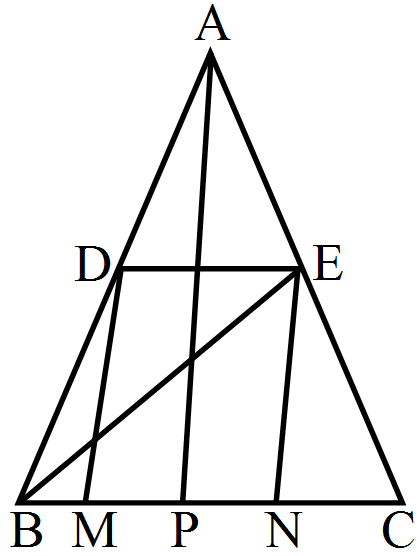
In $\triangle\text{ABC},$ $D$ and $E$ are the mid-points of sides $AB$ and $AC$ respectively.
$\Rightarrow\text{DE || BC}$ and $\text{DE}=\frac{1}{2}\text{BC }...(\text{i})$
Now, $\text{MN = MP + PN}=\frac{1}{2}\text{BP}+\frac{1}{2}\text{CP}=\frac{1}{2}(\text{BP + CP})$
$\therefore\text{MN}=\frac{1}{2}\text{BC ...(ii)}$
From $(i)$ and $(ii),$
$\text{DE || MN}$ and $\text{DE = MN}$
Hence, $DENM$ is a parallelogram. View full question & answer→MCQ 871 Mark
A diagonal of a rectangle is inclined to one side of the rectangle at $35^\circ $. The acute angle between the diagonals is:
- A
$55^\circ $
- ✓
$70^\circ $
- C
$45^\circ$
- D
$50^\circ$
AnswerCorrect option: B. $70^\circ $
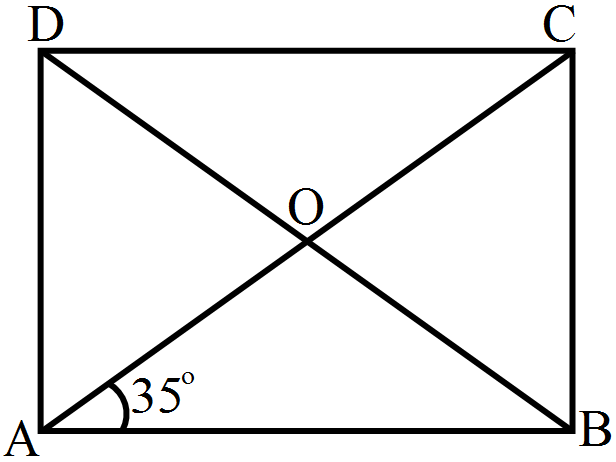
$\angle\text{DAO}+\angle\text{OAB}=\angle\text{DAB}$
$\Rightarrow\angle\text{DAO}+35^{\circ}=90^{\circ}$
$\Rightarrow\angle\text{DAO}=55^{\circ}$
ABCD is a rectangle and diagonals of a rectangle are equal and bisect each other.
$\text{OA = OD}$
$\Rightarrow\angle\text{ODA}=\angle\text{DAO}$ (angles opposte to equal sides are equal)
$\Rightarrow\angle\text{ODA}=55^{\circ}$
In $DODA$, by angle sum property,
$\angle\text{ODA}+\angle\text{DAO}+\angle\text{AOD}=180^{\circ}$
$\Rightarrow55^{\circ}+\angle55^{\circ}+\angle\text{AOD}=180^{\circ}$
$\Rightarrow\angle\text{AOD}=70^{\circ}$
View full question & answer→MCQ 881 Mark
If the degree measures of the angles of quadrilateral are $4x, 7x, 9x$ and $10x$, what is the sum of the measures of the smallest angle and largest angle?
- A
$140^\circ $
- ✓
$168^\circ$
- C
$180^\circ$
- D
$150^\circ$
AnswerCorrect option: B. $168^\circ$
Given,
$ABCD$ is a parallelogram,
Angles of quadrilateral $4x, 7x, 9x, 10x$
$\Rightarrow 4x + 7x + 9x + 10x = 360^\circ $ [angle sum property of quadrilateral]
$\Rightarrow 30x = 360$°
$\Rightarrow\text{x}=\frac{360^\circ}{30}=12^\circ$
Hence, sum of smallest and largest angles $= 4x + 10x = 4 \times 12^\circ + 10 \times 12^\circ$
$= 48^\circ + 120^\circ = 168^\circ$
View full question & answer→MCQ 891 Mark
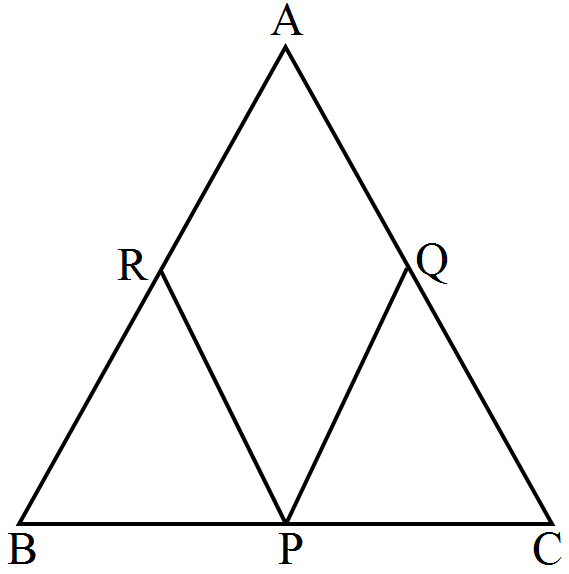
In a $\triangle\text{ABC}, P, Q$ and $R$ are the mid-points of the sides $BC, CA$ and $AB$ respectively. If $AC = 21\ cm, BC = 29\ cm$ and $AB = 30\ cm$, find the perimeter of the quadrilateral $ARPQ?$
- A
$52\ cm$
- B
$20\ cm$
- ✓
$51\ cm$
- D
$80\ cm$
AnswerCorrect option: C. $51\ cm$
In $\triangle\text{ABC},$
$R$ and $P$ are the mid-points of $AB$ and $BC.$
$\therefore\ \text{RP || AC},\ \text{RP}=\frac{1}{2\text{AC}}$ [By mid-point theorem]
In a quadrilateral $RPQA$,
$\Rightarrow \text{RP || AQ}\Rightarrow \text{RP || AQ}$
$\therefore\ \text{RPQA}$ is a parallelogram
$\Rightarrow \text{AR}=\frac{1}{2\text{AB}}$
$\therefore\ \text{AR}=12\times 30=15\text{cm}$
$\Rightarrow \text{AR} = \text{PQ} = 15\text{cm}$ [Since, opposite sides are equal]
$\Rightarrow \text{RP}=\frac{1}{2\text{AC}}=\frac{1}{2}\times 21=10.5\text{cm}$ [Since, opposite sides are equal]
$\Rightarrow $ Perimeter of $ARPQ = AR + QP + RP + AQ$
$= 15 + 15 + 10.5 + 10.5$
$= 51cm$
$\therefore $ Perimeter of $ARPQ$ is $51cm.$
View full question & answer→MCQ 901 Mark
Which of the following quadrilateral is not a rhombus?
AnswerCorrect option: D. One angle between the diagonals is $60^\circ .$
For a rhombus, the angle between the diagonals is $90^\circ $ and not $60^\circ .$
View full question & answer→MCQ 911 Mark
In fig if $DE = 8\ cm$, $\text{DE || BC}$ and $D$ is the mid-Point of $AB$, then the true statement is: 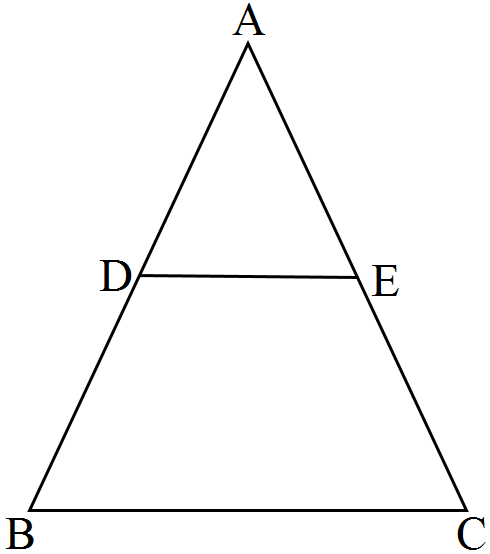
AnswerCorrect option: A. $E$ is the mid-Point of $AC$.
By the converse of Mid-Point Theorem, which states that," If a line segment is drawn passing through the midpoint of any one side of a triangle and parallel to another side, then the line segment bisects the remaining third side.
View full question & answer→MCQ 921 Mark
The angle between two altitudes of a Parallelogram through the vertex of an obtuse angle of the Parallelogram of $60^\circ $. Find the angles of the Parallelogram?
- A
$200^\circ , 100^\circ , 30^\circ , 30^\circ $
- B
$110^\circ , 50^\circ , 105^\circ , 105^\circ$
- C
$150^\circ , 150^\circ , 30^\circ , 30^\circ$
- ✓
$120^\circ , 60^\circ , 120^\circ , 60^\circ$
AnswerCorrect option: D. $120^\circ , 60^\circ , 120^\circ , 60^\circ$
Let $ABCD$ be a parallelogram and $AP$ and $CQ$ are the altitudes drawn from vertex $A$ on sides $DC$ and $BC.$
In quadrilateral $APCQ$, sum of the all angles$= 360^\circ $
So, $60^\circ + 90^\circ + \angle\text{C} + 90^\circ = 360^\circ$
$\angle\text{C} = 360^\circ - 240^\circ = 120^\circ$
$\angle\text{C} + \angle\text{B} = 180^\circ$ (co-interior angles)
$\angle\text{B} = 180^\circ - 120^\circ = 60^\circ$
In parallelogram, opposite angles are equal.
So, $\angle\text{A} = \angle\text{C} = 120^\circ$ and $\angle\text{B} = \angle\text{D} = 60^\circ$
View full question & answer→MCQ 931 Mark
In a trapezium $ABCD, E$ and $F$ be the midpoints of the diagonals $AC$ and $BD$ respectively. Then, $EF = ?$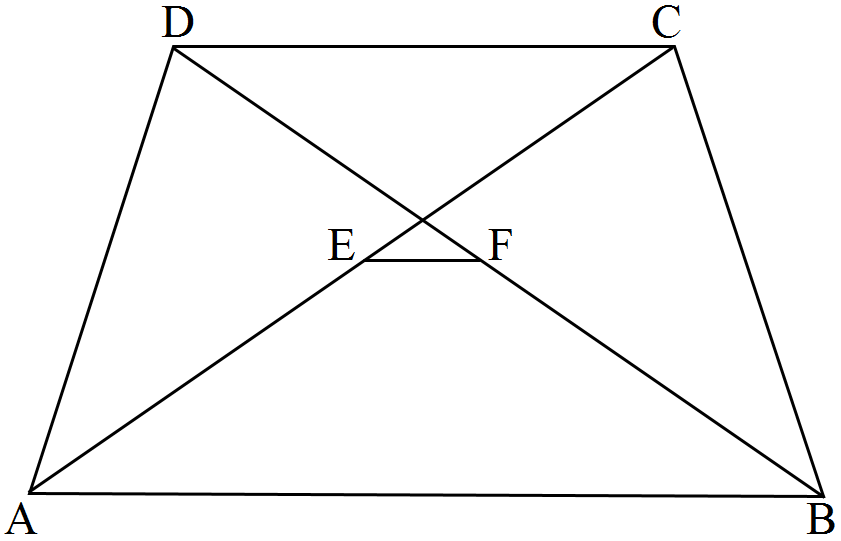
AnswerCorrect option: B. $\frac{1}{2}(\text{AB} - \text{CD})$
Construction: Join $CF$ and extent it to cut $AB$ at point $M$
Firstly, in triangle $MFB$ and triangle $DFC$
$DF = FB$ (As $F$ is the mid-point of $DB)$
$\angle\text{DFC} = \angle\text{MFB}$ (Vertically opposite angle)
$\angle\text{DFC} = \angle\text{FBM}$ (Alternate interior angle)
$∴ By ASA$ congruence rule
$\triangle\text{MFB} ≅ \triangle\text{DFC}$
Now, in triangle $CAM$
$E$ and $F$ are the mid-points of $AC$ and $CM$ respectively.
$\therefore\ \text{EF}=\frac{1}{2}(\text{AM})$
$\text{EF}=\frac{1}{2}(\text{AB} - \text{MB})$
$\text{EF}=\frac{1}{2}(\text{AB} - \text{CD})$
View full question & answer→MCQ 941 Mark
The figure formed by joining the mid-points of the adjacent sides of a Square is a:
Answer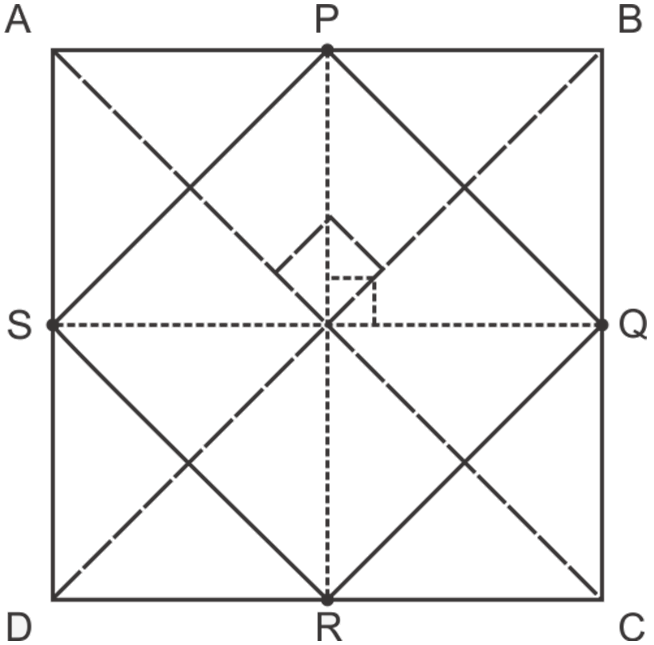
$PS \| QR, PQ \| SR ...(1)$
{Because lines joining the mid-points of any two sides of a triangle are parallel to the third side}
$\text{AC } \bot \text{ BD}$ & $\text{BR } \bot \text{ QS}$ (From Figure)
$SR \| AC$ and $QR \| BD$
$\text{AC } \bot \text{ BD}$
$\Rightarrow \text{SR }\bot \text{ QR}$
Hence $\angle\text{SRQ}=90^\circ\ ...(2)$
Also $\triangle\text{APS}\cong\triangle\text{DSR}$
$\Rightarrow\text{PS} = \text{SR}\dots(3)$
From equations $(1), (2), (3)$
$PQRS$ is a square.
View full question & answer→MCQ 951 Mark
In quadrilateral $ABCD$, if $\angle\text{A} = 60^\circ$ and $\angle\text{B} : \angle\text{C} : \angle\text{D} = 2 : 3 : 7,$ then $\angle\text{D}$ is:
- ✓
$175^{\circ}$
- B
$180^{\circ}$
- C
$25^{\circ}$
- D
$50^{\circ}$
AnswerCorrect option: A. $175^{\circ}$
In quadrilateral, the sum of the all four angles equal to 360º. let $\angle\text{B} = 2\text{x},\ \angle\text{C} = 3\text{x}$ and $\angle\text{D} = 7\text{x}.$
$\angle\text{A} + \angle\text{B} + \angle\text{C} +\angle\text{D} = 360^\circ$
$60 + 2x + 3x + 7x = 360$
$12x = 300^{\circ}$
$x = 25^{\circ}$
So, $\angle\text{D} = 7\text{x} = 7(25^\circ) = 175^\circ$
View full question & answer→MCQ 961 Mark
$D$ and $E$ are the mid-points of the sides $AB$ and $AC$ of $\triangle\text{ABC}$ and $O$ is any point on the side $BC, O$ is joined to A. If $P$ and $Q$ are the mid-points of $OB$ and $OC$ res, Then $DEQP$ is:
AnswerBy mid-point theorem, $D E$ is parallel to $B C$. In triangle $B O A, D P$ parallel to $O A$ and $O A$ is parallel to $Q E$ in triangle $A O C$ (mid-point theorem) because $D$ and $P$ are mid-points in triangle $B O A$ and $E$ and $Q$ are mid-points in triangle $AOC.$
So, $DP$ is parallel to $EQ$. In quadrilateral $DPQE$, both pair of opposite sides are parallel. So, it become parallelogram.
View full question & answer→MCQ 971 Mark
If area of a Parallelogram with sides ' $a$ ' and ' $b$ ' is $A$ and that of a rectangle with sides ' $a$ ' and ' $b$ ' is $B$, then
- A
- B
$A = B$
- C
$A > B$
- ✓
$A < B$
AnswerCorrect option: D. $A < B$
Area of Parallelogram = Base $\times $ Height
If 'a' is the side and $'b'$ is the base the height will be less than $'a'$ using Pythagoras theorem, a as Hypotenuse, h as height, $A < B.$
View full question & answer→MCQ 981 Mark
In quadrilateral $ABCD$, if $\angle\text{A}= 60^\circ$ and $\angle\text{B}: \angle\text{C}: \angle\text{D} = 2:3:7,$ then $\angle\text{D}$ is:
- ✓
$175^\circ$
- B
$25^\circ$
- C
$180^\circ$
- D
$50^\circ$
AnswerCorrect option: A. $175^\circ$
In quadrilateral, the sum of the all four angles equal to $360^\circ .$
Let $\angle\text{B} = 2\text{x}, \ \angle\text{C} = 3\text{x}$ and $\angle\text{D} = 7\text{x}.$
$\angle\text{A} + \angle\text{B} + \angle\text{C} + \angle\text{D} = 360^\circ$
$60 + 2x + 3x + 7x = 360$
$12x = 300$
$x = 25$
So, $\angle\text{D} = 7\text{x} = 7 (25) = 175^\circ$
View full question & answer→MCQ 991 Mark
The bisectors of the angles of a parallelogram enclose a:
AnswerThe bisectors of the angles of a parallelogram encloses a rectangle.
View full question & answer→MCQ 1001 Mark
$D$ and $E$ are the mid-points of the sides $AB$ and $AC$. Of $\triangle\text{ABC}.$ If $BC = 5.6\ cm$, find $DE = ?$ 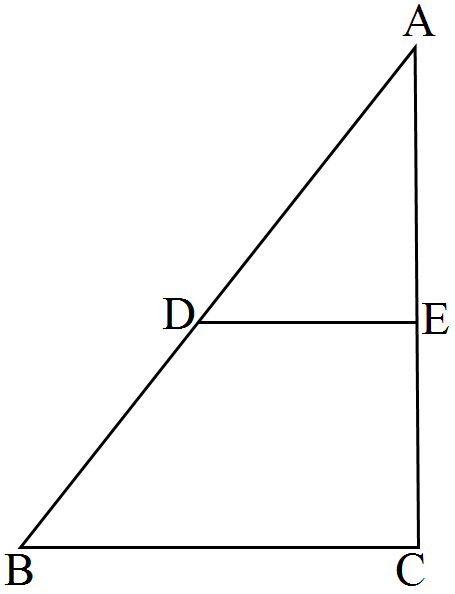
- A
$3\ cm$
- B
$2.5\ cm$
- ✓
$2.8\ cm$
- D
$2.9\ cm$
AnswerCorrect option: C. $2.8\ cm$
By using Mid-Point theorem,
$DE =$ Half of $BC$
Hence, $DE = 0.5 \times 5.6 = 2.8cm$
View full question & answer→