Questions

2 Marks Questions

Take a timed test

48 questions · self-marked practice — reveal the answer and mark yourself.

Question 12 Marks
Attempt titrating an amino acid against a weak base and discover the number of dissociating ( ionizable ) functional groups in the amino acid.
Answer
Titrating a neutral or basic amino acid against a weak base will dissociate only one functional group, whereas titration between acidic amino acid and a weak acid will dissociate two or more functional groups.
View full question & answer
Question 22 Marks
What are macromolecules? Give examples.
Answer
Macromolecules are large high molecular weight substances with complex molecular structure and occur in colloidal state (being insoluble) in intracellular fluid. These are formed by polymerisation of large number of macromolecules. Polysaccharides, proteins and nucleic acids are few examples.
View full question & answer
Question 32 Marks
What are gums made of? Is Fevicol different?
Answer
Gums are natural heteropolysaccharides and are formed of a large number of different monosaccharide units linked together by glycosidic bonds. Fevicol is different from gums as it comprises synthetic polymers.
View full question & answer
Question 42 Marks
Living state and metabolism are synonyms. Justify.OR
Without metabolism, there cannot be living state. Justify.
Answer
  1. Living state is a non-equilibrium steady-state, to be able to perform work.
  2. Living process is a constant effort to prevent equilibrium to be reached; it is achieved by energy input.
  3. Metabolism provides mechanism for the production of energy; hence living state and metabolism are synonymous and there cannot be living state without metabolism.
View full question & answer
Question 52 Marks
Why are lipids found in the macromolecular (acid insoluble) fraction, though they are micromolecules?
Answer
  1. Lipids are not only found as such, but also as components of membranes.
  2. When we homogenize cells, the membranes are disrupted and the membrane fragments form vesicles, which are not water-soluble; hence these membrane fragments (lipids) get separated with the acid-insoluble fraction.
View full question & answer
Question 62 Marks
Differentiate between homopolysaccharide and heteropolysaccharide?
Answer
Difference between homopolysaccharide and heteropolysaccharide is:
S. No
Homopolysaccharide
Heteropolysaccharide
(a)
They are the complex carbohydrates formed by the polymerisation of one type of monosaccharide units.
They are the complex carbohydrates formed by the polymerisation of more than one type of monosaccharide units.
(b)
e.g., starch, glycogen and cellu ose.
e.g., chitin and agar.
View full question & answer
Question 72 Marks
Differentiate between primary and secondary meta bolites.
Answer
S. No.
Primary Metabolites
Secondary Metabolites
1.
These are the metabolites which have identifiable functions and play a specific role in the metabolism.
These are the metabolites formed during metabolism whose role or exact functions in the tissue are not known.
2.
These are important in human metabolic processes, e.g., Amino acids, sugars, etc.
These are useful to human welfare, e.g., alkaloids, flavonoids, essential oils,etc.
View full question & answer
Question 82 Marks
Bring out the differences between primary and secondary metabolites. Write an example for each of them.
Answer
Differences between primary and secondary metabolites are as follows:
S. No
Primary Metabolites
Secondary Metabolites
(a)
These are the metabolites which have identifiable functions and play a specific role in the metabolism.
These are the metabolites formed during metabolism whose role or exact functions in the tissue are not known.
(b)
These are important in human metabolic processes. e.g., amino acids, sugars.
These are useful to human welfare.
e.g., alkaloids, flavonoids, essential oils.
View full question & answer
Question 92 Marks
Peptide bonds are formed between two groups. Name them.
Answer
Peptide bond is formed between the carboxyl group $(- COOH )$ of one amino acid and amino group $\left(- NH _2\right)$ of the next amino acid with elimination of water.
View full question & answer
Question 102 Marks
Given below are the pairs of some proteins and their functions. Which out of these is not a matching pair and why?
S. No.
Protein
Function
(a)
Collagen
Intercellular ground substance
(b)
Antibody
Fight infectious agents
(c)
Insulin
Enzyme
(d)
GLUT-4
Enables glucose transport into cells
Answer
  1. Is not a matching pair. Insulin is a hormone and not an enzyme.
View full question & answer
Question 112 Marks
How are prosthetic groups different from cofactors?
Answer
Differences between prosthetic groups and cofactors are:
S. No
Prosthetic group
Cofactor
(a)
It is the non-protein part or the group which gets permanently attached to the enzyme.
It is the non-protein substance or group which gets attached to the enzyme, temporarily or permanently.
(b)
Prosthetic groups are organic factors, but some are metallic also like Iron, prophyrin of the cytochromes.
These can be organic, inorganic or metallic factors.
View full question & answer
Question 122 Marks
Why are starch and glycogen more suitable than glucose as storage product?
Answer
Starch and glycogen are branched polysaccharides made up of glucose units. Therefore, they occupy lesser space and are less bulky. Moreover, they can be hydrolysed to glucose whenever required.
View full question & answer
Question 132 Marks
Bring out the difference between ligases and lyases.
Answer
Difference between ligases and lyases is given below:
S. No
Ligases
Lyases
(a)
These are the enzymes which catalyse the covalent bonding between two substrates to form a large molecule.
These are the enzymes which catalyse the cleavage of specific covalent bonds in a large molecule to form smaller molecules without the addition of water.
View full question & answer
Question 142 Marks
Name one homopolysaccharide and oneheteropolysaccharide.
Answer
  • Homopolysaccharide- Starch.
  • Heteropolysaccharide- Chitin.
View full question & answer
Question 152 Marks
How do proteins act as carrier proteins?
Answer
Proteins acts as a carrier protein in the following ways Some proteins act as carrier which bind and transport specific molecules across a membrane or in a body fluid.
  1. Haemoglobin of RBCs transports oxygen in the body.
  2. Myoglobin of muscles store oxygen.
  3. Serum albumin carries fatty acids and lipids in the blood.
View full question & answer
Question 162 Marks
Differentiate between essential and non-essential amino acids.
Answer
S. No.
Essential Amino Acids
Non-essential Amino Acids
1.
Those amino acids which the living body cannot synthesise, are called essential amino acids.
Those amino acids which the living body can synthesise, are called non-essential amino acids.
2.
Dietary proteins form the source of essential amino acids.
They need not be taken in the diet.
View full question & answer
Question 172 Marks
Reaction given below is catalysed by oxidoreductase between two substrates A and A’, complete the reaction. A reduced + A’ oxidised$\xrightarrow{\ \ \ \ \ \ \ \ \ \ }$
Answer
Oxidoreductase between two substrates A and A’, complete the reaction. A reduced + A’ oxidised > HD Oxidoreductase is an enzyme that takes part in oxidation and reduction reactions. This enzyjne is involved in transfer of electrons from one molecule called as electron donor to another molecule called electron acceptor. The complete reaction is:$\text{A reduced}+\text{A}'\text{oxidised}= \xrightarrow[\text{A oxidised}+\text{A}'\text{reduced}]{\text{oxidoreductase}}$
View full question & answer
Question 182 Marks
The concentration of a substrate is allowed to increase continuously. Explain the effect of this rise on the rate of enzymatic reaction.
Answer
  1. With the increase in substrate concentration, the velocity of enzyme reaction increases at first.
  2. But it reaches a maximum velocity $\left(V_{\max }\right)$ at a particular concentration of the substrate.
  3. Beyond this, there is no further increase in the velocity of the reaction, as all the active sites of the enzyme are saturated; the number of active sites on the enzyme is fewer than the number of substrate molecules.
View full question & answer
Question 202 Marks
Answer the following:
  1. How many number of base pairs are found in each turn of DNA?
  2. What is the value of pitch of 13 form of DNA?
Answer
  1. 10 base pairs are found in each turn of DNA.
  2. 34nm.
View full question & answer
Question 212 Marks
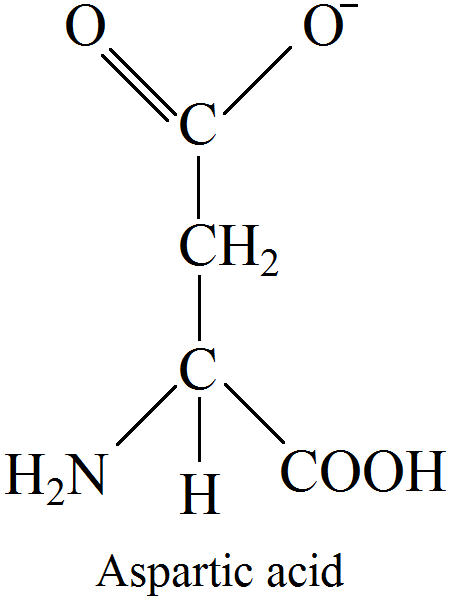
Different forms of the amino acids also has acidic amino acids. Write about it. Also, give structure of any one acidic amino acid.
Answer
Acidic amino acids are those which contain one amino group and two carboxylic groups. e.g.,
View full question & answer
Question 222 Marks
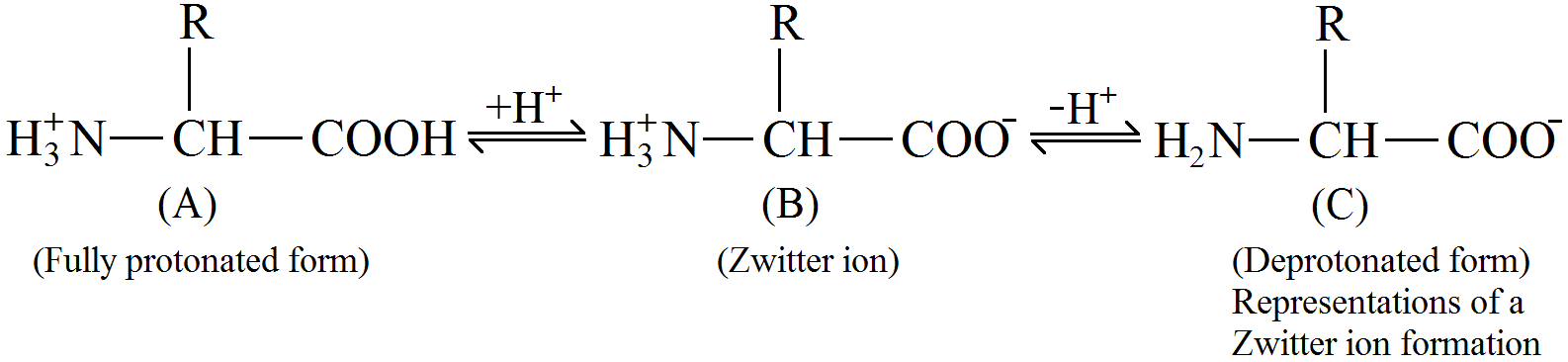
Do amino acids exist as Zwitter ion. Give its structure. Why is it formed?
Answer

Yes, amino acids exist as Zwitter ion.
Zwitter ion Zwitter ion formation is another particular property of amino acid. It is a neutral molecule (with positive and negative charge), having the ionisable nature of $- NH _2$ and - COOH groups. Hence, in solutions of different pHs, the structure of amino acid changes variably.
View full question & answer
Question 232 Marks
Give reason as to why starch is stained blue with iodine, but cellulose is not, though both are polymers of glucose.
Answer
  1. Starch forms helical secondary structures; it can hold iodine molecules in the helical portions and the starch-iodine complex is blue in colour.
  2. But cellulose does not contain complex helices; it cannot hold iodine molecules and hence is not stained by iodine.
View full question & answer
Question 242 Marks
Amino acids are substituted methanes. Justify why are they called a-amino acids?
Answer
Amino acids are substituted methanes because they contain four substituent groups, hydrogen, carboxyl group, amino group and a variable group (R), these substituents are present on the a-carbon and hence, are called a-amino acids.
View full question & answer
Question 252 Marks
Nucleotides are phosphorylated nucleosides. Justify.
Answer
A nucleoside consists of a nitrogen base and a pentose sugar, but when a phosphate is added to the nucleoside, it is called nucleotide, hence, a nucleotide is a phosphorylated nucleoside.
View full question & answer
Question 262 Marks
What is the difference between primary and secondary metabolites?
Answer
Primary metabolites are found in both, animal cells and plant cells. Secondary metabolites are found only in plant cells. Functions of primary metabolites are known to scientists, while functions of secondary metabolites are not known yet.
View full question & answer
Question 272 Marks
What are subunits' in a protein? Describe the subunits found in haemoglobin.
Answer
  1. When a protein is formed of more than one polypeptide chain, the polypeptide chains, are called subunits.
  2. Haemoglobin has four subunits, of which two are alpha chains and two are beta chains.
View full question & answer
Question 282 Marks
Identify the lipid molecule that is crystallisable in nature. Also, give the name of the disorder produced by it in the human body.
Answer
Cholesterol is a crystallisable lipid of high molecular weight which possesses 17 carbon nucleus of four fused hydrocarbon ringsb (cyclopentane perhydrophenanthrene) and a long side chain. Cholesterol is insoluble in water and therefore, when cholesterol level rises in blood, it tends to get deposited in the wall of arteries. This causes arteriosclerosis.
View full question & answer
Question 292 Marks
Write the name of any one aminoacid, sugar, nucleotide and fatty acid.
Answer
  1. Amino acid: glycine.
  2. Sugar: Fructose.
  3. Nucleotide: Adenosine triphosphate.
  4. Fatty acid: Palmitic acid.
View full question & answer
Question 302 Marks
Describe the steps of catalytic cycle of an enzyme action. Write any two factors which affect the enzymatic action.OR
Describe the steps of catalytic action of an enzyme, till the formation of product.OR
Describe the steps of catalytic cycle of an enzyme action.
Answer
  1. The substrate binds to the active site of the enzyme.
  2. The binding of the substrate induces the enzyme to alter its shape, fitting more tightly around the substrate.
  3. The active site of the enzyme, which is now in close proximity of the substrate breaks the chemical bonds of the substrate and hence an enzyme product complex is formed.
  4. The enzyme releases the product(s) and is free to run through the catalytic cycle again.
The factors which affect enzyme action include: temperature, pH, substrate concentration and certain chemicals, called inhibitors.
View full question & answer
Question 312 Marks
Which two changes does a chemical compound undergo? Explain each with example.
Answer
Chemical compounds undergo following two types of changes: Physical changes: are those in which shape of a molecule or a substance changes without breaking of bonds or change in state of matter, e.g., melting of ice in water. Chemical changes: are those changes in which the bonds are broken and new bonds are formed. e.g.,
  1. $\text{Ba(OH)}_2\ \ \ \ \ +\ \ \ \ \ \text{H}_2\text{SO}4\xrightarrow{\ \ \ \ \ \ \ }\text{BaSO}_4 + 2\text{H}_2\text{O}\\\text{(inorganic chemical reaction).}$
  1. Hydrolysis of starch into glucose (organic chemical reaction).
View full question & answer
Question 322 Marks
About the structure of DNA molecule, answer the following questions:
  1. How many hydrogen bonds are formed between.
  1. Guanine and Cytosine,
  2. Adenine and Thymine?
  1. How many base pairs are present in one twin of the helix of a DNA strand?
  2. What is the distance between two successive bases in a DNA strand?
Answer
  1.  
  1. Three.
  2. Two.
  1. Ten base pairs.
  2. 0.34nm. or 3.4Å.
View full question & answer
Question 332 Marks
Classify the following into nitrogen bases, nucleosides and nucleotides.
  1. Cytosine.
  2. Adenosine.
  3. Uridine.
  4. Guanylic acid.
Answer
  1. Nitrogen base.
  2. Nucleoside.
  3. Nucleoside.
  4. Nucleotide.
View full question & answer
Question 342 Marks
Distinguish between:
  1. Reducing sugars and non-reducing sugar.
  2. Purine and pyrimidine.
Answer
  1. Differences between reducing sugars and non-reducing sugars are given below:
S. No
Reducing Sugars
Non-Reducing Sugars
(a)
The sugars have a free aldehyde or ketone group. The sugars can reduce cupric ions of Benedict's or Fehling's solution to cuprous ions.
A free aldehyde or ketone group is absent. They do not reduce cupric ions of Benedict's or Fehling's solution to cuprous ions.
(b)
e.g., ribose, glucose, erythose.
e.g., sucrose, maltose, lactose
  1. Differences between purine and pyrimidine are given below:
S. No
Purine
Pyrimidine
(a)
Purines are large sized nitrogen containing biomolecules.
Pyrimidines are smaller sized nitrogen containing biomolecules.
(b)
It is nine membered and has a double ring. A purine contains four nitrogen atoms at 1', 3', 7'
It is 6 membered and has a single ring. A pyrimidine has nitrogen atoms at two places -1’ and 3' and 9'.
(c)
e.g., adenine and guanine.
e.g., cytosine, thymine and uracil.
View full question & answer
Question 352 Marks
How do metal ions influence the action of enzymes? Give an example.
Answer
Metal ions form coordination bonds with the side chains at the active site of the enzyme and also with the substrate, e.g., zinc is a cofactor in carbonic anhydrase.
View full question & answer
Question 362 Marks
  1. Write the three components of a nucleotide.
  2. Name the bond present in starch.
Answer
  1. A nitrogen base, a pentose sugar and a phosphate.
  2. Glycosidic bond.
View full question & answer
Question 372 Marks
  1. Name the category to fats belong?
  2. What is cholesterol?
  3. What are the two forms of cholesterol?
Answer
  1. Lipids.
  2. It is a common sterol and also the parent compound for steroid hormones.
  3. Cholesterol exists in two forms, i.e., low density cholesterol which is harmful and high density cholesterol, which is essential for various physiological processes.
View full question & answer
Question 382 Marks
Mention four characteristics of metabolic pathways.
Answer
The characteristics of metabolic pathways are as follows:
  1. The pathways are circular or linear.
  2. The pathways criss-cross each other.
  3. Flow of metabolites through a pathway has a definite rate and direction.
  4. They are all enzyme-catalysed.
View full question & answer
Question 392 Marks
Which end of the polypeptide has the first amino acid and which end has the last amino acid? How are they referred to as, respectively?
Answer
  1. The left end has the first amino acid; it is called N-terminal amino acid.
  2. The right end has the last amino acid; it is called C-terminal amino acid.
View full question & answer
Question 402 Marks
How does temperature and pH affect activity of enzyme?
Answer
The activity of enzyme is affected by the following as:
  1. Temperature: Enzyme becomes temporarily inactive at lower temperature and its activity gets completely destroyed at high temperature.
  2. pH: Any change in pH of the medium alter the tertiary structure of protein.Thus, decreasing the enzyme activity.
View full question & answer
Question 412 Marks
  1. What is a phosphodiester bond?
  2. Explain competitive inhibition by giving an example.
Answer
  1. Phosphodiester bond: It is the bond in a nucleic acid (polynucleotide), which links the 3' carbon of the sugar of one nucleotide to the 5' carbon of the sugar of another nucleotide; as there is an ester bond on either side of the phosphate moiety, it is called a phosphodiester bond.
  2. Competitive inhibition: It is the phenomenon is which the inhibitor closely resembles the substrate in its molecular structure and competes with the substrate for the active site (substrate-binding site) on the enzyme; the enzyme activity declines, e.g. inhibition of succinic dehydrogenase by malonate.
View full question & answer
Question 422 Marks
While teaching about the chemistry of life, teacher emphasised that carbohydrates, fats, proteins, vitamins and minerals are important for life in addition to water. Akash was under the impression that fats are not good for body and high cholesterol content generally causes heart related and other problems. Therefore, he asked his father who is a doctor about the role of fats in living organisms.
  1. What are fats?
  2. What is the average percentage of fats present in a cell?
  3. How many fatty acid residues are found in one molecule of fat?
  4. What values are indicated from Akash's character?
Answer
  1. Fats are the esters of fatty acids with glycerol. They are also called glycerides.
  2. 2%
  3. 3 fatty acid residues are found in one molecule of fat.
  4. Akash was a critical thinker had habit of clarifying questions and was attentive in class.
View full question & answer
Question 432 Marks
Where are phosphodiester bond found?
Answer
The bond between phosphate and hydroxyl group of sugar is an ester bond. If one such ester bond is present on both sides, it is called phosphodiester bond.
View full question & answer
Question 442 Marks
Discuss about competitive inhibition of enzymes? How is it different from non-competitive inhibition?
Answer
When the enzyme inhibitor closely resemble the molecular structure of the substrate, the enzyme action is inhibited. This is called competitive inhibition. When the active site is blocked by the inhibitor, the inhibition is said to be non-competitive and no enzyme substrate complex is formed.
View full question & answer
Question 452 Marks
How are prosthetic groups different from co-factors?
Answer
Prosthetic groups are organic compounds and are distinguished from other cofactors in that they are tightly bound to the apoenzyme. For example, in peroxidase and catalase, which catalyze the breakdown of hydrogen peroxide to water and oxygen, haem is the prosthetic group and it is a part of the active site of the enzyme. Cofactor may be organic or inorganic (metal ions).
View full question & answer
Question 462 Marks
What is meant by K value in enzyme reaction? What does it indicate?
Answer
  1. $K _{ m }$ value is defined as the substrate concentration at which half the maximum velocity of the enzyme reaction is attained.
  2. It indicates the affinity of the substrate to the enzyme.
View full question & answer
Question 472 Marks
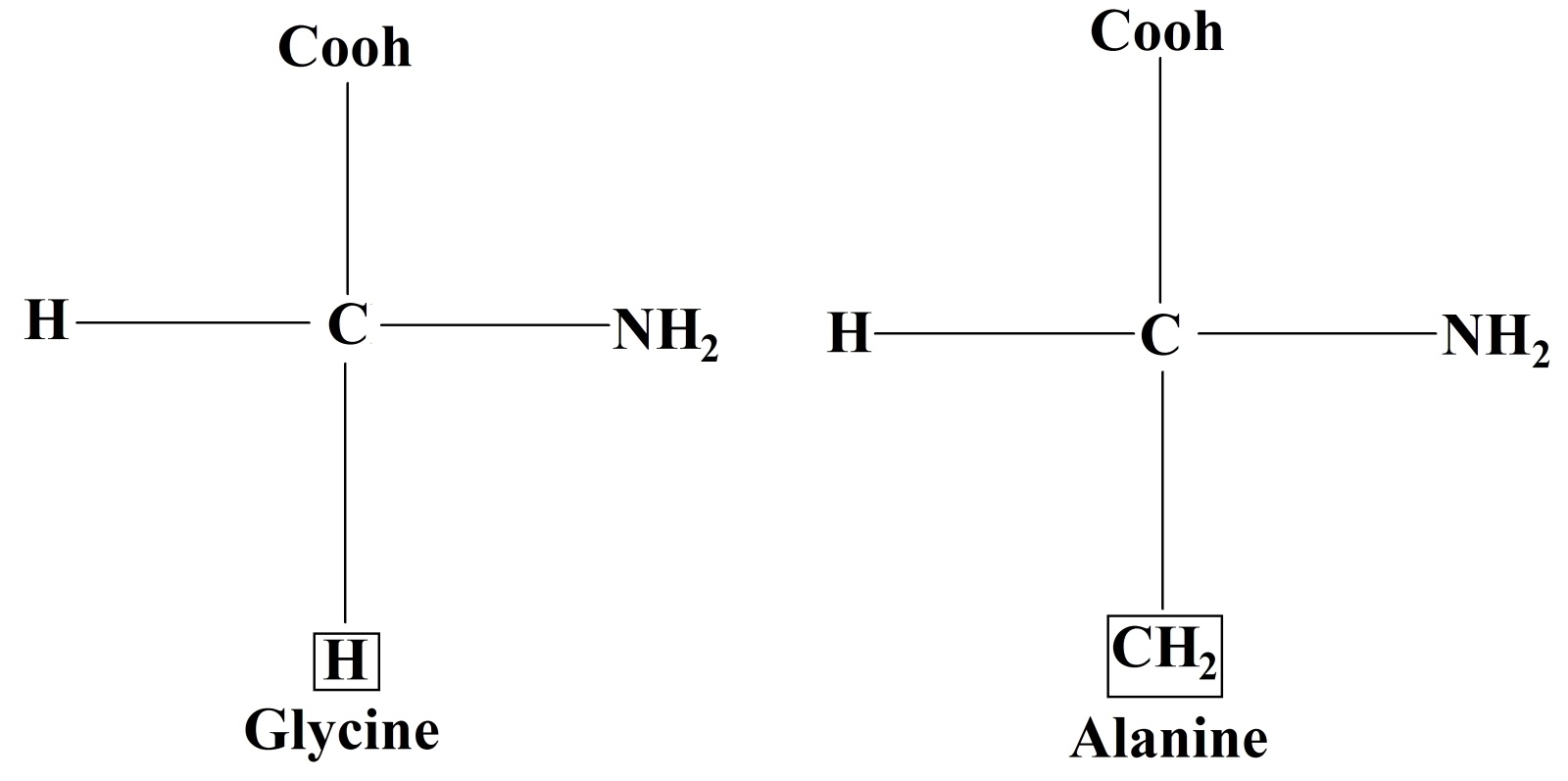
Glycine and Alanine are different with respect to one substituent on the $\alpha$-carbon. What are the other common substituent groups?
Answer
In Glycine and Alanine; other common substituent groups are NH, COOH and H. The following diagram shows this:
View full question & answer
Question 482 Marks
Starch, cellulose, glycogen, chitin are polysaccharides. From the options below, choose the one appropriate and write against
each.
  • Cotton fibre ________.
  • Exoskeleton of cockroach ________.
  • Liver ________.
  • Peeled potato ________.
Answer
  • Cotton fibre Cellulose.
  • Exoskeleton of cockroach Chitin.
  • Liver Glycogen.
  • Peeled potato Starch.
View full question & answer