MCQ 11 Mark
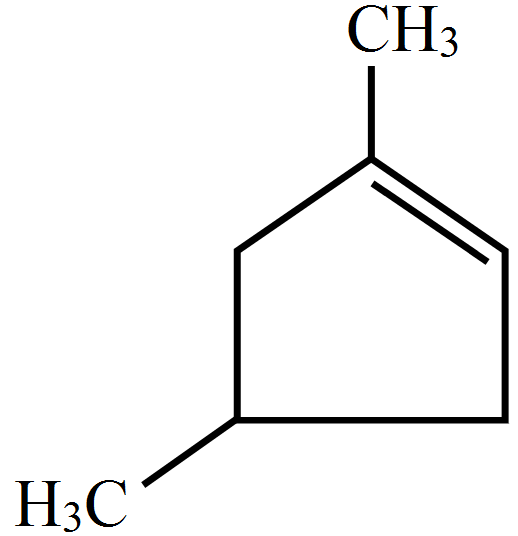
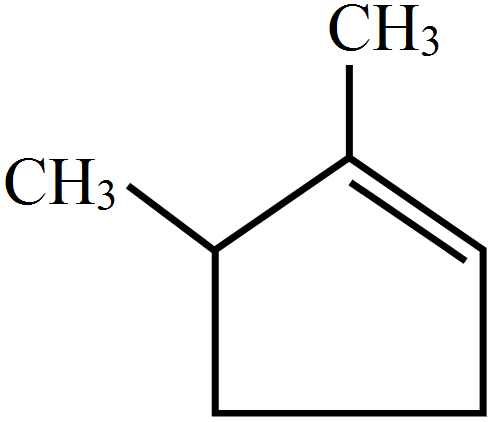
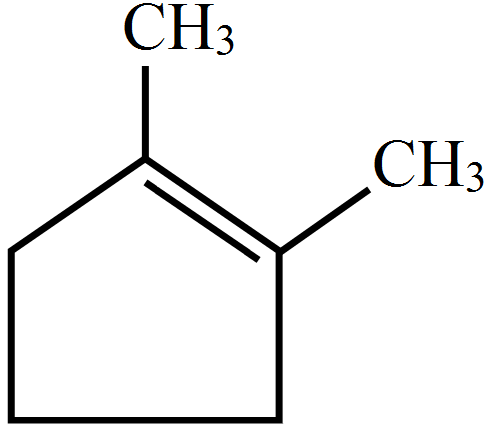
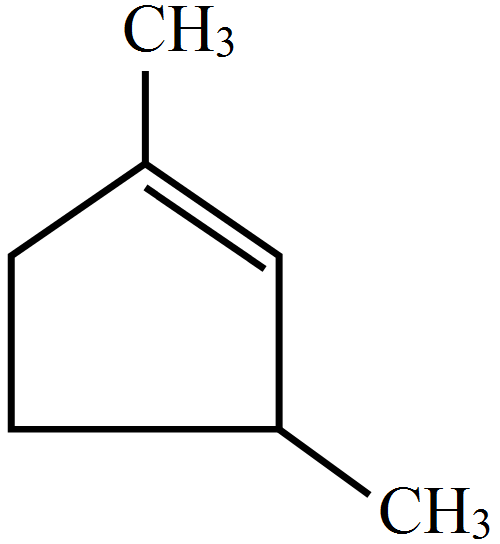
Among the following, which hydrocarbon is not produced by Wurtz reaction?
- ✓
- B
- C
- D
All given options can be prepared.
AnswerBy Wurtz reaction, higher alkanes are prepared.
i.e., $\text{R}-\text{Cl}+2\text{Na}+\text{R}-\text{Cl}\overrightarrow{\ \ \ \ \ }\ \text{R}-\text{R}+2\text{NaCl}\\ \ \ \ \ \ \ \ \ \ \ \ \ \ \ \ \ \ \ \ \ \ \ \ \ \ \ \ \ \ \ \ \ \ \ \ \ \ \ \ \ \ \ \ \ \ \ \ \ _{\text{Alkane}}$
Thus, methane cannot be prepared by this reaction.
View full question & answer→MCQ 21 Mark
Monochlorination of ethylbenzene $\left(\mathrm{PhCH}_2 \mathrm{CH}_3\right) $ with $\mathrm{Cl}_2$ under heat produces $ ..........$
- A
$\mathrm{PhCH}_2 \mathrm{CH}_2 \mathrm{Cl}$
- B
$\mathrm{PhCHClCH}_3$
- C
Both $(a)$ and $(b)$ in equal amounts
- ✓
None of $(b)$ and less of $(a)$
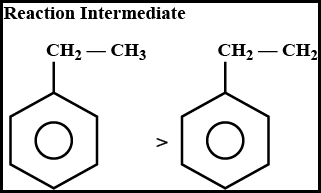
AnswerCorrect option: D. None of $(b)$ and less of $(a)$
More stable due to resonance and hyper conjugate.
Hence none of $(b)$ and less of $(a)$ for free radial will go in resonance.
View full question & answer→MCQ 31 Mark
Phenyl magnesium bromide reacts with methanol to give :
MCQ 41 Mark
The $\text{IUPAC}$ name of given compound is : $\mathrm{CH}_3-\mathrm{C} \equiv \mathrm{C}-\mathrm{C}\left(\mathrm{CH}_3\right)_2-\mathrm{CH}_3$
- A
$4, 4-$ dimethyl $-2-$ heptene $-5-$ yne
- B
$4, 4-$ dimethyl $-2-$ heptene $-6-$ yne
- C
$4, 4-$ dimethyl $-5-$ heptene $-2-$ yne
- ✓
Answer$\mathrm{CH}_3-\mathrm{C} \equiv \mathrm{C}-\mathrm{C}\left(\mathrm{CH}_3\right)_2-\mathrm{CH}_3$
$\text{IUPAC}$ name : $4,4-$ dimethyl $-$ pent $-2-$ yne
View full question & answer→MCQ 51 Mark
The major product formed when $3, 3-$ dimethyl butan $-2-$ ol is heated with concentrated sulphuric acid is :
- A
$2, 3-$ dimethylbut $-1-$ ene
- ✓
$2, 3-$ dimethylbut $-2-$ ene
- C
$3, 3-$ dimethylbut $-1-$ ene
- D
$C$ is and trans $-$ isomers of $2, 3-$ dimethylbut $-1-$ ene
AnswerCorrect option: B. $2, 3-$ dimethylbut $-2-$ ene
$ \ \ \ \ \ \ \ \ \ \ \ \ \ \text{OH}\ \ \ \ \text{CH}_3\ \ \ \ \ \ \ \ \ \ \ \ \ \ \ \ \ \ \ \ \ \ \ \ \ \ \ \ \ \ \ \ \ \ \ \ \text{CH}_3 \ \text{CH}_3\\ \ \ \ \ \ \ \ \ \ \ \ \ \ \ | \ \ \ \ \ \ \ \ \ | \ \ \ \ \ \ \ \ \ \ \ \ \ \ \ \ \ \ \ \ \ \ \ \ \ \ \ \ \ \ \ \ \ \ \ \ \ \ \ \ \ \ \ | \ \ \ \ \ \ \ |\\\text{CH}_3-\text{CH}-\text{C}-\text{CH}_3\xrightarrow[(\text{conc.})]{\Delta,\ \text{H}_2\text{SO}_4}\text{H}_3\text{C}-\text{C}=\text{C}-\text{CH}_3\\ \ \ \ \ \ \ \ \ \ \ \ \ \ \ \ \ \ \ \ \ \ \ \ \ | \ \ \ \ \ \ \ \ \ \ \ \ \ \ \ \ \ \ \ \ \ \ \ \ \ \ \ \ \ \ \ \ \ \ \ \ \ \ \ _{(\text{Major product})}\\ \ \ \ \ \ \ \ \ \ \ \ \ \ \ \ \ \ \ \ \ \ \ \ \text{CH}_3 \ \ \ \ \ \ \ \ \ \ \ \ \ \ \ \ \ \ \ \ \ \ \ \ \ \ \ \ _{(2,3-\text{dimethylbut-2-ene})}\\ \ \ \ _{(3,3-\text{dimethyl, butan-2-ol})}$
View full question & answer→MCQ 61 Mark
Here $,A$ refers to :

- ✓
$\text{CH}\equiv\text{CH}$
- B
$\text{CH}_3-\text{C}\equiv\text{CH}$
- C
$\text{CH}_3-\text{CH}_3$
- D
$\text{CH}\equiv\text{C}-\text{NH}_2$
AnswerCorrect option: A. $\text{CH}\equiv\text{CH}$
View full question & answer→MCQ 71 Mark
Which of the following reactions of methane is incomplete combustion :
- A
$2\text{CH}_4+\text{O}_2\xrightarrow{\text{Cu/523K/100atm}}2\text{CH}_3\text{OH}$
- B
$\text{CH}_4+\text{O}_2\xrightarrow{\text{Mo}_2\text{O}_3}\text{HCHO}+\text{H}_2\text{O}$
- ✓
$\text{CH}_4+\text{O}_2\xrightarrow{\ \ \ \ \ \ \ \ \ \ }\text{C(s)}+2\text{H}_2\text{O}(\text{l})$
- D
$\text{CH}_4+2\text{O}_2\xrightarrow{\ \ \ \ \ \ \ \ \ \ \ }\text{CO}_2\text{(g)}+2\text{H}_2\text{O}(\text{l})$
AnswerCorrect option: C. $\text{CH}_4+\text{O}_2\xrightarrow{\ \ \ \ \ \ \ \ \ \ }\text{C(s)}+2\text{H}_2\text{O}(\text{l})$
During incomplete combustion carbon black is formed. It takes place when there is insufficient supply of air or oxygen.
$\text{CH}_4+\text{O}_2\xrightarrow{\ \ \ \ \ \ \ \ \ \ }\text{C(s)}+2\text{H}_2\text{O}(\text{l})$
View full question & answer→MCQ 81 Mark
Aromatic compounds containing benzene ring are termed as :
MCQ 91 Mark
Arrange the following hydrogne halides in order of their decreasing reactivity with propene.
- A
$\text{HCl > HBr > HI}$
- B
$\text{HBr > HI > HCl}$
- ✓
$\text{HI > HI > HCl}$
- D
$\text{HCl > HI > HBr}$
AnswerCorrect option: C. $\text{HI > HI > HCl}$
View full question & answer→MCQ 101 Mark
Which one of the following compound will give addition reaction?
- A
$\mathrm{CH}_4$
- B
$\mathrm{C}_2 \mathrm{H}_6$
- ✓
$\mathrm{C}_2 \mathrm{H}_4$
- D
$\mathrm{C}_3 \mathrm{H}_8$
AnswerCorrect option: C. $\mathrm{C}_2 \mathrm{H}_4$
$\mathrm{CH}_4, \mathrm{C}_2 \mathrm{H}_6$ and $\mathrm{C}_3 \mathrm{H}_8$ are saturated hydrocarbons.
Hence, they will give substitution reaction.
$\mathrm{C}_2 \mathrm{H}_4$ on the other hand is an unsaturated hydrocarbon.
It will give addition reaction.
For example, catalytic hydrogenation of ethylene gives ethane. A molecule of hydrogen is added across $C=C$ double bond.
$\mathrm{C}_2 \mathrm{H}_4+\mathrm{H}_2 \xrightarrow{\text{Ni/Pt/Pd}}$ $\mathrm{C}_2 \mathrm{H}_6$
View full question & answer→MCQ 111 Mark
$\mathrm{CH}_3 \mathrm{CH}=\mathrm{CH}_2+\mathrm{HBr}$ gives :
- ✓
$ \mathrm{CH}_2=\mathrm{CH}-\mathrm{CH}_2-\mathrm{Br} $
- B
$ \mathrm{CH}_3-\mathrm{CH}_2-\mathrm{CH}_2-\mathrm{Br} $
- C
$ \mathrm{CH}_3 \mathrm{CH}(\mathrm{Br})-\mathrm{CH}_3 $
- D
$ \mathrm{CH}_3-\mathrm{CH}_2-\mathrm{CH}_3 $
AnswerCorrect option: A. $ \mathrm{CH}_2=\mathrm{CH}-\mathrm{CH}_2-\mathrm{Br} $
This is an example of addition reaction.
The double bond is broken and hydrogen and bromine are added to the given compound.
Bromine will add up on secondary carbon. $($Markovnikov's Rule$)\mathrm{CH}_3 \mathrm{CH}=\mathrm{CH}_2+\mathrm{HBr} \rightarrow \mathrm{CH}_3 \mathrm{CH}(\mathrm{Br})-\mathrm{CH}_3$.
View full question & answer→MCQ 121 Mark
Ethylbenzene reacts with $\ce{Cl_2}$ in sunlight to give :
AnswerCorrect option: A. $1-$ Chloro $-1-$ phenylethane
$\mathrm{ph}-\mathrm{CH}_2 \mathrm{CH}_3+\mathrm{Cl}_2$ $\xrightarrow{\text{sunlight}} \ \mathrm{ph}-\mathrm{CH}(\mathrm{Cl})-\mathrm{CH}_3$
This is a substitution reaction where chlorine replaces one hydrogen atom to form $1-$ chloro $-1-$ phenylethane.
View full question & answer→MCQ 131 Mark
The discovery that chlorofluorocarbons initiate a radical $-$ chain reaction that catalytically destroys ozone won the $1995$ Nobel prize in chemistry Given the initiation step below which of the following reactions is the most likely to serve as one of the propagation steps?
$\mathrm{CCl}_2 \mathrm{~F}_2+\mathrm{hv} \rightarrow{ }^* \mathrm{CCIF}_2+{ }^* \mathrm{Cl}$
- A
$ { }^* \mathrm{Cl}+{ }^* \mathrm{Cl} \rightarrow \mathrm{Cl}_2 $
- ✓
$ { }^* \mathrm{Cl}+\mathrm{O}_3 \rightarrow{ }^* \mathrm{OCl}+\mathrm{O}_2 $
- C
$ { }^* \mathrm{CClF}_2+{ }^* \mathrm{Cl} \rightarrow \mathrm{CCl}_2 \mathrm{~F}_2 $
- D
$ 2{ }^* \mathrm{CClF}_2+2 \mathrm{O}_3 \rightarrow 2 \mathrm{COF}_2+\mathrm{Cl}_2+2 \mathrm{O}_2$
AnswerCorrect option: B. $ { }^* \mathrm{Cl}+\mathrm{O}_3 \rightarrow{ }^* \mathrm{OCl}+\mathrm{O}_2 $
The ultraviolet light, as it hits the atmosphere, makes $\text{CFCs}$ break up to form free radicals like this: $\mathrm{CCl}_2 \mathrm{~F}_2 \rightarrow{ }^* \mathrm{CCIF}_2+\mathrm{Cl}^*$ Chlorine free radicals will then go on to react with the ozone in the stratosphere: $\mathrm{O}_3+\mathrm{Cl}^* \rightarrow \mathrm{ClO}^*+\mathrm{O}_2\ ($Propagation step$)$ The chlorine oxide molecule $(\mathrm{ClO})$ is very reactive, and it then proceeds to react with ozone to make two oxygen molecules and a $\text{Cl}*$ free radical : $\mathrm{ClO}^*+\mathrm{O}_3 \rightarrow 2 \mathrm{O}_2+\mathrm{Cl}^*$
That $\text{Cl}*$ free radical will then go on and react with another ozone molecule, resulting in a chain reaction between the last two equations that theoretically never stops, due to their unreactive nature and thus their inability to be easily removed from the atmosphere.
The chlorine atoms aren’t used up, which means they are free to carry on breaking down the ozone.
View full question & answer→MCQ 141 Mark
A single substitution of $H$ atom in an alkane of molar mass by $72\text{ g/mole}$ on chlorination produces only one product. The alkane is :
- A
$n-$ pentane
- B
$2-$ methyl butane
- ✓
$2, 2-$ dimethyl propane
- D
$n-$ butane
AnswerCorrect option: C. $2, 2-$ dimethyl propane
In $2,2-$ Dimethylpropane the central carbon atom is quaternary, meaning all four of its valencies are satisfied by Carbon atoms; which implies that there are no Hydrogen atoms which can be substituted by Chlorine $($or halogen$),$ and all the remaining $4$ carbon atoms are identical, so substitution on any one of those will result in the same compound.
View full question & answer→MCQ 151 Mark
Which of the following compounds is insoluble even in hot concentrated $\mathrm{H}_2 \mathrm{SO}_4\ ?$
AnswerHexane is an alkane which is also called as paraffin or less reactive.
Thus they are not soluble in concentrated $\mathrm{H}_2 \mathrm{SO}_4$
Also, hexane is non $-$ polar and concentrated $\mathrm{H}_2 \mathrm{SO}_4$ is polar, thus hexane is not soluble in $\mathrm{H}_2 \mathrm{SO}_4$.
View full question & answer→MCQ 161 Mark
Trans $-3, 6-$ Dimethyl oct $-4-$ ene $(A)$ exists in two diastereomers $(I)$ and $(II).$ The total number of stereoisomers for $(A)$ is :
AnswerTwo asymmetric $C$ atoms with the same terminal group $(n =$ number of asymmetric $C$ atom and is even$)$
Number of $\text{O. A. I}. =2^{n-1}=2$
Number of mcso forms $=2^{(n-2) / 2}=I$
Total optical isomers $= 3$
One double bond $= 2$ disteromers
Totalstereoisomers $=3 \times 2 = 6$
View full question & answer→MCQ 171 Mark
In the reaction, $\ \ \ \ \ \ \ \ \ \ \ \ \ \text{Br}\\ \ \ \ \ \ \ \ \ \ \ \ \ \ |\\\text{CH}_3-\text{CH}_2\xrightarrow[\Delta]{\text{alc. KOH}}\text{A,} A$ is :
- ✓
$ \mathrm{CH}_2=\mathrm{CH}_2 $
- B
$ \mathrm{CH}_3 \mathrm{CH}_3 $
- C
$\text{CH}\equiv\text{CH}$
- D
Both $(a)$ and $(b)$
AnswerCorrect option: A. $ \mathrm{CH}_2=\mathrm{CH}_2 $
View full question & answer→MCQ 181 Mark
The highest boiling point is expected for :
AnswerCorrect option: B. $n-$ Octane
Boiling point is characterized as the specific temperature at which the vapour pressure of the fluid is equivalent to the environmental pressure.
Among the given options
$n-$ Octane is a straight $-$ chain exacerbate that has a very large surface area.
Along these lines, there are more van der Waals forces of attraction, bringing about high boiling points.
View full question & answer→MCQ 191 Mark
Ethylene is prepared by :
AnswerCorrect option: B. Pyrolysis of ethane at $450^\circ C$
Decomposition of the compound by heat is called pyrolysis or thermal decomposition.
When Ethane is heated in absence of air at $450^\circ C$ gives Ethylene and Hydrogen.
$\ce{CH_3−CH_3}\ \xrightarrow{450^\circ \text{C}} \ \ce{CH_2 = CH_2 + H_2}$
When Alkanes are heated to high temperature in absence of air, the higher alkane molecules break up into smaller molecules of lower alkanes, alkanes, and hydrogen.
Remaining all reactions gives alkanes.
View full question & answer→MCQ 201 Mark
Arrange the following hydrogen halides in order of their decreasing reactivity with propene :
- A
$\text{HCl > HBr > HI}.$
- B
$\text{HBr > HI > HCl}.$
- ✓
$\text{HI > HBr > HCl}.$
- D
$\text{HCl > HI > HBr}.$
AnswerCorrect option: C. $\text{HI > HBr > HCl}.$
The decreasing order of reactivity of hydrogen halides with propene is $\text{HI > HBr > HCl}$.
As the size of halogen increases, the strength of $H–X$ bond decreases and hence, reactivity increases.
View full question & answer→MCQ 211 Mark
The hydrocarbon obtained by treating sodium ethanoate with soda lime is $ ..........$
Answer$\mathrm{CH}_3 \mathrm{COONa}+\mathrm{NaOH} \rightarrow \mathrm{CH}_4+\mathrm{Na}_2 \mathrm{CO}_3$
$\mathrm{CH}_3 \mathrm{COONa}=$ Sodium ethanoate
$\mathrm{NaOH}=$ Soda lime
$\mathrm{CH}_4=$ Methane
$\mathrm{Na}_2 \mathrm{CO}_3=$ Sodium carbonate
View full question & answer→MCQ 221 Mark
Which of the following can be used as the halide $($electrophile provider$)$ for Friedel crafts reaction :
Answer$\because$ Others have double bond character between which is deficient to break. 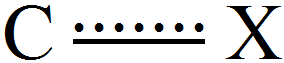
View full question & answer→MCQ 231 Mark
The given reaction, $\text{CH}_3-\text{Cl}+\text{H}_2\xrightarrow{\text{Zn, H}^+}\text{CH}_4+\text{HCl}$ is an example of :
View full question & answer→MCQ 241 Mark
The ratio of sigma and pi bonds in benzene is :
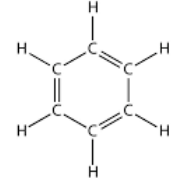
AnswerThe molecular formula of benzene is $\mathrm{C}_6 \mathrm{H}_6$.
Benzene molecule contains $12 \sigma$ and $3 \pi$ bonds.
Hence, the ratio is $4:1.$
View full question & answer→MCQ 251 Mark
Name the $\text{IUPAC}$ nomenclature of $\mathrm{CH}_3-\mathrm{CH}_2-\mathrm{CH}_2-\mathrm{CH}=\mathrm{CH}_2$ :
- ✓
$1-$ Pentene
- B
$2-$ Propene
- C
$3-$ Propene
- D
AnswerCorrect option: A. $1-$ Pentene
Chain of five carbons with double bond on $1, 2$ carbons, $1-$ pentene.
View full question & answer→MCQ 261 Mark
$2-$ methyl propan $-2-$ ol is obtained by the reaction of $X$ with water in the presence of conc. $\mathrm{H}_2 \mathrm{SO}_4$. The $X$ is :
- A
$1-$ methylpropene.
- B
$2, 2-$ dimethylhexane.
- ✓
$2-$ methylpropene.
- D
$2-$ methylbutane.
AnswerCorrect option: C. $2-$ methylpropene.
View full question & answer→MCQ 271 Mark
The energy barrier to free rotation about carbon carbon bond of ethane is about :
- A
$30 \mathrm{~kJ} \mathrm{~mol}^{-1}$
- B
$3 \mathrm{~kJ} \mathrm{~mol}^{-1}$
- ✓
$3 \ \mathrm{kcal}\ \mathrm{mol}^{-1}$
- D
$40 \mathrm{~kJ} \mathrm{~mol}^{-1}$
AnswerCorrect option: C. $3 \ \mathrm{kcal}\ \mathrm{mol}^{-1}$
The staggered structure is the structure of lower energy than eclipsed structure.
The relative energy required for complete a rotation in ethane is called the energy barrier to rotation, and it is about $\text{3 kcal/mol.}$
That is, the eclipsed structure is $3 \text{ kcal}$ higher in energy than the staggered structure.
View full question & answer→MCQ 281 Mark
Attack of electrophile on benzene results in the formation of :
- A
$\sigma$ complex
- B
- C
$\pi$ complex.
- ✓
Both $(a)$ and $(b).$
AnswerCorrect option: D. Both $(a)$ and $(b).$
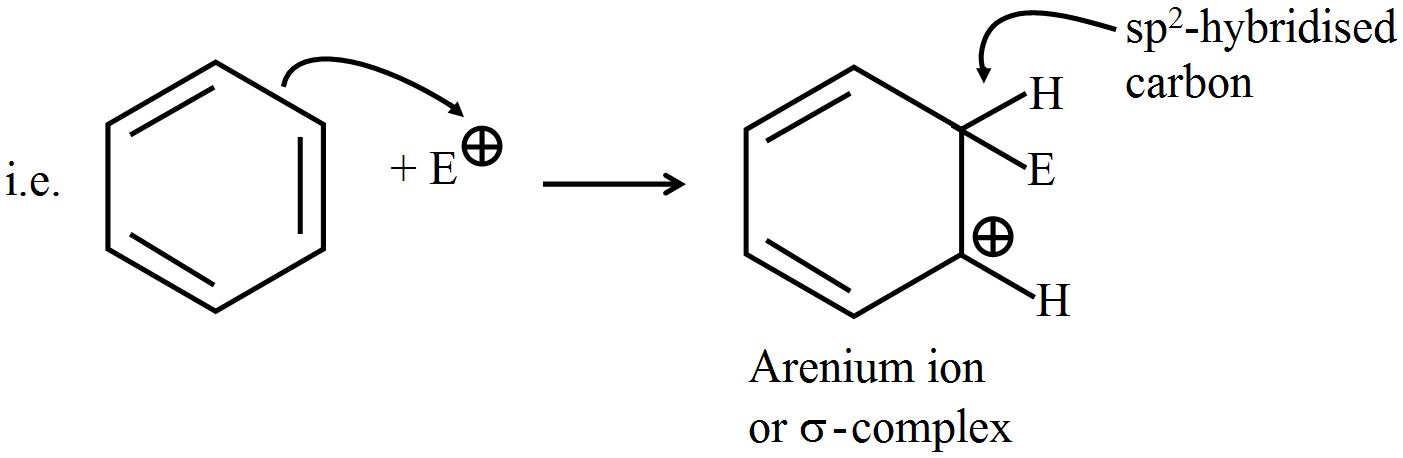
Attack of electrophile on benzene nucleus results in the formation of $\sigma-$ complex or arenium ion, in which one of the carbon is $sp^2-$ hybridised.
View full question & answer→MCQ 291 Mark
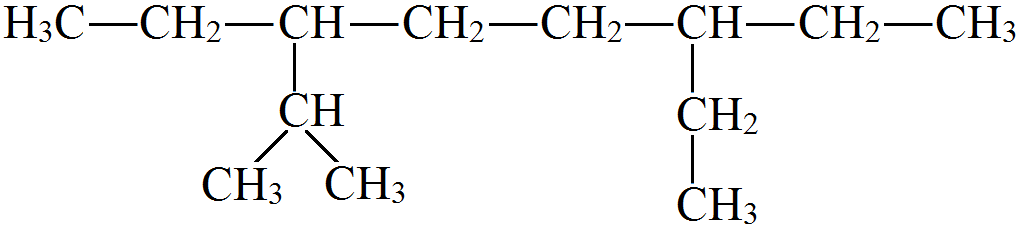
The correct $\text{IUPAC}$ name of the following alkane is :
- ✓
$3, 6-$ Diethyl $-2-$ methyloctane
- B
$5-$ Isopropyl $-3-$ ethyloctane
- C
$3-$ Ethyl $-$ isopropyloctane
- D
$3-$ Isopropyl $-6-$ ethyloctane
AnswerCorrect option: A. $3, 6-$ Diethyl $-2-$ methyloctane
$\text{CH}_3-\text{CH}_2-\stackrel{{3}}{\hbox{ CH}}-\stackrel{{4}}{\hbox{ CH}}_2-\stackrel{{5}}{\hbox{ CH}}_2-\stackrel{{6}}{\hbox{ CH}}-\stackrel{{7}}{\hbox{ CH}}_2-\stackrel{{8}}{\hbox{ CH}}_3\\ \ \ \ \ \ \ \ \ \ \ \ \ \ \ \ \ \ \ \ \ \ \ \ \ \ \ | \ \ \ \ \ \ \ \ \ \ \ \ \ \ \ \ \ \ \ \ \ \ \ \ \ \ \ \ \ \ \ \ \ \ \ \ \ |\\ \ \ \ \ \ \ \ \ \ \ \ \ \ \ \ \ \ \ \ \ \ \ \ 2\text{CH}-\text{CH}_3\ \ \ \ \ \ \ \ \ \ \ \ \ \ \ \ \ \ \ \ \text{CH}_2\\ \ \ \ \ \ \ \ \ \ \ \ \ \ \ \ \ \ \ \ \ \ \ \ \ \ \ |\ \ \ \ \ \ \ \ \ \ \ \ \ \ \ \ \ \ \ \ \ \ \ \ \ \ \ \ \ \ \ \ \ \ \ \ \ |\\ \ \ \ \ \ \ \ \ \ \ \ \ \ \ \ \ \ \ \ \ \ \ \ 1\text{CH}_3\ \ \ \ \ \ \ \ \ \ \ \ \ \ \ \ \ \ \ \ \ \ \ \ \ \ \ \ \ \ \ \text{CH}_3\\ \ \ \ \ \ \ \ \ \ \ \ \ \ \ \ \ \ \ \ \ \ _{3,\ 6-\text{Diethyl-2-methyl octane}}$
View full question & answer→MCQ 301 Mark
There is no ring strain in cyclohexane, but cyclobutane has an angle strin of $9^\circ 44\ ′$. If $\Delta\text{H}_\text{C}^\circ $ of cyclohexane per $\ce{(CH_2)}$ group is $660\text{ kJ mol}^{-1}$ and $\Delta\text{H}_\text{C}^\circ $ of cyclobutane is $2744 \text{ kJ mol}^{-1}$, what is the ring strain in $\text{kJ mol}^{-1}$ of cyclobutane?
- A
$-104$
- ✓
$104$
- C
$-2084$
- D
$2084$
AnswerThe $\Delta\text{H}_\text{C}^\circ $ value of cyclobutane is given. From this if we substract the $\Delta\text{H}_\text{C}^\circ $ value of cyclobutane calculated when there is no angle strain, we will get the value of ring strain of cyclobutane.
The $\Delta\text{H}_\text{C}^\circ $ value of cyclobutane when there is no ring strain can be calculated from $\Delta\text{H}_\text{C}^\circ $ value of cyclohexane per $\ce{CH}_2$ group.
Ring strain $= (\Delta\text{H}_\text{C}^\circ $ of cyclobutane $- 4 \times \Delta\text{H}_\text{C}^\circ $ of per $\ce{(CH_2)}$ group of cyclohexane $) $
$= 2744 - (4 \times 660) = 104 \text{ kJ mol}^{-1}$.
View full question & answer→MCQ 311 Mark
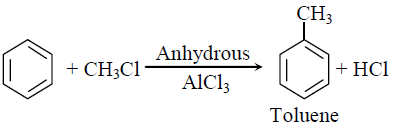
Benzene reacts with $\ce{CH_3Cl}$ in the presence of anhydrous $\ce{AlCl_3}$ to form :
AnswerBenzene reacts with $\ce{CH_3Cl}$ in presence of anhydrous $\ce{AlCl_3}$ to give Toulene.
This is fridel crafts Alkylation and an electrophillic substitution.
View full question & answer→MCQ 321 Mark
The process of elimination of carbon dioxide from carboxylic acid is termed as :
MCQ 331 Mark
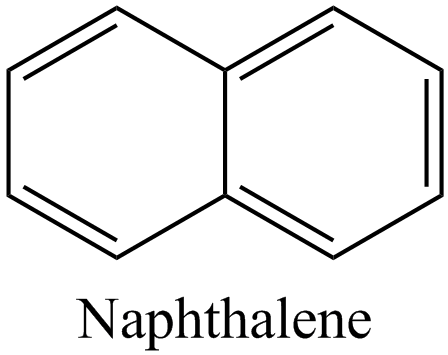
Which content $(s)$ of middle oil separate on cooling?
AnswerThe content of middle oil separate on cooling is naphthalene.
View full question & answer→MCQ 341 Mark
The reaction of Toluene with $\ce{Cl_2}$ in presence of $\ce{FeCl_3}$ predominanly gives :
View full question & answer→MCQ 351 Mark
Alkynes on reduction with sodium in liquid ammonia forms :
- A
Cis $-$ alkene.
- B
- ✓
Trans $-$ alkene.
- D
Both $(a)$ and $(c).$
AnswerCorrect option: C. Trans $-$ alkene.
View full question & answer→MCQ 361 Mark
The reaction of propene with $\mathrm{HOCl}\left(\mathrm{Cl}_2+\mathrm{H}_2 \mathrm{O}\right)$ proceeds through intermediate :
- A
$\ \ \ \ \ \ \ \ \ \ \ \ \oplus\\\text{CH}_3-\text{C}\text{H}-\text{CH}_2\text{OH}$
- ✓
$\ \ \ \ \ \ \ \ \ \ \ \ \oplus\\\text{CH}_3-\text{C}\text{H}-\text{CH}_2-\text{Cl}$
- C
$ \ \ \ \ \ \ \ \ \ \ \ \ \ \ \ \ \ \ \ \ \ \ \ \ \ \ \ \oplus\\ \text{CH}_3-\text{CH(OH)}\text{CH}_2$
- D
$\ \ \ \ \ \ \ \ \ \ \ \ \ \ \ \ \ \ \oplus\\ \text{CH}_3\text{CHCl }\text{CH}_2$
AnswerCorrect option: B. $\ \ \ \ \ \ \ \ \ \ \ \ \oplus\\\text{CH}_3-\text{C}\text{H}-\text{CH}_2-\text{Cl}$
$\ \ \ \ \ \ \ \ \ \ \ \ \ \ \ \ \ \ \ \ominus\\\text{HOCl}\rightarrow\text{OCH}+\text{Cl}^+$

View full question & answer→MCQ 371 Mark
Nitration and chlorination of benzene are :
- A
Nucleophilic and electrophilic substitution respectively.
- B
Electrophilic and nucleophilic substitution respectively.
- ✓
Electrophilic substitution in both the reactions.
- D
Nucleophilic substitution in both the reactions.
AnswerCorrect option: C. Electrophilic substitution in both the reactions.
Since nitration and halogenation, both are carried out by the help of electrophile $\mathrm{NO}^{2+} \ \mathrm{Cl}^{+}$.
Hence, both reactions are electrophilic substitution reactions.
View full question & answer→MCQ 381 Mark
Conformations of ethane in which hydrogen atoms attached to two carbon atoms are closest to each other are known as :
AnswerConformation in which hydrogen atoms attached to two carbons are as closed together as possible is called eclipsed conformation and the other in which hydrogen’s are as far apart as possible is known as the staggered conformation. Any other intermediate conformation is called a skew conformation.
View full question & answer→MCQ 391 Mark
Which compound would give $5-$ keto $ 2-$ methyl hexanal upon ozonolysis followed by reaction with $\frac{\text{Zn}}{\text{H}_2\text{O}}?$
View full question & answer→MCQ 401 Mark
Which of the following organic materials damage $\text{DNA}$ of our body?
AnswerTabacco, coal and petroleum damages $\text{DNA}$ of our body and causes cancer.
View full question & answer→MCQ 411 Mark
Arrange the halogens $\mathrm{F}_2, \mathrm{Cl}_2, \mathrm{Br}_2, \mathrm{I}_2$, in order of their increasing reactivity with alkanes :
- ✓
$ \mathrm{I}_2 < \mathrm{Br}_2 < \mathrm{Cl}_2 < \mathrm{F}_2 $
- B
$ \mathrm{Br}_2 < \mathrm{Cl}_2 < \mathrm{F}_2 < \mathrm{I}_2 $
- C
$ \mathrm{~F}_2 < \mathrm{Cl}_2 < \mathrm{Br}_2 < \mathrm{I}_2 $
- D
$ \mathrm{Br}_2 < \mathrm{I}_2 < \mathrm{Cl}_2 < \mathrm{F}_2 $
AnswerCorrect option: A. $ \mathrm{I}_2 < \mathrm{Br}_2 < \mathrm{Cl}_2 < \mathrm{F}_2 $
Fluorine is highly electronegative element. Electronegativity of halogens decreases down the group. As the electronegativity of halogens decreases, reactivity with alkanes, decreases. Therefore, $F_2$ reacts vigorously and $I_2$ reacts too slow.
View full question & answer→MCQ 421 Mark
The $\ce{C−C}$ bond length of the following molecules is in the order :
- A
$ \mathrm{CH}_2 > \mathrm{C}_2 \mathrm{H}_4 > \mathrm{C}_6 \mathrm{H}_6 < \mathrm{C}_2 \mathrm{H}_2 $
- ✓
$ \mathrm{C}_2 \mathrm{H}_2 < \mathrm{C}_2 \mathrm{H}_4 < \mathrm{C}_6 \mathrm{H}_6 < \mathrm{C}_2 \mathrm{H}_6 $
- C
$ \mathrm{C}_2 \mathrm{H}_6 < \mathrm{C}_2 \mathrm{H}_2 < \mathrm{C}_6 \mathrm{H}_6 < \mathrm{C}_2 \mathrm{H}_4 $
- D
$ \mathrm{C}_2 \mathrm{H}_4 < \mathrm{C}_2 \mathrm{H}_6 < \mathrm{C}_2 \mathrm{H}_2 < \mathrm{C}_6 \mathrm{H}_6 $
AnswerCorrect option: B. $ \mathrm{C}_2 \mathrm{H}_2 < \mathrm{C}_2 \mathrm{H}_4 < \mathrm{C}_6 \mathrm{H}_6 < \mathrm{C}_2 \mathrm{H}_6 $
Bond length is related to bond order, when more electrons participate in bond formation the bond is shorter. By approximation, the bond lengths of two different atoms are the sum of the two individual covalent radii.
The bond length of carbon $-$ carbon triple bond is shorter than carbon $-$ carbon double bond and is shorter than resonance bonding in benzene and is shorter than carbon $-$ carbon single bond.
Therefore, $ \mathrm{C}_2 \mathrm{H}_2 < \mathrm{C}_2 \mathrm{H}_4 < \mathrm{C}_6 \mathrm{H}_6 < \mathrm{C}_2 \mathrm{H}_6 $
View full question & answer→MCQ 431 Mark
The least reactive alkane towards free $-$ radical substitution reactions is :
- ✓
$ \mathrm{CH}_4 $
- B
$ \left(\mathrm{CH}_3\right)_3 \mathrm{CH} $
- C
$ \mathrm{CH}_3 \mathrm{CH}_3 $
- D
$ \mathrm{CH}_3 \mathrm{CH}_2 \mathrm{CH}_3$
AnswerCorrect option: A. $ \mathrm{CH}_4 $
Methane is less reactive towards free $-$ radical mechanism as it has only one carbon and no substituted alkyl group.
Thus it does not have extra carbon atom to make free radical.
View full question & answer→MCQ 441 Mark
Compound $A\ ($molecular formula $\mathrm{C}_5 \mathrm{H}_{10})$ gives only one monochlorinated product. Write the structure of compound $A$.
- A
$1-$ pentene
- B
$2-$ pentene
- C
$1-$ methyl cyclobutane
- ✓
AnswerCyclopentane $\xrightarrow{\text{Cl}_2+\text{hv}}$ Cyclopentylchloride
Compound $A$ has molecular formula $\mathrm{C}_5 \mathrm{H}_{10}$.
The degree of unsaturation is $1$. It should have either one double bond or should be a cyclic compound. If it has one double bond, then it will give many monochlorinated products.
However, it gives only one monochlorinated product.
So, it is a cyclic compound. Thus, it should be cyclopentane.
View full question & answer→MCQ 451 Mark
What happens when calcium carbide is treated with water?
- A
- B
Methane and ethane are formed.
- ✓
- D
Ethene and ethyne are formed.
AnswerIf we mix calcium carbide with water ethyne is released due to endothermic reaction between them.
This is the industrial method of producing ethyne.
$\mathrm{Ca}^{2+}[\mathrm{C} \equiv \mathrm{C}]^{2-}+2 \mathrm{H}_2 \mathrm{O} \rightarrow \mathrm{CH} \equiv \mathrm{CH}+\mathrm{Ca}(\mathrm{OH})_2$
View full question & answer→MCQ 461 Mark
When cyclohexane is poured on water, it floats because cyclohexane is :
MCQ 471 Mark
Which of the following is properly matched?
- A
Kerosene $-\mathrm{C}_5-\mathrm{C}_{10}$
- B
Diesel oil $-\mathrm{C}_5-\mathrm{C}_6$
- ✓
Petrol $-\mathrm{C}_7-\mathrm{C}_9$
- D
AnswerCorrect option: C. Petrol $-\mathrm{C}_7-\mathrm{C}_9$
The number of carbon atoms in Petrol is $-\mathrm{C}_7-\mathrm{C}_9$.
View full question & answer→MCQ 481 Mark
Which type of isomerism is shown by But $-1-$ yne and cyclobutene?
AnswerRing chain isomerism is shown by But $-1-$ yne and cyclobutene.
Alkynes are isomeric with cycloalkenes containing the same number of carbon atoms.
One compound is open chain and other is cyclic and both have same molecular formula that is $\mathrm{C}_4 \mathrm{H}_6$.
Also, the both have different functional groups, so they are functional isomers.
All ring chain isomers are functional isomers but all functional isomers are not ring chain isomers.
View full question & answer→MCQ 491 Mark
Propene is allowed to react with $\text{B}_2 , \text{D}_6$ and the product is treated with acetic acid. The final product obtained is :
- A
$1-$ deuteriopropane
- ✓
$2-$ deuteriopropane
- C
$1-$ deuteriopropene
- D
$2-$ deuteriopropene
AnswerCorrect option: B. $2-$ deuteriopropane
This is an example of hydroboration reaction $($followed by hydrolysis$)$ in which diborane is isotopically labeled.
A molecule of $\text{HD}$ is added across the double bond of propene to form $2-$ deuteriopropane.
$\text{CH}_2\text{CHCH}_3\xrightarrow[\text{CH}_3\text{COOH}]{\text{B}_2\text{D}_6}\text{CH}_3−\text{CHDCH}_3$.
View full question & answer→MCQ 501 Mark
Which one of the following compounds gives methane on treatment with water?
- ✓
$\ce{Al_4C_3}$
- B
$\ce{CaC_2}$
- C
$\text{VC}$
- D
$\text{SiC}$
AnswerCorrect option: A. $\ce{Al_4C_3}$
$\ce{Al_4C_3}$ gives methane on treatment with water.
$\mathrm{Al}_4 \mathrm{C}_3+12 \mathrm{H}_2 \mathrm{O} \rightarrow 4 \mathrm{Al}(\mathrm{OH})_3+3 \mathrm{CH}_4$
View full question & answer→