Sample QuestionsLimits and Derivatives questions
One sample from each question group in this chapter. Select any group above to see the full set with answer keys.
If $x$ is very large, then $\frac{2\text{x}}{1+\text{x}}\text{is:}$
- A
Close to $0$
- B
- C
Lie between $2$ and $3$
- ✓
Close to $2$
Answer: D.
View full solution →If $ \mathrm{f}(\mathrm{x})=\left\{\begin{array}{l}2\mathrm{x}+\mathrm{b}(\mathrm{x}<\alpha)\\\mathrm{x}+\mathrm{d}(\mathrm{\text{x}}\geq\alpha)\end{array}\right.$ is such that $ \lim_\limits{\text{x} \rightarrow \text{a}}\text{f}(\text{x}=\text{L}),$ then $L.$
- ✓
$2d - b$
- B
$b - db$
- C
$d + bd$
- D
$b- 2d$
Answer: A.
View full solution →The fourth term in the expansion $(x - 2y)^{12}$ is:
- A
$ -1670 x^9 \times y^3 $
- B
$ -7160 x^9 \times y^3 $
- ✓
$ -1760 x^9 \times y^3 $
- D
$ -1607 x^9 \times y^3 $
Answer: C.
View full solution →Is Rolle’s theorem valid for $f(x) = x^2 - 3x + 4$ in the interval $[1, 2]\ ?$
Answer: A.
View full solution →If $\text{f}(\text{x})=1-\text{x}+\text{x}^2-\text{x}^3+\dots-\text{x}^{99}+\text{x}^{100},$then $f'(1)$ equals
Answer: D.
View full solution →Directions: In the following questions, the Assertions $(A)$ and Reason$(s) (R)$ have been put forward. Read both the statements carefully and choose the correct alternative from the following:
Assertion $(A) \lim\limits_{\text{x}\rightarrow 0}\frac{3^\text{x}-2^\text{x}}{\tan\text{x}}$ is equal to $\log\big(\frac{3}{2}\big)$
Reason $(R) \lim\limits_{\text{x}\rightarrow 0} \frac{\log(1+\text{x)}}{\tan\text{x}}$ is equal to $2.$
- A
$A$ is true, $R$ is true; $R$ is acorrect explanation of $A.$
- B
$A$ is true, $R$ is true; $R$ is not a correct explanation of $A.$
- ✓
$A$ is true; $R$ is false
- D
$A$ is false; $R$ is true.
Answer: C.
View full solution →Directions: In the following questions, the Assertions $(A)$ and Reason$(s) (R)$ have been put forward. Read both the statements carefully and choose the correct alternative from the following:
Assertion $(A)\ \lim\limits_{\text{x}\rightarrow\pi} \frac{\sin(\pi-\text{x)}}{\pi(\pi-\text{x})}$ is equal to $\pi$
Reason $(R)\ \lim\limits_{\text{x}\rightarrow 0} \frac{\cos\text{x}}{\pi-\text{x}}$ is equal to $\frac{1}{\pi}.$
- A
$A$ is true, $R$ is true; $R$ is acorrect explanation of $A.$
- B
$A$ is true, $R$ is true; $R$ is not a correct explanation of $A.$
- C
$A$ is true; $R$ is false
- ✓
$A$ is false; $R$ is true.
Answer: D.
View full solution →Directions: In the following questions, the Assertions $(A)$ and Reason$(s) (R)$ have been put forward. Read both the statements carefully and choose the correct alternative from the following:
Assertion $(A)\ \lim\limits_{\text{x}\rightarrow0} \frac{\sin\text{ax}}{\sin\text{bx}}$ is equal to $\frac{\text{a}}{\text{b}}.$
Reason $(R)\ \lim\limits_{\text{x}\rightarrow0} \frac{\sin\text{x}}{\text{x}}=1.$
- ✓
$A$ is true, $R$ is true; $R$ is acorrect explanation of $A.$
- B
$A$ is true, $R$ is true; $R$ is not a correct explanation of $A.$
- C
$A$ is true; $R$ is false
- D
$A$ is false; $R$ is true.
Answer: A.
View full solution →Directions: In the following questions, the Assertions $(A)$ and Reason$(s) (R)$ have been put forward. Read both the statements carefully and choose the correct alternative from the following:
Assertion $(A)\ \lim\limits_{\text{x}\rightarrow0} \frac{\ell^{3+\text{x}}-\sin\text{x-}\ell^3}{\text{x}}$ is equal to $\ell^3+1.$
Reason $(R)\ \lim\limits_{\text{x}\rightarrow0} \frac{\tan4\text{x}}{\sin2\text{x}}$ is equal to $2.$
- A
$A$ is true, $R$ is true; $R$ is acorrect explanation of $A.$
- B
$A$ is true, $R$ is true; $R$ is not a correct explanation of $A.$
- C
$A$ is true; $R$ is false
- ✓
$A$ is false; $R$ is true.
Answer: D.
View full solution →Directions: In the following questions, the Assertions $(A)$ and Reason$(s) (R)$ have been put forward. Read both the statements carefully and choose the correct alternative from the following:
Assertion $(A) \lim\limits_{\text{x}\rightarrow0}\frac{\text{ax}+\text{x}\cos\text{x}}{\text{b}\sin\text{x}}$ is equal to $\frac{\text{a+1}}{\text{b}}.$
Reason $(R) \lim\limits_{\text{x}\rightarrow0}\text{x}\sec\text{x}$ is equal to $1.$
- A
$A$ is true, $R$ is true; $R$ is acorrect explanation of $A.$
- B
$A$ is true, $R$ is true; $R$ is not a correct explanation of $A.$
- ✓
$A$ is true; $R$ is false
- D
$A$ is false; $R$ is true.
Answer: C.
View full solution →Find the derivative of function $(x + \sec x)(x - \tan x)$ (it is to be understood that $a, b, c, d, p, q, r$ and $s$ are fixed non-zero constants and $m$ and $n$ are integers$).$
View full solution →Find the derivative of function $\frac{x}{{1 + \tan x}}$ (it is to be understood that a, b, c, d, p, q, r and s are fixed non-zero constants and m and n are integers).
View full solution →Find the derivative of function $(x + \cos x) (x - \tan x)$ (it is to be understood that $a, b, c, d, p, q, r$ and $s$ are fixed non-zero constants and m and n are integers).
View full solution →Find the derivative of function $(a{x^2} + \sin x)(p + q\;\cos x)$ (it is to be understood that $a, b, c, d, p, q, r$ and $s$ are fixed non-zero constants and m and n are integers).
View full solution →Find the derivative of function $(x^2 + 1) \cos x ($it is to be understood that $a, b, c, d, p, q, r$ and $s$ are fixed non-zero constants and $m$ and $n$ are integers$).$
View full solution →Find the derivative of function $\frac{{p{x^2} + qx + r}}{{ax + b}}$ (it is to be understood that a, b, c, d, p, q, r and s are fixed non-zero constants and m and n are integers).
View full solution →Find the derivative of function $\frac{{ax + b}}{{p{x^2} + qx + r}}$ (it is to be understood that a, b, c, d, p, q, r and s are fixed non-zero constants and m and n are integers):.
View full solution →Find the derivative of function $\frac{1}{{a{x^2} + bx + c}}$(it is to be understood that a, b, c, d, p, q, r and s are fixed non-zero constants and m and n are integers).
View full solution →Find the derivative of function $\frac{{1 + \frac{1}{x}}}{{1 - \frac{1}{x}}}$ (it is to be understood that a, b, c, d, p, q, r and s are fixed non-zero constants and m and n are integers).
View full solution →Find the derivative of function $\frac{{ax + b}}{{cx + d}}$ (it is to be understood that a, b, c, d, p, q, r and s are fixed non-zero constants and m and n are integers).
View full solution →Find the derivative of function $cosec\ x \cot x.$
View full solution →Find the derivative of $\frac{2}{{x + 1}} - \frac{{{x^2}}}{{3x - 1}}$
View full solution →Find the derivative of function $2 \tan x - 7 \sec x$
View full solution →To find the limits of trigonometric functions, we use the following theorems
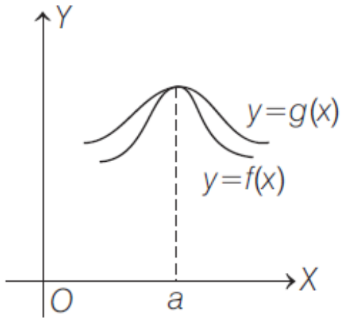
Theorem 1: Let $f$ and $g$ be two real valued functions with the same domain such that $f(x) \leq g(x)$ for all $x$ in the domain of definition. For some real number $a$, if both $\lim _{x \rightarrow a} f(x)$ and $\lim _{x \rightarrow a} g(x)$ exist, then
$
\lim _{x \rightarrow a} f(x) \leq \lim _{x \rightarrow a} g(x) .
$
This is shown in the figure
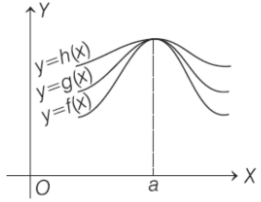
Theorem 2 (Sandwich theorem) : Let $f, g$ and $h$ be real functions such that $f(x) \leq g(x) \leq h(x)$ for all $x$ in the common domain of definition. For some real number $a$, if $\lim _{x \rightarrow a} f(x)=l=\lim _{x \rightarrow a} h(x)$, then $\lim _{x \rightarrow a} g(x)=l$.
This is shown in the figure
Theorem 3 : Three important limits are
(i) $\lim _{x \rightarrow 0} \frac{\sin x}{x}=1$
(ii) $\lim _{x \rightarrow 0} \frac{\frac{x}{1-\cos x}}{x}=0$
(iii) $\lim _{x \rightarrow 0} \frac{\tan ^x x}{x}=1$
Based on above information, answer the following questions.
(i) $\lim _{x \rightarrow 0} \frac{\sin 3 x}{5 x}$ is equal to
(a) $\frac{1}{5}$ (b) $\frac{2}{5}$ (c) $\frac{3}{5}$ (d) $\frac{4}{5}$
(ii) $\lim _{\theta \rightarrow b} \frac{\tan (\theta-b)}{\theta-b}$ is equal to
(a) 0 (b) 1 (c) 2 (d) 3
(iii) $\lim _{x \rightarrow 0} \frac{\tan 2 x-\sin 2 x}{x^3}$ is equal to
(a) 4 (b) 3 (c) 2 (d) 1
(iv) $\lim _{x \rightarrow 0} \frac{2 \sin x-\sin 2 x}{x^3}$ is equal to
(a) 0 (b) 1 (c) 2 (d) 3
(v) $\lim _{x \rightarrow \frac{\pi}{4}} \frac{\sin x-\cos x}{x-\frac{\pi}{4}}$ is equal to
(a) $\sqrt{2}$ (b) 3 (c) 1 (d) $\sqrt{3}$ View full solution →The logarithmic function expressed as $\log _e R^{+} \rightarrow R$ and given by $\log _e x=y$ iff $e^y=x$. The graph of the function is given below :
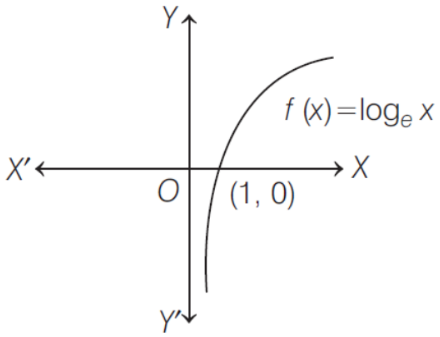
(i) Domain of $f(x)=(0, \infty)$ or $R^{+}$
(ii) Range of $f(x)=(-\infty, \infty)$ or $R$
To find the limit of functions involving logarithmic function, we use the following theorem Theorem $\lim _{x \rightarrow 0} \frac{\log _e(1+x)}{x}=1$
Based on above information, answer the following questions.
(i) $\lim _{x \rightarrow 0} \frac{\log _e(1+5 x)}{x}$ is equal to
(a) 5 (b) 4 (c) 3 (d) 1
(ii) $\lim _{x \rightarrow 0} \frac{\log _e(1+6 x)-5 x^2}{x}$ is equal to
(a) 1 (b) 2 (c) 3 (d) 6
(iii) $\quad \lim _{x \rightarrow 0} \frac{\sqrt{1+x}-1}{\log (1+x)}$ is equal to
(a) 1 (b) $\frac{1}{2}$ (c) $\frac{1}{3}$ (d) $\frac{3}{2}$
(iv) $\quad \lim _{x \rightarrow 5} \frac{\log x-\log 5}{x-5}$ is equal to
(a) $\frac{1}{5}$ (b) $\frac{3}{5}$ (c) $\frac{1}{4}$ (d) $\frac{2}{3}$
(v) $\quad \lim _{x \rightarrow 0} \frac{\log (5+x)-\log (5-x)}{x}$ is equal to
(a) $\frac{1}{5}$ (b) $\frac{2}{5}$ (c) $\frac{3}{5}$ (d) $\frac{4}{5}$ View full solution →A function $f$ is said to be a rational function, if $f(x)=\frac{g(x)}{h(x)}$, where $g(x)$ and $h(x)$ are polynomial functions such that $h(x) \neq 0$.
Then, $\lim _{x \rightarrow a} f(x)=\lim _{x \rightarrow a} \frac{g(x)}{h(x)}$
$
=\frac{\lim _{x \rightarrow a} g(x)}{\lim _{x \rightarrow a} h(x)}=\frac{g(a)}{h(a)}
$
However, if $h(a)=0$, then there are two cases arise,
(i) $g(a) \neq 0$
(ii) $g(a)=0$. In the first case, we say that the limit does not exist.
In the second case, we can find limit.
Based on above information, answer the following questions.
(i) $\lim _{x \rightarrow-1}\left(\frac{x^{10}+x^5+1}{x-1}\right)$ is equal to
(a) $\frac{1}{2}$ (b) $\frac{-1}{2}$ (c) 2 (d) $\frac{3}{2}$
(ii) $\lim _{x \rightarrow-1} \frac{(x-1)^2+3 x^2}{\left(x^4+1\right)^2}$ is equal to
(a) $\frac{7}{4}$ (b) $\frac{6}{5}$ (c) $\frac{4}{7}$ (d) $\frac{3}{4}$
(iii) The value of $\lim _{x \rightarrow 2}\left[\frac{x^2-4}{x^3-4 x^2+4 x}\right]$ is
(a) 0 (b) 1 (c) 2 (d) Does not exist
(iv) $\lim _{x \rightarrow 1} \frac{x^7-2 x^5+1}{x^3-3 x^2+2}$ is equal to
(a) 0 (b) 1 (c) 2 (d) 3
(v) $\lim _{x \rightarrow 0} \frac{\sqrt{1+x^3}-\sqrt{1-x^3}}{x^2}$ is equal to
(a) 1 (b) 0 (c) -1 (d) 2
View full solution →Fill in the blanks.
If $\text{y}=1+\frac{\text{x}}{1!}+\frac{\text{x}^{2}}{2!}+\frac{\text{x}^{3}}{3!}+....$ then ____________.
View full solution →Fill in the blanks.
$\lim\limits_{\pi \rightarrow 0}\Big(\sin\text{mx}\cot\frac{\text{x}}{\sqrt{3}}\Big)=2$ then ___________.
View full solution →Fill in the blanks.
$\lim\limits_{\text{x} \rightarrow 3^{+}}\frac{\text{x}}{[\text{x}]}=$ ___________.
View full solution →Fill in the blanks.
If $\text{f}(\text{x})=\frac{\tan\text{x}}{\text{x}-\pi}$ then $\lim\limits_{\text{x} \rightarrow \pi}\text{f}(\text{x})=$ ____________.
View full solution →