Question 14 Marks
To find the limits of trigonometric functions, we use the following theorems
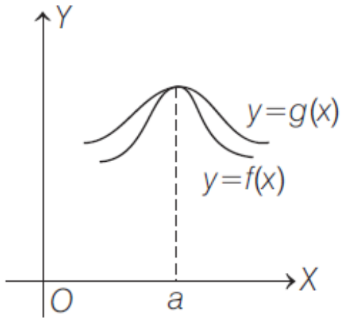
Theorem 1: Let $f$ and $g$ be two real valued functions with the same domain such that $f(x) \leq g(x)$ for all $x$ in the domain of definition. For some real number $a$, if both $\lim _{x \rightarrow a} f(x)$ and $\lim _{x \rightarrow a} g(x)$ exist, then
$
\lim _{x \rightarrow a} f(x) \leq \lim _{x \rightarrow a} g(x) .
$
This is shown in the figure
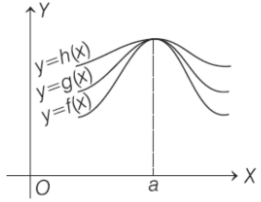
Theorem 2 (Sandwich theorem) : Let $f, g$ and $h$ be real functions such that $f(x) \leq g(x) \leq h(x)$ for all $x$ in the common domain of definition. For some real number $a$, if $\lim _{x \rightarrow a} f(x)=l=\lim _{x \rightarrow a} h(x)$, then $\lim _{x \rightarrow a} g(x)=l$.
This is shown in the figure
Theorem 3 : Three important limits are
(i) $\lim _{x \rightarrow 0} \frac{\sin x}{x}=1$
(ii) $\lim _{x \rightarrow 0} \frac{\frac{x}{1-\cos x}}{x}=0$
(iii) $\lim _{x \rightarrow 0} \frac{\tan ^x x}{x}=1$
Based on above information, answer the following questions.
(i) $\lim _{x \rightarrow 0} \frac{\sin 3 x}{5 x}$ is equal to
(a) $\frac{1}{5}$ (b) $\frac{2}{5}$ (c) $\frac{3}{5}$ (d) $\frac{4}{5}$
(ii) $\lim _{\theta \rightarrow b} \frac{\tan (\theta-b)}{\theta-b}$ is equal to
(a) 0 (b) 1 (c) 2 (d) 3
(iii) $\lim _{x \rightarrow 0} \frac{\tan 2 x-\sin 2 x}{x^3}$ is equal to
(a) 4 (b) 3 (c) 2 (d) 1
(iv) $\lim _{x \rightarrow 0} \frac{2 \sin x-\sin 2 x}{x^3}$ is equal to
(a) 0 (b) 1 (c) 2 (d) 3
(v) $\lim _{x \rightarrow \frac{\pi}{4}} \frac{\sin x-\cos x}{x-\frac{\pi}{4}}$ is equal to
(a) $\sqrt{2}$ (b) 3 (c) 1 (d) $\sqrt{3}$
Theorem 1: Let $f$ and $g$ be two real valued functions with the same domain such that $f(x) \leq g(x)$ for all $x$ in the domain of definition. For some real number $a$, if both $\lim _{x \rightarrow a} f(x)$ and $\lim _{x \rightarrow a} g(x)$ exist, then
$
\lim _{x \rightarrow a} f(x) \leq \lim _{x \rightarrow a} g(x) .
$
This is shown in the figure
Theorem 2 (Sandwich theorem) : Let $f, g$ and $h$ be real functions such that $f(x) \leq g(x) \leq h(x)$ for all $x$ in the common domain of definition. For some real number $a$, if $\lim _{x \rightarrow a} f(x)=l=\lim _{x \rightarrow a} h(x)$, then $\lim _{x \rightarrow a} g(x)=l$.
This is shown in the figure
Theorem 3 : Three important limits are
(i) $\lim _{x \rightarrow 0} \frac{\sin x}{x}=1$
(ii) $\lim _{x \rightarrow 0} \frac{\frac{x}{1-\cos x}}{x}=0$
(iii) $\lim _{x \rightarrow 0} \frac{\tan ^x x}{x}=1$
Based on above information, answer the following questions.
(i) $\lim _{x \rightarrow 0} \frac{\sin 3 x}{5 x}$ is equal to
(a) $\frac{1}{5}$ (b) $\frac{2}{5}$ (c) $\frac{3}{5}$ (d) $\frac{4}{5}$
(ii) $\lim _{\theta \rightarrow b} \frac{\tan (\theta-b)}{\theta-b}$ is equal to
(a) 0 (b) 1 (c) 2 (d) 3
(iii) $\lim _{x \rightarrow 0} \frac{\tan 2 x-\sin 2 x}{x^3}$ is equal to
(a) 4 (b) 3 (c) 2 (d) 1
(iv) $\lim _{x \rightarrow 0} \frac{2 \sin x-\sin 2 x}{x^3}$ is equal to
(a) 0 (b) 1 (c) 2 (d) 3
(v) $\lim _{x \rightarrow \frac{\pi}{4}} \frac{\sin x-\cos x}{x-\frac{\pi}{4}}$ is equal to
(a) $\sqrt{2}$ (b) 3 (c) 1 (d) $\sqrt{3}$
Answer
View full question & answer→(i)
$
\begin{aligned}
\lim _{x \rightarrow 0} \frac{\sin 3 x}{5 x} & =\lim _{x \rightarrow 0} \frac{\sin 3 x}{5 x \times \frac{3}{3}} \\
& =\lim _{x \rightarrow 0} \frac{3}{5} \cdot \frac{\sin 3 x}{3 x} \\
& =\frac{3}{5} \cdot \lim _{3 x \rightarrow 0} \frac{\sin 3 x}{3 x} \\
& {[\text { as } x \rightarrow 0, \text { therefore } 3 x \rightarrow 0] } \\
& =\frac{3}{5} \times 1=\frac{3}{5}\left[\because \lim _{\theta \rightarrow 0} \frac{\sin \theta}{\theta}=1\right]
\end{aligned}
$
(ii)
We have, $\lim _{\theta \rightarrow b} \frac{\tan (\theta-b)}{\theta-b}$
Put $\theta-b=h \Rightarrow \theta=h+b$
Also, when $\theta \rightarrow b$, then $h \rightarrow b$
$
\therefore \lim _{h \rightarrow b} \frac{\tan (\theta-b)}{\theta-b}=\lim _{h \rightarrow 0} \frac{\tan h}{h}=1
$
(iii)
$
\begin{aligned}
& \lim _{x \rightarrow 0} \frac{\tan 2 x-\sin 2 x}{x^3} \\
& =\lim _{x \rightarrow 0} \frac{\frac{\sin 2 x}{\cos 2 x}-\sin 2 x}{x^3} \\
& =\lim _{x \rightarrow 0} \frac{\sin 2 x-\sin 2 x \cdot \cos 2 x}{x^3 \cdot \cos 2 x} \\
& =\lim _{x \rightarrow 0} \frac{\sin 2 x(1-\cos 2 x)}{x^3 \cdot \cos 2 x} \\
& =\lim _{x \rightarrow 0} \frac{\tan 2 x}{x} \cdot \lim _{x \rightarrow 0} \frac{2 \sin ^2 x}{x^2}
\end{aligned}
$
[by using product of limits and
$
\begin{aligned}
& \left.\cos 2 \theta=1-2 \sin ^2 \theta\right] \\
& =2 \cdot \lim _{x \rightarrow 0} \frac{\tan 2 x}{2 x} \times 2 \lim _{x \rightarrow 0}\left(\frac{\sin x}{x}\right)^2 \\
& =2(1) \times 2(1)^2 \\
& =4\left[\because \lim _{x \rightarrow 0} \frac{\sin x}{x}=\lim _{x \rightarrow 0} \frac{\tan x}{x}=1\right]
\end{aligned}
$
(iv)
$
\begin{aligned}
& \lim _{x \rightarrow 0} \frac{2 \sin x-\sin 2 x}{x^3} \\
= & \lim _{x \rightarrow 0} \frac{2 \sin x-2 \sin x \cos x}{x^3} \\
= & {[\because \sin 2 x=2 \sin x \cos x] } \\
= & \lim _{x \rightarrow 0} \frac{2 \sin x(1-\cos x)}{x^3} \\
= & 2 \lim _{x \rightarrow 0} \frac{\sin x}{x} \cdot \lim _{x \rightarrow 0}\left(\frac{1-\cos x}{x^2}\right) \\
= & 2 \cdot 1 \lim _{x \rightarrow 0} \frac{1-\cos x}{x^2}\left[\because \lim _{x \rightarrow 0} \frac{\sin x}{x}=1\right]
\end{aligned}
$
$\begin{aligned} & =2 \lim _{x \rightarrow 0} \frac{2 \sin ^2 \frac{x}{2}}{4 \times \frac{x^2}{4}} \\ & =\frac{2 \cdot 2}{4} \lim _{x \rightarrow 0}\left(\frac{\sin \frac{x}{2}}{\frac{x}{2}}\right)^2=\lim _{x \rightarrow 0}\left(\frac{\sin \frac{x}{2}}{\frac{x}{2}}\right)^2=1\end{aligned}$
(v)
Given,
$
\begin{aligned}
& \lim _{x \rightarrow \pi / 4} \frac{\sqrt{2}\left(\sin x \cdot \frac{1}{\sqrt{2}}-\cos x \cdot \frac{1}{\sqrt{2}}\right)}{\left(x-\frac{\pi}{4}\right)} \\
& =\lim _{x \rightarrow \pi / 4} \frac{\sqrt{2}\left(\sin x \cos \frac{\pi}{4}-\cos x \cdot \sin \frac{\pi}{4}\right)}{\left(x-\frac{\pi}{4}\right)}
\end{aligned}
$
$
\begin{aligned}
& =\lim _{x \rightarrow \pi / 4} \frac{\sqrt{2}\left\{\sin \left(x-\frac{\pi}{4}\right)\right\}}{\left(x-\frac{\pi}{4}\right)} \\
& |\because \sin A \cos B-\cos A \sin B=\sin (A-B)| \\
& =\sqrt{2} \lim _{x-\frac{\pi}{4} \rightarrow 0} \frac{\sin \left(x-\frac{\pi}{4}\right)}{\left(x-\frac{\pi}{4}\right)}=\sqrt{2} \\
& {\left[\because x \rightarrow \frac{\pi}{4} \Rightarrow\left(x-\frac{\pi}{4}\right) \rightarrow 0 \text { and } \lim _{x \rightarrow 0} \frac{\sin x}{x}=1\right]}
\end{aligned}
$
$
\begin{aligned}
\lim _{x \rightarrow 0} \frac{\sin 3 x}{5 x} & =\lim _{x \rightarrow 0} \frac{\sin 3 x}{5 x \times \frac{3}{3}} \\
& =\lim _{x \rightarrow 0} \frac{3}{5} \cdot \frac{\sin 3 x}{3 x} \\
& =\frac{3}{5} \cdot \lim _{3 x \rightarrow 0} \frac{\sin 3 x}{3 x} \\
& {[\text { as } x \rightarrow 0, \text { therefore } 3 x \rightarrow 0] } \\
& =\frac{3}{5} \times 1=\frac{3}{5}\left[\because \lim _{\theta \rightarrow 0} \frac{\sin \theta}{\theta}=1\right]
\end{aligned}
$
(ii)
We have, $\lim _{\theta \rightarrow b} \frac{\tan (\theta-b)}{\theta-b}$
Put $\theta-b=h \Rightarrow \theta=h+b$
Also, when $\theta \rightarrow b$, then $h \rightarrow b$
$
\therefore \lim _{h \rightarrow b} \frac{\tan (\theta-b)}{\theta-b}=\lim _{h \rightarrow 0} \frac{\tan h}{h}=1
$
(iii)
$
\begin{aligned}
& \lim _{x \rightarrow 0} \frac{\tan 2 x-\sin 2 x}{x^3} \\
& =\lim _{x \rightarrow 0} \frac{\frac{\sin 2 x}{\cos 2 x}-\sin 2 x}{x^3} \\
& =\lim _{x \rightarrow 0} \frac{\sin 2 x-\sin 2 x \cdot \cos 2 x}{x^3 \cdot \cos 2 x} \\
& =\lim _{x \rightarrow 0} \frac{\sin 2 x(1-\cos 2 x)}{x^3 \cdot \cos 2 x} \\
& =\lim _{x \rightarrow 0} \frac{\tan 2 x}{x} \cdot \lim _{x \rightarrow 0} \frac{2 \sin ^2 x}{x^2}
\end{aligned}
$
[by using product of limits and
$
\begin{aligned}
& \left.\cos 2 \theta=1-2 \sin ^2 \theta\right] \\
& =2 \cdot \lim _{x \rightarrow 0} \frac{\tan 2 x}{2 x} \times 2 \lim _{x \rightarrow 0}\left(\frac{\sin x}{x}\right)^2 \\
& =2(1) \times 2(1)^2 \\
& =4\left[\because \lim _{x \rightarrow 0} \frac{\sin x}{x}=\lim _{x \rightarrow 0} \frac{\tan x}{x}=1\right]
\end{aligned}
$
(iv)
$
\begin{aligned}
& \lim _{x \rightarrow 0} \frac{2 \sin x-\sin 2 x}{x^3} \\
= & \lim _{x \rightarrow 0} \frac{2 \sin x-2 \sin x \cos x}{x^3} \\
= & {[\because \sin 2 x=2 \sin x \cos x] } \\
= & \lim _{x \rightarrow 0} \frac{2 \sin x(1-\cos x)}{x^3} \\
= & 2 \lim _{x \rightarrow 0} \frac{\sin x}{x} \cdot \lim _{x \rightarrow 0}\left(\frac{1-\cos x}{x^2}\right) \\
= & 2 \cdot 1 \lim _{x \rightarrow 0} \frac{1-\cos x}{x^2}\left[\because \lim _{x \rightarrow 0} \frac{\sin x}{x}=1\right]
\end{aligned}
$
$\begin{aligned} & =2 \lim _{x \rightarrow 0} \frac{2 \sin ^2 \frac{x}{2}}{4 \times \frac{x^2}{4}} \\ & =\frac{2 \cdot 2}{4} \lim _{x \rightarrow 0}\left(\frac{\sin \frac{x}{2}}{\frac{x}{2}}\right)^2=\lim _{x \rightarrow 0}\left(\frac{\sin \frac{x}{2}}{\frac{x}{2}}\right)^2=1\end{aligned}$
(v)
Given,
$
\begin{aligned}
& \lim _{x \rightarrow \pi / 4} \frac{\sqrt{2}\left(\sin x \cdot \frac{1}{\sqrt{2}}-\cos x \cdot \frac{1}{\sqrt{2}}\right)}{\left(x-\frac{\pi}{4}\right)} \\
& =\lim _{x \rightarrow \pi / 4} \frac{\sqrt{2}\left(\sin x \cos \frac{\pi}{4}-\cos x \cdot \sin \frac{\pi}{4}\right)}{\left(x-\frac{\pi}{4}\right)}
\end{aligned}
$
$
\begin{aligned}
& =\lim _{x \rightarrow \pi / 4} \frac{\sqrt{2}\left\{\sin \left(x-\frac{\pi}{4}\right)\right\}}{\left(x-\frac{\pi}{4}\right)} \\
& |\because \sin A \cos B-\cos A \sin B=\sin (A-B)| \\
& =\sqrt{2} \lim _{x-\frac{\pi}{4} \rightarrow 0} \frac{\sin \left(x-\frac{\pi}{4}\right)}{\left(x-\frac{\pi}{4}\right)}=\sqrt{2} \\
& {\left[\because x \rightarrow \frac{\pi}{4} \Rightarrow\left(x-\frac{\pi}{4}\right) \rightarrow 0 \text { and } \lim _{x \rightarrow 0} \frac{\sin x}{x}=1\right]}
\end{aligned}
$