Questions · Page 3 of 3

1 Marks Question

Question 1011 Mark
Is the Kepler's law kinematic?
Answer
Yes, because kepler's third law is the relation between distance and time.
View full question & answer
Question 1021 Mark
Compare the weights of stone when it is $\frac{1}{2}\text{km}$ above the surface of earth and 1km below the surface of earth.
Answer
$\frac{\text{W}_{\text{h}}}{\text{W}_{\text{d}}}=\frac{1-\frac{2\text{h}}{\text{R}}}{1-\frac{\text{d}}{\text{R}}}$ $=\frac{1-\frac{2\Big(\frac{1}{2}\Big)}{\text{R}}}{1-\frac{1}{\text{R}}}=1$
View full question & answer
Question 1031 Mark
What is the amount of work done in bringing a mass from the surface of Earth on one side to a point diametrically opposite to the other side?
Answer
Since gravitational potential difference is zero therefore the work done is zero.
View full question & answer
Question 1041 Mark
Choose the correct alternative: Acceleration due to gravity increases/ decreases with increasing altitude.
Answer
Decreases.
View full question & answer
Question 1051 Mark
Two particles of masses m, and m, attract each other gravitationally and are set in motion under the influence of the gravitational force? Will the centre of mass move?
Answer
Since, gravitational force is an internal force, therefore the centre of mass would not move.
View full question & answer
Question 1061 Mark
Where does a body weigh more at the surface of the earth or in a mine?
Answer
Since value of g in a mine is lesser than at the surface of the Earth, so weight of body in a mine is lesser than the weight of the body on the surface of the earth.
View full question & answer
Question 1071 Mark
What is the gravitational field at a point inside a spherical shell?
Answer
Since no mass is enclosed, gravitational field is zero.
View full question & answer
Question 1081 Mark
Give two characteristics of gravitational force.
Answer
  1. Conservative force.
  2. Acts on the line joining the masses.
View full question & answer
Question 1091 Mark
What is parking orbit?
Answer
The orbit at which the satellite will remain static according to earth (as a frame).
View full question & answer
Question 1101 Mark
Does the speed of a satellite remain constant in a particular orbit (circular)?
Answer
Yes, as $\text{v}=\sqrt{\frac{\text{GM}}{\text{r}}},\text{v}$ depends only upon r. For a particular orbit, r is constant and so is v.
View full question & answer
Question 1111 Mark
Give two uses of polar satellites.
Answer
They are used for,
  1. Ground water survey.
  2. Detecting the areas under forest.
View full question & answer
Question 1121 Mark
What do you mean by a parking orbit of a satellite?
Answer
The orbit of a satellite which is concentric and coplanar with the equatorial plane of Earth and having a revolution period of 24 hours is called a parking orbit.
View full question & answer
Question 1131 Mark
The gravitational Potential energy of a body at a point in a gravitational field of another body is $-\frac{\text{GMm}}{\text{r}}$ What does the negative sign show?
Answer
Negative sign means that the mass m is bound to M.
View full question & answer
Question 1141 Mark
Two planets are at distances $\text{R}_1$ and $\text{R}_2$ from the Sun. What will be the ratio of the squares of their periods?
Answer
$\frac{\text{R}_1^3}{\text{R}_2^3}.$
View full question & answer
Question 1151 Mark
Acceleration due to gravity above earth surface at height his same as below earth surface at distance _________.
Answer
Acceleration due to gravity above earth surface at height his same as below earth surface at distance 2h.
View full question & answer
Question 1161 Mark
How does the orbital velocity of a satellite depend on the mass of the satellite?
Answer
Independent of mass.
View full question & answer
Question 1171 Mark
List one difference and one similarity between gravitational and inertial mass.
Answer
Similarity-Both are equal. Difference-Gravitational mass is measured by using comparison of mass by force, but inertial mass measured by the acceleration caused by the force.
View full question & answer
Question 1181 Mark
What is the relation between the orbital and escape velocity?
Answer
If $\text{v}_\text{e}$ is escape and $\text{v}_0$ is orbital velocity, then $\text{v}_\text{e}=\sqrt{2}\text{v}_0$
View full question & answer
Question 1191 Mark
The gravitational force between two spheres is x when the distance between their centers is y. What will be the new force if the separation is made 3y?
Answer
Since $\text{F}\propto\frac{1}{\text{r}^2}.$ Therefore, if r is increased by a factor of 3. F will be reduced by a factor of 9. Thus, the new force will be $\frac{\text{x}}{9}.$
View full question & answer
Question 1201 Mark
Choose the correct alternative: Acceleration due to gravity is independent of mass of the earth/ mass of the body.
Answer
Mass of the body.
View full question & answer
Question 1211 Mark
What would happen to an artificial satellite, if its orbital velocity is slightly decreased due to some defects in it?
Answer
It will fall onto the Earth.
View full question & answer
Question 1221 Mark
The value of G on the surface of earth is $6.6710^{-11} \mathrm{Nm}^2 \mathrm{~kg}^{-2}$. What is its value on the surface of the moon?
Answer
G is universal constant. So there will be no change.
View full question & answer
Question 1231 Mark
Relation between escape velocity $\text{v}_\text{e}$ and orbital velocity $\text{v}_0$ is __________.
Answer
Relation between escape velocity $\text{v}_\text{e}$ and orbital velocity $\text{v}_0$ is $\text{v}_{\text{e}}=\sqrt{2}\text{v}_0$
View full question & answer
Question 1241 Mark
Choose the correct alternative: Acceleration due to gravity increases/ decreases with increasing depth (assume the earth to be a sphere of uniform density).
Answer
Decreases.
View full question & answer
Question 1261 Mark
Give the dimensional formula of 'g' and 'G'.
Answer
Dimensional formula of ' $\mathrm{g}$ ' $\rightarrow\left[\mathrm{LT}^{-2}\right]$ Dimensional formula of ' $\mathrm{G}$ ' $\rightarrow\left[\mathrm{M}^{-1} \mathrm{~L}^3 \mathrm{~T}^{-2}\right]$
View full question & answer
Question 1271 Mark
Express the constant $k$ of Eq. $(7.38)$ in days and kilometres. Given $k =10^{-13} s ^2 m ^{-3}$. The moon is at a distance of $3.84 \times 10^5 \ km$ from the earth. Obtain its time-period of revolution in days.
Answer
Given
$k=10^{-13} s ^2 m ^{-3}$
$=10^{-13}\left[\frac{1}{(24 \times 60 \times 60)^2} d ^2\right]\left[\frac{1}{(1 / 1000)^3 \ km ^3}\right]$
$=1.33 \times 10^{-14} d ^2 \ km ^{-3}$
Using Eq. $(7.38)$ and the given value of $k,$ the time period of the moon is
$T^2=\left(1.33 \times 10^{-14}\right)\left(3.84 \times 10^5\right)^3$
$T=27.3 d$
View full question & answer
Question 1281 Mark
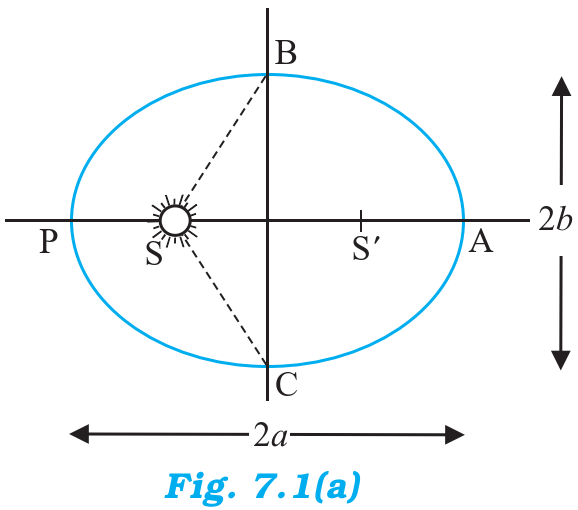
Let the speed of the planet at the perihelion $P$ in Fig. $7.1 (a)$ be $v_p$ and the Sun-planet distance $SP$ be $r_p$ Relate $\left\{r_P, V_P\right\}$ to the corresponding quantities at the aphelion $\left\{r_A, V_A\right\}$. Will the planet take equal times to traverse $\text{B A C}$ and $\text{C P B}$ ?
Image
Answer
The magnitude of the angular momentum at $P$ is $L_p=m_p r_p V_p$, since inspection tells us that $r _p$ and $v _p$ are mutually perpendicular.
Similarly, $L_A=m_p r_A V_A$.
From angular momentum conservation
$m_p r_p V_p=m_p r_A V_A$
$\text { or } \frac{v_p}{v_A}=\frac{r_A}{r_p}$
View full question & answer
1 Marks Question - Page 3 - Physics STD 11 Science Questions - Vidyadip