Questions · Page 1 of 2

2 Marks Questions

Take a timed test

50 questions · self-marked practice — reveal the answer and mark yourself.

Question 12 Marks
Choose the correct alternative: If the zero of potential energy is at infinity, the total energy of an orbiting satellite is negative of its kinetic/ potential energy.
Answer
Kinetic energy.Explanation:
Total mechanical energy of a satellite is the sum of its kinetic energy (always positive) and potential energy (may be negative). At infinity, the gravitational potential energy of the satellite is zero. As the Earth-satellite system is a bound system, the total energy of the satellite is negative. Thus, the total energy of an orbiting satellite at infinity is equal to the negative of its kinetic energy.
View full question & answer
Question 22 Marks
Answer the following: An astronaut inside a small space ship orbiting around the earth cannot detect gravity. If the space station orbiting around the earth has a large size, can he hope to detect gravity?
Answer
Yes, Astronaut can hope to detect gravity if the size of th e spaceship is extremely large, then the magnitude of the gravity will become appreciable and hence the gravitational effect of the spaceship may been me measurable.
View full question & answer
Question 32 Marks
Answer the following: You can shield a charge from electrical forces by putting it inside a hollow conductor. Can you shield a body from the gravitational influence of nearby matter by putting it inside a hollow sphere or by some other means?
Answer
No. Electrical forces depend upon the nature of the intervening medium while the gravitational forces don’t depend upon the nature of the intervening medium. So, such shielding acts are not possible in case of gravitation i.e., gravity screens are not possible.
View full question & answer
Question 42 Marks
Answer the following: If you compare the gravitational force on the earth due to the sun to that due to the moon, you would find that the Sun’s pull is greater than the moon’s pull. (you can check this yourself using the data available in the succeeding exercises). However, the tidal effect of the moon’s pull is greater than the tidal effect of sun. Why?
Answer
Earth moon distance is very small as compared to earth-sun distance. Tidal effect is inversely proportional to the cube of the distance it means it is not governed by inverse square law like the gravitational force (which obeys inverse square law). Hence, tidal effect of moon is larger than that due to the sun.
View full question & answer
Question 52 Marks
Define gravitational field strength. What is the field at a point distance r from a mass M?
Answer
Gravitational field strength is defined as the force experienced by unit mass kept at a point. At a distance r, the force is $\text{F}=\frac{\text{GMm}}{\text{r}^2}$ The gravitational field $\frac{\text{F}}{\text{m}}=\frac{\text{GMm}}{\text{r}^2\text{m}}=\frac{\text{GM}}{\text{r}^2}$
View full question & answer
Question 62 Marks
We can shield a charge from electric fields by putting it inside a hollow conductor. Can we shield a body from the gravitational influence of nearby matter by putting it inside a hollow sphere or by some other means?
Answer
The gravitational force does not depend upon the nature of the medium, but the electric force depends on the intervening medium between the charge and the electric field. So we cannot shield a body from the gravitational force.
View full question & answer
Question 72 Marks
What is a geostationary satellite? Is it same as geo synchronous satellite?
Answer
If the revolution period of a satellite is same as that of the earth, it is called a geo-stationary satellite. Yes, geo-synchronous satellites are geo-stationary satellites.
View full question & answer
Question 82 Marks
Under what circumstances would your weight become zero?
Answer
The weight will become zero under the following circumstances:
  1. During free fall.
  2. At the centre of the earth.
  3. In an artificial satellite.
  4. At a point where gravitational pull of earth is equal to the gravitational pull of the Moon.
View full question & answer
Question 92 Marks
A satellite is revolving just near the Earth's surface. Compute its orbital velocity. Given that radius of Earth $\mathrm{R}= 6400 km $ and $3=9.8 \mathrm{~ms}^{-2}$.
Answer
For a satellite revolving just near the Earth's surface, the orbital velocity has a magnitude given by, $\text{v}_\text{orb}=\sqrt{\text{gR}}$ $\therefore\ \text{v}_\text{orb}=\sqrt{9.8\times6400\times1000}$ $=7.92\times10^3\text{ms}^{-1}$ $=7.92\text{km s}^{-1}$
View full question & answer
Question 102 Marks
If the earth stops rotating about its own axis, what is the effect on the value of weight of any object on the surface of earth?
Answer
If the earth stops rotating, the weight of the object increases due to absence of centrifugal force. However, the weight at the poles remains the same.
View full question & answer
Question 112 Marks
The escape velocity v of a body depends upon:
  1. The acceleration due to gravity $'g\ '$ of the planet.
  2. The radius of the planet $'R\ '.$
Establish dimensionally the relationship between them.
Answer
$\text{v}\propto\text{g}^{\text{a}}\text{R}^{\text{b}}$
$[\text{LT}_{-1}]=\text{K}[\text{LT}^{-2}]^\text{a}[\text{L}]^{\text{b}}$
$\text{a}=\frac{1}{2},\text{b}=\frac{1}{2}$ $\text{K}=\sqrt{2}$
$\therefore\text{v}=\sqrt{2\text{gR}}$
View full question & answer
Question 122 Marks
A spherical planet has mass $\text{M}_p$ and diameter $\text{D}_p$. A particle of mass m falling freely near the surface of this planet will experience an acceleration due to gravity, equal to whom?
Answer
Force is given by, $\text{F}=\frac{\text{GM}_\text{e}}{\text{R}^2}=\frac{\text{GM}_\text{P}\text{m}}{\Big(\frac{\text{D}_\text{P}}{2}\Big)}=\frac{4\text{GM}_\text{P}\text{m}}{\text{D}^2_\text{P}}$ $\frac{\text{F}}{\text{m}}=\frac{4\text{GM}_\text{P}}{\text{D}^2_\text{P}}$
View full question & answer
Question 132 Marks
Why does the earth have an atmosphere and the moon does not?
Answer
The escape velocity from the earth surface is about 11.2km/sec which is greater than the r.m.s. velocity of the air molecules. The escape velocity from the moon's surface is about 2.4km/sec which is less than the r.m.s. velocity of the air molecules. Hence, the earth has an atmosphere and the moon does not.
View full question & answer
Question 142 Marks
A 10kg mass is to be divided into two parts, such that the force of attraction between them is maximum. What is the mass of each portion?
Answer
Let m kg and (10 - m) kg be the mass of two parts separated by a distance r. The force is $\text{F}=\frac{\text{Gm}(10-\text{m})}{\text{r}^2}$ For force to be maximum, $\frac{\text{dF}}{\text{dm}}=0$ $\therefore\frac{\text{G}}{\text{r}^2}[\text{m}(-1)+(10-\text{m}\times1)=0]$ $\therefore\text{m}=10-\text{m}$ $\therefore\text{m}=5\text{kg}$
View full question & answer
Question 152 Marks
Imagine what would happen if the value of $G$ becomes:
  1. $100$ times of its present value.
  2. Times of its present value.
Answer
  1. Earth's attraction would be so large that you would be crushed to the earth.
  2. Earth's attraction would be so less that we can easily jump from the top of a multi$-$storey building.
View full question & answer
Question 162 Marks
If the choice of origin is shifted, what is the change in $(i)$ Gravitational potential $(ii)$ Potential energy?
Answer
  1. Remains dependent on the choice of origin.
  2. Potential energy is independent since it depends only on separation.
View full question & answer
Question 172 Marks
Determine the speed with which the earth would have to rotate on its axis so that a person on the equator would weigh 3/5th as much as at present. Take the equatorial radius as 6400km.
Answer
Acceleration due to gravity at the equator is, $\text{g}_\text{e}=\text{g}-\text{R}\omega^2$ $\text{mg}_\text{e}=\text{mg}-\text{mR}\omega^2$ $\frac35\text{mg}=\text{mg}-\text{mR}\omega^2$ $\Big[\because\text{mg}_\text{e}=\frac35\text{mg}\Big]$ $\therefore\omega=\sqrt{\frac{2\text{g}}{5\text{R}}}=\sqrt{\frac{2\times9.8}{6\times6400\times10^3}}=7.8\times10^{-4}\text{rad/s}$
View full question & answer
Question 182 Marks
Show that the orbital velocity of a satellite revolving the earth is $7.92\text{km s}^{-1}$.
Answer
Orbital velocity, $\text{v}_0=\sqrt{\text{gR}}$ $=\sqrt{9.8\times6.4\times10^6}=7.92\text{km s}^{-1}$
View full question & answer
Question 192 Marks
The radii of two planets are R and 2R respectively and their densities $\rho\text{ and }\frac{\rho}{2}$ respectively. What is the ratio of acceleration due to gravity at their surfaces?
Answer
$\text{g}=\frac{\text{GM}}{\text{R}^2}=\frac{\text{g}\frac{4}{3}\pi\text{R}^3\rho}{\text{R}^2}=\text{g}\frac{4}{3}\pi\text{R}\rho$ $\therefore\frac{\text{g}_1}{\text{g}_2}=\frac{\text{R}}{2\text{R}}.\frac{\rho}{\frac{\rho}{2}}=1$ $\therefore\text{g}_1:\text{g}_2=1:1$
View full question & answer
Question 202 Marks
The escape speed on the earth is 11.2km/ s.What is its value for a planet having double the radius and eight times the mass of the earth?
Answer
$v_p$ (escap speed on a planet) $=\sqrt{\frac{\text{GM}_\text{p}}{\text{R}_\text{p}}}$ $v_e$ (escape speed on the earth) $=\sqrt{\frac{\text{GM}_\text{e}}{\text{R}_\text{e}}}$ Clearly, $\frac{\text{v}_\text{p}}{\text{v}_\text{e}}=\sqrt{\frac{\text{M}_\text{p}}{\text{M}_\text{e}}\times\frac{\text{R}_\text{e}}{\text{R}}_\text{p}}=\sqrt{8\times\frac12}=2$ $\text{v}_\text{p}=2\text{v}_\text{e}22.4\text{km/s}$
View full question & answer
Question 212 Marks
The binding energy of a particle of mass m attached with the earth of mass M and radius R is $\frac{\text{GMm}}{\text{R}}.$ How much energy must be supplied to the particle so that it may escape the gravitational field of the earth? In what form this energy is supplied to the particle?
Answer
The particle will escape the gravitational field of the earth if the energy supplied to it is R equal to its binding energy. Thus, energy supplied to the particle $=\frac{\text{GMm}}{\text{R}}.$ This energy is supplied in the form of the kinetic energy of the particle.
View full question & answer
Question 222 Marks
A planet moving along an elliptical orbit is closest to the Sun at a distance $r_1$ and farthest away at a distance of $r_2$. If $v_1$ and $v_2$ are the linear velocities at these points respectively, then find the ratio $\frac{\text{v}_1}{\text{v}_2}.$
Answer
From the law of conservation of angular momentum, $\text{mr}_1\text{v}=\text{mr}_2\text{v}_2$ $\Rightarrow\text{r}_1\text{v}_1=\text{r}_2\text{v}_2$ $\frac{\text{v}_1}{\text{v}_2}=\frac{\text{r}_2}{\text{r}_2}$
View full question & answer
Question 232 Marks
Jf the kinetic energy of a satellite revolving around the earth in any orbit is doubled, then what will happen to it?
Answer
The total energy of a satellite in any orbit, E = -K, where K is its KE in that orbit. If its kinetic energy is doubled, i.e. an additional kinetic energy (K) is given to it, E = -K + K = 0 and the satellite will leave its orbit and go to infinity.
View full question & answer
Question 242 Marks
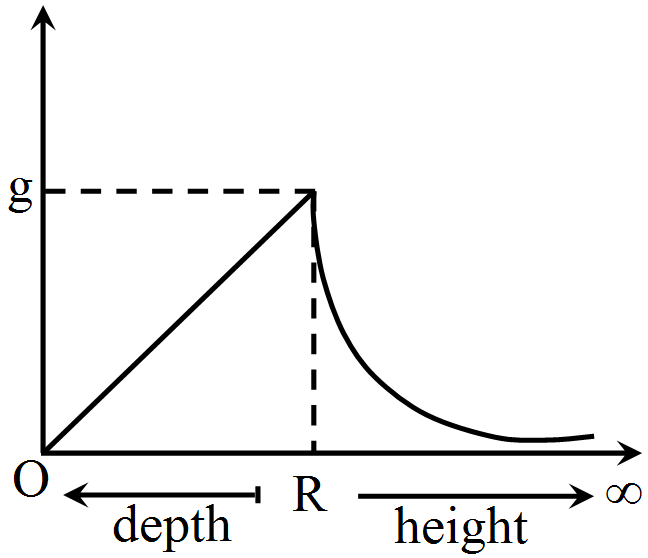
Discuss the variation of $'g\ '$
  1. Due to height.
  2. Due to depth.
Answer
  1. $\text{g}=\text{g}\Big(1-\frac{2\text{h}}{\text{R}}\Big)$
  2. $\text{g}'=\text{g}\Big(1-\frac{\text{d}}{\text{R}}\Big)$

The value of $g$ decreases both on moving up and on moving down from the surface of earth. This can be shown graphically as above.
View full question & answer
Question 252 Marks
What is the acceleration due to gravity at the bottom of a sea 30km deep taking radius of the earth as 6.3 × 10km?
Answer
$\text{g}'=\text{g}\Big(1-\frac{\text{d}}{\text{R}}\Big)$ $=9.8\Big(1-\frac{30\times1000}{6.3\times(1000)^2}\Big) $ $=9.8\Big(1-\frac{1}{210}\Big)$ $=9.8\Big(\frac{209}{210}\Big)=9.75\text{ms}^{-2}$
View full question & answer
Question 262 Marks
What are the conditions under which a rocket fired from the earth, launches an artificial satellite of earth?
Answer
  1. Velocity acquired is more than the escape velocity to go out in space.
  2. Provide sufficient velocity to move in a path of its own.
View full question & answer
Question 272 Marks
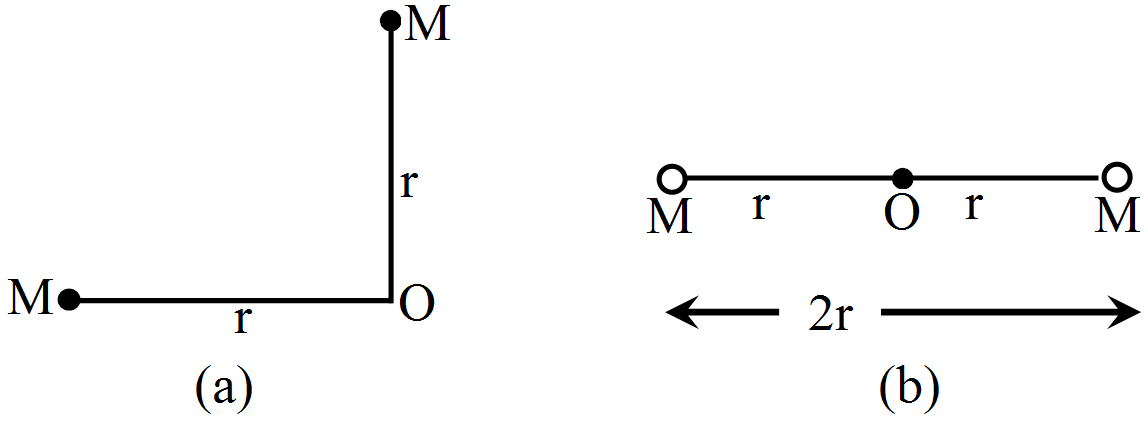
The masses M in the two figures are identical. Which of the two systems has the smaller gravitational potential energy? Why?
Answer
The first system has the outer most masses closer to each other than the second system. Hence the gravitational P.E. of the second system is lesser than that of the first system.
View full question & answer
Question 282 Marks
Determine the speed with which the earth has to rotate on its axis so that a person on the equator weigh $\Big(\frac{3}{5}\Big)^{\text{th}}$ as much as at present. Take the equatorial radius as 6400km.
Answer
$\text{Here, W = mg}$ $\text{and }\text{W}'=\Big(\frac{3}{5}\Big)\text{mg}$ $\text{As W}'=\text{W}-\text{mR}\omega^2$ $\text{So},\frac{3}{5}\text{mg}=\text{mg}-\text{m}\text{R}\omega^2$ $\text{or }\text{mR}\omega^2=\text{mg}-\frac{3}{5}\text{mg}=\frac{2}{5}\text{mg}$ $\text{or }\omega=\sqrt{\frac{2\text{g}}{5\text{R}}}=\sqrt{\frac{2\times9.8}{5\times6400\times10^3}}$ $=4.315\times10^{-4}\text{rad/s}.$
View full question & answer
Question 292 Marks
The asteroid pallas has an orbital period of 4.62 year. Find the semi-major axis of its orbit. Given, $\mathrm{G}=6.67 \times 10^{-}$ ${ }^{11} \mathrm{Nm}^2 \mathrm{~kg}^{-2}$, Mass of the sun $=1.99 \times 10^{30} \mathrm{~kg}$ and 1 year $=3.156 \times 10^7 \mathrm{~s}$
Answer
$\text{T}^2=\frac{4\pi^2\text{a}^3}{\text{GM}_\text{s}}$$\text{a}=\Big[\frac{\text{GM}_\text{s}\text{T}^2}{4\pi^2}\Big]^\frac{1}{3}$
Substituting values, we get
$a = 4.15 \times 10^{11}m$
View full question & answer
Question 302 Marks
The earth is acted upon by the gravitational attraction of the sun. Why don't the earth fall into the sun?
Answer
The earth is orbiting round the sun in a stable orbit (nearly circular) such that the gravitational attraction of the sun just provides the required centripetal force to the earth for its orbital motion. So, net force on the earth is zero and consequently, the earth does not fall into the sun.
View full question & answer
Question 312 Marks
The orbiting velocity of an earth-satellite is 8km s. What will be the escape velocity?
Answer
Escape velocity, $\text{v}_\text{e}=\sqrt{2}\text{v}_0$ $\text{v}_\text{e}=\sqrt2\times8=11.31\text{km s}^{-1}$
View full question & answer
Question 322 Marks
Calculate the gravitational force which Sun exerts on Jupiter.
Answer
Given: $G = 6.67 \times 10^{-11}Nm^2/ kg^2 M_J = 1.9 \times 10^{27}kg M_s = 1.99 \times 10^{30}kg$ Mean distance = $7.8 \times 10^{+11}m$
$\text{F}_\text{g}=\frac{\text{GM}_{\text{S}}\text{M}_\text{J}}{\text{r}^2}$ $=\frac{6.67\times10^{-11}\times1.99\times10^{30}\times1.9\times10^{27}}{(7.8\times10^{11})^2}$ $=4.145\times10^{23}\text{N}$
View full question & answer
Question 332 Marks
Is it possible to place a satellite, so that it is always over New Delhi? Why?
Answer
No, generally the geo-stationary satellites will be in the equatorial plane. Since New Delhi does not lie in this plane, it is not possible.
View full question & answer
Question 342 Marks
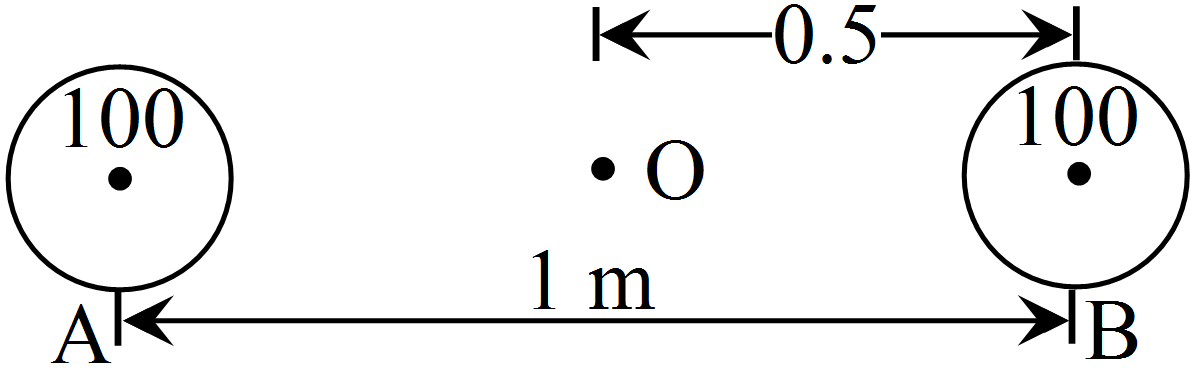
Two masses each of 100kg are separated by 1 metre. Find the gravitational (i) field (ii) potential at the mid-point of the line joining them.
Answer
Gravitational field strength is the force experienced by unit mass kept at a point. Since it is a vector, we have to add vectorially.
$\therefore\text{E}_{\text{g0}}=\text{E}_{\text{gA}}+\text{E}_{\text{gB}}=0,$ Since the masses are equal and separation is same.
But gravitational potential $=-\frac{\text{Gm}}{\text{r}}$
Potential at O (mid-point) $=-\frac{\text{G}\times100}{0.5}-\frac{\text{G}\times100}{0.5}$
$=-\frac{200\text{G}}{0.5}=-400\text{G }\text{J/m}$
View full question & answer
Question 352 Marks
If suddenly the gravitational force of attraction between the earth and a satellite revolving around it becomes zero, what will happen to the satellite?
Answer
Satellite will move tangentially with constant speed equal to its orbital velocity at the time the force ceases to act.
View full question & answer
Question 362 Marks
How can you find the mass of earth, starting from the law of gravitation?
Answer
From law of gravitation, $\text{F} =\frac{\text{GMm}}{\text{r}^2}$If m is a mass on the surface of earth of radius R. The acceleration of the mass m on the surface of earth is g. $\therefore$ Force experienced F = mg Using the two forces we have, $\text{M}=\frac{\text{gR}^2}{\text{G}}$
View full question & answer
Question 372 Marks
A small mass is released by an astronaut in a satellite in space. Will it fall on the earth?
Answer
The orbit of the satellite is independent of its mass. The released mass will continue to orbit the earth as a satellite and hence, will not fall on the earth.
View full question & answer
Question 382 Marks
How far above the earth's surface does the value of g becomes 20% of its value on the surface?
Answer
$\frac{\text{g}'}{\text{g}}=\frac{20}{100},\text{g}'=\text{g}\frac{20}{100}$ $=\text{g}\Big(1-\frac{2\text{h}}{\text{R}}\Big)$ $\frac{20}{100}=\Big(1-\frac{2\text{h}}{\text{R}}\Big),\frac{1}{5}$ $=1-\frac{2\text{h}}{\text{R}}$ $\frac{2\text{h}}{\text{R}}=\frac{4}{5},\text{h}=\frac{2}{5}\text{R}.$
View full question & answer
Question 392 Marks
A satellite does not need any fuel to circle around the earth. Why?
Answer
The gravitational force between satellite and the earth provides the centripetal force required by the satellite to move in a circular orbit. The satellite orbits around earth at such a higher height where air friction is neglible.
View full question & answer
Question 402 Marks
For a satellite orbiting in an orbit, close to the surface of earth, to escape, what is the percentage increase in the kinetic energy required?
Answer
Orbital velocity for close to earth orbits $=\sqrt{\text{gR}}$ Escape velocity required $=\sqrt{2\text{gR}}$ % Increase required $=\frac{\text{v}_{\text{e}}-\text{v}_{\text{o}}}{\text{v}_{\text{o}}}\times100$ $=\frac{\sqrt{\text{gR}(\sqrt{2}-1)}}{\sqrt{\text{gR}}}\times100=41.4\%$
View full question & answer
Question 412 Marks
Choose the correct alternative: If the zero of potential energy is at infinity, the total energy of an orbiting satellite is negative of its kinetic/ potential energy.
Answer
Kinetic energy.Explanation:
Total mechanical energy of a satellite is the sum of its kinetic energy (always positive) and potential energy (may be negative). At infinity, the gravitational potential energy of the satellite is zero. As the Earth-satellite system is a bound system, the total energy of the satellite is negative. Thus, the total energy of an orbiting satellite at infinity is equal to the negative of its kinetic energy.
View full question & answer
Question 422 Marks
The speed of a plane at the perihelion is v, and the radius at perihelion is $r_p$. At aphelion $r_a$, what will be the speed?
Answer
Since angular momentum L has to be conserved, L = mvr = constant. For a given planet, $\text{v}_{\text{p}}\text{r}_{\text{p}}=\text{v}_{\text{a}}\text{r}_{\text{a}}$ $\therefore\text{v}_{\text{a}}=\frac{\text{v}_{\text{p}}\text{r}_{\text{p}}}{\text{r}_{\text{a}}}$
View full question & answer
Question 432 Marks
A mass of 1g is separated from another mass of 1g by a distance of 1cm. How many g-wt of force exists between them?
Answer
$\text{F}=\text{G}\frac{\text{m}_1\text{m}_2}{\text{r}^2}$ $=(6.67\times10^{-8})\Big(\frac{1\times1}{1^2}\Big)\text{dyne}$ $=6.67\times10^{-8}\text{dyne}=\frac{6.67\times10^{-8}}{980}$ $=7\times10^{-11}\text{g-wt}$
View full question & answer
Question 442 Marks
If apple and earth pull each other with equal force, why does earth not move towards apple?
Answer
Acceleration caused on earth due to apple is negligible due to large mass of earth and because the observer is in the same frame so he cannot see motion.
View full question & answer
Question 452 Marks
Does the change in gravitational potential energy of a body between two given points depend upon the nature of path followed, why?
Answer
The change in gravitational potential energy of a body between two given points depends only upon the position of the given points and is independent of the path followed. is due to the fact that the gravitational force is a conservative force and work done by a conservative force depends only on the position of initial and final points and is independent of path followed.
View full question & answer
Question 462 Marks
The time period of a satellite of earth is 5h. If the separation between the earth and the satellite is increased to four times the previous value, then what will be the new time period?
Answer
$\text{T}_2=\text{T}_1\Big[\frac{\text{R}_2}{\text{R}_1}\Big]^{\frac32}$ $=\text{T}_1(4)^\frac32=\text{8T}_1=40\text{h}$
View full question & answer
Question 472 Marks
What is the value of escape velocity from the surface of $(i)$ earth, $(ii)$ moon?
Answer
  1. $\text{v}_{\text{e}}=\sqrt{2\text{gR}}=11.2\text{km/s.}$
  2. $\text{v}_{\text{m}}=\sqrt{\frac{2\text{g}\times\text{R}_{\text{m}}}{6}}=2.38\text{km/s.}$
View full question & answer
Question 482 Marks
What is the gravitational potential energy of a body at heighth from the earth surface?
Answer
Gravitational potential energy, i.e., $\text{U}_\text{h}=-\frac{\text{GMm}}{\text{R}+\text{h}}=-\frac{\text{gR}^2\text{m}}{\text{R}+\text{h}}$ $\Big[\text{where},\text{g}=\frac{\text{GM}}{\text{R}^2}\Big]$ $=-\frac{\text{gR}^2\text{m}}{\text{R}\Big(1+\frac{\text{h}}{\text{R}}\Big)}=-\frac{\text{mgR}}{1+\frac{\text{h}}{\text{R}}}$
View full question & answer
Question 492 Marks
The acceleration due to gravity on a planet is $1.96 \mathrm{~m} \mathrm{~s}^{-2}$. If it is safe to jump from a height of 2m on the earth, then what will be the corresponding safe height on the planet?
Answer
The safety of a person depends upon the momentum with which the person hits the planet. Since, the mass of the person is constant, therefore the maximum velocity v is the limiting factor.
View full question & answer
Question 502 Marks
Define Escape velocity and find its value.
Answer
The velocity with which a body is escaped vertically upwards and it just cross the gravitational field is called escape velocity of the body. Its value is, $\text{V}_\text{e}=\sqrt{2\text{gR}_\text{e}}=11.2\text{km/ s}$
View full question & answer
2 Marks Questions - Physics STD 11 Science Questions - Vidyadip