Question
Explain why,
  1. A horse cannot pull a cart and run in empty space.
  2. Passengers are thrown forward from their seats when a speeding bus stops suddenly.
  3. It is easier to pull a lawn mower than to push it.
  4. A cricketer moves his hands backwards while holding a catch.
Answer

  1. While trying to pull a cart, ahorse pushes the ground backward with some force. The ground in turn exerts an equal and opposite reaction force upon the feet of the horse. This reaction force causes the horse to move forward.
An empty space is devoid of any such reaction force. Therefore, a horse cannot pull a cart and run in empty space.
  1. This is due to inertia of motion. When a speeding bus stops suddenly, the lower part of a passenger’s body, which is in contact with the seat, suddenly comes to rest. However, the upper part tends to remain in motion (as per the first law of motion). As a result, the passenger’s upper body is thrown forward in the direction in which the bus was moving.
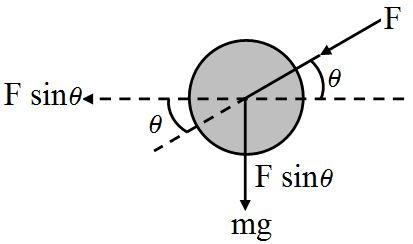
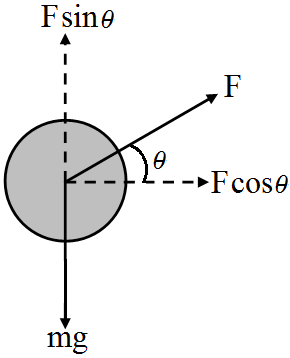
  2. While pulling a lawn mower, a force at an angle $\theta$ is applied on it, as shown in the following figure.

The vertical component of this applied force acts upward. This reduces the effective weight of the mower. On the other hand, while pushing a lawn mower, a force at an angle $\theta$ is applied on it, as shown in the following figure.

In this case, the vertical component of the applied force acts in the direction of the weight of the mower. This increases the effective weight of the mower.
Since the effective weight of the lawn mower is lesser in the first case, pulling the lawn mower is easier than pushing it.
  1. According to Newton’s second law of motion, we have the equation of motion:
$\text{F}=\text{ma}=\frac{\text{m}\triangle\text{v}}{\triangle\text{t}}\ ....(\text{i})$
Where,
F = Stopping force experienced by the cricketer as he catches the ball
m = Mass of the ball
$\triangle\text{t}$ = Time of impact of the ball with the hand
It can be inferred from equation (i) that the impact force is inversely proportional to the impact time, i.e.,
$\frac{\text{F}\propto1}{\triangle\text{t}}\ ...(\text{ii})$
Equation (ii) shows that the force experienced by the cricketer decreases if the time of impact increases and vice versa.
While taking a catch, a cricketer moves his hand backward so as to increase the time of impact $(\triangle\text{t})$. This is turn results in the decrease in the stopping force, thereby preventing the hands of the cricketer from getting hurt.

Need a full question paper?

Generate a complete, print-ready paper with questions like this in minutes — across 16+ boards, with answer keys.

Start Generating Free

Similar questions

The period of oscillation of a simple pendulum is $\text{T}=2\pi\sqrt{\frac{\text{l}}{\text{g}}}$ measured value of 1 is 20.0cm known to 1mm accuracy and time for 100 oscillations of the pendulum is found to be 90s using a wrist watch of 1s resolution. What is the accuracy in determination of g?
Explain the Newton's law of gravity. Write the value, unit and dimension of universal constant of gravitation. Why is it called universal? Or Write Newton's law of gravity. Define universal gravitational constant (G). Also write its units and dimensional formula.
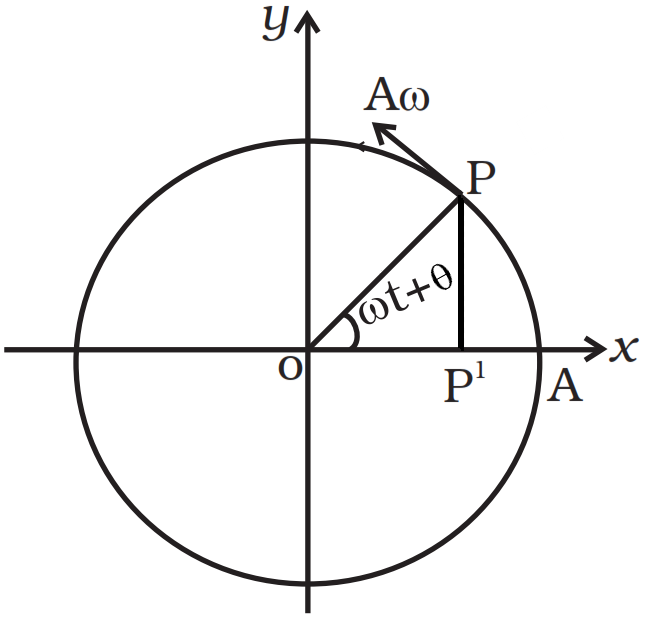
In Fig. 14.9, what will be the sign of the velocity of the point, which is the projection of the velocity of the P′ reference particle P .P is moving in a circle of radius R in anticlockwise direction.
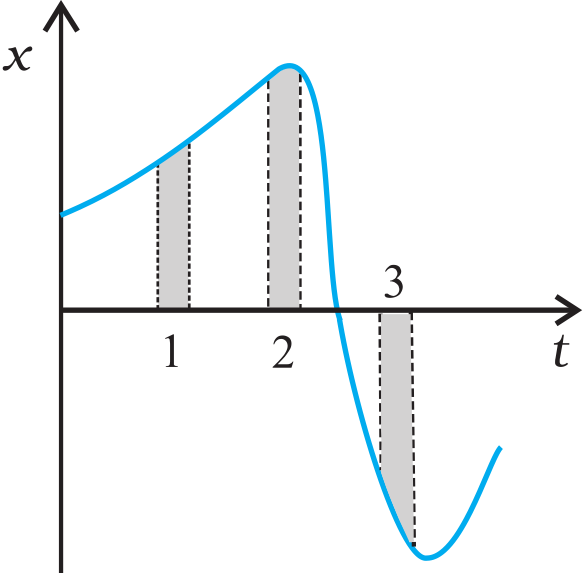
Gives the x-t plot of a particle in one-dimensional motion. Three different equal intervals of time are shown. In which interval is the average speed greatest, and in which is it the least? Give the sign of average velocity for each interval.
Give the postulates of kinetic theory of gases. Derive the expression for pressure exerted by gas molecules in a container. Use it to relate kinetic energy with pressure.
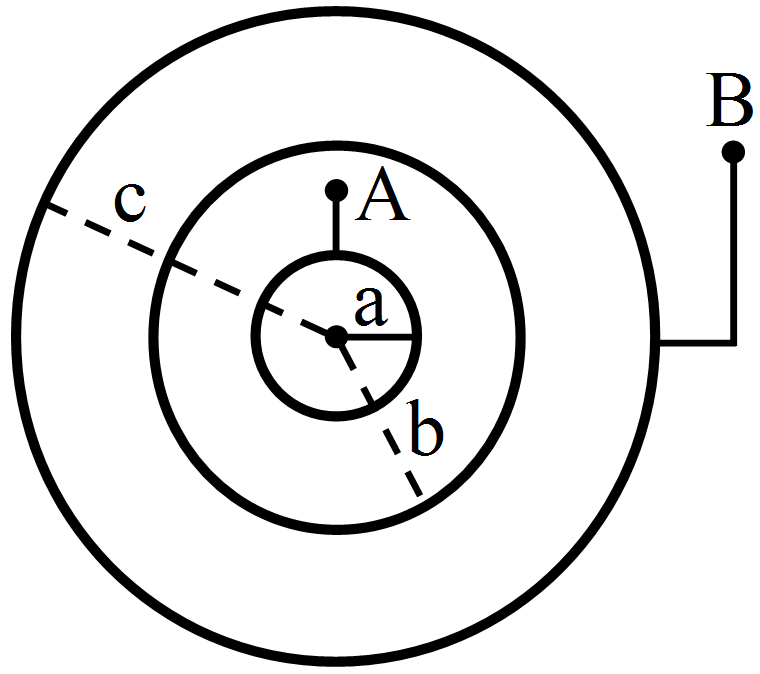
Consider an assembly of three conducting concentric spherical shells of radii a, b and c as shown in figure. Find the capecitance of the assembly between the poima A and B
A sound source, fixed at the origin, is continuously emitting sound at a frequency of 660Hz. The sound travels in air at a speed of 330m/s. A listener is moving along the line x = 336m at a constant speed of 26m/s. Find the frequency of the sound as observed by the listener when he is:
  1. At y = - 140m.
  2. At y = 0.
  3. At y = 140m.
Two 22.7kg ice sleds A and B are placed a short distance apart, one directly behind the other, as shown in Fig. A 3.63kg cat, standing on one sled, jumps across to the other and immediately back to the first. Both jumps are made at a speed of 3.05ms-1 relative to the ice. Find the final speeds of the two sleds.
A piano wire A vibrates at a fundamental frequency of 600Hz. A second identical wire B produces 6 beats per second with it when the tension in A is slightly increased. Find the ratio of the tension in A to the tension in B.
Find the centre of mass of a uniform:
  1. Half-disc.
  2. Quarter-disc.