MCQ 511 Mark
If we do an experiment by swinging a small ball by a thread of length $100\ cm,$ what will be the approximate time for complete to and froperiodic motion?
View full question & answer→MCQ 521 Mark
A body performing simple harmonic motion is expressed by the displacement equation $\text{y}=4\sin2\text{t}$ The magnitude of maximum acceleration of the body is:
View full question & answer→MCQ 531 Mark
The displacement of a particle is represented by the equation $\text{y}=\sin^3\omega\text{t}.$ The motion is:
AnswerCorrect option: C. Simple harmonic with period $\frac{2\pi}{\omega}.$
All sine and cosine functions of $t$ are simple harmonic in nature.
Hence the motion is simple harmonic motion.
A simple harmonic motion is always periodic.
Time period $=\text{T}'=\frac{2\pi}{\omega'}$
hence the motion is simple harmonic with time period $\frac{2\pi}{\omega}.$
View full question & answer→MCQ 541 Mark
Masses $m$ and $3m$ are attached to the two ends of a spring of constant $k.$ If the system vibrates freely, the period of oscillation will be:
- A
$\pi\sqrt{\frac{\text{m}}{\text{k}}}$
- B
$2\pi\sqrt{\frac{3\text{m}}{2\text{k}}}$
- ✓
$\pi\sqrt{\frac{3\text{m}}{\text{k}}}$
- D
$2\pi\sqrt{\frac{4\text{m}}{3\text{k}}}$
AnswerCorrect option: C. $\pi\sqrt{\frac{3\text{m}}{\text{k}}}$
View full question & answer→MCQ 551 Mark
Which of the following expression does not represent simple harmonic motion?
- A
$\text{x}=\text{A}\cos\omega\text{t}+\text{B}\cos\omega\text{t}$
- B
$\text{x}=\text{A}\cos(\omega\text{t}+\alpha)$
- C
$\text{x}=\text{B}\sin(\omega\text{t}+\beta)$
- ✓
$\text{x}=\text{A}\sin\omega\text{t}\cos^2\omega\text{t}$
AnswerCorrect option: D. $\text{x}=\text{A}\sin\omega\text{t}\cos^2\omega\text{t}$
View full question & answer→MCQ 561 Mark
Natural length of the spring is $40\ cm$ and its spring constant is $4000\ Nm^{-1}$. A mass of $20\ kg$ is hung from it.The extension produced in the spring is $(g = 9.8\ ms^{-2})$
- ✓
$4.9\ cm$
- B
$0.49\ cm$
- C
$9.4\ cm$
- D
$0.94\ cm$
AnswerCorrect option: A. $4.9\ cm$
In equilibrium $kx = mg$
$\therefore$ Extension, $\text{x}=\frac{\text{mg}}{\text{k}}$
$\text{x}=\frac{20\times9.8}{4000}$
$\text{x}=0.049\text{m}$
$\text{x}=4.9\text{cm}$
View full question & answer→MCQ 571 Mark
The equation of motion of a particle is $\text{x = a}\cos(\text{at})^2.$ The motion is:
- A
Periodic but not oscillatory.
- B
Periodic and oscillatory.
- ✓
Oscillatory but not periodic.
- D
Neither periodic nor oscillatory.
AnswerCorrect option: C. Oscillatory but not periodic.
Since $x$ varies between $-a$ and $+a$, the motion is oscillatory.
But as $\cos(\alpha\text{t}^2)=\cos(\alpha^2\text{t}^2)$ does not have a period, the motion is not periodic.
View full question & answer→MCQ 581 Mark
The expression for displacement of an object in $\text{SHM}$ is $\text{x}=\text{A}\cos(\omega\text{t})$ The potential energy at $\text{t}=\frac{\text{T}}{4}$is
- A
$\frac{1}{2}\text{kA}^2$
- B
$\frac{1}{8}\text{kA}^2$
- C
$\frac{1}{4}\text{kA}^2$
- ✓
View full question & answer→MCQ 591 Mark
A heavy brass sphere is hung from a spring and it executes vertical vibrations with period $T.$ The sphere is now immersed in a non$-$viscous liquid with a density $(\frac{1}{10})^\text{th}$ that of brass. When set into vertical vibrations with the sphere remaining inside liquid all the time, the time period will be:
- A
$\sqrt{\frac{9}{10\text{T}}}$
- ✓
$\sqrt{\frac{10}{9\text{T}}}$
- C
$\sqrt{\Big(\frac{9}{10}}\Big)\text{T}$
- D
AnswerCorrect option: B. $\sqrt{\frac{10}{9\text{T}}}$
View full question & answer→MCQ 601 Mark
A body is performing $\text{S.H.M.}$ Then its:
AnswerIn case of $\text{S.H.M,}$ average total energy per cycle
$=$ Maximum kinetic energy $(K_0)$
$=$ Maximum potential energy $(U_0)$
Average $KE$ per cycle $=\frac{0+\text{K}_0}{2}=\frac{\text{K}_0}{2}$
Let us write the equation for the $\text{SHM} \text{x}=\text{a}\sin\omega\text{t}.$
Clearly, it is a periodic motion as it involves sine function.
Let us find velocity of the particle, $\text{v}=\frac{\text{dx}}{\text{dt}}=\frac{\text{d}}{\text{dt}}(\text{a}\sin\omega\text{t})=\text{a}\omega\cos\omega\text{t}$
Mean velocity over a complete cycle,
$\text{v}_\text{mean}=\frac{\int_{0}^{2\pi}\omega\text{a}\cos\theta\text{d}\theta}{2\pi}=\frac{\omega\text{a}[\sin\theta]^2_0}{2\pi}=0$
So, $\text{v}_\text{mean}\neq\frac{2}{\pi}\text{v}_\text{max}$
Root mean square speed,
$\text{v}_\text{ms}=\sqrt{\frac{\text{v}^2_\text{min}+\text{v}^2_\text{max}}{2}}=\sqrt{\frac{0+\text{v}^2-\text{max}}{2}}$
$\text{v}_\text{ms}=\frac{1}{\sqrt{2}}\text{v}_\text{max}$
View full question & answer→MCQ 611 Mark
Two simple pendulums of length $5m$ and $10m$ respectively are given small linear displacement in one direction at the same time. They will be again in the phase when the pendulum of shorter length has completed oscillations:
AnswerIn case of simple pendulum,
$\text{T}=2\pi\sqrt{\frac{5}{\text{g}}}$ and $\text{T}'=2\pi\sqrt{\frac{10}{\text{g}}}$
$\therefore\text{T}'=2\text{T}$
Let the two pendulums are in same phase for first time when shorter one has completed $n$ oscillations. Then
$\text{nT = (n}-1)\text{T}'$
$\frac{\text{n}}{\text{n}-1}=\frac{\text{T}'}{\text{T}}=\frac{2\text{T}'}{\text{T}}=2$
$\text{n = 2n}-2$
$\text{n}=2$
View full question & answer→MCQ 621 Mark
A particle executing simple harmonic motion along $y-$axis has its motion described by the equation $\text{y}=\text{A}\sin(\omega\text{t})+\text{B}$ The amplitude of the simple harmonic motion is:
View full question & answer→MCQ 631 Mark
Which of the following relationships between the acceleration a and the displacement $x$ of a particle involve simple harmonic motion?
- A
$a = 0.7x$
- B
$a = -200x^2$
- ✓
$a = -10x$
- D
$a = 100x^3$
AnswerCorrect option: C. $a = -10x$
In $\text{SHM,}$ acceleration $a$ is related to displacement by the relation of the form $a = -kx,$ which is for relation $(c).$
View full question & answer→MCQ 641 Mark
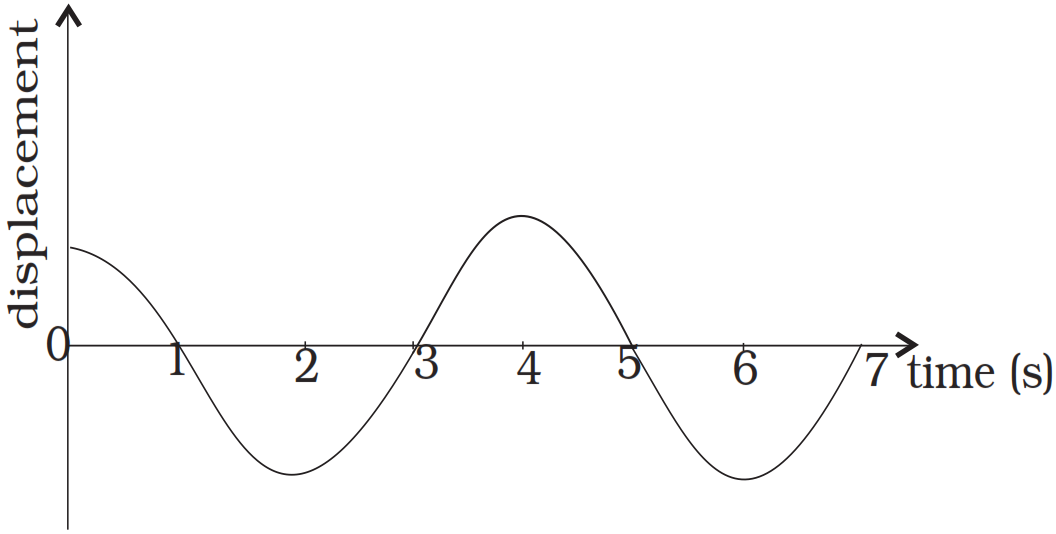
Displacement vs. time curve for a particle executing $\text{S.H.M.}$ is shown in Fig. Choose the correct statements:
- A
Phase of the oscillator is same at $t = 0 s$ and $t = 2 s.$
- B
Phase of the oscillator is same at $t = 2 s$ and $t = 6 s.$
- C
Phase of the oscillator is same at $t = 1 s$ and $t = 5 s.$
- ✓
Both $B$ and $C$
AnswerCorrect option: D. Both $B$ and $C$
Two particles are said to be in same phases if the mode of vibration is same i.e, their distance will be $\text{n}\lambda(\text{n}=1,2,3...)$
Distance between particles at $t = 0$ and $t = 2$ is $\frac{\lambda}{2}.$
So, articles are not in same phase.
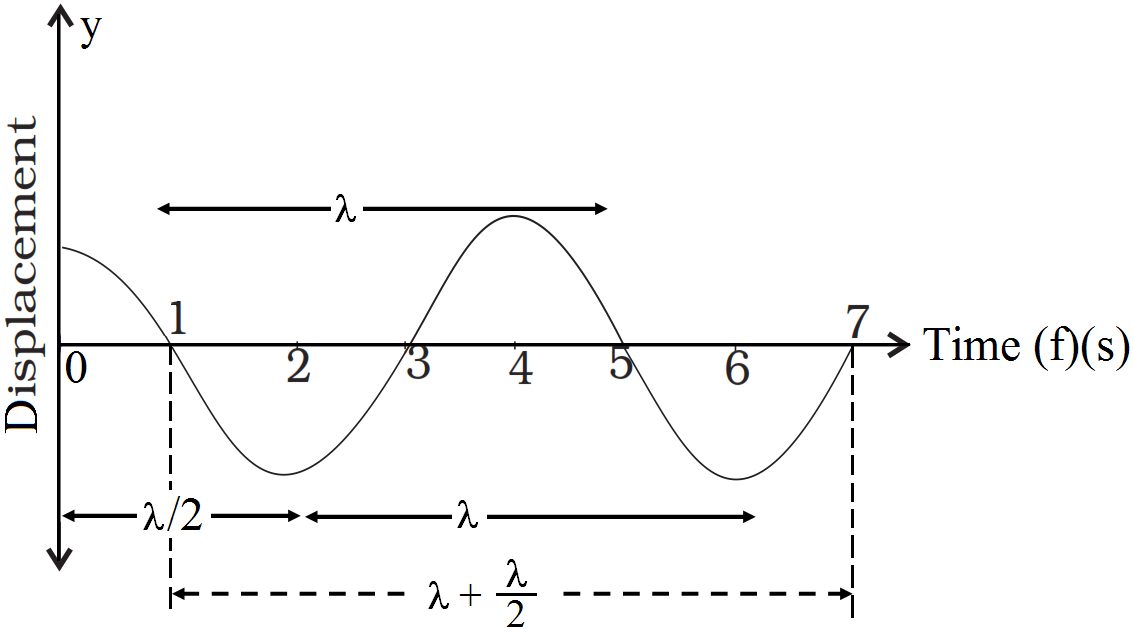
As from figure the particles at $t = 2 \sec$ are at distance $\lambda$,
so are in same phase.
Particles at $t = 1, t = 7$ are the distance $\lambda+\frac{\lambda}{2}=\frac{3\lambda}{2}$ so are not in phase.
Particles at $t = 1$ and $5\sec$ are at distance $= \lambda$ so are in same phase. View full question & answer→MCQ 651 Mark
A point mass oscillates along the $x-$axis according to the law $\text{x = x}_0\cos\Big(\omega\text{t}-\frac{\pi}{4}\Big).$ If the acceleration of the particle is written as, $\text{a = A}\cos(\omega\text{t}+\delta),$ then:
- ✓
$\text{A = x}_0\omega^2,\delta=\frac{3\pi}{4}$
- B
$\text{A = x}_0,\delta=-\frac{\pi}{4}$
- C
$\text{A = x}_0\omega^2,\delta=\frac{\pi}{4}$
- D
$\text{A = x}_0\omega^2,\delta=-\frac{\pi}{4}$
AnswerCorrect option: A. $\text{A = x}_0\omega^2,\delta=\frac{3\pi}{4}$
Acceleration, $\text{a}=\frac{\text{dv}}{\text{dt}}$
$=\text{x}_0\omega^2\cos\Big[\omega\text{t}+\frac{3\pi}{4}\Big]$
View full question & answer→MCQ 661 Mark
The displacement of an oscillating particle varies with time $($in seconds$)$ according to the equation $\text{y}=\sin\frac{\pi}{2}\Big(\frac{\text{t}}2{}+\frac{1}{3}\Big),$ where $y$ is in $cm.$ The maximum acceleration of the particle is approximately:
- ✓
$0.62\ cm-s^{-1}$
- B
$1.81\ cm-s^{-1}$
- C
$3.62\ cm-s^{-1}$.
- D
$5.2\ cm-s^{-2}$
AnswerCorrect option: A. $0.62\ cm-s^{-1}$
Equating the given equation with the equation of $\text{S.H.M}; \text{y = r}\sin(\omega\text{t}+\theta)$
we have $r = 1\ cm$ and $\theta=\frac{\pi}{4}$
$\therefore$ Max. acceleration $=\omega^2\text{r}$
$=\Big(\frac{\pi}{4}\Big)^2\times1$
$=0.62\ \text{cm-s}^{-1}$
View full question & answer→MCQ 671 Mark
A hollow sphere is fitted with water through a small hole in it. It is then hung by a long thread and made to oscillate. As the water slowly flows out of the hole at the bottom, the period of oscillation will:
- A
- B
- C
First decrease and then increase.
- ✓
First increase and then decrease.
AnswerCorrect option: D. First increase and then decrease.
As the water slowly leakes out, centre of gravity of water and sphere falls down from the centre of sphere. Due to which length of simple pendulum $(l)$ increases. This continues till half of the sphere is emptied. After that as water leakes out, the length of simple pendulum $(l)$ decreases.
View full question & answer→MCQ 681 Mark
A particle is acted simultaneously by mutually perpendicular simple hormonic motions $\text{x}=\text{a}\cos\omega\text{t}$ and $\text{y}=\text{a}\sin\omega\text{t}.$ The trajectory of motion of the particle will be:
AnswerResultant displacement is $x + y$
$\text{x}=\text{a}\cos\omega\text{t}\ ...(1)$
$\text{y}=\text{A}\sin\omega\text{t}\ ...(2)$
Dispacement $=\text{a}\cos\omega\text{t}+\text{a}\sin\omega\text{t}$
$\text{y}'=\text{a}\sqrt{2}\Big[\frac{\cos\omega\text{t}}{\sqrt{2}}+\frac{\sin\omega\text{t}}{\sqrt{2}}\Big]$
$\text{y}'\text{a}\sqrt{2}\ [\cos\omega\text{t}\cos45^\circ+\sin\omega\text{t}\sin45^\circ]$as the particle is acted simultaneously by Mutually perpendicular direction.
$\text{y}'=\text{a}\sqrt{2}\cos\text{s}(\omega\text{t}-45^\circ)$
Hence the displacement is neither a straight line nor a parabola.
Now, squaring and adding $(i), (ii)$
$\text{x}^2+\text{y}^2=\text{a}^2\cos^2\omega\text{t}+\text{a}^2\sin^2\omega\text{t}=\text{a}^2[\cos^2\omega\text{t}+\sin^2\omega\text{t}]$
$\text{x}^2+\text{y}^2=\text{a}^2$
This shows the equation of circle, hence the motion is circular motion.
View full question & answer→MCQ 691 Mark
Motion of an oscillating liquid column in a $U-$tube is:
AnswerCorrect option: C. Simple harmonic and time period is independent of the density of the liquid.
As $\text{T}=2\pi\sqrt{\frac{\text{l}}{\text{g}}} ($where $l$ is the length ofthe oscillating liquid column in each limb$)$, it is independent of the density of the liquid.
View full question & answer→MCQ 701 Mark
A particle executes simple harmonic motion between $x = -A$ and $x = +A.$ The time taken for it to go from $0$ to $\frac{\text{A}}{2}$ is $T_1$ and to go from $\frac{\text{A}}{2}$ to $A$ is $T_2$, Then:
- ✓
$T_1 < T_2$
- B
$T_1 > T_2$
- C
$T_1 = T_2$
- D
$T_1 = 2T_2$
AnswerCorrect option: A. $T_1 < T_2$
$\frac{\text{A}}{2}=\text{A}\sin\omega\text{T}_1$
$\sin\omega\text{T}_1=\frac{1}2{}=\sin\frac{\pi}{6}$
$\text{T}_1=\frac{\pi}{6\omega}$
$\sin\omega(\text{T}_1+\text{T}_2)=1=\sin\frac{\pi}{2}$
$\omega(\text{T}_1+\text{T}_2)=\frac{\pi}{2}$
$\text{T}_1+\text{T}_2=\frac{\pi}{2\omega}$
$\text{T}_2=\frac{\pi}{2\omega}-\frac{\pi}{6\omega}=\frac{2\pi}{6\omega}=2\text{T}_1$
So, $\text{T}_1<\text{T}_2$
View full question & answer→MCQ 711 Mark
- A
Non-uniform circular motion.
- ✓
- C
- D
Answerb. Uniform circular motion.
Exlanation:
SHM could be related to uniform circular motion. The projection of uniform circular motion on a diameter of the circle follows simple harmonic motion.
View full question & answer→MCQ 721 Mark
The motion of satellites and planets is:
AnswerThe motion of planets and satellites are repetitive and repeats itself after a fixed interval of time. These type of motions are known as periodic motion.
View full question & answer→MCQ 731 Mark
A horizontal platform with an object placed on it is executing $\text{S.H.M.}$ in the vertical direction. The amplitude of oscillation is $3.92 \times 10^{-3}m.$ At what time the object is not detached from the platform?
- ✓
$0.1256 \sec.$
- B
$0.1356 \sec.$
- C
$0.1456 \sec.$
- D
$0.156 \sec.$
AnswerCorrect option: A. $0.1256 \sec.$
The object is not detached from the platform if
$\text{mg = mr}\omega^2=\text{mr}\frac{4\pi\text{r}^2}{\text{T}^2}$
$\text{T}=2\pi\sqrt{\frac{\text{r}}{\text{g}}}$
$=2\times\frac{22}{7}\sqrt{\frac{3.29\times10^{-3}}{9.8}}$
$=0.1256\text{ sec}$
View full question & answer→MCQ 741 Mark
The length of a simple pendulum is increased by $44\%$. What is the percentage increase in its time period?
- A
$10\%$
- ✓
$20\%$
- C
$40\%$
- D
$44\%$
AnswerCorrect option: B. $20\%$
View full question & answer→MCQ 751 Mark
A particle performs harmonic oscillations along a straight line with a period of $6s$ and amplitude $4\ cm.$ The mean velocity of the particle averaged over the time interval during which it travels a distance of $2\ cm$ starting from the extreme position is:
- A
$1\ cm s^{-1}$
- ✓
$2\ cm s^{-1}$
- C
$4 \cos s^{-1}$
- D
$8\ cm s^{-1}$
AnswerCorrect option: B. $2\ cm s^{-1}$
Here; $f = 6s; r : 4\ cm;$ Displacement from the mean position when the panicle travels $2\ cm$ from the extreme position is, $x = 4 - 2 = 2.0\ cm.$
If $t$ is the time taken then,
$\text{x = r}\cos\omega\text{t = r}\cos\frac{2\pi}{\text{T}}\text{t}$
$\therefore2=4\cos\frac{2\pi}{6}\text{t}$
$\cos\frac{\pi\text{t}}{3}=\frac{2}{4}=\frac{1}{2}=\cos\frac{\pi}{3}$
$\text{t}=1\text{s}$
$\therefore$ Average velocity $=\frac{\text{Distance}}{\text{Time}}=\frac{2}{\text{T}}=2\text{cm s}^{-1}$
View full question & answer→MCQ 761 Mark
A simple pendulum has time period $T$. The bob is given charge and surface below it is given positive charge. The new time period will be:
- ✓
Less than $T$
- B
Greater than $T$
- C
Equal to $T$
- D
AnswerCorrect option: A. Less than $T$
$\text{g}'=\text{g}+\frac{\text{F}_{\text{e}}}{\text{m}},\text{g}'>\text{g}$
Since, $\text{T}=\sqrt{\frac{\text{l}}{\text{g}}}$
So $\text{T}\propto\frac{1}{\sqrt{\text{g}}}$ and $\text{T}'\propto\frac{1}{\sqrt{\text{g}'}}$
$\therefore\text{T}'<\text{T}$
View full question & answer→MCQ 771 Mark
A simple pendulum has time period $T_1$. The point of suspension is now moved upwards according to relation, $y=kt^2. (k = 1ms^{-2}),$ where $y$ is the vertical displacement. The time period now becomes $T_2$. The ratio of $\frac{\text{T}^2_1}{\text{T}^2_2}$ is $(g = 10\ ms^2)$
- ✓
$\frac{6}{5}$
- B
$\frac{5}{6}$
- C
$1$
- D
$\frac{4}{5}$
AnswerCorrect option: A. $\frac{6}{5}$
Given, $\text{y = kt}^2;\frac{\text{dy}}{\text{dt}}=2\text{kt}$ and
$\frac{\text{d}^2\text{y}}{\text{dt}^2}=2\text{k}=2\times1=2\text{ms}^{-2}$
So point of suspension is moving upwards with acceleration $a = 2\ ms^{-2}$.
The effective acceleration due to gravity on pendulum is
$\text{g}'=\text{g + a}=10+2=12\text{ms}^{-2}$
$\text{T}_1=2\pi\sqrt{\frac{\text{l}}{\text{g}}}$ and $\text{T}_2=2\pi\sqrt{\frac{\text{l}}{\text{g}'}}$
$\therefore\frac{\text{T}^2_1}{\text{T}^2_2}=\frac{\text{g}'}{\text{g}}=\frac{12}{10}=\frac{6}{5}$
View full question & answer→MCQ 781 Mark
A mass $M$ suspended from a spring of negligible mass. The spring is pulled a little and then released so that the mass executes $\text{S.H.M.}$ of time period $T.$ If the mass is increased by $m,$ the time period becomes $\frac{5\text{T}}{3}.$ Then the ratio of $\frac{\text{m}}{\text{M}}$ is:
- A
$\frac{3}{5}$
- B
$\frac{25}{9}$
- ✓
$\frac{16}{9}$
- D
$\frac{5}{3}$
AnswerCorrect option: C. $\frac{16}{9}$
$\text{T}=2\pi\sqrt{\frac{\text{M}}{\text{k}}}$ and $\text{T}'=2\pi\sqrt{\frac{\text{M + m}}{\text{k}}}$
$\frac{\text{T}'}{\text{T}}=\Big(\frac{\text{M + m}}{\text{M}}\Big)^{\frac{1}{2}}=\Big(1+\frac{\text{m}}{\text{M}}\Big)^{\frac{1}2{}}$
$\frac{\text{m}}{\text{M}}=\Big(\frac{\text{T}'}{\text{T}}\Big)^2-1=\Big(\frac{5}{3}\Big)^2-1=\frac{16}{9}$
View full question & answer→MCQ 791 Mark
Which of the following statements is/ are true for a simple harmonic oscillator?
- A
Force acting is directly proportional to displacement from the mean position and opposite to it.
- B
- C
The velocity is periodic.
- ✓
AnswerLet us write the equation for the $\text{SHM} \text{x}=\text{a}\sin(\omega\text{t}+\phi)$
Clearly, it is a periodic motion as it involves sine function.
Let us find velocity of the particle, $\text{v}=\frac{\text{dx}}{\text{dt}}=\frac{\text{d}}{\text{dt}}(\text{a}\sin(\omega\text{t}+6\phi))$
Velocity is also periodic because it is a cosine function.
Now let us find acceleration, $\text{A}=\frac{\text{dv}}{\text{dt}}=\frac{\text{d}^2\text{x}}{\text{dt}^2}=-\text{a}\omega^2\sin(\omega\text{t}+\phi)$
The acceleration is a sine function, hence cannot be constant.
$\Rightarrow\text{A}=-(\omega^2\text{a})\sin(\omega\text{t}+\phi)=-\omega^2\text{x}$
Force, $F =$ mass $\times$ acceleration.
$=\text{mA}=-\text{m}\omega^2\text{x}$
Hence, force acting is directly proportional to displacement from the mean position and opposite to it.
View full question & answer→MCQ 801 Mark
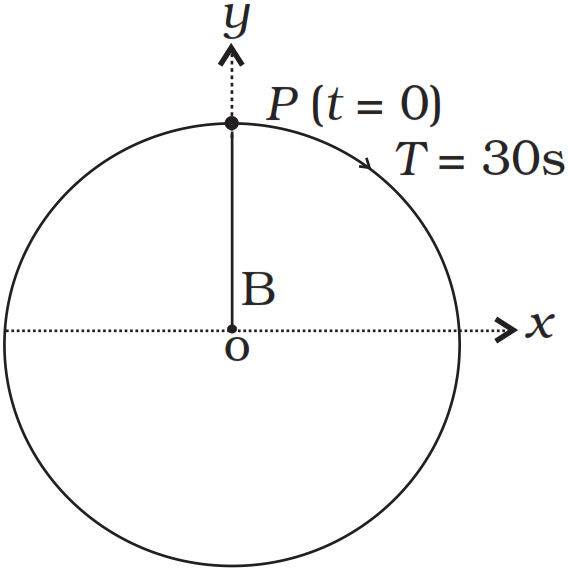
Figure shows the circular motion of a particle. The radius of the circle, the period, sense of revolution and the initial position are indicated on the figure. The simple harmonic motion of the $x-$projection of the radius vector of the rotating particle $P$ is:
- ✓
$\text{x}(\text{t})=\text{B}\sin\Big(\frac{2\pi\text{t}}{30}\Big).$
- B
$\text{x}(\text{t})=\text{B}\cos\Big(\frac{\pi\text{t}}{15}\Big).$
- C
$\text{x}(\text{t})=\text{B}\sin\Big(\frac{\pi\text{t}}{15}+\frac{\pi}{2}\Big).$
- D
$\text{x}(\text{t})=\text{B}\cos\Big(\frac{\pi\text{t}}{15}+\frac{\pi}{2}\Big).$
AnswerCorrect option: A. $\text{x}(\text{t})=\text{B}\sin\Big(\frac{2\pi\text{t}}{30}\Big).$
As the particle $P$ is executing circular motion with radius $B.$
let particle $P$ is at $Q$ at instant $t,$ foot of perpendicular on $x-$axis is at $R$ vector $OQ$ makes $<\theta$ with its zero position not $p$ displacement for $O$ to $R.$
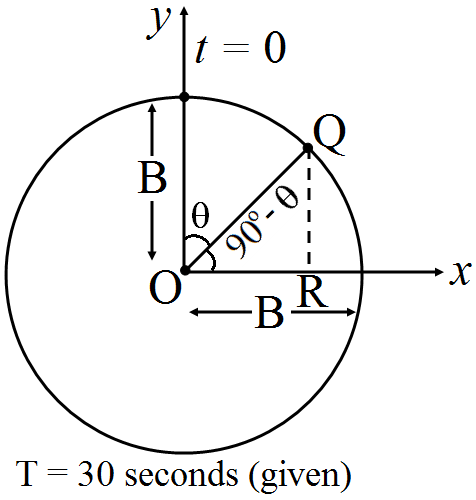
$\text{x}=\text{OQ}\cos(90^\circ-\theta) $
$\text{x}=\text{OQ}\sin\theta=\text{B}\sin\omega\text{t}\therefore\theta=\omega\text{t}$
$\text{x}=\text{B}\sin\frac{2\pi}{\text{T}}\text{t}$
$\therefore\text{x}=\text{B}\sin\Big(\frac{2\pi}{30}\text{t}\Big)$ View full question & answer→MCQ 811 Mark
A $1.00 \times 10^{-20}\ kg$ particle is vibrating with $\text{SHM}$ with a period of $1.00 \times 10^{-5}$ second, and with maximum velocity $1.00 \times 10\ m/s,$ then the maximum displacement from mean position is:
- ✓
$10\ mm$
- B
$1.59\ mm$
- C
$1\ mm$
- D
AnswerCorrect option: A. $10\ mm$
$\text{v}_{\text{max}}=\text{r}\omega=\frac{\text{r}2\pi}{\text{T}}$
$\text{r}=\frac{\text{v}_{\text{max}}\text{T}}{2\pi}=\frac{10^3\times10^-5}{{2\times}\Big(\frac{22}{7}\Big)}=1.59\times10^{-3}\text{m}$
View full question & answer→