Sample QuestionsOscillations questions
One sample from each question group in this chapter. Select any group above to see the full set with answer keys.
A mass of $1\ kg$ attached to the bottom of a spring has a certain frequency of vibration. The following mass has to be added to it in order to reduce the frequency by half:
- A
$1\ kg$
- B
$2\ kg$
- ✓
$3\ kg$
- D
$4\ kg$
Answer: C.
View full solution →The total energy of particle performing $\text{S.H.M.}$ is depends on:
- A
$\text{k, A, m}$
- ✓
$\text{k, A}$
- C
$\text{k, A, x}$
- D
$\text{k, x}$
Answer: B.
View full solution →The motion of a swing is:
- A
Periodic but not oscillatory.
- ✓
- C
- D
Answer: B.
View full solution →The acceleration due to gravity on the surface of the moon is $1.7\ ms^{-2}$. The time period of a simple pendulum on the moon, if its time period on the earth is $3.5s$ is:
- A
$2.2s$
- B
$4.4s$
- ✓
$8.4s$
- D
$16.8s$
Answer: C.
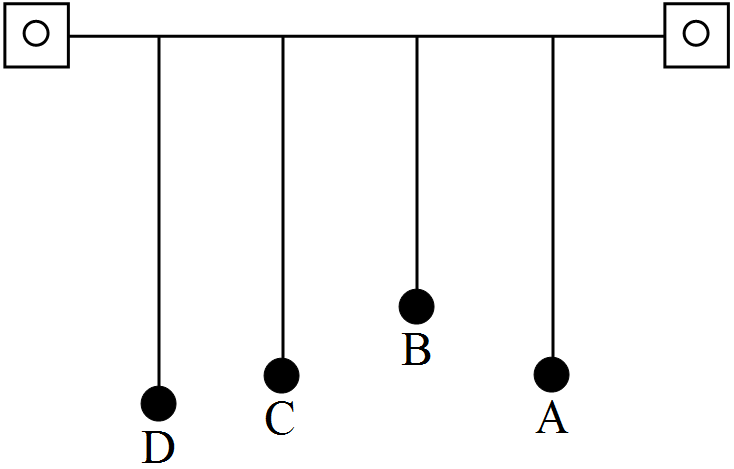
View full solution →Four pendulums $A, B, C$ and $D$ are suspended from the same elastic support as shown in Fig $A$ and $C$ are of the same length, while $B$ is smaller than $A$ and $D$ is larger than $A$. If $A$ is given a transverse displacement,
- A
$D$ will vibrate with maximum amplitude.
- ✓
$C$ will vibrate with maximum amplitude.
- C
$B$ will vibrate with maximum amplitude.
- D
All the four will oscillate with equal amplitude.
Answer: B.
View full solution →The ratio of frequencies of two pendulums are 2 : 3, then their lengths are in ratio of .
State of particle regarding its position and direction of motion at any instant is known as .
Time period of a pendulum hanged in a satellite is .
Time period of simple pendulum executing simple harmonic motion is .
A particle executes simple harmonic motion with a frequency f. The frequency with which its kinetic energy oscillates is .
Which of the following examples represent periodic motion? An arrow released from a bow.
Which of the following functions of time represent (a) simple harmonic, (b) periodic but not simple harmonic, and (c) non-periodic motion? Give period for each case of periodic motion ($\omega$ is any positive constant): $\text{exp}(-\omega^2\text{t}^2)$
View full solution →Which of the following examples represent periodic motion? A swimmer completing one (return) trip from one bank of a river to the other and back.
Which of the following examples represent (nearly) simple harmonic motion and which represent periodic but not simple harmonic motion?General vibrations of a polyatomic molecule about its equilibrium position.
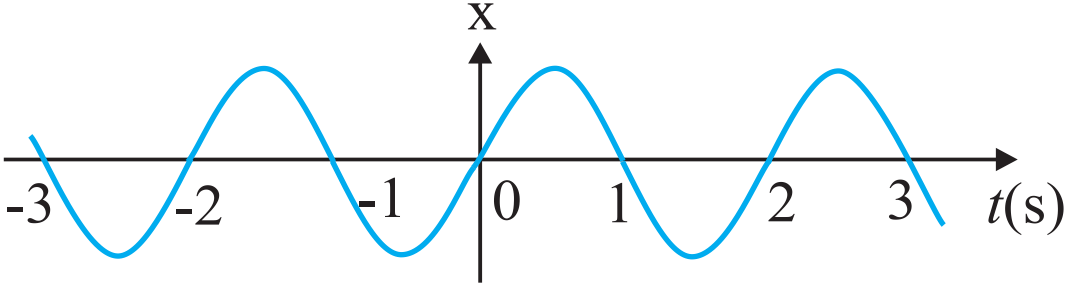
Fig. depicts four x-t plots for linear motion of a particle. Which of the plots represent periodic motion? What is the period of motion (in case of periodic motion)?
The piston in the cylinder head of a locomotive has a stroke (twice the amplitude) of 1.0m. If the piston moves with simple harmonic motion with an angular frequency of 200rad/min, what is its maximum speed?
In Exercise, let us take the position of mass when the spring is unstreched as x = 0, and the direction from left to right as the positive direction of x-axis. Give x as a function of time t for the oscillating mass if at the moment we start the stopwatch (t = 0), the mass is:At the maximum stretched position.
In what way do these functions for SHM differ from each other, in frequency, in amplitude or the initial phase?
In Exercise, let us take the position of mass when the spring is unstreched as x = 0, and the direction from left to right as the positive direction of x-axis. Give x as a function of time t for the oscillating mass if at the moment we start the stopwatch (t = 0), the mass is: At the mean position. In what way do these functions for SHM differ from each other, in frequency, in amplitude or the initial phase?
Answer the following questions:A man with a wristwatch on his hand falls from the top of a tower. Does the watch give correcttime during the free fall?
Which of the following functions of time represent (a) simple harmonic, (b) periodic but not simple harmonic, and (c) non-periodic motion? Give period for each case of periodic motion ($\omega$ is any positive constant): $\sin\omega\text{t}-\cos\omega\text{t}$
View full solution →Plot the corresponding reference circle for each of the following simple harmonic motions. Indicate the initial (t = 0) position of the particle, the radius of the circle, and the angular speed of the rotating particle. For simplicity, the sense of rotation may be fixed to be anticlockwise in every case: (x is in cm and t is in s).$\text{x}=-2\sin\Big(3\text{t}+\frac{\pi}{3}\Big)$
View full solution →Plot the corresponding reference circle for each of the following simple harmonic motions. Indicate the initial (t = 0) position of the particle, the radius of the circle, and the angular speed of the rotating particle. For simplicity, the sense of rotation may be fixed to be anticlockwise in every case: (x is in cm and t is in s).$\text{x}=3\sin\Big(2\pi\text{t}+\frac{\pi}{4}\Big)$
View full solution →Plot the corresponding reference circle for each of the following simple harmonic motions. Indicate the initial (t = 0) position of the particle, the radius of the circle, and the angular speed of the rotating particle. For simplicity, the sense of rotation may be fixed to be anticlockwise in every case: (x is in cm and t is in s).$\text{x}=\cos\Big(\frac{\pi}{6}-\text{t}\Big)$
View full solution →Answer the following questions:The motion of a simple pendulum is approximately simple harmonic for small angle oscillations. For larger angles of oscillation, a more involved analysis shows that T is greater than $2\pi\sqrt{\frac{\text{l}}{\text{g}}}.$ Think of a qualitative argument to appreciate this result.
View full solution →Plot the corresponding reference circle for each of the following simple harmonic motions. Indicate the initial (t = 0) position of the particle, the radius of the circle, and the angular speed of the rotating particle. For simplicity, the sense of rotation may be fixed to be anticlockwise in every case: (x is in cm and t is in s).
$\text{x}=2\cos\pi\text{t}$
View full solution → Figures correspond to two circular motions. The radius of the circle, the period of revolution, the initial position, and the sense of revolution (i.e. clockwise or anti-clockwise) are indicated on each figure.
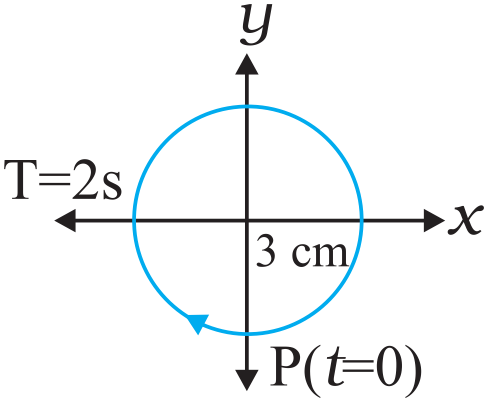
Obtain the corresponding simple harmonic motions of the x-projection of the radius vector of the revolving particle P, in each case.
Figures correspond to two circular motions. The radius of the circle, the period of revolution, the initial position, and the sense of revolution (i.e. clockwise or anti-clockwise) are indicated on each figure.
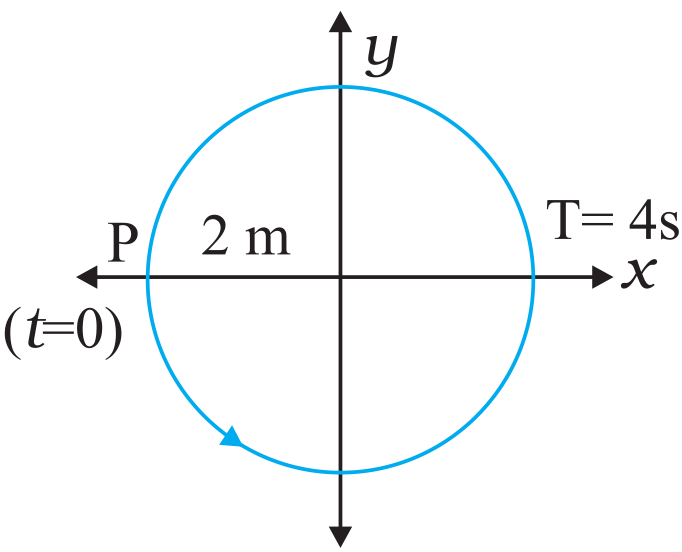
Obtain the corresponding simple harmonic motions of the x-projection of the radius vector of the revolving particle P, in each case.
The acceleration due to gravity on the surface of moon is $1.7m s^{-2}$. What is the time period of a simple pendulum on the surface of moon if its time period on the surface of earth is $3.5 s$? (g on the surface of earth is $9.8m s^{-2}$)
View full solution →A mass attached to a spring is free to oscillate, with angular velocity $\omega,$ in a horizontal plane without friction or damping. It is pulled to a distance $x_0$ and pushed towards the centre with a velocity $\upsilon_0$ at time t = 0. Determine the amplitude of the resulting oscillations in terms of the parameters $\omega,x_0$ and $υ_0$. [Hint: Start with the equation $\text{x}=\text{a}\cos(\omega\text{t}+\theta)$ and note that the initial velocity is negative.]
View full solution → The motion of a particle executing simple harmonic motion is described by the displacement function,$\text{x(t)}=\text{A}\cos(\omega\text{t}+\phi).$
If the initial (t = 0) position of the particle is 1cm and its initial velocity is $\omega\text{ cm/s,}$ what are its amplitude and initial phase angle? The angular frequency of the particle is $\pi\text{s}^{-1}.$ If instead of the cosine function, we choose the sine function to describe the SHM: $\text{x}=\text{B}\sin(\omega\text{t}+\alpha),$ what are the amplitude and initial phase of the particle with the above initial conditions.
View full solution →Read the passage given below and answer the following questions from 1 to 4. Damped Simple Harmonic Motion The oscillations in presence of dissipative force where the amplitude decreases gradually with the passage of time are called damped oscillations. A part of the energy of the oscillating system is lost in the form of heat, in overcoming these resistive forces, As a result, the amplitude of such oscillations decreases exponentially with time, as shown in figure. Eventually, these oscillations die out. In these oscillations, the amplitude of oscillation decreases exponentially due to damping forces like frictional force, viscous force, etc. Due to decrease in amplitude, the energy of the oscillator also goes on decreasing exponentially.
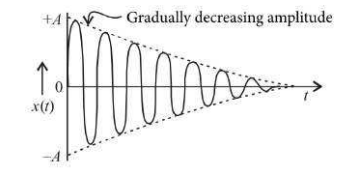
The force producing a resistance to the oscillation is called damping force.
- particle oscillating under force $\overrightarrow{\text{F}}=-\text{k}\overrightarrow{\text{x}}-\text{b}\overrightarrow{\text{v}}$ is a (k and b are constants)
- Simple harmonic oscillator
- Linear oscillator
- Damped oscillator
- Forced oscillator
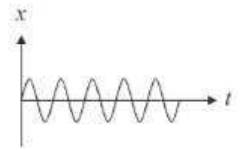
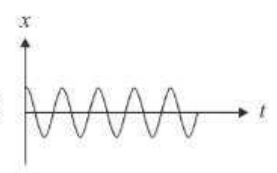
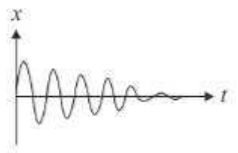
- Which of the following displacement-time graphs represent damped harmonic oscillation?
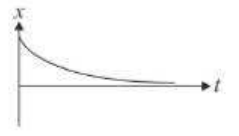
- In case of a force vibration, the resonance wave becomes very sharp when the
- Applied periodic force is small
- Quality factor is small
- Damping force is small
- Restoring force is small
- The S.I. unit of damping constant is:
- $kg s$
- $kg^2s$
- $kg m/s$
- $kg/s$
View full solution →Read the passage given below and answer the following questions from (i) to (v). There are no physical examples of absolutely pure simple harmonic motion. In practice we come across systems that execute simple harmonic motion approximately under certain conditions. Oscillations due to a spring: The simplest observable example of simple harmonic motion is the small oscillations of a block of mass m fixed to a spring, which in turn is fixed to a rigid wall. The block is placed on a frictionless horizontal surface. If the block is pulled on one side and is released, it then executes a to and fro motion about the mean position. Let x = 0, indicate the position of the centre of the block when the spring is in equilibrium. The positions marked as –A and +A indicate the maximum displacements to the left and the right of the mean position. We have already learnt that springs have special properties, which were first discovered by the English physicist Robert Hooke. He had shown that such a system when deformed is subject to a restoring force, the magnitude of which is proportional to the deformation or the displacement and acts in opposite direction. This is known as Hooke’s law. It holds good for displacements small in comparison to the length of the spring. At any time t, if the displacement of the block from its mean position is x, the restoring force F acting on the block is, F(x) = –k x The constant of proportionality, k, is called the spring constant, its value is governed by the elastic properties of the spring. A stiff spring has large k and a soft spring has small k. Equation is same as the force law for SHM and therefore the system executes a simple harmonic motion.Damped oscillations
We know that the motion of a simple pendulum, swinging in air, dies out eventually. Why does it happen? This is because the air drag and the friction at the support oppose the motion of the pendulum and dissipate its energy gradually. The pendulum is said to execute damped oscillations. In damped oscillations, the energy of the system is dissipated continuously; but, for small damping, the oscillations remain approximately periodic. The dissipating forces are generally the frictional forces. The damping force is generally proportional to velocity of the bob and acts opposite to the direction of velocity. If the damping force is denoted by $F_d$, we have $F_d = –b_v$ where the positive constant b depends on characteristics of the medium (viscosity, for example) and the size and shape of the block, is usually valid only for small velocity.
- Damping force is directly proportional to:
- Velocity
- Area
- Acceleration
- None of these
- Oscillations due to spring performs SHM for:
- Only small oscillations of spring
- Only for large oscillations of spring
- Both large as well as small oscillations of spring
- None of these
- Give expression for restoring force in spring while performing small SHM oscillations.
- Explain damped oscillations.
- Explain oscillations due to spring.
View full solution →Read the passage given below and answer the following questions from 1 to 5. Simple Harmonic Motion Simple harmonic motion is the simplest form of oscillation. A particular type of periodic motion in which a particle moves to and fro repeatedly about a mean position under the influence of a restoring force is termed as simple harmonic motion (S.H.M). A body is undergoing simple harmonic motion if it has an acceleration which is directed towards a fixed point, and proportional to the displacement of the body from that point. Acceleration $\text{a}\propto-\text{x}$$\Rightarrow\text{a}=-\text{kx}$ or $\frac{\text{d}^2\text{x}}{\text{dt}^2}=-\text{kx},$
where x = displacement at any instant t.
- Which of the following is not a characteristics of simple harmonic motion?
- The motion is periodic.
- The motion is along a straight line about the mean position.
- The oscillations are responsible for the energy conversion.
- The acceleration of the particle is directed towards the extreme position.
- The equation of motion of a simple harmonic motion is:
- $\frac{\text{d}^2\text{x}}{\text{dt}^2}=-\omega^2\text{x}$
- $\frac{\text{d}^2\text{x}}{\text{dt}^2}=-\omega^2\text{t}$
- $\frac{\text{d}^2\text{x}}{\text{dt}^2}=-\omega\text{x}$
- $\frac{\text{d}^2\text{x}}{\text{dt}^2}=-\omega\text{t}$
- Which of the following expressions does not represent simple harmonic motion?
- $\text{x}=\text{A}\cos\omega\text{t}+\text{B}\sin\omega\text{t}$
- $\text{x}=\text{A}\cos(\omega\text{t}+\alpha)$
- $\text{x}=\text{B}\sin(\omega\text{t}+\beta)$
- $\text{x}=\text{A}\sin\omega\text{t}\cos^2\omega\text{t}$
- The time period of simple harmonic motion depends upon:
- Amplitude
- Energy
- Phase constant
- Mass
- Which of the following motions is not simple harmonic?
- Vertical oscillations of a spring
- Motion of a simple pendulum
- Motion of planet around the Sun
- Oscillation of liquid in a U-tube
View full solution →Read the passage given below and answer the following questions from (i) to (v).
When a system (such as a simple pendulum or a block attached to a spring) is displaced from its equilibrium position and released, it oscillates with its natural frequency $\omega,$ and the oscillations are called free oscillations. All free oscillations eventually die out because of the ever present damping forces. However, an external agency can maintain these oscillations. These are called forced or driven oscillations. We consider the case when the external force is itself periodic, with a frequency wd called the driven frequency. The most important fact of forced periodic oscillations is that the system oscillates not with its natural frequency $\omega,$ but at the frequency $\omega,$ d of the external agency; the free oscillations die out due to damping. The most familiar example of forced oscillation is when a child in a garden swing periodically presses his feet against the ground (or someone else periodically gives the child a push) to maintain the oscillations. The maximum possible amplitude for a given driving frequency is governed by the driving frequency and the damping, and is never infinity. The phenomenon of increase in amplitude when the driving force is close to the natural frequency of the oscillator is called resonance. In our daily life, we encounter phenomena which involve resonance. Your experience with swings is a good example of resonance. You might have realized that the skill in swinging to greater heights lies in the synchronization of the rhythm of pushing against the ground with the natural frequency of the swing.
- When a system oscillates with its natural frequency ω, and the oscillations are called:
- Free oscillations.
- Forced oscillations.
- All free oscillations eventually die out because of:
- Damping force.
- electromagnetic force.
- None of these.
- What is free oscillation?
- What is forced oscillations?
- What is resonance?
View full solution →Read the passage given below and answer the following questions from (i) to (v).
A motion that repeats itself at regular intervals of time is called periodic motion. Very often, the body undergoing periodic motion has an equilibrium position somewhere inside its path. When the body is at this position no net external force acts on it. Therefore, if it is left there at rest, it remains there forever. If the body is given a small displacement from the position, a force comes into play which tries to bring the body back to the equilibrium point, giving rise to oscillations or vibrations. Every oscillatory motion is periodic, but every periodic motion need not be oscillatory. Circular motion is a periodic motion, but it is not oscillatory. The smallest interval of time after which the motion is repeated is called its period. Let us denote the period by the symbol T. Its SI unit is second. The reciprocal of T gives the number of repetitions that occur per unit time. This quantity is called the frequency of the periodic motion. It is represented by the symbol n. The relation between n and T is $\text{n}=\frac{1}{\text{T}}$. The unit of n is thus $s^{-1}$. After the discoverer of radio waves, Heinrich Rudolph Hertz (1857–1894), a special name has been given to the unit of frequency. It is called hertz (abbreviated as Hz). Answer the following.
- Every oscillatory motion is periodic motion true or false?
- True
- False
- Circular motion is
- Oscillatory motion
- Periodic motion
- Rotational motion
- None of these
- Define period. Give its SI unit and dimensions
- Define frequency of periodic motion. How it is related to time period
- What is oscillatory motion
View full solution →