Questions

3 Marks Question

Take a timed test

20 questions · self-marked practice — reveal the answer and mark yourself.

Question 13 Marks
A source emitting a sound of frequency v is placed at a large distance from an observer. The source starts moving towards the observer with a uniform acceleration a. Find the frequency heard by the observer corresponding to the wave emitted just after the source starts. The speed of sound in the medium is u.
Answer
Let the distance between the source and the observer is ‘x’ (initially) So, time taken for the first pulse to reach the observer is $\text{t}_1=\frac{\text{x}}{\text{v}}$ And the second pulse starts after T $\Big($where, $\text{T}=\frac{1}{\text{v}}\Big)$ And it should travel a distance $\Big(\text{x}-\frac{1}{2}\text{a}\text{T}^2\Big).$
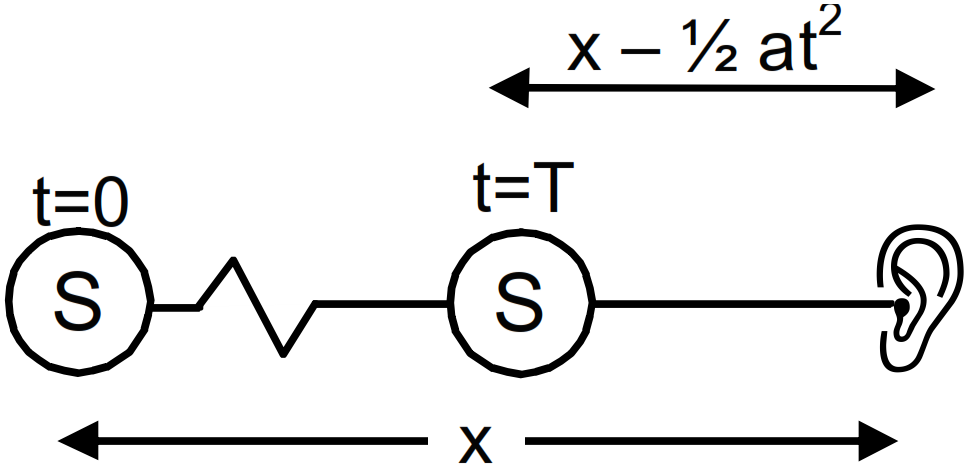
So, $\text{t}_2=\text{T}+\frac{\frac{\text{x}-1}{2}\text{a}\text{T}^2}{\text{v}}$$\text{t}_2-\text{t}_1=\text{T}+\frac{\frac{\text{x}-1}{2}\text{aT}^2}{\text{v}}=\frac{\text{x}}{\text{v}}=\text{T}-\frac{1}{2}\frac{\text{aT}^2}{\text{v}}$
Putting = $\text{T}=\frac{1}{\text{v}}.$ we get$\text{t}_2-\text{t}_1=\frac{2\text{uv}-\text{a}}{2\text{vv}^2}$
So, frequency heard $=\frac{2\text{vv}^2}{2\text{uv}-\text{a}}$ $\Big($because, $\text{f}=\frac{1}{\text{t}_2-\text{t}_1}\Big)$
View full question & answer
Question 23 Marks
A train approaching a platform at a speed of 54km/h sounds a whistle. An observer on the platform finds its frequency to be 1620Hz. The train passes the platform keeping the whistle on and without slowing down. What frequency will the observer hear after the train has crossed the platfrom? The speed of sound in air = 332m/s.
Answer
Here given, apparent frequency = 1620Hz So original frequency of the train is given by$1620=\Big(\frac{332+0+0}{332-15}\Big)\text{f}$
$\Rightarrow\text{f}=\Big(\frac{1620\times317}{332}\Big)\text{Hz}$
So, apparent frequency of the train observed by the observer in$\text{f}_1=\Big(\frac{332+0+0}{332+15}\Big)\text{f}\times\Big(\frac{1620\times317}{332}\Big)$
$=\frac{317}{347}\times1620=1480\text{Hz}.$
View full question & answer
Question 33 Marks
A copper rod of length 1.0m is clamped at its middle point. Find the frequencies between 20Hz - 20,000Hz at which standing longitudinal waves can be set up in the rod. The speed of sound in copper is 3.8km/s.
Answer
Length of the wire $=1.0\text{m}$ For fundamental frequency $\frac{\lambda}{2}=\text{I}$$\Rightarrow\lambda=2\text{I}=2\times1=2\text{m}$
Here given $\text{n}=3.8\text{km/s}=3800\text{m/s}$ We know $\Rightarrow\text{v}=\text{n}\lambda$$\Rightarrow\text{n}=\frac{3800}{2}=1.9\text{kH}.$
So standing frequency between 20Hz and 20kHz which will be heard are$=\text{n}\times1.9\text{kHz}$
Where n = 0, 1, 2, 3, … 10.
View full question & answer
Question 43 Marks
The equation of a travelling sound wave is $\text{y}=6.0\sin(600\text{t}-1.8\text{x})$ where $y$ is measured in $10^{-5}m, t$ in second and $x$ in metre.
  1. Find the ratio of the displacement amplitude of the particles to the wavelength of the wave.
  2. Find the ratio of the velocity amplitude of the particles to the wave speed.
Answer
Here given $\text{r}_\text{y}=6.0\times10^{-5}\text{m}$
  1. Given $\frac{2\pi}{\lambda}=1.8$
$\Rightarrow\lambda=\Big(\frac{2\pi}{1.8}\Big)$
So, $\frac{\text{r}_\text{y}}{\lambda}=\frac{6.0\times(1.8)\times10^{-5}\text{m/s}}{2\pi}$
$=1.7\times10^{-5}\text{m}$
  1. Let, velocity amplitude $= V_y$
$\text{V}=\frac{\text{dy}}{\text{dt}}=3600\cos(600\text{t}-1.8)\times10^{-5}\text{m/s}$
Here $\text{V}_\text{y}=3600\times10^{-5}\text{m/s}$
Again, $\lambda=\frac{2\pi}{1.8}$ and $\text{T}=\frac{2\pi}{600}$
$\Rightarrow$ wave speed $= \text{v}=\frac{\lambda}{\text{T}}$
$=\frac{600}{1.8}$
$=\frac{1000}{3}\text{m/s}.$
So the ratio of $\Big(\frac{\text{V}_\text{y}}{\text{v}}\Big)=\frac{3600\times3\times10^{-5}}{1000}.$
$=1.1\times 10^{-4}\text{m}$
View full question & answer
Question 53 Marks
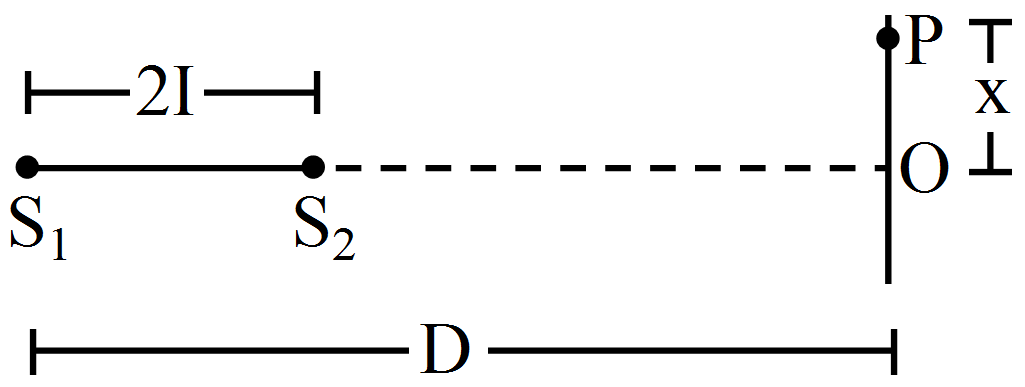
Two coherent narrow slits emitting sound of wavelength $\lambda$ in the same phase are placed parallel to each other at a small separation of $2\lambda.$ The sound is detected by moving a detector on the screen $\sum$ at a distance $\text{D}(>>\lambda)$ from the slit $S_1$ as shown in figure. Find the distance x such that the intensity at P is equal to the intensity at 0.
Answer
Given: $S_1$ & $S_2$ are in the same phase. At O, there will be maximum intensity. There will be maximum intensity at P. From the(in questions):$\triangle\text{S}_1\text{PO}$ and $\triangle\text{S}_2\text{PO}$ are right-angled triangle
So, $(\text{S}_1\text{P})^2-(\text{S}_2\text{P})^2$$=\big[\text{D}^2+\text{x}^2\big]-\Big[(\text{D}-2\lambda)^2+\text{x}^2\Big]^2$
$=4\lambda\text{D}+4\lambda^2=4\lambda\text{D}$
$\Big(\lambda^2$ is small and can be neglected$\Big)$
$\Rightarrow(\text{S}_1\text{P}+\text{S}_2\text{P})(\text{S}_1\text{P}-\text{S}_2\text{P})=4\lambda\text{D}$
$\Rightarrow(\text{S}_1\text{P}-\text{S}_2\text{P})=\frac{4\lambda\text{D}}{(\text{S}_1\text{P}+\text{S}_2\text{P})}$
$\Rightarrow\text{S}_1\text{P}-\text{S}_2\text{P}=\frac{4\lambda\text{D}}{2\sqrt{\text{x}^2+\text{D}^2}}$
For constructive interference, path difference $=\text{n}^\lambda$ So, $\text{S}_1\text{P}-\text{S}_2\text{P}=\frac{4\lambda\text{D}}{2\sqrt{\text{x}^2+\text{D}^2}}=\text{n}\lambda$$\Rightarrow\frac{2\text{D}}{\sqrt{\text{x}^2+\text{D}^2}}=\text{n}$
$\Rightarrow\text{n}^2\big(\text{x}^2+\text{D}^2\big)=4\text{D}^2$
$\Rightarrow\text{n}^2\text{x}^2+\text{n}^2\text{D}^2=4\text{D}^2$
$\Rightarrow\text{n}^2\text{x}^2=4\text{D}^2-\text{n}^2\text{D}^2$
$\Rightarrow\text{n}^2\text{x}^2=\text{D}^2(4-\text{n}^2)$
$\Rightarrow\text{x}=\frac{\text{D}}{\text{n}}\sqrt{4-\text{n}^2}$
When n = 1,$\text{x}=\sqrt{3}\text{D}$ ($1^{st}$ order).
When n = 2,$\text{x}=0$ ($2^{nd}​​​​​​​$ order).
So when $\text{x}=\sqrt{3}\text{D},$ the intensity at P is equal to the intensity at O.
View full question & answer
Question 63 Marks
A traffic policeman standing on a road sounds a whistle emitting the main frequency of 2.00kHz. What could be the appparent frequency heard by a scooter-driver approaching the policeman at a speed of 36.0km/h? Speed of sound in air = 340m/s.
Answer
Let u = velocity of sound; $V_m$ = velocity of the medium; $v_o$ = velocity of the observer; $v_s$ = velocity of the sources.
$\text{f}=\bigg(\frac{\overrightarrow{\text{u}}+\overrightarrow{\text{v}}_\text{m}-\overrightarrow{\text{v}}_0}{\text{v}+\text{V}_\text{m}-\text{v}_\text{s}}\bigg)\text{F}$
Using sign conventions in Doppler’s effect,$\text{V}_\text{m}=0,\ \text{u}=340\text{m/s},\ \text{v}_\text{s}=0$ and $\overrightarrow{\text{v}_0}=-10\text{m}$ (36km/h = 10m/s)
$=\Big(\frac{340+0-(-10)}{340+0-0}\Big)\times2\text{KHz}$
$=\frac{350}{340}\times2\text{KHz}$
$=2.06\text{KHz}.$
View full question & answer
Question 73 Marks
The sound level at a point 5.0m away from a point source is 40dB. What will be the level at a point 50m away from the source?
Answer
We know that $\beta=10\log_{10}\Big(\frac{\text{I}}{\text{I}_0}\Big)$$\beta_\text{A}=10\log\frac{\text{I}_\text{A}}{\text{I}_0},\ \beta_\text{B}=10\log\frac{\text{I}_\text{B}}{\text{I}_0}$
$\Rightarrow\frac{\text{I}_\text{A}}{\text{I}_0}=10^{\big(\frac{\beta_\text{A}}{10}\big)}\Rightarrow\frac{\text{I}_\text{B}}{\text{I}_0}=10^{\big(\frac{\beta_\text{B}}{10}\big)}$
$\Rightarrow\frac{\text{I}_\text{A}}{\text{I}_\text{B}}=\frac{\text{r}_\text{B}^2}{\text{r}^2_\text{A}}=\Big(\frac{50}{5}\Big)^2\Rightarrow10^{\big(\frac{\beta_\text{A}}{\beta_\text{B}}\big)}=10^2$
$\Rightarrow\frac{\beta_\text{A}-\beta_\text{B}}{10}=2\Rightarrow\beta_\text{A}-\beta_\text{B}=20$
$\Rightarrow\beta_\text{B}=40-20$
$=20\text{d}\beta.$
View full question & answer
Question 83 Marks
Calculate the speed of sound in oxygen from the following data. The mass of 22.4 litre of oxygen at STP ( $\mathrm{T}=273 \mathrm{~K}$ and $p=1.0 \times 10^5 \mathrm{~N} / \mathrm{m}^2$ ) is 32 g , the molar heat capacity of oxygen at constant volume is $\mathrm{C}_{\mathrm{v}}=2.5 \mathrm{R}$ and that at constant pressure is $C_p=3.5 R$.
Answer
Given that$\text{p}=1.0\times10^{5}\text{N/m}^2,\ \text{T}=273\text{K},\ \text{M}=32\text{g}=32\times10^{-3}\text{kg}$
$\text{V}=22.4\ \text{liter}=22.4\times10^{-3}\text{m}^3$
$\frac{\text{C}}{\text{C}_\text{v}}=\text{r}=\frac{3.5\text{R}}{2.5\text{R}}=1.4$
$\Rightarrow\text{V}=\sqrt{\frac{\text{rp}}{\text{f}}}=\sqrt{\frac{1.4\times1.0\times10^{-5}}{\frac{32}{22.4}}}=310\text{m/s}$ $\big($because $\rho=\frac{\text{m}}{\text{v}}\big)$
View full question & answer
Question 93 Marks
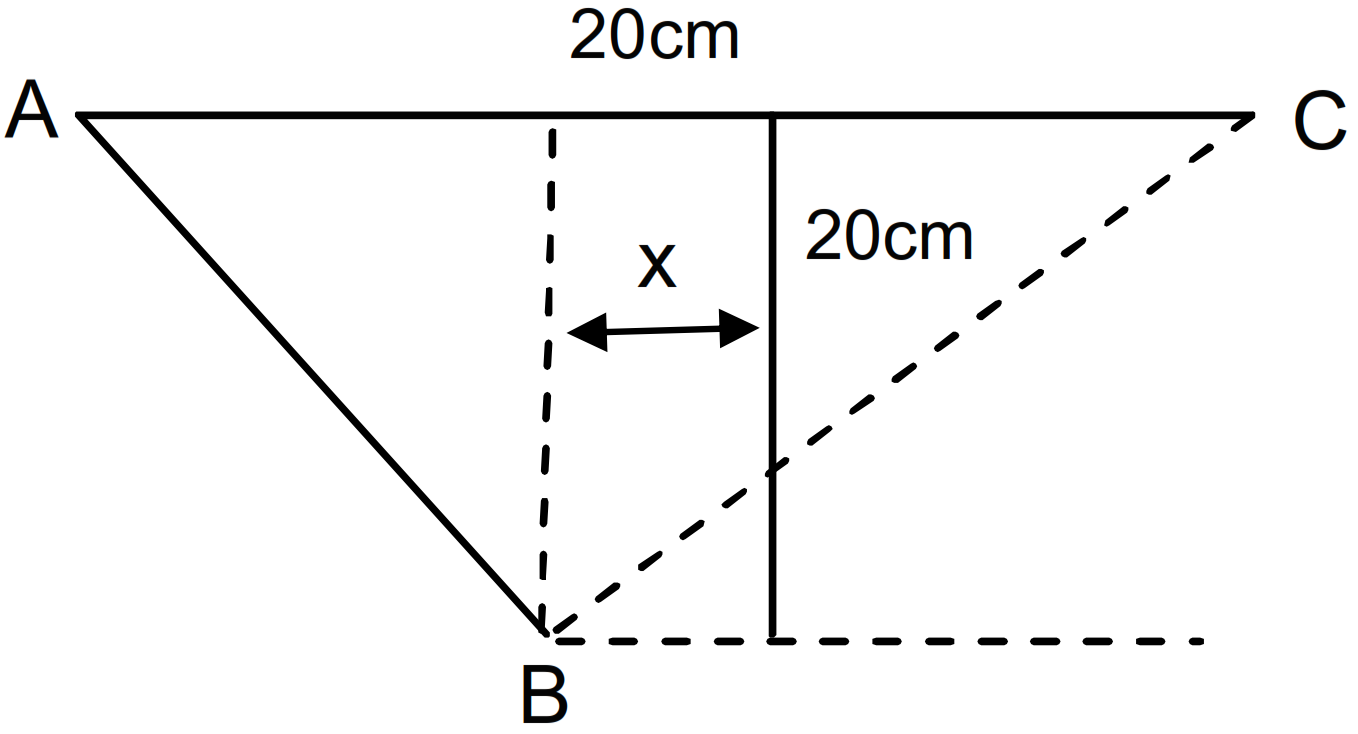
Two sources of sound, $S_1$ and $S_2$, emitting waves of equal wavelength 20.0cm, are placed with a separation of 20.0cm between them. A detector can be moved on a line parallel to $S_1S_2$, and at a distance of 20.0cm from it. Initially, the detector is equidistant from the two sources. Assuming that the waves emitted by the sources are in phase, find the minimum distance through which the detector should be shifted to detect a minimum of sound.
Answer


According to the data
$\lambda=20\text{cm},\text{S}_1\text{S}_2=20\text{cm},\text{BD}=20\text{cm}$
Let the detector is shifted to left for a distance x for hearing the minimum sound.
So path difference $\text{AI}=\text{BC}-\text{AB}$
$=\sqrt{(20)^2+(10+\text{x})^2}-\sqrt{(20)^2+(10-\text{x})^2}$
So the minimum distances hearing for minimum
$=\frac{(2\text{n}+1)\lambda}{2}=\frac{\lambda}{2}=\frac{20}{2}=10\text{cm}$
$=\sqrt{(20)^2+(10+\text{x})^2}-\sqrt{(20)^2+(10-\text{x}^2)}=10$
Solving we get x = 12.0cm.
View full question & answer
Question 103 Marks
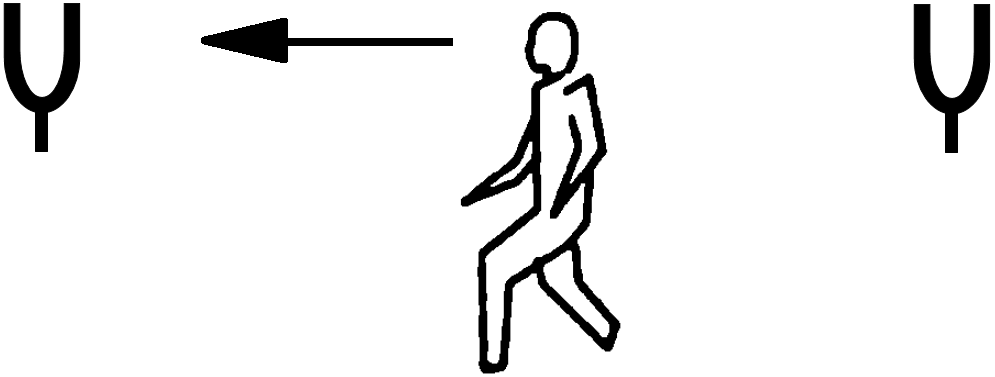
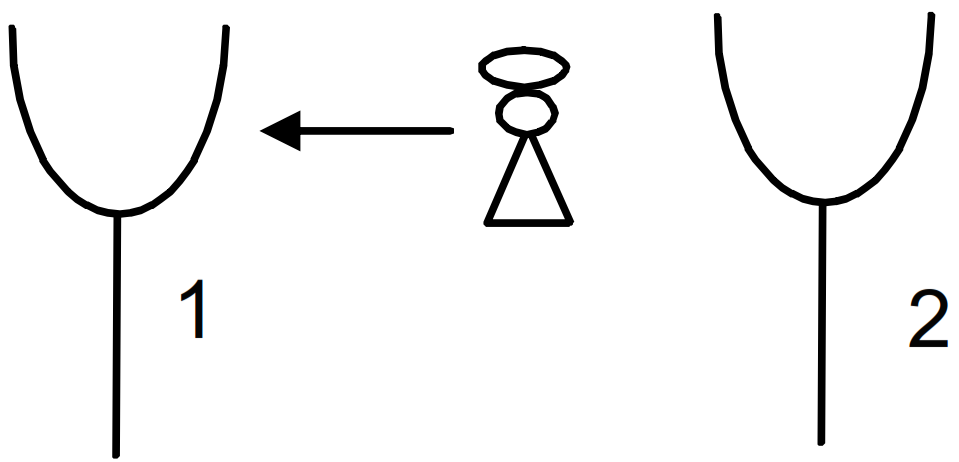
Two identical tuning forks vibrating at the same frequency 256Hz are kept fixed at some distance apart. A listener runs between the forks at a speed of 3.0m/s so that he approaches one tuning fork and recedes from the other figure. Find the beat frequency observed by the listener. Speed of sound in air = 332ms/s.
Answer


Here given velocity of the sources $v_s = 0$
Velocity of the observer $v_0 = 3m/s$
So, the apparent frequency heard by the man $=\Big(\frac{332+3}{332}\Big)\times256=258.3\text{Hz}.$
From the approaching tuning form = f'
$\text{f}'=\Big[\frac{(332-3)}{332}\Big]\times256=253.7\text{Hz}.$
So, beat produced by them $=258.3-253.7=4.6\text{Hz}.$
View full question & answer
Question 113 Marks
The horn of a car emits sound with a dominant frequency of 2400Hz. What will be the apparent dominant frequency heard by a person standing on the road in front of the car if the car is approaching at 18.0km/h? Speed of sound in air = 340m/s.
Answer
$\text{f}^1=\bigg(\frac{\overrightarrow{\text{u}}+\overrightarrow{\text{v}}_\text{m}-\overrightarrow{\text{v}}_0}{\overrightarrow{\text{u}}+\overrightarrow{\text{v}}_\text{m}-\overrightarrow{\text{v}}_\text{s}}\bigg)\text{f}$ [18km/h = 5m/s]
Using sign conventions,
app. Frequency $=\Big(\frac{340+0-0}{340+0-5}\Big)\times2400=2436\text{Hz}.$
View full question & answer
Question 123 Marks
The intensity of sound from a point source is $1.0 \times 10^{-6}W/m^2$ at a distance of 5.0m from the source. What will be the intensity at a distance of 25m from the source?
Answer
Here $\text{I}_1=1.0\times10^{-8}\text{W}_1/\text{m}^2;\text{I}_2=?$$\text{r}_1=5.0\text{m},\ \text{r}_2=25\text{m}.$
We know that $\text{I}\propto\frac{1}{\text{r}^2}$$\Rightarrow\text{I}_1\text{r}_1^2=\text{I}_2\text{r}_2^2$
$\Rightarrow\text{I}_2=\frac{\text{I}_1\text{r}_1^2}{\text{r}^2_2}$
$=\frac{1.0\times10^{-8}\times25}{625}$
$=4.0\times10^{-10}\text{W/m}^2.$
View full question & answer
Question 133 Marks
A bat emitting an ultrasonic wave of frequency $4.5 \times 10^4Hz$ flies at a speed of 6m/s between two parallel walls. Find the two frequencies heard by the bat and the beat frequency between the two. The speed of sound is 330m/s.
Answer
Let, the bat be flying between the walls $W_1$ and $W_2$.
So it will listen two frequency reflecting from walls $W_2$ and $W_1$.
So, apparent frequency, as received by wall $\text{W}=\text{fw}_2=\frac{330+0+0}{330-6}\times\text{f}=\frac{330}{324}$
Therefore, apparent frequency received by the bat from wall $W_2$ is given by
$\text{F}_{\text{B}_2}\ \text{of wall}\ \text{W}_1=\Big(\frac{330+0-(-6)}{330+0+0}\Big)\text{f}_{\text{w}_2}$
$=\Big(\frac{336}{33}\Big)\times\Big(\frac{33}{324}\Big)\text{f}$
Similarly the apparent frequency received by the bat from wall $W_1​​​​​​​$ is
$\text{f}_\text{B}=\Big(\frac{324}{336}\Big)\text{f}$
So the beat frequency heard by the bat will be $=4.47\times10^4=4.3430\times10^4=3270\text{Hz}.$
View full question & answer
Question 143 Marks
A car moves with a speed of $54\ km/h$ towards a cliff. The horn of the car emits sound of frequency $400Hz$ at a speed of $3.35m/s.$
  1. Find the wavelength of the sound emitted by the horn in front of the car.
  2. Find the wavelength of the wave reflected from the cliff.
  3. What frequency does a person sitting in the car hear for the reflected sound wave?
  4. How many beats does he hear in $10$ seconds between the sound coming directly from the horn and that coming after the reflection?
Answer
  1. $\text{f}=1400\text{Hz}, \text{u}=335\text{m/s}$
  1. $\Rightarrow\text{x}'=\Big(\frac{\text{v}}{\text{f}}\Big)=\frac{320\times335}{335\times400}=0.8\text{m}=80\text{cm}$
    The frequency received by the person sitting inside the car from reflected wave,
  2. $\text{f}'=\Big(\frac{335-0}{335-15}\Big)\text{f}=\frac{335}{320}\times400=467[V_s = 0$ and $V_o = -15m/s]$
  3. Because, the difference between the original frequency and the apparent frequency from the wall is very high $(437 - 440 = 37Hz),$ he will not hear any beats $mm$
  4. $\lambda\Big(\frac{\text{v}}{\text{f}}\Big)=\Big(\frac{335}{400}\Big)=0.8\text{m}=80\text{cm}$
    The frequency received and reflected by the wall,
  5. $\text{f}'=\Big(\frac{\text{u}-\text{V}_0}{\text{u}-\text{V}_\text{s}}\Big)\times\text{f}=\frac{335}{320}\times400\ \dots$ $V_s = 54m/s$ and $V_o = 0]$
View full question & answer
Question 153 Marks
A person riding a car moving at $72\ km/h$ sounds a whistle emitting a wave of frequency $1250Hz.$ What frequency will be heard by another person standing on the road.
  1. In front of the car.
  2. Behind the car? Speed of sound in air $= 340m/s.$
Answer
  1. Given $\text{v}_\text{s}=72\text{km/hour}=20\text{m/s},\ \rho=1250$
Apparent frequency $=\frac{340+0+0}{340+0-20}\times1250=1328\text{H}_2$
  1. For second case apparent frequency will be $=\frac{340+0+0}{340+0-(-20)}\times1250=1181\text{Hz}.$
View full question & answer
Question 163 Marks
In a Quincke's experiment, the sound intensity has a minimum value $I$ at a particular position. As the sliding tube is pulled out by a distance of $16.5mm,$ the intensity increases to a maximum of $9I.$ Take the speed of sound in air to be $330m/s.$
  1. Find the frequency of the sound source.
  2. Find the ratio of the amplitudes of the two waves arriving at the detector assuming that it does not change much between the positions of minimum intensity and maximum intensity.
Answer
  1. According to the data
$\frac{\lambda}{4}=16.5\text{mm}$
$\Rightarrow\lambda=66\text{mm}=66\times10^{-3}\text{m}$
$\Rightarrow\text{n}=\frac{\text{V}}{\lambda}=\frac{330}{66\times10^{-3}}=5\text{KHz}$
  1. $\text{I}_\text{minimum}=\text{K}(\text{A}_1-\text{A}_2)^2=\text{I}\Rightarrow\text{A}_1-\text{A}_2=11$
$\text{I}_\text{minimum}=\text{K}(\text{A}_1+\text{A}_2)^2=9\Rightarrow\text{A}_1+\text{A}_2=31$
So, $\frac{\text{A}_1+\text{A}_2}{\text{A}_1+\text{A}_2}=\frac{\text{3}}{4}$
$\Rightarrow\frac{\text{A}_1}{\text{A}_2}=\frac{2}{1}$
So, the ratio amplitudes is $2.$
View full question & answer
Question 173 Marks
A traffic policeman sounds a whistle to stop a car-driver approaching towards him. The car-driver does not stop and takes the plea in court that because of the Doppler shift, the frequency of the whistle reaching him might have gone beyond the audible limit of 20kHz and he did not hear it. Experiments showed that the whistle emits a sound with frequency close to 16kHz. Assuming that the claim of the driver is true, how fast was he driving the car? Take the speed of sound in air to be 330m/s. Is this speed practical with today's technology?
Answer
Here given $f_s=16 \times 10^3 \mathrm{~Hz}$ Apparent frequency $\mathrm{f}^{\prime}=20 \times 103 \mathrm{~Hz}$ (greater than that value) Let the velocity of the observer $=$ v $_0$ Given $v_s=0$ So, $20 \times 10^3=\left(\frac{330+v_0}{330+0}\right) \times 16 \times 10^3 \Rightarrow\left(330+v_0\right)=\frac{20 \times 330}{16}$
$\Rightarrow\text{v}_0=\frac{20\times330-16\times330}{4}$
$=\frac{330}{4}\text{m/s}$
$=297\text{km/h}$
View full question & answer
Question 183 Marks
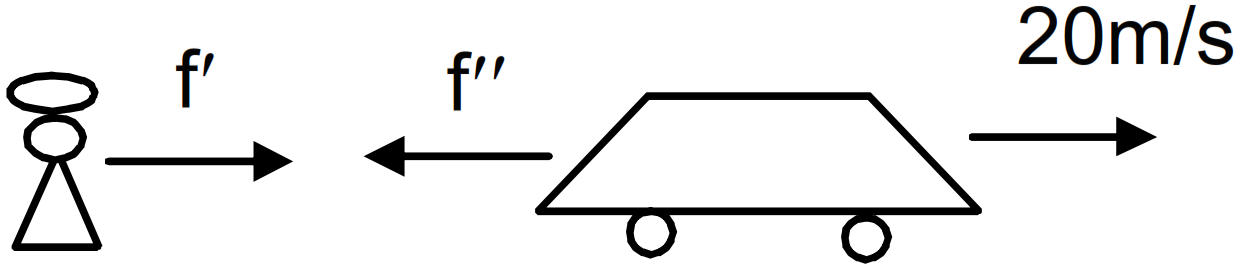
A person standing on a road sends a sound signal to the driver of a car going away from him at a speed of 72km/h. The signal travelling at 330m/s in air and having a frequencyof 1600Hz gets reflected d from the body of the car and returns. Find the frequency of the reflected signal as heard by the person.
Answer

Here given, $\text{u}=330\text{m/s},\ \text{f}=1600\text{Hz}$
So, apparent frequency received by the car
$\text{f}'\Big(\frac{\text{u}-\text{V}_0}{\text{u}-\text{V}_\text{s}}\Big)\text{f}=\Big(\frac{330-20}{330}\Big)\times1600\text{Hz}\ \dots$ $\big[\text{V}_0=20\text{m/s},\ \text{V}_\text{s}=0\big]$
The reflected sound from the car acts as the source for the person.
Here, $\text{V}_\text{s}=-20\text{m/s},\ \text{V}_0=0$
So $\text{f}''=\Big(\frac{330-0}{330+20}\Big)\times\text{f}'=\frac{330}{350}\times\frac{310}{330}\times1600\text{Hz}=1417\text{Hz}.$
$\therefore\ $This is the frequency heard by the person from the car.
View full question & answer
Question 193 Marks
The noise level in a class-room in absence of the teacher is 50dB when 50 students are present. Assuming that on the average each student outputs same sound energy per second, what will be the noise level if the number of students is increased to 100?
Answer
Let the intensity of each student be I. According to the question$\beta_\text{A}=10\log_{10}\frac{50\text{I}}{\text{I}_0};\ \beta_\text{B}=10\log_{10}\Big(\frac{100\text{I}}{\text{I}_0}\Big)$
$\Rightarrow\beta_\text{B}-\beta_\text{A}=10\log_{10}\frac{50\text{I}}{\text{I}_0}-10\log_{10}\Big(\frac{100\text{I}}{\text{I}_0}\Big)$
$=10\log\Big(\frac{100\text{I}}{50\text{I}}\Big)$
$=10\log_{10}2=3$
So, $\beta_\text{A}=50+3=53\text{dB}.$
View full question & answer
Question 203 Marks
A violin player riding on a slow train plays a $440Hz$ note. Another violin player standing near the track plays the same note. When the two are close by and the train approaches the person on the ground, he hears $4.0$ beats per second. The speed of sound in air $= 340m/s$.
  1. Calculate the speed of the train.
  2. What beat frequency is heard by the player in the train?
Answer
Given,
Frequency of violins $f_0= 440Hz$
Speed of sound in air $v = 340ms^{-1}$
Let the velocity of the train $($sources$)$ be $v_s$.
  1. Beat heard by the standing man $= 4$
$\therefore$ Frequency $(f_1)=440+4$
$\text{f}_1=444\text{Hz}$ or $436 Hz$
Now,
$\text{f}_1=\Big(\frac{340}{340-\text{v}_\text{s}}\Big)\times\text{f}_0$
On substituting the values,
We have,
$444=\Big(\frac{340+0}{340-\text{v}_\text{s}}\Big)\times440$
$\Rightarrow444(340-\text{v}_\text{s})=440\times340$
$\Rightarrow340\times(444-440)=440\times\text{v}_\text{s}$
$\Rightarrow340\times4=440\times\text{v}_\text{s}$
$\Rightarrow\text{v}_\text{s}=3.09\text{m/ s}=11\text{km/ h}$
  1. The sitting man will listen to fewer than $4$ beats/-s.
View full question & answer