Questions

2 Marks Questions

Take a timed test

60 questions · self-marked practice — reveal the answer and mark yourself.

Question 12 Marks
Explain why: The coolant in a chemical or a nuclear plant (i.e., the liquid used to prevent the different parts of a plant from getting too hot) should have high specific heat.
Answer
The coolant in a chemical or nuclear plant should have a high specific heat. This is because higher the specific heat of the coolant, higher is its heat-absorbing capacity and vice versa. Hence, a liquid having a high specific heat is the best coolant to be used in a nuclear or chemical plant. This would prevent different parts of the plant from getting too hot.
View full question & answer
Question 22 Marks
Two cylinders A and B of equal capacity are connected to each other via a stopcock. A contains a gas at standard temperature and pressure. B is completely evacuated. The entire system is thermally insulated. The stopcock is suddenly opened. Answer the following: Do the intermediate states of the system (before settling to the final equilibrium state) lie on its P-V-T surface?
Answer
No. The given process is a case of free expansion. It is rapid and cannot be controlled. The intermediate states do not satisfy the gas equation and since they are in non equilibrium states, they do not lie on the P-V-T surface of the system.
View full question & answer
Question 32 Marks
Explain why: Air pressure in a car tyre increases during driving.
Answer
When a car is in motion, the air temperature inside the car increases because of the motion of the air molecules. According to Charles’ law, temperature is directly proportional to pressure. Hence, if the temperature inside a tyre increases, then the air pressure in it will also increase.
View full question & answer
Question 42 Marks
Two cylinders A and B of equal capacity are connected to each other via a stopcock. A contains a gas at standard temperature and pressure. B is completely evacuated. The entire system is thermally insulated. The stopcock is suddenly opened. Answer the following: What is the change in the temperature of the gas?
Answer
Zero. Since no work is being done by the gas during the expansion of the gas, the temperature of the gas will not change at all.
View full question & answer
Question 52 Marks
Explain why: The climate of a harbour town is more temperate than that of a town in a desert at the same latitude.
Answer
A harbour town has a more temperate climate (i.e., without the extremes of heat or cold) than a town located in a desert at the same latitude. This is because the relative humidity in a harbour town is more than it is in a desert town.
View full question & answer
Question 62 Marks
Two cylinders A and B of equal capacity are connected to each other via a stopcock. A contains a gas at standard temperature and pressure. B is completely evacuated. The entire system is thermally insulated. The stopcock is suddenly opened. Answer the following: What is the final pressure of the gas in A and B?
Answer
0.5 atm. The volume available to the gas is doubled as soon as the stopcock between cylinders A and B is opened. Since volume is inversely proportional to pressure, the pressure will decrease to one-half of the original value. Since the initial pressure of the gas is 1 atm, the pressure in each cylinder will be 0.5 atm.
View full question & answer
Question 72 Marks
Two cylinders A and B of equal capacity are connected to each other via a stopcock. A contains a gas at standard temperature and pressure. B is completely evacuated. The entire system is thermally insulated. The stopcock is suddenly opened. Answer the following: What is the change in internal energy of the gas?
Answer
Zero. The internal energy of the gas can change only when work is done by or on the gas. Since in this case no work is done by or on the gas, the internal energy of the gas will not change.
View full question & answer
Question 82 Marks
Define temperature on the basis of the zeroth law of thermodynamics.
Answer
Temperature is a scalar physical quantity and is a property of all thermodynamic systems (in equilibrium states) such that temperature equality is a necessary and sufficient condition for thermal equilibrium.
View full question & answer
Question 92 Marks
What is an isothermal process? Also give essential conditions for an isothermal process to take place.
Answer
A change in pressure and volume of a gas without any change in its temperature is called an isothermal process. Two essential conditions for perfect isothermal process are:
  1. The walls of the container must be perfectly conducting to allow free exchange of heat between the gas and its surrounding.
  2. The process of compression or expansion should be slow so as to provide time for exchange of heat.
View full question & answer
Question 102 Marks
Can a room be cooled by leaving the door of an electric refrigerator open?
Answer
No, the room cannot be cooled by leaving the door of an electric refrigerator open. In fact, the temperature of the room rises because the refrigerator extracts heat from the freezing chambers and rejects it to the surrounding air in the room.
View full question & answer
Question 112 Marks
Why can't the efficiency of an internal combustion engine be raised beyond a limit?
Answer
To increase the efficiency $\Big[=1-\Big(\frac{1}{\rho}\Big)^{\gamma-1}\Big],$ the compression ratio $\rho$ has to be increased. $\rho$ cannot be made greater than 10, because then the cylinder of the engine will have to be made very thick and heavy which will be unsuitable for lighter vehicles. Secondly, during the adiabatic compression, the temperature of the air-petrol mixture will be high enough to cause explosion.
View full question & answer
Question 122 Marks
What happens to the change in internal energy of a gas during:
  1. Isothermal expansion?
  2. Adiabatic expansion?
Answer
  1. For isothermal process, $\text{dU = 0}$ as
$\text{dT = 0}$ and $\text{d = nC}_\text{vdT}$
$\therefore$ Internal energy remains same.
  1. Internal energy decreases.
View full question & answer
Question 132 Marks
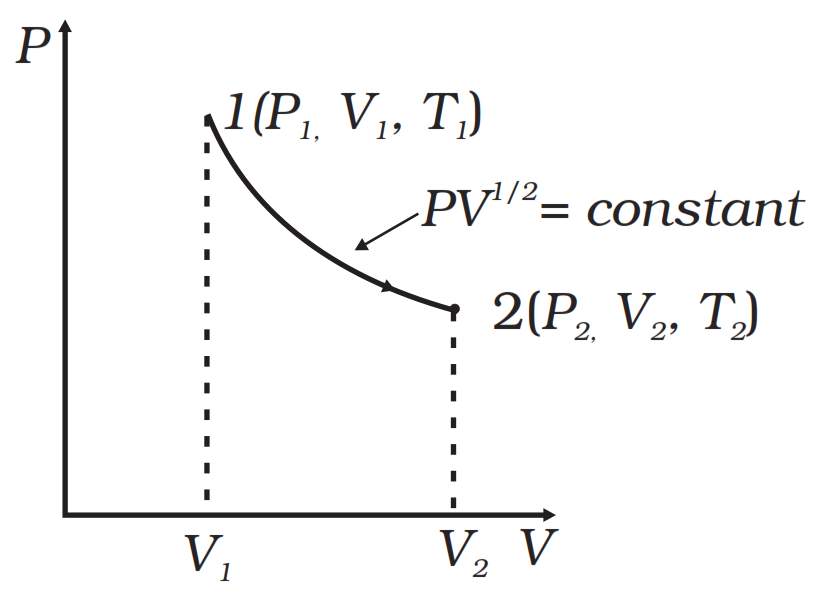
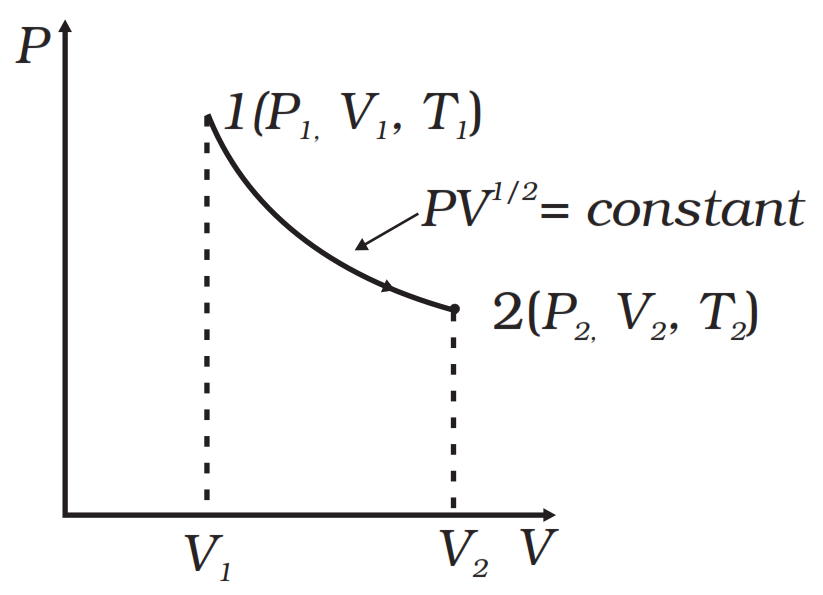
Consider a P-V diagram in which the path followed by one mole of perfect gas in a cylindrical container is shown in Fig. What is the ratio of temperature $\frac{\text{T}_1}{\text{T}_2},\text{if}\text{V}_2=2\text{V}_1?$
Answer
$\therefore\ \text{PV}^\frac{1}{2}=$ constant = K (given) or $\text{P}_1\text{V}_1^\frac{1}{2}=\text{P}_2\text{V}_2^\frac{1}{2}=K\text{and}\ \text{P}=\frac{\text{K}}{\text{V}^\frac{1}{2}}$ from gas equation of ideal gas PV nRT $\Rightarrow\text{T}=\frac{\text{PV}}{\text{nR}}=\frac{\text{P}\sqrt{\text{V}}\sqrt{\text{V}}}{\text{nR}}=\frac{\text{K}\sqrt{\text{V}}}{\text{nR}}$ $\text{T}_1\frac{\text{K}\sqrt{\text{V}_1}}{\text{nR}}\text{and}\text{T}_2=\frac{\text{K}\sqrt{\text{V}_2}}{\text{nR}}$ $\frac{\text{T}_1}{\text{T}_2}=\frac{\frac{\text{K}\sqrt{\text{V}}_1}{\text{nR}}}{\frac{\text{K}\sqrt{\text{V}}_2}{\text{nR}}}=\frac{\sqrt{\text{V}}_1}{\sqrt{\text{V}}_2}=\sqrt\frac{\text{V}_1}{2\text{V}_1}$ $(\therefore\ \text{V}_2=2\text{V}_1\text{given})$ $\therefore\ \frac{\text{T}_1}{\text{T}_2}=\frac{1}{\sqrt2}\ ....(\text{ii})$ required ratio is $1:\sqrt2$
View full question & answer
Question 142 Marks
What are the limitations of the first law of thermodynamics?
Answer
First law of thermodynamics did not tell us about:
  1. The quick or slow nature of a process.
  2. Whether a process is possible or not.
View full question & answer
Question 152 Marks
Compare an isothermal and an adiabatic process.
Answer
S. No.
Isothermal process
Adiabatic process
i.
dT = 0
dQ = 0
ii.
Generally a slow process.
Generally a fast process.
iii.
Carried out in a conducting cylinder.
Carried out in a non conducting cylinder.
View full question & answer
Question 162 Marks
Which of the two will increase the pressure more-an adiabatic or an isothermal process in reducing the volume to 50%?
Answer
For Isothermal process, P'V' = PV $\text{V}'=\frac{\text{V}}{2},\therefore\text{P}'=2\text{P}$ For adiabatic process, $\text{P}'\text{V}^{\gamma}=\text{PV}^{\gamma}$ $\therefore\text{V}'=\frac{\text{V}}{2},\text{P}'=2'\text{P}$ Since $\gamma>1,$ the adiabatic process will increase the pressure more.
View full question & answer
Question 172 Marks
If the co-efficient of performance of a refrigerator is 5 and operates at the room temperature (27°C), find the temperature inside the refrigerator.
Answer
We know, $\beta=\frac{\text{T}_{2}}{\text{T}_{1}-\text{T}_{2}}$ $\big(\beta={5},\text{ T}_{1}=27+273=300\text{K}\big)$ $5=\frac{\text{T}_{2}}{300-\text{T}_{2}}\Rightarrow\text{T}_{2}=1500-5\text{T}_{2}$ $\text{T}_{2}+5\text{T}_{2}=1500\Rightarrow6\text{T}_{2}=1500$ $\text{T}_{2}=\frac{1500}{6}=250\text{K}=250-273=-23^\circ\text{C}.$
View full question & answer
Question 182 Marks
Consider a P-V diagram in which the path followed by one mole of perfect gas in a cylindrical container is shown in Fig. Find the work done when the gas is taken from state 1 to state 2.
Answer
$\therefore\text{PV}^\frac{1}{2}= $ constant = K (given) or Work done for process from 1 to 2 $\text{WD}=\int\limits^{\text{v}_{2}}_{\text{v}_{1}}\text{P}.\text{dV}=\int\limits^{\text{v}_{2}}_{\text{v}_{1}}\frac{\text{K}}{\text{V}^\frac{1}{2}}\text{dV}=\text{K}\int\limits^{\text{v}_{2}}_{\text{v}_{1}}\text{V}^{-\big(\frac{1}{2}\big)\text{dV}}$$$ $\text{WD}=\text{K}\Bigg[\frac{\text{V}^\frac{1}{2}}{\frac{1}{2}}\Bigg]^{\text{v}_2}_{\text{v}_1}=2\text{K}\big[\sqrt{\text{V}_{2}}-\sqrt{\text{V}_1}\big]$ WD form $\text{V}_1\text{to}\text{V}_2,\text{i.e},\text{dW}=2\text{P}_1\text{V}_1^\frac{1}{2}\big[\sqrt{\text{V}_2}-\sqrt{\text{V}_1}\big]$ $=2\text{P}_2\text{V}_2^\frac{1}{2}\big[\sqrt{\text{V}_2}-\sqrt{\text{V}_1}\big]$
View full question & answer
Question 192 Marks
What is the energy required for 1gm of ice to become steam?
Answer
Latent heat of fusion = 80 cal/ gm Latent heat of vapourisation = 540 cal/ gm Specific heat of water = 1 cal/ gm °C Energy required to make 1gm of ice to vapour = 1 × 80 + 1 × 1 (100 - 0) + 540 = 80 + 100 + 540 = 720 calories
View full question & answer
Question 202 Marks
Explain why: The coolant in a chemical or a nuclear plant (i.e., the liquid used to prevent the different parts of a plant from getting too hot) should have high specific heat.
Answer
The coolant in a chemical or nuclear plant should have a high specific heat. This is because higher the specific heat of the coolant, higher is its heat-absorbing capacity and vice versa. Hence, a liquid having a high specific heat is the best coolant to be used in a nuclear or chemical plant. This would prevent different parts of the plant from getting too hot.
View full question & answer
Question 212 Marks
Two cylinders $A$ and $B$ of equal capacity are connected to each other via a stop$-$cock. $'A\ '$ contains a gas at $\text{S.T.P.} 'B\ '$ is completely evacuated. The entire system is thermally insulated. The stop$-$cock is suddenly opened.Answer the following:
  1. What is the change in internal energy of the gas?
  2. What is the change in the temperature of the gas?
Answer
  1. Heat energy exchange $\Delta\text{Q}=0$
Work done $\text{= pdV = 0}$
$\because\text{P}=0$ into the cylinder where gas moved.
  1. $\Delta\text{U}=0$ So, no change in temperature.
Since it is an expansion into vacuum.
View full question & answer
Question 222 Marks
A Carnot engine is operating between 600K and 200K. Consider that the actual energy produced is 2 kJ per kilocalorie of heat absorbed. Compare the real efficiency with the efficiency of Carnot engine.
Answer
Given, $T_1 = 600K, T_2 = 200K$ Efficiency of Cornot engine, $\eta=\frac{\text{T}_1-\text{T}_2}{\text{T}_2}=\frac{600-200}{600}$ $=\frac{400}{600}=\frac23=66\%$ $\text{Real effieciency}=\frac{\text{Energy output}}{\text{Energy input}}$ $=\frac{2}{1\times4.2}=0.47=47\%$ $\therefore\frac{\text{Real effieciency}}{\text{Carnot engine efficiency}}=\frac{47}{66}=0.71$
View full question & answer
Question 232 Marks
If a refrigerator’s door is kept open, will the room become cool or hot? Explain.
Answer
If a refrigerator door is kept open the room will become hotter, because amount of heat absorbed from inside the refrigerator and work done on refrigerator by electricity both will be rejected by refrigerator in room.
View full question & answer
Question 242 Marks
State the law of equi-partition of energy. What is the internal energy with mono, di and tri-atomic gases?
Answer
Law of equi-partition of energy states that every degree of freedom will provide the same amount of energy to the internal energy of the system, i.e., $\frac12\text{RT}$ Internal energy with mono, di and tri-atomic gas is, $\frac32\text{R}\frac52\text{R}$ and $\frac72\text{R}$ respectively.
View full question & answer
Question 252 Marks
Temperature in the freezer of a refrigerator is being maintained at $-13^\circ C$ and room temperature on a particular day was $42^\circ C$. Calculate the coefficient of performance of the refrigerator.
Answer
Here, temperature of colder body $T_2 = -13^\circ C = 260K$ and temperature of hotter surroundings $T_1 = 42^\circ C = 315K$. $\therefore$ Coefficient of performance of refrigrator $\beta=\frac{\text{T}_2}{\text{T}_1-\text{T}_2}$ $=\frac{260}{315-260}$ $=\frac{260}{55}=4.73$
View full question & answer
Question 262 Marks
Define two principle specific heats of a gas. Which is greater and why?
Answer
$\mathbf{C}_{\mathbf{p}}$ : The amount of energy required for 1 mole of a gas to raise its temperature by 1 K at constant pressure condition.
$\mathbf{C}_{\mathrm{v}}$ : The amount of energy required for 1 mole of a gas to raise its temperature by 1 K at constant volume conditions. $\mathrm{C}_{\mathrm{p}}>\mathrm{C}_{\mathrm{v}}$ Since for constant pressure process, both volume and temperature are altered and for constant volume process, only temperature varies.
View full question & answer
Question 272 Marks
A refrigerator cools a body cooler than its surroundings. Does this violate the law of conservation of energy?
Answer
No, since the compressor works on the system to cool the body cooler than the surrounding. If W work is done to take $Q_2$ amount of energy from and pass $Q_1$ energy to the sink (surrounding) then, $W=Q_1-Q_2$
View full question & answer
Question 282 Marks
What is an indicator diagram? What is its significance?
Answer
An indicator diagram is a $P-V$ graph showing the variation of pressure and volume during a thermodynamical process.
It gives us:
  1. The nature of process.
  2. The work done during the process.
View full question & answer
Question 292 Marks
Two samples of gas initially at the same temperature and pressure are compressed from volume V to $\frac{\text{V}}{2}.$ One sample is compressed isothermally and the other adiabatically. In which case will the pressure be higher? Explain.
Answer
Let $P_a$ and $P_i$ be the final pressure during adiabatic and isothermal compression respectively. In case isothermal compression. $\text{PV}=\text{P}_\text{i}\Big(\frac{\text{V}}{2}\Big)$ or $\text{P}_\text{i}=2\text{P}\dots\text{(i)}$ In case of adiabatic compression, $\text{PV}^\gamma=\text{P}_\text{i}\Big(\frac{\text{V}}{2}\Big)^\gamma$ or $\text{P}_\text{a}=2^\gamma\text{P}\dots\text{(ii)}$ $\therefore\frac{\text{P}_\text{a}}{\text{P}_\text{i}}=\frac{2^\gamma}{2}>1,$ because $\gamma>1$ $\therefore\text{P}_\text{a}>\text{P}_\text{i}$ Hence, final pressure during adiabatic compression is greater than the pressure during isothermal compression.
View full question & answer
Question 302 Marks
Can you design a heat Engine of 100% efficiency? Explain your answer.
Answer
The efficiency of a heat engine is $\eta=1-\frac{\text{T}_2}{\text{T}_1}$ The efficiency of heat engine will be 100% or 1 if, $T_2$ = 0K Since temperature equal to 0K cannot be reached, so a heat engine cannot have 100 % efficiency.
View full question & answer
Question 312 Marks
Two cylinders A and B of equal capacity are connected to each other via a stopcock. A contains a gas at standard temperature and pressure. B is completely evacuated. The entire system is thermally insulated. The stopcock is suddenly opened. Answer the following: Do the intermediate states of the system (before settling to the final equilibrium state) lie on its P-V-T surface?
Answer
No. The given process is a case of free expansion. It is rapid and cannot be controlled. The intermediate states do not satisfy the gas equation and since they are in non equilibrium states, they do not lie on the P-V-T surface of the system.
View full question & answer
Question 322 Marks
A carnot engine absorbs 100 calories per cycle from its source at 1600K. Its efficiency is 60%. Find the temperature of the sink and work done per cycle. Given J = 4.2J/ cal.
Answer
$\text{Q}_1=100\text{cal}, \text{T}_1=1600\text{K},\ \eta=60\%=\frac35$ For glass, $\eta=1-\frac{\text{T}_2}{\text{T}_1},$ $\frac35=1-\frac{\text{T}_2}{1600}$ $\text{T}_2=640\text{K}$ As, $\eta=\frac{\text{W}}{\text{Q}_1},\text{W}=\eta\text{Q}_1$ $=\frac35\times100=60\text{cal}.$ $\text{W}=60\times4.2\text{J}$ $=252\text{J}$
View full question & answer
Question 332 Marks
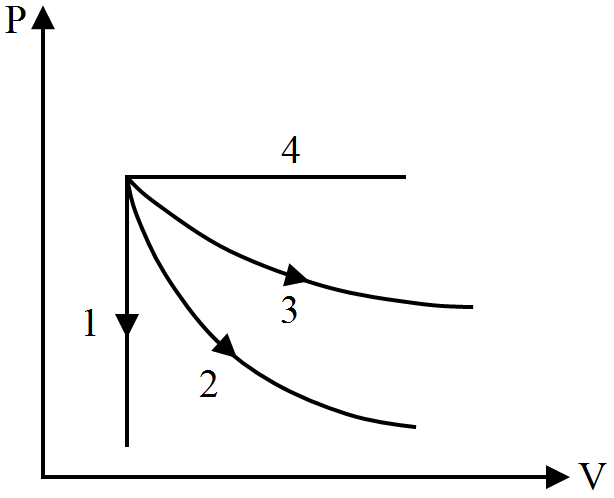
Identify and name the thermodynamic processes marked as $1, 2, 3$ and $4$ as shown in figure.
Answer
  1. Isochoric process as it occurs at constant volume.
  2. Adiabatic process because its slope is steeper than the process indicated by $3,$ which is isothermal process.
  3. Isothermal process.
  4. Isobaric process as it occurs at constant pressure.
View full question & answer
Question 342 Marks
A refrigerator, whose coefficient of performance is 5, extracts heat from the cooling compartment at the rate of 250 per cycle. How much heat per cycle is discharged to the room?
Answer
$\beta=\frac{\text{Q}_2}{\text{Q}_1-\text{Q}_2}$ or $5=\frac{250}{\text{Q}_1-250}$ $5\text{Q}_1-1250=250$ or $\text{Q}_1=\frac{1500}{5}\text{J}=300\text{J}$ $\therefore$ Heat discharged per cycle to the room = 300J.
View full question & answer
Question 352 Marks
When two conductors having thermal resistances $\text{R}_1$ and $\text{R}_2$ are joined end to end and placed between two reservoirs, find the equivalent thermal resistance.
Answer
Since $\frac{\text{Q}}{\text{t}}$ is same in both and $(\theta_1-\theta)+(\theta-\theta_2)$ is $(\theta_1-\theta_2)$ We have, $\text{R}_{\text{eq}}=\text{R}_1+\text{R}_2$
View full question & answer
Question 362 Marks
What are the limitations of the first law of thermodynamics?
Answer
Following are the limitations of the first law of thermodynamics:
  1. It does not tell us about the direction of flow of heat.
  2. It fails to explain why heat cannot be spontaneously converted into work.
View full question & answer
Question 372 Marks
A newly designed thermometer has its lower fixed point and upper fixed point marked 5°C and 95°C respectively. Compute the temperature on this scale corresponding to 50°C.
Answer
Let $\theta$ be the temperature on the scale corresponding to 50°C, then, $\frac{\theta-5}{95-5}=\frac{\text{C}-0}{100-0}=\frac{\text{C}}{100}$ or $\frac{\theta-5}{90}$ $=\frac{50}{100}=\frac12$ or $\theta=50^\circ\text{C}$ Thus, the required temperature on the scale of the designed thermometer is 50°C.
View full question & answer
Question 382 Marks
In a double acting steam engine, the average pressure of steam is $8 \times 10^4 \mathrm{Nm}^{-2}$. The length of the stroke is 0.8 m and area of cross section of the piston is $0.18 \mathrm{~m}^2$. If the piston makes 360 rpm , calculate the horse power of the engine.
Answer
Here, $\text{P}=8\times10^4\text{Nm}^{-2},\text{L}=0.8\text{m}$ $\text{A}=0.18\text{m}^{2},\text{N}=360\text{rpm}=6\text{rps.}$ Horcse power $=\frac{2\text{P}\times\text{L}\times\text{A}\times\text{N}}{746}$ $=\frac{2\times8\times10^4\times0.8\times0.18\times6}{746}$ $=185.3\text{HP}$
View full question & answer
Question 392 Marks
What is the significance of critical temperature?
Answer
The critical temperature is the temperature beyond which a gas cannot be liquefied, whatever large the pressure applied may be.
View full question & answer
Question 402 Marks
Two cylinders A and B of equal capacity are connected to each other via a stopcock. A contains a gas at standard temperature and pressure. B is completely evacuated. The entire system is thermally insulated. The stopcock is suddenly opened. Answer the following: What is the change in the temperature of the gas?
Answer
Zero. Since no work is being done by the gas during the expansion of the gas, the temperature of the gas will not change at all.
View full question & answer
Question 412 Marks
Give two properties of Carnot's engine as compared to other engines. $($Carnot's theorem$).$
Answer
  1. Efficiency is independent of fuel used.
  2. No engine can have an efficiency greater than that of the Carnot's engine.
View full question & answer
Question 422 Marks
Can a system be heated and its temperature remains constant?
Answer
If the system does work aganist the surrounding so that it compensates for the heat supplied, the tempreature can remain constant. It is given that $\Delta\text{T}=0\Rightarrow\Delta\text{U=0}$ $\therefore\Delta\text{Q}=\Delta\text{U}+\Delta\text{W}$ $\Rightarrow\Delta\text{Q}=\Delta\text{W}$ so heat supplied to the system is utilized in expansion system is isothermal.
View full question & answer
Question 432 Marks
How many metres can a man weighing 60kg climb on the energy from a slice of bread which produces 1,00,000 cal of heat? Assume that the human body works at an efficiency of 28%. Take the average value of g as $9.8ms^{-2}$.
Answer
m = 60kg, Energy = 100000 cal, E = 420000 joule, Efficiency = 28% P.E. gained = 28% of available energy, $\therefore\text{mgh}=\frac{28}{100}\times420000$ $\text{h}=\frac{28}{100}\times\frac{420000}{10\times60}=196\text{m}$
View full question & answer
Question 442 Marks
Explain why: The climate of a harbour town is more temperate than that of a town in a desert at the same latitude.
Answer
A harbour town has a more temperate climate (i.e., without the extremes of heat or cold) than a town located in a desert at the same latitude. This is because the relative humidity in a harbour town is more than it is in a desert town.
View full question & answer
Question 452 Marks
Under what condition, an ideal Carnot engine has 100% efficiency?
Answer
Efficiency of a Carnot engine is given by $\eta=\Big(1-\frac{\text{T}_2}{\text{T}_1}\Big)$ Where, $T_2$ = temperature of sink and $T_1$ = temperature of sink source. So, for $\eta=1$ or 100%, $T_2$ = 0K or heat is rejected in to a sink at 0K temperature.
View full question & answer
Question 462 Marks
Two cylinders A and B of equal capacity are connected to each other via a stopcock. A contains a gas at standard temperature and pressure. B is completely evacuated. The entire system is thermally insulated. The stopcock is suddenly opened. Answer the following: What is the final pressure of the gas in A and B?
Answer
0.5 atm. The volume available to the gas is doubled as soon as the stopcock between cylinders A and B is opened. Since volume is inversely proportional to pressure, the pressure will decrease to one-half of the original value. Since the initial pressure of the gas is 1 atm, the pressure in each cylinder will be 0.5 atm.
View full question & answer
Question 472 Marks
Explain, what do you understand by the efficiency of a heat engine?
Answer
The efficiency of a heat engine is stated as the ratio of the net work done by the heat engine and heat absorbed by the working substance. Suppose a heat engine absorbs $Q_1$ heat from the hot reservoir and gives $Q_2​​​​​​​$ heat rejected to the colder reservoir. So, the work done by the working substance is, $W = Q_1 - Q_2​​​​​​​$ So effieciency of heat engine, $\eta=\frac{\text{W}}{\text{Q}_1}=\frac{\text{Q}_1-\text{Q}_2}{\text{Q}_1}=1-\frac{\text{Q}_2}{\text{Q}_2}$
View full question & answer
Question 482 Marks
What is calorimetry? What is the principle of calorimetry?
Answer
Calorimetry deals with the measurement of heat. The vessel which is largely used in such a measurement is called a calorimeter. The principle of calorimetry is, Heat Gained = Heat Lost
View full question & answer
Question 492 Marks
A system containing one mole of an ideal gas is expanded adiabatically. If the temperature falls from $T_1$ to $T_2$, find the work done by the gas.
Answer
W.D. in adiabatic process $\text{W}=\frac{1}{1-\text{r}}[\text{P}_2\text{V}_2-\text{P}_1\text{V}_1]$ If $T_2$ is final temperature of gas in adiabatic expansion, then from standard eq. $\text{P}_1\text{V}_1=\text{RT}_1$ and $\text{P}_2\text{V}_2=\text{RT}_2$ Putting there values, we have, $\text{W}=\frac{1}{1-\text{r}}[\text{RT}_2-\text{RT}_1]=\frac{\text{R}(\text{T}_1-\text{T}_2)}{1-\text{r}}$
View full question & answer
Question 502 Marks
A steam engine intakes steam at 200°C and after doing work exhausts it directly in air at 100°C. Calculate the percentage of heat used for doing work. Assume the engine to be an ideal engine.
Answer
Here, $T_1 = 200^\circ C = 473K$ and $T_2 = 100^\circ C = 373K \therefore$ Efficiency of engine $\eta=\frac{\text{W}}{\text{Q}_1}=\Big(\frac{\text{T}_1-\text{T}_2}{\text{T}_1}\Big)$ $=\frac{473-373}{473}$ $=\frac{100}{473}=0.21$ $\therefore\text{W}=0.21$ $\text{Q}_1=21\%$ of $\text{Q}_1$ Thus, engine will convert 21% of heat used for doing work.
View full question & answer
Question 512 Marks
Two cylinders A and B of equal capacity are connected to each other via a stopcock. A contains a gas at standard temperature and pressure. B is completely evacuated. The entire system is thermally insulated. The stopcock is suddenly opened. Answer the following: What is the change in internal energy of the gas?
Answer
Zero. The internal energy of the gas can change only when work is done by or on the gas. Since in this case no work is done by or on the gas, the internal energy of the gas will not change.
View full question & answer
Question 522 Marks
How the atmosphere is important thermodynamically?
Answer
The atmosphere is important thermo-dynamically because:
  1. The temperature difference brings wind.
  2. The reflected energy from surface is prevented from escaping so that appropriate life supporting temperature exists.
View full question & answer
Question 542 Marks
When ice melts, then change in internal energy is greater than the heat supplied, why?
Answer
When ice melts, volume of water formed is less than that of ice. So, surroundings (environment) does work on the system (ice). And by first law, $\Delta\text{Q}=\Delta\text{W}+\Delta\text{W}$ $\Rightarrow\Delta\text{U}=\Delta\text{Q}-\Delta\text{W}$ $(\Delta\text{W}=$ negative as work is done on the system$)$ $\Rightarrow\Delta\text{U}>\Delta\text{Q}$
View full question & answer
Question 552 Marks
What do you mean by the "phases" of a substance?
Answer
The three states of a substance, namely solid, liquid and gas are called its phases. Whenever a substance can occur in several forms which are homogeneous, physically distinct, and mechanically separable from each other, the forms are called the phases of the same substance. The phases of a substance generally involve either absorption or evolution of heat.
View full question & answer
Question 562 Marks
Write the statements of second law of thermodynamics applicable to:
  1. Heat engine.
  2. Refrigerator.
Answer
  1. Heat engine: One cannot devise a process whose only purpose is to convert heat into work.
  2. Refrigerator: One cannot make heat to flow from a cold to a hot body by itself, without using any external agency.
View full question & answer
Question 572 Marks
The climate of a harbour town is more temperate than that of a town in a desert at the same altitude. Why?
Answer
The relative humidity in a harbour town is more than that in a town in a desert. Hence the climate of a harbour town is more temperate than that of a town in a desert.
View full question & answer
Question 582 Marks
Calculate the fall in temperature of helium initially at 15°C, when it is suddenly expanded to 8 times of its volume. Given $\gamma=\frac53.$
Answer
$\text{T}_1=273+15=278\text{k},\text{T}_2=?$ $\text{V}_2=8\text{V}_1,\gamma=\frac53$ $\text{T}_2\text{V}_2^{\gamma-1}=\text{T}_1\text{V}_1^{\gamma-1}$ $\text{T}_2=\text{T}_1\Big(\frac{\text{V}-1}{\text{V}_2}\Big)^{\gamma-1};\text{T}_2=288\Big(\frac{\text{V}_1}{8\text{V}_1}\Big)^{\frac53-1}$ $\log\text{T}_2=\log288+\frac23\log\Big(\frac13\Big)=1.8573$ $\text{T}_2=\text{antilog }1.8573=71.99\text{K}$ Fall in temperature of helium, $\text{T}_1-\text{T}_2=288-71.99=216.01\text{K}$
View full question & answer
Question 592 Marks
Calculate the difference between two principal specific heats of 1g of helium gas at N.T.P. Molecular weight of helium = 4u and $J = 4.186Jcal^{-1}$ and $R = 8.31 J ~mole^{-1} K^{-1}$.
Answer
Here, $C_P - C_V$ = ? Molecular weight, $m = 4 R = 8.31 J ~mole^{-1} K^{-1}​​​​​​​$ As, $\text{C}_\text{P}-\text{C}_\text{v}=\frac{\text{R}}{\text{J}}=\frac{\text{R}}{\text{mJ}}$ $\therefore\text{C}_\text{P}-\text{C}_\text{V}=\frac{8.31}{4\times4.186}=0.496\text{ cal g}^{-1}\text{K}^{-1}$
View full question & answer
Question 602 Marks
Air pressure in a car tyre increases during driving. Explain.
Answer
Volume of a car tyre is fixed. During driving, temperature of the gas increases while its volume remains constant. So, according to Charle’s law, at constant volume (V), Pressure (P) $\propto$ Temperature (T) Therefore, pressure of gas increases
View full question & answer