Questions

5 Marks Questions

Take a timed test

7 questions · self-marked practice — reveal the answer and mark yourself.

Question 15 Marks
In a refrigerator one removes heat from a lower temperature and deposits to the surroundings at a higher temperature. In this process, mechanical work has to be done which is provided by an electric motor. If the motor is of $1KW$ power, and heat is transferred from $–3^\circ C to 27^\circ C$, find the heat taken out of the refrigerator per second assuming its efficiency is 50% of a perfect engine.
Answer
Carton's engine is perfect heat engine operating between two tempreature $T_1$ and $T_2$ (source and sink). Refrigerator is aiso carnot's engine working in reverse order its efficiency in $\eta$$\eta=1-\frac{\text{T}_{2}}{\text{T}_{2}}=1-\frac{273-3}{273+27}=1-\frac{270}{300}=-.9=1=\frac{1}{10}$
Efficiency of refrigerator's 50 % of perfect engine$\therefore$ Efficiency of refrigerator = 50% of 1 = 0.5
Net efficiency = $\eta'$ = 0.5 × 0.1 = 0.05
$\therefore$ Cofficient of performence $\beta=\frac{\text{Q}_{2}}{\text{W}}=\frac{1-\eta'}{\eta'}$$\beta=\frac{1-0.05}{0.05} =\frac{0.95}{0.05}=19$
Q2 = 19% W .D. by motor on refrigerator = 19 × 1KW =19KJ/ s
View full question & answer
Question 25 Marks
Consider a cycle tyre being filled with air by a pump. Let V be the volume of the tyre (fixed) and at each stroke of the pump $\Delta\text{V}(<<\text{V})$ of air is transferred to the tube adiabatically. What is the work done when the pressure in the tube is increased from $P_1$ to $P_2$?
Answer
Air is transferred into tyre adiabatically let initial volume of air in tyre V and after pumping one stroke it become (V + dV) and pressure increase from P to (P + dP) then $\text{P}_{1}\text{V}_{1}^\gamma=\text{P}_{2}\text{V}_{2}^\gamma$
$\text{P}(\text{d}+\text{dv})^\gamma=(\text{P}+\text{dp})\text{V}^\gamma$
$\text{PV}\Big[1+\frac{\text{dV}}{\text{V}}\Big]^\gamma=\text{P}\Big[1+\frac{\text{dP}}{\text{P}}\Big]\text{V}^\gamma$
As volume of tyre V remains constant $\text{PV}^\gamma\Big[1+\gamma\frac{\text{dV}}{\text{V}}\Big]=\text{PV}^\gamma\Big[1+\frac{\text{dP}}{\text{P}}\Big]$
$\big[$on expanding by binomial theorm neglecting the higher terms of $\Delta\text{V}$ as $\Delta\text{V}<<\text{V}\big]$$1+\gamma\frac{\text{dV}}{\text{V}}=1+\frac{\text{dP}}{\text{P}}$
$\text{dV}=\frac{\text{VdP}}{\gamma\text{P}}$
Integrating both side in limits $W_1$ to $W_2$ and $P_1 → P_2$$\int\text{pdV}=\int\limits^{\text{p}_2}_{\text{p}_1}\frac{\text{VdP}}{\gamma}$
$\int\limits^{\text{w}_2}_{\text{w}_1}\text{dw}=\frac{\text{V}}{\gamma}(\text{P}_{2}-\text{P}_{1})(\text{V}=\text{constant})$
$\text{W}=\frac{(\text{P}_{2}-\text{P}_{1})\text{V}}{\gamma}$
View full question & answer
Question 35 Marks
A person of mass $60kg$ wants to lose $5kg$ by going up and down a $10m$ high stairs. Assume he burns twice as much fat while going up than coming down. If $1kg$ of fat is burnt on expending $7000$ kilo calories, how many times must he go up and down to reduce his weight by $5kg$?
Answer
Gravitational potential energy (PE) of an object at height (h) is mgh. The energy losses by person in the form of fat will be utilised to increase PE of the person. As it is given that he burns twice as much fat while going up than coming down. Thus, the calorie consumed by the person in going up is mgh, and calorie consumed by the person in comming down is 1/ 2 mgh According to the problem, height of the stairs $= h = 10 m$ Work done to burn $5kg$ of fat $= (5kg) (7000 \times 10^3 cal) (4.2J/ cal) = 147 \times 10^6J$ Work done towards burning of fat in one trip (up and down the stairs )$=\text{mgh}+\frac{1}{2}\text{mgh}=\frac{3}{2}\text{mgh}$
$=\frac{3}{2}(60\text{kg})(10\text{m/ s}^2)(10m)=9\times10^3\text{J}$
(as only half the work done while coming down is useful in burning fat ) $\therefore$ Number of times, the person has to go up and down the stairs (no. of trips required)
$\text{N}=\frac{147\times10^6\text{J}}{9\times10^3\text{J}}=16.3\times10^3\text{times}$
View full question & answer
Question 45 Marks
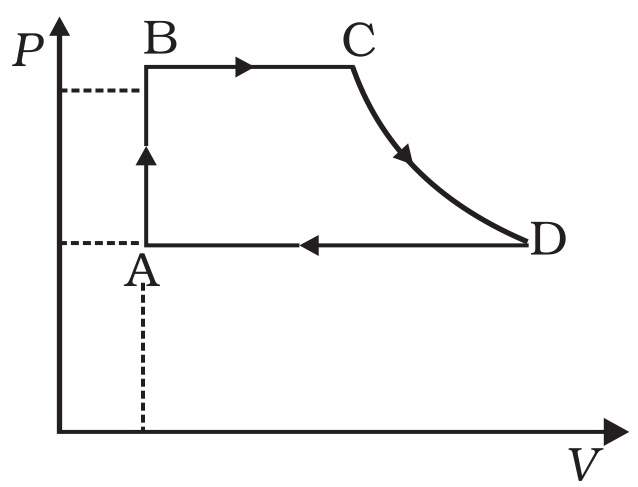
A cycle followed by an engine (made of one mole of an ideal gas in a cylinder with a piston) is shown in Fig. Find heat exchanged by the engine, with the surroundings for each section of the cycle. $(C_v = (3/2) R)$

AB : constant volume
BC : constant pressur CD : adiabati DA : constant pressure
Answer
  1. : For A → B, dV = 0
so,$\text{dW}=\int\text{P}.\text{dV}=\int\text{p}\times0=0$
$\text{dW}=0$

By $1^\text{st}$ law of thermodynamics
$\text{dQ}=\text{dU}+\text{dW}=\text{dU}+0$
$\therefore\ \text{dQ} =\text{dU}$
$\big(\text{dQ}=\text{n}\text{C}_\text{V}\text{dT}\big)$
So, $\text{dQ}-1\frac{3}{2}\text{R}\big(\text{T}_\text{B}-\text{T}_\text{A}\big).....(\text{i})$
$\text{dU}=\text{dQ}=\frac{3}{2}\big(\text{R}\text{T}_\text{}B-\text{R}\text{T}_\text{A}\big)=\frac{3}{2}\big(\text{P}_\text{B}\text{V}_\text{B}-\text{P}_\text{A}\text{}V_\text{A}\big)$
$\therefore$ Heat exchange [to system]
$\text{dQ}_1=\text{dU}=\frac{3}{2}\big(\text{P}_\text{s}\text{V}_\text{s}-\text{P}_\text{A}\text{V}_\text{A}\big)$
  1. For B to C, $\Delta\text{P}=0\ \text{n}=1$
$\text{dQ}=\text{dU}+\text{dW}=\text{C}_\text{V}\text{(dT)}+\text{P}_\text{S}\text{dV}$
$\text{dQ}_2=\frac{3}{2}\text{R}\big(\text{T}_\text{C}-\text{T}_\text{B}\big)+\text{P}_\text{B}\big(\text{V}_\text{C}-\text{V}_\text{B}\big)$
$=\frac{3}{2}\big(\text{T}_\text{C}\text{R}-\text{RT}_\text{B}\big)+\text{P}_\text{B}\text{V}_\text{C}-\text{P}_\text{B}\text{V}_\text{B}$
$=\frac{3}{2}[\text{P}_\text{C}\text{V}_\text{C}]-\frac{3}{2}[\text{P}_\text{B}\text{V}_\text{B}]-\text{P}_\text{B}\text{V}_\text{B}-\text{P}_\text{B}\text{V}_\text{C}$
$\text{V}_\text{A}=\text{V}_\text{B}\ \text{and}\ \text{P}_\text{B}=\text{P}_\text{C}$
$\therefore\text{dQ}_2=\frac{3}{2}\text{P}_\text{B}\text{V}_\text{C}-\frac{3}{2}\text{P}_\text{B}\text{V}_\text{A}-\text{P}_\text{B}\text{V}_\text{A}+\text{P}_\text{B}\text{V}_\text{C}$
$=\frac{5}{2}\text{P}_\text{B}\text{V}_\text{C}-\frac{5}{2}\text{P}_\text{B}\text{V}_\text{A}$
$\text{dQ}_2=\frac{5}{2}\text{P}_\text{B}[\text{V}_\text{C}-\text{V}_\text{A}]$
  1. For diagram C → B, adiabatic change
$\text{dQ}_3=0$ (No exchange of heat )
  1. For diagram D → A, $\Delta\text{P}=0$ Compression of gas from volume $V_D$ to $V_A$ pressure hence heat exchange similar to part (b) i.e. Heat exchange$\text{dQ}_3=\frac{5}{2}\text{P}_\text{A}\big(\text{V}_\text{A}-\text{V}_\text{D}\big)$
View full question & answer
Question 55 Marks
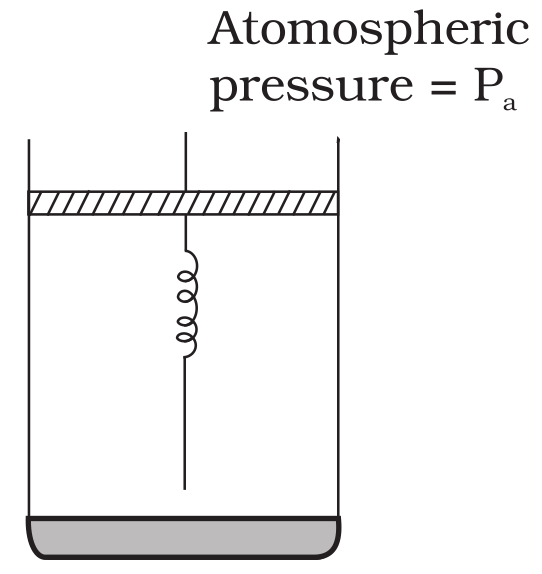
Consider one mole of perfect gas in a cylinder of unit cross section with a piston attached (Fig.) A spring (spring constant k) is attached (unstretched length L) to the piston and to the bottom of the cylinder. Initially the spring is unstretched and the gas is in equilibrium. A certain amount of heat Q is supplied to the gas causing an increase of volume from $V_o$ to $V_1$.
  1. What is the initial pressure of the system.
  2. What is the final pressure of the system.
  3. Uing the first law of thermodynamics, write down a relation between $Q, P_a, V, V_o$ and $k$.
Answer
  1. It is considered that piston is mass less and piston is balanced by atmospheric pressure $(P_a)$. So the initial pressure of system inside the cylinder = $P_a$,
  2. On supply heat Q. Volume of gas increase from $V_0$ to $V_1$ and spring stretched also.So increase in volume = $V_1 - V_0$
If displacement of piston is x then volume increase in cylinder )
= Aera of base × height = A × x
$A \times x = V_1 - V_0$ (A = area of cross section of cylinder)
$\therefore\ \text{x}=\frac{\text{V}_1-\text{V}_0}{\text{A}}$
Force exerted by spring $\text{F}_\text{s}=\text{K}_\text{x}=\frac{\text{K}(\text{V}_1-\text{V}_0)}{\text{A}}$
As the piston is of unit area of cross - section $\therefore\ \text{A}=1$
Force due to spring =$\text{K}(\text{V}_1-\text{V}_0)$ on unit area can be say press due to spring = $\text{K}(\text{V}_1-\text{V}_0)$
Final total pressure on gas $\text{P}_\text{f}=\text{P}_\text{a}+\text{K}(\text{V}_1-\text{V}_0)$
  1. by 1st law of thermodynamics $\text{dQ}=\text{dU}+\text{dW}$
Now $\text{DQ}=\text{dU}+\text{dW}$
$=\text{c}_\text{v}(\text{T}-\text{T}_0)+\text{P}_\text{a}(\text{V}_1-\text{V}_0)+\frac{1}{2}\text{kx}^2$
$\text{dQ}=\text{C}_\text{V}(\text{T}-\text{T}_0)+\text{P}_\text{a}(\text{V}_1-\text{V}_0)+\frac{1}{2}\text{k}(\text{V}_1-\text{V}_0)^2$
It is required relation.
View full question & answer
Question 65 Marks
Consider that an ideal gas ( $n$ moles) is expanding in a process given by $P=f(V)$, which passes through a point $\left(V_0\right.$, $\left.P_0\right)$. Show that the gas is absorbing heat at $\left(P_0, V_0\right)$ if the slope of the curve $P=f(V)$ is larger than the slope of the adiabat passing through $\left(\mathrm{P}_0, \mathrm{~V}_0\right)$.
Answer
slope of graph at $\big(\text{V}_0,\text{P}_0\big)=\Big(\frac{\text{dP}}{\text{dV}}\Big)_{(\text{V}_0\text{P}_0)}$$\text{P}=\text{f}(\text{V})$ for adiabatic process $\text{PV}^\gamma$ = constant (K)
$\text{Or}\ \text{P}=\frac{\text{K}}{\text{V}^\gamma}\ \text{or}\ \frac{\text{dP}}{\text{dV}}=\text{K}\big(-\gamma\big)\text{V}^{-\gamma-1}$
$\frac{\text{dP}}{\text{dV}}=-\gamma\text{PV}^\gamma\text{V}^{-\gamma}\text{V}^{-1}=-\frac{\gamma\text{P}}{\text{V}}$
$\Big(\frac{\text{dP}}{\text{dV}}\Big)_{\text{(P}_0\text{V}_0)}=\frac{-\gamma\text{P}_0}{\text{V}_0}$ Heat absorbed by in the process $\text{P}=\text{f}(\text{V})$
$\text{dQ}=\text{dU}+\text{dW}$
$\text{dQ}=\text{n}\text{C}_\text{V}\text{dT}+\text{PdV}\ .....(\text{i})$
$\text{PV}=\text{nRT}$
$\text{T}=\frac{\text{PV}}{\text{nR}}=\frac{\text{V}}{\text{nR}}\text{f}(\text{V})$
$\frac{\text{dT}}{\text{dV}}=\frac{1}{\text{nR}}\big[\text{f}(\text{V})+\text{Vf}\ '(\text{V})\big]$
$\frac{\text{dQ}}{\text{dV}}=\text{nC}_\text{V}\frac{\text{dT}}{\text{dV}}+\text{P}.\frac{\text{dV}}{\text{dV}}=\frac{\text{nC}_\text{V}}{\text{nR}}$$\big[\text{f(V)}+\text{Vf}\ '\text{(V)}\big]+\text{P}$
$\Big(\frac{\text{dQ}}{\text{dV}}\Big)_{\text{V}-\text{V}_0}=\frac{\text{C}_\text{V}}{\text{R}}$
$\big[\text{f}(\text{V}_0)+\text{V}_0\text{f}\ '(\text{V}_0)\big]+\text{f}_0\text{V})$
$\big[\because\text{P}=\text{f}(\text{V})\text{ given}\big]$
$=\text{f}(\text{V}_0)\Big[\frac{\text{C}_\text{V}}{\text{R}}+1\Big]+\text{V}_0\text{f}\ '(\text{V}_0)\frac{\text{C}_\text{V}}{\text{R}}$
$\text{C}_\text{P}-\text{C}_\text{V}=\text{R}\Rightarrow\frac{\text{C}_\text{P}}{\text{C}_\text{V}}-1=\frac{\text{R}}{\text{C}_\text{V}}$
$\therefore\gamma-1=\frac{\text{R}}{\text{C}_\text{V}}\Rightarrow\text{C}_\text{V}=\frac{\text{R}}{\gamma-1}\Rightarrow\frac{\text{C}_\text{V}}{\text{R}}=\frac{1}{\gamma-1}$
$\Big(\frac{\text{dQ}}{\text{dV}}\Big)_{\text{V-V}_0}=\text{f}(\text{V}_0)\Big[\frac{1}{\gamma-1}\Big]+\text{V}_0\text{f}\ '(\text{V}_0)\frac{1}{\gamma-1}$
$=\text{f}(\text{V}_0)\Big[\frac{1+\gamma-1}{\gamma-1}\Big]+\frac{\text{V}_0\text{f}\ '(\text{V}_0)}{\gamma-1}$
$=\frac{\gamma}{(\gamma-1)}\text{f}(\text{V}_0)+\text{V}_0\frac{\text{f}\ '(\text{V}_0)}{\gamma-1}$
$=\frac{1}{(\gamma-1)}\big[\gamma\ \text{f}(\text{V}_0)+\text{V}_0\text{f}\ '(\text{V}_0)\big]$
$\big(\because\ \text{f}(\text{V}_0)=\text{P}_0\big)$
$\Big(\frac{\text{dQ}}{\text{dV}}\Big)_{\text{V}-\text{V}_0}=\frac{1}{\gamma-1}$
$\big[\gamma\ \text{P}_0+\text{V}_0\text{f}\ '(\text{V}_0)\big]$
$\therefore\ \Big(\frac{\text{dQ}}{\text{dV}}\Big)_{\text{V}-\text{V}_0}>1\therefore\ \text{and}\ \gamma>1\ \text{so}\ \frac{1}{\gamma-1}\text{is}+\text{ve}$
$\therefore\ \gamma\text{P}_0+\text{V}_0\text{f}\ '(\text{V}_0)>0$
$\text{V}_0\text{f}\ '(\text{V}_0)>-\gamma\text{P}_0$
$\text{f}\ '(\text{V}_0)>\frac{-\gamma\text{P}_0}{\text{V}_0}$
View full question & answer
Question 75 Marks
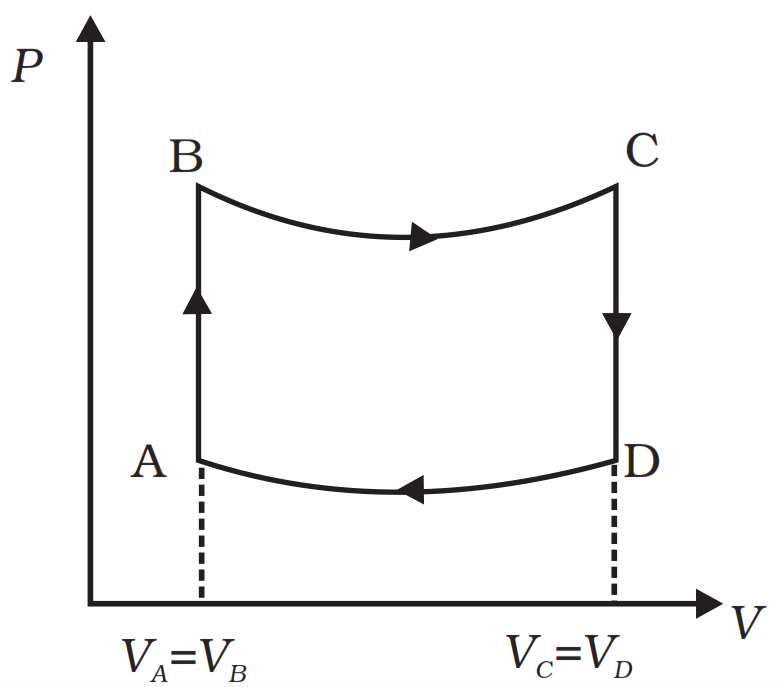
A cycle followed by an engine (made of one mole of perfect gas in a cylinder with a piston) is shown in Fig.
A to B : volume constant B to C : adiabatic C to D : volume constant D to A : adiabatic $V_C= V_D= 2V_A= 2V_B$
  1. In which part of the cycle heat is supplied to the engine from outside?
  2. In which part of the cycle heat is being given to the surrounding by the engine?
  3. What is the work done by the engine in one cycle? Write your answer in term of $P_A, P_B, V_A$.
  4. What is the efficiency of the engine?[$\gamma=\frac{5}{3}$ for the gas], $\big(\text{C}_\text{v}=\frac{3}{2}\text{R for one mole}\big)$
Answer
(a) A to B
(b) C to D
(c) $\text{W}_\text{AB}=\int\limits^\text{B}_\text{A}\text{pdV}=0;\text{W}_\text{CD}=0.$
Simillarly. $\text{W}_\text{BC}=\Big[\int\limits^\text{C}_\text{B}\text{pdV}=\text{k}\int\limits^\text{C}_\text{B}\frac{\text{dV}}{\text{V}^\text{r}}=\text{k}\frac{\text{V}^\text{-r+1}}{-\text{R}+1}\Big]^{\text{V}_{\text{C}}}_{\text{V}_\text{B}}$
$= \frac{1}{1-\gamma}(\text{P}_\text{c}\text{V}_\text{c}-\text{P}_\text{B}\text{V}_\text{B})$
Simillarly, $\text{W}_\text{DA}=\frac{1}{1-\gamma}(\text{P}_\text{A}\text{V}_\text{A}-\text{P}_\text{D}\text{V}_\text{D})$
Now $\text{P}_\text{C}=\text{P}_\text{B}\Big(\frac{\text{V}_\text{B}}{\text{V}_\text{C}}\Big)^\gamma=2^{-\gamma}\text{P}_\text{B}$
Simillarly, $\text{P}_\text{D}=\text{P}_\text{A}2^{-\gamma}$
Total work done $=\text{W}_\text{BC}+\text{W}_\text{DA}$
$=\frac{1}{1-\gamma}\big[\text{P}_\text{B}\text{V}_\text{B}\big(2^{-\gamma+1}-1\big)-\text{P}_\text{A}\text{V}_\text{A}\big(2^{-\gamma+1}-1\big)\big]$
$=\frac{1}{1-\gamma}\big(2^{1-\gamma}-1\big)\big(\text{P}_\text{B}-\text{P}_\text{A}\big)\text{V}_\text{A}$
$=\frac{3}{2}\big(1-\Big(\frac{1}{2}\Big)^\frac{2}{3}\big)\big(\text{P}_\text{B}-\text{P}_\text{A}\big)\text{V}_\text{A}$
  1. Heat supplied during process A, B
$\text{d}\text{Q}_\text{AB}=\text{d}\text{U}_\text{AB}$
$\text{Q}_\text{AB}=\frac{3}{2}\text{n}\text{R}\big(\text{T}_\text{B}-\text{T}_\text{A}\big)\text{V}_\text{A}$
$\text{Efficiency}=\frac{\text{Net Work done }}{\text{Heat Supplied}}=\Big[1-\Big(\frac{1}{2}\Big)^\frac{2}{3}\Big]$
View full question & answer