Questions

3 Marks Question

Take a timed test

24 questions · self-marked practice — reveal the answer and mark yourself.

Question 13 Marks
Can kinetic energy of a system be increased without applying any external force on the system?
Answer
Yes. Let us consider an isolated system of two particles falling towards each other under their mutual gravitational force of attraction. Here, the net force on the system is zero, but the velocities of the particles keep on increasing. Also, the kinetic energy of the system is increased without applying any external force on it.
View full question & answer
Question 23 Marks
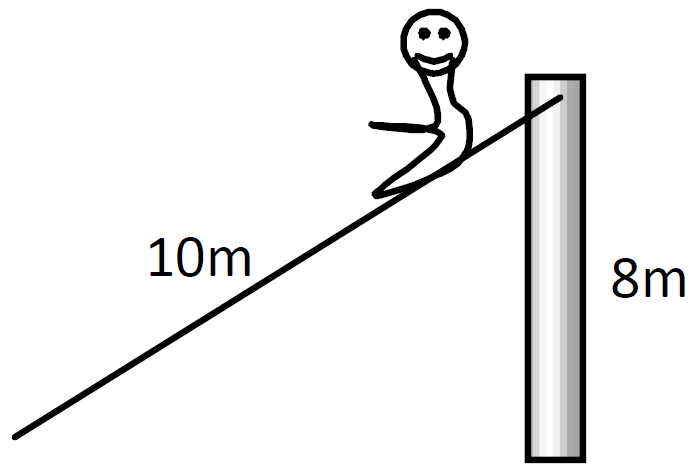
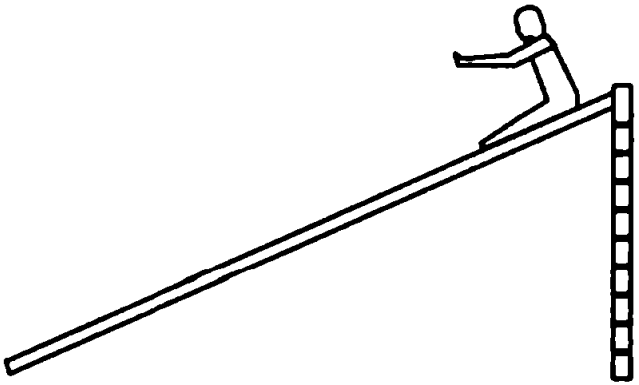
In a children's park, there is a slide which has a total length of $10m$ and a height of $8.0m ($figure$).$ Vertical ladder are provided to reach the top. A boy weighing $200N$ climbs up the ladder to the top of the slide and slides down to the ground. The average friction offered by the slide is three tenth of his weight. Find
  1. The work done by the ladder on the boy as he goes up.
  2. The work done by the slide on the boy as he comes down. Neglect any work done by forces inside the body of the boy.
Answer
$\ell=10\text{m},\text{h}=8\text{m},\text{mg}=200\text{N}$$\text{f}=200\times\frac{3}{10}=60\text{N}$

  1. Work done by the ladder on the boy is zero when the boy is going up because the work is done by the boy himself.
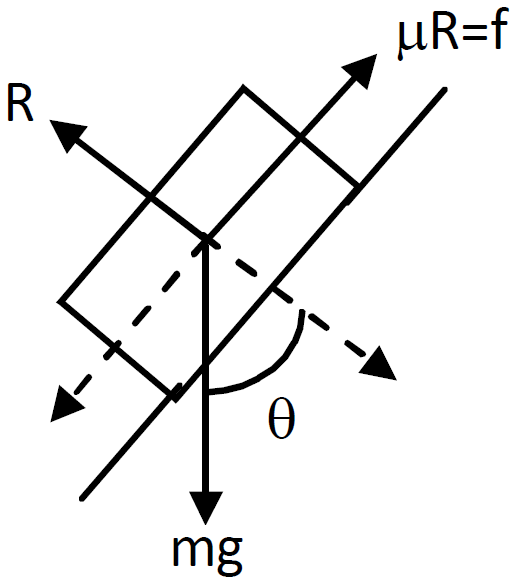
  2. Work done against frictional force, $\text{W}=\mu\text{RS}=\text{f}\ell$
$=(-60)\times10=-600\text{J}$
Work done by the forces inside the boy is,
$\text{W}_\text{b}=(\text{mg}\sin\theta)\times10$
$=200\times\frac{8}{10}\times10$
$=1600\text{J}$
View full question & answer
Question 33 Marks
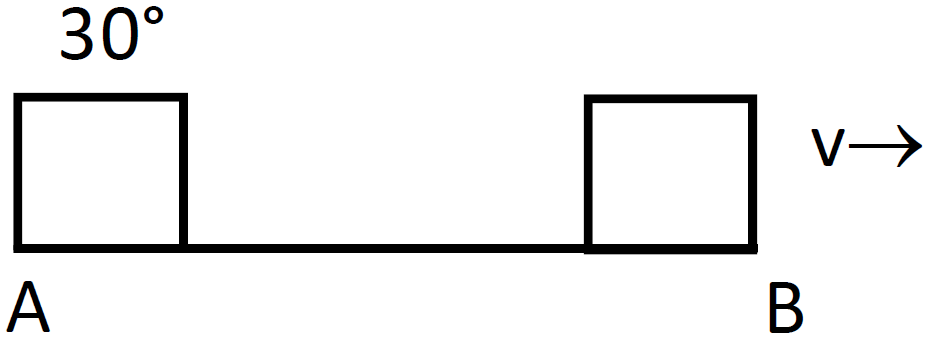
Consider the situation of the previous question from a frame moving with a speed $v_0$ parallel to the initial velocity of the block.
  1. What are the initial and final kinetic energies?
  2. What is the work done by the kinetic friction?
Answer
The relative velocity of the ball w.r.t. the moving frame is given by $\text{v}_\text{r}=\text{v}-\text{v}_0$
  1. Initial kinetic energy of the ball $=\frac{1}{2}\text{mv}_\text{r}^2=\frac{1}{2}\text{m}(\text{v}-\text{v}_0)^2$
Also, final kinetic energy of the ball $=\frac{1}{2}\text{m}(0-\text{v}_0)^2=\frac{1}{2}\text{mv}_0^2$
  1. Work done by the kinetic friction $=$ final kinetic energy $-$ initial kinetic energy
$=\frac{1}{2}\text{m}(\text{v}_0)^2-\frac{1}{2}\text{m}(\text{v}-\text{v}_0)^2$
$=-\frac{1}{2}\text{mv}^2+\text{mv}\text{v}_0$
View full question & answer
Question 43 Marks
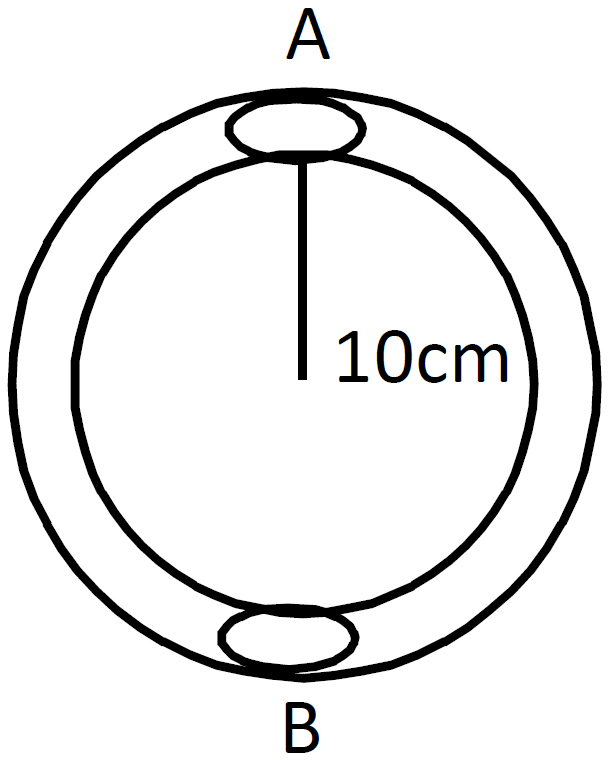
A block of mass $100g$ is moved with a speed of $5.0m/s$ at the highest point in a closed circular tube of radius $10cm$ kept in a vertical plane. The cross-section of the tube is such that the block just fits in it. The block makes several oscillations inside the tube and finally stops at the lowest point. Find the work done by the tube on the block during the process.
Answer


Given, m = 100g = 0.1kg, v = 5m/sec, r = 10cm
Work done by the block = total energy at A - total energy at B
$\Big(\frac{1}{2}\text{mv}^2+\text{mgh}\Big)-0$
$\Rightarrow\text{W}=\frac{1}{2}\text{mv}^2+\text{mgh}-0$
$=\frac{1}{2}\times(0.1)\times25+(0.1)\times10\times(0.2)$[h = 2r = 0.2m]
$\Rightarrow\text{W}=1.25+0.2​​$
$\Rightarrow\text{W}=1.45\text{J}$
So, the work done by the tube on the body is
$W_t = -1.45J$
View full question & answer
Question 53 Marks
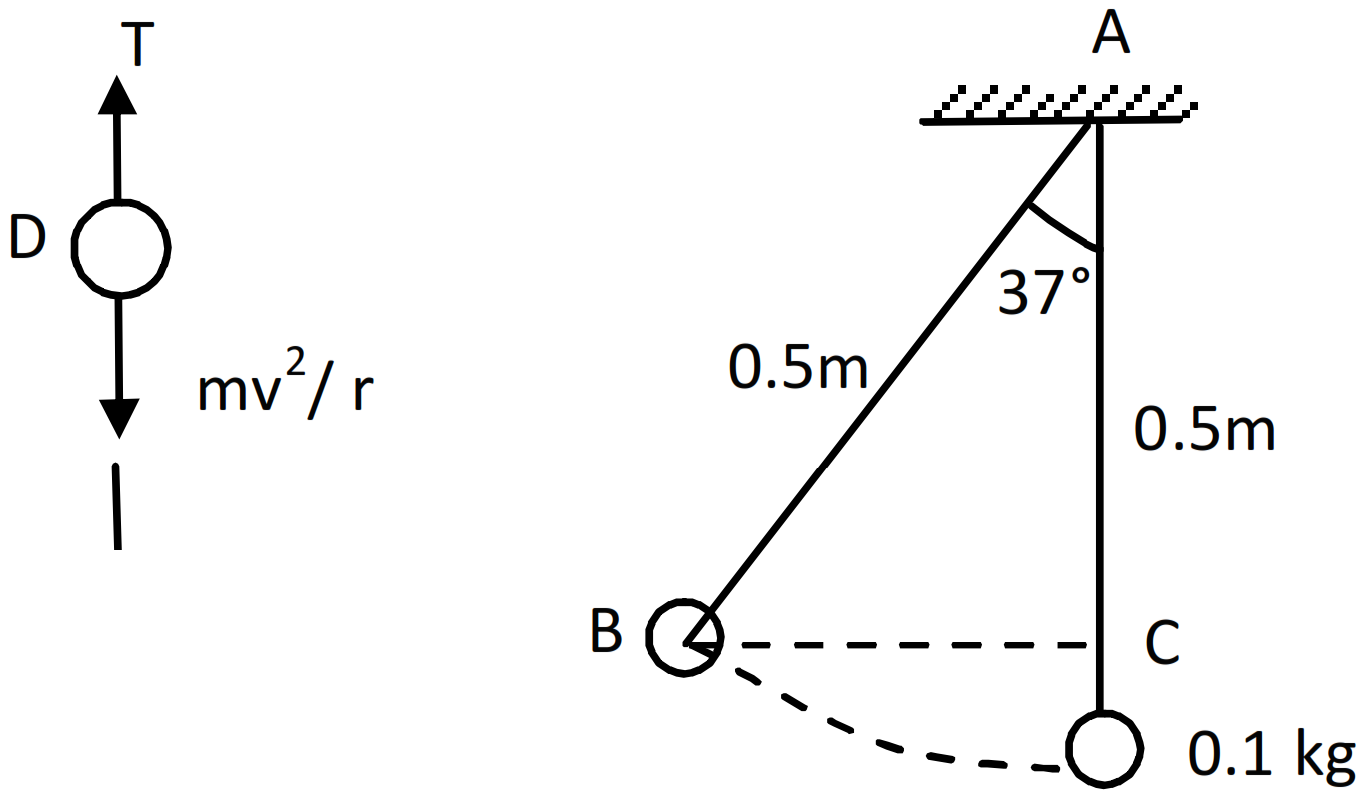
A simple pendulum consists of a 50cm long string connected to a 100g ball. The ball is pulled aside so that the string makes an angle of 37° with the vertical and is then released. Find the tension in the string when the bob is at its lowest position.
Answer
From the figure, $\cos\theta=\frac{\text{AC}}{\text{AB}}$
$\Rightarrow\text{AC}=\text{AB}\cos\theta$
$\Rightarrow(0.5)\times(0.8)=0.4$
So, CD = (0.5) - (0.4) = (0.1)m Energy at D = energy at B$\frac{1}{2}\text{mv}^2=\text{mg}(\text{CD})$
$\text{v}^2=2\times10\times(0.1)=2$
So, the tension is given by,$\text{T}=\frac{\text{mv}^2}{\text{r}}+\text{mg}$
$\Rightarrow(0.1)\Big(\frac{2}{0.5}+10\Big)=1.4\text{N}$
View full question & answer
Question 63 Marks
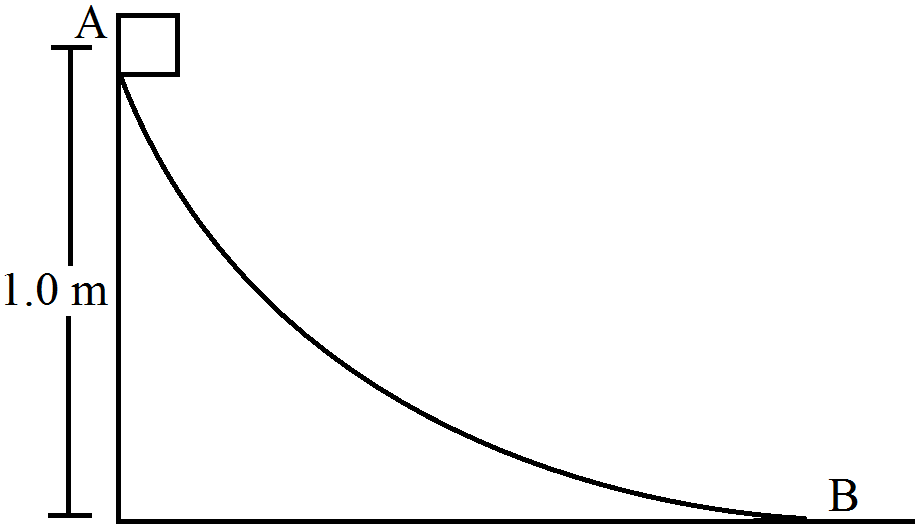
A block weighing 10N travels down a smooth curved track AB joined to a rough horizontal surface (figure). The rough surface has a friction coefficient of 0.20 with the block. If the block starts slipping on the track from a point 1.0m above the horizontal surface, how far will it move on the rough surface?
Answer

$\text{mg}=10\text{N},\mu=0.2,\text{H}=1\text{m},\text{u}=\text{v}=0$
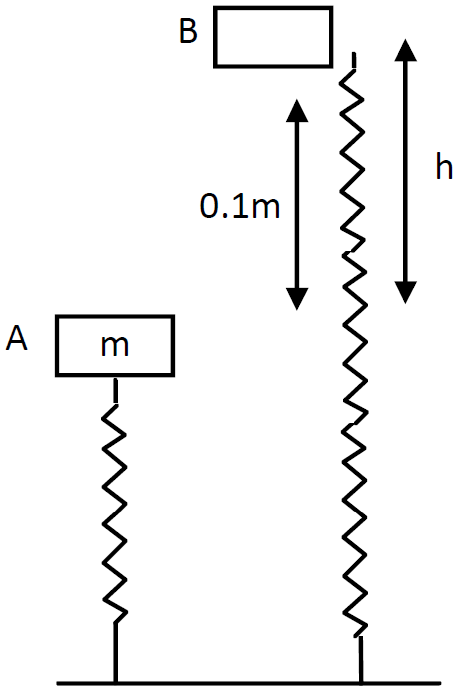
change in P.E. = work done.
Increase in K.E.
⇒ w = mgh = 10 × 1 = 10J
Again, on the horizontal surface the fictional force
$\text{F}=\mu\text{R}=\mu\text{mg}$
$=0.2\times10=2\text{N}$
So, the K.E. is used to overcome friction
$\Rightarrow\text{S}=\frac{\text{W}}{\text{F}}=\frac{10\text{J}}{2\text{N}}=5\text{m}$
View full question & answer
Question 73 Marks
When you lift a box from the floor and put it on an almirah the potential energy of the box increases, but there is no change in its kinetic energy. Is it a violation of conservation of energy?
Answer
No Work done in lifting the box increases the potential energy of the box. During lifting at every point, the force applied by us on the box in the upward direction is equal to the gravitational force acting on the box in the downward direction. Therefore, there is no change in the velocity of the box. As a result, the kinetic energy of the box will not change.
View full question & answer
Question 83 Marks
A ball is given a speed $v$ on a rough horizontal surface. The ball travels through a distance $l$ on the surface and stops.
  1. What are the initial and final kinetic energies of the ball?
  2. What is the work done by the kinetic friction?
Answer
  1. Initial kinetic energy of the ball, $\text{K}_\text{i}=\frac{1}{2}\text{mv}^2$
Here, $m$ is the mass of the ball.
The final kinetic of the ball is zero.
Work done by the kinetic friction is equal to the change in kinetic energy of the ball.
$\therefore$ Work done by the kinetic friction $=\text{K}_\text{f}-\text{K}_\text{i}$
$=0-\frac{1}{2}\text{mv}^2$
$=-\frac{1}{2}\text{mv}^2$
View full question & answer
Question 93 Marks
A block of mass $250g$ is kept on a vertical spring of spring constant $100N/m$ fixed from below. The spring is now compressed to have a length $10cm$ shorter than its natural length and the system is released from this position. How high does the block rise? Take $g =10m/s^2$.
Answer


m = 250g = 0.250kg,
k = 100N/ m, m = 10cm = 0.1m
$g = 10m/ sec^2$
Applying law of conservation of energy,
$=\frac{1}{2}\text{kx}^2=\text{mgh}$
$\Rightarrow\text{h}=\frac{1}{2}\Big(\frac{\text{kx}^2}{\text{mg}}\Big)$
$=\frac{100\times(0.1)^2}{2\times0.25\times10}$
$=0.2\text{m}=20\text{cm}$
View full question & answer
Question 103 Marks
A particle is released from the top of an incline of height h. Does the kinetic energy of the particle at the bottom of the incline depend on the angle of incline? Do you need any more information to answer this question in Yes or No?
Answer
No, the kinetic energy of the particle at the bottom of the inclined plane does not depend on the angle of inclination. When the particle reaches the ground, all its potential energy, while at the top of the inclined plane, is converted into kinetic energy. As we know that kinetic energy depends only on the height of the particle, it will be the same for different angles of inclination.
No, we do not need any other information to answer this question.
View full question & answer
Question 113 Marks
A block of mass 30.0kg is being brought down by a chain. If the block acquires a speed of 40.0cm/s in dropping down 2.00m, find the work done by the chain during the process.
Answer
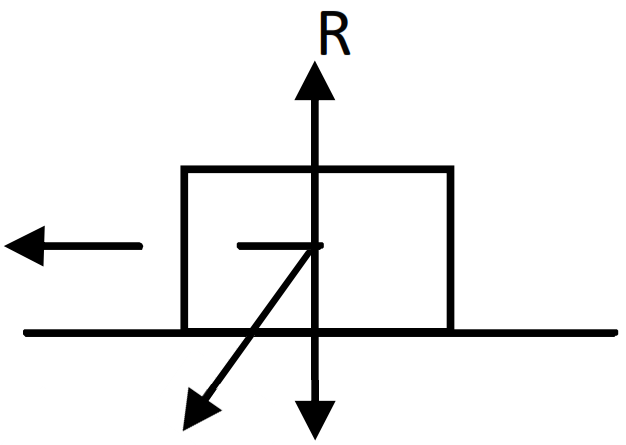
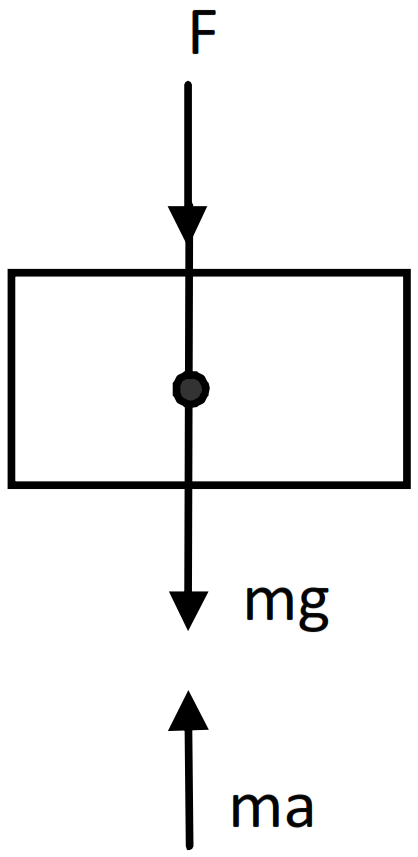
Given m = 30kg, v = 40cm/sec = 0.4m/sec, s = 2m From the free body diagram, the force given by the chain is,

F = (ma - mg) = m(a - g) [where a = acceleration of the block]$\text{a}=\frac{\text{v}^2-\text{u}^2}{2\text{s}}$
$=\frac{0.16}{0.4}=0.04\text{m}/\text{sec}^2$
So, work done $\text{W}=\text{Fs}\cos\theta=\text{m}(\text{a}-\text{g})\text{s}\cos\theta$$\Rightarrow\text{W}=30(0.04-9.8)\times2$
$\Rightarrow\text{W}=-585.5$
$\Rightarrow\text{W}=-586\text{J}$
So, $\text{W}=-586\text{J}$
View full question & answer
Question 123 Marks
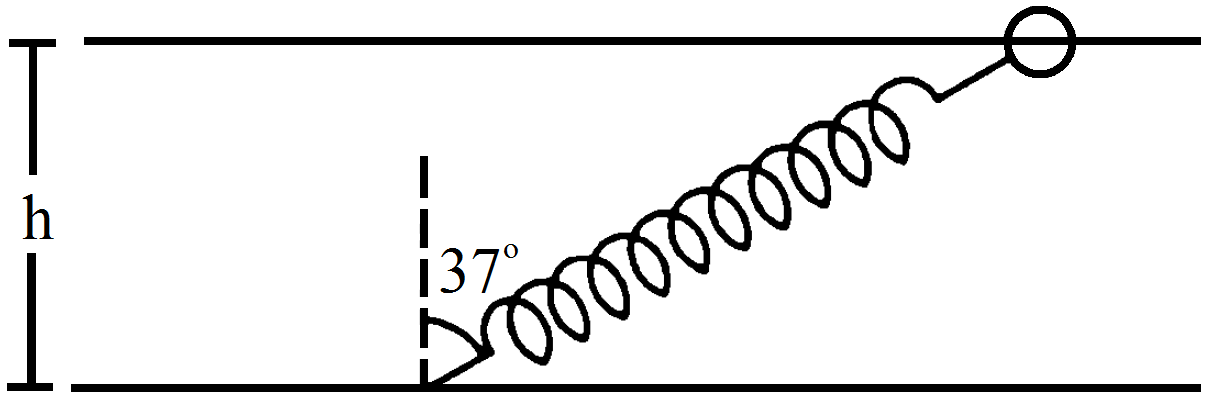
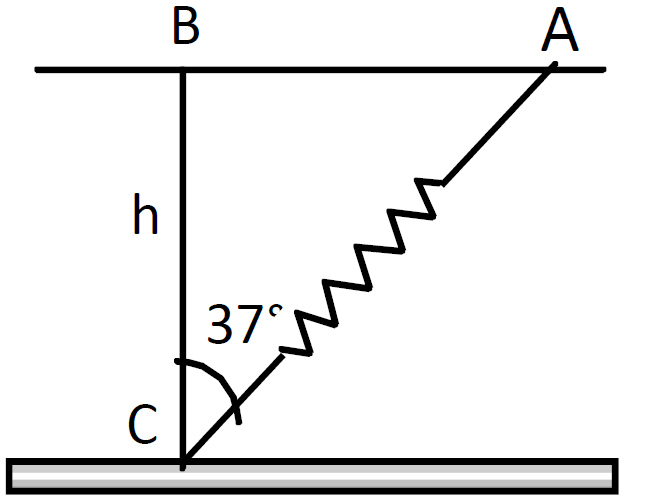
One end of a spring of natural length h and spring constant k is fixed at the ground and the other is fitted with a smooth ring of mass m which is allowed to slide on a horizontal rod fixed at a height h (figure). Initially, the spring makes an angle of 37° with the vertical when the system is released from rest. Find the speed of the ring when the spring becomes vertical.
Answer

$\theta=37^\circ,$ l = h = natural length
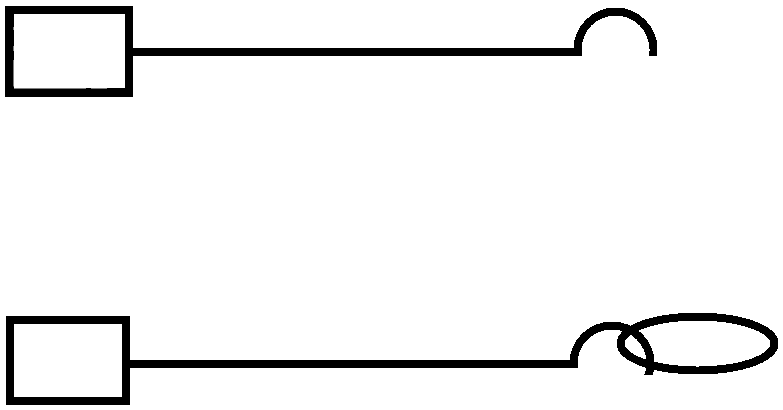
Let the velocity when the spring is vertical be ‘v’.
$\cos=37^\circ=\frac{\text{BC}}{\text{AC}}=0.8=\frac{4}{5}$
$\text{AC}=(\text{h}+\text{x})=\frac{5\text{h}}{4}$ (because BC = h)
So, $\text{x}=\frac{5\text{h}}{4}-\text{h}=\frac{\text{h}}{4}$
Applying work energy principle $=\frac{1}{2}\text{kx}^2+\frac{1}{2}\text{mv}^2$
$\Rightarrow\text{v}=\text{x}\sqrt{\Big(\frac{\text{k}}{\text{m}}\Big)}=\frac{\text{h}}{4}\sqrt{\frac{\text{k}}{\text{m}}}$
View full question & answer
Question 133 Marks
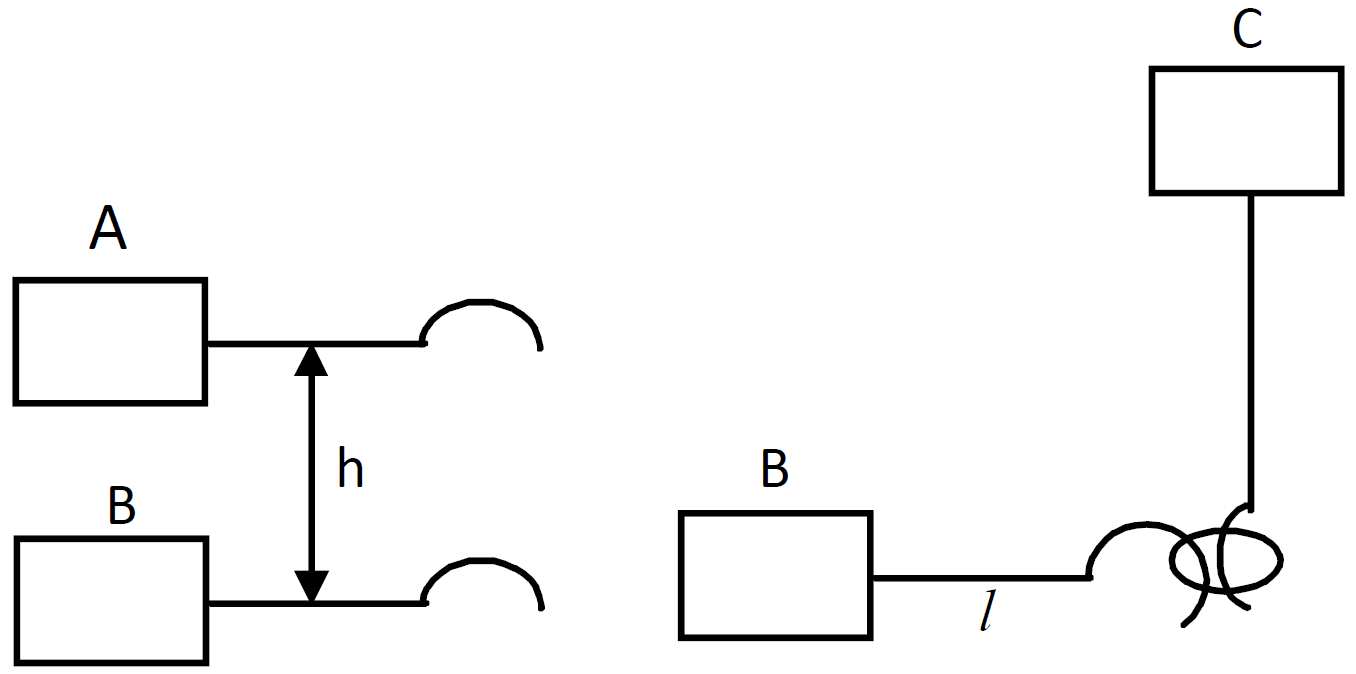
Figure shows a light rod of length l rigidly attached to a small heavy block at one end and a hook at the other end. The system is released from rest with the rod in a horizontal position. There is a fixed smooth ring at a depth h below the initial position of the hook and the hook gets into the ring as it reaches there. What should be the minimum value of h so that the block moves in a complete circle about the ring?
Answer

The minimum velocity required to cross the height point $\text{c}=\sqrt{2\text{gl}}$
Let the rod released from a height h.
Total energy at A = total energy at B
$\text{mgh}=\frac{1}{2}\text{mv}^2$
$\text{mgh}=\frac{1}{2}\text{m}(2\text{gl})$
[Because v = required velocity at B such that the block makes a complete circle.]
So, h = l
View full question & answer
Question 143 Marks
Water falling from a $50m$ high fall is to be used for generating electric energy. If $1.8 x 10^5kg$ of water falls per hour and half the gravitational potential energy can be converted into electric energy, how many $100W$ lamps can be lit?
Answer
$h = 50m, m = 1.8 \times 10^5 kg/hr, P = 100\ watt, P.E. = mgh = 1.8 \times 10^5 \times 9.8 \times 50 = 882 \times 10^5 J/hr$ Because, half the potential energy is converted into electricity.
Electrical energy $=\frac{1}{2}\text{P.E.} = 441 \times 10^5 J/hr$ So, power in watt (J/sec) is given by $=\frac{441\times10^5}{3600}$$\therefore$ number of 100W lamps, that can be lit $=\frac{441\times10^5}{3600\times100}=122.5\approx122$
View full question & answer
Question 153 Marks
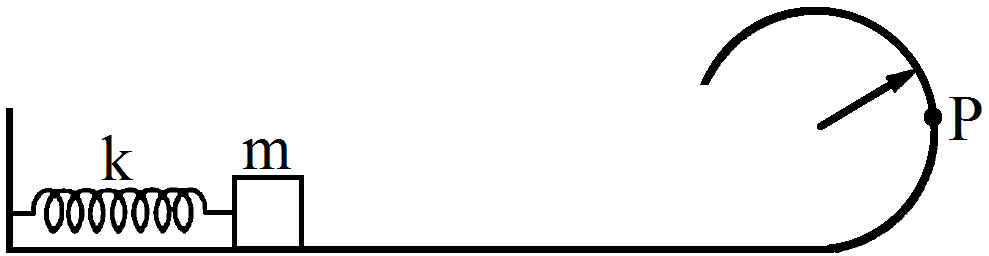
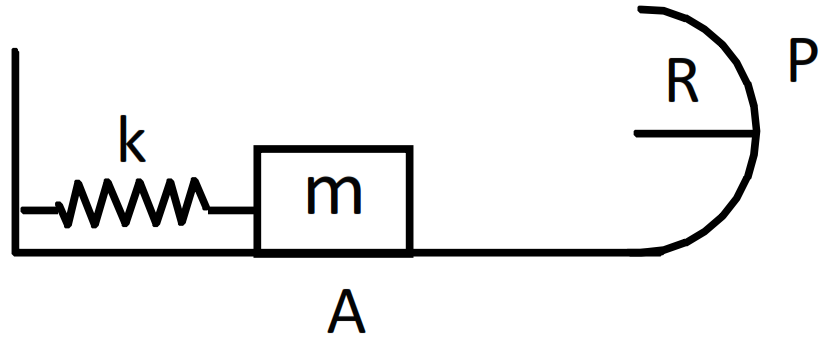
Figure shows a smooth track, a part of which is a circle of radius R. A block of mass m is pushed against a spring of spring constant k fixed at the left end and is then released. Find the initial compression of the spring so that the block presses the track with a force mg when it reaches the point P, where the radius of the track is horizontal.
Answer


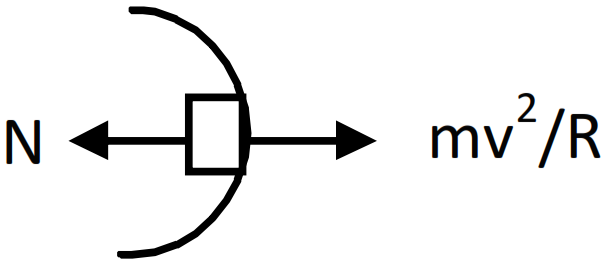
Given, N = mg
As shown in the figure, $\frac{\text{mv}^2}{\text{R}}=\text{mg}$
$\Rightarrow\text{v}^2=\text{gR}\ \dots(1)$
Total energy at point A = energy at P
$\frac{1}{2}\text{kx}^2=\frac{\text{mgR}+2\text{mgR}}{2}$ [because $v^2$ = gR]
$\Rightarrow\text{x}^2=\frac{{3\text{mgR}}}{\text{k}}$
$\Rightarrow\text{x}=\sqrt{\frac{{3\text{mgR}}}{\text{k}}}$
View full question & answer
Question 163 Marks
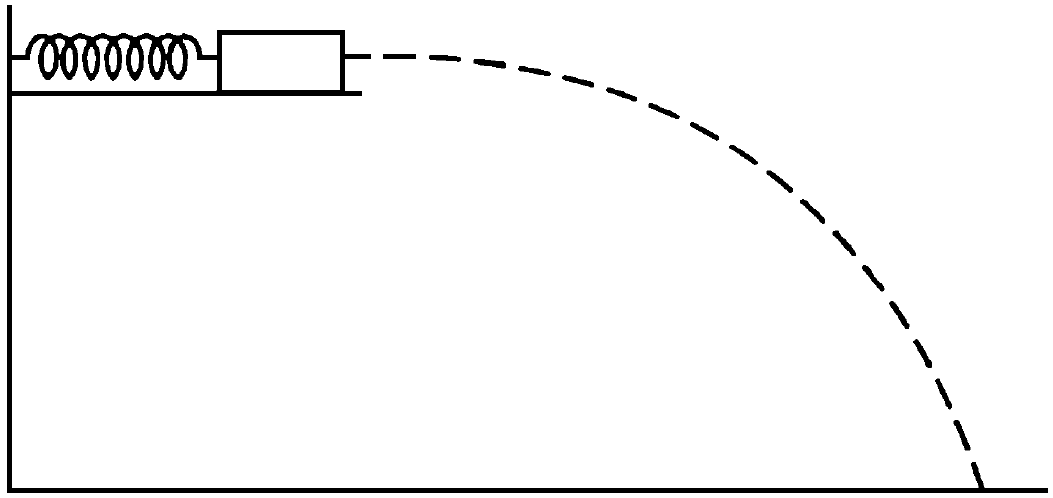
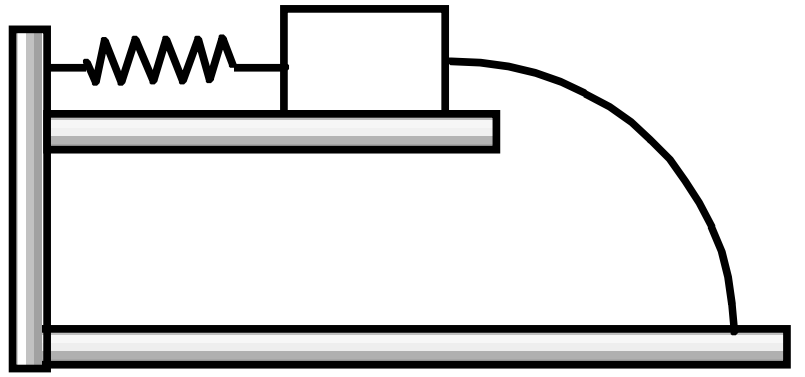
A small block of mass 100g is pressed against a horizontal spring fixed at one end to compress the spring through 5.0cm (figure). The spring constant is 100N/m. When released, the block moves horizontally till it leaves the spring. Where will it hit the ground 2m below the spring?
Answer

m = 100g = 0.1kg, x = 5cm = 0.05m, k = 100N/m
When the body leaves the spring, let the velocity be v,
$\frac{1}{2}\text{mv}^2=\frac{1}{2}\text{k}\text{x}^2$
$\Rightarrow\text{v}=\text{x}\sqrt{\frac{\text{k}}{\text{m}}}$
$\Rightarrow0.05\times\sqrt{\frac{100}{0.1}}=1.58\text{m}/\text{sec}$
For the projectile motion, $\theta=0^\circ,\text{Y}=-2$
Now, $\text{Y}=(\text{u}\sin\theta)\text{t}-\frac{1}{2}\text{gt}^2$
$\Rightarrow-2=\Big(\frac{-1}{2}\Big)\times9.8\times\text{t}^2$
$\Rightarrow\text{t}=0.63\text{sec}$
So, $\text{x}=(\text{u}\cos\theta)\text{t}$
$\Rightarrow1.58\times0.63=1\text{m}$
View full question & answer
Question 173 Marks
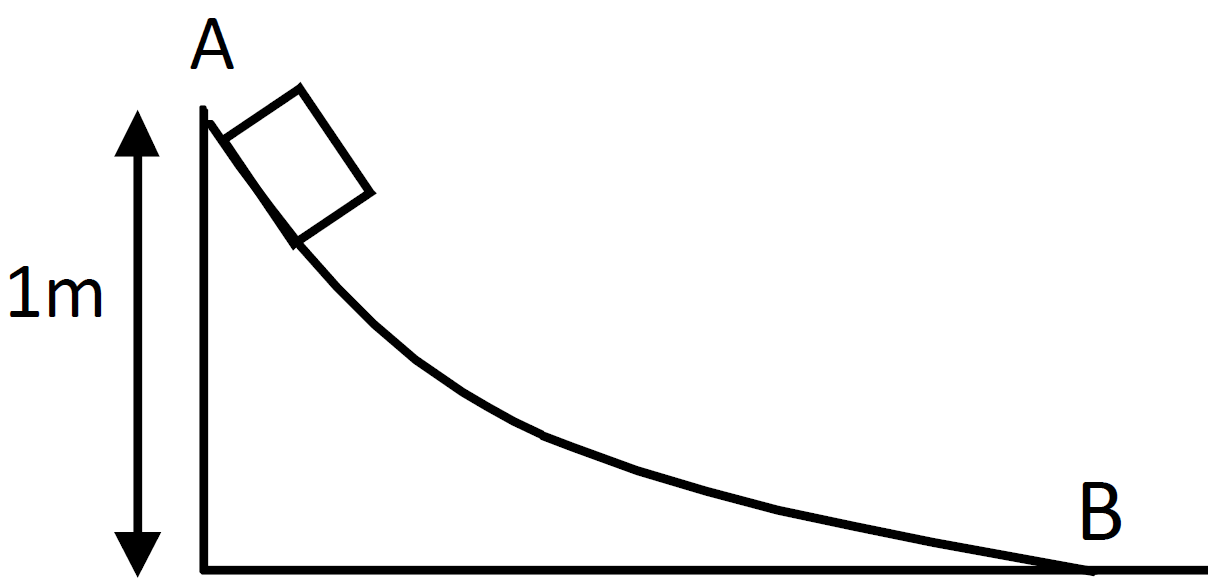
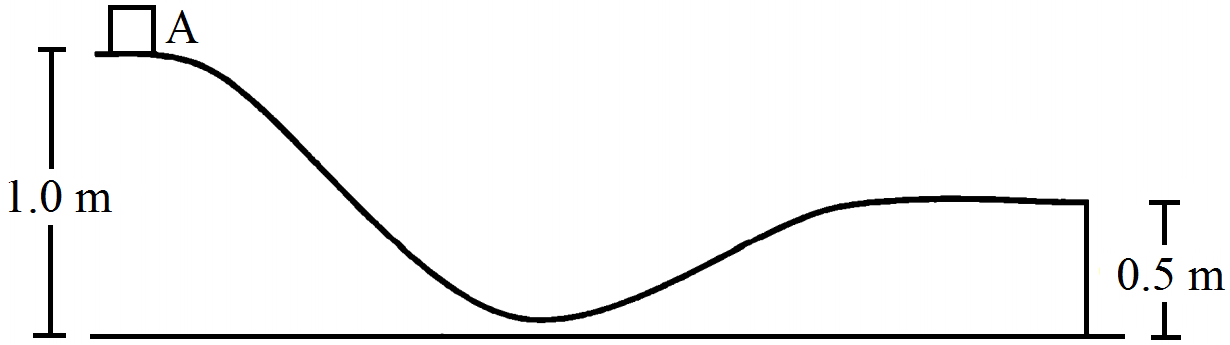
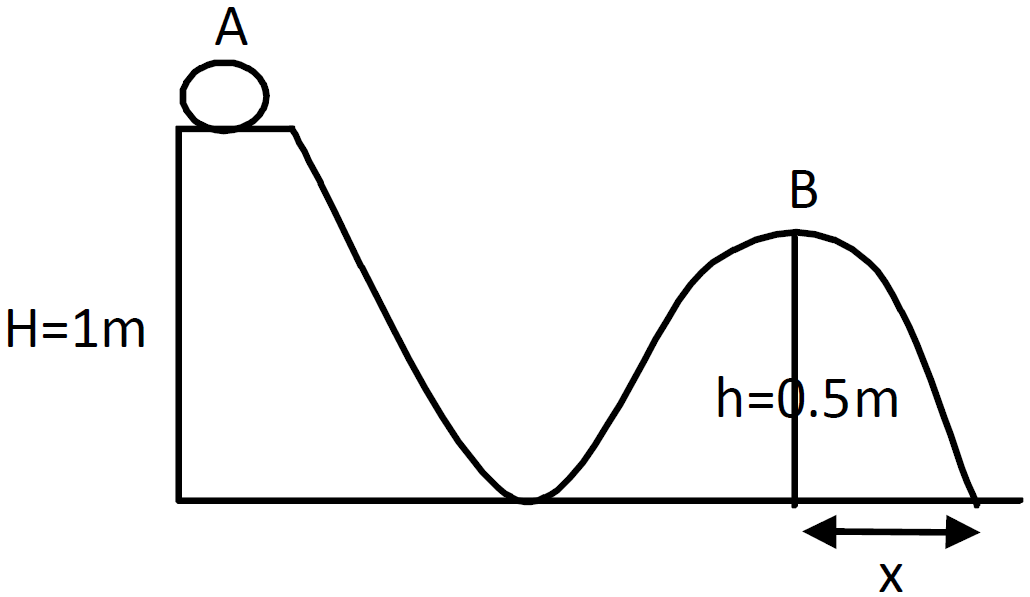
Figure shows a particle sliding on a frictionless track which terminates in a straight horizontal section. If the particle starts slipping from the point A, how far away from the track will the particle hit the ground?
Answer


H = 1m, h = 0.5mApplying law of conservation of Energy for point A & B
$\text{mgH}=\frac{1}{2}\text{mv}^2+\text{mgh}$
$\Rightarrow\text{g}=\frac{1}{2}\text{v}^2+0.5\text{g}$
$\Rightarrow\text{v}^22(\text{g}-0.59)=\text{g}$
$\Rightarrow\text{v}=\sqrt{\text{g}}=3.1\text{m}/\text{s}$
After point B the body exhibits projectile motion for which
$\theta=0^\circ,\text{v}=-0.5$
So, $-0.5=(\text{u}\sin\theta)\text{t}-\Big(\frac{1}{2}\Big)\text{gt}^2$
$\Rightarrow0.5=4.9\ \text{t}^2$
$\Rightarrow\text{t}=0.31\text{sec}$
So, $\text{x}=(\text{v}\cos\theta)\text{t}$
$=3.1\times3.1=1\text{m}$
So, the particle will hit the ground at a horizontal distance in from B.
View full question & answer
Question 183 Marks
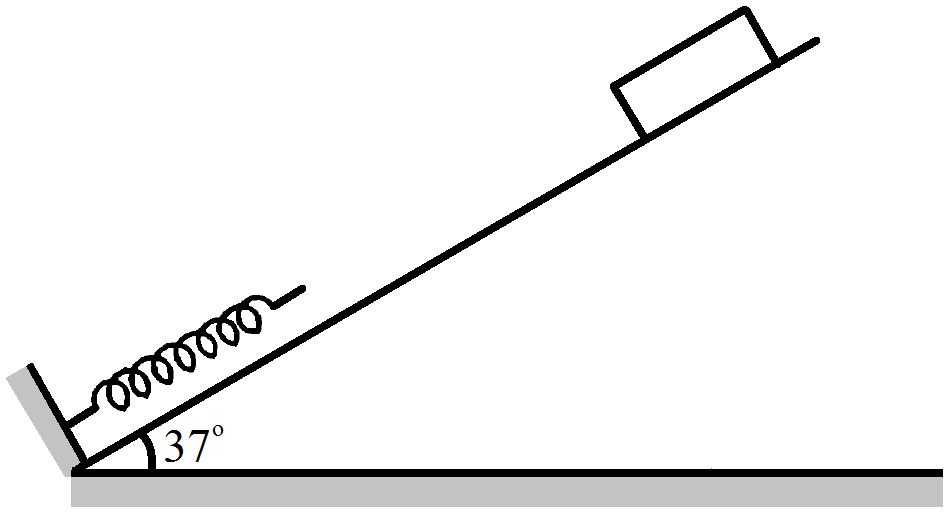
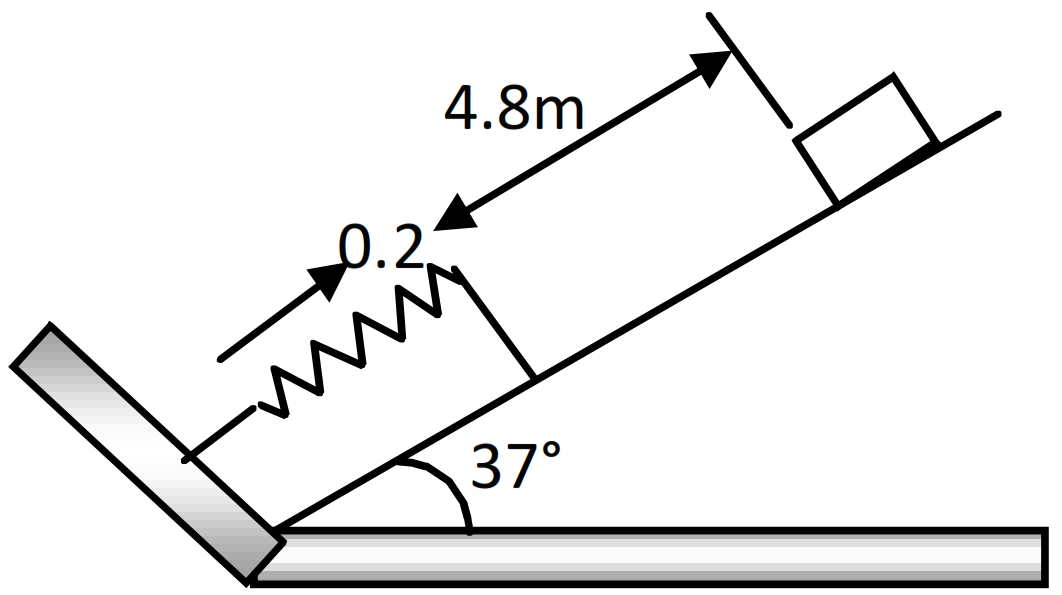
Figure shows a spring fixed at the bottom end of an incline of inclination $37^\circ $. A small block of mass $2\ kg$ starts slipping down the incline from a point $4.8m$ away from the spring. The block compresses the spring by $20\ cm$, stops momentarily and then rebounds through a distance of $1m$ up the incline. Find.
  1. The friction coefficient between the plane and the block.
  2. The spring constant of the spring. Take $g = 10m/s^2$​​​​​​​.
Answer


$m = 2\ kg, s_1 = 4.8m, R = 20\ cm = 0.2m, s_2 = 1m,$
$\sin37^\circ=0.60=\frac{3}{5},\theta=37^\circ,$
$ \cos37^\circ=.79=0.8=\frac{4}{5},\text{g}=10\text{m}/\text{sec}^2$
Applying work – Energy principle for downward motion of the body
$0-0=\text{mg}\sin37^\circ\times5-\mu\text{R}\times5-\frac{1}{2}\text{kx}^2$
$\Rightarrow20\times(0.60)\times1-\mu\times20\times(0.80)\times1+\frac{1}{2}\text{k}(0.2)^2=0$
$\Rightarrow60-80\mu-0.02\text{k}=0​​$
$\Rightarrow80\mu+0.02\text{k}=60\ \dots(1)$
Similarly, for the upward motion of the body the equation is,
$0-0=(-\text{mg}\sin37^\circ)\times1-\mu\text{R}\times1+\frac{1}{2}\text{k}(0.2)^2$
$\Rightarrow-20\times(0.60)\times1-\mu\times20\times(0.80)\times1+\frac{1}{2}\text{k}(0.2)^2=0$
$\Rightarrow-12-16\mu+0.02\text{K}=0\ \dots(2)$
Adding equation $(i)$ equation $(ii),$ we get $96\mu=48$
$\Rightarrow\mu=0.5$
Now putting the value of $\mu$ in equation $(1), K = 1000N/m$
View full question & answer
Question 193 Marks
A constant force of 2.50N accelerates a stationary particle of mass 15g through a displacement of 2.50m. Find the work done and the average power delivered.
Answer

F = 2.50N, S = 2.5m, m = 15g = 0.015kg.
So, $\text{w} =\text{F} \times \text{S}$
$\Rightarrow\text{a}=\frac{\text{F}}{\text{m}}=\frac{2.5}{0.015}$
$=\frac{500}{3}\text{m/s}^2$
$=\text{F}\times\text{S}\cos0^\circ$ (acting along the same line)
$=2.5\times2.5=6.25\text{J}$
Let the velocity of the body at b = U. Applying work-energy principle $\frac{1}{2}\text{mv}^2-0=6.25$
$\Rightarrow\text{V}=\sqrt{\frac{6.25\times2}{0.015}}=28.86\text{m/sec}$
So, time taken to travel from A to B.
$\Rightarrow\text{t}=\frac{\text{v-u}}{\text{a}}=\frac{28.86\times3}{500}$
$\therefore$ Average power $=\frac{\text{W}}{\text{t}}=\frac{6.25\times500}{(28.86)\times3}=36.1$
View full question & answer
Question 203 Marks
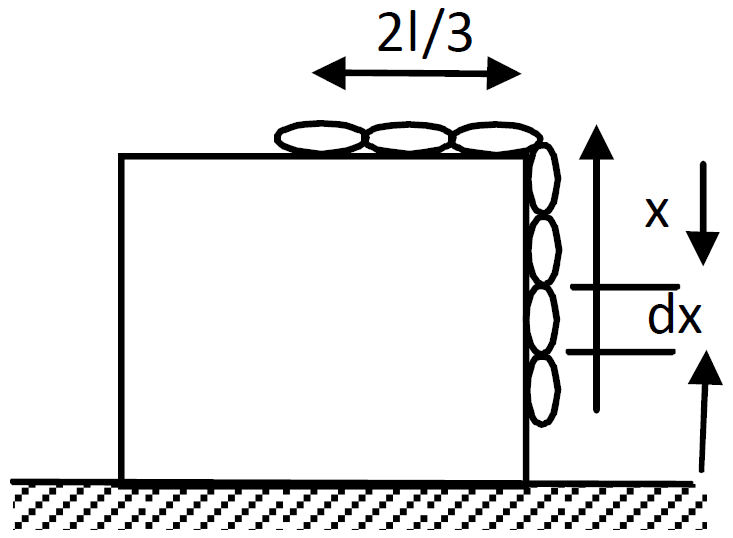
A uniform chain of mass m and length l overhangs a table with its two third part on the table. Find the work to be done by a person to put the hanging part back on the table.
Answer

Let ‘dx’ be the length of an element at a distance × from the table
mass of ‘dx’ length $=\Big(\frac{\text{m}}{\ell}\Big)\text{dx}$
Work done to put dx part back on the table,
$\text{W}=\Big(\frac{\text{m}}{\ell}\Big)\text{dx }\text{g(x)}$
So, total work done to put $\frac{\ell}{3}$ part back on the table,
$\text{W}=\int\limits_0^{\frac{1}{3}}\Big(\frac{\text{m}}{\ell}\Big)\text{gx dx}$
$\Rightarrow\text{W}=\Big(\frac{\text{m}}{\ell}\Big)\text{g}\Big[\frac{\text{x}^2}{2}\Big]_0^\frac{\ell}{3}$
$\Rightarrow\frac{\text{mg}\ell^2}{18\ell}=\frac{\text{mg}\ell}{18}$
View full question & answer
Question 213 Marks
When an apple falls from a tree what happens to its gravitational potential energy just as it reaches the ground? After it strikes the ground?
Answer
When an apple falls from a tree, its gravitational potential energy decreases as it reaches the ground. After it strikes the ground, its potential energy will remain unchanged.
View full question & answer
Question 223 Marks
A particle of mass m moves on a straight line with its velocity varying with the distance travelled according to the equation $\text{v}=\text{a}\sqrt{\text{x}},$ where a is a constant. Find the total work done by all the forces during a displacement from x = 0 to x = d.
Answer
Given, $\text{v}=\text{a}\sqrt{\text{x}},$ (uniformly accelerated motion) Displacement $\text{s} =\text{d} – 0 =\text{d}$ Putting $\text{x} = 0, \text{v}_1= 0$ Puttin $\text{x}=\text{d},\text{v}_2=\text{a}\sqrt{\text{d}}$$\text{a}=\frac{\text{v}_2^2-\text{u}_2^2}{2\text{s}}$
$=\frac{\text{a}^2\text{d}}{2\text{d}}=\frac{\text{a}^2}{2}$
Force $\text{F}=\text{ma}=\frac{\text{ma}^2}{2}$ Work done $\text{W}=\text{Fs}\cos\theta$$\text{W}=\frac{\text{ma}^2}{2}\times\text{d}=\frac{\text{ma}^2\text{d}}{2}$
View full question & answer
Question 233 Marks
A block of mass $5.0kg$ is suspended from the end of a vertical spring which is stretched by $10cm$ under the load of the block. The block is given a sharp impulse from below so that it acquires an upward speed of $2.0m/s$. How high will it rise? Take $g = 10m/s^2$.
Answer
$m = 5kg, x = 10cm = 0.1m, v = 2m/\sec, h = ? G = 10m/\sec^2$
​​​​​​​ So, $\text{k}=\frac{\text{mg}}{\text{x}}=\frac{50}{0.1}=500\text{N}/\text{m}$ Total energy just after the blow $\text{E}=\frac{1}{2}\text{mv}^2+\frac{1}{2}\text{kx}^2\ \dots(1)$ Total energy a a height h $=\frac{1}{2}\text{k}(\text{h}-\text{x})^2+\text{mgh}\ \dots(2)$$=\frac{1}{2}\text{mv}^2+\frac{1}{2}\text{kx}^2$
$=\frac{1}{2}\text{k}(\text{h}-\text{x})^2+\text{mgh}$
On, solving we can get, H = 0.2m = 20cm
View full question & answer
Question 243 Marks
Can normal force do a nonzero work on an object. If yes, give an example. If no, give reason.
Answer
Yes. Let us consider an elevator accelerating upward with a body placed in it. In this case, the normal reaction offered by the floor of the elevator on the body is greater than the weight of the body acting in the downward direction. If a person is observing this from the ground, then, for him, the normal reaction is doing a positive work, as the elevator is moving upward.
View full question & answer