Questions

5 Marks Questions

Take a timed test

13 questions · self-marked practice — reveal the answer and mark yourself.

Question 15 Marks
The $\text{K}_\alpha$ and $\text{K}_\beta$ X-rays of molybdenum have wavelengths 0.71A and 0.63A respectively. Find the wavelength of $\text{L}_\alpha$ X-ray of molybdenum.
Answer
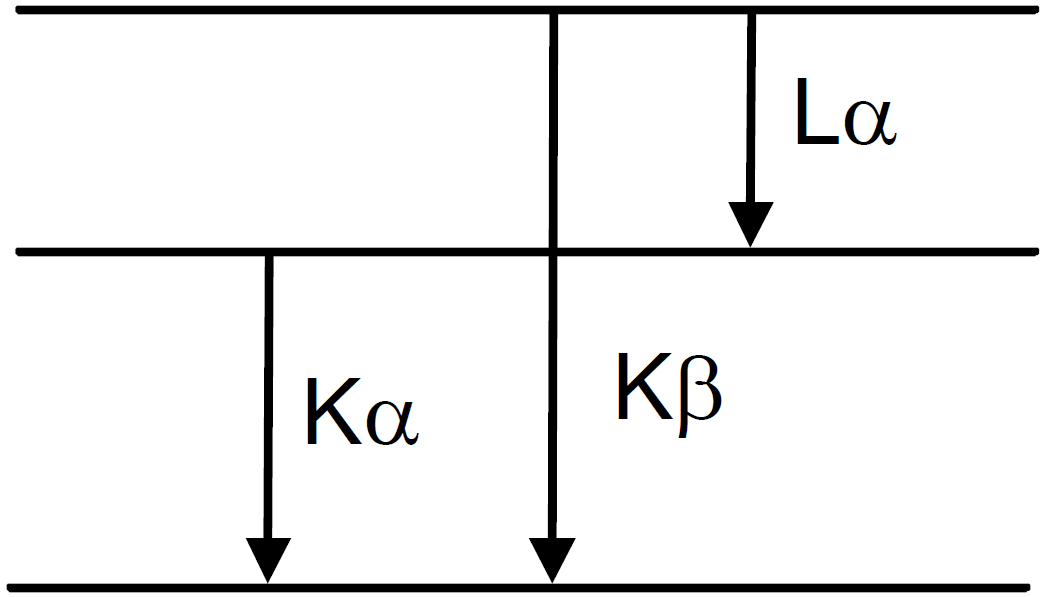
$\text{K}_\alpha=\text{E}_\text{K}-\text{E}_\text{L}\ ...(1)\ \lambda\text{K}_\beta=0.71\mathring{\text{A}}$
$\text{K}_\beta=\text{E}_\text{K}-\text{E}_\text{M}\ ...(2)\ \lambda\text{K}_\beta=63\mathring{\text{A}}$
$\text{L}_\alpha=\text{E}_\text{L}-\text{E}_\text{L}-\text{E}_\text{M}\ ...(3)$
Subtracting (2) from (1)
$\text{K}_\alpha-\text{K}_\beta=\text{E}_\text{M}-\text{E}_\text{L}=-\text{L}_\alpha$
Or, $\text{L}_\alpha=\text{K}_\beta-\text{K}_\alpha$
$=\frac{3\times10^8}{0.63\times10^{-10}}-\frac{3\times10^8}{0.71\times10^{-10}}$
$=4.761\times10^{18}-4.225\times10^{18}$
$=0.536\times10^{18}\text{Hz}$
Again $\lambda=\frac{3\times10^8}{0.536\times10^{18}}$
$=5.6\times10^{-10}=5.6\mathring{\text{A}}$
View full question & answer
Question 25 Marks
Use Moseley's law with $b=1$ to find the frequency of the $\mathrm{K}_\alpha \mathrm{X}$-ray of $\mathrm{La}(\mathrm{Z}=57)$ if the frequency of the $\mathrm{K}_\alpha \mathrm{X}$-ray of $\mathrm{Cu}(\mathrm{Z}=29)$ is known to be $1.88 \times 10^{18} \mathrm{~Hz}$.
Answer
b = 1 For $\propto\text{a}(57)$$\sqrt{\text{v}}=\text{a}(\text{Z-b})$
$\Rightarrow\sqrt{\text{v}}=\text{a}(57-1)=\text{a}\times56\ ...(1)$
For Cu(29)$\sqrt{1.88\times10^{78}}=\text{a}(29-1)=28\text{a}\ ...(2)$
dividing (1) and (2)$\sqrt{\frac{\text{V}}{1.88\times10^{18}}}=\frac{\text{a}\times56}{\text{a}\times28}=2$
$\Rightarrow\text{v}=1.88\times10^{18}(2)^2$
$=4\times1.88\times10^{18}=7.52\times10^8\text{Hz}$
View full question & answer
Question 35 Marks
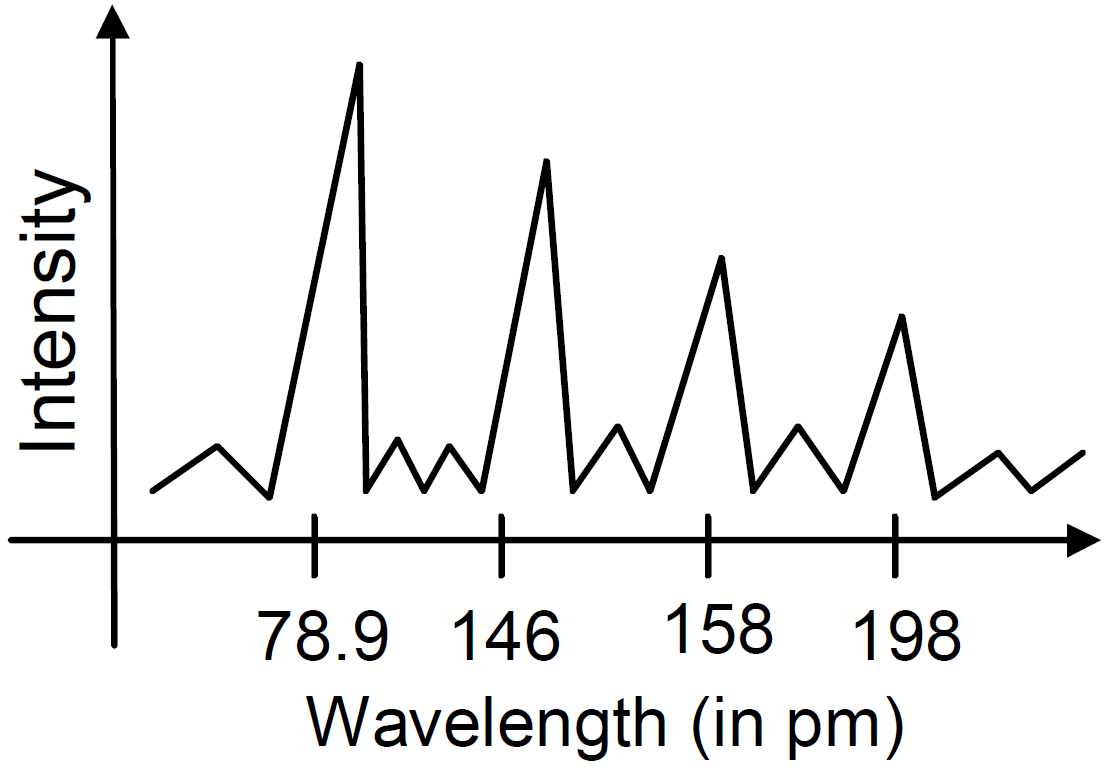
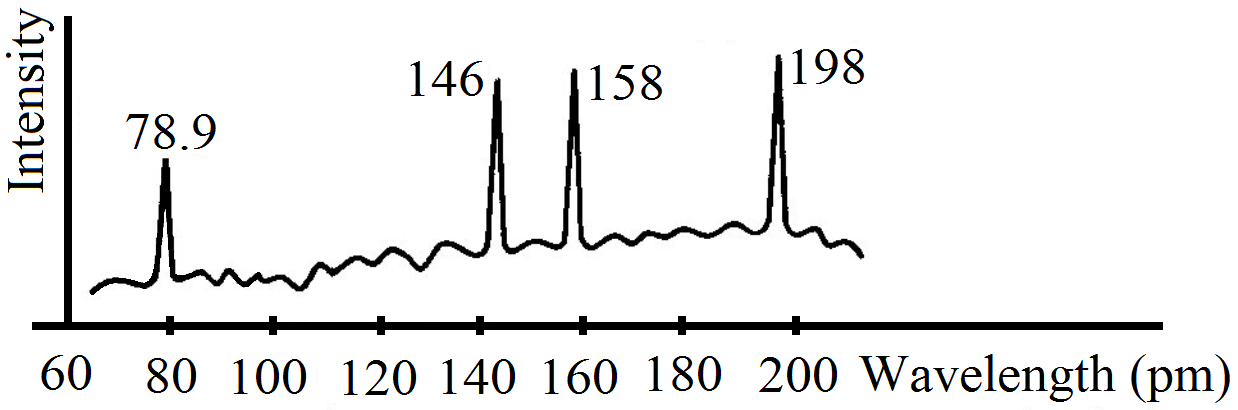
Continuous X-rays are made to strike a tissue paper soaked with polluted water. The incoming X-rays excite the atoms of the sample by knocking out the electrons from the inner shells. Characteristic X-rays are analysed and the intensity is plotted against the wavelength. Assuming that only $\text{K}_\alpha$ intensities are detected, list the elements present in the sample from the plot. Use Moseley's equation $v - (25 \times 10^{14}Hz)(Z - 1)^2.$
Answer


Given
$v = (25 \times 10^{14}Hz) (Z -1)^2$​​​​​​​
$\frac{\text{C}}{\lambda}=25\times10^{14}(\text{Z}-1)^2$
  1. $\frac{\text{3}\times10^8}{78.9\times10^{-12}\times25\times10^{14}}=(\text{Z}-1)^2$
$(\text{Z}-1)^2=38.98$
$\text{Z}=39.98=40$ It is (Zr)
  1. $\frac{3\times10^8}{146\times10^{-12}\times25\times10^{14}}=(\text{Z}-1)^2$
$(\text{Z}-1)^2=0.0008219\times10^6$
$\Rightarrow\text{Z}-1=28.669 $
$\text{Z}=29.669=30$ It is (Zn).
  1. $\frac{3\times10^8}{158\times10^{-12}\times25\times10^{14}}=(\text{Z}-1)^2$
$(\text{Z}-1)^2=0.0007594\times10^6$
$\Rightarrow\text{Z}-1=27.5589$
$\text{Z}=28.5589=29$ It is (Cu).
  1. $\frac{3\times10^8}{19\times10^{-12}\times25\times10^{14}}=(\text{Z}-1)^2$
$(\text{Z}-1)^2=0.000606\times10^6$
$\Rightarrow\text{Z}-1=24.6182 $
$\text{Z}=25.6182=26$ It is (Fe).
View full question & answer
Question 45 Marks
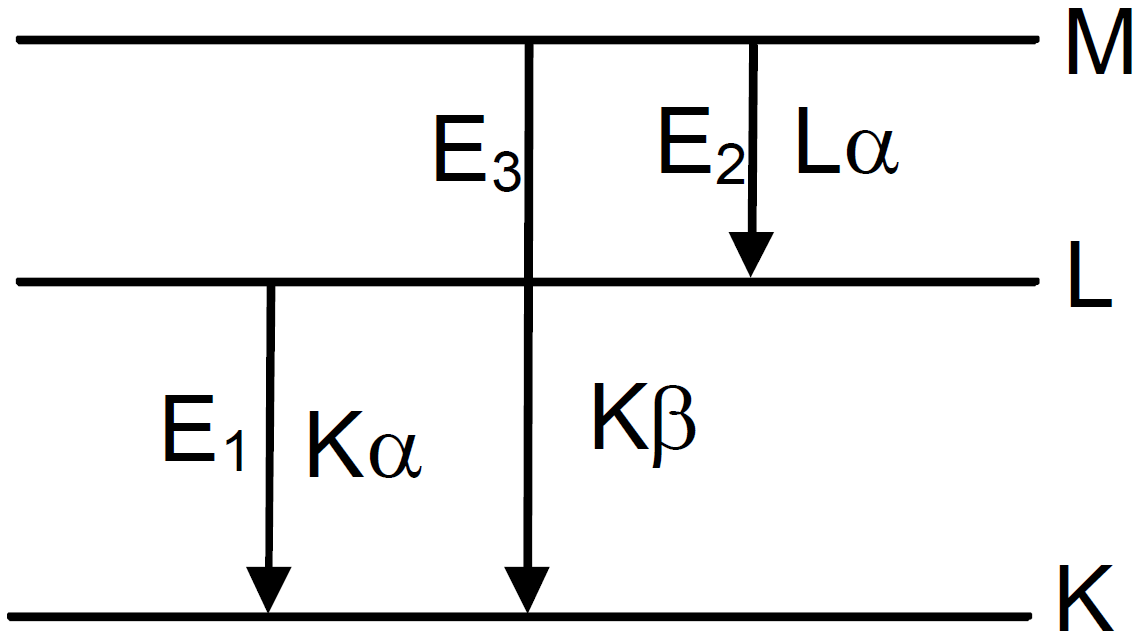
The wavelengths of $\text{K}_\alpha$ and $\text{L}_\alpha$ X-rays of a material are 21.3pm and 141pm respectively. Find the wavelength of $\text{K}_\beta$ X-ray of the material.
Answer

$\text{E}_1=\frac{1242}{21.3\times10^{-3}}=58.309\times10^3\text{eV}$
$\text{E}_2=\frac{1242}{141\times10^{-3}}=8.8085\times10^3\text{eV}$
$\text{E}_3=\text{E}_1+\text{E}_2$
$\Rightarrow(58.309+8.809)\text{ev}=67.118\times10^3\text{ev}$
$\lambda=\frac{\text{hc}}{\text{E}_3}=\frac{1242}{67.118\times10^3}$
$=18.5\times10^{-3}\text{nm}=18.5\text{pm}$
View full question & answer
Question 55 Marks
A certain element emits $\text{K}_\alpha$ X-ray of energy 3.69keV. Use the data from the previous problem to identify the element.
Answer
$\text{E}=3.69\text{Kev}=3690\text{eV}$$\lambda=\frac{\text{hc}}{\text{E}}=\frac{1242}{3690}=0.33658\text{nm}$
$\sqrt{\frac{\text{C}}{\lambda}}\text{a}(\text{z}-\text{b})$
$\text{a}=5\times10^7\sqrt{\text{Hz}}$
$\text{b}=1.37$ (from previous problem)
$\sqrt{\frac{3\times10^8}{0.34\times10^{-9}}}$
$=5\times10^7(\text{Z}-1.37)$
$\Rightarrow\sqrt8.82\times10^{-17}=5\times10^7({\text{Z}-1.37)}$
$\Rightarrow9.39\times10^8=5\times10^7(\text{Z}-1.37)$
$\Rightarrow\frac{93.9}{5}=\text{Z}-1.37$
$\Rightarrow\text{Z}=20.15=20$
$\therefore$ The element is calcium.
View full question & answer
Question 65 Marks
Can $\text{L}_\alpha$ X-ray of one material have shorter wavelength than $\text{K}_\alpha$ X-ray of another?
Answer
An $\text{L}\alpha$ X-ray is emitted when an electron jumps from the M to the L shell, and a $\text{K}_\alpha$ X-ray is emitted when an electron jumps from the L to the K shell. Less energy is involved when an electron jumps from the M to the L shell than when it jumps from the L to the K shell. Also, wavelength of a photon is inversely related to its energy. Therefore, an $\text{L}\alpha$ X-ray has higher wavelength than a $\text{K}_\alpha$ X-ray for the same material.
View full question & answer
Question 75 Marks
When a Coolidge tube is operated for some time it becomes hot. Where does the heat come from?
Answer
A Coolidge tube apparatus consists of a filament and a target. The filament is heated to produce electrons that are accelerated by applying an electric field between the filament and the target. When these accelerated electrons enter the target, they collide with the target atoms. In the process, the electrons lose their kinetic energy. A part of this kinetic energy is utilised for emitting X-rays and the remaining energy is absorbed by the target. Inside the target, the kinetic energy of the electrons is converted into heat energy. This raises the temperature of the target and hence, it heats the Coolidge tube.
View full question & answer
Question 85 Marks
The energy of a silver atom with a vacancy in K shell is 25.31keV, in L shell is 3.56keV and in M shell is 0.530keV higher than the energy of the atom with no vacancy. Find the frequency of $\text{K}_\alpha\text{K}_\beta$ and $\text{L}_\alpha$ X-rays of silver.
Answer
Given: Energy of electron in the K shell, $E_k = 25.31keV$ Energy of electron in the L shell, $E_L = 3.56keV$ Energy of electron in the M shell, $E_M = 0.530keV$ Let f be the frequency of $\text{K}_\alpha$ X-ray and $f_0$ be the frequency of $\text{K}_\beta$ X-ray. Let $f_1$ be the frequency of $\text{L}_\alpha$ X-rays of silver.$\therefore\text{K}_\alpha=\text{E}_\text{K}-\text{E}_\text{L}=\text{hf}$
Here, h = Planck constant f = frequency of $\text{K}_\alpha$ X-ray$\text{f}=\frac{\text{E}_\text{K}-\text{E}_\text{L}}{\text{h}}$
$\text{f}=\frac{(25.31-3.56)}{6.63\times10^{-34}}\times1.6\times10^{-19}\times10^3$
$\text{f}=\frac{21.75\times10^3\times10^{15}}{6.67}$
$\text{f}=5.25\times10^{18}\text{Hz}$
$\text{K}_\beta=\text{E}_\text{K}-\text{E}_\text{M}=\text{hf}_0$
$\Rightarrow\text{f}_0=\frac{\text{E}_\text{K}-\text{E}_\text{M}}{\text{h}}$
$\Rightarrow\text{f}_0=\frac{(25.31-0.53)}{6.67\times10^{-34}}\times10^3\times1.6\times10^{-19}$
$\Rightarrow\text{f}_0=5.985\times10^{18}\text{Hz}$
$\text{K}_\text{L}=\text{E}_\text{L}-\text{E}_\text{M}=\text{hf}_1$
$\text{f}_1=\frac{\text{E}_\text{L}-\text{E}_\text{M}}{\text{h}}$
$\text{f}_1=\frac{3.56-0.530}{6.63\times10^{-34}}\times10^3\times1.6\times10^{-19}$
$\text{f}_1=7.32\times10^{17}\text{Hz}$
View full question & answer
Question 95 Marks
Is it possible that in a Coolidge tube characteristic $\text{L}_\alpha$ X-rays are emitted but not $\text{K}_\alpha$ X-rays?
Answer
$\text{K}_\alpha$ X-rays are emitted due to the transition of an electron from the L shell to the K shell and $\text{L}_\alpha$ X-rays due to the transition of an electron from the M shell to the L shell. If $\text{K}_\alpha$ X-rays are not emitted, then the L shell will not be vacant to take the electron from the M shell. Hence, $\text{L}_\alpha$ X-rays will not be emitted. Therefore, it is not possible that in a Coolidge tube, characteristic $\text{L}_\alpha$ X-rays are emitted but not $\text{K}_\alpha$ X-rays.
View full question & answer
Question 105 Marks
The short-wavelength limit shifts by 26pm when the operating voltage in an X-ray tube is increased to 1.5 times the original value. What was the original value of the operating voltage?
Answer
Give$\lambda'=\lambda-26\text{pm},$
$\text{V}'=1.5\text{V}$
Now $\lambda=\frac{\text{hc}}{\text{ev}},$$\lambda'=\frac{\text{hc}}{\text{ev}'}$
Or $\lambda\text{V}=\lambda'\text{V}'$$\Rightarrow\lambda\text{V}=\Big(\lambda-26\times10^{-12}\Big)\times1.5\text{V}$
$\Rightarrow\lambda=1.5\lambda-1.5\times26\times10^{-12}$
$\Rightarrow\lambda=\frac{39\times10^{-12}}{0.5}$
$=78\times10^{-12}\text{m}$
$\text{V}=\frac{\text{hc}}{\text{e}\lambda}$
$=\frac{6.63\times3\times10^{-34}\times10^8}{1.6\times10^{-19}\times78\times10^{-12}}$
$=0.15937\times10^5=15.93\times10^3\text{V}$
$15.93\text{KV}.$
View full question & answer
Question 115 Marks
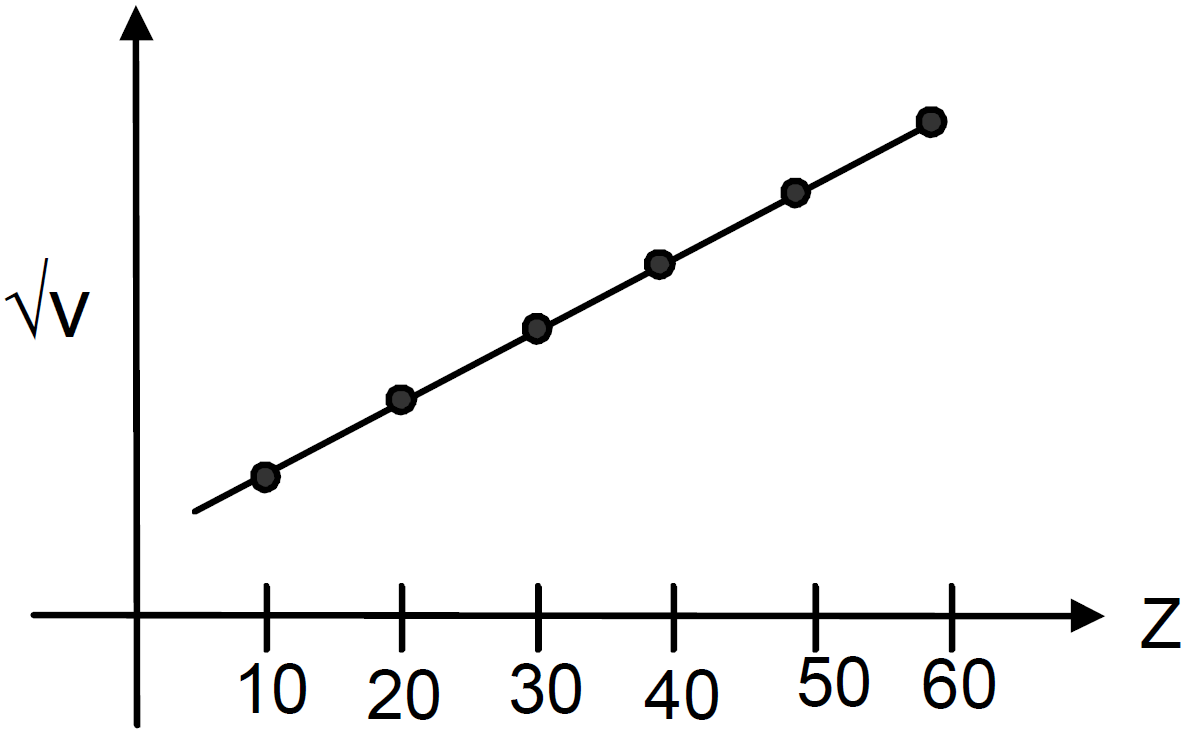
The $\text{K}_\beta$ X-rays from certain elements are given below. Draw a Moseley-type plot of $\sqrt{\text{v}}$ versus Z for $\text{K}_\beta$ radiation.
Element
Ne
P
Ca
Mn
Zn
Br
Energy (keV)
0.858
2.14
4.02
6.51
9.57
13.3
Answer

$\text{K}_\text{B}$ radiation is when the e jumps from
n = 3 to n = 1 (here n is principal quantum no)
$\Delta\text{E}=\text{hv}=\text{Rhc(z-h)}^2\Big(\frac{1}{2^2}-\frac{1}{3^2}\Big)$
$\sqrt{\text{v}}=\sqrt{\frac{9\text{RC}}{8}}(\text{z}-\text{h})$
$\therefore\sqrt{\text{v}}\propto\text{z}$
Second method :
We can directly get value of v b
hv = Energy
$\Rightarrow\text{v}=\frac{\text{Energy(in Kev)}}{\text{h}}$
This we have to find out $\sqrt{\text{v}}$ and draw the same graph as above.
View full question & answer
Question 125 Marks
The $\text{K}_\alpha$ X-rays of aluminium (Z = 13) and zinc (Z = 30) have wavelengths 887pm and 146pm respectively. Use Moseley's law $\sqrt{\text{v}}=\text{a}(\text{z-b})$ to find the wavelengths of the $\text{K}_\alpha$ X-ray of iron (Z = 26).
Answer
$\lambda_1=887\text{pm}$$\text{v}=\frac{\text{C}}{\lambda}=\frac{3\times10^8}{887\times10^{-12}}$
$=3.383\times10^7=33.82\times10^{16}$
$=5.815\times10^8$
$\lambda_2=146\text{pm}$
$\text{v}=\frac{3\times10^8}{146\times10^{-12}}$
$=0.02054\times10^{20}=2.054\times10^{18}$
$=1.4331\times10^9$
We know, $\sqrt{\text{v}}=\text{a}(\text{z-b})$
$\Rightarrow\frac{\sqrt{5.815\times10^8}\ =\text{ a}(13-\text{b})}{\sqrt{1.4331\times10^9}\ =\text{ a}(30-\text{b})}$
$\Rightarrow\frac{13-\text{b}}{30-\text{b}}=\frac{5.815\times10^{-1}}{1.4331}=0.4057$
$\Rightarrow30\times0.4057-0.4057\text{b}$
$=13-\text{b}$
$\Rightarrow12.171-0.4.57\text{b}+\text{b}=13$
$\Rightarrow\text{b}=\frac{0.829}{0.5943}=1.39491$
$\Rightarrow\text{a}=\frac{5.815\times10^8}{11.33}=0.51323\times10^8$
$=5\times10^7$
For ‘Fe’,
$\sqrt{\text{v}}=5\times10^7(26-1.39)$
$=5\times24.61\times10^7=123.05\times10^7$
$\frac{\text{C}}{\lambda}=15141.3\times10^{14}$
$=\lambda=\frac{3\times10^8}{15141.3\times10^{14}}$
$=0.000198\times10^{-6}\text{m}=198\times10^{-12}$
$=198\text{pm}$
View full question & answer
Question 135 Marks
An X-ray tube operates at 40kV. Suppose the electron converts 70% of its energy into a photon at each collision. Find the lowest there wavelengths emitted from the tube. Neglect the energy imparted to the atom with which the electron collides.
Answer
$\mathrm{V}=40 \mathrm{KV}=40 \times 10^3 \mathrm{~V}$ Energy $=40 \times 10^3 \mathrm{eV}$ Energy utilized $=\frac{70}{100}\times40\times10^3$$=28\times10^3\text{eV}$
$\lambda=\frac{\text{hc}}{\text{E}}=\frac{1242-\text{ev-nm}}{28\times10^3\text{ev}}$
$\Rightarrow44.35\times10^{-3}\text{nm}=44.35\text{pm}$
For other wavelengths, E = 70% (left over energy)$=\frac{70}{100}\times(40-28)10^3=84\times10^2$
$\lambda'=\frac{\text{hc}}{\text{E}}=\frac{1242}{8.4\times10^3}$
$=147.86\times10^{-3}\text{nm}$
$=147.86\text{pm}=148\text{pm}$
For third wavelengths,$\text{E}=\frac{70}{100}=(12-8.4)\times10^3$
$=7\times3.6\times10^2=25.2\times10^2$
$\lambda'=\frac{\text{hc}}{\text{E}}=\frac{1242}{25.2\times10^2}$
$=49.2857\times10^{-2}\text{nm}=493\text{pm}$
View full question & answer