Questions

5 Marks Questions

Take a timed test

34 questions · self-marked practice — reveal the answer and mark yourself.

Question 15 Marks
Why ozone hole forms over Antarctica? How will enhanced ultraviolet radiation affect us?
Answer
The ozone hole is more prominent over the region of Antarctica. It is formed due to an increased concentration of chlorine in the atmosphere.Chlorine is mainly released from chlorofluorocarbons (CFC's) widely used as refrigerants.
  1. When released in stratosphere, these substances drift towards poles and get accumulated on the ice clouds formed at high altitudes.
  2. Ice provides a surface on which breakdown of all the CFC compounds takes place to release chlorine atom.
  3. These chlorine atoms breakdown ozone resulting in thinning of the ozone layer. Normally, the ozone layer plays a protective role by absorbing harmful UV radiations but reduction in its thickness allows UV rays to reach Earth's surface.
Effects of ultraviolet radiation on humans:
  1. Early ageing of skin.
  2. Increased incidences of cancer of the skin.
  3. Cataract of the eyes.
  4. Inflammation of cornea of the eye (known as snow blindness).
  5. Weakened immune system.
View full question & answer
Question 25 Marks
What are the various constituents of domestic sewage? Discuss the effects of sewage discharge on a river.
Answer
Various constituents of domestic sewage are:
  1. Solid wastes such as faecal matter, detergents etc, dissolved/ suspended in water from the kitchen, toilets, bathrooms and laundry.
  2. Harmful pathogens including disease causing microbes-bacteria, viruses, fungi etc.
  3. Dissolved minerals such as phosphates, nitrates, sodium ions, ammonia etc.
Discharge of untreated sewage in water bodies leads to:
  1. Contamination of water in the water bodies with the faecal matter rendering it unfit for future usage.
  2. Accumulation of various pathogens in the water bodies that can cause water borne diseases.
  3. Increase in the Biological Oxygen Demand (BOD) of the water body thereby deteriorating the quality of water.
  4. Excessive accumulations of minerals causes accelerated aging of the water bodies due to rapid growth of algae, called eutrophication.
  5. Negative impact on the flora and fauna of the particular water body. Number of fishes are found to be less in water bodies with high BOD.
View full question & answer
Question 35 Marks
Discuss the causes and effects of global warming. What measures need to be taken to control global warming?
Answer
Long term rise in temperature of the Earth's surface is called global warming. Causes: Increase in the atmospheric levels of gases $\left(\mathrm{CO}_2, \mathrm{CH}_4, \mathrm{NO}_2\right.$, etc. $)$ due to extensive burning of fossil fuels. Accumulation of these gases in higher concentration does not allow the Earth's heat to escape in the outer atmosphere, thus leading to increase in its surface temperature. Effects of global warming: Global warming is defined as an increase in the average temperature of the Earth's surface. It has been observed that in the past three decades, the average temperature of the Earth has increased by 0.6° C. As a result, the natural water cycle has been disturbed resulting in changes in the pattern of rainfall. It also changes the amount of rain water. Also, it results in the melting of Polar ice caps and mountain glaciers, which has caused a rise in the sea level, leading to the inundation of coastal regions.Control measures for preventing global warming:
  1. Reducing the use of fossil fuels.
  2. Use of bio-fuels.
  3. Improving energy efficiency.
  4. Use of renewable source of energy such as CNG etc.
  5. Reforestation: Planting of trees saplings.
  6. Recycling of materials.
View full question & answer
Question 45 Marks
What initiatives were taken for reducing vehicular air pollution in Delhi? Has air quality improved in Delhi?
Answer
Delhi has been categorized as the fourth most polluted city of the world in a list of 47wQbNPTDJp9hMYdvogK2hAUiHsGeiybwaWe36bwtRQ3UTpYV7YuZ8FV5j9nauFCWwcjM6dTzpL5s2N79Rp5unwdMvc8ZKU>
Various steps have been taken to improve the quality of air in Delhi:
  • Introduction of CNG (Compressed Natural Gas): By the order of the supreme court of India, CNG-powered vehicles were introduced at the end of year 2006 to reduce the levels of pollution in Delhi. CNG is a clean fuel that produces very little unburnt particles.
  • Phasing out of old vehicles.
  • Use of unleaded petrol.
  • Use of low-sulphur petrol and diesel.
  • Use of catalytic converters.
  • Application of stringent pollution-level norms for vehicles.
  • Implementation of Bharat stage I, which is equivalent to euro II norms in vehicles of major Indian cities.
The introduction of CNG-powered vehicles has improved Delhi’s air quality, which has lead to a substantial fall in the level of $CO_2$ and $SO_2$. However, the problem of suspended particulate matter (SPM) and respiratory suspended particulate matter (RSPM) still persists.
View full question & answer
Question 55 Marks
What measures, as an individual, you would take to reduce environmental pollution?
Answer
As an individual, we can take certain steps to reduce environmental pollution such as:
  1. Using CNG instead of petrol, diesel. Opting more for either public transport or encouraging more and more carpooling.
  2. Minimising the solid waste generation and recycling the plastic, metal and glass commodities.
  3. Using the biodegradable waste generated in the kitchen to prepare compost.
  4. Avoiding the usage of plastic bags wherever possible and opting for the jute or cotton bags.
  5. Avoiding tinned food products.
  6. Celebrating a cracker-free Diwali and encouraging others to follow it as well.
  7. Using catalytic converters in the automobiles. Getting them checked for pollution on a regular basis.
  8. Educating everyone and encouraging them to opt for renewable sources of energy.
View full question & answer
Question 65 Marks
Match the items given in column A and B:
Column A Column B
a Catalytic converter i Particulate matter
b Electrostatic precipitator ii Carbon monoxide and nitrogen oxides
c Earmuffs iii High noise level
d Landfills iv Solid wastes
Answer
Column A Column B
a Catalytic converter ii Carbon monoxide and nitrogen oxides
b Electrostatic precipitator i Particulate matter
c Earmuffs iii High noise level
d Landfills iv Solid wastes
View full question & answer
Question 75 Marks
Public all over India is very much concerned about the deteriorating air quality in large parts of North India. Alarmed by this situation the Resident’s Welfare Association of your locality organised an awareness programme entitled "Bury not burn". They invited you, being a biology student to participate.
  1. How would you justify your arguments that promote burying and discourage burning? (Give two reasons)
  2. With the help of flow charts, one for each practice depict the chain of events that follow.
Answer
  1.  
  • Burying of biodegradable wastes (Agricultural waste/plant parts such as dry leaves/vegetable peels/fallen flower/rotten fruits etc.): in the pit/landfill and should be covered with soil leading to the decomposition of organic matter/which enrich soil/increase soil fertility.
  • If these things are burnt it will lead to formation of harmful gases/smoke/particulate matter which causes air pollution/global warming/respiratory diseases.
  1.  
  • Burying of biodegradable wastes (Agricultural waste/plant parts such as dry leaves/vegetable peels/fallen flower/rotten fruits etc.): in pit/landfill $\rightarrow$ decomposition $\rightarrow$ compost $\rightarrow$ increase soil fertility/recycling of nutrients.
  • Burying of biodegradable wastes (Agricultural waste/plant parts such as dry leaves/vegetable peels/fallen flower/rotten fruits etc.): fragmentation $\rightarrow$ catabolism $\rightarrow$ humification $\rightarrow$ mineralisation
  • Burying of biodegradable wastes (Agricultural waste/plant parts such as dry leaves/vegetable peels/fallen flower/rotten fruits etc.): Detritus $\rightarrow$ decompositions.
  • If these things are burnt: air pollution/global warming $\rightarrow$ respiratory disease
  • If these things are burnt: release of $CO_2 \rightarrow $ global warming
View full question & answer
Question 85 Marks
Since October 02, 2014 "Swachh Bharat Abhiyan" has been launched in our country.
  1. Write your views on this initiative giving justification.
  2. As a biologist name two problems that you may face while implementing the programme in your locality.
  3. Suggest two remedial methods to overcome these problems.
Answer
  1. Value point conveying importance of clean environment/surrounding.
  2. Social attitude/co-ordination/financial issues/disposal of collected garbage/separation of biodegradable and non-degradable waste/lack of awareness.
  3. Campaigning/creating awareness/organising competitions/giving incentives/provision of imposing penalty/complaining to appropriate authority/publicity through mass media/using masks or gloves for separation and disposal of various categories of garbage.
View full question & answer
Question 95 Marks
Looking at the deteriorating air quality because of air pollution in many cities of the country, the citizens are very much worried and concerned about their health. The doctors have declared health emergency in the cities where the air quality is very severely poor.
  1. Mention any two major causes of air pollution.
  2. Write any two harmful effects of air pollution to plants and humans.
  3. As a captain of your school Eco-club, suggest any two programmes you would plan to organise in the school so as to bring awareness among the students on how to check air pollution in and around the school.
Answer
  1. Two causes of air pollution:
  1. Burning of fossil fuels.
  2. Smoke released from vehicles.
  3. Industrial effluents.
  4. Smoke stacks of thermal power plants.
  1. Harmful effects of air pollution:
  1. It affects respiratory system of humans and of animals.
  2. It also reduces growth and yield of crops & cause premature death of plants.
  1.  
  1. Encouraging public transport i.e. buses & using CNG instead of diesel.
  2. Planting more trees to curb pollution.
View full question & answer
Question 105 Marks
List some adverse effects of particulate matter on human health.
Answer
  1. According to Central Pollution Control Board (CPCB), particulate size of 2.5 micrometers or less in diameter (PM 2.5) are responsible for causing the greatest harm to the human health. These fine particulates cause breathing and respiratory symptoms, irritation, inflammations and damage to the lungs and premature death.
  2. About 40% of human deaths occur due to air pollution.
  3. Causes increase in susceptibility to diseases.
  4. Causes cancer and genetic mutations.
  5. Causes respiratory ailments like asthma, hay fever and other allergic diseases.
  6. Causes cardiovascular diseases and damage to CNS resulting in premature death.
  7. Causes immediate effects like inflammation, nausea, headache, irritation to the eyes and nose.
View full question & answer
Question 115 Marks
Is it true that if the dissolved oxygen level drops to zero, the water will become septic. Give an example which could lower the dissolved oxygen content of an aquatic body.
Answer
It is true that if dissolved oxygen level drops to zero, the water will become septic. Absence of oxygen in water means the water will no longer be able to sustain living beings because aquatic plants and animals use dissolved oxygen for respiration.
When sewage is discharged into water body, microorganisms feed on organic impurities. In this process, they consume most of the oxygen present in water. This reduced the level of dissolved oxygen to negligible level.
View full question & answer
Question 125 Marks
Discuss the following:
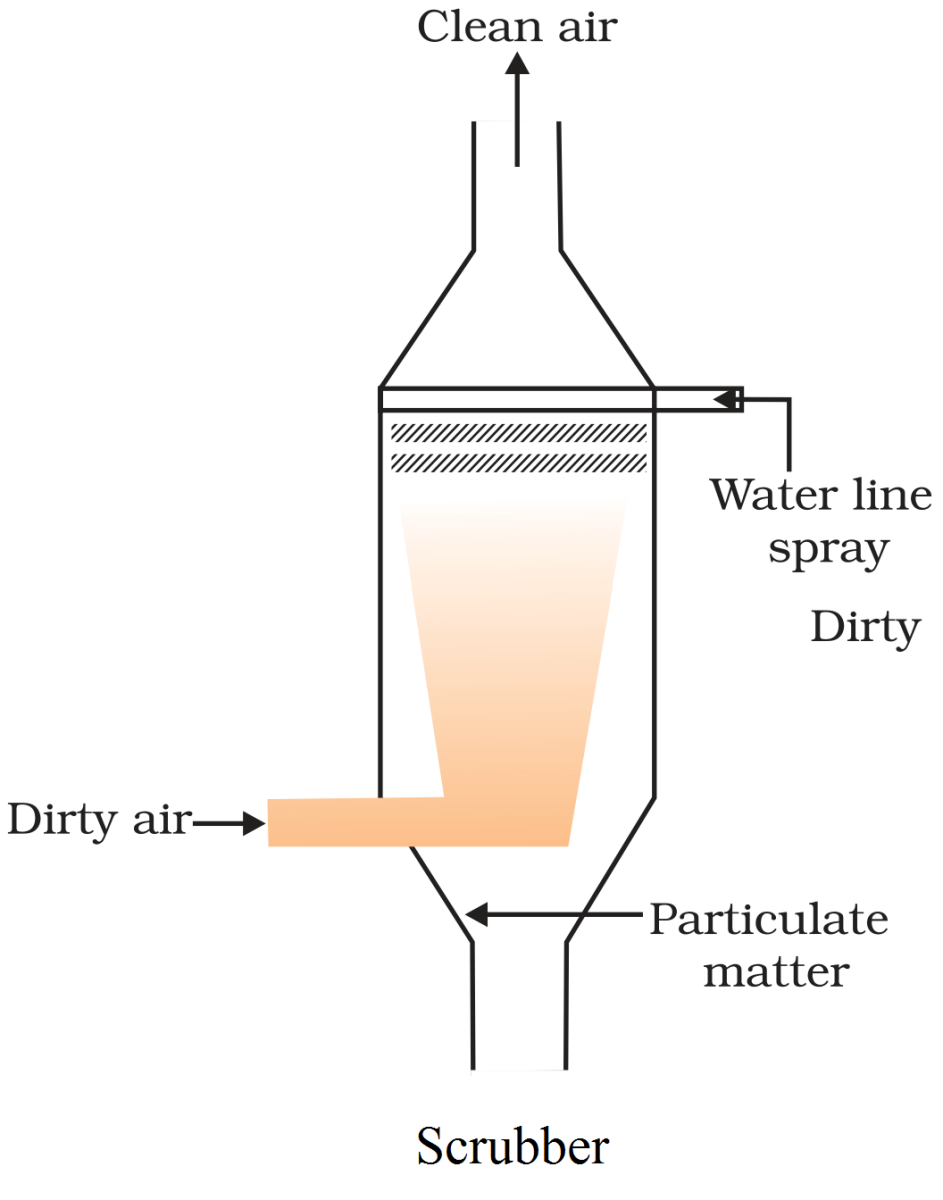
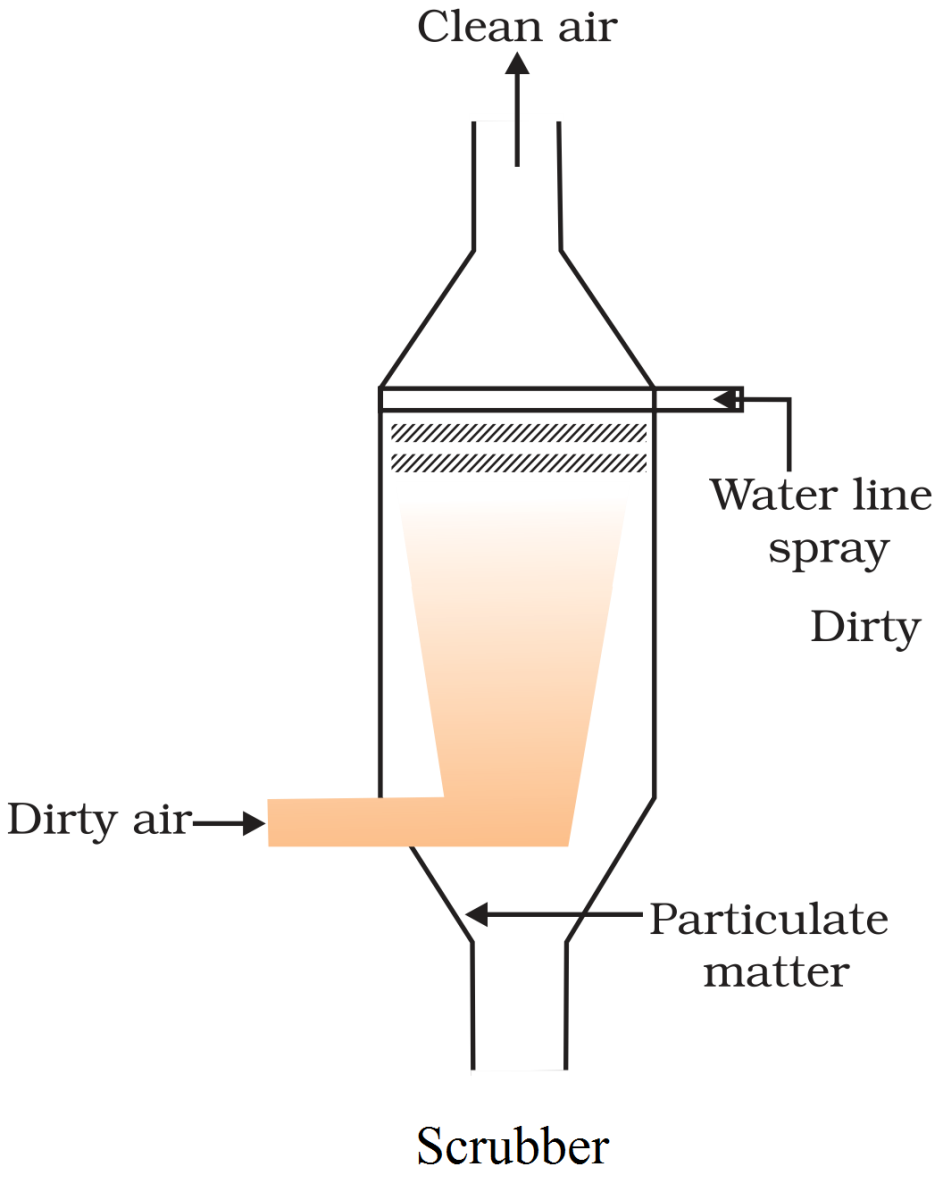
Scrubber.
Answer
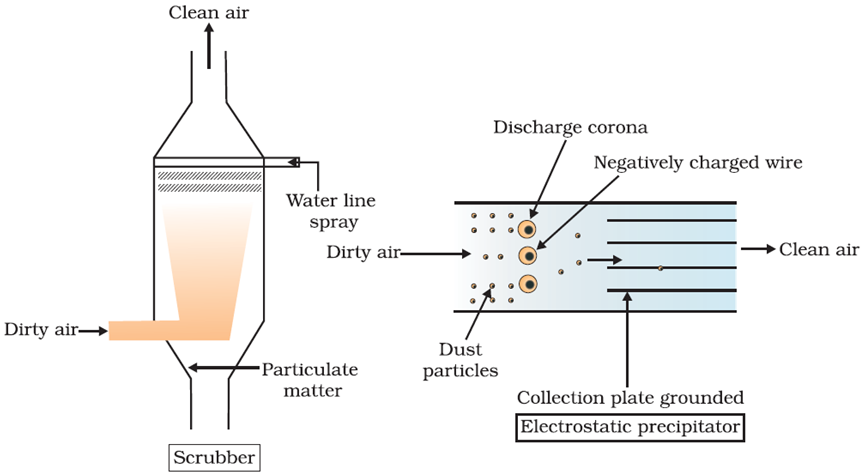
Scrubber:
  1. It is used to remove gases like sulphur dioxide from industrial exhaust.
  2. The exhaust is passed through a spray of water or lime.
  3. Water dissolves gases and lime reacts with sulphur dioxide to form a precipitate of calcium sulphate and sulphide.
View full question & answer
Question 135 Marks
Expand FOAM. Describe the project of integrated waste water treatment, it is responsible for the upkeep.
Answer
FOAM: Friends of Arcata Marsh
  1. It is a citizens group responsible for the upkeep and safeguarding of a project of integrated waste water treatment in the town of Arcata in the northern coast of California.
  2. Collaborating with the biologists of Humboldt State University, the people of the town created an integrated waste water treatment process within a natural system.
  3. The cleaning occurs in two stages:
  • The conventional sedimentation, filtration and chlorination are done, after this, the dangerous pollutants like dissolved heavy metals remain.
  • The biologists developed a series of six connected marshes over 60 hectares of marshland; and seeded into them appropriate plants, algae, fungi and bacteria, which neutralise, absorb and assimilate the pollutants.
  1. As water flows through the marshes, it gets purified naturally.
  2. The marshes also constitute a sanctuary with a high level of biodiversity including fishes, birds and other animals which reside there now.
View full question & answer
Question 145 Marks
  1. A mere 0.1 percent impurities make domestic sewage unfit for human consumption. Categorise the types of impurities with one example each.
  2. What is polyblend?
  3. Why does a greenhouse warm up?
Answer
  1. The impurities in the sewage water can be categorised as:
  1. Suspended solids:
  • e.g. clay, grit, sand.
  1. Colloidal matter:
  • e.g. faecal matter, cloth fibres, paper fibres, some bacteria.
  1. Dissolved substances:
  • e.g. ammonia, nitrates or sodium, calcium, phosphate (any one in each of the above).
  1. Polyblend is a fine powder recycled and modified plastic.
  2. A greenhouse warms up because the glass panel lets the light in, but does not allow the heat to escape.
View full question & answer
Question 155 Marks
Describe the functioning of electrostatic precipitator along with a schematic diagram.
Answer
Electrostatic precipitator:
  • It is the most widely used method for removal of particulate matter, about 90% of particulate matter is removed from the exhaust of thermal power plants.
  • It has electrode wires and a stage of collecting plates.
  • The electrode wires are maintained at several thousand volts, which produce a corona that releases electrons.
  • These electrons get attached to the (dust) particles and give them a net negative charge within a very small fraction of a second.
  • The collecting plates are grounded and hence attract the charged particles.
  • The velocity of air between the plates must be low enough to allow the particles to fall on them.
View full question & answer
Question 165 Marks
What is meant by ozone shield? Name two ozone depleting substances. How do the ozone depleting substances affect the ozone shield? Write one damaging effect of ozone depletion on humans and plants.
Answer
Ozone shield: The ozone layer in the stratosphere absorbs a portion of the radiation from the sun, preventing it from reaching the planet’s surface. Most importantly it absorbs the portion of UV light called UVB has been linked to many harmful effects, including skin cancers, cataracts, and harm to some crops and marine life.
These compounds contribute to ozone depletion, and are called ozone-depleting substances. ODS that release chlorine include (CFCs), (HCFCs).
Harmful Effects of UV Rays:
  1. In the absence of ozone, DNA and proteins of living organisms preferentially absorb W-B rays and is high energy break the chemical bonds within these molecules. This causes
  1. Damage to DNA and leads to mutation.
  2. Damage to the skin cells.
  3. Ageing of the skin.
  4. Various types of cancers.
  1. W-B rays are absorbed by human eye and in high dose, it causes inflammation of cornea. This is called snow-blindness cataract. It leads to diminishing of eye sight, photo burning and later permanent damage to cornea.
View full question & answer
Question 175 Marks
Explain the ways by which solid waste can be disposed.
Answer
Methods of Solid Waste Disposal:
  1. Open burning: Municipal waste is reduced by burning in open dumps but the unburnt waste serve as the breeding ground for rats and flies.
  2. Sanitary landfills: Wastes are dumped in a depression or trench after compaction and covered with dirt. But seepage of chemicals from these landfills can pollute underground water resources.
  3. Rag-pickers and kabadiwallahs: Wastes are collected and separated out into reusable or recyclable categories.
  4. Natural breakdown: The biodegradable materials are kept into deep pits in the ground for natural breakdown.
  5. Recycling: E-wastes can be recycled in specifically built factories or manually to recover important metals.
  6. Incineration: Majority of e-wastes generated in developed world is exported to developing world where they are incinerated.
View full question & answer
Question 185 Marks
  1. Why are catalytic converters recommended for vehicles?
  2. Why should such vehicles use only unleaded petrol?
  3. Why is CNG preferred to diesel as a fuel in vehicles?
Answer
  1. Catalytic converters are recommended in automobiles to reduce air pollution by their exhaust.
  • Catalytic converters have metals like rhodium, palladium and platinum, which convert the unburnt hydrocarbons into carbon dioxide and water, carbon monoxide into carbon dioxide and nitric oxides into nitrogen.
  1. Only unleaded petrol must be used in such vehicles as lead would inactivate the catalyst.
  2. CNG is preferred as a fuel because:
  • It burns efficiently in the vehicles and very little of it is left unburnt.
  • It cannot be adulterated.
View full question & answer
Question 195 Marks
Write a short note on electronic waste. List the various sources of e-wastes and the problems associated with its disposa
Answer
Discarded computers and other electronic items comprise electronic waste. E-waste contains various metals; like copper, iron, nickel, gold, silver, etc. and plastic.Sources of E-waste: Computers, printers, scanners, webcam, mobile phones, music players, e-reader, etc.
Problems associated with disposal of e-waste:
  • Dumping of e-waste will result in accumulation of plastic on land.
  • Extraction of metals; like iron or gold involves incineration of plastic components which creates many polluting substances.
Manual handling of e-waste can be harmful for workers.
View full question & answer
Question 205 Marks
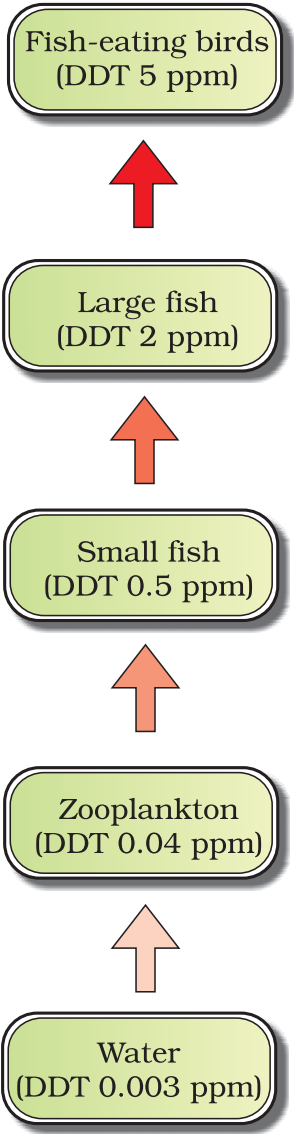
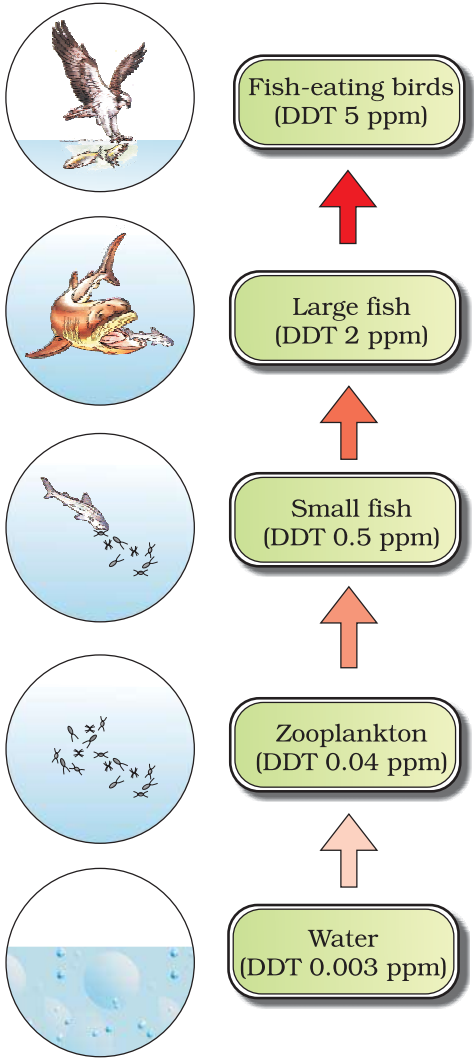
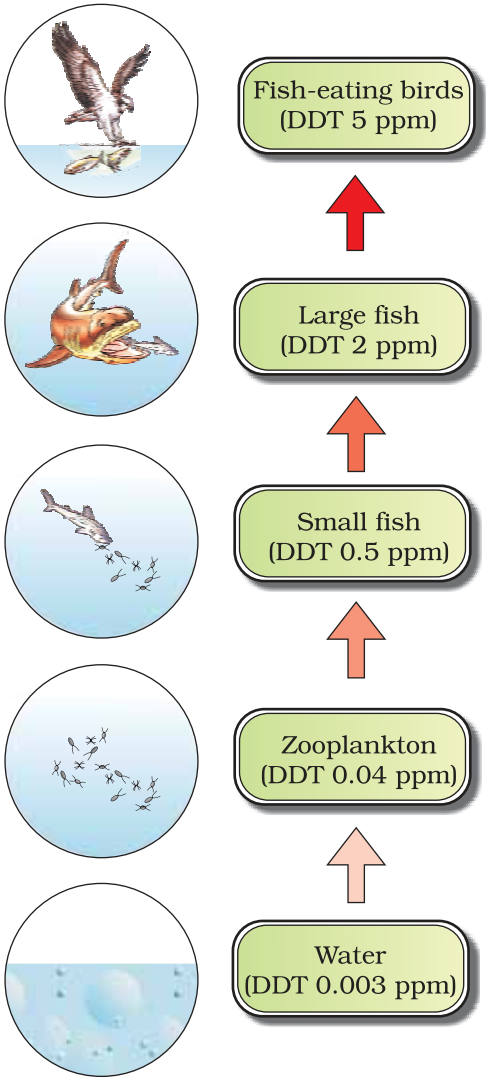
Study the given aquatic food chain and answer the questions that follow:
  1. Give reasons why there is a continuous increase in the DDT content in different trophic levels of the chain.
  2. Name the phenomenon responsible for the increase in DDT content.
Answer
  1. There is a continuous increase in DDT content in different trophic levels of the chain, this is known as biological magnification in the aquatic food chain. This happens because a toxic substance accumulated by an organism cannot be metabolised or excreted and is thus passed on to the next higher trophic level. Thus, concentration of DDT is increased at successive tropic levels.
  2. Biomagnification.
View full question & answer
Question 215 Marks
Discuss the following:
Chipko Movement.
Answer
Chipko Movement: Chipko movement (Hug the Trees Movement) was an organised resistance to the destruction of forests. It started in 1974 in Reni village of Garhwal. A contractor was allowed to cut trees in a forest near the village. When the contractor’s workers appeared, the women of the village reached the forest quickly and clasped the tree trunks with their arms, preventing the workers from cutting down the trees. Mr. Sunder Lal Bahuguna, a Gandhian activist and philosopher was the leader of Chipko Movement.
View full question & answer
Question 225 Marks
  1. Why is the ozone layer required in the stratosphere? How does it get degraded? Explain.
  2. Why is the ozone depletion a threat to mankind?
Answer
  1. Ozone layer in the stratosphere acts as a shield to absorb the ultraviolet radiation from the sun, which is highly injurious to living organisms.
  • Chlorofluorocarbons (CFCs), from refrigerators and aerosol sprays, degrade the ozone layers.
  • The UV rays act on the CFCs and release CI atoms, which degrade ozone to molecular oxygen.
  1. In the absence of ozone, which absorbs the ultraviolet radiation, the UV rays reach the earth and cause the following ill-effects.
  • (i) UV-B damages DNA and causes mutation in living organisms.
  • (ii) It causes ageing of skin, damage to skin cells and various types of skin cancers.
  • (iii) A high dose of UV-B causes inflammation of cornea, called snow blindness, cataract and even permanent damage to cornea.
View full question & answer
Question 235 Marks
What is organic farming? Discuss the benefits of organic farming as a viable practise in the context of developing nations like India.
Answer
The use of Biofertilisers in agriculture is called organic farming. Biofertilisers are organisms that enrich the nutrient quality of the soil. The main sources of biofertilisers are bacteria, fungi and cyanobacteria. The nodules on the roots of leguminous plants formed by the symbiotic association of Rhizobium. These bacteria fix atmospheric nitrogen into organic forms, which is used by the plant as nutrient. Other bacteria can fix atmospheric nitrogen while free-living in the soil (examples Azospirillum and Azotobacter), thus enriching the nitrogen content of the soil.
Currently, in our country, a number of biofertilisers are available commercially in the market and farmers use these regularly in their fields to replenish soil nutrients and to reduce dependence on chemical fertilisers.
View full question & answer
Question 245 Marks
How can slash and burn agriculture become environment friendly?
Answer
Slash and bum agriculture, commonly called as Jhum cultivation in the north-eastern states of India, has also contributed to deforestation. In slash and bum agriculture, the farmers cut down the trees of the forest and bum the plant remains. The ash is used as a fertilizer and the land is then used for farming or cattle grazing. After cultivation, the area is left for several years so as to allow its recovery. The farmers then move on to other areas and repeat this process. In earlier days, when Jhum cultivation was in prevalence, enough time-gap was given such that the land recovered from the effect of cultivation. With increasing population, and Treated cultivation, this recovery phase is done away with, resulting in deforestation.
View full question & answer
Question 255 Marks
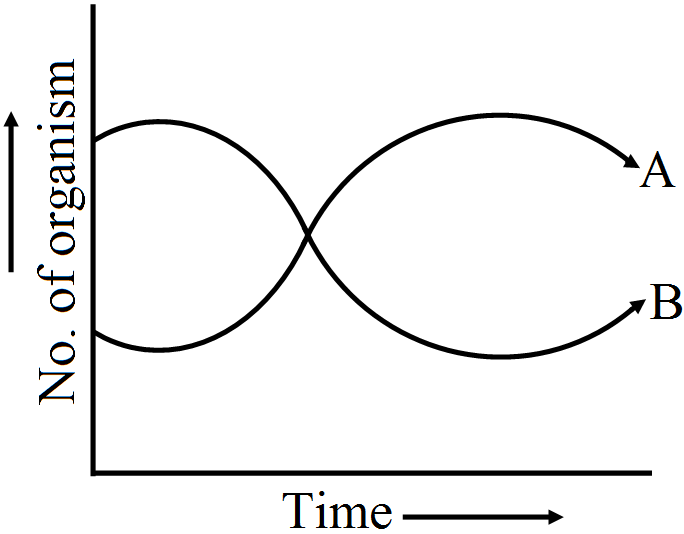
  1. The graph below represents the growth patterns of two types of aquatic organisms over a brief period of time in a water body, surrounded by agricultural land, extensively supplied with fertilisers. Identify the organisms that would represent: (i) A and (ii) B.
  2. State the reason for such a change in the water body and also write the term given to it.
Answer
  1.  
  1. A. Planktonic Algae (algal growth): Due to large amount of nutrient free floating algae develops in lake (a water body).
  2. B. Fishes: Due to decrease in D.O. the fishes and other aquatic organisms die.
  1. Eutrophication (Algal bloom): The eutrophication is defined as the natural ageing of a lake (water body) by biological enrichment of its water." The reason for it is: a young water body (lake) has cold, clear, life supporting water. When it is supplied by fertilizers or some nutrient such as phosphorous as well as nitrogen are introduced in it; the growth of aquatic organisms takes place. Then the microbes consume lot of $O_2$.
View full question & answer
Question 265 Marks
Naman entered into a quarrel with some farmers who were spraying DDT in their field. Many people gathered at the spot to see and enjoy the incident. The angry mob demanded that Naman should not interfere in the farmer's job. Naman tried to explain his point and finally succeeded in explaining the harmful effects of DDT.
  1. What is biomagnification? Explain with an example.
  2. Is biomagnification related with DDT only? Comment.
  3. What is the effect of DDT on birds?
  4. What values did Naman promote?
Answer
  1. Biomagnification is a cumulative increase in the concentrations of a persistent substance (e.g. pesticides, metals, etc.) as it moves up the food chain. This occurs when agricultural, industrial, or human waste pours into the ocean directly or via rivers, sewage, etc. Some of the most dangerous of these toxins settle in the sediment of the sea floor and are consumed by bottom feeders.
With each step up the food chain, there is an increase in the concentration of these chemicals. This affects humans because a large percentage of the fish we consume are higher on the food chain and therefore likely to carry a high concentration of potentially harmful chemicals.
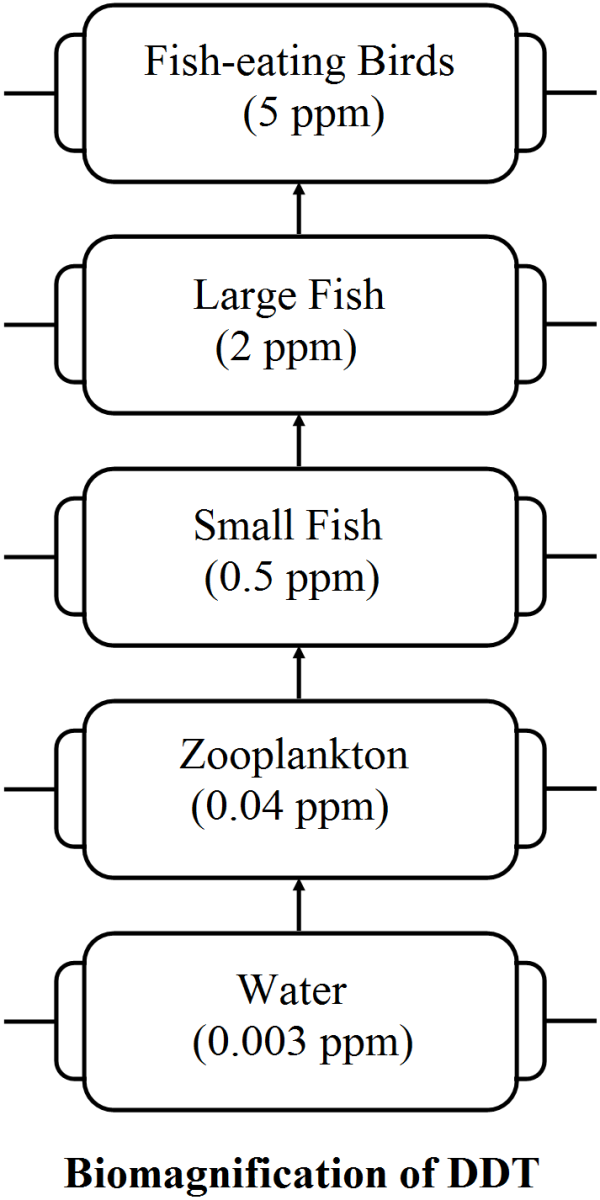
  1. Biomagnification in the aquatic food chain. Biomagnification refers to increase in concentration of the toxicant at successive trophic levels. This happens because a toxic substance accumulated by an organism cannot be metabolised or excreted, and is thus passed on to the next higher trophic level. This phenomenon is well-known for mercury and DDT. Figure 16.5 shows biomagnification of DDT in an aquatic food chain. In this manner, the concentration of DDT is increased at successive trophic levels; say if it starts at 0.003 ppb (ppb = parts per billion) in water, it can ultimately can reach 25 ppm (ppm = parts per million) in fish-eating birds, through biomagnification. High concentrations of DDT disturb calcium metabolism in birds, which causes thinning of eggshell and their premature breaking, eventually causing decline in bird populations.
  1. The insidious aspect of this phenomenon is that large concentrations of chlorinated hydrocarbons do not usually kill the bird outright. Rather, DDT and its relatives alter the bird's calcium metabolism in a way that results in thin eggshells.
  2. Health awareness, eco-friendly nature and boldness for the right cause.
View full question & answer
Question 275 Marks
Observe figure and answer the following questions.
  1. What ecological term is used to describe the DDT accumulation at different trophic levels?
  2. List any one effect of DDT accumulation on birds.
  3. Will DDT accumulation lead to eutrophication?
  4. Does it affect the BOD?
  5. Name disease caused by accumulation of any heavy metal.
Answer
  1. The ecological term used to describe the DDT accumulation at different trophic levels is called biomagnifications.
  2. High concentrations of DDT disturb calcium metabolism in birds, which causes thinning of egg shell and their premature breaking, eventually causing decline in bird populations.
  3. Yes, DDT accumulation can lead to eutrophication.
  4. It increases the BOD, resulting in a decrease in dissolved oxygen in the water body.
  5. Eating fish that has accumulated mercury, a heavy metal, causes a disease called Minamata. It is characterized by diarrhoea, haemolysis, numbness, deafness, mental derangement, meningitis and death
View full question & answer
Question 285 Marks
What is integrated waste water management? Discuss its advantage.
Answer
Integrated Waste Water Treatment:
  • In the town of Arcata situated on northern coast of California, an integrated waste water treatment process was developed with the help of biologists from Humboldt State University.
  • The cleaning occurs in two stages:
  1. The conventional sedimentation, filtration and chlorine treatments are given. The treated water still contains lots of heavy metals and other dangerous pollutants.
  2. Appropriate plants, algae, fungi and bacteria were grown in a marshland through which water was flowed. The various life forms neutralise, absorb and assimilate the pollutants and purify the water naturally.
  • ‘Ecosan’ toilets have been developed in areas of Kerala and Sri Lanka for ecological sanitation.
  • Advantages of ecological sanitation:
  1. It is a practical, hygienic and efficient method of waste disposal.
  2. It is cost effective.
  3. Human excreta can be recycled into natural fertiliser to replace chemical fertiliser.
View full question & answer
Question 295 Marks
Create an aquatic food chain in a water body into which effluents flow from a pesticide factory. Diagrammatically represent biomagnification in this food chain. Explain why a decline in the predator-bird population is expected, when it feeds on the tertiary consumers of this food chain.
Answer
Due to biomagnification of DDT, i.e., excess presence of DDT in the body of the bird, interferes with calcium metabolism and causes thinning of eggs shell; hence the eggs break prematurely and there is a decline in the bird population.
View full question & answer
Question 305 Marks
Discuss the following:Radioactive wastes.
Answer
Radioactive wastes: Radioactive wastes such as uranium, are used as fuel in the atomic power plant. The accidental leakage and disposal of radioactive wastes are the most serious problems. All safety measures for this purpose should be strictly enforced. Highlevel radioactive wastes generate a lot of heat and thus require cooling, as well as special protective shield during handling and transport. Radiation, that is given off by nuclear wastes is extremely harmful to the organisms, because it causes mutation at a very high rate. At high doses, nuclear radiation is lethal but at lower doses, it creates various disorders, the most frequent of all being cancer. Therefore, nuclear waste is an extremely potent pollutant and has to be dealt with utmost caution.
View full question & answer
Question 315 Marks
What is meant by ozone shield? Name two ozone depleting substances. How do the ozonedepleting substances affect the ozone shield? Write one damaging effects of ozone depletion on humans and plants respectively.
Answer
The thin layer of ozone around the atmosphere that prevents entry of harmful UV rays is called ozone shield. Methane and CFCs are the two ozone depleting substances.
Chlorofluorocarbons (CFCs) release active chlorine (Cl atom) when acts with UV rays and Cl atoms degrade ozone releasing molecular oxygen. Depletion of ozone allows the entry of UV-B radiation to the earth which damages DNA causes mutation leading to skin cancer in humans and also rate of photosynthesis decreases in plants.
View full question & answer
Question 325 Marks
What are the basic characteristics of a modern landfil site. List any three and also mention the reasons for their use.
Answer
Characteristic of a modern landfill site is as follows:
  1. Methods to contain leachate such as lining clay or plastic liners: This helps in preventing the leachate from seeping into the underground aquifers. This prevents soil population and groundwater pollution.
  2. Compaction and covering of the waste to prevent it from being blown by wind: Compaction helps in better space utilization because more waste can be accommodated in smaller area. Covering prevents spread of dust and harmful germs and is thus safer from health perspective.
  3. Installation of a landfill gas extraction system to extract the gas for use in generation of power: This enables faster generation of methane which can be used for power generation. In some countries, landfill sites have become important contributors to power generation.
View full question & answer
Question 335 Marks
Water logging and soil salinity are some of the problems that have come in the wake of the Green Revolution. Discuss their causes and adverse effects to the environment.
Answer
Causes of water logging and soil salinity: Many canals were built to implement Green Revolution. This made for easy availability of water for irrigation. Excess use of water during irrigation results in water logging. This draws salt to the soil surface and increases soil salinity. Also, excess use of fertilizers has lead to accumulation of many unused salts resulting in soil salinity.
Effects of Water Logging:
  1. Increases soil salinity.
  2. Many crops cannot survive in water logged conditions.
  3. Prolonged period of water logging will reduce the number of microorganism and creatures in soil. This will reduce biodiversity in soil.
  4. Decomposition of organic matter in stagnant water will release methane which is a potent greenhouse gas.
Effects of Soil Salinity:
  1. Most of the plants cannot survive in saline soil.
  2. Soil will become barren.
  3. Desertification may take place.
View full question & answer
Question 345 Marks
How does an electrostatic precipitator work?
Answer
Electrostatic precipitator has electrode wires that are maintained at several thousand volts, which produce a corona that releases electrons. These electrons attach to dust particles giving them a net negative charge. The collecting plates are grounded and attract the charged dust particles. The velocity of air between the plates must be low enough to allow the dust to fall.
View full question & answer