Question types

Electrochemistry question types

397 questions across 7 question groups — pick any mix to generate a Chemistry paper with step-by-step answer keys.

397
Questions
7
Question groups
5
Question types
Sample Questions

Electrochemistry questions

One sample from each question group in this chapter. Select any group above to see the full set with answer keys.

A compound which liberates reddish brown gas around the anode during electrolysis in its molten state is$-$
  • A
    Sodium chloride.
  • B
    Copper $(II)$ oxide.
  • C
    Copper $(II)$ sulphate.
  • Lead $(II)$ bromide.

Answer: D.

View full solution
How much charge in Faraday is required for the reduction of $1$ mole of $Ag^+$ to $Ag?$
  • A
    $19.29 \times 10^4C$
  • $96487C$
  • C
    $38.59 \times 10^4C$
  • D
    $4824C$

Answer: B.

View full solution
The process used to decompose compounds using electric current is called :
  • Electrolysis.
  • B
    Electrification.
  • C
    Currents.
  • D
    Electrolytic process.

Answer: A.

View full solution
Which of the following is not true?
  • A
    The electrode which pushes electrons into external circuit is known as anode
  • B
    The electrode which pulls electrons out of external circuit is known as cathode
  • C
    Weak electrolytes conduct relatively small quantity of electricity than strong electrolytes
  • Effect of dilution on conductance of strong electrolyte can be explained by Arrhenius theory.

Answer: D.

View full solution
In these questions, a statement of assertion followed by a statement of reason is given. Choose the correct answer out of the following choices.
Assertion: The conductivity of solution is greater than pure solvent.
Reason: Conductivity depends upon number of the ions present in solution.
  • Assertion and reason both are correct statements and reason is correct explanation for assertion.
  • B
    Assertion and reason both are correct statements but reason is not correct explanation for assertion.
  • C
    Assertion is correct statement but reason is wrong statement.
  • D
    Assertion is wrong statement but reason is correct statement.

Answer: A.

View full solution
In these questions, a statement of assertion followed by a statement of reason is given. Choose the correct answer out of the following choices.
Assertion : On increasing dilution, the specific conductance keep on increasing.
Reason : On increasing dilution, degree of ionisation of weak electrolyte increases and molality of ions also
increases.
  • A
    If both Assertion and Reason are correct and the Reason is a correct explanation of the Assertion.
  • B
    If both Assertion and Reason are correct but Reason is not a correct explanation of the Assertion.
  • C
    If the Assertion is correct but Reason is incorrect.
  • If both the Assertion and Reason are incorrect.

Answer: D.

View full solution
In these questions, a statement of assertion followed by a statement of reason is given. Choose the correct answer out of the following choices.
Assertion: Conductance of a substance increases with decrease in resistance.
Reason: The inverse of resistance is called conductance.
  • Assertion and reason both are correct statements and reason is correct explanation for assertion.
  • B
    Assertion and reason both are correct statements but reason is not correct explanation for assertion.
  • C
    Assertion is correct statement but reason is wrong statement.
  • D
    Assertion is wrong statement but reason is correct statement.

Answer: A.

View full solution
In these questions, a statement of assertion followed by a statement of reason is given. Choose the correct answer out of the following choices.
Assertion: The electrical resistance of any object decreases with increase in its length.
Reason: The electrical resistance of any object decreases with increase in its area of cross-section.
  • A
    Assertion and reason both are correct statements and reason is correct explanation for assertion.
  • B
    Assertion and reason both are correct statements but reason is not correct explanation for assertion.
  • C
    Assertion is correct statement but reason is wrong statement.
  • Assertion is wrong statement but reason is correct statement.

Answer: D.

View full solution
In these questions, a statement of assertion followed by a statement of reason is given. Choose the correct answer out of the following choices.
Assertion: Zinc displaces copper from copper sulphate solution.
Reason: $E^\circ $ of zinc is $-0.76V$ and that of copper is $+0.34V.$
  • Assertion and reason both are correct statements and reason is correct explanation for assertion.
  • B
    Assertion and reason both are correct statements but reason is not correct explanation for assertion.
  • C
    Assertion is correct statement but reason is wrong statement.
  • D
    Assertion is wrong statement but reason is correct statement.

Answer: A.

View full solution
Consider the reaction:
$\mathrm{Cr}_2 \mathrm{O}_7^{2-}+14 \mathrm{H}^{+}+6 \mathrm{e}^{-} \rightarrow 2 \mathrm{Cr}^{3+}+8 \mathrm{H}_2 \mathrm{O}$
$\text { What is the quantity of electricity in coulombs needed to reduce } 1 \mathrm{~mol} \text { of } \mathrm{Cr}_2 \mathrm{O}_7 2^{-} \text {? }$
View full solution
Using the standard electrode potentials given in Table $3.1,$ predict if the reaction between the following is feasible:
$Fe^{3+} (aq)$ and $Br^– (aq)$
View full solution
Using the standard electrode potentials given in Table $3.1,$ predict if the reaction between the following is feasible:
$Br_2\ (aq)$ and $Fe^{2+}\ (aq).$
View full solution
Q 213 Marks Question3 Marks
In the button cells widely used in watches and other devices the following reaction takes place:
$Zn(s) + Ag_2O(s) + H_2O(l) → Zn^{2+}(aq) + 2Ag(s) + 2OH^– (aq)$
Determine $\triangle_\text{r}\text{G}^\ominus$ and $\text{E}^\ominus$ for the reaction.
View full solution
Q 223 Marks Question3 Marks
The cell in which the following reaction occurs:
$2\text{Fe}^{3+}(\text{aq})+2\text{I}^-(\text{aq})\rightarrow2\text{Fe}^{2+}(\text{aq})+\text{I}_2(\text{s})\ \text{has}\ \text{E}^\circ_{\text{cell}}$ = 0.236 V at 298 K. Calculate the standard Gibbs energy and the equilibrium constant of the cell reaction.
View full solution
Q 233 Marks Question3 Marks
Conductivity of $0.00241 M$ acetic acid is $7.896 \times 10^{–5} S cm^{–1}$. Calculate its molar conductivity and if $\wedge^\circ_\text{m}$ for acetic acid is $390.5 S cm^2 mol^{–1}$, what is its dissociation constant?
View full solution
Q 243 Marks Question3 Marks
Three electrolytic cells A, B, C containing solutions of $ZnSO_4, AgNO_3$ and $CuSO_4$, respectively are connected in series. A steady current of $1.5$ amperes was passed through them until $1.45 g$ of silver deposited at the cathode of cell B. How long did the current flow? What mass of copper and zinc were deposited?
View full solution
Q 253 Marks Question3 Marks
Write the Nernst equation and emf of the following cells at $298\ K:$
$Pt(s) | Br_2(l) | Br^– (0.010 M) || H^+ (0.030 M) | H_2(g) (1 bar)|Pt(s).$
View full solution
Standard electrode potentials are used for various processes:
  • It is used to measure relative strengths of various oxidants and reductants.
  • It is used to calculate standard cell potential.
  • It is used to predict possible reactions.
A set of half-reactions (in acidic medium) along with their standard reduction potential, $E^\circ ($in volt$)$ values are given below:
$I_2 + 2e^- \rightarrow 2I^- ; E^\circ = 0.54 V$
$Cl_2 + 2e^- \rightarrow 2Cl^- ; E^\circ = 1.36 V$
$Mn^{3+} +e^- \rightarrow Mn^{2+}; E^\circ = 1.50 V$
$Fe^{3+} + e^- \rightarrow Fe^{2+}; E^\circ = 0.77 V$
$O_2 + 4H^+ + 4e^- \rightarrow 2H_2O ; E^\circ = 1.23 V$
The following questions are multiple choice questions. Choose the most appropriate answer:
  1. Which of the following statements is correct?
  1. $Cl^-$ is oxidised by $O_2.$
  2. $Fe^{2+}$ is oxidised by iodine.
  3. $I^-$ is oxidised by chlorine.
  4. $Mn^{2+}$ is oxidised by chlorine.
  1. $Mn^{3+}$ is not stable in acidic medium, while $Fe^{3+}$ is stable because:
  1. $O_2$ oxidises $Mn^{2+}$ to $Mn^{3+}$
  2. $O_2$ oxidises both $Mn^{2+}$ to $Mn^{3+}$ and $Fe^{2+}$ to $Fe^{3+}$
  3. $Fe^{3+}$ oxidises $H_2O$ to $O_2$
  4. $Mn^{3+}$ oxidises $H_2O$ to $O_2$
  1. The strongest reducing agent in the aqueous solution is:
  1. $I^-$
  2. $Cl^-$
  3. $Mn^{2+}$
  4. $Fe^{2+}$
  1. The emf for the following reaction is:
$\text{I}_2+\text{KCl}\rightleftharpoons2\text{KI}+\text{Cl}_2$
  1. $-0.82\ V$
  2. $+0.82\ V$
  3. $-0.73\ V$
  4. $+0.73\ V$
  1. Which of the following statements is correct for the following reaction?
$Fe^{3+} + Mn^{2+} \rightarrow Fe^{2+}+ Mn^{3+}$
  1. The emf of the cell is positive.
  2. $Fe^{3+}$ oxidises $Mn^{2+}.$
  3. The reaction does not occur.
  4. All are correct.

 
View full solution
Electrical work done in unit time is equal to electrical potential multiplied by total charge passed. ln order to obtain maximum work from a cell, the charge has to be passed reversibly. The reversible work done by a cell is equal to decrease in its Gibb's energy. Hence, Gibb's energy of reaction is given by
$\Delta\text{G}=\text{nFE}_\text{cell}$
Hence, Eis the emfof the cell and nFis the amount of energy.
In these questions (Q. No. i-Iv), a statement of assertion followed by a statement ofreason is given. Choose the correct answer out of the following choices.
  1. Assertion and reason both are correct statements and reason is correct explanation for assertion.
  2. Assertion and reason both are correct statements but reason is not correct explanation for assertion.
  3. Assertion is correct statement but reason is wrong statement.
  4. Assertion is wrong statement but reason is correct statement.
  1. Assertion: $\Delta\text{G}^\circ=-\text{nFE}^\circ$
Reason: E should be positive for a spontaneous reaction.
  1. Assertion: An electrochemical cell can be set up only if the red ox reaction is spontaneous.
Reason: A reaction is spontaneous if free energy change is negative.
  1. Assertion: For an electrochemical cell, $\Delta\text{G}<0$ and $\text{E}_\text{cell}>0.$
Reason: The given cell is non-spontaneous.
  1. Assertion: Current stops flowing when $E_{cell} = 0.$
Reason: Equilibrium of the cell reaction is attained.
  1. Assertion: $E_{cell}$ should have a positive value for the cell to function.
Reason: $E_{cell} = E_{cathode} - E_{anode}$
View full solution
All chemical reactions involve interaction of atoms and molecules. A large number of atoms/molecules are present in a few gram of any chemical compound varying with their atomic/ molecular masses. To handle such large number conveniently, the mole concept was introduced. All electrochemical cell reactions are also based on mole concept. For example, a $4.0$ molar aqueous solution of NaCl is prepared and 500mL of this solution is electrolysed. This leads to the evolution of chlorine gas at one of the electrode. The amount of products formed can be calculated by using mole concept.
The following questions are multiple choice questions. Choose the most appropriate answer:
  1. The total number of moles of chlorine gas evolved is:
  1. $0.5$
  2. $1.0$
  3. $1.5$
  4. $1.9$
  1. If cathode is a Hg electrode, then the maximum weight of amalgam formed from this solution is:
  1. $300g$
  2. $446g$
  3. $396g$
  4. $296g$
  1. The total charge (coulomb) required for complete electrolysis is:
  1. $186000$
  2. $24125$
  3. $48296$
  4. $193000$
  1. In the electrolysis, the number of moles of electrons involved are:
  1. $2$
  2. $1$
  3. $3$
  4. $4$
  1. In electrolysis of aqueous $NaCl$ solution when Pt electrode is taken, then which gas is liberated at cathode?
  1. $H_2$gas
  2. $Cl_2$gas
  3. $O_2$gas
  4. None of these.
View full solution
Two types of conductors are generally used, metallic and electrolytic. Free electrons are the current carrier in metallic and in electrolytic conductors, free ions. Specific conductance or conductivity of an electrolytic solution is given by
$\text{K}=\text{C}\times\frac{\text{l}}{\text{A}}$
where, $\text{C}\times\frac{1}{\text{R}}$ and $\frac{\text{l}}{\text{A}}=\text{G}^\star$ (cell constant)
Molar conductance $(\wedge_\text{m})$ and equivalent conductance $(\wedge_\text{e})$ of an electrolyte solution are calculated as
$\wedge_\text{m}=\frac{\text{K}\times1000}{\text{M}}$ or $\wedge_\text{e}=\frac{\text{K}\times1000}{\text{N}}$
where, M = molarity of solution and N is normality of solution. Molar conductance of strong electrolyte depends on the concentration.
$\wedge_\text{m}=\wedge^\circ_{\text{m}^-}\text{b}\sqrt{\text{C}}$
$\wedge^\circ_\text{m}=$ molar conductance at infinite dilution, b = constant, C = cone.of solution
In these questions (Q. No. i-iv), a statement of assertion followed by a statement of reason is given. Choose the correct answer out of the following choices.
  1. Assertion and reason both are correct statements and reason is correct explanation for assertion.
  2. Assertion and reason both are correct statements but reason is not correct explanation for assertion.
  3. Assertion is correct statement but reason is wrong statement.
  4. Assertion is wrong statement but reason is correct statement.
  1. Assertion: The molar conductivity of strong electrolyte decreases with increase in concentration.
Reason: At high concentration, migration ofions is slow.
  1. Assertion: The molar conductance of weak electrolyte at infinite dilution is equal to the sum of molar conductance of cations and anions.
Reason: Kohlrausch's law is applicable for strong electrolytes.
  1. Assertion: Equivalent conductance of all electrolytes increases with increasing concentration.
Reason: More number ofions are available per gram equivalent at higher concentration.
  1. Assertion: Specific conductance decreases with dilution whereas equivalent conductance increases.
Reason: On dilution, number of ions per millilitre decreases but total number ofions increases considerably.
  1. Assertion: The ratio of specific conductivity to the observed conductance does not depend upon the concentration of the solution taken in the conductivity cell.
Reason: Specific conductivity decreases with dilution whereas observed conductance increases with dilution.
View full solution
Molar conductivity of ions are given as product of charge on ions to their ionic mobilities and Faradays constant.
$\lambda_\text{A}\text{n}+=\text{n}\mu_\text{A}\text{n}+\text{F}$ (here $\mu$ is the ionic mobility of $A^{n+})$
For electrolytes say $A_xB_y,$ molar conductivity is given by
$\lambda_{\text{m}(\text{A}_\text{x}\text{B}_\text{y})}=\text{x}_\text{n}\mu_{\text{A}^\text{n}}+\text{F}+\text{y}_\text{m}\lambda_{\text{A}^\text{m}}-\text{F}$
Ions
Ionic mobility
$K^+$
$7.616 \times 10^{-4}$
$Ca^{2+}$
$12.33 \times 10^{-4}$
$Br^-$
$8.09 \times 10^{-4}$
$\text{SO}_{4}^{2-}$
$16.58 \times 10^{-4}$
The following questions are multiple choice questions. Choose the most appropriate answer:
  1. At infinite dilution, the equivalent conductance of $CaSO_4$ is:
  1. $256 \times 10^{-4}$
  2. $279$
  3. $23.7$
  4. $2.0 \times 10^{-8}$
  1. If the degree of dissociation of $CaSO_4$ solution is $10\%$ then equivalent conductance of $CaSO_4$ is:
  1. $3.59$
  2. $36.9$
  3. $27.9$
  4. $30.6$
  1. The correct order of equivalent conductance at infinite dilution of LiCl, NaCl, KCl is:
  1. $LiCl = NaCl = KCl$
  2. $LiCl > NaCl > KCl$
  3. $KCl > LiCl > NaCl$
  4. $KCl > NaCl > LiCl$
  1. What is the unit of equivalent conductivity?
  1. $ohm^{-1}\ cm^2\ eq^{-1}$
  2. $ohm\ cm^2\ eq-1$
  3. $ohm^{-1}\ cm\ eq^{-1}$
  4. $ohm\ cm^{-2}\ eq^{-2}$
  1. If the molar conductance value of $Ca^{2+}$ and $Cl^-$ at infinite dilution are $118.88 \times 10^{-4}m^2$ mho $mol^{-1}$ and $77.33 \times 10^{-4}m^2$ mho $mol^{-1}$ respectively then the molar conductance of $CaCl_2 ($in $m^2$ mho $mol^{-1})$ will be:
  1. $120.18 \times 10^{-4}$
  2. $135 \times 10^{-4}$
  3. $273.54 \times 10^{-4}$
  4. $192.1 \times 10^{-4}$
View full solution
Match the terms given in Column I with the units given in Column II.
 
Column I   Column II
i. $\text{K}$ a. $\text{I}\times\text{t}$
ii. $\wedge_{\text{m}}$ b. $\frac{\wedge_{\text{m}}}{\wedge^\circ_\text{m}}$
iii. $\alpha$ c. $\frac{\text{k}}{\text{c}}$
iv. $\text{Q}$ d. $\frac{\text{G}^*}{\text{R}}$
View full solution
Match the terms given in Column I with the units given in Column II.
 
Column I   Column II
i. $\wedge_{\text{m}}$ a. Intensive property.
ii. $\text{E}^{\ominus}_{\text{Cell}}$ b. Depends on number of ions/volume.
iii. $\text{K}$ c. Extensive property.
iv. $\Delta_{\text{r}}\text{G}_{\text{Cell}}$ d. Increases with dilution.
View full solution

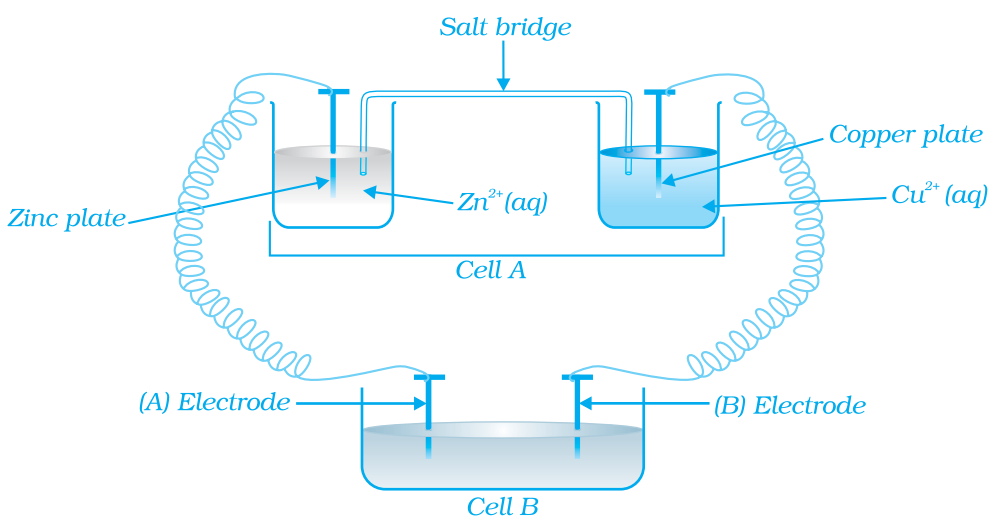
Consider the and answer the following questions.

i. Cell 'A' has $E_{\text {Cell }}=2 \mathrm{~V}$ and Cell 'B' has $E_{\text {Cell }}=1.1 \mathrm{~V}$ which of the two cells ' $A$ ' or ' $B$ ' will act as an electrolytic cell. Which electrode reactions will occur in this cell?
ii. If cell 'A' has $E_{C e l l}=0.5 \mathrm{~V}$ and cell 'B' has $E_{C e l l}=1.1 \mathrm{~V}$ then what will be the reactions at anode and cathode?
View full solution
Match the items of Column I and Column II.
 
Column I
 
Column II
i.
Lechlanche cell
a.
Cell reaction $2H_2 + O_2 ⎯→ 2H_2O$
ii.
Ni–Cd cell
b.
Does not involve any ion in solution and is used in hearing aids.
iii.
Fuel cell
c.
Rechargeable.
iv.
Mercury cell
d.
Reaction at anode, $Zn ⎯→ Zn^{2+} + 2e^-$
 
 
e.
Converts energy of combustion into electrical energy.
View full solution
Match the items of Column I and Column II.
 
Column I
 
Column II
i.
Lead storage battery
a.
Maximum efficiency.
ii.
Mercury cell
b.
Prevented by galvanisation.
iii.
Fuel cell
c.
Gives steady potential.
iv.
Rusting
d.
Pb is anode, $PbO_2$ is cathode.
View full solution

Generate a Electrochemistry paper free

Pick question groups from the list above, set marks and difficulty, and export a branded PDF with step-by-step answer keys. First 3 chapters free — no signup.

Download App