Questions

Case study (4 Marks)

Take a timed test

10 questions · self-marked practice — reveal the answer and mark yourself.

Question 14 Marks
If there is a statement involving the natural number n such that:
  1. The statement is true for $n = 1$
  2. When the statement is true for $n = k ($where $k$ is some positive integer$),$ then the statement is also true for $n = k + 1.$
Then, the statement is true for all natural numbers n.
Also, if $A$ is a square matrix of order n, then $A^2$ is defined as $AA$. In general, $A^m = AA .... A (m$ times$)$. where m is any positive integer.
Based on the above information, answer the following questions.
  1. If $\text{A}=\begin{bmatrix}3&-4\\1&-1\end{bmatrix},$ then for any positive integer n,
  1. $\text{A}^\text{n}=\begin{bmatrix}3\text{n}&-4\text{n}\\\text{n}&-\text{n}\end{bmatrix}$
  2. $\text{A}^\text{n}=\begin{bmatrix}1+2\text{n}&-4\text{n}\\\text{n}&1-2\text{n}\end{bmatrix}$
  3. $\text{A}^\text{n}=\begin{bmatrix}3\text{n}&-8\text{n}\\1&-\text{n}\end{bmatrix}$
  4. $\text{A}^\text{n}=\begin{bmatrix}1+3\text{n}&-4\text{n}\\\text{n}&1-3\text{n}\end{bmatrix}$
  1. If $\text{A}=\begin{bmatrix}1&2\\0&1\end{bmatrix},$ then $|A^n|$, where $\text{n}\in\text{ N},$ is equal to:
  1. $2^n$
  2. $3^n$
  3. $n$
  4. $1$
  1. If $\text{A}=\begin{bmatrix}1&0\\1&1\end{bmatrix}$ and $\text{I}=\begin{bmatrix}1&0\\0&1\end{bmatrix}$ then which of the following holds for all natural numbers $\text{n}\geq1?$
  1. $A^n= nA - (n - 1)I$
  2. $A^n = 2^{n-1} A - (n - 1)I$
  3. $A^n= nA + (n - 1)I$
  4. $A^n = 2^{n-1} A + (n - 1)I$
  1. Let $\text{A}=\begin{bmatrix}\text{a}&0&0\\0&\text{a}&0\\0&0&\text{a}\end{bmatrix}$ and $\text{A}^\text{n}=[\text{a}_{\text{ij}}]_{3\times3}$ for some positive integer n, then the cofactor of $a_{13}$ is:
  1. $a^n$
  2. $-a^n$
  3. $2a^n$
  4. $0$
  1. If $A$ is a square matrix such that $|A| = 2,$ then for any positive integer n, $|A^n|$ is equal to:
  1. $0$
  2. $2n$
  3. $2^n$
  4. $n^2$
Answer
  1. (b) $\text{A}^\text{n}=\begin{bmatrix}1+2\text{n}&-4\text{n}\\\text{n}&1-2\text{n}\end{bmatrix}$
Solution:
We have, $\text{A}=\begin{bmatrix}3&-4\\1&-1\end{bmatrix}$
$\therefore\text{A}^2=\begin{bmatrix}3&-4\\1&-1\end{bmatrix}\begin{bmatrix}3&-4\\1&-1\end{bmatrix}=\begin{bmatrix}5&-8\\2&-3\end{bmatrix},$ which can be obtained from $\text{A}^\text{n}=\begin{bmatrix}1+2\text{n}&-4\text{n}\\\text{n}&1-2\text{n}\end{bmatrix}$ for $n = 2.$
  1. (d) $1$
Solution:
We have, $\text{A}=\begin{bmatrix}1&2\\0&1\end{bmatrix}$
$\therefore|\text{A}|=\begin{vmatrix}1&2\\0&1\end{vmatrix}=1-0=1$
Also, $|A^n| = |A· A ...... A(n$ times$)| = |A|^n = 1^n = 1$
  1. (a) $A^n= nA - (n - 1)I$
Solution:
For $n = 1,$ all options are true.
$\text{A}^2=\text{A}\cdot\text{A}=\begin{bmatrix}1&0\\1&1\end{bmatrix}\begin{bmatrix}1&0\\1&1\end{bmatrix}=\begin{bmatrix}1&0\\2&1\end{bmatrix}$
and $\text{A}^3=\text{A}^2\cdot\text{A}=\begin{bmatrix}1&0\\2&1\end{bmatrix}\begin{bmatrix}1&0\\1&1\end{bmatrix}=\begin{bmatrix}1&0\\3&1\end{bmatrix}$
Putting $n = 3$, in $(a),$ we get $A^3 = 3A - 2I$
$=3\begin{bmatrix}1&0\\1&1\end{bmatrix}-\begin{bmatrix}2&0\\0&2\end{bmatrix}$
$=\begin{bmatrix}3&0\\3&3\end{bmatrix}-\begin{bmatrix}2&0\\0&2\end{bmatrix}=\begin{bmatrix}1&0\\3&1\end{bmatrix},$ which is true.
All other options are different from $A^3 = 3A -2I$ for $n = 3.$
  1. (d) $0$
Solution:
We have, $\text{A}=\begin{bmatrix}\text{a}&0&0\\0&\text{a}&0\\0&0&\text{a}\end{bmatrix}$
$\therefore\text{A}^2=\text{A}\cdot\text{A}=\begin{bmatrix}\text{a}&0&0\\0&\text{a}&0\\0&0&\text{a}\end{bmatrix}\begin{bmatrix}\text{a}&0&0\\0&\text{a}&0\\0&0&\text{a}\end{bmatrix}$
$=\begin{bmatrix}\text{a}^2&0&0\\0&\text{a}^2&0\\0&0&\text{a}^2\end{bmatrix}$
Similarly, $\text{A}^\text{n}=\begin{bmatrix}\text{a}^\text{n}&0&0\\0&\text{a}^\text{n}&0\\0&0&\text{a}^\text{n}\end{bmatrix}$
Now, cofactor of $\text{a}_{13}=(-1)^{1+3}\begin{vmatrix}0&\text{a}^\text{n}\\0&0\end{vmatrix}=0$
  1. (c) $2^n$​​​​​​​
Solution:
We have, $|A| = 2$ and $|A^n| = |A·A ...... A(n- $ times$)|$
$= |A| |A| ...... |A|(n -$ times$) = |A|^n = 2^n$​​​​​​​
View full question & answer
Question 24 Marks
Area of a triangle whose vertices are $(x_1, y_1), (x_2, y_2)$ and $(x_3, y_3)$ is given by the determinant:
$\Delta=\frac{1}{2}\begin{vmatrix}\text{x}_1&\text{y}_1&1\\\text{x}_2&\text{y}_2&1\\\text{x}_3&\text{y}_3&1\end{vmatrix}$
Since, area is a positive quantity, so we always take the absolute value of the determinant $\Delta.$ Also, the area of the triangle formed by three collinear points is zero.
Based on the above information, answer the following questions.
  1. Find the area of the triangle whose vertices are $(-2, 6), (3, -6) $ and $(1, 5).$
  1. $30$ sq. units
  2. $35 $ sq. units
  3. $40$ sq. units
  4. $15.5$ sq. units
  1. If the points $(2, -3), (k, -1)$ and $(0, 4)$ are collinear, then find the value of $4k.$
  1. $4$
  2. $\frac{7}{140}$
  3. $47$
  4. $\frac{40}{7}$
  1. If the area of a triangle $ABC,$ with vertices $A(1, 3), B(0, 0)$ and $C(k, 0)$ is 3 sq. units, then a value of $k$ is:
  1. $2$
  2. $3$
  3. $4$
  4. $5$
  1. Using determinants, find the equation of the tine joining the points $A(1, 2)$ and $B(3, 6).$
  1. $y = 2x$
  2. $x = 3y$
  3. $y = x$
  4. $4x - y = 5$
  1. If $\text{A}\equiv(11,7),\text{B}\equiv(5,5)$ and $\text{C}\equiv(-1,3),$ then:
  1. $\Delta\text{ABC}$ is scalene triangle.
  2. $\Delta\text{ABC}$ is equilateral triangle.
  3. $A, B$ and $C$ are collinear.
  4. None of these.
Answer
  1. (d) $15.5$ sq. units
Solution:
Let $\Delta$ be the area of the triangle then,
$\Delta=\frac{1}{2}\begin{vmatrix}\begin{vmatrix}-2&6&1\\3&-6&1\\1&5&1\end{vmatrix}\end{vmatrix}$
$=\frac{1}{2}|-2(-6-5)-6(3-1)+1(15+6)|$
$\Rightarrow\Delta=\frac{1}{2}|43-12|=15.5\text{ sq. units}$
  1. (d) $\frac{40}{7}$
Solution:
The given points are collinear.
$\therefore\frac{1}{2}\begin{vmatrix}2&-3&1\\\text{k}&-1&1\\0&4&1\end{vmatrix}=0$
Expanding along $R_1$ we get
$2(-1 - 4) + 3(k) + 1(4k) = 0$
$\Rightarrow7\text{k}-10=0\Rightarrow\text{k}=\frac{10}{7}\Rightarrow4\text{k}=\frac{40}{7}$
  1. (a) $2$
Solution:
Area of $\Delta\text{ABC}=3 \text{ sq.units}$ [Given]
$\Rightarrow\frac{1}{2}\begin{vmatrix}1&3&1\\0&0&1\\\text{k}&0&1\end{vmatrix}=\pm3\Rightarrow\begin{vmatrix}1&3&1\\0&0&1\\\text{k}&0&1\end{vmatrix}=\pm6$
$\Rightarrow1(0-0)-3(0-\text{k})+1(0-0)=\pm6$
$\Rightarrow3\text{k}=\pm6\Rightarrow\text{k}=\pm2$
  1. (a) $y = 2x$
Solution:
Let $Q(x, y) $ be any point on the line joining $A(1, 2)$ and $B(3, 6).$ Then, area of $\Delta\text{ABQ}=0$
$\Rightarrow\frac{1}{2}\begin{vmatrix}1&2&1\\3&6&1\\\text{x}&\text{y}&1\end{vmatrix}=0$
$⇒ 1(6 - y) - 2(3 - x) + 1 (3y - 6x) = 0$
$⇒ 6 - y - 6 + 2x + 3y - 6x = 0$
$⇒ -4x = -2y ⇒ 2x = y.$
  1. (c) $A, B$ and $C$ are collinear.
Solution:
Area of $\Delta\text{ABC}$ is given by
$\frac{1}{2}\begin{vmatrix}11&7&1\\5&5&1\\-1&3&1\end{vmatrix}=\frac{1}{2}\big[11(5-3)-7(5+1)+1(15+5)\big]$
$=\frac{1}{2}[22-42+20]=0$
$\therefore$ Points are collinear.
View full question & answer
Question 34 Marks
A company produces three products every day. Their production on certain day is $45$ tons. It is found that the production of third product exceeds the production of first product by $8$ tons while the total production of first and third product is twice the production of second product.

Using the concepts of matrices and determinants, answer the following questions.
  1. If $x, y$ and $z$ respectively denotes the quantity (in tons) of first, second and third product produced, then which of the following is true?
  1. $x + y + z = 45$
  2. $x + 8 = z$
  3. $x - 2y + z = 0$
  4. All of these.
  1. If $\begin{pmatrix}1&1&1\\1&0&-2\\1&-1&1\end{pmatrix}^{-1}=\frac{1}{6}\begin{pmatrix}2&2&2\\3&0&-3\\1&-2&1\end{pmatrix}$ then the inverse of $\begin{pmatrix}1&1&1\\1&0&-1\\1&-2&1\end{pmatrix}$ is:
  1. $\begin{pmatrix}\frac{1}{3}&\frac{1}{3}&\frac{1}{3}\\\frac{1}{2}&0&\frac{-1}{2}\\\frac{1}{6}&\frac{-1}{3}&\frac{1}{6}\end{pmatrix}$
  2. $\begin{pmatrix}\frac{1}{2}&0&-\frac{1}{2}\\\frac{1}{3}&\frac{1}{3}&\frac{1}{3}\\\frac{1}{6}&\frac{-1}{3}&\frac{1}{6}\end{pmatrix}$
  3. $\begin{pmatrix}\frac{1}{3}&\frac{1}{2}&\frac{1}{6}\\\frac{1}{3}&0&\frac{-1}{3}\\\frac{1}{3}&\frac{-1}{2}&\frac{1}{6}\end{pmatrix}$
  4. None of these.
  1. $x : y : z$ is equal to:
  1. $12 : 13 : 20$
  2. $11 : 15 : 19$
  3. $15 : 19 : 11$
  4. $13 : 12 : 20$
  1. Which of the following is not true?
  1. $|A| = |A'|$
  2. $(A')^{-1} = (A^{-1})'$
  3. $A$ is skew synunetric matrix of odd order, then $|A| = 0$
  4. $|AB| = |A| + |B|$
  1. Which of the following is not true in the given determinant of $A,$ where A $=[\text{a}_\text{ij}]_{3\times3}?$
  1. Order of minor is less than order of the det $(A).$
  2. Minor of an element can never be equal to cofactor of the same element.
  3. Value of a determinant is obtained by multiplying elements of a row or column by corresponding cofactors.
  4. Order of minors and cofactors of same elements of $A$ is same.
Answer
  1. (d) All of these.
Solution:
According to given condition, we have the following system of linear equations.
$x + y + z = 45$
$x + 8 = z$ or $x + O.y - z = -8$
and $x + z = 2y$ or $x - 2y + z = 0$
  1. (c) $\begin{pmatrix}\frac{1}{3}&\frac{1}{2}&\frac{1}{6}\\\frac{1}{3}&0&\frac{-1}{3}\\\frac{1}{3}&\frac{-1}{2}&\frac{1}{6}\end{pmatrix}$
Solution:
Let $A =\begin{pmatrix}1&1&1\\1&0&-2\\1&-1&1\end{pmatrix}$ then we have,
$\text{A}^{-1}=\frac{1}{6}\begin{pmatrix}2&2&2\\3&0&-3\\1&-2&1\end{pmatrix}$
Now, $(A')^{-1} = (A^{-1})'$
$=\frac{1}{6}\begin{pmatrix}2&3&1\\2&0&-2\\2&-3&1\end{pmatrix}=\begin{pmatrix}\frac{1}{3}&\frac{1}{2}&\frac{1}{6}\\\frac{1}{3}&0&\frac{-1}{3}\\\frac{1}{3}&\frac{-1}{2}&\frac{1}{6}\end{pmatrix}$
  1. (b) $11 : 15 : 19$
Solution:
The above system of equations can be written in matrix form as
$A'X =B$, where,
$\text{A}'=\begin{pmatrix}1&1&1\\1&0&-1\\1&-2&1\end{pmatrix},\text{X}=\begin{bmatrix}\text{x}\\\text{y}\\\text{z}\end{bmatrix}$ and $\text{B}=\begin{bmatrix}45\\-8\\0\end{bmatrix}$
$\Rightarrow\text{X}=(\text{A}')^{-1}\text{B}=\frac{1}{6}\begin{bmatrix}2&3&1\\2&0&-2\\2&-3&1\end{bmatrix}\begin{bmatrix}45\\-8\\0\end{bmatrix}$
$=\frac{1}{6}\begin{bmatrix}90-24\\90\\90+24\end{bmatrix}=\frac{1}{6}\begin{bmatrix}66\\90\\114\end{bmatrix}=\begin{bmatrix}11\\15\\19\end{bmatrix}$
Thus, $x : y : z = 11 : 15 : 19$
  1. (d) $|AB| = |A| + |B|$
Solution:
Clearly, $|AB| = |A|.|B|$​​​​​​​
  1. (b) Minor of an element can never be equal to cofactor of the same element.
View full question & answer
Question 44 Marks
Let $\text{A}=\begin{bmatrix}1&0\\2&1\end{bmatrix},$ and $U_1, U_2$ are e first and second columns respectively of a $2 \times 2$ matrix $U$. Also, let the column matrices $U_1$ and $U_2$ satisfying $\text{AU}_1=\begin{bmatrix}1\\0\end{bmatrix}$ and $\text{AU}_2=\begin{bmatrix}2\\3\end{bmatrix}.$
Based on the above information, answer the following questions.
  1. The matrix $U_1 + U_2$ is equal to:
  1. $\begin{bmatrix}1\\-1\end{bmatrix}$
  2. $\begin{bmatrix}2\\-2\end{bmatrix}$
  3. $\begin{bmatrix}3\\-3\end{bmatrix}$
  4. $\begin{bmatrix}4\\-4\end{bmatrix}$
  1. The value of $|U|$ is:
  1. $2$
  2. $-2$
  3. $3$
  4. $-3$
  1. If $\text{X}=\begin{bmatrix}3&2\end{bmatrix}\text{U}\begin{bmatrix}3\\2\end{bmatrix},$ then the value of |X| =
  1. $3$
  2. $-3$
  3. $-5$
  4. $5$
  1. The minor of element at the position $a_{22}$ in $U$ is:
  1. $1$
  2. $2$
  3. $-2$
  4. $-1$
  1. If $\text{U}=[\text{a}_\text{ij}]_{2\times2},$ then the value of $a_{11}A_{11}+ a_{12}A_{12},$ where $A_{ij} $ denotes the cofactor of $a_{ij},$ is:
  1. $1$
  2. $2$
  3. $-3$
  4. $3$
Answer
  1. (c) $\begin{bmatrix}3\\-3\end{bmatrix}$
Solution:
We have, $\text{A}=\begin{bmatrix}1&0\\2&1\end{bmatrix}$
Let $\text{U}_1=\begin{bmatrix}\text{a}\\\text{b}\end{bmatrix}$ and $\text{AU}_1=\begin{bmatrix}1\\0\end{bmatrix}$
$\Rightarrow\begin{bmatrix}1&0\\2&1\end{bmatrix}\begin{bmatrix}\text{a}\\\text{b}\end{bmatrix}=\begin{bmatrix}1\\0\end{bmatrix}\Rightarrow\begin{bmatrix}\text{a}\\2\text{a}+\text{b}\end{bmatrix}=\begin{bmatrix}1\\0\end{bmatrix}$
$⇒ a = 1$ and $2a + b = 0 ⇒ a = 1$ and $b = -2.$
Let $\text{U}_2=\begin{bmatrix}\text{c}\\\text{d}\end{bmatrix}$ then $\text{AU}_2=\begin{bmatrix}2\\3\end{bmatrix}$
$\Rightarrow\begin{bmatrix}1&0\\2&1\end{bmatrix}\begin{bmatrix}\text{c}\\\text{d}\end{bmatrix}=\begin{bmatrix}2\\3\end{bmatrix}\Rightarrow\begin{bmatrix}\text{c}\\2\text{c}+\text{d}\end{bmatrix}=\begin{bmatrix}2\\3\end{bmatrix}$
$⇒ c = 2$ and $2c + d = 3$
$⇒ c = 2$ and $d = 3 - 4= -1$
Thus, $\text{U}_1+\text{U}_2=\begin{bmatrix}1\\-2\end{bmatrix}+\begin{bmatrix}2\\-1\end{bmatrix}=\begin{bmatrix}3\\-3\end{bmatrix}$
  1. (c) $3$
Solution:
Clearly, $\text{U}=\begin{bmatrix}1&2\\-2&-1\end{bmatrix}$
$\therefore|\text{U}|=\begin{vmatrix}1&2\\-2&-1\end{vmatrix}=-1+4=3$
  1. (d) $5$
Solution:
We have, $\text{X}=\begin{bmatrix}3&2\end{bmatrix}\begin{bmatrix}1&2\\-2&-1\end{bmatrix}\begin{bmatrix}3\\2\end{bmatrix}$
$=\begin{bmatrix}3&2\end{bmatrix}\begin{bmatrix}7\\-8\end{bmatrix}=[21-16]=[5]$
$\therefore|\text{X}|=5$
  1. (a) $1$
Solution:
$a_{22}$ in U is $-1$ and its minor is $1.$
  1. (d) $3$
Solution:
Since, the sum of products of elements of any row (or column) with their corresponding cofactors is equal to the value of determinant.
$\therefore a_{11}A_{11} + a_{12}A_{12} = |U| = 3$
View full question & answer
Question 54 Marks
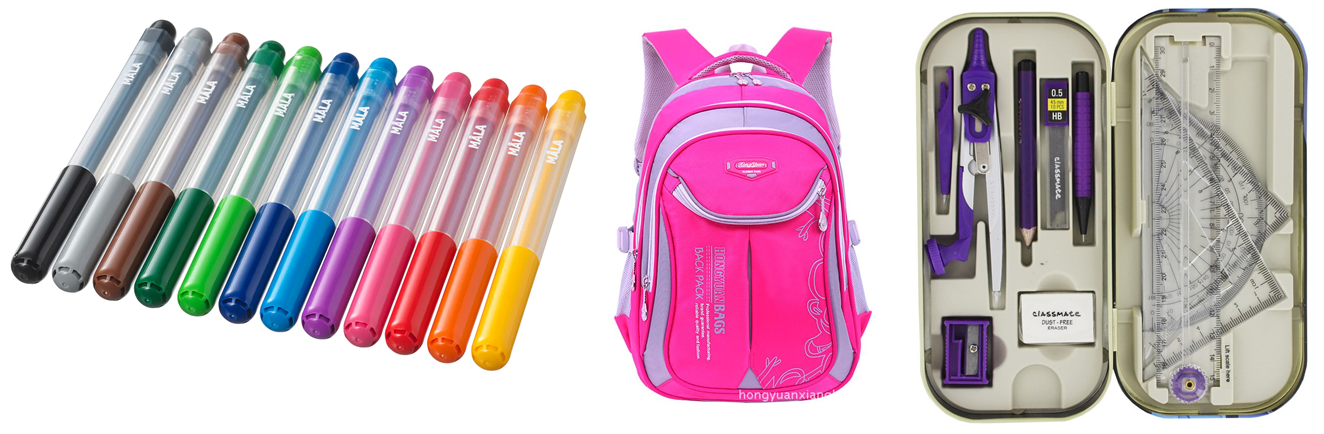
Gaurav purchased $5$ pens, $3$ bags and $1$ instrument box and pays $₹ 16$. From the same shop, Dheeraj purchased $2$ pens, $1$ bag and $3$ instrument boxes and pays $₹ 19,$ while Ankur purchased $1$ pen, $2$ bags and $4$ instrument boxes and pays $₹ 25.$

Using the concept of matrices and determinants, answer the following questions.
  1. The cost of one pen is:
  1. $₹ 2$
  2. $₹ 5$
  3. $₹ 1$
  4. $₹ 3$
  1. What is the cost of one pen and one bag?
  1. $₹ 3$
  2. $₹ 5$
  3. $₹ 7$
  4. $₹ 8$
  1. What is the cost of one pen and one instrument box?
  1. $₹ 7$
  2. $₹ 6$
  3. $₹ 8$
  4. $₹ 9$
  1. Which of the following is correct?
  1. Determinant is a square matrix.
  2. Determinant is a number associated to a matrix.
  3. Determinant is a number associated to a square matrix.
  4. All of the above.
  1. From the matrix equation $AB = AC,$ it can be concluded that $B = C$ provided:
  1. $A$ is singular.
  2. $A$ is non-singular.
  3. $A$ is symmetric.
  4. $A$ is square.
Answer
Let the cost of $1$ pen $= ₹ x$
the cost of $1$ bag $= ₹ y,$
and the cost of $1$ instrument box $= ₹ z$
According to the question, we have
$5x + 3y + z = 16, 2x + y + 3z = 19, x + 2y + 4z = 25$
This system of equation can be written as $AX = B,$
Where, $\text{A}=\begin{bmatrix}5&3&1\\2&1&3\\1&2&4\end{bmatrix},\text{B}=\begin{bmatrix}16\\19\\25\end{bmatrix}$ and $\text{X}=\begin{bmatrix}\text{x}\\\text{y}\\\text{z}\end{bmatrix}$
$|A| = 5(4 - 6) - 3(8 - 3) + 1(4 - 1)$
$= -10 - 3(5) + 3 = -22 ≠ 0$
$\therefore A^{-1} $exists.
Now, $X = A^{-1}B$, where $\text{A}^{-1}=\frac{1}{[\text{A}]}(\text{adj A}).$
Here, $\text{adj A}=\begin{bmatrix}-2&-5&3\\-10&19&-7\\8&-13&-1\end{bmatrix}'=\begin{bmatrix}-2&-10&8\\-5&19&-13\\3&-7&-1\end{bmatrix}$
$\therefore\text{A}^{-1}=\frac{1}{-22}\begin{bmatrix}-2&-10&8\\-5&19&-13\\3&-7&-1\end{bmatrix}$
$\therefore\text{X}=\begin{bmatrix}\text{x}\\\text{y}\\\text{z}\end{bmatrix}=\frac{1}{-22}\begin{bmatrix}-2&-10&8\\-5&19&-13\\3&-7&-1\end{bmatrix}\begin{bmatrix}16\\19\\25\end{bmatrix}$
$=\frac{1}{-22}\begin{bmatrix}-32-190+200\\-80+361-325\\48-133-25\end{bmatrix}=\frac{-1}{22}\begin{bmatrix}-22\\-44\\-110\end{bmatrix}=\begin{bmatrix}1\\2\\5\end{bmatrix}$
$\therefore\text{x}=1,\text{y}=2,\text{z}=5$
Hence, cost of one pen, one bag and an instrument box is $₹ 1, ₹ 2$ and $₹ 5$ respectively.
  1. (c) ₹ 1
Solution:

Cost of one pen is $ ₹ 1.​​​​​​$
  1. (a)$ ₹ 3$
Solution:

Cost of one pen and one bag$= ₹(1 + 2) = ₹ 3$
  1. (b) $₹ 6$
Solution:

Cost of one pen and one instrument box = $₹(1 + 5) = ₹ 6$
  1. (c) Determinant is a number associated to a square matrix.
Solution:

According to the definition of determinant, determinant is a number associated to a square matrix.
  1. (b) $A$ is non-singular.
Solution:

Given matrix equation is $AB = AC$

Pre-multiplying by $A^{-1}$ on both sides, we get

$A^{-1} AB = A^{-1} AC \Rightarrow (A^{-1}A) B = (A^{-1}A)C$

$\Rightarrow IB = IC ( \because  AA^{-1} = A^{-1}A = I)$

$\Rightarrow B = C$

Since $A^{-1}$ exists only if $A$ is non-singular.

$\therefore$ For $B = C, A$ should be non-singular.
View full question & answer
Question 64 Marks
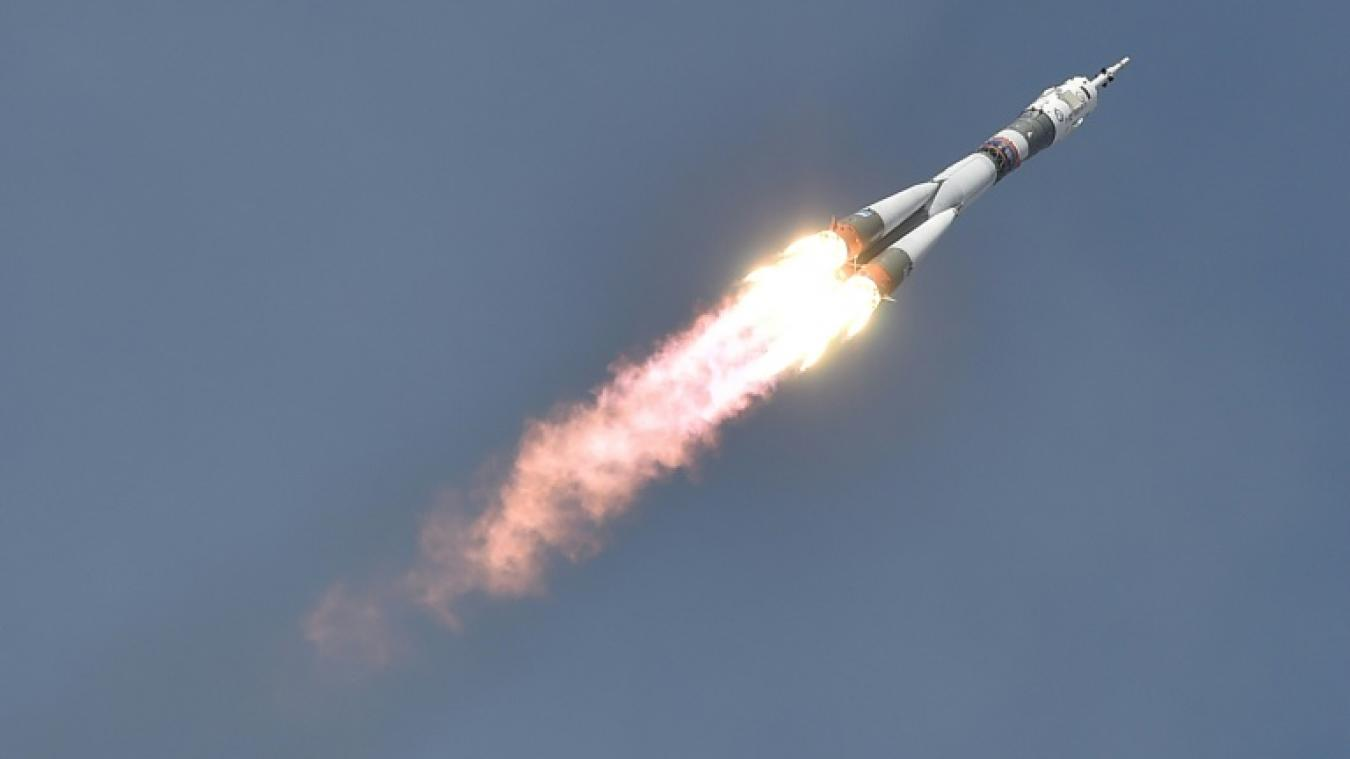
The upward speed v(I) of a rocket at time I is approximated by $\text{v}(\text{t})=\text{at}^2+\text{bt}+\text{c},0\leq\text{t}\leq100,$ here $a, b$ and $c$ are constants. It has been found that the speed at times $t = 3, t = 6$ and $t = 9$ seconds are respectively $64, 133$ and $208$ miles per second..

If $\begin{bmatrix}9&3&1\\36&6&1\\81&9&1\end{bmatrix}^{-1}=\frac{1}{18}\begin{bmatrix}1&-2&1\\-15&24&-9\\54&-54&18\end{bmatrix},$ then answer the following questions.
  1. The value of $b + c$ is:
  1. $20$
  2. $21$
  3. $\frac{3}{4}$
  4. $\frac{4}{3}$
  1. The value of $a + c$ is:
  1. $1$
  2. $20$
  3. $\frac{4}{3}$
  4. None of these.
  1. v(t) is given by:
  1. $\text{t}^2+20\text{t}+1$
  2. $\frac{1}{3}\text{t}^2+20\text{t}+1$
  3. $\text{t}^2+\frac{1}{3}\text{t}+20$
  4. $\text{t}^2+\text{t}+1$
  1. The speed at time $1 = 15$ seconds is:
  1. $346$ miles/ sec
  2. $356$ miles/ sec
  3. $366$ miles/ sec
  4. $376$ miles/ sec
  1. The time at which the speed of rocket is $784$ miles/ sec is:
  1. $20$ seconds
  2. $30$ seconds
  3. $25$ seconds
  4. $27$ seconds
Answer
Since $v(3) = 64, v(6) = 133$ and $v(9) = 208,$ we get the following system of linear equations:
$9a + 3b + c = 64$
$36a + 6b + c= 133$
$8la+ 9b + c = 208$
This can be written in matrix form as
$\begin{bmatrix}9&3&1\\36&6&1\\81&9&1\end{bmatrix}\begin{bmatrix}\text{a}\\\text{b}\\\text{c}\end{bmatrix}=\begin{bmatrix}64\\133\\208\end{bmatrix}$
or $AX = B$
Since, $\text{A}^{-1}=\frac{1}{18}\begin{pmatrix}1&-2&1\\-15&24&-9\\54&-54&18\end{pmatrix}$
$\therefore\text{X}=\begin{bmatrix}\text{a}\\\text{b}\\\text{c}\end{bmatrix}=\text{A}^{-1}\text{B}=\frac{1}{18}\begin{pmatrix}1&-2&1\\-15&24&-9\\54&-54&18\end{pmatrix}\begin{pmatrix}64\\133\\208\end{pmatrix}$
$\frac{1}{18}\begin{pmatrix}64-266+208\\-960+3192-1872\\3456-7182+3744\end{pmatrix}=\frac{1}{18}\begin{pmatrix}6\\360\\18\end{pmatrix}=\begin{pmatrix}\frac{1}{3}\\20\\1\end{pmatrix}$
Thus, $\text{a}=\frac{1}{3}, b = 20$ and $c = 1$
  1. (b) $21$
  1. (c) $\frac{4}{3}$
  1. (b) $\frac{1}{3}\text{t}^2+20\text{t}+1$
Solution:

$\text{v}(\text{t})=\frac{1}{3}\text{t}^2+20\text{t}+1$
  1. (d) $376$ miles/ sec
Solution:

Clearly, required speed $= v(15)$

$=\frac{1}{3}\times225+20\times15+1$

$= 75 + 300 + 1 = 376$ miles per second.
  1. (d) $27$ seconds
Solution:

Consider, $v(t) = 784$

$\Rightarrow\frac{1}{3}\text{t}^2+20\text{t}+1=784$

$\Rightarrow t^2 + 60t = 2349$

$\Rightarrow t^2 + (87 - 27)t - 2349 = 0$

$\Rightarrow t(t + 87) -27(t + 87) = 0$

$\Rightarrow (t - 27)(t + 87) = 0$

$⇒ t = 27$ seconds [$\because$ Time can't be negative)]
View full question & answer
Question 74 Marks
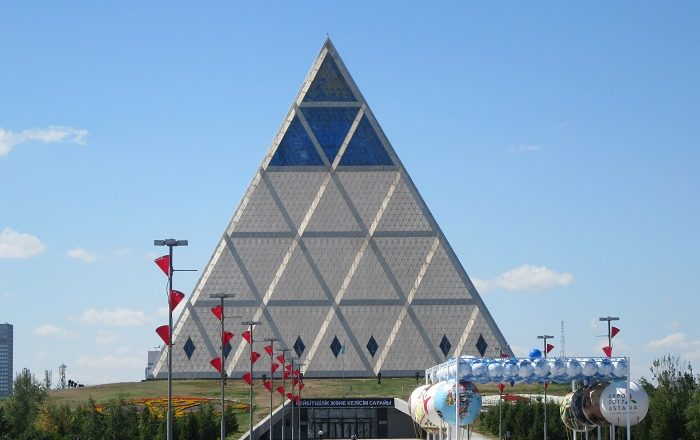
Each triangular face of the Pyramid of Peace in Kazakhstan is made up of $25$ smaller equilateral triangles as shown in the figure.

Using the above information and concept of determinants, answer the following questions.
  1. If the vertices ofoneof the smaller equilateral triangle are (0, 0), $(3,\sqrt{3})$ and $(3,-\sqrt{3}),$ then the area of such triangle is:
  1. $\sqrt{3}\text{ sq}.\text{units}$
  2. $2\sqrt{3}\text{ sq}.\text{units}$
  3. $3\sqrt{3}\text{ sq}.\text{units}$
  4. None of these.
  1. The area of a face of the Pyramid is:
  1. $25\sqrt{3}\text{ sq}.\text{units}$
  2. $50\sqrt{3}\text{ sq}.\text{units}$
  3. $75\sqrt{3}\text{ sq}.\text{units}$
  4. $35\sqrt{3}\text{ sq}.\text{units}$
  1. The length of a altitude of a smaller equilateral triangle is:
  1. $2$ units
  2. $3$ units
  3. $\sqrt{3}\text{ units}$
  4. $4$ units
  1. If $(2, 4), (2, 6)$ are two vertices of a smaller equilateral triangle, then the third vertex will lie on the line represented by:
  1. $\text{x}+\text{y}=5$
  2. $\text{x}=1+\sqrt3$
  3. $\text{x}=2+\sqrt3$
  4. $2\text{x}+\text{y}=5$
  1. Let $A(a, 0), B(0, b)$ and $C(1, 1)$ be three points. If $\frac{1}{\text{a}}+\frac{1}{\text{b}}=1,$ then the three points are:
  1. Vertices of an equilateral triangle.
  2. Vertices of a right angled triangle.
  3. Collinear.
  4. Vertices of an isosceles triangle.
Answer
  1. (c) $3\sqrt{3}\text{ sq}.\text{units}$
Solution:
Area of triangle is given by $\begin{vmatrix}\frac{1}{2}\begin{vmatrix}\text{x}_1&\text{y}_1&1\\\text{x}_2&\text{y}_2&1\\\text{x}_3&\text{y}_3&1\end{vmatrix}\end{vmatrix}.$
$\therefore$ Required area $=\begin{vmatrix}\frac{1}{2}\begin{vmatrix}0&0&1\\3&\sqrt{3}&1\\3&-\sqrt{3}&1\end{vmatrix}\end{vmatrix}$
$=\begin{vmatrix}\frac{1}{2}[1(-3\sqrt{3}-3\sqrt{3})]\end{vmatrix} [$Expanding along $R_1]$
$=3\sqrt{3}\text{ sq}.\text{units}$
  1. (c) $75\sqrt{3}\text{ sq}.\text{units}$
Solution:
Since a face of the Pyramid consist of $25$ smaller equilateral triangles.
$\therefore$ Required area $=25\times3\sqrt{3}=75\sqrt{3}\text{ sq}.\text{units}$
  1. (b) 3 units
Solution:
Area of equilateral triangle $=\frac{\sqrt{3}}{4}\text{a}^2$
$\therefore3\sqrt{3}=\frac{\sqrt{3}}{4}\text{a}^2\Rightarrow\text{a}^2=12\Rightarrow\text{a}=2\sqrt{3}$
Let h be the length of altitude of a smaller equilateral triangle. Then,
$\frac{1}{2}\times\text{base}\times\text{height}=3\sqrt{3}$
$\Rightarrow\frac{1}{2}\times2\sqrt{3}\times\text{h}=3\sqrt{3}\Rightarrow\text{h}=3\text{ units}$
  1. (c) $\text{x}=2+\sqrt3$
Solution:
Let the third vertex be (x, y), then we get $\frac{1}{2}\begin{vmatrix}2&4&1\\2&6&1\\\text{x}&\text{y}&1\end{vmatrix}=\pm3\sqrt3$
$\Rightarrow\frac{1}{2}[2(6-\text{y})-4(2-\text{x})+1(2\text{y}-6\text{x})]=\pm3\sqrt3$
$\Rightarrow12-2\text{y}-8+4\text{x}+2\text{y}-6\text{x}=\pm6\sqrt3$
$\Rightarrow4-2\text{x}=\pm6\sqrt3$
$\Rightarrow2-\text{x}=\pm3\sqrt3\Rightarrow\text{x}=2\pm3\sqrt3$
  1. (c) Collinear.
Solution:
Area of $\triangle\text{ABC}=\frac{1}{2}\begin{vmatrix}\text{a}&0&1\\0&\text{b}&1\\1&1&1\end{vmatrix}$
$=\frac{1}{2}[\text{a}(\text{b}-1)-0+1(0-\text{b})]$
$=\frac{1}{2}(\text{ab}-\text{a}-\text{b})=0$
$\Big[\because\frac{1}{\text{a}}+\frac{1}{\text{b}}=1\Rightarrow\text{b}+\text{a}=\text{ab}\Big]$
$\therefore$ Points A, Band Care collinear.
View full question & answer
Question 84 Marks
Three shopkeepers Salim, Vijay and Venket are using polythene bags, handmade bags (prepared by prisoners) and newspaper's envelope as carry bags. It is found that the shopkeepers Salim, Vijay and Venket are using $(20, 30, 40), (30, 40, 20)$ and $(40, 20, 30)$ polythene bags, handmade bags and newspaper's envelopes respectively. The shopkeepers Salim, Vijay and Venket spent $₹ 250, ₹ 270 $ and $₹ 200$ on these carry bags respectively.

Using the concept of matrices and determinants, answer the following questions.
  1. What is the cost of one polythene bag?
  1. $₹ 1$
  2. $₹ 2$
  3. $₹ 3$
  4. $₹ 5$
  1. What is the cost of one handmade bag?
  1. $₹ 1$
  2. $₹ 2$
  3. $₹ 3$
  4. $₹ 5$
  1. What is the cost of one newspaper envelope?
  1. $₹ 1$
  2. $₹ 2$
  3. $₹ 3$
  4. $₹ 5$
  1. Keeping in mind the social conditions, which shopkeeper is better?
  1. Salim
  2. Vijay
  3. Venket
  4. None of these.
  1. Keeping in mind the environmental conditions, which shopkeeper is better?
  1. Salim
  2. Vijay
  3. Venket
  4. None of these.
Answer
Let the cost of a polythene bag $= ₹ x$, the cost of a handmade bag $= ₹ y$ and the cost of a newspaper bag $= ₹ z$
According to question,
$20x + 30y + 40z = 250, 30x + 40y + 20z = 270$
$40x + 20y + 30z = 200$
This system can be written as $AX = B,$ where
$\text{A}=\begin{bmatrix}20&30&40\\30&40&20\\40&20&30\end{bmatrix},\text{X}=\begin{bmatrix}\text{x}\\\text{y}\\\text{z}\end{bmatrix}$ and $\text{B}=\begin{bmatrix}250\\270\\200\end{bmatrix}$
$|\text{A}|=\begin{vmatrix}20&30&40\\30&40&20\\40&20&30\end{vmatrix}$
$= 20(1200 - 400) - 30(900 - 800) + 40(600 - 1600)$
$= 20(800) - 30(100) + 40(-1000)$
$= 16000 - 3000 - 40000 = -27000 ≠ 0$
So, $A^{-1} $ exists and system has a solution given by $X = A^{-1}B.$
Now, $\text{adj A}=\begin{bmatrix}800&-100&-1000\\-100&-1000&800\\-1000&800&-100\end{bmatrix}'$
$=\begin{bmatrix}800&-100&-1000\\-100&-1000&800\\-1000&800&-100\end{bmatrix}$
$\therefore\text{A}^{-1}=\frac{1}{|\text{A}|}(\text{adj A})=\frac{1}{-27000}\begin{bmatrix}800&-100&-1000\\-100&-1000&800\\-1000&800&-100\end{bmatrix}$
Now $\text{X}=\begin{bmatrix}\text{x}\\\text{y}\\\text{z}\end{bmatrix}=\frac{1}{27000}\begin{bmatrix}-800&100&1000\\100&1000&-800\\1000&-800&100\end{bmatrix}\begin{bmatrix}250\\270\\200\end{bmatrix}$
$=\frac{1}{27000}\begin{bmatrix}27000\\135000\\54000\end{bmatrix}\Rightarrow\begin{bmatrix}\text{x}\\\text{y}\\\text{z}\end{bmatrix}=\begin{bmatrix}1\\5\\2\end{bmatrix}$
$\Rightarrow\text{x}=1,\text{y}=5,\text{z}=2$
Hence, cost of a polythene bag, a handmade bag and a newspaper envelope is $₹ 1, ₹ 5$ and $₹ 2$ respectively.
  1. (a) $₹ 1$
  1. (d) $₹ 5$
  1. (b) $₹ 2$
  1. (b) Vijay
Solution:

Vijay investing most of the money on hand -rnade bags.
  1. (a) Salim
Solution:

Salim investing less amount of money on polythene bags.
View full question & answer
Question 94 Marks
Minor of an element $a_{ij}$ of a determinant is the determinant obtained by deleting its $i^{th}$ row and $j^{th}$ column in which element $a_{ij}$ lies and is denoted by $M_{ij}.$
Cofactor of an element $a_{ij}$, denoted by $A_{ij}$, is defined by $A_{ij} = (-1)^{i+j} M_{ij},$ where $M_{ij}$ is minor of $a_{ij}$.
Also, the determinant of a square matrix A is the sum of the products of the elements of any row (or column) with their corresponding cofactors. For example, if $\text{A}=[\text{a}_\text{ij}]_{3\times3},$ then $|A| = a_{11}A_{11} + a_{12}A_{12} + a_{13}A_{13}.$
  1. Find the sum of the cofactors of all the elements of $\begin{vmatrix}1&-2\\4&3\end{vmatrix}.$
  1. $2$
  2. $-2$
  3. $4$
  4. $1$
  1. Find the minor of $a_{21}$ of $\begin{vmatrix}5&6&-3\\-4&3&2\\-4&-7&3\end{vmatrix}.$
  1. $3$
  2. $-3$
  3. $39$
  4. $-39$
  1. In the determinant $\begin{vmatrix}2&-3&5\\6&0&4\\1&5&-7\end{vmatrix},$ find the value of $a_{32}.A_{32}.$
  1. $27$
  2. $-110$
  3. $110$
  4. $-27$
  1. If $\Delta=\begin{vmatrix}5&3&8\\2&0&1\\1&2&3\end{vmatrix},$ then write the minor of $a_{23}.$
  1. $-10$
  2. $-7$
  3. $10$
  4. $7$
  1. If $\Delta=\begin{vmatrix}2&-3&5\\6&0&4\\1&5&-7\end{vmatrix},$ then find the value of $|\Delta|.$
  1. $26$
  2. $28$
  3. $72$
  4. $46$
Answer
  1. (a) 2
Solution:
Let $\Delta=\begin{vmatrix}1&-2\\4&3\end{vmatrix}$
Cofactor of $1 = 3$, cofactor of $-2 = -4$
Cofactor of $4 = 2,$ cofactor of $3 = 1$
$\therefore$ Required sum $= 3 - 4 + 2 + 1 = 2$
  1. (b) $-3$
Solution:
Let $\Delta=\begin{vmatrix}5&6&-3\\-4&3&2\\-4&-7&3\end{vmatrix}$
Minor of $\text{a}_{21}=\begin{vmatrix}6&-3\\-7&3\end{vmatrix}=18-21=-3$
  1. (c) 110
Solution:
Let $\Delta=\begin{vmatrix}2&-3&5\\6&0&4\\1&5&-7\end{vmatrix}$
Clearly, $a_{32} = 5$
and $A_{32} =$ cofactor of $a_{32} $ in $\Delta=(-1)^{3+2}\begin{vmatrix}2&5&6&4\end{vmatrix}$
$= (-1) (8 - 30) = 22$
$\therefore a_{32}.A_{32} = 5 \times 22 = 110$​​​​​​​
  1. (d) $7$
Solution:
Here, $\Delta=\begin{vmatrix}5&3&8\\2&0&1\\1&2&3\end{vmatrix}$
$\therefore$ Minor of $\text{a}_{23}=\begin{vmatrix}5&3\\1&2\end{vmatrix}=10-3=7$
  1. (b) $28$
Solution:
Here, $\Delta=\begin{vmatrix}2&-3&5\\6&0&4\\1&5&-7\end{vmatrix}$
$\text{A}_{11}=(-1)^{1+1}\begin{vmatrix}0&4\\5&-7\end{vmatrix}=1(0-20)=-20,$
$\text{A}_{12}=(-1)^{1+2}\begin{vmatrix}6&4\\1&-7\end{vmatrix}=-1(-42-4)=46,$
$\text{A}_{13}=(-1)^{1+3}\begin{vmatrix}6&0\\1&5\end{vmatrix}=1(30-0)=30$
$\therefore\Delta=\text{a}_{11}\text{A}_{11}+\text{a}_{12}\text{a}_{12}+\text{a}_{13}\text{A}_{13}$
$= 2(-20) -3(46) + 5(30) = -28$
$\Rightarrow|\Delta|=28$
View full question & answer
Question 104 Marks
Two schools $A$ and $B$ want to award their selected students on the values of Honesty, Hard work and Punctuality. The school $A$ wants to award $₹ x$ each, $₹ y$ each and $₹ z$ each for the three respective values to its $3, 2$ and $1$ students respectively with a total award money of $₹ 2200$. School $B$ wants to spend $₹ 3100$ to award its $4, 1$ and $3$ students on the respective values $($by giving the same award money to the three values as school $A)$. The total amount of award for one prize on each value is $₹ 1200.$

Using the concept of matrices and determinants, answer the following questions.
  1. What is the award money for Honesty?
  1. $₹ 350$
  2. $₹ 300$
  3. $₹ 500$
  4. $₹ 400$
  1. What is the award money for Punctuality?
  1. $₹ 300$
  2. $₹ 280$
  3. $₹ 450$
  4. $₹ 500$
  1. What is the award money for Hard work?
  1. $₹ 500$
  2. $₹ 400$
  3. $₹ 300$
  4. $₹ 550$
  1. If a matrix $P$ is both symmetric and skew-symmetric, then |P| is equal to:
  1. $1$
  2. $-1$
  3. $0$
  4. None of these.
  1. If $P$ and $Q$ are two matrices such that $PQ = Q$ and $QP = P,$ then $|Q^2|$ is equal to:
  1. $|Q|$
  2. $|P|$
  3. $1$
  4. $0$
Answer
Three equations are formed from the given statements:
$3x + 2y + z = 2200$
$4x + y + 3z = 3100$ and $x + y + z = 1200$
Converting the system of equations in matrix form, we get
$\begin{bmatrix}3&2&1\\4&1&3\\1&1&1\end{bmatrix}\begin{bmatrix}\text{x}\\\text{y}\\\text{z}\end{bmatrix}=\begin{bmatrix}2200\\3100\\1200\end{bmatrix}$
i.e., $PX = Q,$
Where, $\text{P}=\begin{bmatrix}3&2&1\\4&1&3\\1&1&1\end{bmatrix},\text{X}=\begin{bmatrix}\text{x}\\\text{y}\\\text{z}\end{bmatrix}$ and $\text{Q}=\begin{bmatrix}2200\\3100\\1200\end{bmatrix}$
$|P| = 3(1 - 3) - 2(4 - 3) + 1(4 - 1) = -6 - 2 + 3 = -5 ≠ 0$
$\Rightarrow X = P^{-1} Q,$ provided $P^{-1}$ exists.
$\therefore\text{adj P}=\begin{bmatrix}-2&-1&5\\-1&2&-5\\3&-1&-5\end{bmatrix}$
$\text{P}^{-1}=\frac{1}{[\text{P}]}(\text{adj P})$
$=\frac{1}{-5}\begin{bmatrix}-2&-1&5\\-1&2&-5\\3&-1&-5\end{bmatrix}=\frac{1}{5}\begin{bmatrix}2&1&-5\\1&-2&5\\-3&1&5\end{bmatrix}$
$\therefore\text{X}=\frac{1}{5}\begin{bmatrix}2&1&-5\\1&-2&5\\-3&1&5\end{bmatrix}\begin{bmatrix}2200\\3100\\1200\end{bmatrix}$
$=\frac{1}{5}\begin{bmatrix}4400+3100-6000\\2200-6200+6000\\-6600+3100+6000\end{bmatrix}=\begin{bmatrix}300\\400\\500\end{bmatrix}$
$\Rightarrow\text{x}=300,\text{y}=400\text{ and z}=500$
Hence the money awarded for Honesty, Hardwork and Punctuality are $₹ 300, ₹ 400$ and $₹ 500$ respectively.
  1. (b) $₹ 300$
  1. (d) $₹ 500$
  1. (b) $₹ 400$
  1. (c)$ 0$
Solution:

If a matrix $P$ is both symmetric and skew-symmetric then it will be a zero matrix. So, $|P| = 0.$
  1. (a) $|Q|$
Solution:
We have, $Q^2 = QQ = Q(PQ)$
$= (QP)Q = PQ = Q$
$\therefore |Q^2| = |Q|$
View full question & answer