The linear inequations or constraints
$x + 3 y \leq 60$
$x + y \geq 10$
$x \leq y$
$x \geq 0 , y \geq 0$ and objective functions is max or min $(Z) = 3x + 9y$
Reducing the above inequations into equations and finding their point of intersection i.e.,
$x + 3y = 60$ ... (i)
$x + y = 10$ ... (ii)
$x = y$ ... (iii)
$x = 0, y = 0 $... (iv) | Equations | Point of Intersection |
| (i) and (ii) | $x = -15, y = 25$ |
| | Point is $\Rightarrow$ $(-15, 25)$ |
| (i) and (iii) | x = 15 $\Rightarrow$ y = 15 |
| | Point is $\Rightarrow$ $(15, 15)$ |
| (ii) and (iii) | $x = 5, y = 5$ |
| | Point is $(5, 5)$ |
| (i) and (iv) | when x = 0 $\Rightarrow$ y = 20, |
| | Point is$ (0, 20)$ |
| | when y = 0 $\Rightarrow$ x = 60, |
| | Point is $(60, 0)$ |
| (ii) and (iv) | when x = 0 $\Rightarrow$ y = 10, |
| | Point is $(0, 10)$ |
| | when y = 0 $\Rightarrow$ x = 10, |
| | Point is $(10, 0)$ |
Now for feasible region,
For $x + 3 y \leq 60$, putting x = 0 and y = 0, we have
$0 + 0 \geq 10$ i.e., Not true
$\Rightarrow$ The shaded region will be away from origin.
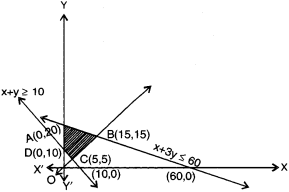
Also, we have $x \geq 0$, and $y \geq 0$ indicates that the shaded part will exist in first quadrant only. Here feasible region will be ABCDA, having corner points as $A(0, 20), B(15, 15), C(5, 5)\ and\ D(0, 10)$.
For optimal point substituting the value of all corner points in objective function $Z = 3x + 9y$
| Corner points | Z |
| $A (0, 20)$ | $180$ | Maximum |
| $B (15, 15)$ | $180$ |
| $C (5, 5)$ | $60$ | Minimum |
| $D (0, 10)$ | $90$ |
So that the minimum value of Z is 60 at C (5, 5) of the feasible region and the maximum value at A (0, 20) and B(15, 15) is Z = 180.