Sample QuestionsLinear Programming questions
One sample from each question group in this chapter. Select any group above to see the full set with answer keys.
The corner points of the feasible region determined by the system of linear inequalities are $(0, 0), (4, 0), (2, 4)$ and $(0, 5).$ If the maximum value of $z = ax + by,$ where $a, b > 0$ occurs at both $(2, 4)$ and $(4, 0),$ then:
- ✓
$a = 2b$
- B
$2a = b$
- C
$a = b$
- D
$3a = b$
Answer: A.
View full solution →Maximize $Z = 11x + 8y,$ subject to $\text{x}\leq4,\text{y}\leq6,\text{x}\geq0,\text{y}\geq0.$
- A
$44$ at $(4, 2)$
- ✓
$60$ at $(4, 2)$
- C
$62$ at $(4, 0)$
- D
Answer: B.
View full solution →The corner point of the feasible region determined by the system of linear constraints are $(0, 0), (0, 40), (20, 40), (60, 20), (60, 0).$ The objective function is $Z = 4x + 3y.$ Compare the quantity in Column $A$ and Column $B.$
|
Column $A$
|
Column $B$
|
|
Maximum of $Z$
|
$325$
|
Answer: B.
View full solution →The value of $\frac{0.76\times0.76\times0.76+0.24\times0.24\times0.24}{0.76\times0.76-0.76\times0.24+ 0.24+0.24}$ is:
Answer: B.
View full solution →The maximum value of $Z = 4x + 2y$ Subjected to the constraints $2\text{x}+3\text{y}\leq18,\text{x}+\text{y}\geq10,\text{x},\text{y}\geq0$ is:
Answer: D.
View full solution →Directions: In the following questions, the Assertions $(A)$ and Reason$(s) (R)$ have been put forward. Read both the statements carefully and choose the correct alternative from the following:
Assertion: The linear programming problem,maximize $z = 2x + 3y$ subject to constraints $\text{x}+\text{y}\leq4,\text{x}\geq0,\text{y}\geq0$ It gives the maximum value of $Z$ as $8 .$
Reason: To obtain maximum value of $Z,$ we need to compare value of $Z$ at all the corner points of the feasible region.
- A
$A$ is true$, R$ is true$; R$ is a correct explanation for $A.$
- B
$A$ is true$,R$ is true$; R$ is not a correct explanation for $A.$
- C
$A$ is true$, R$ is false.
- ✓
$A$ is false$, R$ is true.
Answer: D.
View full solution →Directions: In the following questions, the Assertions $(A)$ and Reason$(s) (R)$ have been put forward. Read both the statements carefully and choose the correct alternative from the following:
Assertion $(A):$ Consider the linear programming problem. Maximise $Z = 4x + y$ Subject to constraints $\text{x}+\text{y}\leq50;\text{x}+\text{y}\geq100$ and $\text{x},\text{y}\geq0,$ Then, maximum value of $Z$ is $50.$
Reason $(R):$ If the shaded region is bounded then maximum value of objective function can be determined.
- A
Both $A$ and $R$ are true and $R$ is the correct explanation of $A$
- B
Both $A$ and $R$ are true but $R$ is $\text{NOT}$ the correct explanation of $A$
- C
$A$ is true but $R$ is false.
- ✓
$A$ is false but $R$ is true.
Answer: D.
View full solution →Directions: In the following questions, the Assertions $(A)$ and Reason$(s) (R)$ have been put forward. Read both the statements carefully and choose the correct alternative from the following: Consider, the graph of constraints stated as linear inequalities as below: $5\text{x}+\text{y}\leq100,\text{x}+\text{y}\leq60,\text{x},\text{y}\geq0.$
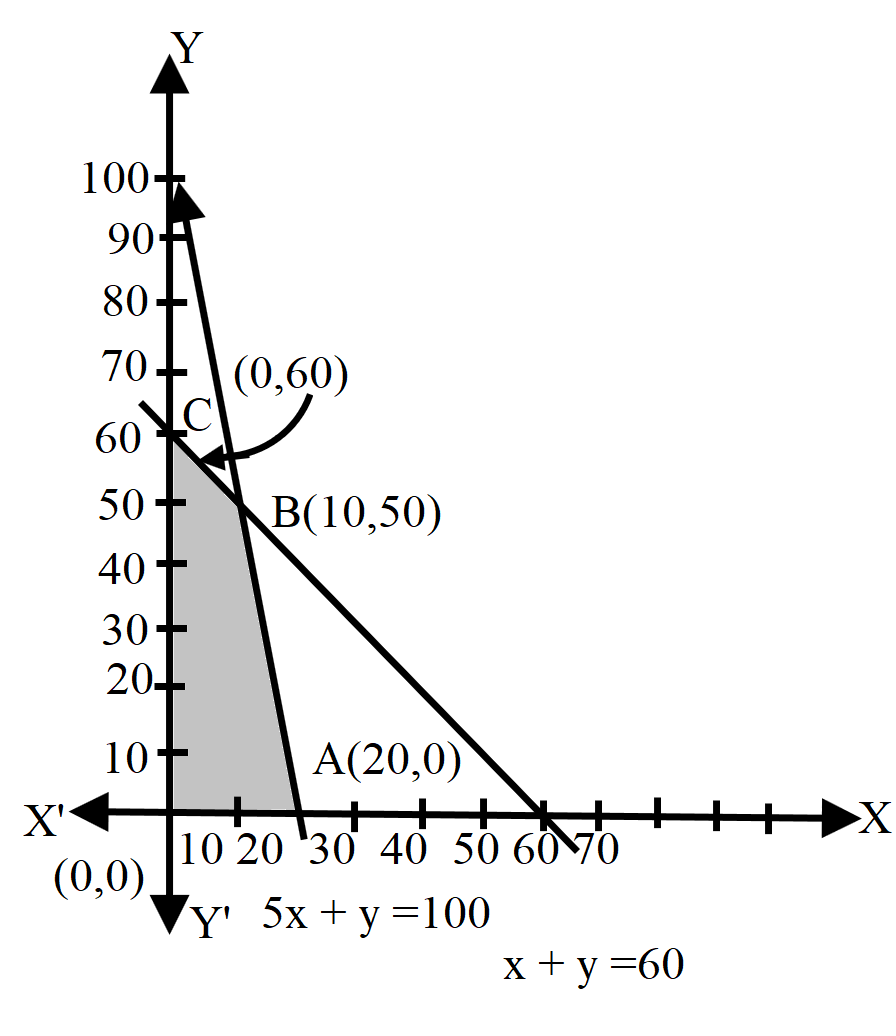
Assertion $(A):$ The points $(10, 50), (0, 60) , (10, 10)$ and $(20, 0)$ are feasible solutions.
Reason $(R):$ Points within and on the boundary of the feasible region represent feasible solutions of the constraints. - ✓
Both $A$ and $R$ are true and $R$ is the correct explanation of $A$
- B
Both $A$ and $R$ are true but $R$ is $\text{NOT}$ the correct explanation of $A$
- C
$A$ is true but $R$ is false.
- D
$A$ is false but $R$ is true.
Answer: A.
View full solution →Directions: In the following questions, the Assertions $(A)$ and Reason$(s) (R)$ have been put forward. Read both the statements carefully and choose the correct alternative from the following: Consider, the graph of constraints stated as linear inequalities as below: $5\text{x}+\text{y}\leq100,\text{x}+\text{y}\leq60,\text{x},\text{y}\geq0.$
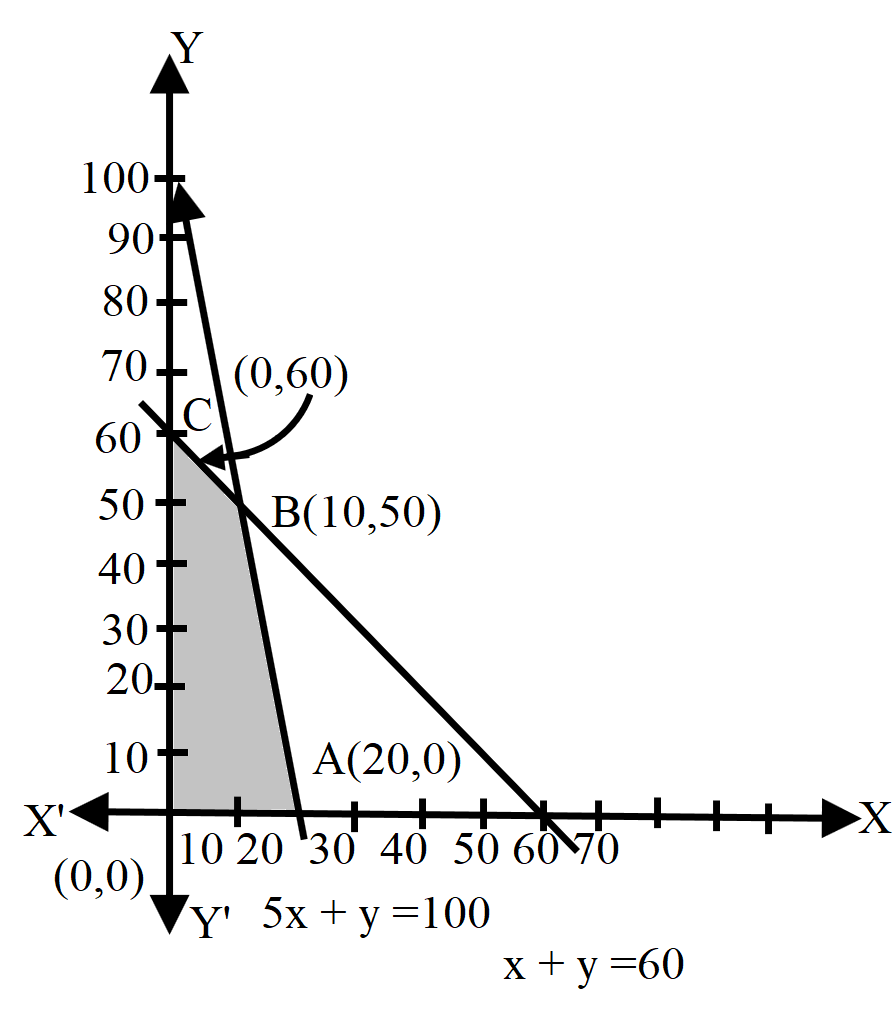
Assertion $(A): (25, 40)$ is an infeasible solution of the problem.
Reason $(R):$ Any point inside the feasible region is called an infeasible solution. - A
Both $A$ and $R$ are true and $R$ is the correct explanation of $A$
- B
Both $A$ and $R$ are true but $R$ is $\text{NOT}$ the correct explanation of $A$
- ✓
$A$ is true but $R$ is false.
- D
$A$ is false but $R$ is true.
Answer: C.
View full solution →Directions: In the following questions, the Assertions $(A)$ and Reason$(s) (R)$ have been put forward. Read both the statements carefully and choose the correct alternative from the following:
Assertion: Maximise $Z = 3x + 4y,$ subjectto constraints: $\text{x}+\text{y}\leq1,\text{x}\geq0,\text{y}\geq0$ Then maximum value of $Z$ is $4.$
Reason: If the shaded region is not bounded then maximum value cannot be determined.
- A
$A$ is true$,R$ is true$; R$ is a correct explanation for $A.$
- B
$A$ is true$,R$ is true$; R$ is not a correct explanation for $A.$
- ✓
$A$ is true$, R$ is false.
- D
$A$ is false$, R$ is true.
Answer: C.
View full solution →Solve the Linear Programming Problem graphically:
Minimize Z = -3x + 4y subject to $x + 2y \leq 8, \ 3x + 2y \leq 12, \ x \geq 0, \ y \geq 0.$
View full solution →Show that the minimum of Z occurs at more than two points.
Maximize Z = x + y, subject to $x - y \leq - 1, - x + y \leq 0, \ x, \ y \geq 0$.
View full solution →Solve the Linear Programming Problem graphically:
Maximise Z = 3x + 4y subject to the constraints: $x + y \le4, \ x \geq 0, \ y \geq 0$
View full solution →Solve the following linear programming problem graphically:
Minimise Z = 200x + 500y subject to the constraints:
$x + 2 y \geq 10$
$3 x + 4 y \leq 24$
$x \geq 0 , y \geq 0$
View full solution →Solve the following linear programming problem graphically:
Maximise Z = 4x + y subject to the constraints:
x + y $\le$ 50
3x + y $\le$ 90
x $\ge$ 0, y $\ge$ 0
View full solution →Show that the minimum of Z occurs at more than two points.
Maximize Z = -x + 2y subject to the constraints: $x \geq 3,x + y \geq 5,x + 2y \geq 6,y \geq 0$.
View full solution →Show that the minimum of Z occurs at more than two points.
Minimise and Maximise Z = x + 2y subject to $x + 2 y \geq 100,2 x - y \leq 0,2 x + y \leq 200$; $x , \ y \geq 0$.
View full solution →Show that the minimum of Z occurs at more than two points.
Minimize and Maximize Z = 5x + 10y subject to $x + 2y \leq 120, \ x + y \geq 60$, $x - 2y \geq 0, \ x, \ y \geq 0$.
View full solution →Solve the Linear Programming Problem graphically:
Minimise Z = x + 2y subject to 2x + y $\ge$ 3, x + 2y $\ge$ 6, x, y $\ge$ 0.
View full solution →Solve the Linear Programming Problem graphically:
Maximize Z = 3x + 2y subject to $x + 2y \leq 10,3x + y \leq 15,x,y \geq0$
View full solution →Fill in the blanks.
A corner point of a feasible region is a point in the region which is the _________ of two boundary lines.
Fill in the blanks.
In a LPP, the linear inequalities or restrictions on the variables are called _________.
Fill in the blanks.
If the feasible region for a LPP is _________, then the optimal value of the objective function Z = ax + by may or may not exist.
Fill in the blanks.
In a LPP if the objective function Z = ax + by has the same maximum value on two corner points of the feasible region, then every point on the line segment joining these two points give the same _________ value.
Fill in the blanks.
A feasible region of a system of linear inequalities is said to be _________, if it can be enclosed within a circle.
Fill in the blanks.
The feasible region for an LPP is always a _________ polygon.
State whether the statements are True or False:
If the feasible region for a LPP is unbounded, maximum or minimum of the objective function Z = ax + by may or may not exist.
State whether the statements are True or False:
In a LPP, the maximum value of the objective function Z = ax + by is always finite.
State whether the statements are True or False:
Maximum value of the objective function Z = ax + by in a LPP always occurs at only one corner point of the feasible region.
State whether the statements are True or False:
In a LPP, the minimum value of the objective function Z = ax + by is always 0 if origin is one of the corner point of the feasible region.