MCQ 11 Mark
Directions: In the following questions, a statement of assertion $(A)$ is followed by a statement of reason $(R).$ Mark the correct choice as:
If $A = \{1, 2, 3\}, B = \{4,5, 6, 7\}$ and $f = \{(1, 4), (2,5), (3, 6)\}$ is a function from $A$ to $B.$
Assertion: $f(x)$ is a one $-$ one function.
Reason: $f(x)$ is an onto function.
- A
Both $A$ and $R$ are true and $R$ is the correct explanation of $A.$
- B
Both $A$ and $R$ are true but $R$ is not the correct explanation of $A.$
- ✓
$A$ is true but $R$ is false.
- D
$A$ is false and $R$ is true.
AnswerCorrect option: C. $A$ is true but $R$ is false.
Given$, A= \{1, 2, 3\}, B = \{4, 5, 6, 7\}$
and $f : A \rightarrow B$ is defined as $f = \{(1, 4), (2, 5), (3, 6)\}$
i.e.$, f(1) = 4, f(2) = 5$ and $f(3) = 6.$
It can be seen that the images of distinct elements of $A$ under $f$ are distinct.
So$, f$ is one $-$ one.
So$, A$ is true.
Range of $f = \{4, 5, 6\}.$
$Co -$ domain $= \{4, 5, 6, 7\}.$
Since $co -$ domain $\neq$ range$, f(x)$ is not an onto function.
Hence $R$ is false.
View full question & answer→MCQ 21 Mark
Directions: In the following questions, a statement of assertion $(A)$ is followed by a statement of reason $(R).$ Mark the correct choice as:
Assertion: A relation $R = \{(1, 1), (1, 2), (2, 2), (2, 3), (3, 3)\}$ defined on the set $A = \{1, 2, 3\}$ is symmetri.
Reason: A relation $R$ on the set $A$ is symmetric $(\text{a},\text{b})\in\text{R}$
$\Rightarrow(\text{b},\text{a})\in\text{R}.$
- A
Both $A$ and $R$ are true and $R$ is the correct explanation of $A.$
- B
Both $A$ and $R$ are true but $R$ is not the correct explanation of $A.$
- C
$A$ is true but $R$ is false.
- ✓
$A$ is false but $R$ is true.
AnswerCorrect option: D. $A$ is false but $R$ is true.
View full question & answer→MCQ 31 Mark
Directions: In the following questions, a statement of assertion $(A)$ is followed by a statement of reason $(R).$ Mark the correct choice as:
Consider the set $A = \{1, 3, 5\}.$
Assertion: The number of reflexive relations on set $A$ is $2^9.$
Reason: A relation is said to be reflexive if xRx, $\forall\ \text{x}\in\text{A}.$
- A
Both $A$ and $R$ are true and $R$ is the correct explanation of $A.$
- B
Both $A$ and $R$ are true but $R$ is not the correct explanation of $A.$
- C
$A$ is true but $R$ is false.
- ✓
$A$ is false and $R$ is true.
AnswerCorrect option: D. $A$ is false and $R$ is true.
By definition, a relation in A is said to be reflexive if $xRx,$ $\forall\ \text{x}\in\text{A}.$
So $R$ is true.
The number of reflexive relations on a set containing n elements is $2^{n2-n}. $
Here $n = 3.$
The number of reflexive relations on a set $A = 2^{9-3} = 2^6.$
Hence $A$ is false.
View full question & answer→MCQ 41 Mark
Directions: In the following questions, a statement of assertion $(A)$ is followed by a statement of reason $(R).$ Mark the correct choice as:
Assertion: $A = \{1, 2, 3\}, B = \{4, 5, 6, 7\}, f = \{(1, 4), (2, 5), (3, 6)\}$ is a function from $A$ to $B.$Then $f$ is one $-$ one.
Reason: A function $f$ is one $-$ one if distinct elements of $A$ have distinct images in $B.$
- ✓
Both $A$ and $R$ are true and $R$ is the correct explanation of $A.$
- B
Both $A$ and $R$ are true but $R$ is not the correct explanation of $A.$
- C
$A$ is true but $R$ is false.
- D
$A$ is false but $R$ is true.
AnswerCorrect option: A. Both $A$ and $R$ are true and $R$ is the correct explanation of $A.$
View full question & answer→MCQ 51 Mark
Directions: In the following questions, a statement of assertion $(A)$ is followed by a statement of reason $(R)$. Mark the correct choice as:
Assertion: If $n(A) = p$ and $n(B) = q$ then the number of relations from $A$ to $B$ is $2^{pq}.$
Reason: A relation from $A$ to $B$ is a subset of $A \times B.$
- ✓
Both $A$ and $R$ are true and $R$ is the correct explanation of $A.$
- B
Both $A$ and $R$ are true but $R$ is not the correct explanation of $A.$
- C
$A$ is true but $R$ is false.
- D
$A$ is false but $R$ is true.
AnswerCorrect option: A. Both $A$ and $R$ are true and $R$ is the correct explanation of $A.$
Both $A$ and $R$ are true and $R$ is the correct explanation of $A.$
View full question & answer→MCQ 61 Mark
Directions: In the following questions, the Assertions $(A)$ and Reason$(s)\ (R)$ have been put forward. Read both the statements carefully and choose the correct alternative from the following:
Assertion: $\text{u}=\text{f}(\cot\text{x})\&\text{f}(1)=\sqrt2$ and $\text{g}(\sqrt{2})=2$ then $\Big(\frac{\text{du}}{\text{dv}}\Big)_{\text{x}=\frac{\text{x}}{4}}=1.$
Reason: If $u = f(x), v = g(x)$ then derivative of $\text{f w.r.t.}$ to $g$ is $\frac{\text{du}}{\text{dv}}=\frac{\frac{\text{du}}{\text{dx}}}{\frac{\text{dv}}{\text{dx}}}.$
- ✓
Both Assertion and Reason are correct and Reason is the correct explanation for Assertion.
- B
Both Assertion and Reason are correct but Reason is not the correct explanation for Assertion.
- C
Assertion is correct but Reason is incorrect.
- D
Both Assertion and Reason are incorrect.
AnswerCorrect option: A. Both Assertion and Reason are correct and Reason is the correct explanation for Assertion.
View full question & answer→MCQ 71 Mark
Directions: In the following questions, a statement of assertion $(A)$ is followed by a statement of reason $(R).$ Mark the correct choice as:
Let $W$ be the set of words in the English dictionary. $A$ relation $R$ is defined on $W$ as $R = \{(\text{x},\text{y})\in\text{W}\times\text{W}$such that $x$ and $y$ have at least one letter in common$\}.$
Assertion: $R$ is reflexive.
Reason: $R$ is symmetric.
- A
Both $A$ and $R$ are true and $R$ is the correct explanation of $A.$
- ✓
Both $A$ and $R$ are true but $R$ is not the correct explanation of $A.$
- C
$A$ is true but $R$ is false.
- D
$A$ is false and $R$ is true.
AnswerCorrect option: B. Both $A$ and $R$ are true but $R$ is not the correct explanation of $A.$
For any word $x$ and $x$ have atleast one $($all$)$ letter in common
$\therefore(\text{x},\text{x})\in\text{R},\forall\ \text{x}\in\text{W}$
$\therefore R$ is reflexive
Let $(\text{x},\text{y})\in\text{R},\text{x},\text{y}\in\text{W}$
$\Rightarrow x$ and $y$ have atleast one letter in common
$\Rightarrow y$ and $x$ have atleast one letter in common
$\Rightarrow(\text{y},\text{x})\in\text{R}$
$\therefore R$ is symmetric
Hence $A$ is true$, R$ is true$; R$ is not a correct explanation for $A.$
View full question & answer→MCQ 81 Mark
Directions: In the following questions, a statement of assertion $(A)$ is followed by a statement of reason $(R).$ Mark the correct choice as:
Assertion: $A,\ B$ are two sets such that $n(A) = p$ and $n(B) = q,$ The number of functions from $A$ onto $B$ is $q^p ..$
Reason: Every function is a relation.
- A
Both $A$ and $R$ are true and $R$ is the correct explanation of $A.$
- ✓
Both $A$ and $R$ are true but $R$ is not the correct explanation of $A.$
- C
$A$ is true but $R$ is false.
- D
$A$ is false but $R$ is true.
AnswerCorrect option: B. Both $A$ and $R$ are true but $R$ is not the correct explanation of $A.$
View full question & answer→MCQ 91 Mark
Directions: In the following questions, a statement of assertion $(A)$ is followed by a statement of reason $(R).$ Mark the correct choice as:
Assertion: $n(A) =5, n(B) =5$ and $f : A B$ is one $-$ one then $f$ is bijection.
Reason: If $n(A) = n(B)$ then every one $-$ one function from $A$ to $B$ is onto
- ✓
Both $A$ and $R$ are true and $R$ is the correct explanation of $A.$
- B
Both $A$ and $R$ are true but $R$ is not the correct explanation of $A.$
- C
$A$ is true but $R$ is false.
- D
$A$ is false but $R$ is true.
AnswerCorrect option: A. Both $A$ and $R$ are true and $R$ is the correct explanation of $A.$
View full question & answer→MCQ 101 Mark
Directions: In the following questions, a statement of assertion $(A)$ is followed by a statement of reason $(R).$ Mark the correct choice as:
Assertion: A relation $R = \{(1, 1), (1, 2), (2, 2), (2, 3) (3, 3)\}$ defined on the set $A = \{1, 2, 3\}$ is reflexive.
Reason: A relation $R$ on the set $A$ is reflexive if $(\text{a},\text{a})\in\text{R},\forall\ \text{a}\in\text{A}.$
- ✓
Both $A$ and $R$ are true and $R$ is the correct explanation of $A.$
- B
Both $A$ and $R$ are true but $R$ is not the correct explanation of $A.$
- C
$A$ is true but $R$ is false.
- D
$A$ is false but $R$ is true.
AnswerCorrect option: A. Both $A$ and $R$ are true and $R$ is the correct explanation of $A.$
View full question & answer→MCQ 111 Mark
Directions: In the following questions, a statement of assertion $(A)$ is followed by a statement of reason $(R).$ Mark the correct choice as:
Assertion: The range of the function $\frac{\text{x}^{2}}{1+\text{x}^{2}}$ is $(0, 1).$
Reason: If $\text{f}(\text{x})\leq\text{g}(\text{x})$ then the range of $\frac{\text{f}(\text{x})}{\text{g}(\text{x})},\text{g}(\text{x})\neq0$ is $(0, 1).$
- A
Both $A$ and $R$ are true and $R$ is the correct explanation of $A.$
- B
Both $A$ and $R$ are true but $R$ is not the correct explanation of $A.$
- ✓
$A$ is true but $R$ is false.
- D
$A$ is false but $R$ is true.
AnswerCorrect option: C. $A$ is true but $R$ is false.
View full question & answer→MCQ 121 Mark
Directions: In the following questions, a statement of assertion $(A)$ is followed by a statement of reason $(R).$ Mark the correct choice as:
Assertion: A relation $R = \{(1,1), (1, 3), (3, 1), (3, 3), (3, 5)\}$ defined on the set $A = \{1, 3, 5\}$ is reflexive.
Reason: A relation $R$ on the set $A$ is transitive if $(\text{a},\text{b})\in\text{R}$ and $(\text{b},\text{c})\in\text{R}$
$\Rightarrow(\text{a},\text{c})\in\text{R}).$
- A
Both $A$ and $R$ are true and $R$ is the correct explanation of $A.$
- B
Both $A$ and $R$ are true but $R$ is not the correct explanation of $A.$
- C
$A$ is true but $R$ is false.
- ✓
$A$ is false but $R$ is true.
AnswerCorrect option: D. $A$ is false but $R$ is true.
View full question & answer→MCQ 131 Mark
Directions: In the following questions, a statement of assertion $(A)$ is followed by a statement of reason $(R).$ Mark the correct choice as:
Assertion: The function $f : R \rightarrow R, \text{f}(\text{x})=\mid\text{x}\ \mid$ is not one $-$ one.
Reason: The function $\text{f}(\text{x})=\mid\text{x}\ \mid$ is not onto.
- A
Both $A$ and $R$ are true and $R$ is the correct explanation of $A.$
- ✓
Both $A$ and $R$ are true but $R$ is not the correct explanation of $A.$
- C
$A$ is true but $R$ is false.
- D
$A$ is false but $R$ is true.
AnswerCorrect option: B. Both $A$ and $R$ are true but $R$ is not the correct explanation of $A.$
View full question & answer→MCQ 141 Mark
Directions: In the following questions, a statement of assertion $(A)$ is followed by a statement of reason $(R).$ Mark the correct choice as:
Assertion: If $X = \{0, 1, 2\}$ and the function defined by $f(x) = x^2 - 2$ is surjection then $Y = \{-2, -1, 0\}.$
Reason: If $f : X \rightarrow Y$ is surjective if $f(X) = Y.$
- ✓
Both $A$ and $R$ are true and $R$ is the correct explanation of $A$.
- B
Both $A$ and $R$ are true but $R$ is not the correct explanation of $A.$
- C
$A$ is true but $R$ is false.
- D
$A$ is false but $R$ is true.
AnswerCorrect option: A. Both $A$ and $R$ are true and $R$ is the correct explanation of $A$.
View full question & answer→MCQ 151 Mark
Directions: In the following questions, a statement of assertion $(A)$ is followed by a statement of reason $(R).$ Mark the correct choice as:
Let $R$ be the relation in the set of integers $Z$ given by $R = \{a, b) : 2$ divides $a - b\}.$
Assertion: $R$ is a reflexive relation.
Reason: A relation is said to be reflexive if $\text{xRx}, \forall\ \text{x}\in\text{Z}.$
- ✓
Both $A$ and $R$ are true and $R$ is the correct explanation of $A.$
- B
Both $A$ and $R$ are true but $R$ is not the correct explanation of $A.$
- C
$A$ is true but $R$ is false.
- D
$A$ is false and $R$ is true.
AnswerCorrect option: A. Both $A$ and $R$ are true and $R$ is the correct explanation of $A.$
By definition, a relation in $Z$ is said to be reflexive if $\text{xRx}, \forall\ \text{x}\in\text{Z}.$
So $R$ is true.
$a - a = 0$
$\Rightarrow 2$ divides $a - a$
$\Rightarrow aRa.$
Hence $R$ is reflexive and $A$ is true.
$R$ is the correct explanation for $A.$
View full question & answer→MCQ 161 Mark
Directions: In the following questions, a statement of assertion $(A)$ is followed by a statement of reason $(R).$ Mark the correct choice as:
Assertion: A function $f : A \rightarrow B,$ cannot be an onto function if $n(A) < n(B).$
Reason: A function $f$ is onto if every element of $co -$ domain has at least one pre $-$ image in the domain.
- ✓
Both $A$ and $R$ are true and $R$ is the correct explanation of $A.$
- B
Both $A$ and $R$ are true but $R$ is not the correct explanation of $A.$
- C
$A$ is true but $R$ is false.
- D
$A$ is false but $R$ is true.
AnswerCorrect option: A. Both $A$ and $R$ are true and $R$ is the correct explanation of $A.$
View full question & answer→MCQ 171 Mark
Directions: In the following questions, a statement of assertion $(A)$ is followed by a statement of reason $(R).$ Mark the correct choice as:
Assertion: A relation $R = \{(1, 1), (1, 3), (1.5), (3, 1), (3, 3), (3,5\}$ defined on the set $A = \{1, 3, 5\}$ is transitive.
Reason: A relation $R$ on the set $A$ is symmetric $(\text{a},\text{b})\in\text{R}$ and $(\text{a},\text{c})\in\text{R}$
$\Rightarrow(\text{a},\text{c})\in\text{R}).$
- A
Both $A$ and $R$ are true and $R$ is the correct explanation of $A.$
- B
Both $A$ and $R$ are true but $R$ is not the correct explanation of $A.$
- ✓
$A$ is true but $R$ is false.
- D
$A$ is false but $R$ is true.
AnswerCorrect option: C. $A$ is true but $R$ is false.
View full question & answer→MCQ 181 Mark
Directions: In the following questions, a statement of assertion $(A)$ is followed by a statement of reason $(R).$ Mark the correct choice as:
Consider the function $f : R \rightarrow R$ defined as
$\text{f}(\text{x})=\frac{\text{x}}{\text{x}^{2}+1}.$
Assertion: $f(x)$ is not one $-$ one.
Reason: $f(x)$ is not onto.
- A
Both $A$ and $R$ are true and $R$ is the correct explanation of $A.$
- ✓
Both $A$ and $R$ are true but $R$ is not the correct explanation of $A.$
- C
$A$ is true but $R$ is false.
- D
$A$ is false but $R$ is true.
AnswerCorrect option: B. Both $A$ and $R$ are true but $R$ is not the correct explanation of $A.$
View full question & answer→MCQ 191 Mark
Directions: In the following questions, a statement of assertion $(A)$ is followed by a statement of reason $(R).$ Mark the correct choice as:
Assertion: Domain and Range of a relation $R = \{(x, y) : x -2y = 0\}$ defined on the set $A = \{1, 2, 3, 4\}$ are respectively ${1, 2, 3, 4}$ and ${2, 4, 6, 8}.$
Reason: Domain and Range of a relation $R$ are respectively the sets $\{\text{a}:\text{a}\in\text{A}$ and $(\text{a},\text{b})\in\text{R}.\}$ and $\{\text{b}:\text{b}\in\text{A}$ and $(\text{a},\text{b})\in\text{R}.\}$
- A
Both $A$ and $R$ are true and $R$ is the correct explanation of $A.$
- B
Both $A$ and $R$ are true but $R$ is not the correct explanation of $A.$
- C
$A$ is true but $R$ is false.
- ✓
$A$ is false but $R$ is true.
AnswerCorrect option: D. $A$ is false but $R$ is true.
View full question & answer→MCQ 201 Mark
Directions: In the following questions, a statement of assertion $(A)$ is followed by a statement of reason $(R).$ Mark the correct choice as:
Assertion: Consider the function f : $R \rightarrow R$ defined by $f(x) = x^3.$ Then f is one $-$ one.
Reason: Every polynomial function is one $-$ one.
- A
Both $A$ and $R$ are true and $R$ is the correct explanation of $A.$
- B
Both $A$ and $R$ are true but $R$ is not the correct explanation of $A.$
- ✓
$A$ is true but $R $ is false.
- D
$A$ is false but $R$ is true.
AnswerCorrect option: C. $A$ is true but $R $ is false.
$A$ is true but $R$ is false.
View full question & answer→MCQ 211 Mark
Directions: In the following questions, a statement of assertion $(A)$ is followed by a statement of reason $(R).$ Mark the correct choice as:
Assertion: If $n(A) = m,$ then the number of reflexive relations on $A$ is $m.$
Reason: A relation $R$ on the set $A$ is reflexive if $(\text{a},\text{a})\in\text{R},\forall\ \text{a}\in\text{A}.$
- A
Both $A$ and $R$ are true and $R$ is the correct explanation of $A.$
- B
Both $A$ and $R$ are true but $R$ is not the correct explanation of $A.$
- C
$A$ is true but $R$ is false.
- ✓
$A$ is false but $R$ is true.
AnswerCorrect option: D. $A$ is false but $R$ is true.
View full question & answer→MCQ 221 Mark
Directions: In the following questions, a statement of assertion $(A)$ is followed by a statement of reason $(R)$. Mark the correct choice as:
Consider the function f : $R > R$ defined as $f(x) = x^3.$
Assertion: $f(x)$ is a one $-$ one function.
Reason: $f(x)$ is a one $-$ one function if co $-$ domain $=$ range.
- A
Both $A$ and $R$ are true and $R$ is the correct explanation of $A.$
- B
Both $A$ and $R$ are true but $R$ is not the correct explanation of $A.$
- ✓
$A$ is true but $R$ is false.
- D
$A$ is false and $R$ is true.
AnswerCorrect option: C. $A$ is true but $R$ is false.
$f(x)$ is a one $-$ one function if
$f(x_1) = f(x_2) > x_1 = x_2,$
Hence $R$ is false.
Let $f(x_1) = f(x_2)$ for some $\text{x}_{1},\text{x}_{2}\in\text{R}$
$\Rightarrow (x_1)^3= (x_2)^3$
$\Rightarrow x_1 = x_2$
Hence $f(x)$ is one - one.
Hence A is true.
View full question & answer→MCQ 231 Mark
Directions: In the following questions, a statement of assertion $(A)$ is followed by a statement of reason $(R).$ Mark the correct choice as:
Assertion: Consider the function $4$ defined by $\text{f}(\text{x})=\frac{\text{x}}{\text{x}^{2}+1}.$ Then $f$ is one $-$ one.
Reason: $\text{f}(4)=\frac{4}{17}$ and $\text{f}\big(\frac{1}{4}\big)=\frac{4}{17}.$
- A
Both $A$ and $R$ are true and $R$ is the correct explanation of $A.$
- B
Both $A$ and $R$ are true but $R$ is not the correct explanation of $A.$
- C
$A$ is true but $R$ is false.
- ✓
$A$ is false but $R$ is true.
AnswerCorrect option: D. $A$ is false but $R$ is true.
View full question & answer→MCQ 241 Mark
Directions: In the following questions, a statement of assertion $(A)$ is followed by a statement of reason $(R).$ Mark the correct choice as:
Assertion: $A,\ B$ are two sets such that $n(A) = m$ and $n(B) = n.$ The number of one $-$ one functions from $A$ onto $B$ is $n_{pm},$ if $\text{n}\geq\text{m}.$
Reason: A function $f$ is one $-$ one if distinct elements of $A$ have distinct images in $B.$
- ✓
Both $A$ and $R$ are true and $R$ is the correct explanation of $A.$
- B
Both $A$ and $R$ are true but $R$ is not the correct explanation of $A.$
- C
$A$ is true but $R$ is false.
- D
$A$ is false but $R$ is true.
AnswerCorrect option: A. Both $A$ and $R$ are true and $R$ is the correct explanation of $A.$
View full question & answer→MCQ 251 Mark
Assertion (A): The relation $R=\{(x, y):(x+y)$ is a prime number and $x, y \in N\}$ is not a reflexive relation.
Reason (R) : The number ' $2 n$ ' is composite for all natural numbers $n$.
AnswerNow, $\forall x \in R,(x, x) \notin R$ as $x+x=2 x$ is composite number i.e., not a prime number. So, $R$ is not a reflexive relation.
Reason is false as for $n=1,2 n$ is a prime number.
Hence, assertion (A) is true but reason (R) is false.
View full question & answer→MCQ 261 Mark
Assertion $( A )$ : The relation $f:\{1,2,3,4\} \rightarrow\{x, y$, $z, p\}$ defined by $f=\{(1, x),(2, y),(3, z)\}$ is a bijective function.
Reason $( R )$ : The function $f:\{1,2,3\} \rightarrow\{x, y, z, p\}$ such that $f=\{(1, x),(2, y),(3, z)\}$ is one-one.
- A
Both $(A)$ and $(R)$ are true and $(R)$ is the correct explanation of (A).
- B
Both $(A)$ and $(R)$ are true but (R) is not the correct explanation of (A).
- C
(A) is true but $( R )$ is false.
- D
(A) is false but ( $R$ ) is true.
AnswerThe element 4 has no image under $f \Rightarrow$ relation $f$ is not a function. So, Assertion is false.
The given function $f:\{1,2,3\} \rightarrow\{x, y, z, p\}$ is one - one as for each element of $\{1,2,3\}$, there is different image in $\{x, y, z, p\}$ under $f$.
$\therefore \quad$ Reason is true.
View full question & answer→MCQ 271 Mark
Assertion $(A)$ : Relation $R$ defined in the set $A$ as $R\{(x, y): y-x$ is an integer, $x, y \in R\}$ is an equivalence relation.
Reason $(R)$ : Relation $R$ defined in the set $B$ as $R\{(x, y): x=\alpha y$ for some rational number $\alpha$, $x, y \in R\}$ is an equivalence relation.
- A
Both $(A)$ and $(R)$ are true and $(R)$ is the correct explanation of $(A)$.
- B
Both $(A)$ and $(R)$ are true but $(R)$ is not the correct explanation of $(A)$.
- ✓
$(A)$ is true but $(R)$ is false.
- D
$(A)$ is false but $(R)$ is true.
AnswerCorrect option: C. $(A)$ is true but $(R)$ is false.
For every $(x, x) \in R$
$ \Rightarrow x-x=0$, which is an integer.
$\therefore A$ is reflexive
Let, $(x, y) \in R $
$\Rightarrow y-x$ is an integer.
$\Rightarrow x-y$ is an integer.
$\Rightarrow (y, x) \in R$
$ \therefore R$ is symmetric.
Let $(x, y),(y, z) \in R$. Let $x, y, z \in R$
$(x, y) \in R \Rightarrow y-x \text { is an integer }\ $
$(y, z) \in R \Rightarrow z-y \text { is an integer }$
$\Rightarrow z-x$ is an integer.
$\Rightarrow (x, z) \in R \therefore R$ is transitive
Hence, $R$ is an equivalence relation.
Now, $R=\{(x, y): x=\alpha y, \alpha \in Q\}$
Since, $(0, x) \in R $
$\Rightarrow 0=\alpha x$ for $\alpha=0$
But $(x, 0) \notin R$
$ \Rightarrow R$ is not symmetric
$\therefore R$ is not an equivalence relation.
$\therefore $ Assertion is true, Reason is false.
View full question & answer→MCQ 281 Mark
Assertion (A) : If $f: R \rightarrow R$ defined by $f(x)=7 x-[7 x]$, where [.] denotes greatest integer $\leq x \forall x \in R$, then $f$ is not one-one function.
Reason (R) : Fractional part functions are always many-one.
- ✓
Both (A) and (R) are true and (R) is the correct explanation of (A).
- B
Both (A) and (R) are true but (R) is not the correct explanation of (A).
- C
(A) is true but (R) is false.
- D
(A) is false but (R) is true.
AnswerCorrect option: A. Both (A) and (R) are true and (R) is the correct explanation of (A).
(a) : $f(x)=7 x-[7 x]$
Let $7 x=y$
Then $f\left(\frac{y}{7}\right)=y-[y]=\{y\}$
$\Rightarrow f(x)$ is many-one.
$\therefore \quad$ Reason is correct & many-one function cannot be one-one function, so Assertion is also correct.
View full question & answer→MCQ 291 Mark
Assertion (A) : Let $f:(e, \infty) \rightarrow R$ defined by $f(x)=\log (\log (\log x))$ is bijective.
Reason (R) : A function $f$ will be bijective if $f$ is both one-one and onto.
- ✓
Both (A) and (R) are true and (R) is the correct explanation of (A).
- B
Both (A) and (R) are true but (R) is not the correct explanation of (A).
- C
(A) is true but (R) is false.
- D
(A) is false but (R) is true.
AnswerCorrect option: A. Both (A) and (R) are true and (R) is the correct explanation of (A).
(a) : As $x \in(e, \infty)$
$\Rightarrow \log x>1 \Rightarrow \log (\log x)>\log 1$
$\Rightarrow \log (\log x)>0$
$\Rightarrow \log (\log (\log (x))>\log 0$
$\Rightarrow \log (\log (\log x)) \in(-\infty, \infty)$
$\Rightarrow$ codomain of $f(x)=$ Range of $f(x) \Rightarrow f$ is onto
Again logarithmic functions are always one-one.
$\therefore f(x)$ is both one - one and onto.
View full question & answer→MCQ 301 Mark
Assertion $(A) :$ The function $f: R \rightarrow[0,1)$ defined by $f(x)=\frac{x^2}{x^2+1}$ is surjective.
Reason $(R) :$ For surjection, Range of $f(x)=$ codomain of $f(x)$
- ✓
Both $(A)$ and $(R)$ are true and $(R)$ is the correct explanation of $(A).$
- B
Both $(A)$ and $(R)$ are true but $(R) $ is not the correct explanation of $(A).$
- C
$(A)$ is true but $(R)$ is false.
- D
$(A)$ is false but $(R)$ is true.
AnswerCorrect option: A. Both $(A)$ and $(R)$ are true and $(R)$ is the correct explanation of $(A).$
For onto function, codomain of $f=$ range of $f$.
We have, $f(x)=\frac{x^2}{1+x^2}$.
Then $y \geq 0$.
$\Rightarrow y\left(1+x^2\right)=x^2 $
$\Rightarrow x^2(y-1)=-y$
$\Rightarrow x^2=\frac{y}{1-y} \geq 0$
$\Rightarrow \frac{y-0}{y-1} \leq 0 $
$\Rightarrow 0 \leq y<1 (\because y \neq 1)$
$\Rightarrow$ codomain of $f=$ Range of $f$, as $f: R \rightarrow[0,1)$.
View full question & answer→MCQ 311 Mark
Assertion $(A)$ : If set $A$ contains $7$ elements and set $B$ contains $6$ elements, then the number of one $-$ one onto mapping from $A$ to $B$ is $420$ .
Reason $(R)$ : If $A$ and $B$ are two non $-$ empty sets containing $m$ and $n$ elements respectively, then number of one $-$ one onto functions from $A$ to $B$
$=\left\{n !, \text { if } m=n \ 0, \text { if } m \neq n \right. \text {. \}}$
- A
Both $(A) $ and $(R)$ are true and $(R)$ is the correct explanation of $(A)$.
- B
Both $(A) $ and $(R)$ are true but $(R)$ is not the correct explanation of $(A)$.
- C
$(A)$ is true but $(R) $ is false.
- ✓
$(A)$ is false but $(R)$ is true.
AnswerCorrect option: D. $(A)$ is false but $(R)$ is true.
Clearly, reason is true.
Now, $m=7$ and $n=6$ i.e., $m \neq n$
$\therefore $ Number of one $-$ one onto mapping from $A$ to $B$ is $0 $.
$\therefore $ Assertion is false and Reason is true.
View full question & answer→MCQ 321 Mark
Assertion (A) : Let $A=\{-1,1,2,3\}$ and $B=\{1,4,9\}$, where $f: A \rightarrow B$ given by $f(x)=x^2$, then $f$ is not one-one function.
Reason (R): If $x_1 \neq x_2 \Rightarrow f\left(x_1\right) \neq f\left(x_2\right)$, for every $x_1, x_2 \in$ domain, then $f$ is one-one.
- ✓
Both (A) and (R) are true and (R) is the correct explanation of (A).
- B
Both (A) and (R) are true but (R) is not the correct explanation of (A).
- C
(A) is true but (R) is false.
- D
(A) is false but (R) is true.
AnswerCorrect option: A. Both (A) and (R) are true and (R) is the correct explanation of (A).
(a) : Here $f(-1)=1, f(1)=1$, $f(2)=4, f(3)=9$
Two elements 1 and -1 have the same image $1 \in B$.
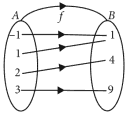
So, $f$ is not one-one function. View full question & answer→MCQ 331 Mark
Assertion (A) : The relation $R$ in a set
$A=\{1,2,3,4\}$ defined by $R=\{(x, y): 3 x-y=0\}$
have the Domain $=\{1,2,3,4\}$ and Range $=$ $\{3,6,9,12\}$.
Reason (R) : Domain & Range of the relation $(R)$ is respectively the set of all first & second entries of the distinct ordered pair of the relation.
- A
Both (A) and (R) are true and (R) is the correct explanation of (A).
- B
Both (A) and (R) are true but (R) is not the correct explanation of (A).
- C
(A) is true but (R) is false.
- ✓
(A) is false but (R) is true.
AnswerCorrect option: D. (A) is false but (R) is true.
(d) $: R=\{(x, y): y=3 x, x \in A\} \therefore R=\{(1,3)\}$
$\therefore \quad$ Domain of the relation $=\{1\}$ and Range of the relation $=\{3\}$.
View full question & answer→