Question 12 Marks
A 1.0m long metallic rod is rotated with an angular frequency of 400 rad $s^{-1}$ about an axis normal to the rod passing through its one end. The other end of the rod is in contact with a circular metallic ring. A constant and uniform magnetic field of 0.5T parallel to the axis exists everywhere. Calculate the emf developed between the centre and the ring.
Answer
View full question & answer→Length of the rod, l = 1m
Angular frequency, $\omega=400\text{ rad/s}$
Magnetic field strength, B = 0.5T
One end of the rod has zero linear velocity, while the other end has a linear velocity of $\text{l}\omega.$
Average linear velocity of the rod, $\text{v}=\frac{\text{l}\omega+0}{2}=\frac{\text{l}\omega}{2}$
Emf developed between the centre and the ring,
$\text{e}=\text{Blv}=\text{Bl}\Big(\frac{\text{l}\omega}{2}\Big)=\frac{\text{B}\text{l}^2\omega}{2}$
$=\frac{0.5\times(1)^2\times400}{2}=100\text{V}$
Hence, the emf developed between the centre and the ring is 100V.
Angular frequency, $\omega=400\text{ rad/s}$
Magnetic field strength, B = 0.5T
One end of the rod has zero linear velocity, while the other end has a linear velocity of $\text{l}\omega.$
Average linear velocity of the rod, $\text{v}=\frac{\text{l}\omega+0}{2}=\frac{\text{l}\omega}{2}$
Emf developed between the centre and the ring,
$\text{e}=\text{Blv}=\text{Bl}\Big(\frac{\text{l}\omega}{2}\Big)=\frac{\text{B}\text{l}^2\omega}{2}$
$=\frac{0.5\times(1)^2\times400}{2}=100\text{V}$
Hence, the emf developed between the centre and the ring is 100V.
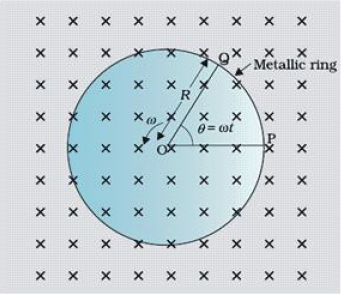 The magnitude of the emf, generated across a length dr of the rod, as it moves at right angles to the magnetic field, is given by