MCQ 11 Mark
A coil of area $80 cm^2$ and number of turns $50$ is rotating about an axis perpendicular to a magnetic field of $0.05$ Tesla at $2000$ rotations per minute. The maximum value of emf induced in it will be.
AnswerCorrect option: C. $\frac{4\pi}{3}\text{volt}$
$\text{Max.emf = nAB}\omega$
$=50\times0.008\times0.05\times2000\frac{2\pi}{60}=\frac{4\pi}{3}\text{V}$
View full question & answer→MCQ 21 Mark
The self-inductance of a long solenoid carrying current is independent of:
- A
- ✓
- C
- D
magnetic permeability of the core
AnswerSelf-inductance of a solenoid is given by $\text{L}=\frac{\mu_0\text{N}^2\text{A}}{1}$
where, $N =$ number of turns in solenoid
$l =$ length of the solenoid
$A =$ area of one turn of solenoid.
The self-inductance of solenoid does not depend on current passing through it.
View full question & answer→MCQ 31 Mark
When a coil of cross-sectional area A and number of turns $N$ is rotated in a uniform magnetic field $B$ with angular velocity $\omega$ then the maximum emf induced in the coil will be.
AnswerCorrect option: C. $\text{BNA}\omega$
$emf =$ rate of change of flux
$=\text{BNA}\omega$
View full question & answer→MCQ 41 Mark
When a coil is moved or rotated relative a fixed magnet then.
AnswerAfter performing a large number of experiments, Faraday and Henry made the following observations about electromagnetic induction
- a current is induced in a coil when it is moved $($rotated$)$ relative to a fixed magnet.
- a current is also induced in a fixed coil when a magnet is moved $($or rotated$)$ relative to the fixed coil.
- no current is induced in a coil when the coil and magnet both are stationary relative to one another.
- when the direction of motion of coil $($or magnet$)$ is reversed , the direction of current induced in the coil also get reversed.
- the magnitude of current induced in the coil can be increased.
- by winding the coil on a soft iron core.
- by increasing the number of turns in the coil.
- by increasing the strength of magnet.
- by increasing the speed of rotation of coil $($magnet$).$
View full question & answer→MCQ 51 Mark
Two circular coils can be arranged in any of the three situations shown in the figure. Their mutual inductance will be.

- ✓
maximum in situation $(A)$
- B
maximum in situation $(B)$
- C
maximum in situation $(C)$
- D
the same in all situations
AnswerCorrect option: A. maximum in situation $(A)$
View full question & answer→MCQ 61 Mark
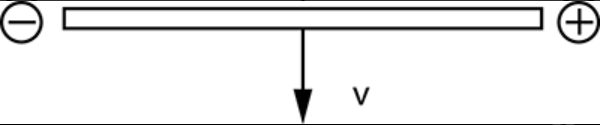
A wire moves with a velocity v through a magnetic field and experiences an induced charge separation as shown in the figure. Then the direction of the magnetic field is
- ✓
- B
- C
towards the bottom of the page.
- D
towards the top of the page.
AnswerForce on change is given by $q(V \times B)$
So, $F = q(v \times B)$
So, force direction is in the direction of $V \times B$
So, by using right hand rule for determing the direction of $V \times B$, we get direction of $B$ into the plane of page.
View full question & answer→MCQ 71 Mark
The number of turns in an air core solenoid of length $25cm$ and radius $4cm$ is $100.$ Its self inductance will be.
- A
$5 \times 10^{-4} H$
- ✓
$2.5 \times 10^{-4} H$
- C
$5.4 \times 10^{-3} H$
- D
$2.5 \times 10^{-3} H$
AnswerCorrect option: B. $2.5 \times 10^{-4} H$
b. $2.5 \times 10^{-4} H$
Explanation:
Inducatnce $=\mu\text{N}^2\frac{\text{Area}}{\text{length}}$
$=\mu100^2\frac{\pi0.4^2}{0.25}=25\times10^{-4}\text{H}$
View full question & answer→MCQ 81 Mark
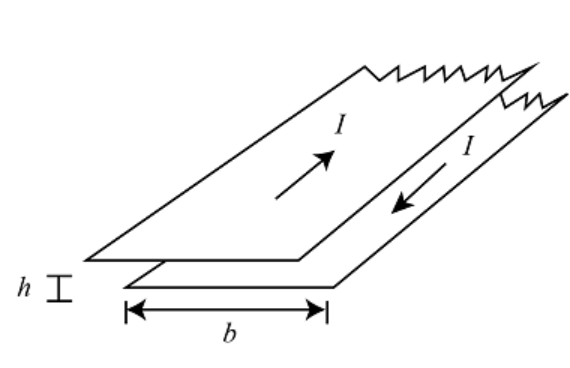
Calculate the inductance of a unit length of a double tape line as shown in figure. The tapes are separated by a distance h which is considerably less than their width b.
- ✓
$\frac{\mu_0\text{h}}{\text{b}}$
- B
$\frac{\mu_0\text{h}}{\text{2b}}$
- C
$\frac{2\mu_0\text{h}}{\text{b}}$
- D
$\frac{\sqrt2\mu_0\text{h}}{\text{b}}$
AnswerCorrect option: A. $\frac{\mu_0\text{h}}{\text{b}}$
$\oint\overrightarrow{\text{B}}\cdot=\mu_0\text{I}$
$\Rightarrow\text{B}.2\text{b}=\mu_0\text{I}$
$\Rightarrow\text{B}=\frac{\mu_0\text{I}}{2\text{b}}\rightarrow$ due to one tape
Net field $= 2B$
Magnetic flux passing through this double tape
$\phi=\text{2BA}=2\text{B(Ih)}$
$\Rightarrow\phi=\frac{\mu_0\text{I}}{\text{b}}\text{Ih}$
$\text{L}=\frac{\phi}{\text{I}}=\frac{\mu_0\text{Ih}}{\text{b}}$
$\Rightarrow\frac{\text{L}}{\text{I}}=\frac{\mu_0\text{h}}{\text{b}}$
View full question & answer→MCQ 91 Mark
An airplane with wingspan $50$ m is flying horizontally with a speed of $360 \ kmhr ^{-1}$ over a place where the vertical component of the earth's magnetic field is $2 \times 10^{-2}$. The potential difference between the tips of the wings would be
- ✓
$100V$
- B
$1.0V$
- C
$0.2V$
- D
$0.01V$
AnswerCorrect option: A. $100V$
emf between the wing tips $= Blv$
$=0.02\times50\times360\times\frac{1000}{3600}$
$=100\text{V}$
View full question & answer→MCQ 101 Mark
No. of magnetic lines of force present per unit volume is called.
AnswerMagnetic flux is no. of the magnetic lines of force present per unit surface.
Magnetic flux is often also called magnetic flux density. or even magnetic field line density.
View full question & answer→MCQ 111 Mark
When a loop moves towards a stationary magnet with speed v, the induced emf in the loop is $E$. If the magnet also moves away from the loop with the same speed, then the emf induced in the loop is.
- A
$E$
- B
$2E$
- C
$\frac{\text{E}}{2}$
- ✓
AnswerFaraday's Law states that an electric field is induced by changing magnetic flux.
If both move with the same velocity in the same direction, the relative velocity is zero, hence there is no change of magnetic flux across the loop with time.
View full question & answer→MCQ 121 Mark
The coefficient of mutual induction between two coils is $4 H$ . If the current in the primary reduces from $5 A$ to zero in $10^{-3}$ second then the induced emf in the secondary coil will be
- A
$104V$
- B
$25 \times 103 V$
- ✓
$2 \times 104 V$
- D
$15 \times 103 V$
AnswerCorrect option: C. $2 \times 104 V$
c. $2 \times 104 V$
Explanation:
$\text{emf}=-\text{M}\frac{\text{dI}}{\text{dt}}$
$=-4\frac{0-5}{10^{-3}}=2\times10^4\text{V}$
View full question & answer→MCQ 131 Mark
For a coil having $L=2 \ m H$, current flow through it is $I=t^2 e^{-t}$ then the time at which emf become zero: -
Answer$I=t^2 e^{-t}$
$\text{e}=\frac{\text{LdI}}{\text{dt}}$
$\frac{\text{dI}}{\text{dt}}=2\text{te}^{\text{-t}}\text{-t}^2\text{e}^{\text{-t}}=0$
$\text{t}=2\sec$
View full question & answer→MCQ 141 Mark
An electric potential difference will be induced between the ends of the conductor shown in the figure, if the conductor moves in the direction shown by:
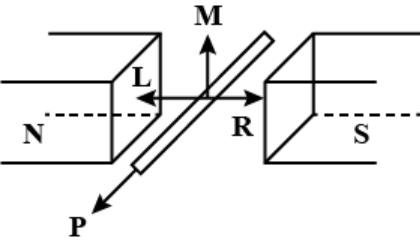
AnswerFleming’s Right Hand Rule gives the direction of current in the conductor whenever it is moved in any magnetic field. It states that if we stretch our right hand fingers perpendicular to each other as shown in fig, then if fore finger is in the direction of Magnetic field and thumb is in the direction of motion of conductor then middle finger gives the direction of current in the conductor.
Explanation for the correct answer:
For induction of emf in the conductor, the motion of conductor should be perpendicular to the direction of magnetic field. Thus, Option $B$ and $C$ are eliminated.
Now if we move conductor in $P$ direction, the motion will be perpendicular to the direction of magnetic field but then the charge separation in the conductor will take place perpendicular to the length of the conductor. Thus, due to less space for charge separation emf can not be induced in the conductor. Thus, Option A is eliminated.
If conductor is moved in direction $M$ then the charge separation in the conductor takes place across its length, there will be enough space for charge separation. And thus emf will be induced across the conductor.
View full question & answer→MCQ 151 Mark
The number of turns in a coil of wire of fixed radius is $600$ and its self inductance is $108\ mH$. The self inductance of a coil of $500$ turns will be:
- A
$74\ mH$
- ✓
$75\ mH$
- C
$76\ mH$
- D
$77\ mH$
AnswerCorrect option: B. $75\ mH$
$\text{L}=\frac{\mu\text{n}^2\text{A}}{\text{L}}\cdot$
$\text{L}\propto\text{n}^2$
Thus, for $500$ turns, self inductance would be $\frac{108\times(500)^2}{(600)^2}=\frac{108\times25}{36}=75\text{mH}$
View full question & answer→MCQ 161 Mark
Two coils $X$ and $Y$ are linked such that emf $E$ is induced in $Y$ when the current in $X$ is changing at the rate $\text{I}\big(=\frac{\text{dI}}{\text{dt}}\big)$. If a current $I0$ is now made to flow through $Y$, the flux linked with $X$ will be.
- A
$\text{EI}_0\text{I}$
- B
$\frac{\text{I}_0\text{I}}{\text{E}}$
- C
$\Big(\frac{\text{E}}{\text{I}_0}\Big)\text{I}$
- ✓
$\Big(\frac{\text{E}}{\text{I}}\Big)\text{I}_0$
AnswerCorrect option: D. $\Big(\frac{\text{E}}{\text{I}}\Big)\text{I}_0$
Let $M$ be the mutual inductance,
We can write $E = MI′$
We know that $\text{E}=-\frac{\text{d}\phi_\text{B}}{\text{dt}}$
$\phi_\text{B}=-\int\text{Edt}=-\text{M}\int\text{I dt}=-\text{MI}$
whereI is the current in the circuit.
Given $I = I0.$
So $\phi_\text{B}=-\text{MI}_0=-\big(\frac{\text{E}}{\text{I}}\big)\text{I}_0$
Sign is indicative of the direction. So for magnitude only
$\phi_\text{B}=\Big(\frac{\text{E}}{\text{I}}\Big)\text{I}_0$
View full question & answer→MCQ 171 Mark
Magnetic flux $\phi ($in weber$)$ linked with a closed circuit of resistance $10\Omega$ varies with time $t ($in second$)$ as $\phi=512-4\text{t}+1$.The induced electromotive force in the circuit at $t = 0.2$ second is.
- A
$0.4 V$
- B
$-0.4 V$
- C
$-2.0 V$
- ✓
$2.0 V$
AnswerCorrect option: D. $2.0 V$
$\phi=\text{BA}\phi=\text{BA}$
View full question & answer→MCQ 181 Mark
A cycle wheel with $64$ spokes is rotating with $N$ rotations per second at right angles to horizontal component of magnetic field. The induced emf generated between its axle and rim is $E$. If the number of spokes is reduced to $32$ then the value of induced emf will be:
- ✓
$\text{E}$
- B
$2\text{E}$
- C
$\frac{\text{E}}{2}$
- D
$\frac{\text{E}}{4}$
AnswerCorrect option: A. $\text{E}$
The emf induced is independent of the number of spoke and only depends on the lenght of spoke and the angular speed.
Therefore emf induced is same as before $= E$
View full question & answer→MCQ 191 Mark
Which of the following are not units of self inductance?
- ✓
Weber/m$^2$
- B
Ohm$−$second
- C
Joule$−$ampere
- D
Joule$−$ampere $−2$
AnswerCorrect option: A. Weber/m$^2$
View full question & answer→MCQ 201 Mark
A circular coil of n turns is kept in a uniform magnetic field such that the plane of the coil is perpendicular to the field. The magnetic flux associated with the coil is now $\phi$ . Now the coil is opened and made into another circular coil of twice the radius of the previous coil and kept in the same field such that the plane of the coil is perpendicular to the field. The magnetic flux associated with this coil now is:
- A
$\phi$
- ✓
$2\phi$
- C
$\frac{\phi}{4}$
- D
$\frac{\phi}{2}$
AnswerCorrect option: B. $2\phi$
$\text{flux}(\phi)=\text{nBA}$
$=\text{nB}\pi\text{r}^2$
Let total length of coil is $l$
$\text{I}=(\text{n}\pi\text{r})$
Now, since same wire length has double radius $80,$
$\text{I}=\text{n}_1(2\pi2\text{r})$
$\text{I}=\text{n}_1=\frac{\text{n}}{2}$
Now, flux $=\frac{\text{n}}{2}\text{BA}$
$=\frac{\text{n}}{2}\text{B}\pi4\text{r}^2$
$=2\text{nB}\pi\text{r}^2$
$=2\phi$
So, new flux $=2\phi$
View full question & answer→MCQ 211 Mark
A conducting rod of length $L$ is falling with velocity $V$ in a uniform horizontal magnetic field $B$ normal to the rod. The induced emf between the ends the rod will be:
- A
$2\text{BVI}$
- B
$\text{zero}$
- ✓
$\text{BIV}$
- D
$\frac{\text{BV1}}{2}$
AnswerCorrect option: C. $\text{BIV}$
Force on charge q due to the motion of rod in the field $= F = qVB$
This force on the charge is attributed to the induced electric field $E$
Therefore,
$Eq = F = qVB$
$E = VB$
therefore, an electric field $E = VB$ is said to be induced in the rod due to the motion in the magnetic field.
Potential difference due to the field $=$ emf induced $= E \times $ length $= El = V$ Blvolts
View full question & answer→MCQ 221 Mark
The induced emf produced when a magnet is inserted into a coil does not depend upon:
- A
The number of turns in the coil
- ✓
The resistance of the coil
- C
The speed of approach of the magnet
- D
AnswerCorrect option: B. The resistance of the coil
The induced emf produced when a magnet is inserted into a coil does not depend upon the resistance of the coil.
View full question & answer→MCQ 231 Mark
When a straight wire is moved up and down rapidly between two poles of a horseshoe magnet then $.......$ is produced in the wire.
AnswerAn electric current is produced in the wire. The production of electricity from magnetism is called electromagnetic induction
View full question & answer→MCQ 241 Mark
The electric flux through a certain area of dielectric is $8.76 \times 10^3 t^4$. The displacement current through the area is $12.9$ pA at $t =26.1 \ ms$. Find the dielectric constant of the material.
- ✓
$2 \times 10^{-8}$
- B
$4 \times 10^{-8}$
- C
$8 \times 10^{-8}$
- D
$2 \times 10^{-7}$
AnswerCorrect option: A. $2 \times 10^{-8}$
Displacement current is $\text{i}_\text{D}=\in\frac{\text{d}\phi_\text{E}}{\text{dt}}$
or $\in=\frac{\text{i}_\text{D}}{(\frac{\text{d}\phi_\text{E}}{\text{dt}})}$
$\in=\frac{12.9\times10^{-9}}{4(8.76)\times10^3\times(26.1\times10^{-3})^3}$
$\simeq2\times10^{-8}$
View full question & answer→MCQ 251 Mark
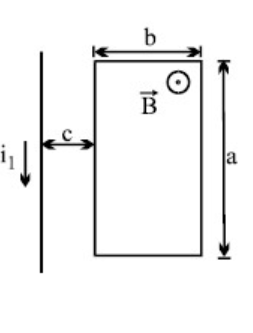
A long straight wire is placed along the axis of a circular ring of radius $R$. The mutual inductance of this system is.
- A
$\frac{\mu_0\text{R}}{2}$
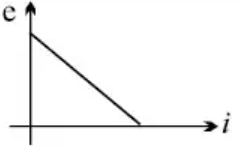
- ✓
$\frac{\mu_0\pi\text{R}}{2}$
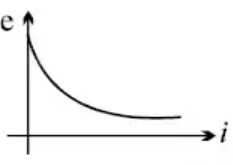
- C
$\frac{\mu_0}{2}$
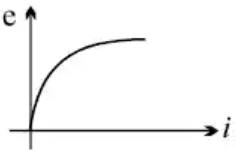
- D
$0$
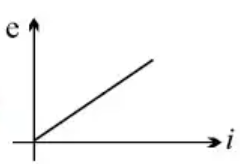
AnswerCorrect option: B. $\frac{\mu_0\pi\text{R}}{2}$
Magnetic field due to wire at the ring is
$\text{B}=\frac{\mu0\text{i}}{4\pi\text{R}}$
$\therefore\text{then}\phi$
$=\phi\overrightarrow{\text{B}\cdot}\overrightarrow{\text{A}}$
$\Rightarrow\mid\text{B}\mid\mid\text{A}\mid\cos\theta$
$\phi=\text{O},\text{as}\cos90^\circ=0$
$\therefore\text{mutual induction = 0}$
View full question & answer→MCQ 261 Mark
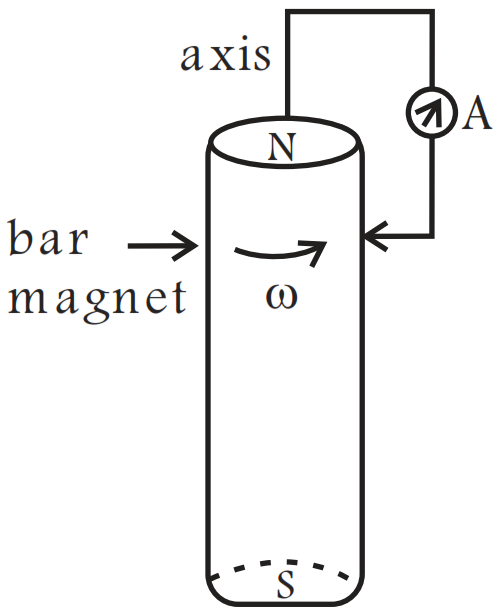
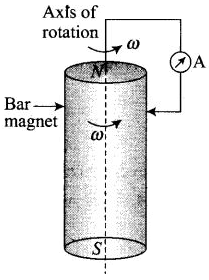
A cylindrical bar magnet is rotated about its axis $($Fig$)$. A wire is connected from the axis and is made to touch the cylindrical surface through a contact. Then,
- ✓
A direct current flows in the ammeter $A.$
- B
No current flows through the ammeter $A$.
- C
An alternating sinusoidal current flows through the ammeter A with a time period $\text{T}=\frac{2\pi}{\omega}$.
- D
A time varying non-sinosoidal current flows through the ammeter $A.$
AnswerCorrect option: A. A direct current flows in the ammeter $A.$
Key concept: The phenomenon of electromagnetic induction is used in this problem. Whenever the number of magnetic lines of force $($magnetic flux$)$ passing through a circuit changes $($or a moving conductor cuts the magnetic flux$)$ an emf is produced in the circuit $($or emf induces across the ends of the conductor$)$ is called induced emf. The induced emf persists only as long as there is a change or cutting of flux.
When cylindrical bar magnet is rotated about its axis, no change in flux linked with the circuit takes place, consequently no emf induces and hence, no current flows through the ammeter A.
Hence the ammeter shows no deflection.
View full question & answer→MCQ 271 Mark
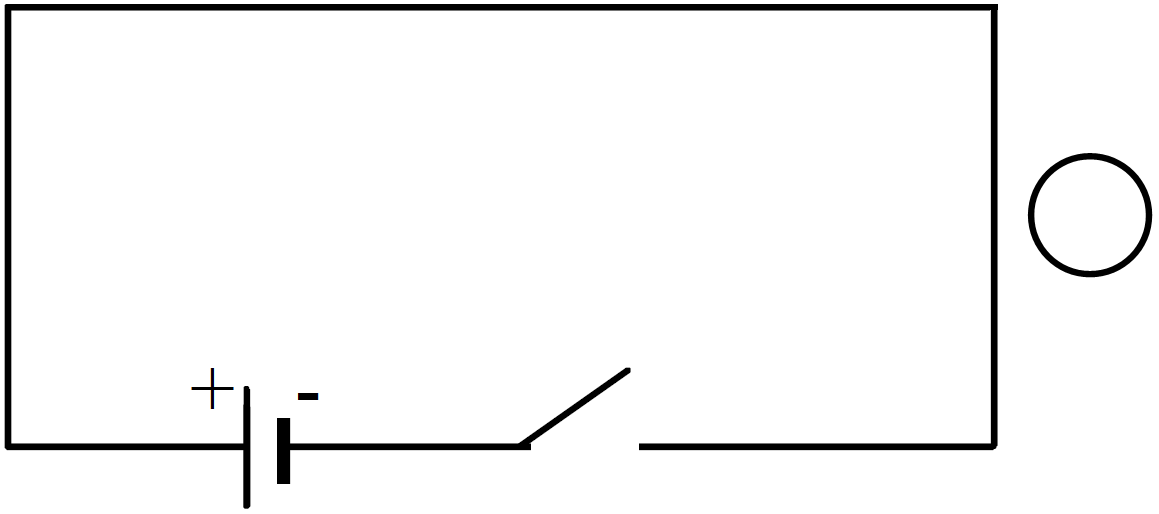
Consider the situation shown in figure. If the switch is closed and after some time it is opened again, the closed loop will show:
- A
An anticlockwise current$-$pulse.
- B
A clockwise current$-$pulse.
- C
An anticlockwise current$-$pulse and then a clockwise current$-$pulse.
- ✓
A clockwise current$-$pulse and then an anticlockwise current$-$pulse.
AnswerCorrect option: D. A clockwise current$-$pulse and then an anticlockwise current$-$pulse.
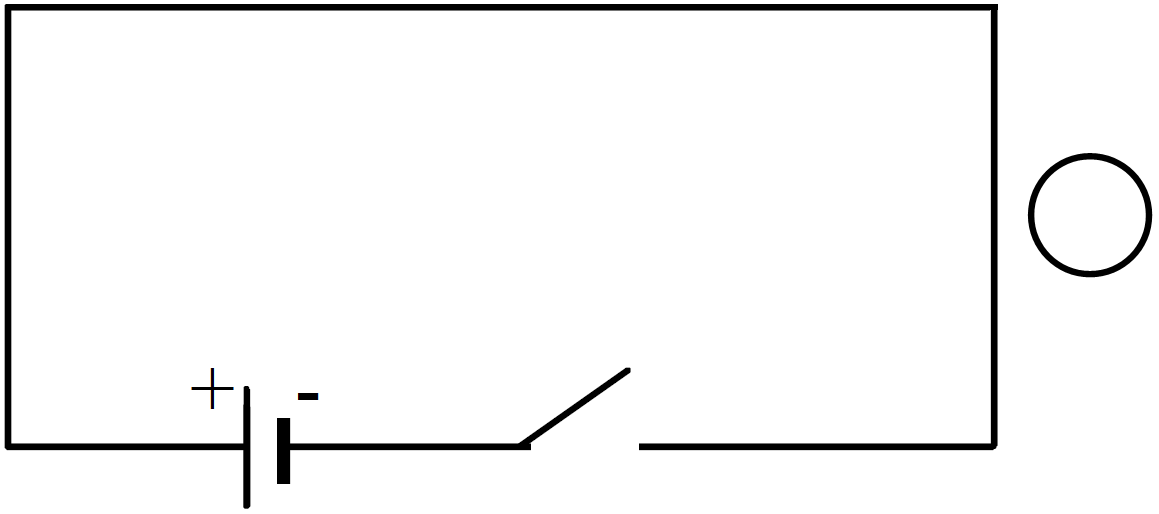
When the switch is closed than a clock wise current pulse generated $($Because initially current flow the terminal to negative terminal$).$
Due to Mutual Induction, current is generated in the loop. If circuit is open after some time. Dut to loop an anticlock wise current pulse generated in the circuit.
View full question & answer→MCQ 281 Mark
Consider the following statements:
- An emf can be induced by moving a conductor in a magnetic field.
- An emf can be induced by changing the magnetic field.
- ✓
Both $A$ and $B$ are true.
- B
$A$ is true but $B$ is false.
- C
$B$ is true but $A$ is false.
- D
Both $A$ and $B$ are false.
AnswerCorrect option: A. Both $A$ and $B$ are true.
$Þ$ An emf con be induced by moving a condcutor in a magnetic field.
$\hat{\text{I}}=\text{Bvl}$
$Þ$ An emf can be induced by charging the magnetic field.
$\in=\frac{-\text{d}\phi}{\text{dt}} \phi\rightarrow\text{flux}$
View full question & answer→MCQ 291 Mark
A conducting rod of length $L$ is falling with velocity $v$ perpendicular to a uniform horizontal magnetic field $B$. The potential difference between its two ends will be.
- A
$2BLv$
- ✓
$BLv$
- C
$\frac{1}{2}\text{BLv}$
- D
$(BLv)^2$
AnswerForce on $a$ charge $q$ in the rod $= qvB$
electric field inside the rod due to displacements of charges due to force by relative motion in magnetic field $=\frac{\text{emf}}{1}$
As the rod moves in constant velocity, net force of constituent charge $q$ in the rod $= 0$
Therefore,
$\text{q}\frac{\text{emf}}{1}=\text{qvB}$
$\Rightarrow\text{emf}=\text{BIv}$
View full question & answer→MCQ 301 Mark
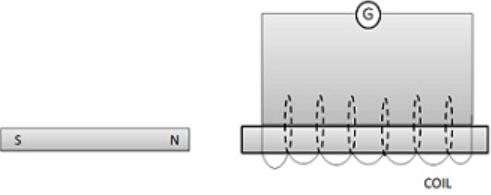
Refer to the figure. When does the the galvanometer $(G)$ deflect?
- ✓
The magnet is pushed into the coil
- B
The magnet is rotated into the coil
- C
The magnet is stationary at the centre of the coil.
- D
The number of turns in the coil is reduced.
AnswerCorrect option: A. The magnet is pushed into the coil
The deflection in the galvanometer $(G)$ occurs, when the magnet is pushed into the coil. This is because the relative motion between the two induces an emf into the coil.
View full question & answer→MCQ 311 Mark
If a current increases from zero to one ampere in $0.1$ second in a coil of $5\ mH$, then the magnitude of the induced $e.m.f.$ will be.
- A
$0.005\ volt$
- B
$0.5\ volt$
- ✓
$0.05\ volt$
- D
$5\ volt$
AnswerCorrect option: C. $0.05\ volt$
$\in=\text{L}\times(\text{rate of change of current})$
$=\frac{(5\times10^{-3})}{(\frac{1}{0.1})}$
$=0.05\text{V}$
View full question & answer→MCQ 321 Mark
The value of mutual inductance can be increased by.
- A
decreasing $N$
- ✓
increasing $N$
- C
winding the coil on wooden frame
- D
winding the coil on china clay
AnswerCorrect option: B. increasing $N$
$\text{M}=\mu\text{N}_1\text{N}_2\frac{\text{Area}_{12}}{\text{length}_{12}}$
Area$_{12} -$ area in common to both the coils where the flux links both of them together.
length$_{12} -$ length in common to both the coils where the flux links both of them together.
Therefore to increase the mutual inductance, the number of turns can be increased.
View full question & answer→MCQ 331 Mark
An ac generator consists of a coil of $200$ turns, $100\ cm$ in diameter. If the coil rotates at$ 500$ rpm in a magnetic field of $0.25T,$ then the maximum induced emf.
- A
$20.6 V$
- B
$51.7 V$
- C
$4.1 V$
- ✓
Answer$emf =$ rate of change of flux
$=200\times\pi0.5^2\times0.25\times500\times\frac{2\pi}{60}$
$=2056.17\text{V}$
View full question & answer→MCQ 341 Mark
The area of a coil is $500 cm^2$ and the number of turns in it is $2000$ . It is kept perpendicular to a magnetic field of induction $4 \times 10-5 Wb / m ^2$. The coil is rotated through $180$ in $0.1$ second. If the resistance of the total circuit is $20 \Omega$, then the value of the induced charge flowing in the circuit will be :
- A
$1 \times 10^{-4} C$
- B
$2 \times 10^{-4} C$
- C
$3 \times 10^{-4} C$
- ✓
$4 \times 10^{-4} C$
AnswerCorrect option: D. $4 \times 10^{-4} C$
d. $4 \times 10^{-4} C$
Explanation:
Initial flux through the coil, $=\text{BA}\cos\theta$
$=\text{BA}\cos0^\circ$ as the coil is perpendicular to magnetic field
= BA Wb
Final flux after the rotation,
$=\text{BA}\cos180^\circ$ the coil is rotated through $180^o$
=-BA Wb
Therefore, estimated value of the induced emf (E) as per Faraday's law is,
$\text{E}=\frac{\text{N}}{\text{t}}=\frac{\text{N}(\text{BA-(-BA}))}{\text{t}}=\frac{\text{2NBA}}{\text{t}}........(\text{i})$
Further, $\text{E}=\text{IR}=\frac{\text{QR}}{\text{t}}............(\text{ii})$
From (i) & (ii)
$\text{Q}=\frac{\text{2NBA}}{\text{R}}=\frac{2\times2000\times4\times10^{-5}\times500\times10^{-4}}{20}=4\times10^{-4}\text{C}$
View full question & answer→MCQ 351 Mark
Two coils of self inductances $2$ mH and $8$ mH are placed so close together that the effective flux in one coil is completely linked with the other. The mutual inductance between these coils is:
- A
$10 mH$
- B
$6 mH$
- ✓
$4 mH$
- D
$16 mH$
AnswerCorrect option: C. $4 mH$
$c. 4 mH$
Explanation:
Given,
$L ^1 =2 mH$
$L ^2 =8 mH$
The mutual inductance between coil is
$M =\sqrt{ L _1 L_2}$
$M =\sqrt{2 \times 8}=16 mH$
$M =4 mH$
View full question & answer→MCQ 361 Mark
A coil has $100$ turns. When a current of $5A$ produces a magnetic flux of $1\mu\text{Wb}$, the coefficient of self induction is :
- A
$10\mu\text{H}$
- ✓
$20\mu\text{H}$
- C
$30\mu\text{H}$
- D
$40\mu\text{H}$
AnswerCorrect option: B. $20\mu\text{H}$
$\text{N}\phi=\text{Li}$
$\text{L}=\frac{\text{N}\phi}{\text{i}}$
$=\frac{100\times1\times10^{-6}}{5}$
$=20\times10^{-6}\text{H}$
$=20\mu\text{H}$
View full question & answer→MCQ 371 Mark
Which of the following uses the principle of electromagnetic induction?
AnswerThe change in magnetic field lines associated with a coil is the cause of induced electric current in it. This is the principle of Electromagnetic induction. This change can be achieved by:
by moving the coil in a magnetic field or
by changing the magnetic field around the coil.
Electric generator uses this principle in which a coil rotates in a magnetic field such that the current is induced in it due to the change in magnetic field lines linked with it.
View full question & answer→MCQ 381 Mark
A small circular coil of radius $1\ cm$ and number of turns $100$ is placed inside a long solenoid of radius $5\ cm$ and number of turns $8per \ cm$. The axis of the coil is parallel to the solenoid axis. Then, the coefficient of mutual inductance of the two coils is $($in milli Henry$).$
- ✓
$0.032$
- B
$0.064$
- C
$0.016$
- D
AnswerCorrect option: A. $0.032$
Field inside solenoid $=\text{B}=\mu\text{Ni}$
$N -$ number of turns per length in solenoid $=\frac{800}{\text{m}}$
Flux linking the smaller coil $=\lambda=100\times\pi\text{r}^2\text{B}=100\times\pi\text{r}^2\mu\text{Ni}$
mutual inductance $=\text{M}=\frac{\lambda}{\text{i}}=100\times\pi\text{r}^2\mu\text{N}=3.15\text{mH}$
View full question & answer→MCQ 391 Mark
How many meters of a thin wire are required to design a solenoid of length $1m$ and $L = 1\ mH$? Assume cross$-$sectional diameter is very small.
- A
$10m$
- B
$40m$
- C
$70m$
- ✓
$100m$
AnswerCorrect option: D. $100m$
Length of the wire $\text{I}=\text{nI}_02\pi\text{r and } \text{L}=\mu_0\text{n}^2\text{I}_0\pi\text{r}^2$
or $\text{n}=\sqrt\frac{\text{L}}{\mu_0\text{I}_0\pi\text{r}^2}$
Thus, $\text{I}=\sqrt{\frac{\text{L}}{\mu_0\text{I}_0\pi\text{r}^2}}\text{r}_02\pi\text{r}$
$2\pi\text{r}=\sqrt{\frac{\text{LI}_04\pi}{\mu_0}}$
$=\sqrt{\frac{10^{-3}\times1\times4\pi}{4\pi\times10^{-7}}}=100\text{m}$
View full question & answer→MCQ 401 Mark
When the current changes from $+2A to -2A$ in $0.05$ second, an $e.m.f.$ of $8V$ is induced in a coil. The coefficient of self$-$induction of the coil is:
- A
$0.2H$
- B
$0.4H$
- C
$0.8H$
- ✓
$0.1H$
AnswerCorrect option: D. $0.1H$
lf e is the induced $e.m.f.$ in the coil, then $\text{e}=\text{-L}\frac{\text{di}}{\text{dt}}$
$\therefore\text{L}=-\frac{\text{e}}{\frac{\text{di}}{\text{dt}}}$
Substituting values, we get $\text{L}=\frac{-8\times0.05}{-4}=0.1\text{H}$
View full question & answer→MCQ 411 Mark
Comment on the statement given below: In self$-$inductionWhen the current in a coil is increasing, induced emf opposes it
When the current in a coil is decreasing, induced emf supports it
- ✓
$A$ is true, $B$ is false
- B
$A$ and $B$ are false
- C
$A$ and $B$ are true
- D
$A$ is false, $B$ is true
AnswerCorrect option: A. $A$ is true, $B$ is false
In self-induction,induced emf always opposes when the current in a coil is changing either increasing or decreasing.
So, $A$ is true, $B$ is false because when the current in a coil is increasing or decreasing, induced emf opposes it.
View full question & answer→MCQ 421 Mark
A train is moving towards north with a speed of $180$ kilometers per hour. If the vertical component of the earths magnetic filed is $0.2 \times 10^{-4} T$, the emf induced in the axle of length $1.5 m$ is
- ✓
$1.5mV$
- B
$15mV$
- C
$54mV$
- D
$5.4mV$
AnswerCorrect option: A. $1.5mV$
$emf = BlV$
$=0.2\times10^{-4}\times1.5\times180\times\frac{1000}{3600}$
$=1.5\times10^{-3}\text{V}$.
$=1.5\text{mV}$
View full question & answer→MCQ 431 Mark
An electron is moving in a circular orbit of radius $R$ with an angular acceleration $\alpha$ At the center of the orbit is kept a conducting loop of radius , $(r < r)$
AnswerCorrect option: B. $\frac{\mu_0\text{er}^2}{4\text{R}}\alpha$
Using the formulas$-$
$\text{I}=\frac{\text{e}}{\text{T}}=\frac{\text{e}\omega}{2\pi}$
$B$ at center $=\frac{\mu_0}{2\text{R}}=\frac{\mu_0\text{e}\omega}{4\pi\text{R}}$
$\phi=\text{B}.\pi\text{r}^2=\frac{\mu_0}{4\pi\text{R}}\text{e}\omega\pi\text{r}^2$
$=\frac{\mu_0\text{e}\omega\text{r}^2}{4\text{R}}$
$\text{e}=-\frac{\text{d}\phi}{\text{dt}}=\frac{\mu\text{e}\text{r}^2\alpha}{4\text{R}}$
View full question & answer→MCQ 441 Mark
When rate of change of current in a circuit is unity, the induced emf is equal to.
- A
total flux linked with the coil.
- B
- C
number of turns in the circle.
- ✓
coefficient of self induction.
AnswerCorrect option: D. coefficient of self induction.
Induced emf is equal to
$\text{emf}=\frac{\text{d}(\text{N}\phi)}{\text{dt}}=\frac{\text{-d}(\text{Li})}{\text{dt}}=-\text{L}\frac{\text{di}}{\text{dt}}$
So, when rate of change of current is equal to unity, emf is equal to coefficent of self inductance.
View full question & answer→MCQ 451 Mark
An electromagnetic field exists only when there is.
AnswerAn electromagnetic field exists only when there is current. electric current flowing through a wire caused a nearby compass to deflect. $...$ In most conductors, the magnetic field exists only as long as the current is flowing $($i.e. an electrical charge is in motion$).$
View full question & answer→MCQ 461 Mark
The self inductance $L$ of $a$ solenoid of length $l$ and area of crosssection A, with a fixed number of turns $N$ increases as:
- A
$l$ and $A$ increase.
- ✓
$l$ decreases and $A$ increases.
- C
$l$ increases and $A$ decreases.
- D
Both $l$ and $A$ decrease.
AnswerCorrect option: B. $l$ decreases and $A$ increases.
Key concept: The self inductance $L$ of $a$ solenoid depends on various factor like geometry and magnetic permeability of the core material.
$\text{L}=\mu_\text{r}\mu_0\text{n}^2\text{Al}$
where, $\text{n}=\frac{\text{N}}{\text{l}} ($no. of turns per unit length$)$
- No. of turns: Larger the number of turns in solenoid, larger is its self inductance.
- Area of cross section: Larger the area of cross section of the solenoid, larger is its self inductance.
- Permeability of the core material. The self inductance of a solenoid increases $μr$ times if it is wound over an iron core of relative permeability $μr$.
The long solenoid of cross$-$sectional area $A$ and length $l$, having $A$ turns, filled inside of the solenoid with a material of relative permeability $($e.g., soft iron, which has a high value of relative permeability$)$ then its self inductance is $\text{L}=\mu_\text{r}\mu_0\text{n}^2\frac{\text{A}}{\text{l}}$.
So, the self inductance $L$ of a solenoid increases as $l$ decreases and $A$ increases because $L$ is directly proportional to area and inversely proportional to length.
Important point: The self and mutual inductance of capacitance and resistance depend on the geometry of the devices as well as permittivity/permeability of the medium.
View full question & answer→MCQ 471 Mark
Two coils are at fixed locations. When coil $1$ has no current and the current in coil $2$ increases at the rate of $15.0 As ^{-1}$, the emf in coil $1$ is $25 \ mV$ . When coil $2$ has no current and coil $1$ has a current of $3.6$ A , the flux linkage in coil $2$ is.
- A
$16\ mWb$
- B
$10\ mWb$
- C
$4.00\ mWb$
- ✓
$6.00\ mWb$
AnswerCorrect option: D. $6.00\ mWb$
$\mid\text{M}\mid=\frac{\text{e}_1}{\big(\frac{\text{di}_2}{\text{dt}}\big)}=\frac{\phi_2}{\text{i}_1}$
$\therefore\phi_2=\frac{\text{e}_1\text{i}_1}{(\frac{\text{di}^2}{\text{dt}})}=\frac{(25.0\times10^{-3})(3.6)}{(15)}$
$=6\times10^{-3}=6\text{mWb}$
View full question & answer→MCQ 481 Mark
The average self-induced emf in a $25\ mH$ solenoid when the current in it falls from $0.2A$ to $0A$ in $0.01$ second, is
- A
$0.05V$
- ✓
$0.5V$
- C
$500V$
- D
$50V$
AnswerCorrect option: B. $0.5V$
$\text{emf}=\text{L}\frac{\text{di}}{\text{dt}}$
$=25\times10^{-3}\times\frac{0.2}{0.01}$
$=0.5\text{V}$
View full question & answer→MCQ 491 Mark
The self inductance of a motor of an electric fan is $10H$. In order to impart maximum power at $50\ Hz$, it should be connected to a capacitance of:
- A
$4\mu\text{F}$
- B
$8\mu\text{F}$
- ✓
$1\mu\text{F}$
- D
$2\mu\text{F}$
AnswerCorrect option: C. $1\mu\text{F}$
Maximum power is transferred at resonance.
$\therefore\text{f}_0=\frac{1}{2\pi\sqrt{\text{LC}}}$
$\text{or C}=\frac{1}{4\pi^2\text{f}^2_0\text{L}}=\frac{1}{4\times10\times(50)^2\times10}$
$=10^{-6}\text{F}=1\mu\text{F}$
View full question & answer→MCQ 501 Mark
To obtain maximum $\text{EMF}$ from a number of cells, they must be connected in.
AnswerA. Series Cells in Series connection.
In series, cells are joined end to end so that the same current flows through each cell. In case if the cells are connected in series the emf of the battery connected to the sum of the emf of the individual cell, If $E$ is the overall emf of the battery combined with n number cells and $E1, E2,......Em$ is the $\text{EMFs}$ of individual cell Then $E = E1 + E2+.....+Em.$
View full question & answer→