Questions · Page 2 of 2

5 Marks Questions

Question 515 Marks
A capacitor having a capacitance of $100\mu\text{F}$ is charged to a potential difference of 24V. The charging battery is disconnected and the capacitor is connected to another battery of emf 12V with the positive plate of the capacitor joined with the positive terminal of the battery:
  1. Find the charges on the capacitor before and after the reconnection.
  2. Find the charge flown through the 12V battery.
  3. Is work done by the battery or is it done on the battery? Find its magnitude.
  4. Find the decrease in electrostatic field energy.
  5. Find the heat developed during the flow of charge after reconnection.
Answer
  1. Before reconnection
$\text{C}=100\mu\text{f}$

$\text{V}=24\text{V}$

$\text{q}=\text{CV}=2400\mu\text{C}$ (Before reconnection)

After connection

When $\text{C}=100\mu\text{f}$

$\text{V}=12\text{V}$

$\text{q}=\text{CV}=1200\mu\text{C}$ (After connection)
  1. C = 100, V = 12V
$\therefore$ q = CV = 1200v
  1. We know $\text{V}=\frac{\text{W}}{\text{q}}$
W = vq = 12 × 1200 = 14400 J = 14.4 mJ

The work done on the battery.
  1. Initial electrostatic field energy $\text{U}_{\text{i}}=\Big(\frac{1}{2}\Big)\text{CV}_1^2$
Final Electrostatic field energy $\text{U}_{\text{f}}=\Big(\frac{1}{2}\Big)\text{CV}_2^2$

$\therefore$ Decrease in Electrostatic

Field energy $=\Big(\frac{1}2{}\Big)\text{CV}_1^2-\Big(\frac{1}2{}\Big)\text{CV}_2^2$

$=\Big(\frac{1}{2}\Big)\text{C}(\text{V}_1^2-\text{V}_2^2)$

$=\Big(\frac{1}{2}\Big)\times100(576-144)=21600\text{J}$

$\therefore$ Energy = 21600j = 21.6mJ
  1. After reconnection
$\text{C}=100\mu\text{c},\ \text{V}=12\text{v}$

$\therefore$ The energy appeared $=\Big(\frac{1}{2}\Big)\times100\times144$

$=7200\text{J}=7.2\text{mJ}$

This amount of energy is developed as heat when the charge flow through the capacitor.
View full question & answer
Question 525 Marks
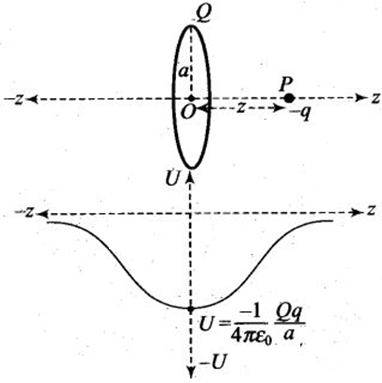
Calculate potential energy of a point charge -q placed along the axis due to a charge +Q uniformly distributed along a ring of radius R. Sketch P.E. as a function of axial distance z from the centre of the ring. Looking at graph, can you see what would happen if -q is displaced slightly from the centre of the ring (along the axis)?
Answer
The potential energy (U) of a point charge q placed at-potential V, U = qV In our case a negative charged particle is placed at the axis of a ring having charge Q. Let the ring has radius a, the electric potential at an axial distance z from the centre of the ring is $\text{V}=\frac{1}{4\pi\in_0}\frac{\text{Q}}{\sqrt{\text{z}^2+\text{a}^2}}$ Hence potential energy of a point charge -q is $\text{U}=\text{qV}=(-\text{q})\bigg[\frac{1}{4\pi\in_0}\frac{\text{Q}}{\sqrt{\text{z}^2+\text{a}^2}}\bigg]$ $\text{U}=-\frac{1}{4\pi\in_0}\frac{\text{Qq}}{\sqrt{\text{z}^2+\text{a}^2}}=\frac{1}{4\pi\in_0\text{a}}\frac{-\text{Qq}}{\sqrt{1+\Big(\frac{\text{z}}{\text{a}}\Big)^2}}$ At $\text{z}=0,\text{U}=-\frac{1}{4\pi\in_0}\frac{\text{Qq}}{\text{a}}$ At $\text{z}\rightarrow\infty,\text{U}\rightarrow0$
The variation of potential energy with z is shown in the figure. The charge -q displaced would perform oscillations. Nothing can be concluded just by looking at the graph.
View full question & answer
Question 535 Marks
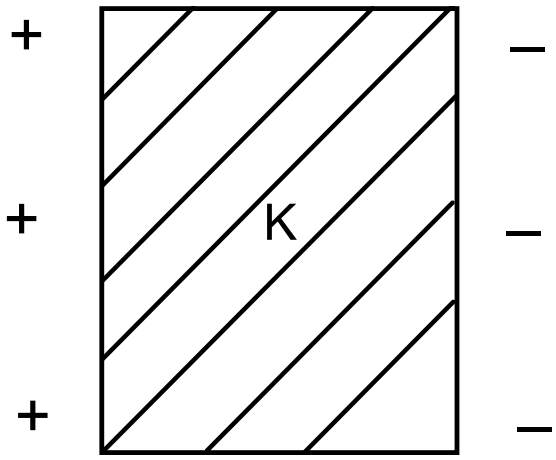
A parallel-plate capacitor of plate area A and plate separation d is charged to a potential difference V and then the battery is disconnected. A slab of dielectric constant K is then inserted between the plates of the capacitor so as to fill the space between the plates. Find the work done on the system in the process of inserting the slab.
Answer
Before inserting
$\text{C}=\frac{\in_0\text{A}}{\text{d}}\text{C}$
$\text{Q}=\frac{\in_0\text{AV}}{\text{d}}\text{C}$
After inserting
$\text{C}=\frac{\in_0\text{A}}{\frac{\text{d}}{\text{k}}}=\frac{\in_0\text{Ak}}{\text{d}}$
$\text{Q}_1=\frac{\in_0\text{Ak}}{\text{d}}\text{V}$

The charge flown through the power supply
$\text{Q}=\text{Q}_1-\text{Q}$
$=\frac{\in_0\text{AkV}}{\text{d}}-\frac{\in_0\text{AV}}{\text{d}}=\frac{\in_0\text{AV}}{\text{d}}(\text{k}-1)$
Workdone = Charge in emf
$=\frac{1}2{}\frac{\text{q}^2}{\text{C}}=\frac{1}{2}\frac{\frac{\in_0^2\text{A}^2\text{V}^2}{\text{d}^2}(\text{k}-1)^2}{\frac{\in_0\text{A}}{\text{d}}(\text{k}-1)}$
$=\frac{\in_0\text{AV}^2}{2\text{d}}(\text{k}-1)$
View full question & answer
Question 545 Marks
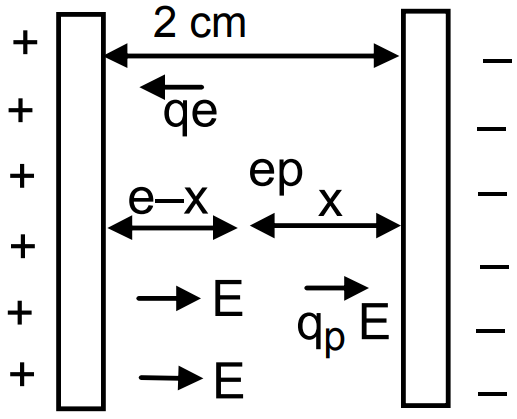
The plates of a capacitor are 2.00cm apart. An electronproton pair is released somewhere in the gap between the plates and it is found that the proton reaches the negative plate at the same time as the electron reaches the positive plate. At what distance from the negative plate was the pair released?
Answer

The acceleration of electron $\text{a}_{\text{e}}=\frac{\text{qeme}}{\text{Me}}$
The acceleration of proton $=\frac{\text{qpe}}{\text{Mp}}=\text{ap}$
The distance travelled by proton $\text{X}=\frac{1}{2}\text{apt}^2\ \dots(1)$
The distance travelled by electron ...(2)
From (1) and (2)
$\Rightarrow2-\text{X}=\frac{1}{2}\text{a}_{\text{c}}\text{t}^2$
$\text{x}=\frac{1}{2}\text{a}_{\text{c}}\text{t}^2$
$\Rightarrow\frac{\text{x}}{2-\text{x}}=\frac{\text{a}_{\text{p}}}{\text{a}_{\text{c}}}=\frac{\big(\frac{\text{q}_{\text{p}\text{E}}}{\text{M}_{\text{p}}}\big)}{\big(\frac{\text{q}_{\text{c}\text{F}}}{\text{M}_{\text{c}}}\big)}$
$=\frac{\text{x}}{2-\text{x}}=\frac{\text{M}_{\text{c}}}{\text{M}_{\text{p}}}=\frac{9.1\times10^{-31}}{1.67\times10^{-27}}$
$=\frac{9.1}{1.67}\times10^{-4}=5.449\times10^{-4}$
$\Rightarrow\text{x}=10.898\times10^{-4}-5.449\times10^{-4}\text{x}$
$\Rightarrow\text{x}=\frac{10.898\times10^{-4}}{1.0005449}=0.001089226$
View full question & answer
Question 555 Marks
A capacitor is made of two circular plates of radius R each, separated by a distance d < < R. The capacitor is connected to a constant voltage. A thin conducting disc of radius r < < R. and thickness t < < r is placed at a centre of the bottom plate. Find the minimum voltage required to lift the disc if the mass of the disc is m.
Answer
Initially the thin conducting’disc is placed at the centre of the bottom plate, the potential of the disc will be equal to potential of the disc. The disc will be lifted if weight is balanced by electrostatic force. The electric field on the disc, when potential difference V is applied across it
is given by $\text{E}=\frac{\text{V}}{\text{d}}$
Let charge q' is transferred to the disc during the process,
$\therefore\ \text{q}'=-\in_0\frac{\text{V}}{\text{d}}\pi\text{r}^2$
The force acting on the disc is
$\text{F}_\text{electric}=-\frac{\text{V}}{\text{d}}\times\text{q}'=\in_0\frac{\text{V}^2}{\text{d}^2}\pi\text{r}^2$
If the disc is to be lifed, then $F_{electric} = mg$
$\in_0\frac{\text{V}^2}{\text{d}^2}\pi\text{r}^2=\text{mg}\Rightarrow\ \text{V}=\sqrt{\frac{\text{mgd}}{\pi\in_0\text{r}^2}}$
This is the required expression.
View full question & answer
Question 565 Marks
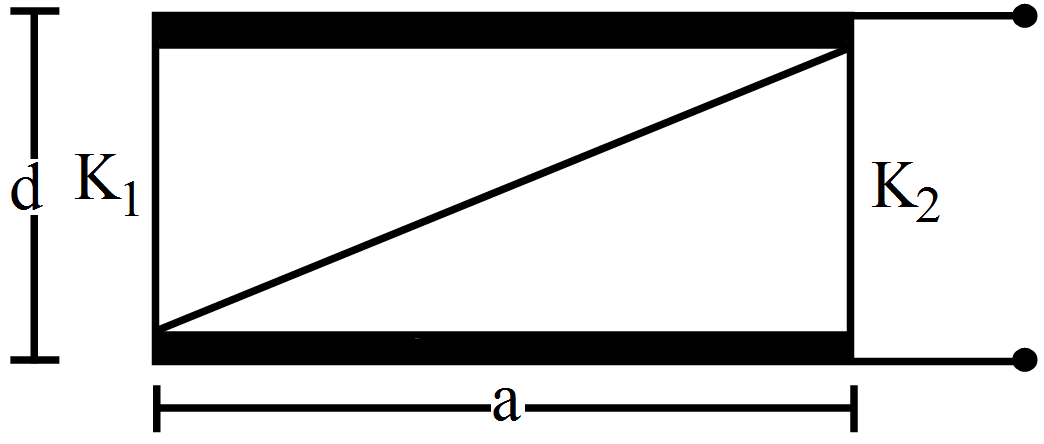
A capacitor is formed by two square metal-plates of edge a, separated by a distance d. Dielectrics of dielectric constants $K_1$ and $K_2$ are filled in the gap as shown in figure. Find the capacitance.
Answer


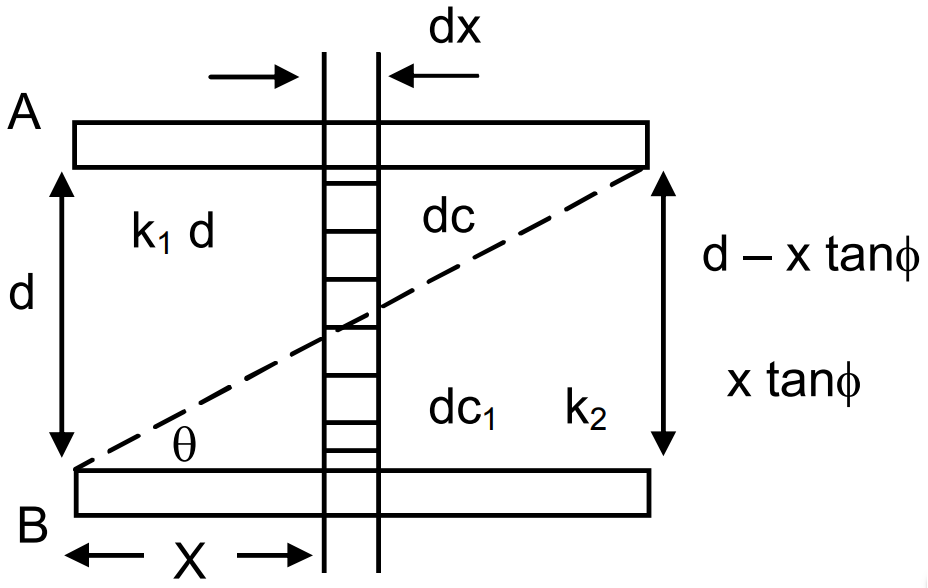
Consider an elemental capacitor of with dx our at a distance ‘x’ from one end. It is constituted of two capacitor elements of dielectric constants $k_1$ and $k_2$ with plate separation $\text{x}\tan\phi$ and $\text{d}-\text{x}\tan\phi$ respectively in series.
$\frac{1}{\text{dcR}}=\frac{1}{\text{dc}_1}+\frac{1}{\text{dc}_2}=\frac{\text{x}\tan\phi}{\in_0\text{k}_2(\text{bdx})}+\frac{\text{d}-\text{x}\tan\phi}{\in_0\text{k}_1(\text{bdx})}$
$\text{dcR}=\frac{\in_0\text{bdx}}{\frac{\text{x}\tan\phi}{\text{k}_2}+\frac{(\text{d}-\text{x}\tan\phi)}{\text{k}_1}}$
$\text{C}_{\text{R}}=\in_0\text{bk}_1\text{k}_2\int\frac{\text{dx}}{\text{k}_2\text{d}+(\text{k}_1+\text{k}_2)\text{x}\tan\phi}$
$=\frac{\in_0\text{bk}_1\text{k}_2}{\tan\phi(\text{k}_1-\text{k}_2)}[\log_{\text{e}}\text{k}_2\text{d}+(\text{k}_1+\text{k}_2)\text{x}\tan\phi]\text{a}$
$=\frac{\in_0\text{bk}_1\text{k}_2}{\tan\phi(\text{k}_1-\text{k}_2)}[\log_{\text{e}}\text{k}_2\text{d}+(\text{k}_1+\text{k}_2)\text{a}\tan\phi-\log_{\text{e}}\text{k}_2\text{d}]$
$\therefore\tan\phi=\frac{\text{c}}{\text{a}}$ and $\text{A}=\text{a}\times\text{a}$
$\text{C}_{\text{R}}=\frac{\in_0\text{ak}_1\text{k}_2}{\frac{\text{d}}{\text{a}}(\text{k}_1-\text{k}_2)}$ $\Big[\log_{\text{e}}\Big(\frac{\text{k}_1}{\text{k}_2}\Big)\Big]$
$\text{C}_{\text{R}}=\frac{\in_0\text{a}^2\text{k}_1\text{k}_2}{\text{d}(\text{k}_1-\text{k}_2)}$ $\Big[\log_{\text{e}}\Big(\frac{\text{k}_1}{\text{k}_2}\Big)\Big]$
$\text{C}_{\text{R}}=\frac{\in_0\text{a}^2\text{k}_1\text{k}_2}{\text{d}(\text{k}_1-\text{k}_2)}$ $\text{ln}\frac{\text{k}_1}{\text{k}_2}$
View full question & answer
Question 575 Marks
Two charges -q each are separated by distance 2d. A third charge +q is kept at mid point O. Find potential energy of +q as a function of small distance x from O due to -q charges. Sketch P.E. v/s x and convince yourself that the charge at O is in an unstable equilibrium.
Answer
$\text{U}=\frac{1}{4\pi\in_0}\left\{\frac{-\text{q}^2}{(\text{d}-\text{x})}+\frac{-\text{q}^2}{(\text{d}+\text{x})}\right\}$
$\Rightarrow\ \text{U}=\frac{-\text{q}^2}{4\pi\in_0}\frac{2\text{q}}{(\text{d}^2-\text{x}^2)}$
$\Rightarrow\ \frac{\text{dU}}{\text{dx}}=\frac{-\text{q}^2 2\text{d}}{4\pi\in_0}\frac{2\text{x}}{(\text{d}^2-\text{x}^2)^2}$
Here, $\frac{\text{dU}}{\text{dx}}=0$ at x = 0
x is an equilibrium point.
$\frac{\text{d}^2\text{U}}{\text{dx}^2}=\bigg(\frac{-2\text{dq}^2}{4\pi\in_0}\bigg)\Bigg[\frac{2}{(\text{d}^2-\text{x}^2)^2}-\frac{8\text{x}^2}{(\text{d}^2-\text{x}^2)^3}\Bigg]$
$=\bigg(\frac{-2\text{dq}^2}{4\pi\in_0}\bigg)\frac{1}{(\text{d}^2-\text{x}^2)^3}\bigg[2(\text{d}^2-\text{x}^2)^2-8\text{x}^2\bigg]$
At, x = 0
$\frac{\text{d}^2\text{U}}{\text{dx}^2}=\bigg(\frac{-2\text{dq}^2}{4\pi\in_0}\bigg)\bigg(\frac{1}{\text{d}^6}\bigg)(2\text{d}^2),\text{ which is}<0$
So, unstable equilibrium.
View full question & answer
Question 585 Marks
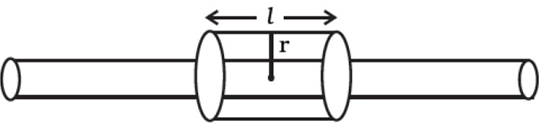
Find the equation of the equipotentials for an infinite cylinder of radius $r_0$, carrying charge of linear density $\lambda$.
Answer
To find the potential at distance r from the line consider the electric field. We note that from symmetry the field lines must be radially outward. Draw a cylindrical Gaussian surface of radius rand length. Then

$\int\text{E.dS}=\frac{1}{\in_0}\lambda\text{l}$
or $\text{E}_\text{r}2\pi\text{rl}=\frac{1}{\in_0}\lambda\text{l}\Rightarrow\ \text{E}_\text{r}=\frac{\lambda}{2\pi\in_0\text{r}}$
Hence, if r0 is the radius, $\text{V}(\text{r})-\text{V}(\text{r}_0)=-\int_{\text{r}_0}^\text{r}\text{E.dl}=\frac{\lambda}{2\pi\in_0}$ In $\frac{\text{r}_0}{\text{r}}$
For a given V,
In $\frac{\text{r}}{\text{r}_0}=-\frac{2\pi\in_0}{\lambda}\big[\text{V(r)}-\text{V(r)}_0\big]$
$\Rightarrow\ \text{r}=\text{r}_0\text{e}^{-2\pi\in_0\big[\text{V(r)}-\text{V(r)}_0\big]/\lambda}$
The equipotential surfaces are cylinders of radius, $\text{r}=\text{r}_{0}\text{e}^{-2\pi\in_0\big[\text{V(r)}-\text{V(r)}_0\big]/\lambda}$
View full question & answer
Question 595 Marks
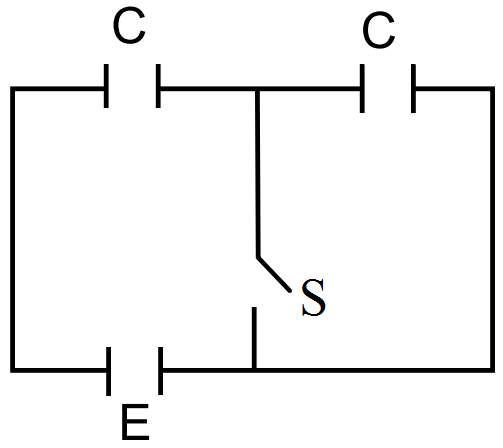
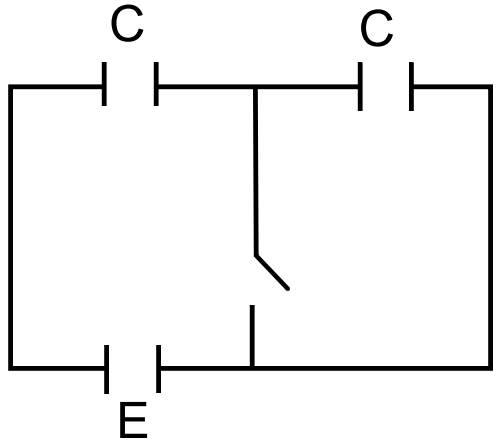
Consider the situation shown in figure. The switch S is open for a long time and then closed:
  1. Find the charge flown through the battery when the switch S is closed.
  2. Find the work done by the battery.
  3. Find the change in energy stored in the capacitors.
  4. Find the heat developed in the system.
Answer
  1. Since the switch was open for a long time, hence the charge flown must be due to the both, when the switch is closed.
$\text{C}_\text{ef}=\frac{\text{C}}{2}$

so $\text{q}=\frac{\text{E}\times\text{C}}{2}$
  1. Workdone
$=\text{q}\times\text{v}=\frac{\text{EC}}{2}\times\text{E}=\frac{\text{E}^2\text{C}}{2}$
  1. $\text{E}_{\text{i}}=\frac{1}{2}\times\frac{\text{C}}{2}\times\text{E}^2=\frac{\text{E}^2\text{C}}{4}$
$\text{E}_{\text{f}}=\frac{1}{2}\times\text{C}\times\text{E}^2=\frac{\text{E}^2\text{C}}{2}$

$\text{E}_{\text{i}}-\text{E}_{\text{j}}=\frac{\text{E}^2\text{C}}{4}$
  1. The net charge in the energy is wasted as heat.
View full question & answer
Question 605 Marks
Briefly explain the principle of a capacitor. Derive an expression for the capacitance of a parallel plate capacitor, whose plates are separated by a dielectric medium.
Answer
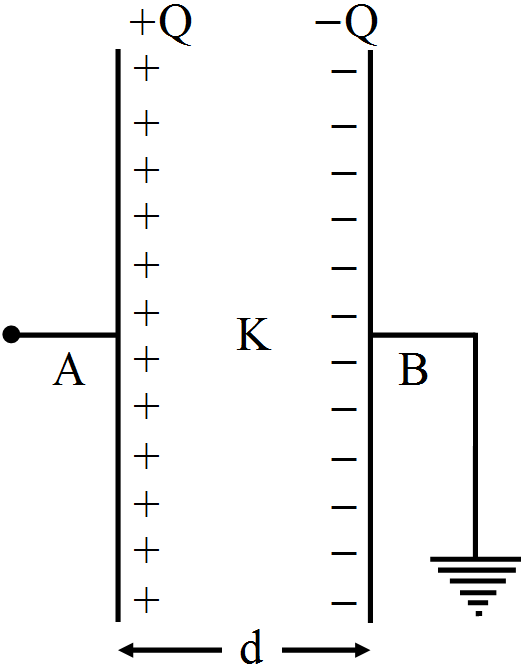
Principle of a Capacitor: A capacitor works on the principle that the capacitance of a conductor increases appreciably when an earthed conductor is brought near it. Parallel Plate Capacitor: Consider a parallel plate capacitor having two plane metallic plates A and B, placed parallel to each other (see fig.). The plates carry equal and opposite charges +Q and -Q respectively. In general, the electric field between the plates due to charges +Q and -Q remains uniform, but at the edges, the electric field lines deviate outward. If the separation between the plates is much smaller than the size of plates, the electric field strength between the plates may be assumed uniform.
Let A be the area of each plate, ‘d’ the separation between the plates, K the dielectric constant of medium between the plates. If $\sigma$ is the magnitude of charge density of plates, then, $\sigma=\frac{\text{Q}}{\text{A}}$ The electric field strength between the plates, $\text{E}=\frac{\sigma}{\text{K}{\varepsilon}_0}$ where $=\varepsilon_0$ permittivity of free space. ....(i) The potential difference between the plates, $\text{V}_{\text{AB}}=\text{ED}=\frac{\sigma\text{d}}{\text{K}\varepsilon_0}\ ...(\text{ii})$ Putting the value of $\sigma,$ we get, $\text{V}_{\text{AB}}=\frac{\Big(\frac{\text{Q}}{\text{A}}\text{d}\Big)}{\text{K}{\varepsilon}_0}=\frac{\sigma\text{d}}{\text{K}{\varepsilon}_0\text{A}}$ $\therefore$ Capacitance of capacitor, $\text{C}=\frac{\text{Q}}{\text{V}_{\text{AB}}}=\frac{\text{Q}}{\Big(\frac{\text{Qd}}{\text{K}\varepsilon_0}\Big)}\ \text{or}\ \text{C}=\frac{\text{K}\varepsilon_0\text{A}}{\text{d}}\ ...(\text{iii)}$ This is a general expression for capacitance of parallel plate capacitor. Obviously, the capacitance is directly proportional to the dielectric constant of medium between the plates. For air capacitor (K = 1); capacitance. This is expression for the capacitance of a parallel plate air capacitor. It can be seen that the capacitance of parallel plate (air) capacitor is:
  1. Directly proportional to the area of each plate.
  2. Inversely proportional to the distance between the plates.
  3. Independent of the material of the plates.
View full question & answer
Question 615 Marks
  1. Derive an expression for equivalent capacitance of three capacitors when connected in series.
  2. Derive an expression for equivalent capacitance of three capacitors when connected in parallel.
Answer
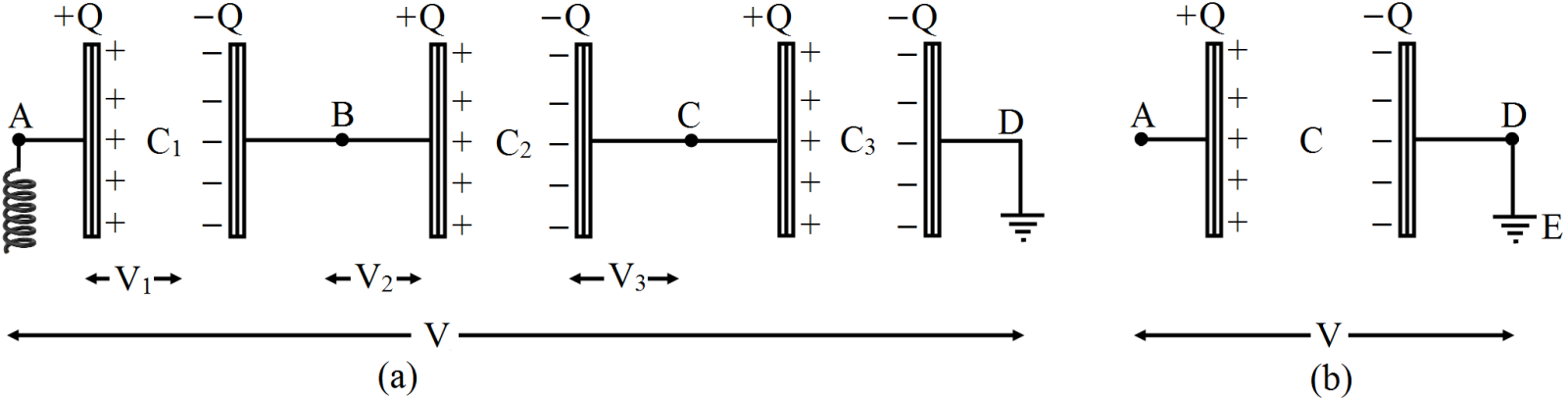
In fig. (a) Three capacitors of capacitances $C_1, C_2, C_3$ are connected in series between points A and D.
In 'series’ first plate of each capacitor has charge +Q and second plate of each capacitor has charge -Q
i.e., charge on each capacitor is Q. Let the potential differences across the capacitors $C_1, C_2, C_3$ be $V_1, V_2, V_3$ respectively.
As the second plate of first capacitor $C_1$ and first plate of second capacitor $C_2$ are connected together,
their potentials are equal. Let this common potential be $ V_B.$
Similarly the common potential of second plate of $C_2$ and first plate of $C_3$ is $V_C.$
The second plate of capacitor $C_3$ is connected to earth,
therefore its potential $V_D = 0$. As charge flows from higher potential to lower potential,
therefore $V_A > V_B > V_C > V_D.$ For the frist capacitor,
$\text{V}_1=\text{V}_\text{A}-\text{V}_\text{B}=\frac{\text{Q}}{\text{C}_1}\ ...(\text{i)}$
For the second capacitor, $\text{V}_1=\text{V}_\text{B}-\text{V}_\text{C}=\frac{\text{Q}}{\text{C}_2}\ ...(\text{ii)}$
For the third capacitor, $\text{V}_3=\text{V}_\text{C}-\text{V}_\text{D}=\frac{\text{Q}}{\text{C}_3}\ ...(\text{iii)}$ Adding (i), (ii) and (iii), we get, $\text{V}_1+\text{V}_2+\text{V}_3=\text{V}_\text{A}-\text{V}_\text{D}=\text{Q}\Big[\frac{1}{\text{C}_1}+\frac{1}{\text{C}_2}+\frac{1}{\text{C}_3}\Big]\ ...(\text{iv)}$
If V be the potential difference between A and D, then, $\text{V}_\text{A}-\text{V}_\text{D}=\text{V}$ $\therefore$ From (iv), we get, $\text{V}=\big(\text{V}_1+\text{V}_2+\text{V}_3=\text{Q}\Big[\frac{1}{\text{C}_1}+\frac{1}{\text{C}_2}+\frac{1}{\text{C}_3}\Big]\ ...(\text{v})$
If in place of all the three capacitors, only one capacitor is placed between A and D such that on giving it charge Q,
the potential difference between its plates become V,
then it will be called equivalent capacitor. If its capacitance is C,
then, $\text{V}=\frac{\text{Q}}{\text{C}}\ ...(\text{vi})$ Comparing (v) and (vi),
we get, $\frac{\text{Q}}{\text{C}}=\text{Q}\Big[\frac{1}{\text{C}_1}+\frac{1}{\text{C}_2}+\frac{1}{\text{C}_3}\Big]\ \text{Or}\ \frac{1}{\text{C}}=\frac{1}{\text{C}_1}+\frac{1}{\text{C}_2}+\frac{1}{\text{C}_3}$
View full question & answer
Question 625 Marks
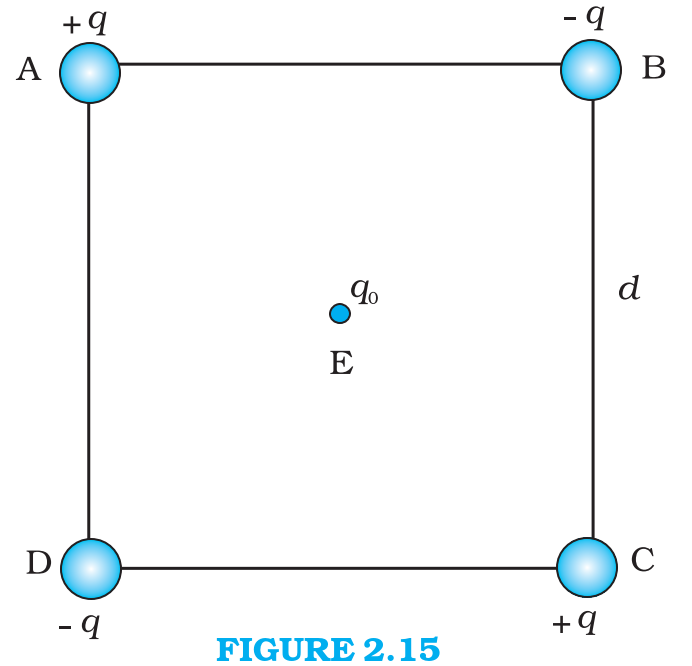
Four charges are arranged at the corners of a square $\text{ABCD}$ of side $d$, as shown in Fig. $2.15.\ (a)$ Find the work required to put together this arrangement. $(b)$ A charge $q_0$ is brought to the centre $E$ of the square, the four charges being held fixed at its corners. How much extra work is needed to do this?
Image
Answer
$(a)$ Since the work done depends on the final arrangement of the charges, and not on how they are put together, we calculate work needed for one way of putting the charges at $A, B, C$ and $D$.
Suppose, first the charge $+q$ is brought to $A$, and then the charges $-q,+q$, and $-q$ are brought to $B, C$ and $D,$  respectively.
The total work needed can be calculated in steps:
$(i)$ Work needed to bring charge $+q$ to $A$ when no charge is present elsewhere: this is zero.
$(ii)$ Work needed to bring $-q$ to $B$ when $+q$ is at $A$. This is given by $($ charge at $B ) \times($ electrostatic potential at $B$ due to charge $+q$ at $A )$
$=-q \times\left(\frac{q}{4 \pi \varepsilon_0 d}\right)=-\frac{q^2}{4 \pi \varepsilon_0 d}$
$(iii)$ Work needed to bring charge $+q$ to $C$ when $+q$ is at $A$ and $-q$ is at $B$.
This is given by $($charge at $C) \times ($potential at $C$ due to charges at $A$ and $B )$
$=+q\left(\frac{+q}{4 \pi \varepsilon_0 d \sqrt{2}}+\frac{-q}{4 \pi \varepsilon_0 d}\right)$
$=\frac{-q^2}{4 \pi \varepsilon_0 d}\left(1-\frac{1}{\sqrt{2}}\right)$
$(iv)$ Work needed to bring $-q$ to $D$ when $+q$ at $A ,-q$ at $B$, and $+q$ at $C$.
This is given by $($charge at $D) \times ($potential at $D$ due to charges at $A, B$ and $C)$
$=-q\left(\frac{+q}{4 \pi \varepsilon_0 d}+\frac{-q}{4 \pi \varepsilon_0 d \sqrt{2}}+\frac{q}{4 \pi \varepsilon_0 d}\right)$
$=\frac{-q^2}{4 \pi \varepsilon_0 d}\left(2-\frac{1}{\sqrt{2}}\right)$
Add the work done in steps $(i), (ii), (iii)$ and $(iv)$. The total work required is
$=\frac{-q^2}{4 \pi \varepsilon_0 d}\left\{(0)+(1)+\left(1-\frac{1}{\sqrt{2}}\right)+\left(2-\frac{1}{\sqrt{2}}\right)\right\}$
$=\frac{-q^2}{4 \pi \varepsilon_0 d}(4-\sqrt{2})$
The work done depends only on the arrangement of the charges, and not how they are assembled.
By definition, this is the total electrostatic energy of the charges.
$($Students may try calculating same work/energy by taking charges in any other order they desire and convince themselves that the energy will remain the same.$)$
$(b)$ The extra work necessary to bring a charge $q_0$ to the point $E$ when the four charges are at $A, B, C$ and $D$ is $q_0 \times ($electrostatic potential at $E$ due to the charges at $A , B , C$ and $D )$.
The electrostatic potential at $E$ is clearly zero since potential due to $A$ and $C$ is cancelled by that due to $B$ and $D$.
Hence, no work is required to bring any charge to point $E$.
View full question & answer