Questions · Page 1 of 2

5 Marks Questions

🎯

Test yourself on this topic

50 questions · timed · auto-graded

Question 15 Marks
A 600pF capacitor is charged by a 200V supply. It is then disconnected from the supply and is connected to another uncharged 600 pF capacitor. How much electrostatic energy is lost in the process?
Answer
Capacitance of the capacitor, C = 600 pF
Potential difference V = 200 V
Electrostatic energy stored in the capacitor is given by,
$\text{E}=\frac{1}{2}\text{CV}^2$
$=\frac{1}{2}\times(600\times10^{-12})\times(200)^2$
$= 1.2 \times 10^{-5}$ J
If supply is disconnected from the capacitor and another capacitor of capacitance C = 600 pf is connected to it, then equivalent capacitance (C') of the combination is given by,
$\frac{1}{\text{C}'}=\frac{1}{\text{C}}+\frac{1}{\text{C}}$
$=\frac{1}{600}+\frac{1}{600}=\frac{2}{600}=\frac{1}{300}$
$\therefore\text{C}'=300\ \text{pF}$
New electrostatic energy can be calculated as
$\text{E}'=\frac{1}{2}\times\text{C}'\times{\text{V}}^2$
$=\frac{1}{2}\times300\times(200)^2$
$= 0.6 \times 10^{-5}J$
Loss in electrostatic energy = E - E'
$= 1.2 \times 10^{-5} - 0.6 \times 10^{-5}$
$= 0.6 \times 10^{-5}$
$= 6 \times 10^{-6}J$
Therefore, the electrostatic energy lost in the process is $6 \times 10^{-6} J.$
View full question & answer
Question 25 Marks
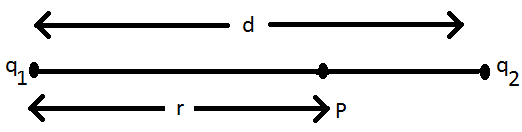
Two charges $5 \times 10^{–8} C$ and $–3 \times 10^{–8} C$ are located 16 cm apart. At what point(s) on the line joining the two charges is the electric potential zero? Take the potential at infinity to be zero.
Answer
There are two charges, $q_1 = 5 \times 10^{-8} C\ \  q_2 = -3 \times 10^{-8} C$
Distance between the two charges, d = 16 cm = 0.16 m Consider a point P on the line joining the two charges,
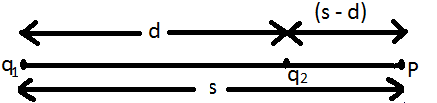
as shown in the given figure.

r = Distance of point P from charge $q_1$ Let the electric potential (V) at point P be zero.
Potential at point P is the sum of potentials caused by charges $q_1$ and $q_2$ respectively.
$\therefore\text{V}=\frac{\text{q}_1}{4\pi\in_0\text{r}}+\frac{\text{q}_2}{4\pi\in_0(\text{d}-\text{r})} \dots\dots(1)$ Where,
$∈_0 =$ Permittivity of free space For V = 0,
equation (1) reduces to $\frac{\text{q}_1}{4\pi\in_0\text{r}}=-\frac{\text{q}_2}{4\pi\in_0(\text{d}-\text{r})}$ $\frac{\text{q}_1}{\text{r}}=\frac{-\text{q}_2}{\text({d}-\text{r})}$ $\frac{5\times10^{-8}}{\text{r}}=-\frac{(-3\times10^{-8})}{(0.16-\text{r})}$ $\frac{0.16}{\text{r}}=\frac{8}{5}$
$\therefore$ r = 0.1m = 10cm
Therefore, the potential is zero at a distance of 10 cm from the positive charge between the charges.

Suppose point P is outside the system of two charges at a distance s from the negative charge,
where potential is zero, as shown in the following figure. For this arrangement, potential is given by,
$\text{V}=\frac{\text{q}_1}{4\pi\in_0\text{s}}+\frac{\text{q}_2}{4\pi\in_0(\text{s}-\text{d})} \dots\dots(2)$
For V = 0,equation (2) reduces to
$\frac{\text{q}_1}{4\pi\in_0\text{s}}=-\frac{\text{q}_2}{4\pi\in_0(\text{s}-\text{d})} \dots\dots(2)$ $\frac{\text{q}_1}{\text{s}}=\frac{-\text{q}_2}{\text{s}-\text{d}}$ $\frac{5\times10^{-8}}{\text{s}}=-\frac{(-3\times10^{-8})}{(\text{s}-0.16)}$ $1-\frac{0.16}{\text{s}}=\frac{3}{5}$
∴ s = 0.4m = 40cm Therefore, the potential is zero at a distance of 40 cm from the positive charge outside the system of charges.
View full question & answer
Question 35 Marks
Show that the force on each plate of a parallel plate capacitor has a magnitude equal to $\frac{1}{2}$ QE, where Q is the charge on the capacitor, and E is the magnitude of electric field between the plates. Explain the origin of the factor $\frac{1}{2}$.
Answer
Let F be the force applied to separate the plates of a parallel plate capacitor by a distance of $\triangle\times$. Hence, work done by the force to do so = $\text{F}\triangle\times$
As a result, the potential energy of the capacitor increases by an amount given as $\text{uA} \triangle \times$.
Where,
u = Energy density
A = Area of each plate
d = Distance between the plates
V = Potential difference across the plates The work done will be equal to the increase in the potential energy i.e.,
$\text{F}\triangle\text{x}=\text{uA}\triangle\text{x}$
$\text{F}=\text{uA}=\bigg(\frac{1}{2}\in_{0} \text{E}^{2}\bigg)\text{A}$
Electric intensity is given by,
$\text{E}=\frac{\text{V}}{\text{d}}$
$\therefore\text{F} =\frac{1}{2}\in_{0}\bigg(\frac{\text{v}}{\text{d}}\bigg)\text{EA}=\frac{1}{2}\bigg(\in_{0}\text{A}\frac{\text{V}}{\text{d}}\bigg)\text{E}$
However, capacitance,$\text{C}=\frac{\in_{0}\ \text{A}}{\text{d}}$
$\therefore \text{F}=\frac{1}{2}({\text{CV}})\text{E}$
Charge on the capacitor is given by,
$\text{Q}=\text{CV}$
$\text{F}=\frac{1}{2}\text{QE}$
The physical origin of the factor, $\frac{1}{2}$, in the force formula lies in the fact that just outside the conductor, field is E and inside it is zero. Hence, it is the average value, $\frac{\text{E}}{2}$, of the field that contributes to the force.
View full question & answer
Question 45 Marks
A cube of side b has a charge q at each of its vertices. Determine the potential and electric field due to this charge array at the centre of the cube.
Answer
Length of the side of a cube = b
Charge at each of its vertices = q
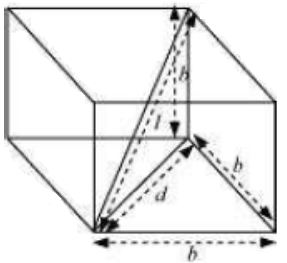
A cube of side b is shown in the following figure.

d = Diagonal of one of the six faces of the cube
$\text{d}^2=\sqrt{\text{b}^2+\text{b}^2}=\sqrt{2\text{b}^2}$
$\text{d}=\text{b}\sqrt{2}$
I = Length of the diagonal of the cube
$\text{l}^2=\sqrt{\text{d}^2+\text{b}^2}$
$=\sqrt{\Big(\sqrt{2}\text{b}\Big)^2+\text{b}^2}=\sqrt{2\text{b}^2+\text{b}^2}=\sqrt{3\text{b}^2}$
$\text{l}=\text{b}\sqrt{3}$
$\text{r}=\frac{\text{l}}{2}=\frac{\text{b}\sqrt{3}}{2}$ is the di tance between the centre of the cube and one of the eight vertices
The electric potential (V) at the centre of the cube is due to the presence of eight charges at the vertices.
$\text{V}=\frac{8\text{q}}{4\pi\in_0}$
$=\frac{8\text{q}}{4\pi\in_0\bigg(\text{b}\frac{\sqrt{3}}{2}\bigg)}$
$=\frac{4\text{q}}{\sqrt{3}\pi\in_0\text{b}}$
Therefore, the potential at the centre of the cube is $=\frac{4\text{q}}{\sqrt{3}\pi\in_0\text{b}}.$
The electric field at the centre of the cube, due to the eight charges, gets cancelled. This is because the charges are distributed symmetrically with respect to the centre of the cube. Hence, the electric field is zero at the centre.
View full question & answer
Question 55 Marks
Figure shows a charge array known as an electric quadrupole. For a point on the axis of the quadrupole, obtain the dependence of potential on r for r/a >> 1, and contrast your results with thatdue to an electric dipole, and an electric monopole (i.e., a single charge).
Answer
Four charges of same magnitude are placed at points X, Y, Y, and Z respectively, as shown in the following figure. A point is located at P, which is r distance away from point Y. The system of charges forms an electric quadrupole. It can be considered that the system of the electric quadrupole has three charges. Charge +q placed at point X
Charge -2q placed at point Y
Charge +q placed at point Z XY = YZ = a
YP = r
PX = r + a
PZ = r - a Electrostatic potential caused by the system of three charges at point P is given by, $\text{V}=\frac{1}{{4}\pi\in_{0}}\bigg[\frac{\text{q}}{\text{XP}}-\frac{{2}\text{q}}{\text{YP}}+\frac{\text{q}}{\text{ZP}}\bigg]$ $=\frac{1}{{4}\pi\in_{0}}\bigg[\frac{\text{q}}{\text{r}+\text{a}}-\frac{{2}\text{q}}{\text{r}}+\frac{\text{q}}{\text{r}-\text{a}}\bigg]$ $=\frac{\text{q}}{{4}\pi\in_{0}}\bigg[\frac{\text{r}(\text{r}-\text{a})-{2}(\text{r}+\text{a})(\text{r}-\text{a})+\text{r}(\text{r}+\text{a})}{\text{r}(\text{r}+\text{a})(\text{r}-\text{a})}\bigg]$ $=\frac{\text{q}}{{4}\pi\in_{0}}\bigg[\frac{\text{r}^2-\text{ra}-{2}\text{r}^2+{2}\text{a}^2+\text{r}^2+\text{ra}}{\text{r}(\text{r}^2-\text{a}^2)}\bigg]$ $=\frac{\text{q}}{{4}\pi\in_{0}}\bigg[\frac{2\text{a}^2}{\text{r}(\text{r}^2-\text{a}^2)}\bigg]$ $=\frac{{2}\text{qa}^2}{{4}\pi\in_{0}\text{r}^3\bigg({1}-\frac{\text{a}^2}{\text{r}^2}\bigg)}$ since $\frac{\text{r}}{\text{a}}>>{1}$ $\therefore\ \frac{\text{r}}{\text{a}}>>{1}$$\frac{\text{r}^2}{\text{a}^2}$ is taken as negligible.
$\therefore\ \text{V}=\frac{{2}\text{qa}^2}{{4}\pi\in_{0}\text{r}^3}$ It can be inferred that potential, $\text{V}\propto\frac{1}{\text{r}^3}$ However, it is known that for a dipole, $\text{V}\propto\frac{1}{\text{r}^2}$ And, for a monopole, $\text{V}\propto\frac{1}{\text{r}}$
View full question & answer
Question 65 Marks
An electrical technician requires a capacitance of 2μF in a circuitacross a potential difference of 1kV. A large number of 1μF capacitors are available to him each of which can withstand a potential difference of not more than 400V. Suggest a possible arrangement that requires the minimum number of capacitors.
Answer
Total required capacitance, $C = 2μF$
Potential difference, $V = 1kV = 1000V$
Capacitance of each capacitor, $C_1 = 1\mu\ F$
Each capacitor can withstand a potential difference, $V_1 = 400V$
$\frac{1000}{400}={2.5}$
Suppose a number of capacitors are connected in series and these series circuits are connected in parallel (row) to each other.
The potential difference across each row must be 1000V and potential difference across each capacitor must be 400V.
Hence, number of capacitors in each row is given as,
Hence, there are three capacitors in each row.
Capacitance of each row $=\frac{1}{1+1+1}=\frac{1}{3}\ \mu \text{F}\ \frac{1}{3}+\frac{1}{3}+\frac{1}{3}+ .....\text{n terms,}$
However, capacitance of the ciruit is given as 2μF.
$\therefore\ \frac{\text{n}}{3}={2}$ N = 6Let there are n rows, each having three capacitors, which are connected in parallel.
Hence,equivalent capacitance of the circuit is given as,
Hence, 6 rows of three capacitors are present in the circuit. A minimum of 6 × 3 i.e., 18capacitors are required for the given arrangement.
View full question & answer
Question 75 Marks
Two tiny spheres carrying charges 1.5 µC and 2.5 µC are located 30 cm apart. Find the potential and electric field:
  1. At the mid-point of the line joining the two charges, and
  2. At a point 10 cm from this midpoint in a plane normal to the line and passing through the mid-point.
Answer
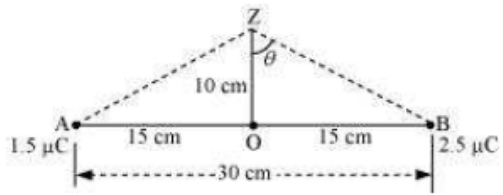
Two charges placed at points A and B are represented in the given figure. O is the mid-point of the line joining the two charges.

Magnitude of charge located at $A, q_1 = 1.5\ µC$
Magnitude of charge located at $B, q_2 = 2.5\ µC$
Distance between the two charges, $d = 30\ cm = 0.3\ m$
  1. Let V1 and E1 are the electric potential and electric field respectively at O.
V1 = Potential due to charge at A + Potential due to charge at B
$\text{V}_1=\frac{\text{q}_1}{4\pi\in_0\Big(\frac{\text{d}}{2}\Big)}+\frac{\text{q}_2}{4\pi\in_0\Big(\frac{\text{d}}{2}\Big)}=\frac{1}{4\pi\in_0\Big(\frac{\text{d}}{2}\Big)}(\text{q}_1+\text{q}_2)$
Where,
$\in_0$ = Permittivity of free space
$\frac{1}{4\pi\in_0}=9\times10^9\text{NC}^2\text{m}^{-2}$
$\therefore\text{V}_1=\frac{9\times10^9\times10^{-6}}{\Big(\frac{0.30}{2}\Big)}(2.5+1.5)=2.4\times10^5\text{V}$
$E_1=$ Electric field due to $q_2$ - Electric field due to $q_1$​​​​​​​
$=\frac{\text{q}_2}{4\pi\in_0\Big(\frac{\text{d}}{2}\Big)^2}-\frac{\text{q}_1}{4\pi\in_0\Big(\frac{\text{d}}{2}\Big)^2}$
$=\frac{9\times10^9}{\Big(\frac{0.30}{2}\Big)^2}\times10^{-6}\times(2.5-1.5)$
$= 4 \times 10^5 Vm^{-1}​​​​​​​$​​​​​​​
Therefore, the potential at mid-point is $2.4\times 10^5$ V and the electric field at mid-point is $4 \times 10^5$ V rn-1. The field is directed from the larger charge to the smaller charge.
  1. Consider a point Z such that normal distanceoz $= 10\ cm = 0.1\ m$, as shown in the following figure.


$V_2$ and $E_2$ are the electric potential and electric field respectively at Z.
It can be observed from the figure that distance,
$\text{BZ}=\text{AZ}=\sqrt{(0.1)^2+(0.15)^2}=0.18\text{m}$
$V_2=$ Electric potential due to A + Electric Potential due to B
$=\frac{\text{q}_1}{4\pi\in_0(\text{AZ})}-\frac{\text{q}_2}{4\pi\in_0(\text{BZ})}$
$=\frac{9\times10^9\times1.5\times10^{-6}}{(0.18)^2}$
$= 0.416 \times 10^{-6} V/m$
Electric field due to $q_2$ at Z,
$\text{E}_\text{B}=\frac{\text{q}_2}{4\pi\in_0(\text{BZ})^2}$
$=\frac{9\times10^9\times2.5\times10^{-6}}{(0.18)^2}$
$= 0.69 \times 10^6 Vm^{-1}​​​​​​​$​​​​​​​
The resultant field intensity at z,
$\text{E}=\sqrt{\text{E}^2_\text{A}+\text{E}^2_\text{B}+2\text{E}_\text{A}\text{E}_\text{B}\cos2\theta}$
Where, 2$\theta$is the angle, $\angle$AZB
From the figure, we obtain
$\cos\theta=\frac{0.10}{0.18}=\frac{5}{9}=0.5556$
$\theta=\cos^{-1}0.5556=56.25$
$\therefore2\theta=112.5^{\circ}$
$\cos2\theta=-0.38$
$\text{E}=\sqrt{(0.416\times10^6)^2\times(0.69\times10^6)^2+2\times0.416\times0.69\times10^{12}\times(-0.38)}$
$= 6.6 \times 10^5 Vm^{-1}​​​​​​​$​​​​​​​
Therefore, the potential at a point 10 cm (perpendicular to the mid-point) is $2.0\times 10^5$ V and electric field is $6.6 \times 10^5 Vm^{-1}.$
View full question & answer
Question 85 Marks
A charge of 8 mC is located at the origin. Calculate the work done in taking a small charge of $–2 \times 10^{–9}$ C from a point P (0, 0, 3 cm) to a point Q (0, 4 cm, 0), via a point R (0, 6 cm, 9 cm).
Answer
Charge located at the origin, $q = 8 mC = 8 \times 10^{-3}C$
Magnitude of a small charge, which is taken from a point P to point R to point $Q, q_1= -2 \times 10^{-9}\ C$
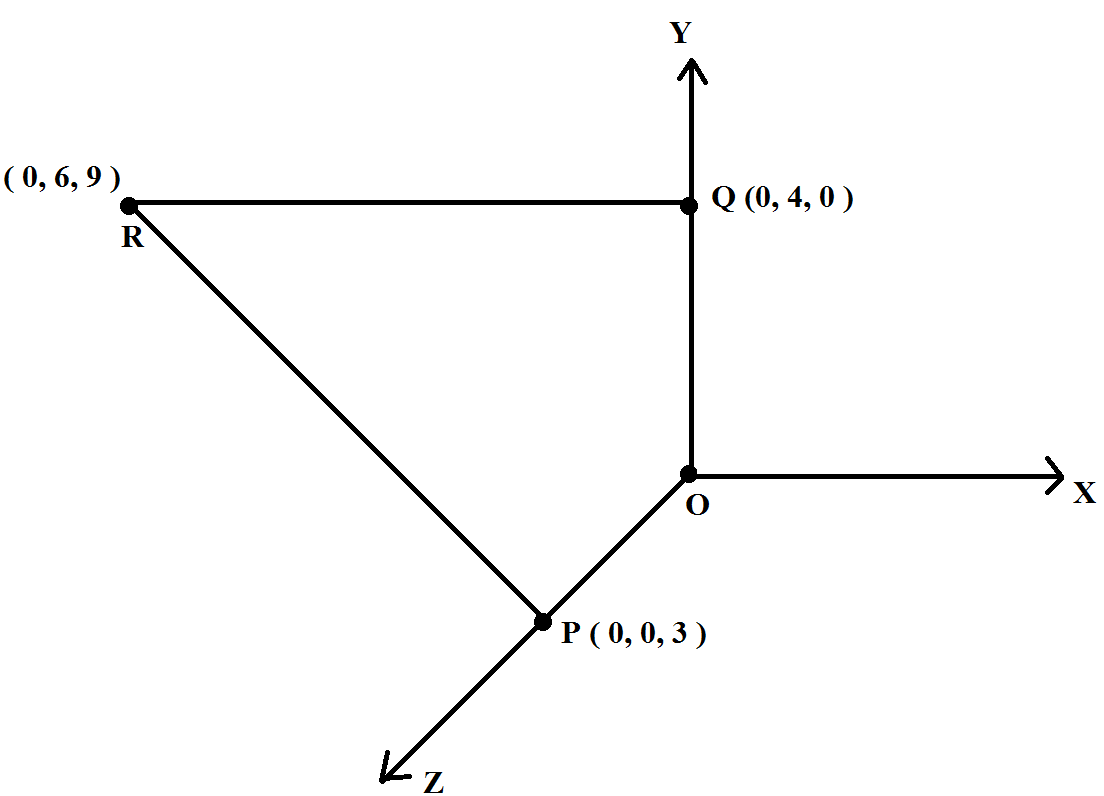
All the points are represented in the given figure.

Point P is at a distance, $d_1 = 3\ cm$, from the origin along z-axts.
Point Q is at a distance, $d_2 = 4\ cm$, from the origin along y-axis.
Potential at point P, $\text{V}_1=\frac{\text{q}}{4\pi\in_0\times\text{d}_1}$
Potential at point Q, $\text{V}_2=\frac{\text{q}}{4\pi\in_0\times\text{d}_2}$
Work done (W) by the electrostatic force is independent of the path.
$\therefore\text{W}=\text{q}_1[\text{V}_2-\text{V}_1]$
$=\text{q}_1\bigg[\frac{\text{q}}{4\pi\in_0\text{d}_2}-\frac{\text{q}}{4\pi\in_0\text{d}_1}\bigg]$
$=\frac{\text{qq}_1}{4\pi\in_0}\bigg[\frac{1}{\text{d}_2}-\frac{1}{\text{d}_{1}}\bigg] \dots\dots(1)$
Where, $\frac{1}{4\pi\in_0}=9\times10^9\text{Nm}^2\text{C}^{-2}$
$\therefore\text{W}=9\times10^9\times8\times10^{-3}\times(-2\times10^{-9})\Big[\frac{1}{0.04}-\frac{1}{0.03}\Big]$
$=-144\times10^{-3}\times\Big(\frac{-25}{3}\Big)$
= 1.27 J
Therefore, work done during the process is 1.27 J.
View full question & answer
Question 95 Marks
  1. Show that the normal component of electrostatic field has a discontinuity from one side of a charged surface to another given by
$(\text{E}_2-\text{E}_1).\hat{\text{n}}=\frac{\sigma}{\in_0}$

where $\hat{\text{n}}$ is a unit vector normal to the surface at a point and σ is the surface charge density at that point. (The direction of $\hat{\text{n}}$ is from side 1 to side 2.) Hence show that just outside a conductor, the electric field is σ $\hat{\text{n}} /ε_0.$
  1. Show that the tangential component of electrostatic field is continuous from one side of a charged surface to another.
[Hint: For (a), use Gauss’s law. For, (b) use the fact that work done by electrostatic field on a closed loop is zero.]
Answer
  1. Electric fielcl on one side of a charged body is $E_1$ and electric field on the other side of the same body is $E_2.$ If infinite plane charged body has a uniform thickness, then electric field due to one surface of the charged body is given by,
$\vec{\text{E}}_1=-\frac{\sigma}{2\in_0}\hat{\text{n}} \dots\dots(1)$
Where,
$\hat{\text{n}}$ = Unit vector normal to the surface at a point
$\sigma$ = Surface charge density at that point
Electric field due to the other surface of the charged body,
$\vec{\text{E}}_2=-\frac{\sigma}{2\in_0}\hat{\text{n}} \dots\dots(2)$
Electric field at any point due to the two surfaces,
$\vec{\text{E}}_2-\vec{\text{E}}_1=\frac{\sigma}{2\in_0}\hat{\text{n}}+\frac{\sigma}{2\in_0}\hat{\text{n}}=\frac{\sigma}{\in_0}\hat{\text{n}}$
$(\vec{\text{E}}_2-\vec{\text{E}}_1).\hat{\text{n}}=\frac{\sigma}{\in_0} \dots\dots(3)$
Since inside a closed conductor, $\vec{\text{E}}_1=0,$
$\therefore\vec{\text{E}}=\vec{\text{E}}_2=-\frac{\sigma}{2\in_0}\hat{\text{n}}$
Therefore, the electric fielcl just outside the conductor is $\frac{\sigma}{\in_0}\hat{\text{n}}.$
  1. When a charged particle is moved from one point to the other on a closed loop, the work done by the electrostatic field is zero. Hence, the tangential component of electrostatic field Is continuous from one side of a charged surface to the other.
View full question & answer
Question 105 Marks
The plates of a parallel plate capacitor have an area of $90cm^2$ each and are separated by 2.5mm. The capacitor is charged by connecting it to a 400V supply.
  1. How much electrostatic energy is stored by the capacitor?
  2. View this energy as stored in the electrostatic field between the plates, and obtain the energy per unit volume u. Hence arrive at a relation between u and the magnitude of electric field E between the plates.
Answer
Area of the plates of a parallel plate capacitor, $A = 90cm^2 = 90 \times 10^{-4}m^2$
Distance between the plates, $d = 2.5mm = 2.5 \times 10^{-3}m$
Potential difference across the plates, $V = 400V$
  1. Capacitance of the capacitor is given by the relation,
$\text{C}=\frac{\in_{0}\ \text{A}}{\text{d}}$
Electrostatic energy stored in the capacitor is given by the relation, $\text{E}_1=\frac{1}{2}\text{CV}^{2}$
$\frac{1}{2}\frac{\in_{0}\text{A}}{\text{d}}\text{V}^2$
Where,
$\in_{0}$ = Permittivity of free space $= 8.85 \times 10^{-12}C^2N^{-1}m^{-2}​​​​​​​$​​​​​​​
$\therefore\ \text{E}_{1} =\frac{{1} \times {8.85}\times {10}^{-12}\times {90}\times {10}^{-4}(400)^{2}}{{2}\times 2.5\times{10}^{-3}}$
$={2.55}\times{10}^{-6}\text{J}$
Hence, the electrostatic energy stored by the capacitor is $={2.55}\times{10}^{-6}\text{J}$
  1. Volume of the given capacitor,
$\text{V}^1=\text{A}\times\text{d}$
$={90} \times {10}^{-4}\times{25}\times{10}^{-3}$
$={2.25}\times {10}^{-4}\text{m}^{3}$
Energy stored in the capacitor per unit volume is given by,
$\text{u}=\frac{\text{E}_1}{\text{V}_1}$
$=\frac{{2.25}\times{10}^{-6}}{{2.25}\times{10}^{-4}}={0.113} \text{Jm}^{-3}$
Again,$\text{u}=\frac{\text{E}_1}{\text{V}_1}$
Where,
$\frac{\text{V}}{\text{d}}=$ Electric intensity = E
$\therefore\ \text{u} = \frac{1}{2}\in_{0} \text{E}^{2}$
View full question & answer
Question 115 Marks
A parallel plate capacitor is to be designed with a voltage rating 1kV, using a material of dielectric constant 3 and dielectric strength about $10^7Vm^{–1}$. (Dielectric strength is the maximum electric field a material can tolerate without breakdown, i.e., without starting to conduct electricity through partial ionisation.) For safety, we should like the field never to exceed, say 10% of the dielectric strength. What minimum area of the plates is required to have a capacitance of 50pF?
Answer
Potential rating of a parallel plate capacitor, V = 1kV= 1000V
Dielectric constant of a matertal, $\in_{\text{r}}={3}$
Dielectric strength $={10}^{7}\frac{\text{V}}{\text{m}}$
For safety, the field intensity never exceeds 10% of the dielectric strength.
Hence, electric field intensity, E = 10% of $10^7 = 10^6$ $\frac{\text{V}}{\text{m}}$
Capacitance of the parallel plate capacitor, $C = 50pf = 50 \times 10^{-12}F$
Distance between the plates is given by,
$\text{d}=\frac{\text{V}}{\text{E}}$
$=\frac{1000}{{10}^{6}}={10}^{-3}\text{m}$
Capacitance i given by the relation,
$\text{C}=\frac{\in_{0}\in_{\text{r}\text{A}}}{\text{d}}$
where, A = Area of each plate$\in_{0}$= Permittivity of free space $= 8.85 \times 10^{-12} N^{-1} C^2 m^{-2}$​​​​​​​
$\therefore\ \text{A}=\frac{\text{Cd}}{\in_{0}\in_{\text{r}}}$ $=\frac{{50}\times{10}^{-12}\times{10}^{-3}}{{8.85}\times{10}^{-12}\times{3}}\approx{19}\text{cm}^{2}$
 Hence, the area of each plate is about $19cm^2.$
View full question & answer
Question 125 Marks
A 4µF capacitor is charged by a 200V supply. It is then disconnected from the supply, and is connected to another uncharged 2µF capacitor. How much electrostatic energy of the first capacitor is lost in the form of heat and electromagnetic radiation?
Answer
Capacitance of a charged capacitor,$ C_1 = 4\mu\text{F} = 4 \times 10^{-6} F$ Supply voltage, $V_1 = 200V$
Electrostatic energystored in $C_1$ is given by,
$\text{E}_1=\frac{1}{2}\text{C}_1\text{V}_1^{2}$
$=\frac{1}{2}\times{4}\times{10}^{-6}\times{(200)^{2}}$
$={8}\times{10}^{-2}\text{J}$
$\text{C}_2={2}\mu\text{F}={2}\times{10}^{-6}\text{F}$
Capacitance of an uncharged capacitor,
When $C_2$ is connected to the circuit, the potential acquired by it is $V_2.$
$\therefore\ \text{V}_2(\text{C}_1+\text{C}_2)=\text{C}_1\text{V}_1$
$\text{V}_2\times ({4}+{2})\times{10}^{-6}={4}\times{10}^{-6}{200}$
$\text{V}_2=\frac{400}{3}\text{V}$
According to the conservation of charge, initial charge on capacitor $C_1$ is equal to the final charge on capacitors, $C_1$ and $C_2.$
Electrostatic energy for the combination of two capacitors is given by,
$\text{E}_1=\frac{1}{2}(\text{C}_1+\text{C}_2)\text{V}_2^2$
$=\frac{1}{2}({2}+{4})\times{10}^{-6}\times\bigg(\frac{400}{3}\bigg)^{2}$
$={5.33}\times{10}^{-2}\text{J}$
Hence, amount of electrostatic energy lost by capacitor $C_1$​​​​​​​
View full question & answer
Question 135 Marks
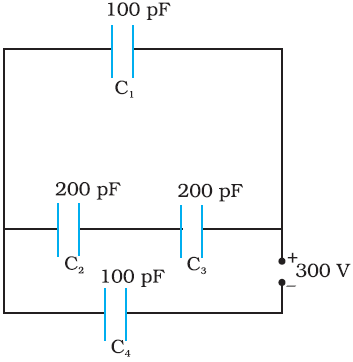
Obtain the equivalent capacitance of the network in Fig. For a 300V supply, determine the charge and voltage across each capacitor.
Answer
Capacitance of capacitor $C_1$ is 100 pF.
Capacitance of capacitor $C_2$ is 200 pF.
Capacitance of capacitor $C_3$ is 200 pF.
Capacitance of capacitor $C_4$ is 100 pF.
Supply potential, V = 300 V Capacitors $C_2$ and $C_3$ are connected in series.
Let their equivalent capacitance be $C^1$
$\therefore\ \frac{1}{\text{C}^1}=\frac{1}{200}+\frac{1}{200}=\frac{2}{200}$ $\text{C}^1={100}\text{pF}$
Capacitors $C_1$ and C' are in parallel.
Let their equivalent capacitance be Cn
$\therefore\ \text{C}^\text{n}=\text{C}^1+\text{C}_1$
$={100}+{100}={200}\text{pF}$
$C^n$ and $C_4$ are connected in series. Let their equivalent capacitance be C.
$\therefore\ \frac{1}{\text{C}}=\frac{1}{\text{C}^\text{n}}+\frac{1}{\text{C}_4}$
$=\frac{1}{200}+\frac{1}{100}=\frac{2+1}{200}$
$\text{C}=\frac{200}{3}\text{pF}$
Hence, the equivalent capacitance of the circuit is $\frac{200}{3}\text{pF}$ Potential difference across $C^n= V^n$ Potential difference across $C_4 = V_4​​​​​​​\therefore\ \text{V}^\text{s}+\text{V}_4=\text{V}=300\text{V}$
Charge on $C_1$ is given by,$\text{Q}_4=\text{CV}$
$=\frac{200}{3}\times10^{-12}\times{300}$
$={2}\times{10}^{-8}\text{C}$
$\therefore\ \text{V}_4=\frac{\text{Q}_4}{\text{C}_4}$.
$=\frac{{2}\times{10}^{-8}}{{100}\times{10}^{-12}}={200}\text{V}$.
$\therefore $ voltage across $C_1$ is given by,
$\text{V}_1=\text{V}-\text{V}_4$$={300}-{200}={100}\text{V}$
$\text{Q}_1=\text{C}_1\text{V}_1$
$={100}\times{10}^{-12}\times{100}$
$={10}^{-8}$
Hence, potential difference, $V_1,$ across $ C_1$ is 100V. Charge on $C_1$ is given by, $C_2$ and $C_3$ having same capacitances have a potential difference of 100V together. Since $C_2$ and $C_3$ are in series, the potential difference across $C_2$ and $C_3$ is given by,
$\text{V}_2=\text{V}_3={50}\text{V}$
Therefore, charge on $C_2$ is given by,$\text{Q}_2 =\text{C}_2\text{V}_2$.
$={200}\times{10}^{-12}\times{50}$.
$={10}^{-8}\text{C}$
$\frac{200}{3}\text{pF with}$.
Hence, the equivalent capacitance of the given circuit is,
$\text{Q}_1={10}^{-8}\text{C}$ $\text{V}_1={100}\text{V}$
$\text{Q}_2={10}^{-8}\text{C}$ $\text{V}_2={50}\text{V}$
$\text{Q}_3={10}^{-8}\text{C}$ $\text{V}_3={50}\text{V}$
$\text{Q}^{4}={2}\times{10}^{-8}\text{C}$ $\text{V}_4={200}\text{V}$
View full question & answer
Question 145 Marks
A spherical capacitor has an inner sphere of radius 12cm and an outer sphere of radius 13cm. The outer sphere is earthed and the inner sphere is given a charge of 2.5µC. The space between the concentric spheres is filled with a liquid of dielectric constant 32.
  1. Determine the capacitance of the capacitor.
  2. What is the potential of the inner sphere?
  3. Compare the capacitance of this capacitor with that of an isolated sphere of radius 12cm. Explain why the latter is much smaller.
Answer
Radius of the inner sphere, $r_2= 12cm = 0.12$ m Radius of the outer sphere, $r_1 = 13cm = 0.13m$ Charge on the inner sphere, $\text{q}={2.5}\mu\text{C}={2.5}\times{10}^{-6}$
Dielectric constant of a liquid, $\in_{\text{r}}= {32}$
  1. Capacitance of the capacitor is given by the relatioon,
$\text{C}=\frac{{4}\pi\in_0\text{r}_1\text{r}_2}{\text{r}_1-\text{r}_2}$
Where,
$\in_0$ = Permittivity of free space $= 8.85 \times 10^{-12} C^2 N^{-1} m^{-2}$
$\text{V}=\frac{1}{{4}\pi\in_0}{9}\times{10}^{9}\text{Nm}^{2}\text{C}^{-2}$
$\therefore \text{C}=\frac{32\times0.12\times0.13}{9\times10^{9}\times(0.13-.12)}$
$={5.5}\times{10}^{-9}\text{F}$
Hence, the capacitance of the capacitor is approximately.
  1.  
  1. Potential of the inner sphere is given by,
$\text{V}=\frac{\text{q}}{\text{C}}$
$=\frac{2.5\times10^{-6}}{5.5\times10^{-9}}=4.5\times10^{2}\text{V}$
Hence, the potential of the inner sphere is $4.5\times10^{2}\text{V}$
  1. Radius of an isolated sphere, $\text{r}=12\times10^{-2}\text{m}$
  2. Capacitance of the sphere is given by the relation,
$\text{C}^{1}={4}\pi\in_{0}\text{r}$
$={4}\pi\times8.85\times10^{-12}\times12\times10^{-2}$​​​​​​​
$=1.33\times10^{-11}\text{F}$
  1. The capacitance of the isolated sphere is less in comparison to the concentric spheres. This is because the outer sphere of the concentric spheres is earthed. Hence, the potential difference is less and the capacitance is more than the isolated sphere.
View full question & answer
Question 155 Marks
A 12pF capacitor is connected to a 50V battery. How much electrostatic energy is stored in the capacitor?
Answer
Capacitor of the capacitance, $C = 12 pF = 12 \times 10^{-12} F$
Potential difference, $V = 50 V$
Electrostatic energy stored in the capacitor is given by the relation,
$\text{E}=\frac{1}{2}\text{CV}^2$
$=\frac{1}{2}\times12\times10^{-12}\times(50)^2$
$= 1.5 \times 10^{-8} J$
Therefore, the electrostatic energy stored in the capacitor is $1.5 \times 10^{-8} J.$
View full question & answer
Question 165 Marks
Two charges -q and +q are located at points (0, 0, -a) and (0, 0, a), respectively.
  1. What is the electrostatic potential at the points (0, 0, z) and (x, y, 0)?
  2. Obtain the dependence of potential on the distance r of a point from the origin when r/a >> 1.
  3. How much work is done in moving a small test charge from the point (5, 0, 0) to (-7, 0, 0) along the x-axis? Does the answer change if the path of the test charge between the same points is not along the x-axis?
Answer
  1. Zero at both the points.
Charge -q is located at (0, 0, -a) and charge +q is located at (0, 0, a). Hence, they form a dipole. Point (0, 0, z) is on the axis of this dipole and point (x, y, 0) is normal to the axis of the dipole. Hence, electrostatic potential at point (x, y, 0) is zero. Electrostatic potential at point (0, 0, z) is given by,
$\text{V}=\frac{1}{{4}\pi\in_{0}}\big(\frac{\text{q}}{\text{z}-\text{a}}\big)-\frac{1}{{4}\pi\in_{0}}\Big(\frac{\text{q}}{\text{z}+\text{a}}\Big)$
$=\frac{\text{q}(\text{z}+\text{a}-\text{z}+\text{a})}{{4}\pi\in_{0}(\text{z}^2-\text{a}^2)}$
$=\frac{{2}\text{qa}}{{4}\pi\in_{0}(\text{z}^2-\text{a}^2)}$
$=\frac{\text{P}}{{4}\pi\in_{0}(\text{z}^2-\text{a}^2)}$
Where,
$\in_{0}=$ Permittivity of free space
p = Dipole moment of the system of two charges = 2qa
  1. Distance r is much greater than half of the distance between the two charges. Hence, the potential (V) at a distance r is inversely proportional to square of the distance.
i.e. $\text{V}\propto\frac{1}{\text{r}^2}$
  1. Zero
The answer does not change if the path of the test is not along the x-axis.
A test charge is moved from point (5, 0, 0) to point (-7, 0, 0) along the x-axis. Electrostatic potential $(V_1)$ at point (5, 0, 0) is given by,
$\text{V}_{1}=\frac{\text{-q}}{{4}\pi\in_{0}}\frac{1}{\sqrt{({5}-{0})^{2}+(\text{-a})^{2}}}+\frac{\text{q}}{{4}\pi\in_{0}}\frac{1}{({5}-{0})^2+\text{a}^2}$
$=\frac{\text{-q}}{{4}\pi\in_{0}\sqrt{{25}+\text{a}^{2}}}+\frac{\text{q}}{{4}\pi\in_{0}\sqrt{{25}+\text{a}^{2}}}$
$={0}$
Electrostatic potential, $V_2$ at point (-7, 0, 0) is given by,
$\text{V}_{2}=\frac{\text{-q}}{{4}\pi\in_{0}}\frac{1}{\sqrt{(-7)^{2}+\text{(-a)}^{2}}}+\frac{q}{{4}\pi\in_{0}}\frac{1}{\sqrt{(-7)^2+(\text{-a})^{2}}}$
$=\frac{\text{-q}}{{4}\pi\in_{0}\sqrt{49+\text{a}^{2}}}+\frac{\text{q}}{{4}\pi\in_{0}}\frac{1}{\sqrt{49+\text{a}^{2}}}$
$={0}$
Hence, no work is done in moving a small test charge from point (5, 0, 0) to point (-7, 0, 0)along the x-axis.
The answer does not change because work done by the electrostatic field in moving a testcharge between the two points is independent of the path connecting the two points.
View full question & answer
Question 175 Marks
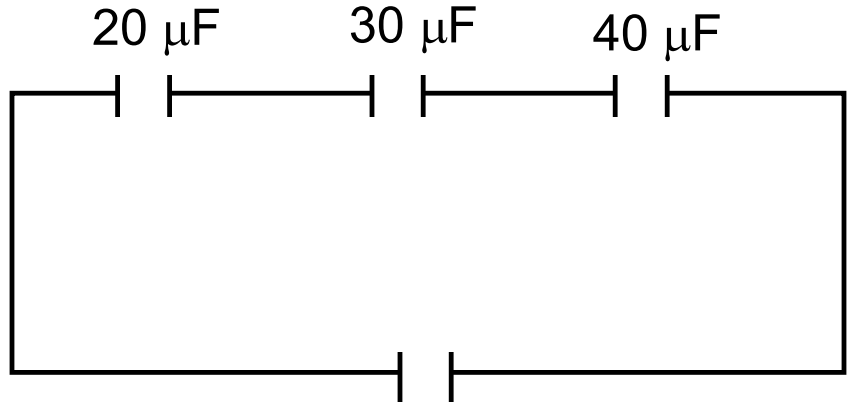
Three capacitors having capacitances $20\mu\text{F},\ 30\mu\text{F}$ and $40\mu\text{F}$ are connected in series with a 12V battery. Find the charge on each of the capacitors. How much work has been done by the battery in charging the capacitors?
Answer

$\therefore$ The equivalent capacity
$\text{C}=\frac{\text{C}_1\text{C}_2\text{C}_3}{\text{C}_2\text{C}_3+\text{C}_1\text{C}_3+\text{C}_1\text{C}_2}$
$=\frac{20\times30\times40}{30\times40+20\times40+20\times30}=\frac{24000}{2600}=9.23\mu\text{F}$
Let Equivalent charge at the capacitor = q
$\text{C}=\frac{\text{q}}{\text{V}}$
$\Rightarrow\text{q}=\text{C}\times\text{V}=9.23\times12=110\mu\text{C}$ on each.
As this is a series combination, the charge on each capacitor is same as the equivalent charge which is $110\mu\text{C}.$
Let the work done by the battery = W
$\therefore\text{V}=\frac{\text{W}}{\text{q}}$
$\Rightarrow\text{W}=\text{Vq}=110\times12\times10^{-6}$
$=1.33\times10^{-3}\text{J.}$
View full question & answer
Question 185 Marks
Figure shows a charge array known as an electric quadrupole. For a point on the axis of the quadrupole, obtain the dependence of potential on r for r/a >> 1, and contrast your results with thatdue to an electric dipole, and an electric monopole (i.e., a single charge).
Answer
Four charges of same magnitude are placed at points X, Y, Y, and Z respectively, as shown in the following figure. A point is located at P, which is r distance away from point Y. The system of charges forms an electric quadrupole. It can be considered that the system of the electric quadrupole has three charges. Charge +q placed at point X
Charge -2q placed at point Y
Charge +q placed at point Z XY = YZ = a
YP = r
PX = r + a
PZ = r - a Electrostatic potential caused by the system of three charges at point P is given by, $\text{V}=\frac{1}{{4}\pi\in_{0}}\bigg[\frac{\text{q}}{\text{XP}}-\frac{{2}\text{q}}{\text{YP}}+\frac{\text{q}}{\text{ZP}}\bigg]$ $=\frac{1}{{4}\pi\in_{0}}\bigg[\frac{\text{q}}{\text{r}+\text{a}}-\frac{{2}\text{q}}{\text{r}}+\frac{\text{q}}{\text{r}-\text{a}}\bigg]$ $=\frac{\text{q}}{{4}\pi\in_{0}}\bigg[\frac{\text{r}(\text{r}-\text{a})-{2}(\text{r}+\text{a})(\text{r}-\text{a})+\text{r}(\text{r}+\text{a})}{\text{r}(\text{r}+\text{a})(\text{r}-\text{a})}\bigg]$ $=\frac{\text{q}}{{4}\pi\in_{0}}\bigg[\frac{\text{r}^2-\text{ra}-{2}\text{r}^2+{2}\text{a}^2+\text{r}^2+\text{ra}}{\text{r}(\text{r}^2-\text{a}^2)}\bigg]$ $=\frac{\text{q}}{{4}\pi\in_{0}}\bigg[\frac{2\text{a}^2}{\text{r}(\text{r}^2-\text{a}^2)}\bigg]$ $=\frac{{2}\text{qa}^2}{{4}\pi\in_{0}\text{r}^3\bigg({1}-\frac{\text{a}^2}{\text{r}^2}\bigg)}$ since $\frac{\text{r}}{\text{a}}>>{1}$ $\therefore\ \frac{\text{r}}{\text{a}}>>{1}$$\frac{\text{r}^2}{\text{a}^2}$ is taken as negligible.
$\therefore\ \text{V}=\frac{{2}\text{qa}^2}{{4}\pi\in_{0}\text{r}^3}$ It can be inferred that potential, $\text{V}\propto\frac{1}{\text{r}^3}$ However, it is known that for a dipole, $\text{V}\propto\frac{1}{\text{r}^2}$ And, for a monopole, $\text{V}\propto\frac{1}{\text{r}}$
View full question & answer
Question 195 Marks
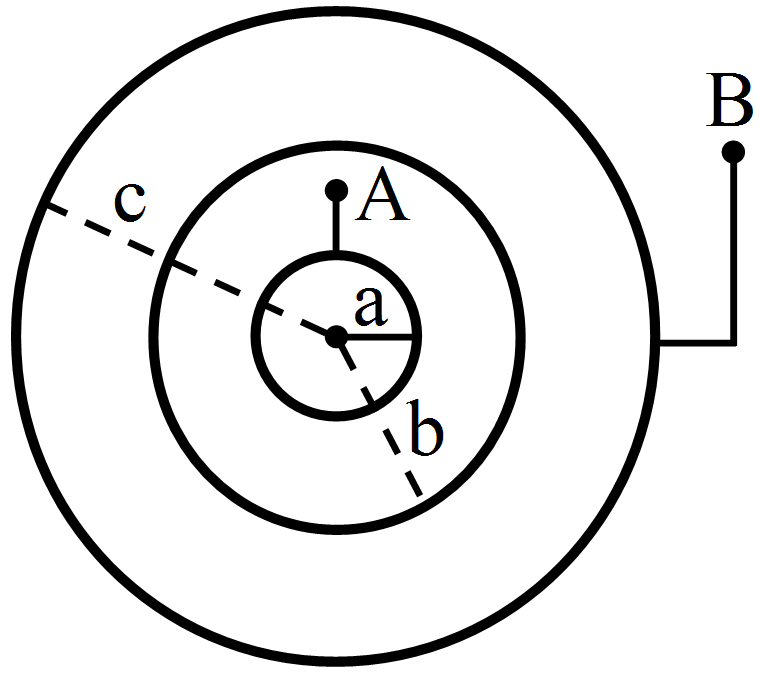
Suppose the space between the two inner shells of the previous problem is filled with a dielectric of dielectric coastant K. Find the capacitance of the system between A and B.
Answer
Here we should consider two spherical capacitor of capacitance
cab and cbc in series
$\text{Cab}=\frac{4\pi\in_0\text{abk}}{(\text{b}-\text{a})}$
$\text{Cbc}=\frac{4\pi\in_0\text{bc}}{(\text{c}-\text{b})}$
$\frac{1}{\text{C}}=\frac{1}{\text{Cab}}+\frac{1}{\text{Cbc}}$
$=\frac{(\text{b}-\text{a})}{4\pi\in_0\text{abk}}+\frac{(\text{c}-\text{b})}{4\pi\in_0\text{bc}}$
$=\frac{\text{c}(\text{b}-\text{a})+\text{ka}(\text{c}-\text{b})}{\text{k}4\pi\in_0\text{abc}}$
$\text{C}=\frac{\text{k}4\pi\in_0\text{abc}}{\text{c}(\text{b}-\text{a})+\text{ka}(\text{c}-\text{b})}$
View full question & answer
Question 205 Marks
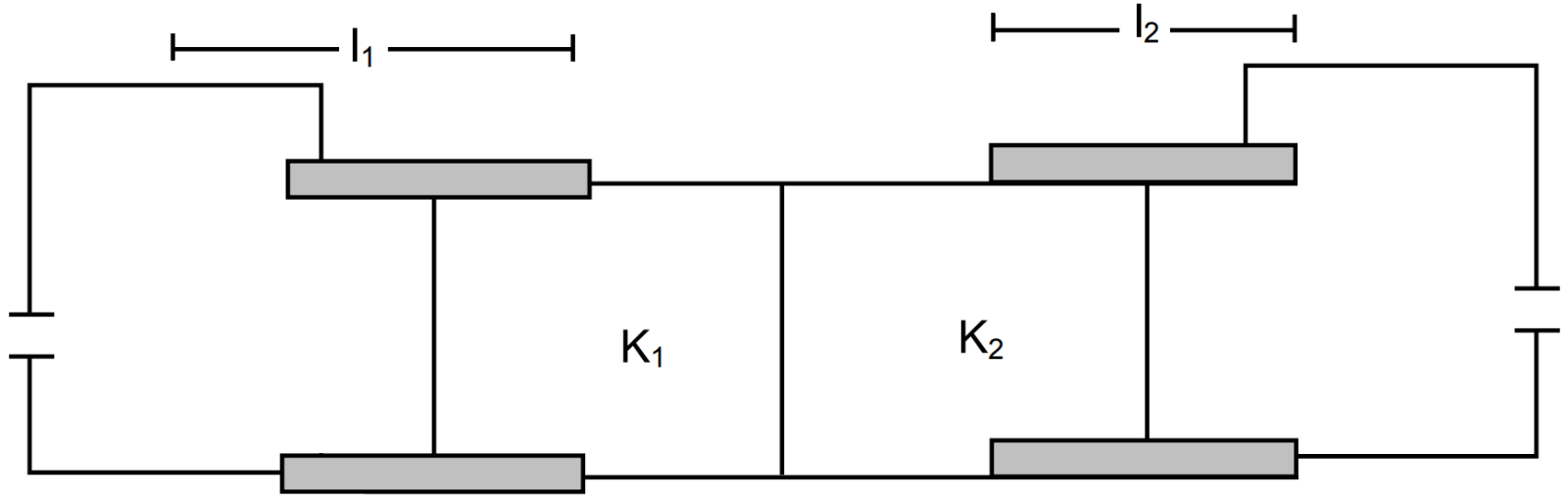
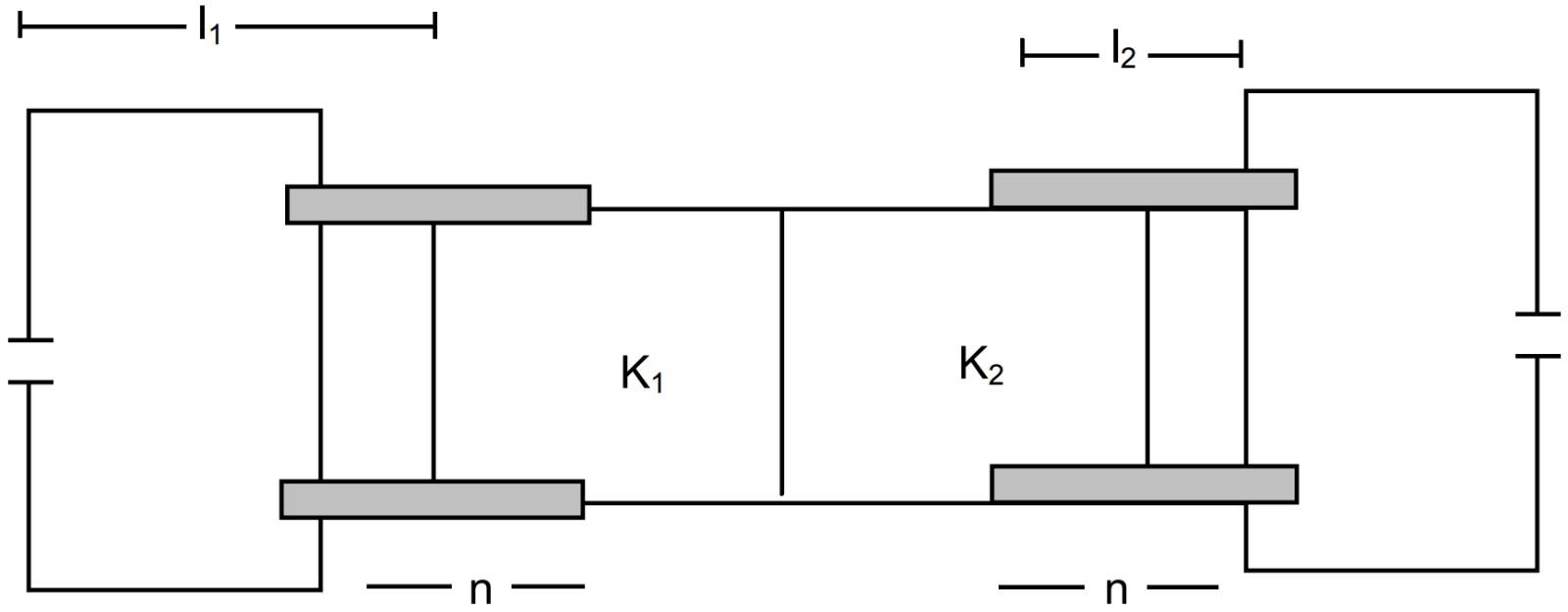
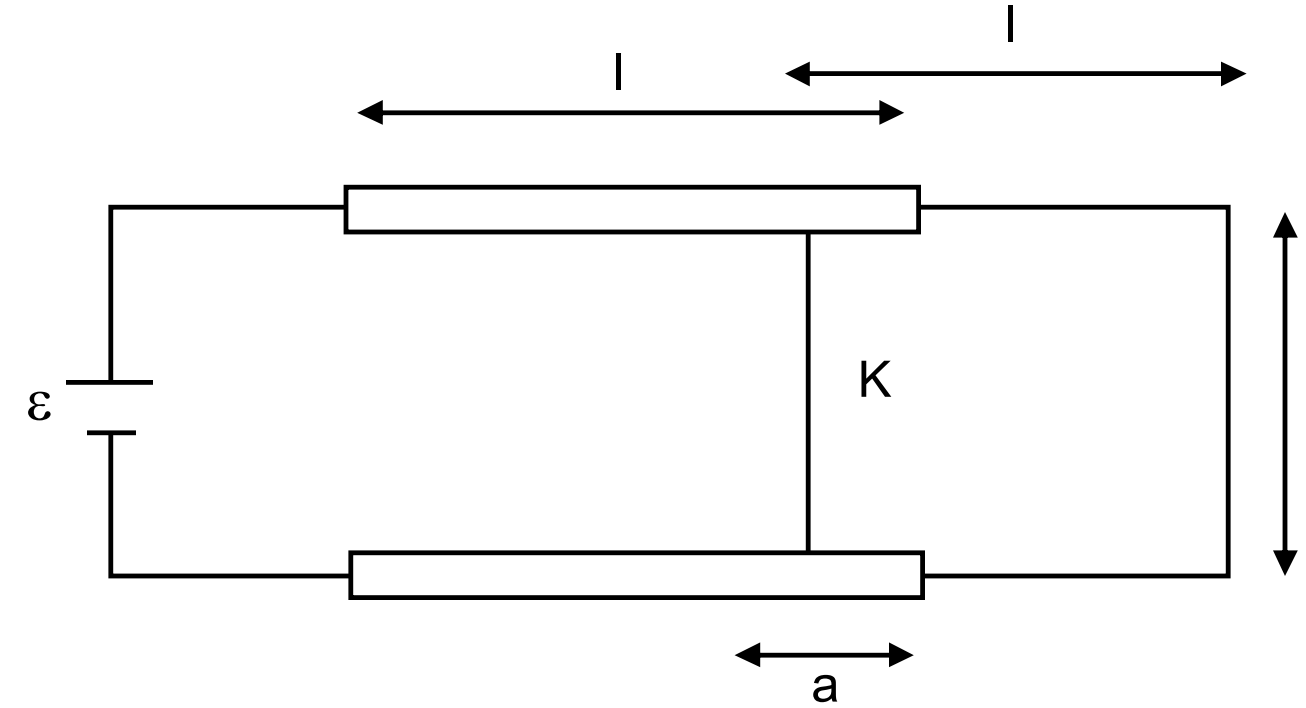
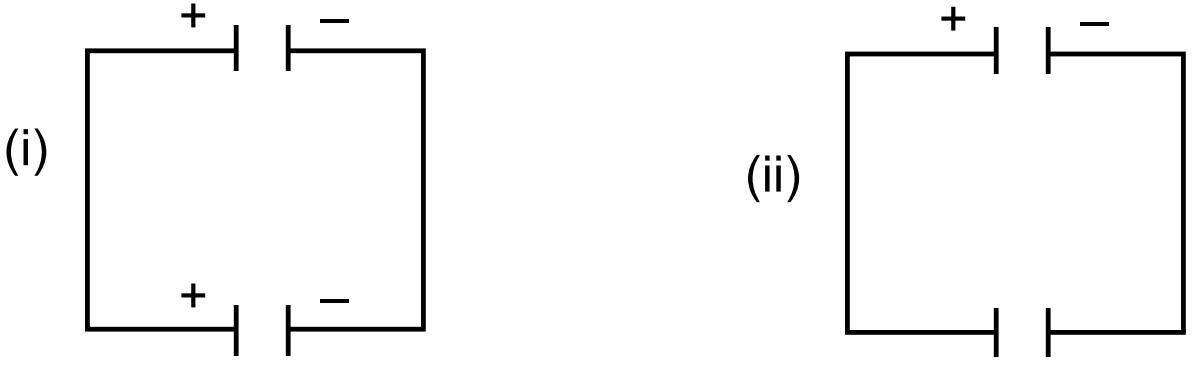
Figure shows two parallel plate capacitors with fixed plates and connected to two batteries. The separation between the plates is the same for the two capacitors. The plates are rectangular in shape with width b and lengths $l_1$ and $l_2$ The left half of the dielectric slab has a dielectric constant $K_1$ and the right half $K_2.$ Neglecting any friction, find the ratio of the emf of the left. battery to that of the right battery for which the dielectric slab may remain in equilibrium.
Answer

Consider the left side
The plate area of the part with the dielectric is by its capacitance $\text{C}_1=\frac{\text{K}_1\in_0\text{bx}}{\text{d}}$ and with out dielectric $\text{C}_2=\frac{\in_0\text{b}(\text{L}_1-\text{x})}{\text{d}}$
These are connected in parallel
$\text{C}=\text{C}_1+\text{C}_2$
$=\frac{\in_0\text{b}}{\text{d}}[\text{L}_1+\text{x}(\text{k}_1-1)]$
Let the potential $V_1$​​​​​​​
$\text{U}=\Big(\frac{1}{2}\Big)\text{CV}_1^2=\frac{\in_0\text{bv}_1^2}{2\text{d}}[\text{L}_1+\text{x}(\text{k}-1)]\ \dots(1)$
Suppose dielectric slab is attracted by electric field and an external force F consider the part dx which makes inside further, As the potential difference remains constant at V.
The charge supply, dq = (dc)v to the capacitor.
The work done by the battery is $dw_b = v.dq = (dc)v^2​​​​​​​$​​​​​​​
The external force F does a work dwe = (–f.dx) during a small displacement.
The total work done in the capacitor is $dw_b + dw_e = (dc)v^2 - fdx$
This should be equal to the increase dv in the stored energy.
Thus $\Big(\frac{1}{2}\Big)(\text{dk})\text{v}^2=(\text{dc})\text{v}^2-\text{fdx}$
$\text{f}=\frac{1}{2}\text{v}^2\frac{\text{dc}}{\text{dx}}$
from equation (1)
$\text{F}=\frac{\in_0\text{bv}^2}{2\text{d}}(\text{k}_1-1)$
$\Rightarrow\text{V}_1^2=\frac{\text{F}\times2\text{d}}{\in_0\text{b}(\text{k}_1-1)}$
$\Rightarrow\text{V}_1=\sqrt{\frac{\text{F}\times2\text{d}}{\in_0\text{b}(\text{k}_1-1)}}$
For the right side, $\text{V}_2=\sqrt{\frac{\text{F}\times2\text{d}}{\in_0\text{b}(\text{k}_2-1)}}$
$\frac{\text{V}_1}{\text{V}_2}=\frac{\sqrt{\frac{\text{F}\times2\text{d}}{\in_0\text{b}(\text{k}_1-1)}}}{\sqrt{\frac{\text{F}\times2\text{d}}{\in_0\text{b}(\text{k}_2-1)}}}$
$\frac{\text{V}_1}{\text{V}_2}=\frac{\sqrt{\text{k}_2-1}}{\sqrt{\text{k}_1-1}}$
$\therefore$ The ratio of the emf of the left battery to the right battery $=\frac{\sqrt{\text{k}_2-1}}{\sqrt{\text{k}_1-1}}$
View full question & answer
Question 215 Marks
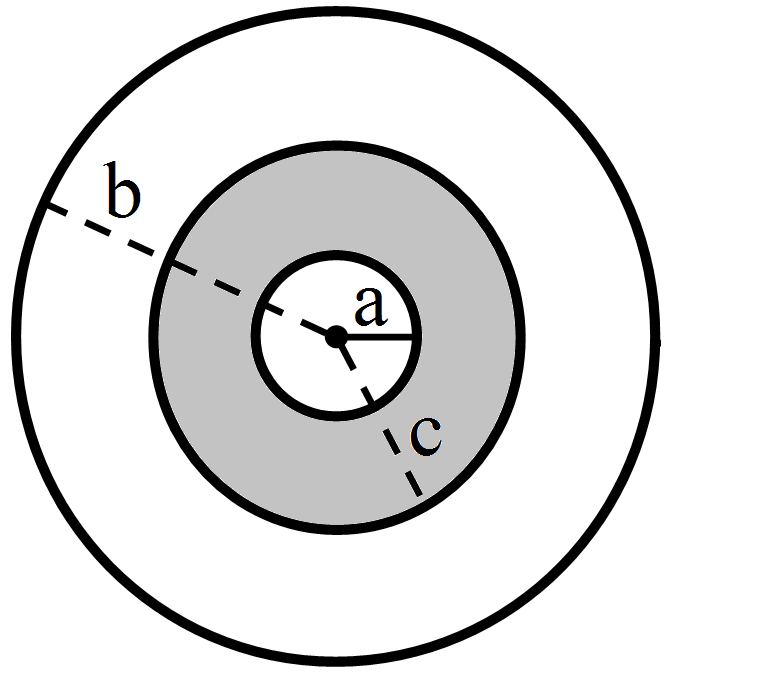
Consider an assembly of three conducting concentric spherical shells of radii a, b and c as shown in figure. Find the capecitance of the assembly between the poima A and B
Answer
These three metallic hollow spheres form two spherical capacitors, which are connected in series. Solving them individually, for (1) and (2)
$\text{C}_1=\frac{4\pi\in_0\text{ab}}{\text{b}-\text{a}}$ $(\therefore$ for a spherical capacitor formed by two spheres of radii $R_2 > R_1)$
$\text{C}=\frac{4\pi\in_0\text{R}_2\text{R}_1}{\text{R}_2-\text{R}_1}$
Similarly for (2) and (3)
$\text{C}_2=\frac{4\pi\in_0\text{bc}}{\text{c}-\text{b}}$
$\text{C}_{\text{eff}}=\frac{\text{C}_1\text{C}_2}{\text{C}_1+\text{C}_2}$
$=\frac{\frac{(4\pi\in_0)^2\text{ab}^2\text{c}}{(\text{b}-\text{a})(\text{c}-\text{a})}}{4\pi\in_0\Big[\frac{\text{ab}(\text{c}-\text{b})+\text{bc}(\text{b}-\text{a})}{(\text{b}-\text{a})(\text{c}-\text{b})}\Big]}$
$=\frac{4\pi\in_0\text{ab}^2\text{c}}{\text{abc}-\text{ab}^2+\text{b}^2\text{c}-\text{abc}}$
$=\frac{4\pi\in_0\text{ab}^2\text{c}}{\text{b}^2(\text{c}-\text{a})}$
$=\frac{4\pi\in_0\text{a}\text{c}}{\text{c}-\text{a}}$
View full question & answer
Question 225 Marks
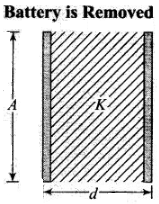
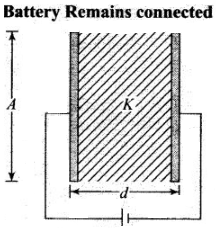
A capacitor has some dielectric between its plates, and the capacitor is connected to a DC source. The battery is now disconnected and then the dielectric is removed. State whether the capacitance, the energy stored in it, electric field, charge stored and the voltage will increase, decrease or remain constant.
Answer
The capacitance of the parallel plate capacitor, filled with dielectric medium of dielectric constant K is given by $\text{C}=\frac{\text{K}\in_0\text{A}}{\text{d}}$.
The capacitance of the parallel plate capacitor decreases with the removal of dielectric medium as for air or vacuum K = 1 and for dielectric K > 1.
If we disconnect the battery from capacitor, then the charge stored will remain the same due to conservation of charge.
The energy stored in an isolated charge capacitor $\text{U}=\frac{\text{q}^2}{2\text{C}}$ as q is constant, energy stored $\text{U}\propto\frac{1}{\text{C}}$. As C decreases with the removal of dielectric medium, therefore energy stored increases.
The potential difference across the plates of the capacitor is given by $\text{V}=\frac{\text{q}}{\text{C}}$.
Since q is constant and C decreases which in turn increases V and therefore E increases as $\text{E}=\frac{\text{V}}{\text{d}}$.
Quantity
Capacity C' = KC C' = KC
Charge Q' = Q (Charge is conserved) Q' = KQ
Potential
$\text{V}'=\frac{\text{V}}{\text{K}}$
V' = V (Since Battery maintains the potential difference)
Intensity
$\text{E}'=\frac{\text{E}}{\text{K}}$
E' = E
Energy
$\text{U}'=\frac{\text{U}}{\text{K}}$
U' = UK
View full question & answer
Question 235 Marks
A parallel-plate capacitor has plate area $25.0cm^2$ and a separation of 2.00mm between the plates. The capacitor is connected to a battery of 12.0V:
  1. Find the charge on the capacitor.
  2. The plate separation is decreased to 1.00mm. Find the extra charge given by the battery to the positive plate.
Answer


Plate area $A = 25cm^2 = 2.5 \times 10^{-3}m$
Separation $d = 2mm = 2 \times 10^{-3}m$
Potential $v = 12v$​​​​​​​
  1. We know
$\text{C}=\frac{\in_0\text{A}}{\text{d}}$
$=\frac{8.85\times10^{-12}\times2.5\times10^{-3}}{2\times10^{-3}}$
$=11.06\times10^{-12}\text{F}$
$\text{C}=\frac{\text{q}}{\text{v}}$
$\Rightarrow11.06\times10^{-12}=\frac{\text{q}}{12}$
$\Rightarrow\text{q}_1=1.32\times10^{-10}\text{C}.$
  1. Then d = decreased to 1mm
$\therefore\ \text{d}=1\text{mm}=1\times10^{-3}\text{m}$
$\text{C}=\frac{\in_0\text{A}}{\text{d}}=\frac{\text{q}}{\text{v}}$
$=\frac{8.85\times10^{-12}\times2.5\times10^{-3}}{1\times10^{-3}}=\frac{2}{12}$
$\Rightarrow\text{q}_2=8.85\times2.5\times12\times10^{-12}$
$\Rightarrow\text{q}_2=2.65\times10^{-10}\text{C}.$
$\therefore$ The extra charge given to plate $= (2.65 - 1.32) \times 10^{-10} = 1.33 \times 10^{-10}C.$
View full question & answer
Question 245 Marks
Two capacitors of capacitances 20.0pF and 50.0pF are connected in series with a 6.00V battery. Find:
  1. The potential difference across each capacitor.
  2. The energy stored in each capacitor.
Answer
$C_1 = 20PF = 20 \times 10^{-12}F,$
$C_2 = 50PF = 50 \times 10^{-12}F$
Effective $\text{C}=\frac{\text{C}_1\text{C}_2}{\text{C}_1+\text{C}_2}=\frac{2\times10^{-11}\times5\times10^{-11}}{2\times10^{-11}+5\times10^{-11}}$
$=1.428\times10^{-11}\text{F}$
Charge $\text{q}=1.428\times10^{-11}\times6=8.568\times10^{-11}\text{C}$
$\text{V}_1=\frac{\text{q}}{\text{C}_1}=\frac{8.568\times10^{-11}}{2\times10^{-11}}=4.284\text{V}$
$\text{V}_2=\frac{\text{q}}{\text{C}_2}=\frac{8.568\times10^{-11}}{5\times10^{-11}}=1.71\text{V}$
Energy stored in each capacitor
$\text{E}_1=\Big(\frac{1}{2}\Big)\text{C}_1\text{V}_1^2$
$=\Big(\frac{1}{2}\Big)\times2\times10^{-11}\times(4.284)^2$
$=18.35\times10^{-11}\approx184\text{PJ}$
$\text{E}_2=\Big(\frac{1}{2}\Big)\text{C}_2\text{V}_2^2$
$=\Big(\frac{1}{2}\Big)\times5\times10^{-11}\times(1.71)^2$
$=7.35\times10^{-11}\approx73.5\text{PJ}$
View full question & answer
Question 255 Marks
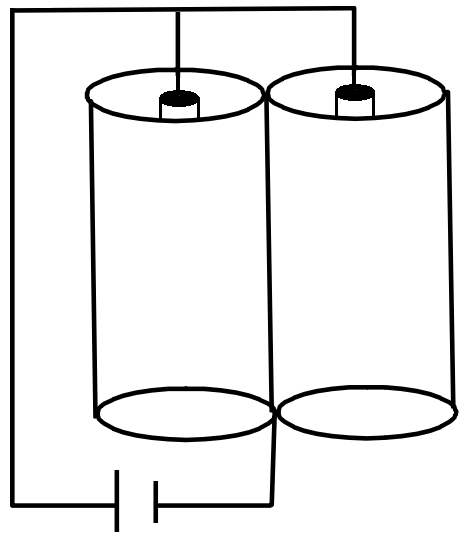
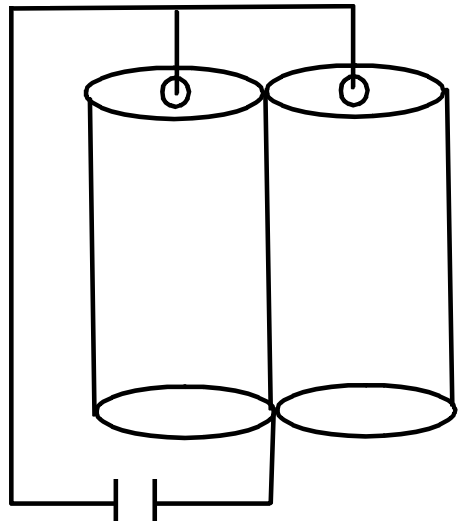
The outer cylinders of two cylindrical capacitors of capacitance $2.2\mu\text{F}$ each, are kept in contact and the inner cylinders are connected through a wire. A battery of emf 10V is connected as shown in figure. Find the total charge supplied by the battery to the inner cylinders.
Answer

The capacitance of the outer sphere $=2.2\mu\text{F}$
$\text{C}=2.2\mu\text{F}$
Potential, V = 10v
Let the charge given to individual cylinder = q.
$\text{C}=\frac{\text{q}}{\text{V}}$
$\Rightarrow\text{q}=\text{CV}=2.2\times10=22\mu\text{F}$
$\therefore$ The total charge given to the inner cylinder $=22+22=44\mu\text{F}$
View full question & answer
Question 265 Marks
Two metal spheres, one of radius R and the other of radius 2R, both have same surface charge density $\sigma$. They are brought in contact and separated. What will be new surface charge densities on them?
Answer
The charges on metal spheres before contact, are
$\text{Q}_1=\sigma.4\pi\text{R}^2$
and $\text{Q}_2=\sigma.4\pi(2\text{R})^2=4(\sigma.4\pi\text{R}^2)=4\text{Q}_1$
Let the charges on the metal spheres, after coming ib contact becomes $Q'_1$ and $Q'_2.$
Applying law of comservation of charges,
$\text{Q}'_1+\text{Q}'_2=\text{Q}_1+\text{Q}_2=5\text{Q}_1=5(\sigma.4\pi\text{R}^2)\ ...(\text{i})$
When metal spheres come in contact, they acquire equal potentials. Therefore, we have
$\frac{1}{4\pi\in_0}\frac{\text{Q}'_1}{\text{R}}=\frac{1}{4\pi\in_0}\frac{\text{Q}'2}{2\text{R}}\Rightarrow\ \text{Q}'_1=\frac{\text{Q}'_2}{2}\ .....\text{(i)}$
On solving (i) and (ii), we get
$\therefore\ \text{Q}'_1=\frac{5}{3}(\sigma.4\pi\text{R}^2)$ and $\text{Q}'_2=\frac{10}{3}(\sigma.4\pi\text{R}^2)$
$\therefore\ \sigma_1=\frac{5\sigma}{3}$ and $\sigma_2=\frac{5}{6}\sigma$.
View full question & answer
Question 275 Marks
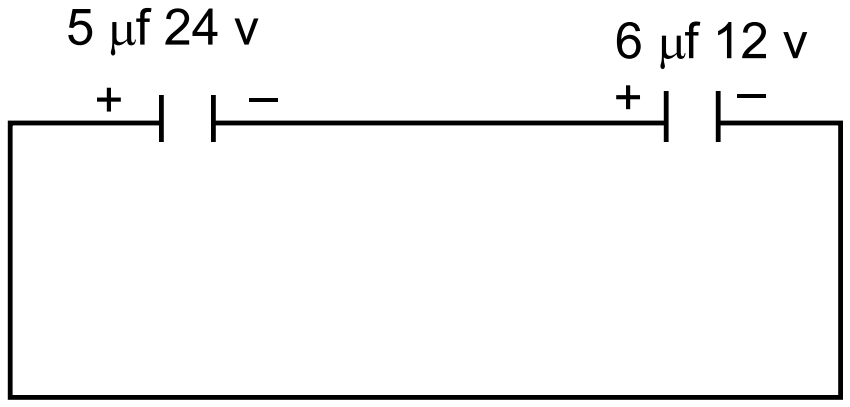
A capacitor of capacitance $5.00\mu\text{F}$ is charged to 24.0V and another capacitor of capacitance $6.0\mu\text{F}$ is charged to 12.0V:
  1. Find the energy stored in each capacitor.
  2. The positive plate of the first capacitor is now connected to the negative plate of the second and vice versa. Find the new charges on the capacitors.
  3. Find the loss of electrostatic energy during the process.
  4. Where does this energy go?
Answer
  1. $\text{C}_1=5\mu\text{f}$
$\text{V}_1=24\text{V}$
$\text{q}_1=\text{C}_1\text{V}_1=5\times24=120\mu\text{c}$
and $\text{C}_2=6\mu\text{f}$
$\text{V}_2=\text{R}$
$\text{q}_2=\text{C}_2\text{V}_2=6\times12=72$
$\therefore$ Energy stored on first capacitor
$\text{E}_1=\frac{1}2{}\frac{\text{q}_1^2}{\text{C}_1}=\frac{1}{2}\times\frac{(120)^2}{2}=1440\text{J}=1.44\text{mJ}$
Energy stored on $2^{nd}$ capacitor
$\text{E}_2=\frac{1}2{}\frac{\text{q}_2^2}{\text{C}_1}=\frac{1}{2}\times\frac{(72)^2}{6}=432\text{J}=4.32\text{mJ}$
  1. $C_1V_1$
$C_2V_2​​​​​​​$​​​​​​​


Let the effective potential = V
$\text{V}=\frac{\text{C}_1\text{V}_1-\text{C}_2\text{V}_2}{\text{C}_1+\text{C}_2}=\frac{120-72}{5+6}=4.36$
The new charge $\text{C}_1\text{V}=5\times4.36=21.8\mu\text{c}$
and $\text{C}_2\text{V}=6\times4.36=26.2\mu\text{c}$
  1. $\text{U}_1=\Big(\frac{1}{2}\Big)\text{C}_1\text{V}^2$
$\text{U}_2=\Big(\frac{1}{2}\Big)\text{C}_2\text{V}^2$
$\text{U}_{\text{f}}=\Big(\frac{1}{2}\Big)\text{V}^2(\text{C}_1+\text{C}_2)$
$=\Big(\frac{1}{2}\Big)(4.36)^2(5+6)$
$=104.5\times10^{-6}\text{J}=0.1045\text{mJ}$
But $\text{U}_{\text{i}}=1.44+0.433=1.873$
$\therefore$ The loss in $KE = 1.873 - 0.1045 = 1.7687 = 1.77mJ$
View full question & answer
Question 285 Marks
Find the expression for the energy stored in the capacitor. Also find the energy lost when the charged capacitor is disconnected from the source and connected in parallel with the uncharged capacitor. Where does this loss of energy appear?
Answer
$Q = Q_1 + Q_2$
$V_1 = V_2$ Potential of both capacitors after they are connected with each other.
$\therefore\frac{\text{Q}_1}{\text{C}_1}=\frac{\text{Q}_2}{\text{C}_2}\Rightarrow\text{Q}=\Big(\frac{\text{C}_1}{\text{C}_2}+1\Big)\text{Q}_2$
$\text{Q}_2=\frac{\text{QC}_2}{\text{C}_1+\text{C}_2},\text{Q}_1=\frac{\text{QC}_1}{\text{C}_1+\text{C}_2}$
$\text{V}_2=\text{V}_1=\frac{\text{Q}}{\text{C}_1+\text{C}_2}=\frac{\text{Q}_2}{\text{C}_2}=\frac{\text{Q}_1}{\text{C}_1}$
$\text{U}_{\text{f}}=\frac{1}{2}\text{C}_1\text{V}^2_1+\frac{1}{2}\text{C}_2\text{V}^2_2$
$=\frac{1}{2}\big(\text{C}_1+\text{C}_2\big)\frac{\text{Q}^2}{\big(\text{C}_1+\text{C}_2\big) ^2}=\frac{\text{Q}^2}{2\big(\text{C}_1+\text{C}_2\big)}$
$\text{U}_{\text{i}}=\frac{\text{Q}^2}{2\text{C}_1}$
$\text{U}_{\text{i}}-\text{U}_\text{f}=\frac{\text{Q}^2}{2\text{C}_1}-\frac{\text{Q}^2}{2\big(\text{C}_1+\text{C}_2\big)}=\frac{\text{Q}^2(\text{C}_2)}{(\text{C}_1)(\text{C}_1+\text{C}_2)}$
The lost energy appears in the form of heat.
View full question & answer
Question 295 Marks
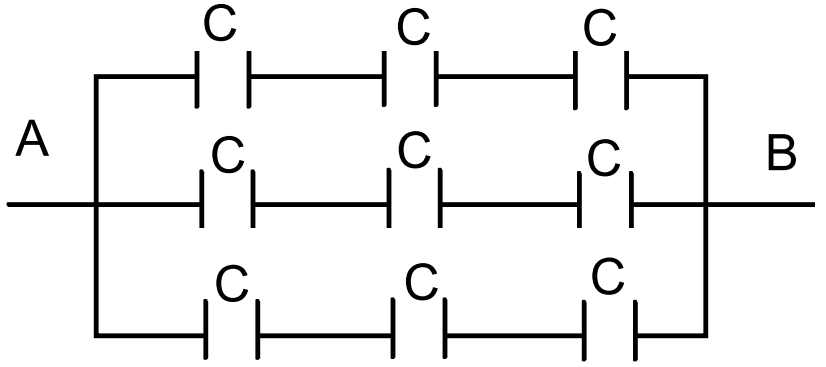
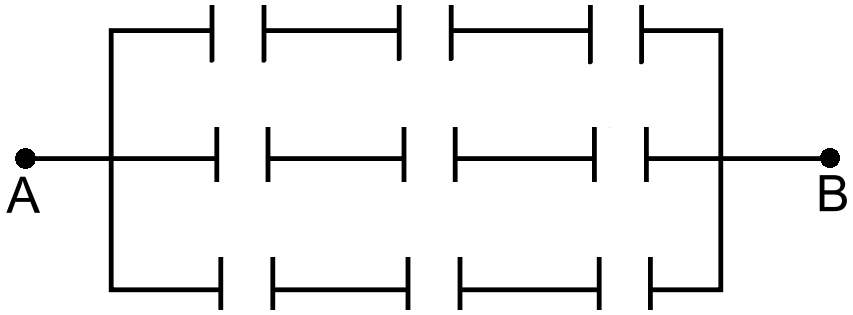
Each of the capacitors shown in figure has a capacitance of $2\mu\text{F}.$ Find the equivalent capacitance of the assembly between the points A and B. Suppose, a battery of emf 60 volts is connected between A and B. Find the potential difference appearing on the individual capacitors.
Answer

$\therefore\text{C}=2\mu\text{F}$
$\therefore$ In this system the capacitance are arranged in series. Then the capacitance is parallel to each other.
$\therefore$ The equation of capacitance in one row
$\text{C}=\frac{\text{C}}{3}$
and three capacitance of capacity $\frac{\text{C}}{3}$ are connected in parallel
$\therefore$ The equation of capacitance
$\text{C}=\frac{\text{C}}{3}+\frac{\text{C}}{3}+\frac{\text{C}}{3}=\text{C}=2\mu\text{F}$
As the volt capacitance on each row are same and the individual is
$=\frac{\text{Total}}{\text{No. of capacitance}}=\frac{60}{3}=20\text{V}$
View full question & answer
Question 305 Marks
Establish the relation between electric field and potential gradient.
Answer
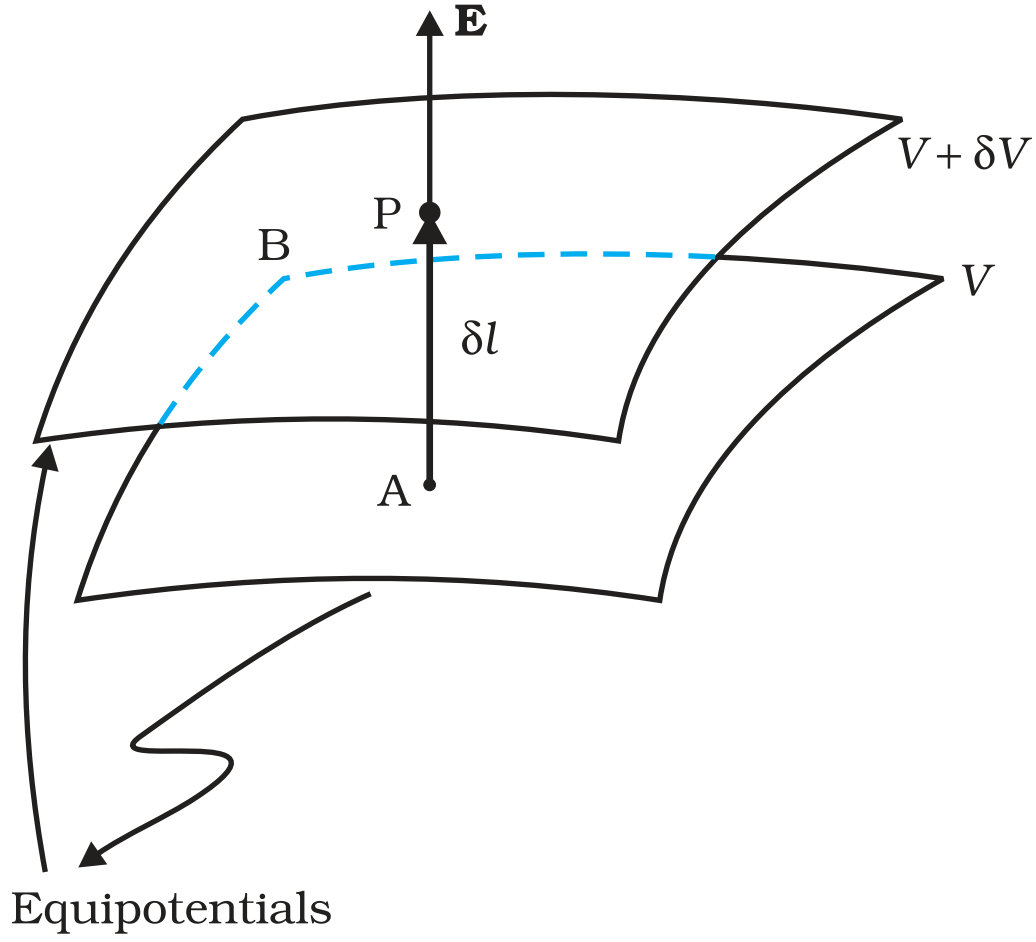
Let us consider two closely spaced equipotential surfaces A and B as shown in figure.

Let the potential of A be $V_A = V $ and potential of B be $V_B = V - dV$
where dV is decrease in potential in the direction of electric field $\vec{\text{E}}$ normal to A and B.
Let dr be the perpendicular distance between the two equipotential surfaces.
When a unit positive charge is moved along this perpendicular from the surface B to surface A against the electric field,
the work done in this process is: $\text{W}_{\text{BA}}=-\vec{\text{E}}(\text{dr})$
This work done equals the potentail difference $V_A - V_B,$
$\therefore\text{W}_{\text{BA}}=\text{V}_{\text{A}}-\text{V}_{\text{B}}=\text{V}-(\text{V}-\text{dV})=\text{dV}$
$\therefore-\vec{\text{E}}=\text{dV}$ Or, $\vec{\text{E}}=-\frac{\text{dV}}{\text{dr}}$
= negative of potential gradlant.
View full question & answer
Question 315 Marks
Calculate potential on the axis of a disc of radius R due to a charge Q uniformly distributed on its surface.
Answer
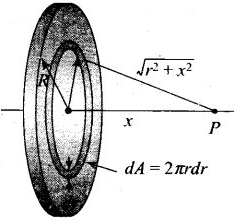
Let us consider a point P on the axis of the disc at a distance x from the centre of the disk and take the plane of the disk to be perpendicular to the x-acis. Let the disc is divided into a number of charged tings as shown in figure.

The electric potential of each ring, of radius r and width dr, have charge dq is given by
$\text{dq}=\sigma\text{dA}=\sigma2\ \pi\text{rdr}$
and potential is given by
$\text{dV}=\frac{1}{4\pi\in_0}\frac{\text{dq}}{\sqrt{\text{r}^2+\text{x}^2}}=\frac{1}{4\pi\in_0}\frac{\sigma2\pi\text{rdr}}{\sqrt{\text{r}^2+\text{x}^2}}$
The total electric potential at P, is given by
$\text{V}=\frac{\sigma}{4\in_0}\int_0^\text{R}\frac{2\text{rdr}}{\sqrt{\text{r}^2+\text{x}^2}}=\frac{\sigma}{4\in_0}\Bigg[\frac{\sqrt{\text{r}^2+\text{x}^2}}{\frac{1}{2}}\Bigg]_0^\text{R}$
$\Rightarrow\ \text{V}=\frac{\sigma}{4\in_0}\big[\sqrt{\text{R}^2+\text{x}^2}-\text{x}\big]$
$=\frac{\text{Q}}{2\pi\in_0\text{R}^2}\big[\sqrt{\text{R}^2+\text{x}^2}-\text{x}\big]$
View full question & answer
Question 325 Marks
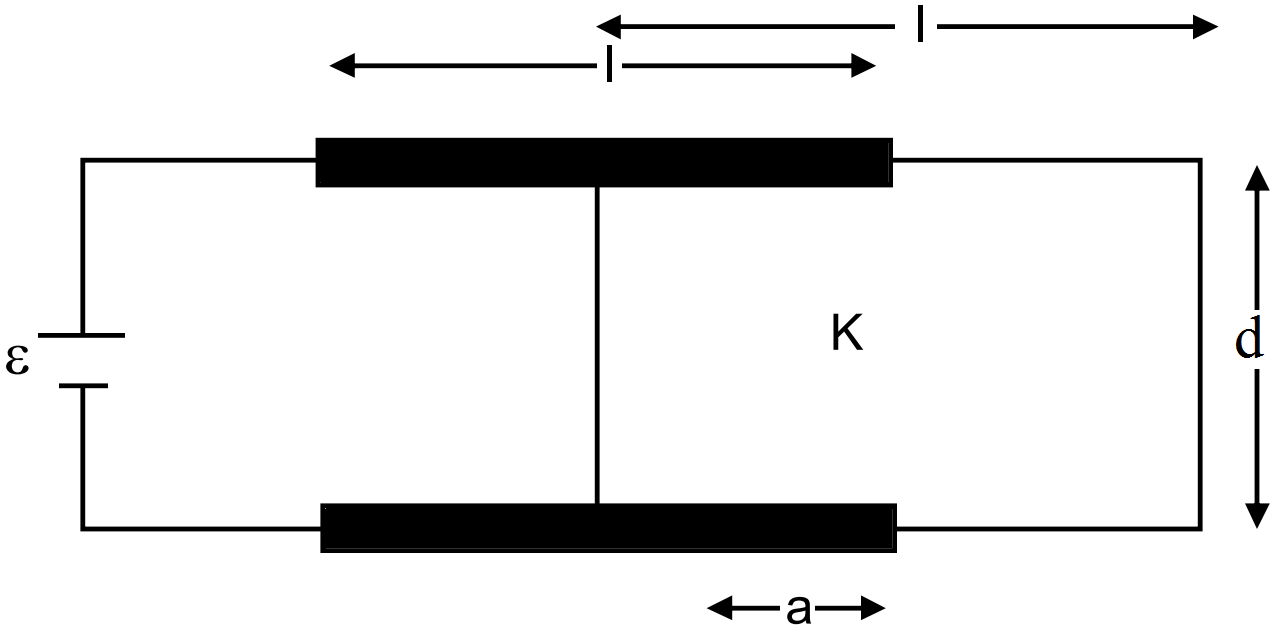
Consider the situation shown in figure. The plates of the capacitor have plate area A and are clamped in the laboratory. The dielectric slab is released from rest with a length a inside the capacitor. Neglecting any effect of friction or gravity, show that the slab will execute periodic motion and find its time period.
Answer
Capacitance of the portion with dielectrics,
$\text{C}_1=\frac{\text{k}\in_0\text{A}}{\ell\text{d}}$
Capacitance of the portion without dielectrics
$\text{C}_2=\frac{\in_0(\ell-\text{a})\text{A}}{\ell\text{d}}$

$\therefore$ Net capacitance $\text{C}=\text{C}_1+\text{C}_2$
$=\frac{\in_0\text{A}}{\ell\text{d}}[\text{ka}+(\ell-\text{a})]$
$\text{C}=\frac{\in_0\text{A}}{\ell\text{d}}[\ell+\text{a}(\text{k}-1)]$
Consider the motion of dielectric in the capacitor.
Let it further move a distance dx, which causes an increase of capacitance by dc
$\therefore$ dQ = (dc)E
The work done by the battery $dw = Vdg = E(dc)E = E^2dc$
Let force acting on it be f
$\therefore$ Work done by the force during the displacement, $dx = fdx$
$\therefore$ Increase in energy stored in the capacitor
$\Rightarrow\Big(\frac{1}{2}\Big)(\text{dc})\text{E}^2=(\text{dc})\text{E}^2-\text{fdx}$
$\Rightarrow\text{fdx}=\Big(\frac{1}2{}\Big)(\text{dc})\text{E}^2$
$\Rightarrow\text{f}=\frac{1}{2}\frac{{\text{E}^2\text{dc}}}{\text{dx}}$
$\text{C}=\frac{\in_0\text{A}}{\ell\text{d}}[\ell+\text{a}(\text{k}-1)]$ (Here x = a)
$\Rightarrow\frac{\text{dc}}{\text{da}}=\frac{-\text{d}}{\text{da}}\Big[\frac{\in_0\text{A}}{\ell\text{d}}\big\{\ell+\text{a}(\text{k}-1)\big\}\Big]$
$\Rightarrow\frac{\in_0\text{A}}{\ell\text{d}}(\text{k}-1)=\frac{\text{dc}}{\text{dx}}$
$\Rightarrow\text{f}=\frac{1}{2}\text{E}^2\frac{\text{dc}}{\text{dx}}=\frac{1}{2}\text{E}^2\Big\{\frac{\in_0\text{A}}{\ell\text{d}}(\text{k}-1)\Big\}$
$\therefore\text{a}_{\text{d}}=\frac{\text{f}}{\text{m}}=\frac{\text{E}^2\in_0\text{A}(\text{k}-1)}{2\ell\text{dm}}$ $\Big[\therefore(\ell-\text{a})=\frac{1}{2}\text{a}_{\text{d}}\text{t}^2\Big]$
$\Rightarrow\text{t}=\sqrt{\frac{2(\ell-\text{a})}{\text{a}_{\text{d}}}}=\sqrt{\frac{2(\ell-\text{a})2\ell\text{dm}}{\text{E}^2\in_0\text{A}(\text{k}-1)}}$
$=\sqrt{\frac{4\text{m}\ell\text{d}(\ell-\text{a})}{\in_0\text{AE}^2(\text{k}-1)}}$
$\therefore$ Time period $=\text{2t}=\sqrt{\frac{\text{8m}\ell\text{d}(\ell-\text{a})}{\in_0\text{AE}^2(\text{k}-1)}}$
View full question & answer
Question 335 Marks
Two point charges of magnitude +q and -q are placed at $\Big(-\frac{\text{d}}{2},0,0\Big)$ and $\Big(\frac{\text{d}}{2},0,0\Big)$, respectively. Find the equation of the equipoential surface where the potential is zero.
Answer
The potential at the point P is given by
$\frac{1}{4\pi\in_0}\frac{\text{q}}{\bigg[\Big(\frac{\text{x}+\text{d}}{2}\Big)^2+\text{h}^2\bigg]^\frac{1}{2}}-\frac{1}{4\pi\in_0}\frac{\text{q}}{\bigg[\Big(\frac{\text{x}-\text{d}}{2}\Big)^2+\text{h}^2\bigg]^\frac{1}{2}}$
For net electric potential ar P to be zero,
${\bigg[\Big(\frac{\text{x}+\text{d}}{2}\Big)^2+\text{h}^2\bigg]^\frac{1}{2}}={\bigg[\Big(\frac{\text{x}-\text{d}}{2}\Big)^2+\text{h}^2\bigg]^\frac{1}{2}}$
Or $\Big(\frac{\text{x}+\text{d}}{2}\Big)^2+\text{h}^2=\Big(\frac{\text{x}-\text{d}}{2}\Big)^2+\text{h}^2$
$\Rightarrow\ \frac{\text{x}^2-\text{dx}+\text{d}^2}{4}=\frac{\text{x}^2+\text{dx}+\text{d}^2}{4}$
Or $2\text{dx}=0$
$\Rightarrow\ \text{x}=0$
The equation of the required plane is x = 0. It means it is v-z plane.
View full question & answer
Question 345 Marks
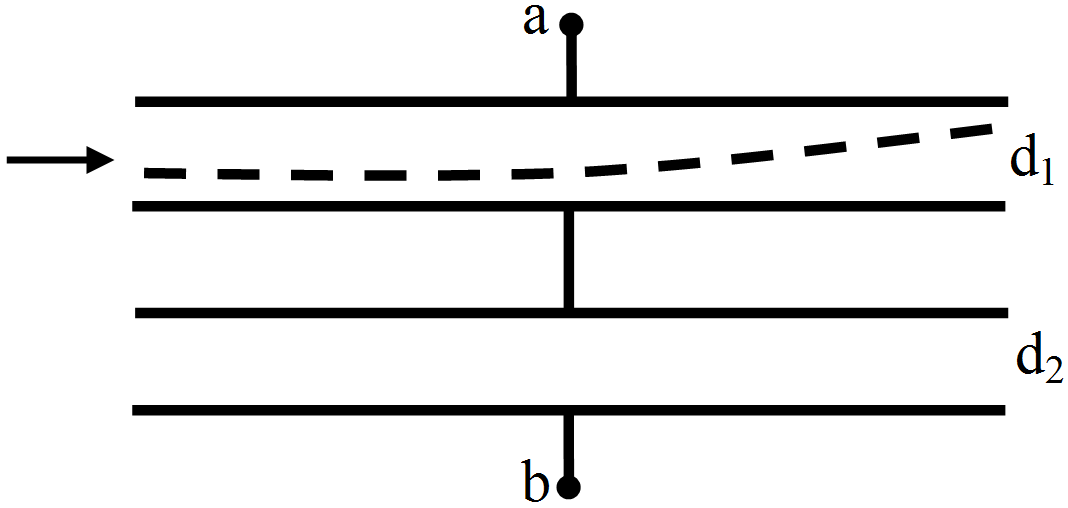
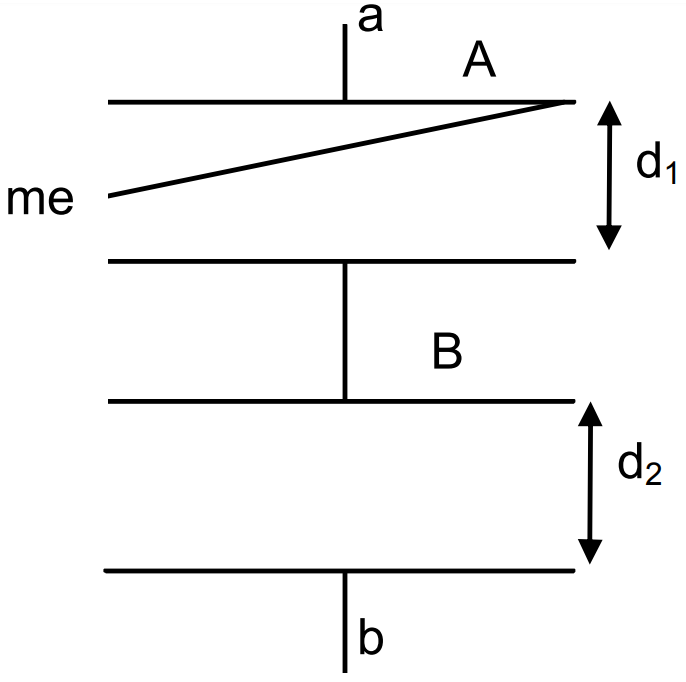
Both the capacitors shown in figure are made of square plates of edge a. The separations between the plates of the capacitors are $d_1$ and $d_2$ as shown in the figure. A potential difference V is applied between the points a and b, An electron is projected between the plates of the upper capacitor along the central line. With what minimum speed should the electron be projected so that it does not collide with any plate? Consider only the electric forces.
Answer
Let mass of electron $=\mu$
Charge electron = e
We know, ‘q’

For a charged particle to be projected in side to plates of a parallel plate capacitor with electric field E,
$\text{y}=\frac{1\text{qE}}{2\text{m}}\Big(\frac{\text{x}}{\mu}\Big)^2$
where y–Vertical distance covered or
x–Horizontal distance covered
$\mu-$Initial velocity
From the given data,
$\text{y}=\frac{\text{d}_1}{2},\ \text{E}=\frac{\text{V}}{\text{R}}=\frac{\text{qd}_1}{\in_0\text{a}^2\times\text{d}_1}=\frac{\text{q}}{\in_0\text{a}^2,}$ $\text{x}=\text{a},\ \mu=?$
For capacitor A –
$\text{V}_1=\frac{\text{q}}{\text{C}_1}=\frac{\text{qd}_1}{\in_0\text{a}^2}$ as $\text{C}_1=\frac{\in_0\text{a}^2}{\text{d}_1}$
Here q = chare on capacitor.
q = C × V where C = Equivalent capacitance of the total arrangement $=\frac{\in_0\text{a}^2}{\text{d}_1+\text{d}_2}$
So, $\text{q}=\frac{\in_0\text{a}^2}{\text{d}_1+\text{d}_2}\times\text{V}$
Hence $\text{E}=\frac{\text{q}}{\in_0\text{a}^2}$
$=\frac{\in_0\text{a}^2\times\text{V}}{(\text{d}_1+\text{d}_2)\in_0\text{a}^2}=\frac{\text{V}}{(\text{d}_1+\text{d}_2)}$
Substituting the data in the known equation, we get, $\frac{\text{d}_1}{2}=\frac{1}{2}\times\frac{\text{e}\times\text{V}}{(\text{d}_1+\text{d}_2)\text{m}}\times\frac{\text{a} ^2}{\text{u}^2}$
$\Rightarrow\text{u}^2=\frac{\text{Vea}^2}{\text{d}_1\text{m}(\text{d}_1+\text{d}_2)}$
$\Rightarrow\text{u}=\Big(\frac{\text{Vea}^2}{\text{d}_1\text{m}(\text{d}_1+\text{d}_2)}\Big)^{\frac{1}{2}}$
View full question & answer
Question 355 Marks
Calculate potential on the axis of a ring due to charge Q uniformly distributed along the ring of radius R.
Answer
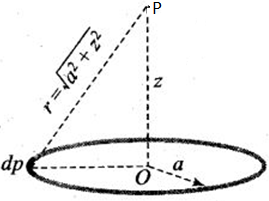
Let us take point P to be at a distance z from the centre of the ring, as shown in figure. the charge element dq is at a distance z from the point P. therefore, V can be written as

$\text{V}=\frac{1}{4\pi\in_0}\int\frac{\text{dq}}{\text{r}}=\frac{1}{4\pi\in_0}\int\frac{\text{dq}}{\sqrt{\text{z}^2+\text{a}^2}}$
Since each element dq is at the same distance from point P, so we have net potential
$\text{V}=\frac{1}{4\pi\in_0}\frac{\text{dq}}{\sqrt{\text{z}^2+\text{a}^2}}\int\text{dq}=\frac{1}{4\pi\in_0}\frac{1}{\sqrt{\text{z}^2+\text{a}^2}}[\text{Q}]$
The net electric potential $\text{V}=\frac{1}{4\pi\in_0}\frac{\text{Q}}{\sqrt{\text{z}^2+\text{a}^2}}$.
View full question & answer
Question 365 Marks
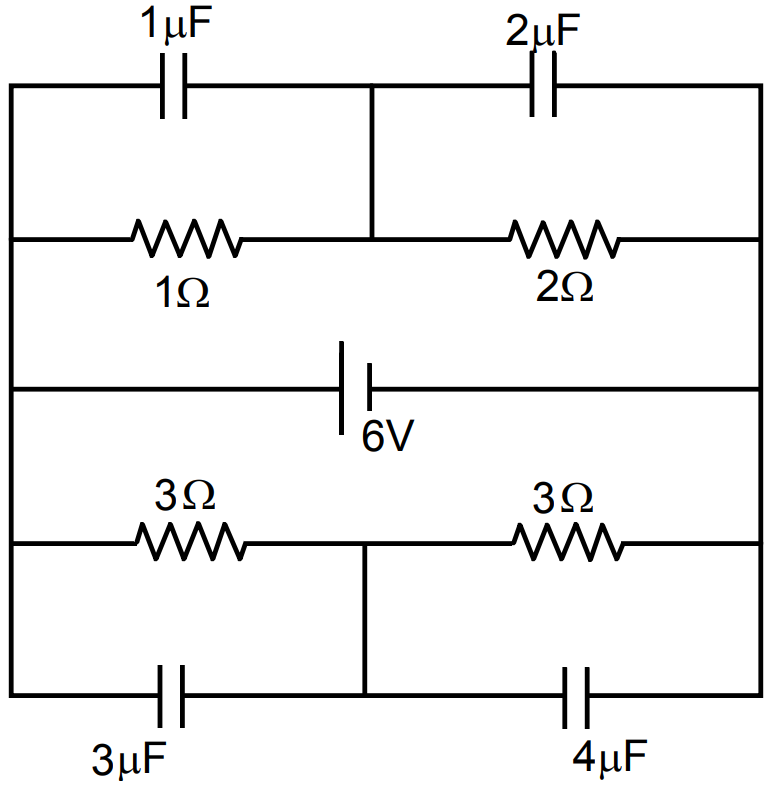
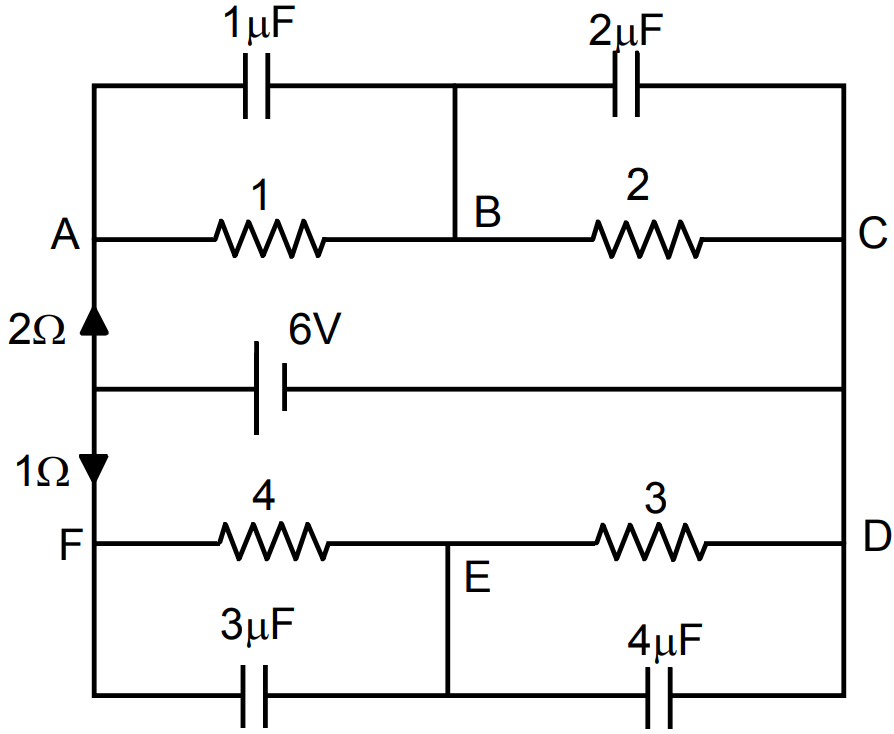
Find the charges on the four capacitors of capacitances $1\mu\text{F},2\mu\text{F},3\mu\text{F}$ and $4\mu\text{F}$ shown in the figure.
Answer
At steady state no current flows through the capacitor.

$\text{R}_\text{eq}=\frac{3\times6}{3+6}=2\Omega$
$\text{i}=\frac{6}{2}=3$
Since current is divided in the inverse ratio of the resistance in each branch, thus $2\Omega$ will pass through $1,2\Omega$ branch and 1 through $3,3\Omega$ branch
$\text{V}_\text{AB}=2\times1=2\text{V}$
Q on $1\mu\text{F}$ capacitor $=2\times1\mu\text{c}=2\mu\text{C}$
$\text{V}_\text{BC}=2\times2=4\text{V}$
Q on $2\mu\text{F}$ capacitor $=4\times2\mu\text{c}=8\mu\text{C}$
$\text{V}_\text{DE}=1\times3=2\text{V}$
Q on $4\mu\text{F}$ capacitor
$\text{V}_\text{FE}=3\times1=\text{V}$
Q across $3\mu\text{F}$ capacitor $=3\times3\mu\text{c}=9\mu\text{C}.$
View full question & answer
Question 375 Marks
A $5.0\mu\text{F}$ capacitor is charged to 12V. The positive plate of this capacitor is now connected to the negative terminal of a 12V battery and vice versa. Calculate the heat developed in the connecting wires.
Answer

When the capacitor is connected to the battery, a charge Q = CE appears on one plate and -Q on the other. When the polarity is reversed, a charge -Q appears on the first plate and +Q on the second. A charge 2Q, therefore passes through the battery from the negative to the positive terminal.
The battery does a work.
$W = Q × E = 2QE = 2CE^2$​​​​​​​
In this process. The energy stored in the capacitor is the same in the two cases. Thus the workdone by battery appears as heat in the connecting wires. The heat produced is therefore,
$2CE^2 = 2 \times 5 \times 10^{-6} \times 144 = 144 \times 10^{-5}J = 1.44\ mJ [$have $C = 5\mu f, V = E = 12V]$
View full question & answer
Question 385 Marks
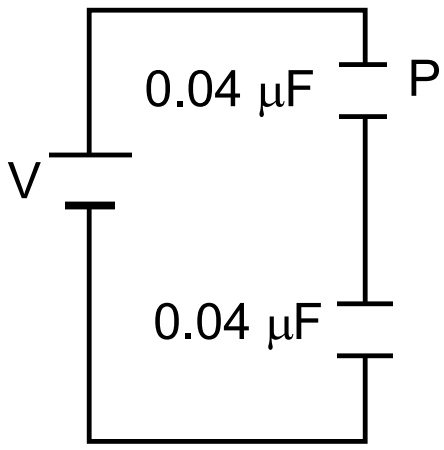
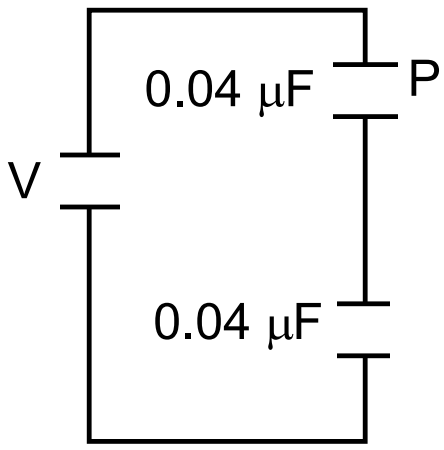
The particle P shown in figure has a mass of 10mg and a charge of $-0.01\mu\text{C}.$ Each plate has a surface area $100cm^2$​​​​​​​ on one side. What potential difference V should be applied to the combination to hold the particle P in equilibrium?
Answer

Given that mass of particle m = 10mg
Charge 1 $=-0.01\mu\text{C}$
$A = 100cm^2$​​​​​​​
Let potential = V
The Equation capacitance $\text{C}=\frac{0.04}{2}=0.02\mu\text{F}$
The particle may be in equilibrium, so that the wt. of the particle acting down ward, must be balanced by the electric force acting up ward.
$\therefore$ qE = Mg
Electric force $=\text{qE}=\text{q}\frac{\text{V}}{\text{d}}$ where V–Potential, d–separation of both the plates.
$=\text{q}\frac{\text{VC}}{\in_9\text{A}},\ \text{C}=\frac{\in_0\text{A}}{\text{q}},\ \text{d}=\frac{\in_0\text{A}}{\text{C}}$
$\text{qE}=\text{mg}$
$=\frac{\text{QVC}}{\in_0\text{A}}=\text{mg}$
$=\frac{0.01\times0.02\times\text{V}}{8.85\times10^{-12}\times100}=0.1\times980$
$\Rightarrow\text{V}=\frac{0.1\times980\times8.85\times10^{-10}}{0.0002}$
$=0.00043=43\text{MV}$
View full question & answer
Question 395 Marks
A sphercial capacitor is made of two conducting spherical shells of radii a and b. The space between the shells is filled with a dielectric of dielectric constant K up to a radius c as shown in figure. Calculate the capacitance.
Answer
Here, we should consider a capacitor cac and cabc in series. $\text{Cac}=\frac{4\pi\in_0\text{ack}}{\text{k}(\text{c}-\text{a})}$ $\text{Cbc}=\frac{4\pi\in_0\text{bc}}{(\text{b}-\text{c})}$
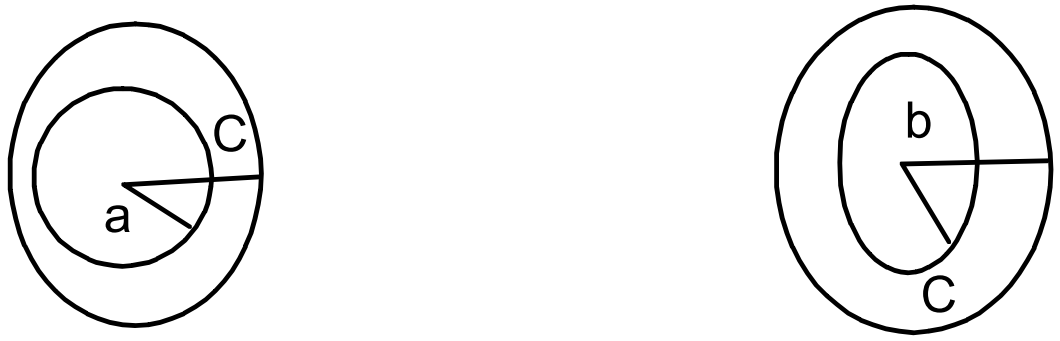
$\frac{1}{\text{C}}=\frac{1}{\text{Cac}}+\frac{1}{\text{Cbc}}$ $=\frac{(\text{c}-\text{a})}{4\pi\in_0\text{ack}}+\frac{(\text{b}-\text{c})}{4\pi\in_0\text{bc}}$ $=\frac{\text{b}(\text{c}-\text{a})+\text{ka}(\text{b}-\text{c})}{\text{k}4\pi\in_0\text{abc}}$ $\text{C}=\frac{4\pi\in_0\text{kabc}}{\text{ka}(\text{b}-\text{c})+\text{b}(\text{c}-\text{a})}$
View full question & answer
Question 405 Marks
A parallel-plate capacitor having plate area $20cm^2$ and separation between the plates 1.00mm is connected to a battery of 12.0V. The plates are pulled apart to increase the separation to 2.0mm.
  1. Calculate the charge flown through the circuit during the process.
  2. How much energy is absorbed by the battery during the process?
  3. Calculate the stored energy in the electric field before and after the process.
  4. Using the expression for the force between the plates, find the work done by the person pulling the plates apart.
  5. Show and justify that no heat is produced during this transfer of charge as the separation is increased.
Answer
Area $=a = 20cm^2 = 2 \times 10^{-2}m^2 $
d = Separation $= 1mm = 10^{-3}m$
$\text{C}_{\text{i}}=\frac{\in_0\times2\times10^{-3}}{10^{-3}}=2\in_0$
$\text{C}_{\text{f}}=\frac{\in_0\times2\times10^{-3}}{2\times10^{-3}}=\in_0$
$\text{q}_{\text{i}}=24\in_0$
$\text{q}_{\text{f}}=12\in_0$
  1. So, q flown out $12\in_0.$ i.e., $q_i - q_f​​​​​​​$​​​​​​​
So, $q = 12 \times 8.85 \times 10^{-12} = 106.2 \times 10^{-12}C = 1.06 \times 10^{-10}C​​​​​​​$​​​​​​​
  1. Energy absorbed by battery during the process
$= q \times v = 1.06 \times 10^{-10}C \times 12$
$= 12.7 \times 10^{-10}J​​​​​​​$​​​​​​​
  1. Before the process
$\text{E}_{\text{i}}=\Big(\frac{1}{2}\Big)\times\text{C}_{\text{i}}\times\text{V}^2$
$=\Big(\frac{1}{2}\Big)\times2\times8.85\times10^{-12}\times144$
$=12.7\times10^{-10}\text{J}$
After the force
$\text{E}_{\text{f}}=\Big(\frac{1}{2}\Big)\times\text{C}_{\text{f}}\times\text{V}^2$
$=\Big(\frac{1}{2}\Big)\times8.85\times10^{-12}\times144$
$=6.35\times10^{-10}\text{J}$
  1. Workdone = Force × Distance
$=\frac{1}{2}\frac{\text{q}^2}{\in_0\text{A}}=1\times10^{3}$
$=\frac{1}{2}\times\frac{12\times12\times\in_0\times\in_0\times10^{-3}}{\in_0\times2\times10^{-3}}$
  1. From (c) and (d) we have calculated, the energy loss by the separation of plates is equal to the work done by the man on plate. Hence no heat is produced in transformer.
View full question & answer
Question 415 Marks
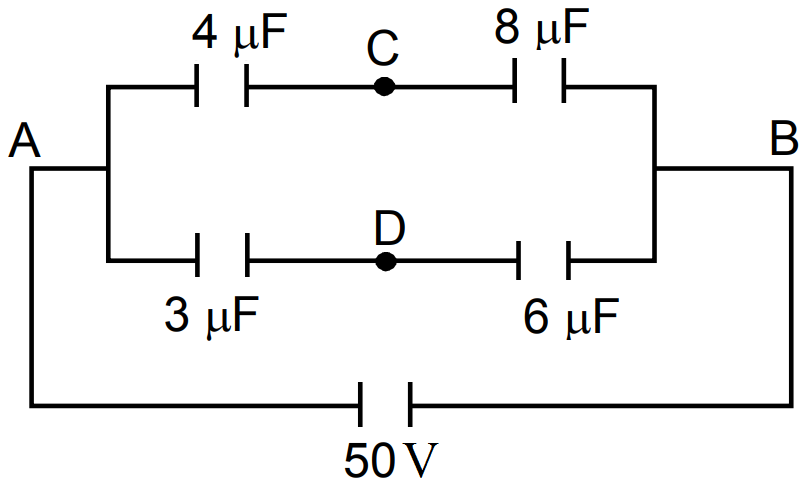
Take the potential of the point B in figure to be zero:
  1. Find the potentials at the points C and D.
  2. If a capacitor is connected between C and D, what charge will appear on this capacitor?
Answer

  1. Capacitor $=\frac{4\times8}{4+8}=\frac{8}{3}\mu\text{F}$
and $=\frac{6\times3}{6+3}=2\mu\text{F}$
  1. The charge on the capacitance $\frac{8}{3}\mu\text{F}$
$\therefore\text{Q}=\frac{8}{3}\times50=\frac{400}{3}$

$\therefore$ The potential at $4\mu\text{F}=\frac{400}{3\times4}=\frac{100}{3}$

at $8\mu\text{F}=\frac{400}{3\times8}=\frac{100}{6}$

The Potential difference $=\frac{100}{3}-\frac{100}{6}=\frac{50}{3}\mu\text{V}$
  1. Hence the effective charge at $2\mu\text{F}=50\times2=100\mu\text{F}$
$\therefore$ Potential at $3\mu\text{F}=\frac{100}{3};$ Potential at $6\mu\text{F}=\frac{100}{6}$

$\therefore$ Difference $=\frac{100}{3}-\frac{100}{6}=\frac{50}{3}\mu\text{V}$

$\therefore$ The potential at C & D is $\frac{50}{3}\mu\text{V}$
  1. $\therefore\frac{\text{P}}{\text{Q}}=\frac{\text{R}}{\text{S}}=\frac{1}2{}=\frac{1}{2}=$ It is balanced. So, from it is cleared that the wheat star bridge balanced.
So, the potential at the point C & D are same. So, no current flow through the point C & D.

So, if we connect another capacitor at the point C & D the charge on the capacitor is zero.
View full question & answer
Question 425 Marks
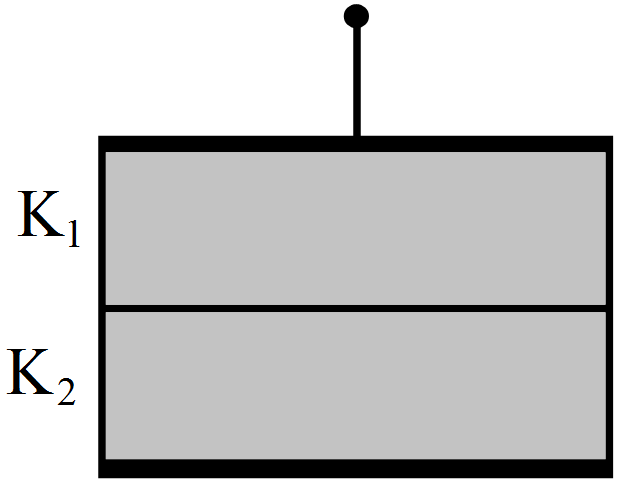
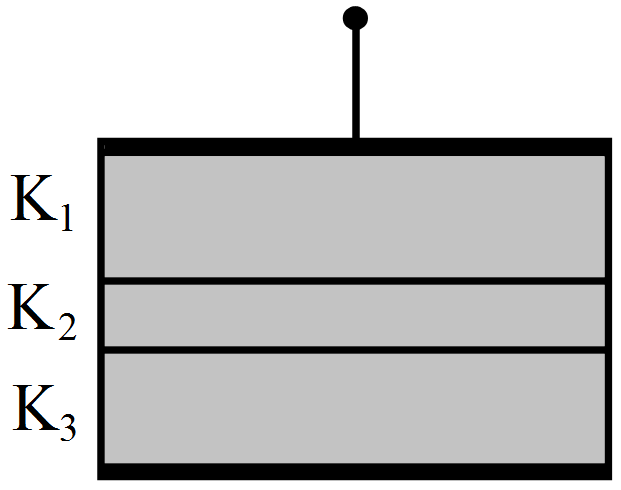
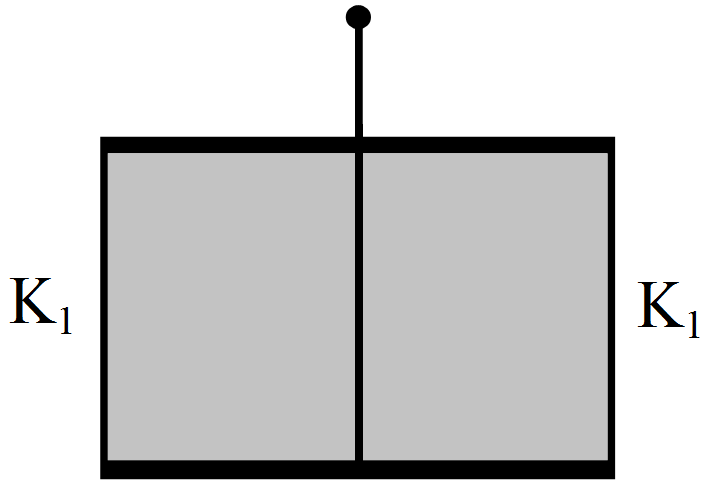
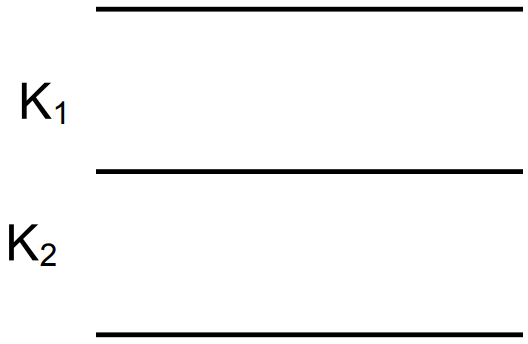
Find the capacitances of the capacitors shown in figure. The plate area is A and the separation between the plates is d. Different dielectric slabs in a particular part of the figure are of the same thickness and the entire gap between the plates is filled with the dielectric slabs.


Answer
  1. Area = A
Separation = d


$\text{C}_1=\frac{\in_0\text{Ak}_1}{\frac{\text{d}}{2}}$

$\text{C}_2=\frac{\in_0\text{Ak}_2}{\frac{\text{d}}{2}}$

$\text{C}=\frac{\text{C}_1\text{C}_2}{\text{C}_1+\text{C}_2}=\frac{\frac{2\in_0\text{Ak}_1}{\text{d}}\times\frac{2\in_0\text{Ak}_2}{\text{d}}}{\frac{2\in_0\text{Ak}_1}{\text{d}}+\frac{2\in_0\text{Ak}_2}{\text{d}}}$

$=\frac{\frac{(2\in_0\text{A})^2\text{k}_1\text{k}_2}{\text{d}^2}}{(2\in_0\text{A})\frac{\text{k}_1\text{d+}\text{k}_2\text{d}}{\text{d}^2}}=\frac{2\text{k}_1\text{k}_2\in_0\text{A}}{\text{d}(\text{k}_1+\text{k}_2)}$
  1. $\frac{1}{\text{C}}=\frac{1}{\text{C}_1}+\frac{1}{\text{C}_2}+\frac{1}{\text{C}_3}$
$=\frac{1}{\frac{3\in_0\text{Ak}_1}{\text{d}}}+\frac{1}{\frac{3\in_0\text{Ak}_2}{\text{d}}}+\frac{1}{\frac{3\in_0\text{Ak}_3}{\text{d}}}$

$=\frac{\text{d}}{3\in_0\text{A}}\Big[\frac{1}{\text{k}_1}+\frac{1}{\text{k}_2}+\frac{1}{\text{k}_3}\Big]$

$=\frac{\text{d}}{3\in_0\text{A}}\Big[\frac{\text{k}_2\text{k}_3+\text{k}_1\text{k}_3+\text{k}_1\text{k}_2}{\text{k}_1\text{k}_2\text{k}_3}\Big]$

$\therefore\text{C}=\frac{3\in_0\text{A}\text{k}_1\text{k}_2\text{k}_3}{\text{d}(\text{k}_1\text{k}_2+\text{k}_2\text{k}_3+\text{k}_1\text{k}_3)}$
  1. $\text{C}=\text{C}_1+\text{C}_2$
$=\frac{\in_0\frac{\text{A}}{2}\text{k}_1}{\text{d}}+\frac{\in_0\frac{\text{A}}{2}\text{k}_2}{\text{d}}=\frac{\in_0\text{A}}{2\text{d}}(\text{k}_1+\text{k}_2)$
View full question & answer
Question 435 Marks
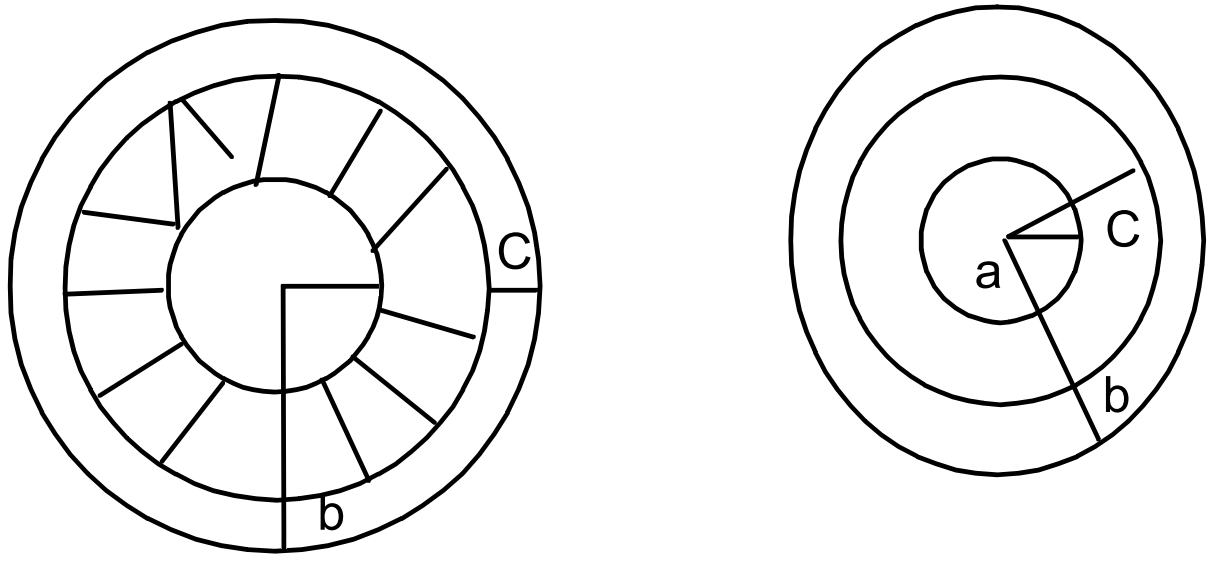
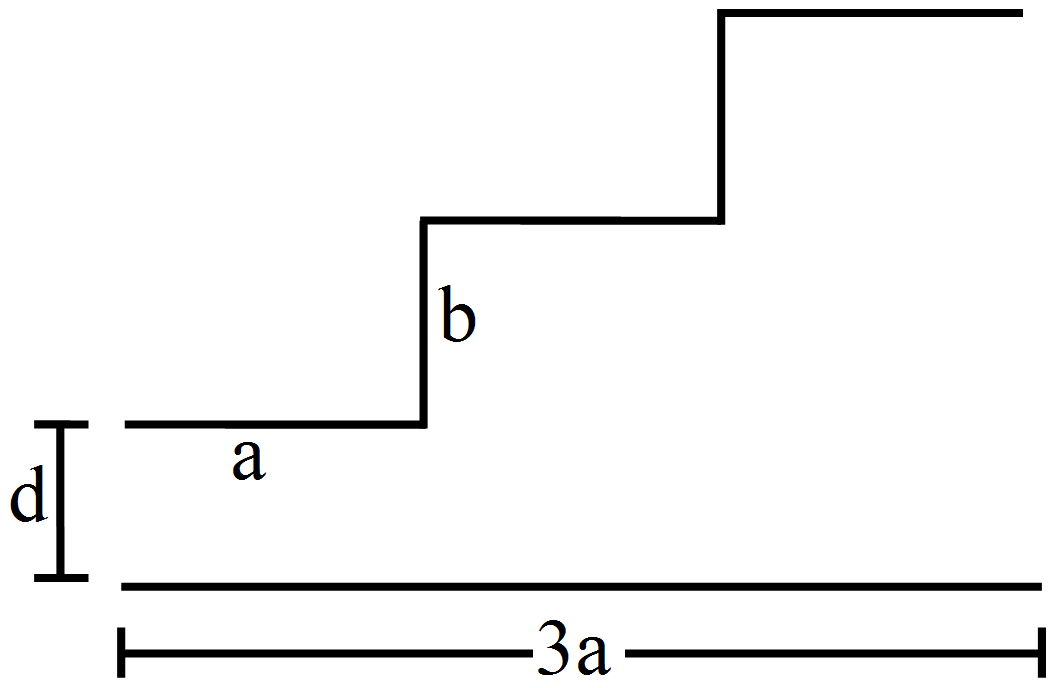
A capacitor is made of a flat plate of area A and a second plate having a stair-like structure as shown in figure. The width of each stair is a and the height is b. Find the capacitance of the assembly.
Answer

In the figure the three capacitors are arranged in parallel.
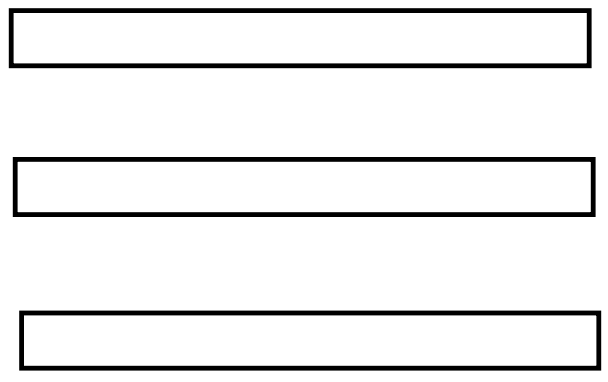
All have same surface area $=\text{a}=\frac{\text{A}}{3}$
First capacitance $\text{C}_1=\frac{\in_0\text{A}}{3\text{d}}$
Second capacitance $\text{C}_2=\frac{\in_0\text{A}}{3(\text{b}+\text{d})}$
Third capacitance $\text{C}_3=\frac{\in_0\text{A}}{3(2\text{b}+\text{d})}$
$\text{C}_{\text{eq}}=\text{C}_1+\text{C}_2+\text{C}_3$
$=\frac{\in_0\text{A}}{3\text{d}}+\frac{\in_0\text{A}}{3(\text{b}+\text{d})}+\frac{\in_0\text{A}}{3(2\text{b}+\text{d})}$
$=\frac{\in_0\text{A}}{3}\Big(\frac{1}{\text{d}}+\frac{1}{\text{b}+\text{d}}+\frac{2}{\text{2b}+\text{d}}\Big)$
$=\frac{\in_0\text{A}}{3}\Big(\frac{(\text{b}+\text{d})(2\text{b}+\text{d})+(2\text{b}+\text{d})\text{d}+(\text{b}+\text{d})\text{d}}{\text{d}(\text{b}+\text{d})(2\text{b}+\text{d})}\Big)$
$=\frac{\in_0\text{A}\big(3\text{d}^2+6\text{bd}+2\text{b}^2\big)}{3\text{d}(\text{b}+\text{d})(2\text{b}+\text{d})}$
View full question & answer
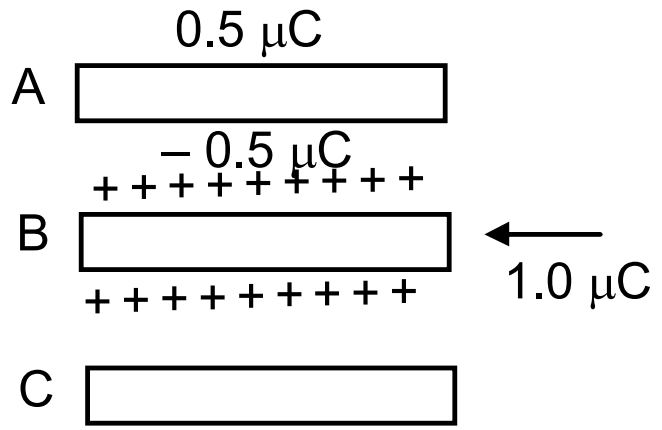
Question 445 Marks
The capacitance between the adjacent plates shown in figure is 50nF. A charge of $1.0\mu\text{C}$ is placed on the middle plate:
  1. What will be the charge on the outer surface of the upper plate?
  2. Find the potential difference developed between the upper and the middle plates.
Answer

  1. When charge of $1\mu\text{C}$ is introduced to the B plate, we also get $0.5\mu\text{C}$ charge on the upper surface of Plate ‘A’.
  2. Given $\text{C}=50\mu\text{F}=50\times10^{-9}\text{F}=5\times10^{-8}\text{F}$
Now charge $=0.5\times10^{-6}\text{C}$

$\text{V}=\frac{\text{q}}{\text{C}}=\frac{5\times10^{-7}\text{C}}{5\times10^{-8}\text{F}}=10\text{V}$
View full question & answer
Question 455 Marks
Two charges $q_1$ and $q_2$ are placed at $(0, 0, d)$ and $(0, 0, -d)$ respectively. Find locus of points where the potential a zero.
Answer
Key concept: Following the principle of superposition of potentials as described in last section, let us find the potential V due to a collection of discrete point charges $q_1, q_2, … q_n,$ at a point P.

As we know, the potential at point P is $\text{V}=\sum\text{V}_\text{i},$
where $\text{V}_\text{i}=\frac{\text{q}_\text{i}}{4\pi\in_0};\text{r}_\text{i}=$ magnitude of position vector P relative to $q_i.$
Then $\text{V}_\text{i}=\frac{1}{4\pi\in_0}\sum\frac{\text{q}_\text{i}}{\text{r}_\text{pi}}$
Let us take a point on the required plane as (x, y, z). The two charges lies on z-axis at a separation of 2d. The potential at the point P due to two charges is given by
$\frac{\text{q}_1}{\sqrt{\text{x}^2+\text{y}^2+(\text{z}-\text{d})^2}}+\frac{\text{q}_2}{\sqrt{\text{x}^2+\text{y}^2+(\text{z}+\text{d})^2}}=0$
$\therefore\ \frac{\text{q}_1}{\sqrt{\text{x}^2+\text{y}^2+(\text{z}-\text{d})^2}}=\frac{-\text{q}_2}{\sqrt{\text{x}^2+\text{y}^2+(\text{z}+\text{d})^2}}$
On squaring and simplifying, we get
$\text{x}^2+\text{y}^2+\text{z}^2+\begin{bmatrix} \frac{\Big(\frac{\text{q}_1}{\text{q}_2}\Big)^2+1}{\Big(\frac{\text{q}_1}{\text{q}_2}\Big)^2-1}\end{bmatrix} (2\text{zd})+\text{d}^2-0$
The standerd equation pf sphere is
$\text{x}^2+\text{y}^2+\text{z}^2+2\text{ux}+2\text{uy}+2\text{wz}+\text{g}=0$
with centre (-u, -v, -w) and redius
$\sqrt{\text{u}^2+\text{v}^2+\text{w}^2-\text{g}}$
Hence centre of sphere will be
$\Bigg(0, 0, -\text{d}\Bigg[\frac{\text{q}_1^2+\text{q}_2^2}{\text{q}_1^2-\text{q}_2^2}\Bigg]\Bigg)$
And radius is
$\text{r}=\sqrt{\Bigg(\text{d}\Bigg[\frac{\text{q}_1^2+\text{q}_2^2}{\text{q}_1^2-\text{q}_2^2}\Bigg]\Bigg)^2-\text{d}^2}=\frac{2\text{q}_1\text{q}_2\text{d}}{\text{q}_1^2-\text{q}_2^2}$
View full question & answer
Question 465 Marks
A capacitor having a capacitance of $100\mu\text{F}$ is charged to a potential difference of 50V.
  1. What is the magnitude of the charge on each plate?
  2. The charging battery is disconnected and a dielectric of dielectric constant 2.5 is inserted. Calculate the new potential difference between the plates.
  3. What charge would have produced this potential difference in absence of the dielectric slab.
  4. Find the charge induced at a surface of the dielectric slab.
Answer
Capacitance $=100\mu\text{F}=10^{-4}\text{F}$
P.d = 30V
  1. $q = CV = 10^{-4} \times 50 = 5 \times 10^{-3}$​​​​​​​
$c = 5mc$

Dielectric constant $= 2.5$​​​​​​​
  1. New $C = C' = 2.5 \times C = 2.5 \times 10^{-4}F$
New $\text{p.d}=\frac{\text{q}}{\text{c}}$ $[\because$ 'q' remains same after disconnection of battery$]$

$=\frac{5\times10^{-3}}{2.5\times10^{-4}}=20\text{V}$
  1. In the absence of the dielectric slab, the charge that must have produced
$C \times V = 10^{-4} \times 20 = 2 \times 10^{-3}c = 2mc​​​​​​​$​​​​​​​
  1. Charge induced at a surface of the dielectric slab
$=\text{q}\Big(1-\frac{1}{\text{k}}\Big)$ (where k = dielectric constant, q = charge of plate)
$=5\times10^{-3}\Big(1-\frac{1}{2.5}\Big)$
$=5\times10^{-3}\times\frac{3}{5}$
$=3\times10^{-3}=3\text{mc}$
View full question & answer
Question 475 Marks
A parallel-plate capacitor having plate area $400cm^2$ and separation between the plates 1.0mm is connected to a power supply of 100V. A dielectric slab of thickness 1.0mm and dielectric constant 5.0 is inserted into the gap:
  1. Find the increase in electrostatic energy.
  2. If the power supply is now disconnected and the dielectric slab is taken out, find the further increase in energy.
  3. Why does the energy increase in inserting the slab as well as in taking it out?
Answer
$A = 400cm^2 = 4 \times 10^{-2}m^2$
$d = 1cm = 1 \times 10^{-3}m$
$V = 160V$
$t = 0.5 = 5 \times 10^{-4}m$
$k = 5$
$\text{C}=\frac{\in_0\text{A}}{\text{d}-\text{t}+\frac{\text{t}}{\text{k}}}$
$=\frac{8.85\times10^{-12}\times4\times10^{-2}}{10^{-3}-5\times10^{-4}+\frac{5\times10^{-4}}{5}}$
$=\frac{35.4\times10^{-4}}{10^{-3}-0.5}$
View full question & answer
Question 485 Marks
Consider the situation of the previous problem. A charges of $-2.0 \times 10^{-4}C$ is moved from the point A to the point B. Find the change in electrical potential energy $U_B - U_A$ for the cases (a), (b) and (c).
Answer
  1. The Electric field is along x-direction
Thus potential difference between,
$\text{A}=(0, 0);\ \text{B}=(4, 2)$
$\Rightarrow\delta\text{V}=-\text{E}\times\delta\text{x}$
$=-20\times(40)$
$=-80\text{V}$
Potential energy $(U_B - U_A)$ between the points $=\delta\text{V}\times\text{q}$
$=-80\times(-2)\times10^{-4}$
$=160\times10^{-4}$
$=0.016\text{J}$
  1. $\text{A}=(4\text{m},2\text{m});\ \text{B}=(6\text{m},5\text{m})$
$\Rightarrow\delta\text{V}=-\text{E}\times\delta\text{x}$
$=-20\times2$
$=-40\text{V}$
Potential energy $(U_B - U_A)$ between the points $=\delta\text{V}\times\text{q}$
$=-40\times(-2)\times10^{-4})$
$=80\times10^{-4}$
$=0.008\text{J}$
  1. $\text{A}=(0,0);\ \text{B}=(6\text{m}, 5\text{m})$
$\Rightarrow\delta\text{V}=-\text{E}\times\delta\text{x}$
$=-20\times6$
$=-120\text{V}$
Potential energy $(U_B - U_A)$ between the points A and B
$\Rightarrow\delta\text{V}\times\text{q}$
$=-120\times(-2\times10^{-4})$
$=240\times10^{-4}$
$=0.024\text{J}$
View full question & answer
Question 495 Marks
A parallel-plate capacitor of capacitance $5\mu\text{F}$ is connected to a battery of emf 6V. The separation between the plates is 2mm:
  1. Find the charge on the positive plate.
  2. Find the electric field between the plates.
  3. A dielectric slab of thickness 1mm and dielectric constant 5 is inserted into the gap to occupy the lower half of it. Find the capacitance of the new combination.
  4. How much charge has flown through the battery after the slab is inserted?
Answer
$\text{C}=5\mu\text{F}$
$\text{V}=6\text{V}$
$\text{d}=2\text{mm}=2\times10^{-3}\text{m}$
  1. The charge on the +ve plate
$\text{q}=\text{CV}=5\mu\text{F}\times6\text{V}=30\mu\text{c}$
  1. $\text{E}=\frac{\text{V}}{\text{d}}$
$=\frac{6\text{V}}{2\times10^{-3}\text{m}}=3\times10^3\text{V/M}$
  1. $\text{d}=2\times10^{-3}\text{m}$
$\text{t}=1\times10^{-3}\text{m}$

$\text{k}=5$ or $\text{C}=\frac{\in_0\text{A}}{\text{d}}$

$\Rightarrow5\times10^{-6}=\frac{8.85\times\text{A}\times10^{-12}}{2\times10^{-3}}\times10^{-9}$

$\Rightarrow\text{A}=\frac{10^4}{8.85}$

When the dielectric placed on it

$\text{C}_1=\frac{\in_0\text{A}}{\text{d}-\text{t}+\frac{\text{t}}{\text{k}}}=\frac{8.85\times10^{-12}\times\frac{10^4}{8.85}}{10^{-3}+\frac{10^{-3}}{5}}$

$=\frac{10^{-12}\times10^4\times5}{6\times10^{-3}}=\frac{5}{6}\times10^{-5}$

$=0.00000833=8.33\mu\text{F}.$
  1. $\text{C}=5\times10^{-6}\text{f}.$
$\text{V}=6\text{V}$

$\therefore\text{Q}=\text{CV}=3\times10^{-5}\text{f}=30\mu\text{f}$

$\text{C}'=8.3\times10^{-6}\text{f}$

$\text{V}=6\text{V}$

$\therefore\text{Q}'=\text{C}'\text{V}=8.3\times10^{-6}\times6\approx50\mu\text{F}$

$\therefore$ charge flown $=\text{Q}'-\text{Q}=20\mu\text{F}$
View full question & answer
Question 505 Marks
  1. Compare the individual dipole moment and the specimen dipole moment for $H_2O $ molecule and $O_2$ molecule when placed in:
  1. Absence of external electric field.
  2. Presence of external eclectic field. Justify your answer.
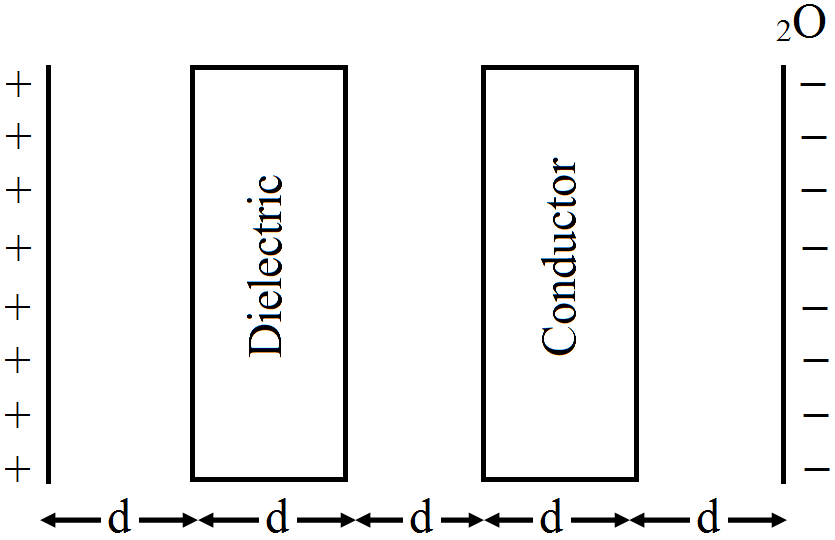
  1. Given two parallel conducting plates of area A and charge densities $+\sigma$ and $-\sigma.$ A dielectric slab of constant K and a conducting slab of thickness d each are inserted in between them as shown.
  1. Find the potential difference between the plates.
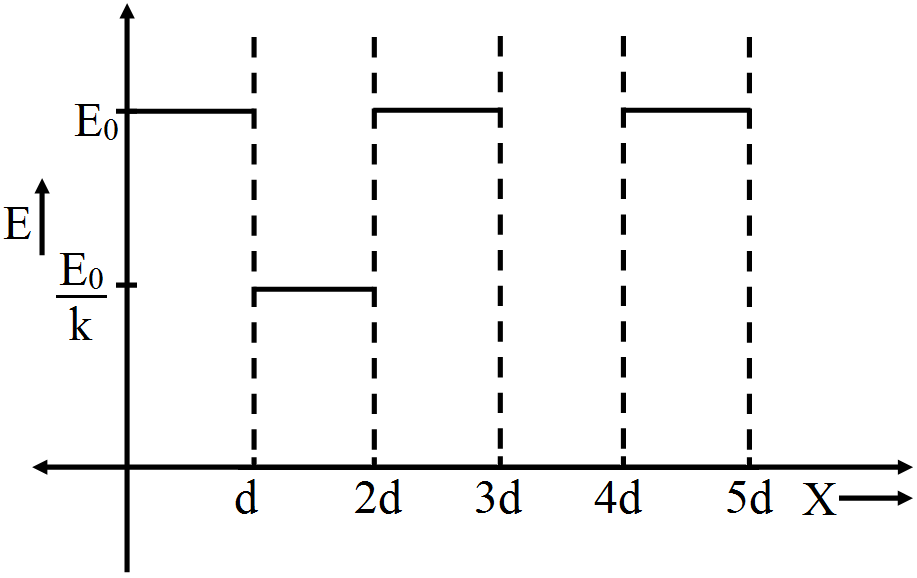
  2. Plot E versus x graph, taking x = 0 at positive plate and x = 5d at negative plate.
Answer
  1.  
S. No
 
Non-Polar $(O_2​​​​​​​)$
Polar$(H_2O)$
a.
Absence of electric field:
  • Individual.
  • Specimen.
  • No dipole moment exists.
  • No dipole moment exists.
  • Dipole moment exists.
  • Dipole are randomly oriented net P = 0.
b.
Presence of electric field:
  • Individual.
  • Specimen.
  • Dipole moment exists (molecules become polarised).
  • Dipole moment exists.
  • Torque acts on the molecules to align them parallel to $\vec{\text{E}}.$
  • Net dipole moment exists parallel to dipole moment exists $\vec{\text{E}}.$
  1.  
  1. The potential difference between the plates is given by:
  2. E versus x graph,
View full question & answer
5 Marks Questions - Physics STD 12 Science Questions - Vidyadip