Question 12 Marks
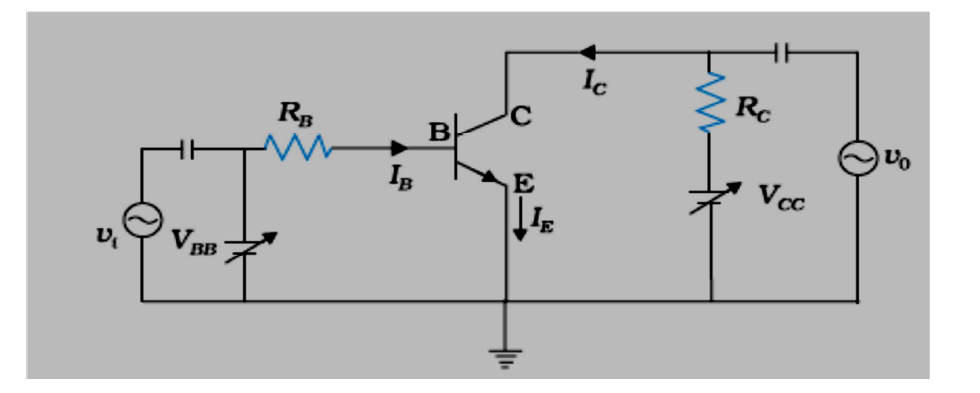
Two amplifiers are connected one after the other in series (cascaded). The first amplifier has a voltage gain of 10 and the second has a voltage gain of 20. If the input signal is 0.01 volt, calculate the output ac signal.
Answer
View full question & answer→Voltage gain of the first amplifier, $\mathrm{V}_1=10$
Voltage gain of the second amplifier, $\mathrm{V}_2=20$
Input signal voltage, $\mathrm{V}_{\mathrm{i}}=0.01 \mathrm{~V}$
Output AC signal voltage $=\mathrm{V}_0$
The total voltage gain of a two-stage cascaded amplifier is given by the product of voltage gains of both the stages, i.e.,
$V=V_1 \times V_2 $
$ =10 \times 20=200$
We have the relation:
$\mathrm{V}=\frac{\mathrm{V}_0}{\mathrm{~V}_1} $
$ \mathrm{~V}_0=\mathrm{V} \times \mathrm{V}_{\mathrm{i}} $
$ =200 \times 0.01=2 \mathrm{~V}$
Therefore, the output AC signal of the given amplifier is 2 V .
Voltage gain of the second amplifier, $\mathrm{V}_2=20$
Input signal voltage, $\mathrm{V}_{\mathrm{i}}=0.01 \mathrm{~V}$
Output AC signal voltage $=\mathrm{V}_0$
The total voltage gain of a two-stage cascaded amplifier is given by the product of voltage gains of both the stages, i.e.,
$V=V_1 \times V_2 $
$ =10 \times 20=200$
We have the relation:
$\mathrm{V}=\frac{\mathrm{V}_0}{\mathrm{~V}_1} $
$ \mathrm{~V}_0=\mathrm{V} \times \mathrm{V}_{\mathrm{i}} $
$ =200 \times 0.01=2 \mathrm{~V}$
Therefore, the output AC signal of the given amplifier is 2 V .
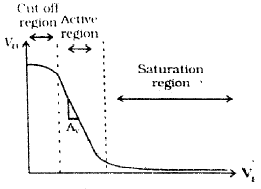
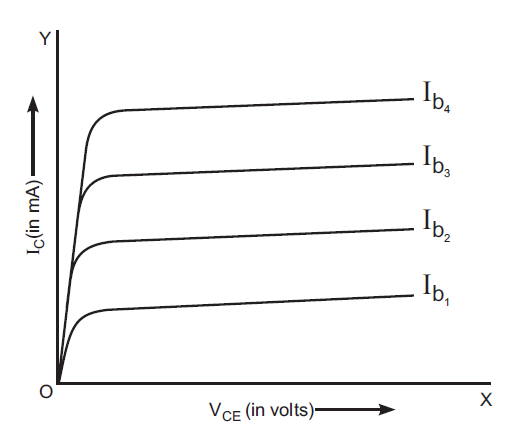 The reciprocal of the slope of the linear part of the output characteristics represents the output resistance.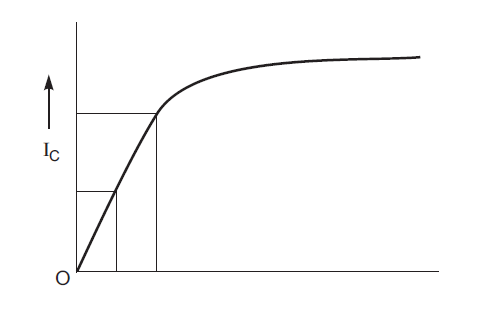


.gif)
 or any other difference.


 Current in the circuit = Drift current