Question types

Semiconductor Electronic: Material, Devices And Simple Circuits question types

470 questions across 7 question groups — pick any mix to generate a Physics paper with step-by-step answer keys.

470
Questions
7
Question groups
5
Question types
Sample Questions

Semiconductor Electronic: Material, Devices And Simple Circuits questions

One sample from each question group in this chapter. Select any group above to see the full set with answer keys.

The thickness of the depletion region is of the order of $........$ of a micrometre.
  • A
    One$-$hundredth
  • B
    One$-$tenth
  • C
    One$-$thousandth
  • None of these

Answer: D.

View full solution
In a $p-$type semiconductor, the acceptor valence band is:
  • Close to the valence band of the host crystal.
  • B
    Close to conduction band of the host crystal.
  • C
    Below the conduction band of the host crystal.
  • D
    Above the conduction band of the host crystal.

Answer: A.

View full solution
The energy gap in glass at room temperature is:
  • A
    Greater than that in a semiconductor.
  • B
    Less than that in a good conductor.
  • C
    Greater than that in a good conductor.
  • Both $(1)$ and $(3)$ are true.

Answer: D.

View full solution
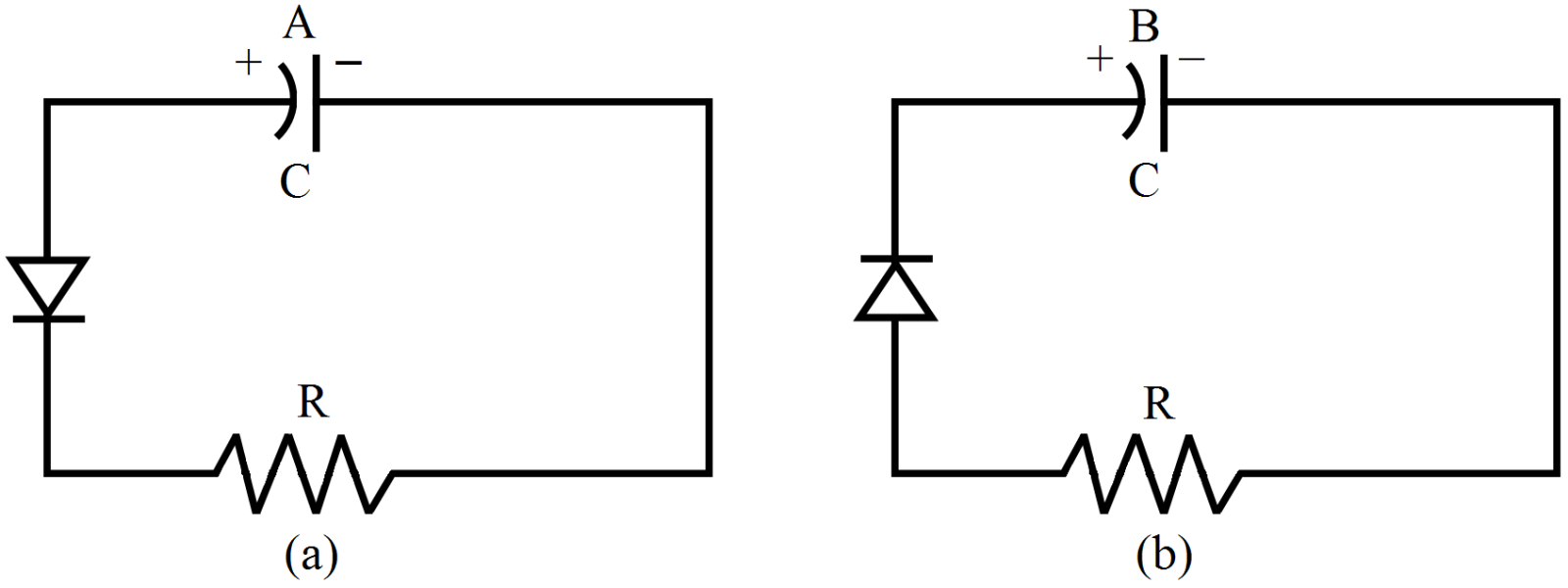
Two identical capacitors $A$ and $B$ are charged to the same potential $V$ and are connected in two circuits at $t = 0$ as shown in figure. The charges on the capahltors at a time $t = CR$ are, respectively:
  • A
    $\text{VC}, \text{VC}$
  • $\frac{\text{VC}}{\text{e}}, \text{VC}$
  • C
    $\text{VC}, \frac{\text{VC}}{\text{e}}$
  • D
    $\frac{\text{VC}}{\text{e}}, \frac{\text{VC}}{\text{e}}$

Answer: B.

View full solution
There is a sudden increase in current in zener diode is:
  • Due to rupture of bonds
  • B
    Resistance of deplection layer becomes less
  • C
    Due to high doping
  • D
    Due to less doping

Answer: A.

View full solution
Two statements are given-one labelled Assertion (A) and the other labelled Reason (R). Select the correct answer to these questions from thecodes(a), (b), (c) and (d) as given below.
  1. Both A and R are true and R is the correct explanation of A.
  2. Both A and R are true but R is not the correct explanation of A.
  3. A is true but R is false.
  4. A is false and R is also false.
Assertion: Diode lasers are used as optical sources in optical communicatiod.
Reason: Diode lasers consume less energy.
View full solution
Two statements are given-one labelled Assertion (A) and the other labelled Reason (R). Select the correct answer to these questions from thecodes(a), (b), (c) and (d) as given below.
  1. Both A and R are true and R is the correct explanation of A.
  2. Both A and R are true but R is not the correct explanation of A.
  3. A is true but R is false.
  4. A is false and R is also false.
Assertion: Diamond behaves like an insulator.
Reason: There is a large energy gap between valence band and conduction band of diamond.
View full solution
Two statements are given-one labelled Assertion (A) and the other labelled Reason (R). Select the correct answer to these questions from thecodes(a), (b), (c) and (d) as given below.
  1. Both A and R are true and R is the correct explanation of A.
  2. Both A and R are true but R is not the correct explanation of A.
  3. A is true but R is false.
  4. A is false and R is also false.
Assertion: In a semiconductor diode, the reverse biased current is due to drift of free electrons and holes.
Reason: The drift of electrons and holes is due to thermal excitation.
View full solution
Two statements are given-one labelled Assertion (A) and the other labelled Reason (R). Select the correct answer to these questions from thecodes(a), (b), (c) and (d) as given below.
  1. Both A and R are true and R is the correct explanation of A.
  2. Both A and R are true but R is not the correct explanation of A.
  3. A is true but R is false.
  4. A is false and R is also false.
Assertion: At absolute zero the conductivity of semiconductor is zero.
Reason: In a semiconductor there are no free electrons at any temperature.
View full solution
Two statements are given-one labelled Assertion (A) and the other labelled Reason (R). Select the correct answer to these questions from thecodes(a), (b), (c) and (d) as given below.
  1. Both A and R are true and R is the correct explanation of A.
  2. Both A and R are true but R is not the correct explanation of A.
  3. A is true but R is false.
  4. A is false and R is also false.
Assertion: : The half-wave rectifier work only for positive half cycle of ac.
Reason: In half-wave rectifier only one diode is used.
View full solution
In an n-type silicon, which of the following statement is true:
  1. Electrons are majority carriers and trivalent atoms are the dopants.
  2. Electrons are minority carriers and pentavalent atoms are the dopants.
  3. Holes are minority carriers and pentavalent atoms are the dopants.
  4. Holes are majority carriers and trivalent atoms are the dopants.
View full solution
For transistor action, which of the following statements are correct:
  1. Base, emitter and collector regions should have similar size and doping concentrations.
  2. The base region must be very thin and lightly doped.
  3. The emitter junction is forward biased and collector junction is reverse biased.
  4. Both the emitter junction as well as the collector junction are forward biased.
View full solution
Carbon, silicon and germanium have four valence electrons each. These are characterised by valence and conduction bands separated by energy band gap respectively equal to $ \left(E_g\right)_C, \left(E_g\right)_{S i}$ and $ \left(E_g\right)_{G e} $ Which of the following statements is true
  • A
    $ \left(E_g\right)_{\mathrm{Si}} < \left(E_g\right)_{G e} < \left(E_g\right)_C $
     
  • B
    $ \left(E_g\right)_C < \left(E_g\right)_{G e} < \left(E_g\right)_{S i} $
     
  • $ \left(E_g\right)_C > \left(E_g\right)_{S i} > \left(E_g\right)_{G e} $
     
  • D
    $ \left(E_g\right)_C=\left(E_g\right)_{\mathrm{Si}}=\left(E_g\right)_{G e}$

Answer: C.

View full solution
For a transistor amplifier, the voltage gain,
  1. Remains constant for all frequencies.
  2. Is high at high and low frequencies and constant in the middle frequency range.
  3. Is low at high and low frequencies and constant at mid frequencies.
  4. None of the above.
View full solution
Two amplifiers are connected one after the other in series (cascaded). The first amplifier has a voltage gain of 10 and the second has a voltage gain of 20. If the input signal is 0.01 volt, calculate the output ac signal.
View full solution
In half-wave rectification, what is the output frequency if the input frequency is 50 Hz. What is the output frequency of a full-wave rectifier for the same input frequency.
View full solution
Draw typical output characteristics of an n-p-n transistor in CE configuration. Show how these characteristics can be used to determine output resistance.
View full solution
Q 213 Marks Question3 Marks
Write the two processes that take place in the formation of a p-n junction. Explain with the help of a diagram, the formation of depletion region and barrier potential in a p-n junction.
View full solution
Q 223 Marks Question3 Marks
The number of silicon atoms per $\mathrm{m}^3$ is $5 \times 10^{28}$. This is doped simultaneously with $5 \times 10^{22}$ atoms per $\mathrm{m}^3$ of Arsenci and $5 \times 10^{20}$ per $\mathrm{m}^3$ atoms of Indium. Calculate the number of electrons and holes Given that $\mathrm{n}_{\mathrm{i}}=1.5 \times 10^{16} \mathrm{~m}^{-3}$. Is the material n-type or p-type?
View full solution
Q 233 Marks Question3 Marks
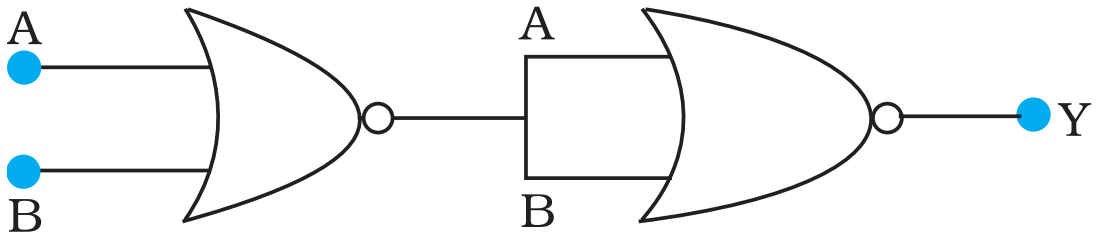
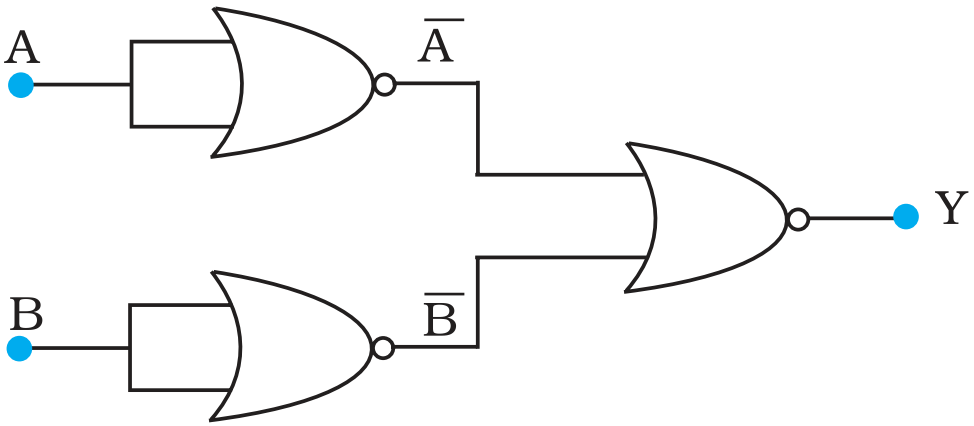
Write the truth table for circuit given in Fig. 14.47 below consisting of NOR gates and identify the logic operation (OR, AND, NOT) which this circuit is performing.
(Hint: A = 0, B = 1 then A and B inputs of second NOR gate will be 0 and hence Y=1. Similarly work out the values of Y for other combinations of A and B. Compare with the truth table of OR, AND, NOT gates and find the correct one.)
View full solution
Q 243 Marks Question3 Marks
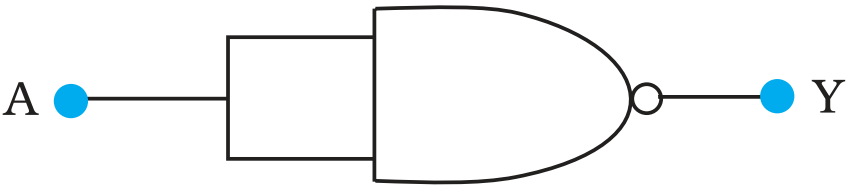
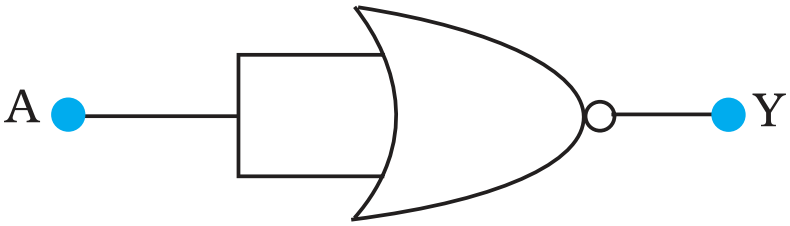
Write the truth table for a NAND gate connected as given in Fig. 14.45.

Hence identify the exact logic operation carried out by this circuit.
View full solution
Write the truth table for the circuits given in Fig. 14.48 consisting of NOR gates only. Identify the logic operations (OR, AND, NOT) performed by the two circuits.
  1.  
  1.  
View full solution
In an intrinsic semiconductor the energy gap $E_g$ is 1.2eV. Its hole mobility is much smaller than electron mobility and independent of temperature. What is the ratio between conductivity at 600K and that at 300K? Assume that the temperature dependence of intrinsic carrier concentration $n_i$ is given by,
$\text{n}_{\text{i}}=\text{n}_{\text{0}}\ {\text{exp}}\Big(-\frac{\text{E}_\text{g}}{2{\text{K}_{\text{B}}}{\text{T}}}\Big)$
where $n_0$​​​​​​​ is a constant.
View full solution
In a p-n junction diode, the current I can be expressed as,
$I=I_0\ \text{exp}\Big(\frac{\text{eV}}{2\text{k}_{\text{B}}\text{T}}-1\Big)$
where $I_0$ is called the reverse saturation current, V is the voltage across the diode and is positive for forward bias and negative for reverse bias, and $I$ is the current through the diode, $k_g$ is the Boltzmann constant $(8.6\times 10^{-5} eV/K)$ and T is the absolute temperature. If for a given diode $I_0 = 5\times 10^{-12} A$ and $T = 300 K$, then,
  1. What will be the forward current at a forward voltage of 0.6V?
  2. What will be the increase in the current if the voltage across the diode is increased to 0.7V?
  3. What is the dynamic resistance?
  4. What will be the current if reverse bias voltage changes from 1V to 2V?
View full solution
  1. Describe briefly, with the help of a diagram, the role of the two important processes involved in the formation of a p-n junction.
  2. Name the device which is used as a voltage regulator. Draw the necessary circuit diagram and explain its working.
View full solution
  1. Draw the circuit diagrams of a p-n junction diode in (i) forward bias, (ii) reverse bias. How are these circuits used to study the V - I characteristics of a silicon diode? Draw the typical V - I characteristics.
  2. What is a light emitting diode (LED)? Mention two important advantages of LEDs over conventional lamps.
View full solution
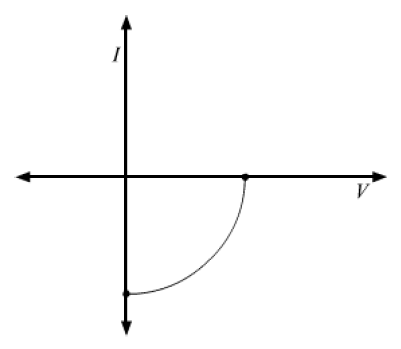
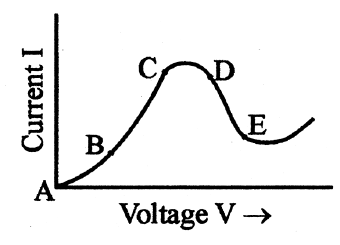
Graph showing the variation of current versus voltage for a material GaAs is shown in the figure. Identify the region of.
  1. Negative resistance.
  2. Where Ohm's law is obeyed.
View full solution
  1. State briefly the processes involved in the formation of p-n junction explaining clearly how the depletion region is formed.
  2. Using the necessary circuit diagrams, show how the V-I characteristics of a p-n junction are obtained in
  1. Forward biasing.
  2. Reverse biasing.
How are these characteristics made use of in rectification?
View full solution

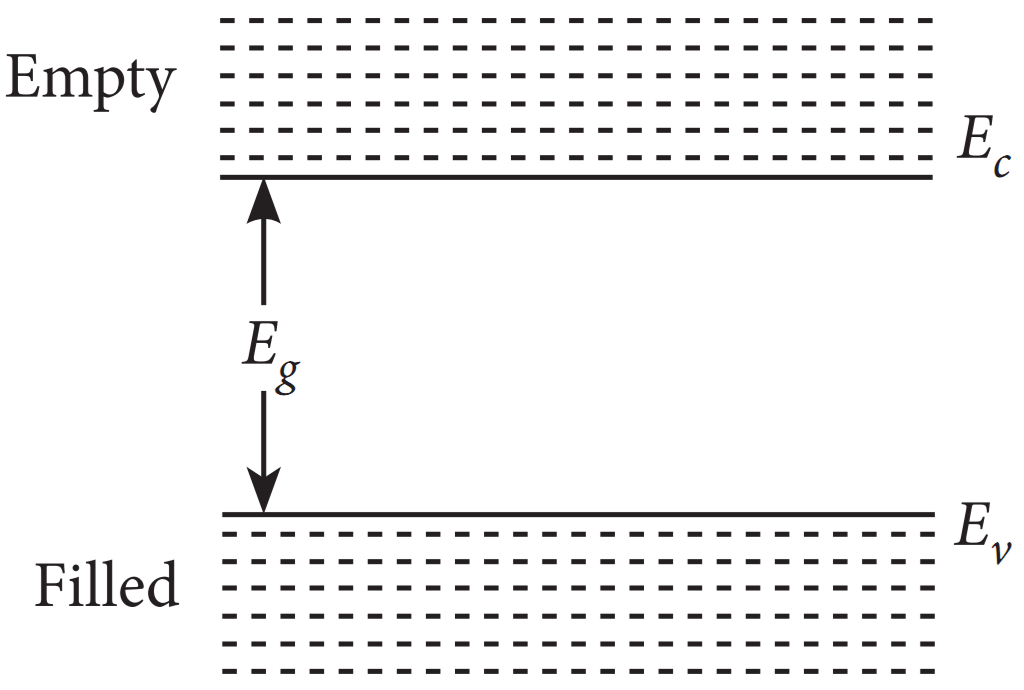
From Bohr's atomic model, we know that the electrons have well defined energy levels in an isolated atom. But due to interatomic interactions in a crystal, the electrons of the outer shells are forced to have energies different from those in isolated atoms. Each energy level splits into a number of energy levels forming a continuous band. The gap between top of valence band and bottom of the conduction band in which no allowed energy levels for electrons can exist is called energy gap.
  1. In an insulator energy band gap is:
  1. $E_g= 0$
  2. $E_g < 3eV$
  3. $E_g > 3eV$
  4. None of the above.
  1. In a semiconductor, separation between conduction and valence band is of the order of:
  1. 0eV
  2. 1eV
  3. 10eV
  4. 50eV
  1. Based on the band theory of conductors, insulators and semiconductors, the forbidden gap is smallest in:
  1. Conductors.
  2. Insulators.
  3. Semiconductors.
  4. All of these.
  1. Carbon, silicon and germanium have four valence electrons each. At room temperature which one of the following statements is most appropriate?
  1. The number of free electrons for conduction is significant only in Si and Ge but small in C.
  2. The number of free conduction electrons is significant in C but small in Si and Ge.
  3. The number of free conduction electrons is negligibly small in all the three.
  4. The number of free electrons for conduction is significant in all the three.
  1. Solids having highest energy level partially filled with electrons are:
  1. Semiconductor.
  2. Conductor.
  3. Insulator.
  4. None of these.
View full solution
P-n junction is a single crystal of Ge or Si doped in such a manner that one half portion of it acts asp-type semiconductor and other half functions as n-type semiconductor. As soon as a p-n junction is formed, the holes from the p-region diffuse into then-region, and electron from n region diffuse in top-region. This results in the development of V 8 across the junction which opposes the further diffusion of electrons and holes through the junction.
  1. In an unbiased p-n junction electrons diffuse from n-region top-region because:
  1. Holes in p-region attract them.
  2. Electrons travel across the junction due to potential difference.
  3. Electron concentration inn-region is more as compared to that in p-region.
  4. Only electrons move from n top region and not the vice-versa.
  1. Electron hole recombination in p-n junction may lead to emission of:
  1. Light.
  2. Ultraviolet rays.
  3. Sound.
  4. Radioactive rays.
  1. In an unbiased p-n junction:
  1. Potential at pis equal to that at n.
  2. Potential at pis + ve and that at n is - ve.
  3. Potential at pis more than that at n.
  4. Potential at pis less than that at n.
  1. The potential of depletion layer is due to:
  1. Electrons.
  2. Holes.
  3. Ions.
  4. Forbidden band.
  1. In the depletion layer of unbiased p-n junction,
  1. It is devoid of charge carriers.
  2. Has only electrons.
  3. Has only holes.
  4. P-n junction has a weak electric field.
View full solution

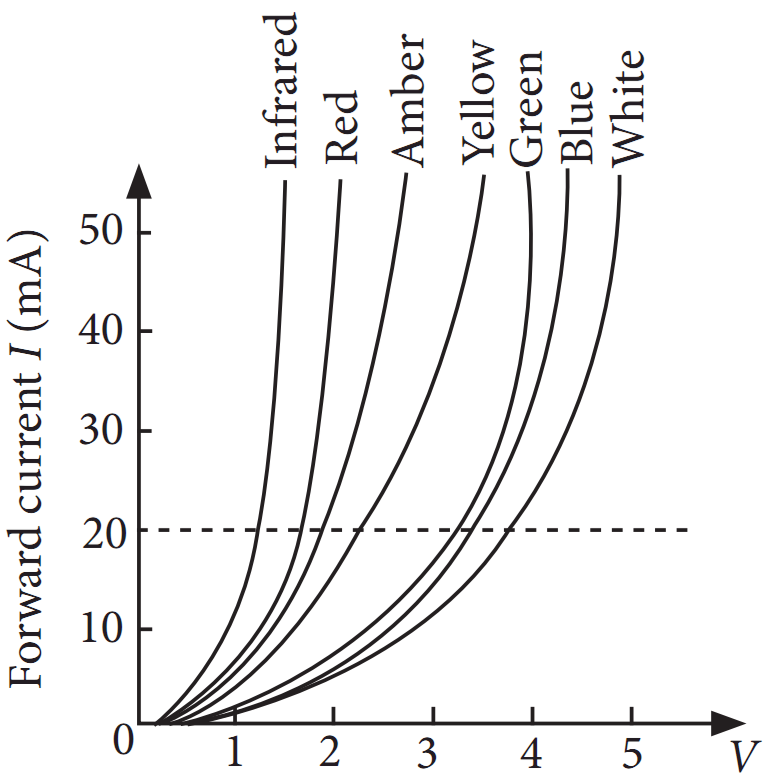
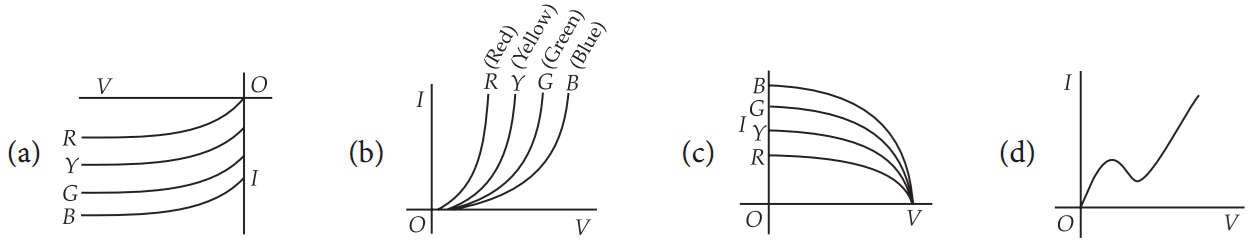
Light emitting diode is a photoelectric device which converts electrical energy into light energy. It is a heavily doped p-n junction diode which under forward biased emits spontaneous radiation. The general shape of the I-V characteristics of an LED is similar to that of a normal p-n junction diode, as shown. The barrier potentials are much higher and slightly different for each colour.
  1. The I-V characteristic of an LED is:
  1. The schematic symbol of light emitting diode is (LED).
  1. An LED is constructed from a p-n junction based on a certain Ga-As-P semiconducting material whose energy gap is 1.9eV. Identify the colour of the emitted light.
  1. Blue.
  2. Red.
  3. Violet.
  4. Green.
  1. Which one of the following statement is not correct in the case of light emitting diodes?
  1. It is a heavily doped p-n junction.
  2. It emits light only when it is forward biased.
  3. It emits light only when it is reverse biased.
  4. The energy of the tight emitted is less than the energy gap of the semiconductor used.
  1. The energy of radiation emitted by LED is:
  1. Greater than the band gap of the semiconductor used.
  2. Always less than the band gap of the semiconductor used.
  3. Always equal to the band gap of the semiconductor used.
  4. Equal to or less than the band gap of the semiconductor used.
View full solution

Generate a Semiconductor Electronic: Material, Devices And Simple Circuits paper free

Pick question groups from the list above, set marks and difficulty, and export a branded PDF with step-by-step answer keys. First 3 chapters free — no signup.

Download App