Questions

5 Marks Questions

Take a timed test

26 questions · self-marked practice — reveal the answer and mark yourself.

Question 15 Marks
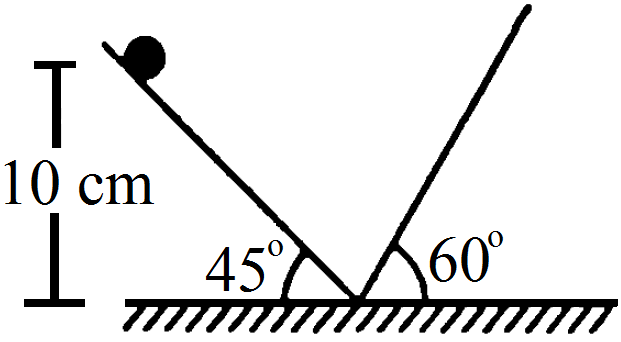
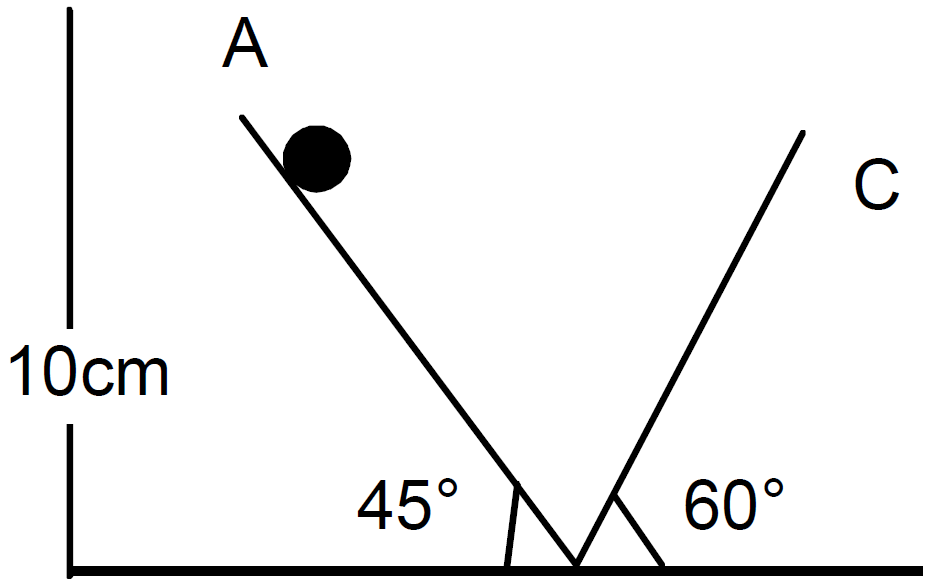
Find the time period of the motion of the particle shown in figure Neglect the small effect of the bend near the bottom.
Answer
Let the time taken to travel AB and BC be $t_1$ and $t_2$ respectively Fro part AB, a$_1 = g \sin 45^\circ.$
$\text{s}_1=\frac{0.1}{\sin45^\circ}=2\text{m}$
Let, v = velocity at B
$\therefore\text{v}^2-\text{u}^2=2\text{a}_1\text{s}_1$
$\Rightarrow\text{v}^2=2\times\text{g}\sin45^\circ\times\frac{0.1}{\sin45^\circ}=2$
$\Rightarrow\text{v}\sqrt{2}\text{m/s}$
$\therefore\text{t}_1=\frac{\text{v}-\text{u}}{\text{a}_1}=\frac{\sqrt{2}-0}{\frac{\text{g}}{\sqrt{2}}}=\frac{2}{\text{g}}=\frac{2}{10}=0.2\sec$
Again for part BC, $\text{a}_2=-\text{g}\sin60^\circ,\ \text{u}=\sqrt{2},\text{v}=0$
$\therefore\text{t}_2=\frac{0-\sqrt{2}}{-\text{g}\Big(\frac{\sqrt{3}}{2}\Big)}=\frac{2\sqrt{2}}{\sqrt{3}\text{g}}=\frac{2\times(1.414)}{(1.732)\times10}=0.165\sec.$
So, time period $=2(\text{t}_1+\text{t}_2)=2(0.2+0.155)=0.71\sec$
View full question & answer
Question 25 Marks
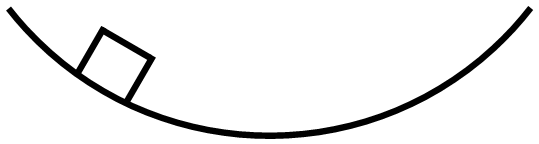
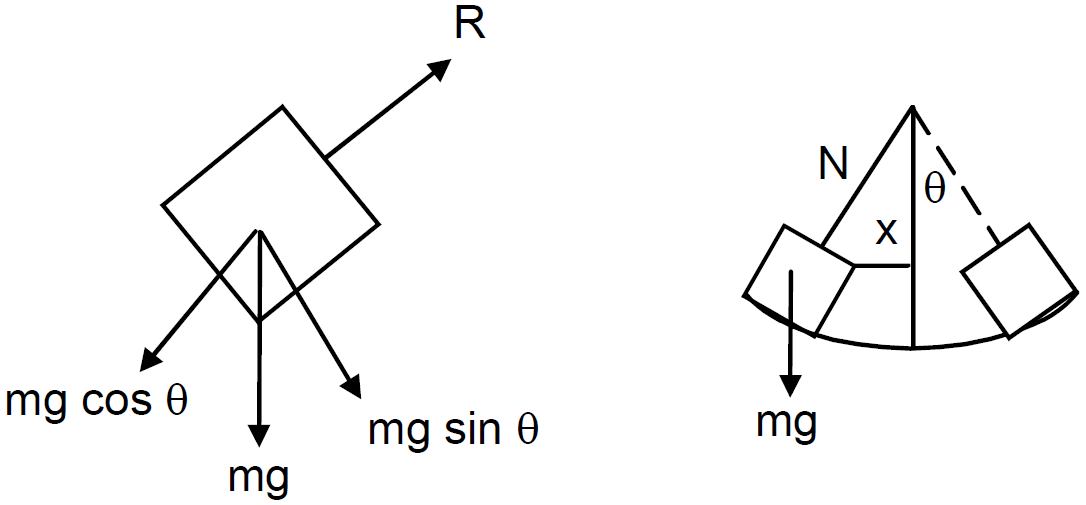
A small block oscillates back and forth on a smooth concave surface of radius R figure. Find the time period of small oscillation.
Answer
Given that, R = radius. Let N = normal reaction. Driving force $\text{F}=\text{mg}\sin\theta.$ Acceleration $=\text{a}=\text{g}\sin\theta$ As, $\sin\theta$ is very small, $\sin\theta\rightarrow\theta$$\therefore$ Acceleration $\text{a}=\text{g}\theta$
Let ‘x’ be the displacement from the mean position of the body,$\therefore\theta=\frac{\text{x}}{\text{R}}$
$\Rightarrow\text{a}=\text{g}\theta=\text{g}\Big(\frac{\text{x}}{\text{R}}\Big)\Rightarrow\Big(\frac{\text{a}}{\text{x}}\Big)=\Big(\frac{\text{g}}{\text{R}}\Big)$
So the body makes S.H.M.$\therefore\text{T}=2\pi\sqrt{\frac{\text{Displacement}}{\text{Acceleration}}}=2\pi\sqrt{\frac{\text{x}}{\frac{\text{gx}}{\text{R}}}}=2\pi\sqrt{\frac{\text{R}}{\text{g}}}$
View full question & answer
Question 35 Marks
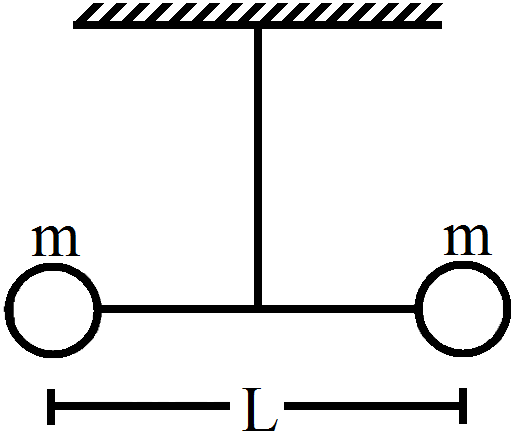
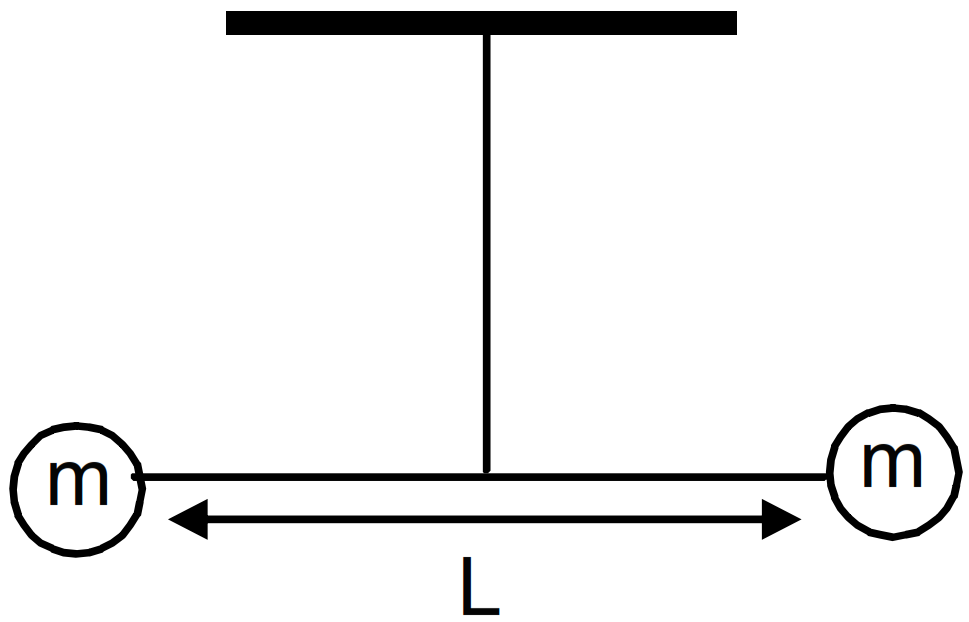
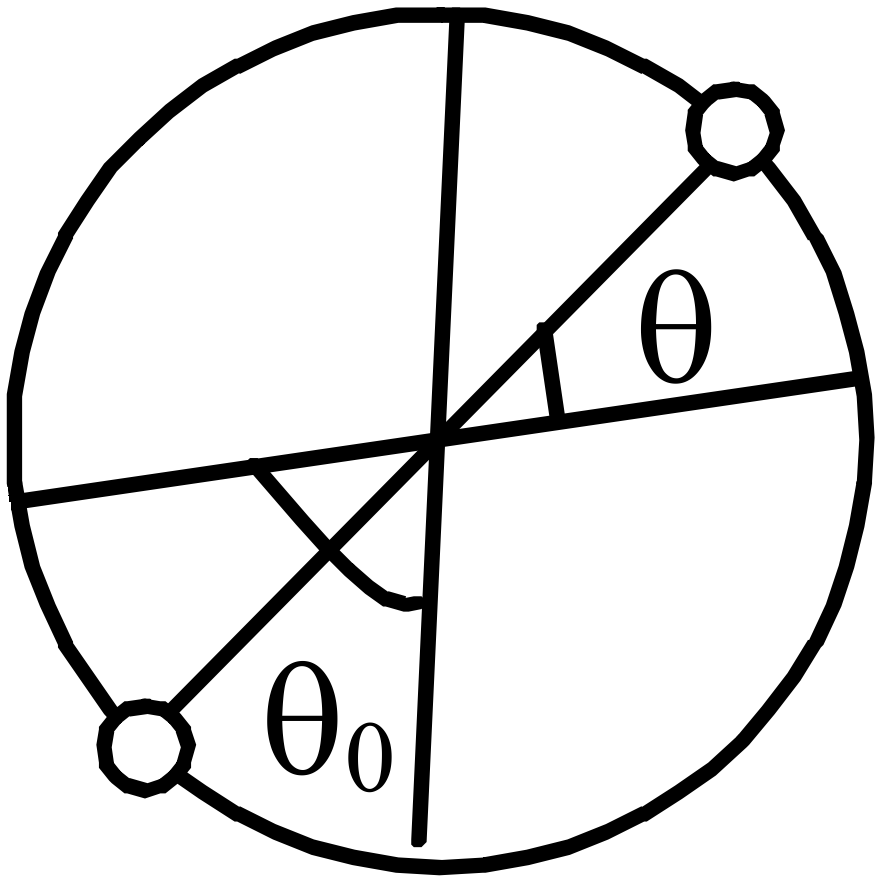
Two small balls, each of mass m are connected by a light rigid rod of length L. The system is suspended from its centre by a thin wire of torsional constant k. The rod is rotated about the wire through an angle $\theta_0$ and released. Find the tension in the rod' as the system passes through the mean position.
Answer
The M.I of the two ball system$\text{l}=2\text{m}\Big(\frac{\text{L}}{2}\Big)^2=\text{m}\frac{\text{L}^2}{2}$
At any position $\theta$ during the oscillation, Torque $=\text{k}\theta$ So, work done during the displacement 0 to $\theta_{0,}$$\text{W}=\int\limits^{\theta}_{0}\text{k}\theta\text{d}\theta=\frac{\text{k}\theta_0^2}{2}$
By work energy method,$\Big(\frac{1}{2}\Big)\text{l}\omega^2-0=$ Work done $\frac{\text{k}\theta_0^2}{2}$
$\therefore\omega^2=\frac{\text{k}\theta_0^2}{2\text{l}}=\frac{\text{k}\theta_0^2}{\text{mL}^2}$
Now, from the freebody diagram of the rod,$\text{T}_2=\sqrt{(\text{m}\omega^2\text{L})^2+(\text{mg})^2}$
$=\sqrt{\Big(\text{m}\frac{\text{k}\theta_0^2}{\text{mL}^2}\times\text{L}\Big)^2+\text{m}^2\text{g}^2}=\frac{\text{k}^2\theta_0^4}{\text{L}^2}+\text{m}^2\text{g}^2$
View full question & answer
Question 45 Marks
A particle having mass 10g oscillates according to the equation $\text{x}=(2.0\text{cm})\sin\big[(100\text{s}^{-1})\text{t}+\frac{\pi}{6}\big].$ Find (a) the amplitude, the time period and the spring constant (b) the position, the velocity and the acceleration at t = 0.
Answer
$\text{x}=(2.0\text{cm})\sin\Big[(100\text{s}^{-1})\text{t}+\Big(\frac{\pi}{6}\Big)\Big]$m = 10g.
  1. Amplitude = 2cm
$\omega=100\sec^{-1}$
$\therefore\text{T}=\frac{2\pi}{100}=\frac{\pi}{50}\sec=0.063\sec.$
We know that $\text{T}=2\pi\sqrt{\frac{\text{m}}{\text{k}}}$
$\Rightarrow\text{T}^2=4\pi^2\times\frac{\text{m}}{\text{k}}$
$\Rightarrow\text{k}=\frac{4\pi^2}{\text{T}^2}\text{m}$
$=10^5\text{dyne/cm}=100\text{N/m}$ $\Big[\text{because}\ \omega=\frac{2\pi}{\text{T}}=100\sec^{-1}\Big]$
  1. At t = 0
$\text{x}=2\text{cm}\sin\Big(\frac{\pi}{6}\Big)=2\times\Big(\frac{1}{2}\Big)=1\text{cm}.$ from the mean position.
We know that $\text{x}=\text{A}\sin(\omega\text{t}+\phi)$
$\text{v}=\text{A}\cos(\omega\text{t}+\phi)$
$=2\times100\cos\big(0+\frac{\pi}{6}\big)=200\times\frac{\sqrt{3}}{2}$
$=100\sqrt{3}\sec^{-1}=1.73\text{m/s}$
  1. $\text{a}=-\omega^2\text{x}=100^2\times1$
$=100\text{m/s}^2$
View full question & answer
Question 55 Marks
A particle executes simple harmonic motion with an amplitude of 10cm and time period 6s. At t = 0 it is at position x = 5cm going towards positive x-direction. Write the equation for the displacement x at time t. Find the magnitude of the acceleration of the particle at t = 4s.
Answer
Given, $\text{r}=10\text{cm}.$ At $\text{t}=0,\ \text{x}=5\text{cm}$$\text{T}=6\sec.$
So, $\text{W}=\frac{2\pi}{\text{T}}=\frac{2\pi}{6}=\frac{\pi}{3}\sec^{-1}$ At, $\text{t}=0,\ \text{x}=5\text{cm}$ So, $\text{5}=10\sin(\text{w}\times0+\phi)=10\sin\phi$ $[\text{y}=\text{r}\sin\text{wt}]$$\sin\phi=\frac{1}{2}\Rightarrow\phi=\frac{\pi}{6}$
$\therefore$ Equation of displacement $\text{x}=(10\text{cm})\sin\Big(\frac{\pi}{3}\Big)$
At $\text{t}=4$ secound$\text{x}=10\sin\Big[\frac{\pi}{3}\times4+\frac{\pi}{6}\Big]=10\sin\Big[\frac{8\pi+\pi}{6}\Big]$
$=10\sin\Big(\frac{3\pi}{2}\Big)=10\sin\Big(\pi+\frac{\pi}{2}\Big)$
$=-10\sin\Big(\frac{\pi}{2}\Big)=-10$
Acceleration $\text{a}=-\text{w}^2\text{x}=-\Big(\frac{\pi^2}{9}\Big)\times(-10)$$=10.9\approx0.11\text{cm}/\sec$
View full question & answer
Question 65 Marks
The equation of motion of a particle started at t = 0 is given by $\text{x}=5\sin\big(20\text{t}+\frac{\pi}{3}\big)$ where x is in centimetre and t in second. When does the particle.
  1. First come to rest.
  2. First have zero acceleration.
  3. First have maximum speed?
Answer
$\text{x}=5\sin\big(20\text{t}+\frac{\pi}{3}\big)$
  1. Max. displacement from the mean position = Amplitude of the particle. At the extreme position, the velocity becomes ‘0’.
$\therefore\text{x}=5=$ Amplitude.
$\therefore5=5=\sin\big(20\text{t}+\frac{\pi}{3}\big)$
$\sin\big(20\text{t}+\frac{\pi}{3}\big)=1=\sin\big(\frac{\pi}{2}\big)$
$\Rightarrow20\text{t}+\frac{\pi}{3}=\frac{\pi}{2}$
$\Rightarrow\text{t}=\frac{\pi}{120}\sec.,$
So, at $\frac{\pi}{120}\sec$ it first comes to rest.
  1. $\text{a}=\omega^2\text{x}=\omega^2\big[5\sin\big(20\text{t}+\frac{\pi}{3}\big)\big]$
For $\text{a}=0,\ 5\sin\big(20\text{t}+\frac{\pi}{3}\big)=0$
$\Rightarrow\sin\big(20\text{t}+\frac{\pi}{3}\big)=\sin(\pi)$
$\Rightarrow20\text{t}=\pi-\frac{\pi}{3}=\frac{2\pi}{3}$
$\Rightarrow\text{t}=\frac{\pi}{30}\sec.$
  1. $\text{v}=\text{A}\omega\cos\big(\omega\text{t}+\frac{\pi}{3}\big)=20\times5\cos\big(20\text{t}+\frac{\pi}{3}\big)$
when, v is maximum i.e. $\cos\big(20\text{t}+\frac{\pi}{3}\big)=-1=\cos\pi$
$\Rightarrow20\text{t}=\pi-\frac{\pi}{3}=\frac{2\pi}{3}$
$\Rightarrow\text{t}=\frac{\pi}{30}\sec.$
View full question & answer
Question 75 Marks
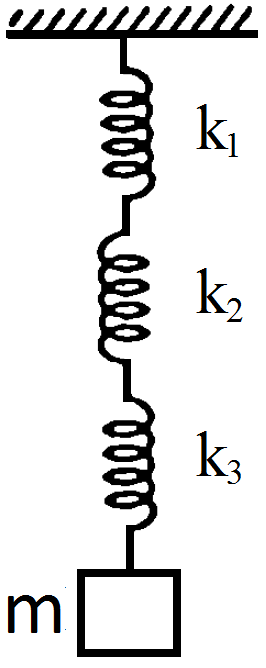
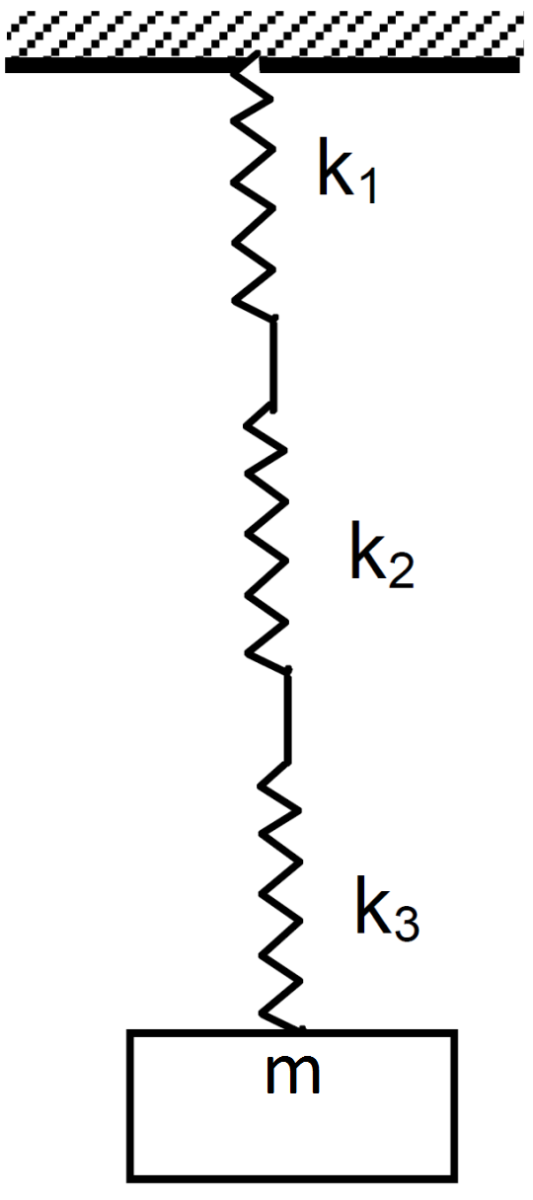
Find the elastic potential energy stored in each spring shown in figure when the block is in equilibrium. Also find the time period of vertical oscillation of the block.
Answer
$k_1, k_2, k_3$ are in series,$\frac{1}{\text{k}}=\frac{1}{\text{k}_1}+\frac{1}{\text{k}_2}+\frac{1}{\text{k}_3}$
$\Rightarrow\text{k}=\frac{\text{k}_1\text{k}_2\text{k}_3}{\text{k}_1\text{k}_2+\text{k}_2\text{k}_3+\text{k}_1\text{k}_3}$
Time period $\text{T}=2\pi\sqrt{\frac{\text{m}}{\text{k}}}=2\pi\sqrt{\frac{\text{m(k}_1\text{k}_2+\text{k}_2\text{k}_3+\text{k}_1\text{k}_3)}{\text{k}_1\text{k}_2\text{k}_3}}$
$=2\pi\sqrt{\text{m}\Big(\frac{1}{\text{k}_1}+\frac{1}{\text{k}_2}+\frac{1}{\text{k}_3}\Big)}$
Now, Force = weight = mg.
$\therefore$ At $k_1$ spring, $\text{x}_1=\frac{\text{mg}}{\text{k}_1}$
Similarly $\text{x}_2=\frac{\text{mg}}{\text{k}_2}$ and $\text{x}_3=\frac{\text{mg}}{\text{k}_3}$
$\therefore\text{PE}_1=\Big(\frac{1}{2}\Big)\text{k}_1\text{x}_1^2=\frac{1}{2}\text{k}_1\Big(\frac{\text{mg}}{\text{k}_1}\Big)^2=\frac{1}{2}\text{k}_1\frac{\text{m}^2\text{g}^2}{\text{k}_1^2}=\frac{\text{m}^2\text{g}^2}{2\text{k}_1}$
Similarly $\text{PE}_2=\frac{\text{m}^2\text{g}^2}{2\text{k}_2}$ and $\text{PE}_3=\frac{\text{m}^2\text{g}^2}{\text{2k}_3}$
View full question & answer
Question 85 Marks
The position, velocity and acceleration of a particle executing simple harmonic motion are found to have magnitudes 2cm, 1m/s and $10m/s^2$ at a certain instant. Find the amplitude and the time period of the motion.
Answer
Given that, at a particular instant, X = 2cm = 0.02m V = 1m/sec $A = 10 m/s^2 $
We know that $\text{a}=\omega^2\text{x}$
​​​​​​​$\Rightarrow\omega=\sqrt{\frac{\text{a}}{\text{x}}}=\sqrt{\frac{10}{0.02}}=\sqrt{500}=10\sqrt{5}$
$\text{T}=\frac{2\pi}{\omega}=\frac{2\pi}{10\sqrt{5}}=\frac{2\times3.14}{10\times2.236}=0.28\text{ seconds.}$
Again, amplitude r is given by $\text{v}=\omega\Big(\sqrt{\text{r}^2-\text{x}^2}\Big)$$\Rightarrow\text{v}^2=\omega^2(\text{r}^2-\text{x}^2)$
$1=500(\text{r}^2-0.0004)$
$\Rightarrow\text{r}=0.0489\approx0.049\text{m}$
$\therefore\text{r}=4.9\text{cm.}$
View full question & answer
Question 95 Marks
A particle is subjected to two simple harmonic motions given by $\text{x}_1=2.0\sin(100\pi\text{t})$ and $\text{x}_2=2.0\sin\Big(120\pi\text{t}+\frac{\pi}{3}\Big)$ where x is in centimeter and t in second. Find the displacement of the particle at
  1. t = 0.0125.
  2. t = 0.025.
Answer
$\text{x}_1=2\sin100\pi\text{t}$$\text{x}_2=2\sin\Big(120\pi\text{t}+\frac{\pi}{3}\Big)$
So, resultant displacement is given by,
$\text{x}=\text{x}_1+\text{x}_2=2\Big[\sin(100\pi\text{t})+\sin\Big(120\pi\text{t}+\frac{\pi}{3}\Big)\Big]$
  1. At $\text{t}=0.0125\text{s},$
$\text{x}=2\Big[\sin(100\pi\times0.0125)+\sin\Big(120\pi\times0.0125+\frac{\pi}{3}\Big)\Big]$
$=2\Big[\sin\frac{5\pi}{4}+\sin\Big(\frac{3\pi}{2}+\frac{\pi}{3}\Big)\Big]$
$=2[(-0.707)+(-0.5)]=-2.41\text{cm}$
  1. At $\text{t}=0.025\text{s}.$
$\text{x}=2\Big[\sin(100\pi\times0.025)+\sin\Big(120\pi\times0.025+\frac{\pi}{3}\Big)\Big]$
$=2\Big[\sin\frac{5\pi}{2}+\sin\Big(3\pi+\frac{\pi}{3}\Big)\Big]$
$=2[1+(-0.8666)]=0.27\text{cm.}$
View full question & answer
Question 105 Marks
Consider a particle moving in simple harmonic motion according to the equation $\text{x}=2.0\cos(50\pi\text{t}+\tan^{-1}0.75)$ where x is in centimetre and t in second. The motion is started at $t = 0.$
  1. When does the particle come to rest for the first time?
  2. When does the acceleration have its maximum magnitude for the first time?
  3. When does the particle come to rest for the second time?
Answer
  1. $\text{x}=2.0\cos(50\pi\text{t}+\tan^{-1}0.75)$
$=2.0\cos(50\pi\text{t}+0.643)$
$\text{v}=\frac{\text{dx}}{\text{dt}}=-100\sin(50\pi\text{t}+0.643)$
$\Rightarrow\sin(50\pi\text{t}+0.643)=0$
As the particle comes to rest for the $1^{st}$ time
$\Rightarrow50\pi\text{t}+0.643=\pi$
$\Rightarrow\text{t}=1.6\times10^{-2}\sec.$
  1. Acceleration $\text{a}=\frac{\text{dv}}{\text{dt}}=-100\pi\times50\pi\cos(50\pi\text{t}+0.643)$
For maximum acceleration $\cos(50\pi\text{t}+0.643)=-1\cos\pi$ (max) (so a is max)
$\Rightarrow\text{t}=1.6\times10^{-2}\sec.$
  1. When the particle comes to rest for second time,
$50\pi\text{t}+0.643=2\pi$
$\Rightarrow\text{t}=3.6\times10^{-2}\text{s}.$
View full question & answer
Question 115 Marks
A simple pendulum is constructed by hanging a heavy ball by a 5.0m long string. It undergoes small oscillations.
  1. How many oscillations does it make per second?
  2. What will be the frequency if the system is taken on the moon where acceleration due to gravitation of the moon is $1.67m/s^2.$
Answer
$\text{L}=5\text{m}$
  1. $\text{T}=2\pi\sqrt{\frac{\ell}{\text{g}}}=2\pi\sqrt{0.5}=2\pi(0.7)$
$\therefore$ in $2\pi(0.7)\sec$ the body completes 1 oscillation,
In 1 second, the body will complete $\frac{1}{2\pi(0.7)}$ oscillation
$\therefore\text{f}=\frac{1}{2\pi(0.7)}=\frac{10}{14\pi}=\frac{0.70}{\pi}$ Times
  1. When it is taken to the moon
$\text{T}=2\pi\sqrt{\frac{\ell}{\text{g'}}}$ where g' → Acceleration in the moon.
$=2\pi\sqrt{\frac{5}{1.67}}$
$\therefore\text{f}=\frac{1}{\text{T}}=\frac{1}{2\pi}\sqrt{\frac{1.67}{5}}=\frac{1}{2\pi}(0.577)=\frac{1}{2\pi\sqrt{3}}$ times.
View full question & answer
Question 125 Marks
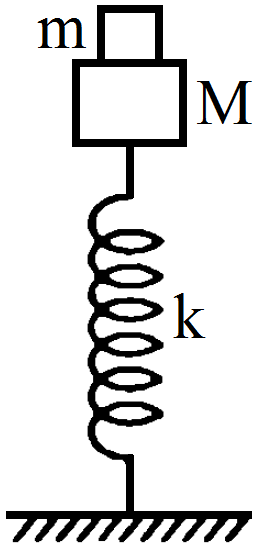
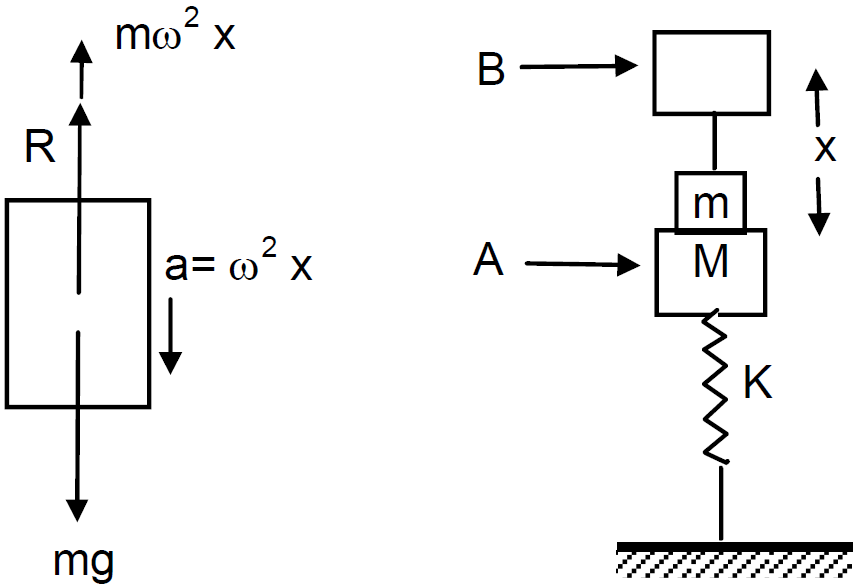
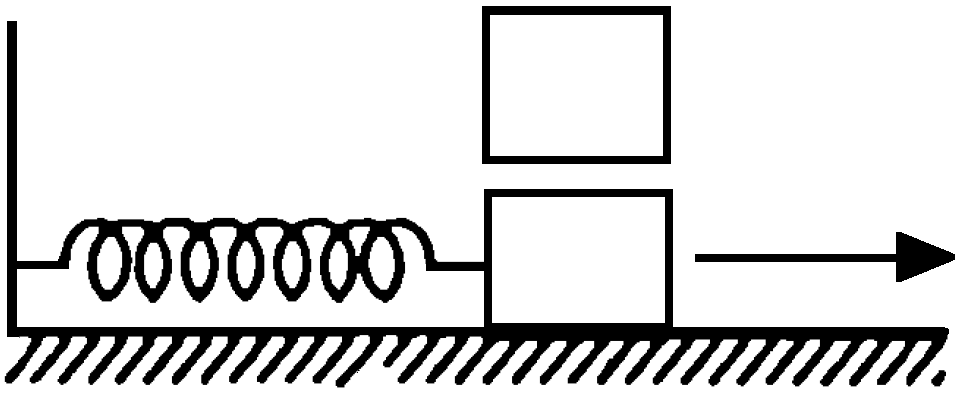
A small block of mass m is kept on a bigger block of mass M which is attached to a vertical spring of spring constant k as shown in the figure. The system oscillates vertically.
  1. Find the resultant force on the smaller block when it is displaced through a distance x above its equilibrium position.
  2. Find the normal force on the smaller block at this position. When is this force smallest in magnitude?
  3. What can be the maximum amplitude with which the two blocks may oscillate together?
Answer

  1. From the free body diagram,
$\therefore\text{R}+\text{m}\omega^2\text{x}-\text{mg}=0\ ...(1)$

Resultant force $\text{m}\omega^2\text{x}=\text{mg}-\text{R}$

$\Rightarrow\text{m}\omega^2\text{x}=\text{m}\Big(\frac{\text{k}}{\text{M}+\text{m}}\Big)$

$\Rightarrow\text{x}=\frac{\text{mkx}}{\text{M}+\text{m}}$

$\Big[\omega=\sqrt{\frac{\text{k}}{\text{M}+\text{m}}}$ for spring mass system $\Big]$
  1. $\text{R}=\text{mg}-\text{m}\omega^2\text{x}=\text{mg}-\text{m}\frac{\text{k}}{\text{M}+\text{m}}\text{x}=\text{mg}-\frac{\text{mkx}}{\text{M}+\text{m}}$
For R to be smallest, $\text{m}\omega^2\text{x}$ should be max. i.e. x is maximum.

The particle should be at the high point.
  1. We have $\text{R}=\text{mg}-\text{m}\omega^2\text{x}$
The tow blocks may oscillates together in such a way that R is greater than 0. At limiting condition, $\text{R}=0,\ \text{mg}=\text{m}\omega^2\text{x}$

$\text{x}=\frac{\text{mg}}{\text{m}\omega^2}=\frac{\text{mg}(\text{M}+\text{m})}{\text{mk}}$

So, the maximum amplitude is $=\frac{\text{g}(\text{M}+\text{m})}{\text{k}}$
View full question & answer
Question 135 Marks
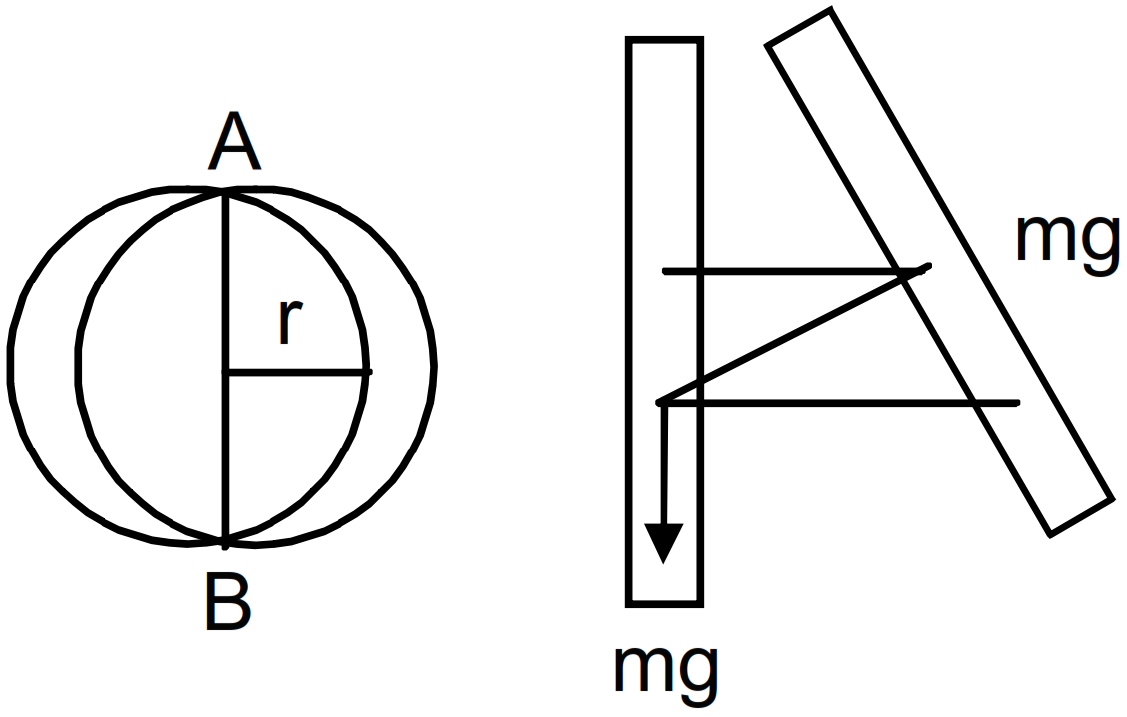
A closed circular wire hung on a nail in a wall undergoes small oscillations of amplitude $2^0 $ and time period 2s. Find,
  1. The radius of the circular wire,
  2. The speed of the particle farthest away from the point of suspension as it goes through its mean position,
  3. The acceleration of this particle as it goes through its mean position and
  4. The acceleration of this particle when it is at an extreme position. Take $\text{g}=\pi^2\text{m/s}^2.$
Answer
(For a compound pendulum)
  1. $\text{T}=2\pi\sqrt{\frac{\text{I}}{\text{mg}\ell}}=2\pi\sqrt{\frac{\text{I}}{\text{mgr}}}$
The MI of the circular wire about the point of suspension is given by,
$\therefore\text{l}=\text{mr}^2+\text{mr}^2=2\text{mr}^2$ is Moment of inertia about A.
$\therefore2=2\pi\sqrt{\frac{2\text{mr}^2\text{mgr}}{\text{m}^2\text{g}^2\text{r}^2}}=2\pi\sqrt{\frac{2\text{r}}{\text{g}}}$
$\Rightarrow\frac{2\text{r}}{\text{g}}=\frac{1}{\pi^2}$
$\Rightarrow\text{r}=\frac{\text{g}}{2\pi^2}=0.5\pi=50\text{cm}.$
  1. $\Big(\frac{1}{2}\Big)\omega^2-0=\text{mgr}(1-\cos\theta)$
$\Rightarrow\Big(\frac{1}{2}\Big)2\text{mr}^2-\omega^2=\text{mgr}(1-\cos2^\circ)$
$\Rightarrow\omega^2=\frac{\text{g}}{\text{r}}(1-\cos2^\circ)$
$\Rightarrow\omega=0.11\text{rad}/\text{sec}$ [putting the values of g and r]
$\Rightarrow\text{v}=\omega\times2\text{r}=11\text{cm/sec.}$
  1. Acceleration at the end position will be centripetal.
$=\text{a}_\text{n}=\omega^2(2\text{r})=(0.11)^2\times100=1.2\text{cm/s}^2$
The direction of ‘an’ is towards the point of suspension.
  1. At the extreme position the centrepetal acceleration will be zero. But, the particle will still have acceleration due to the SHM.
Because, T = 2sec.
Angular frequency $\omega=\frac{2\pi}{\text{T}}(\pi=3.14)$
So, angular acceleration at the extreme position,
$\alpha=\omega^2\theta=\pi^2\times\frac{2\pi}{180}=\frac{2\pi^3}{180}$ $\Big[1^\circ=\frac{\pi}{180}$ radious $\Big]$
So, tangential acceleration $=\alpha(2\text{r})=\frac{2\pi^3}{180}\times100=34\text{cm/s}^2.$
View full question & answer
Question 145 Marks
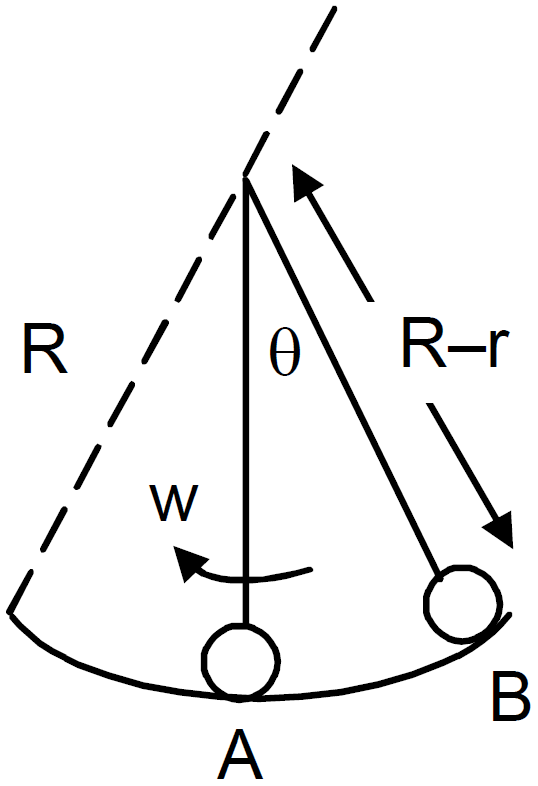
A spherical ball of mass m and radius r rolls without slipping on a rough concave surface of large radius R. It makes small oscillations about the lowest point, Find the time period.
Answer
Let the angular velocity of the system about the point os suspension at any time be $\omega.$ So, $\text{v}_{\text{c}}=(\text{R}-\text{r})\omega$ Again $\text{V}_\text{c}=\text{r}\omega_1$ [where, $\omega _1$ = rotational velocity of the sphere]$\omega_1=\frac{\text{v}_\text{c}}{\text{r}}=\Big(\frac{\text{R}+-\text{r}}{\text{r}}\Big)\omega\ ...(1)$
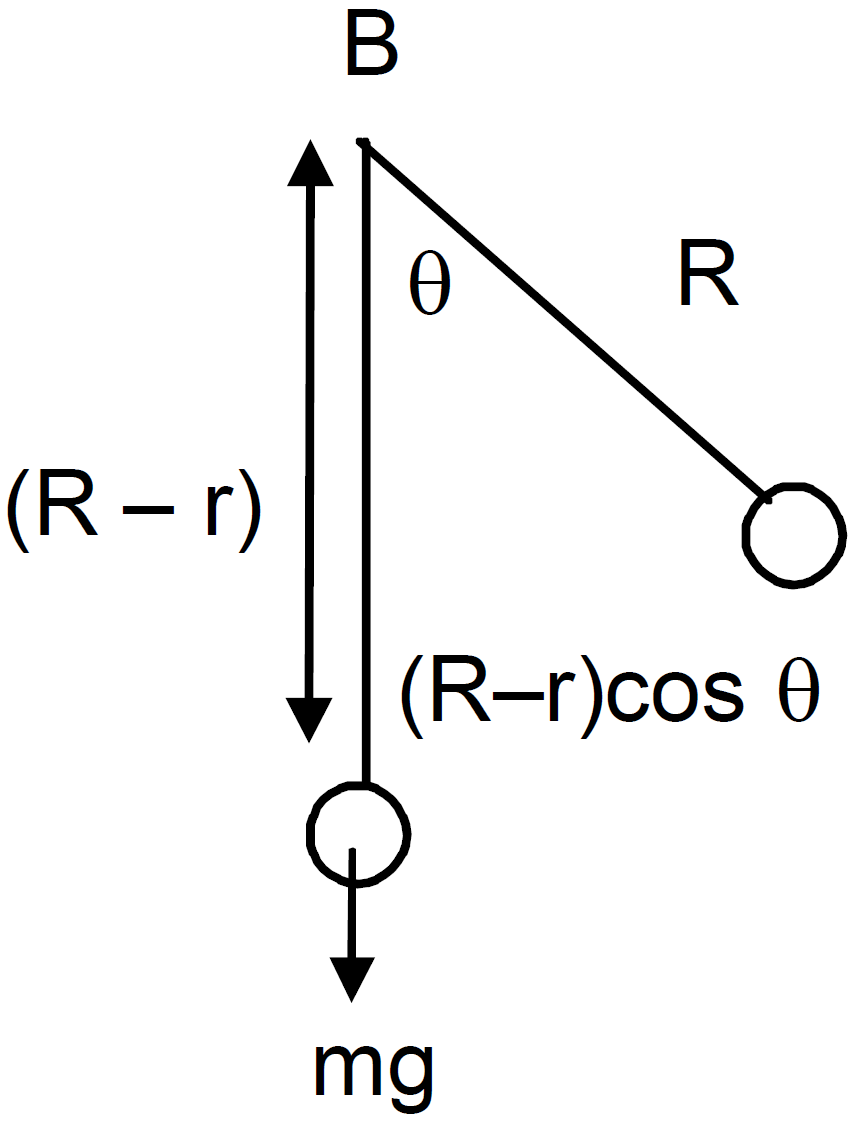
By Energy method, Total energy in SHM is constant. So, $\text{mg}(\text{R}-\text{r})(\text{1}-\cos\theta)+\Big(\frac{1}{2}\Big)\text{mv}_{\text{c}}^2+\Big(\frac{1}{2}\Big)\text{l}\omega_1^2=$ constant$\therefore\text{mg}(\text{R}-\text{r})(1-\cos\theta)+\Big(\frac{1}{2}\Big)\text{m}(\text{R}-\text{r})^2\omega^2+\Big(\frac{1}{2}\Big)\text{mr}^2\Big(\frac{\text{R}-\text{r}}{\text{r}}\Big)^2\omega^2=$ constant
$\Rightarrow\text{g}(\text{R}-1)1-\cos\theta+(\text{R}-\text{r}^2)\omega^2\Big[\frac{1}{2}+\frac{1}{5}\Big]=$ constant
Taking derivative, $\text{g}(\text{R}-\text{r})\sin\theta\frac{\text{d}\theta}{\text{dt}}=\frac{7}{10}(\text{R}-\text{r})^22\omega\frac{\text{d}\omega}{\text{dt}}$$\Rightarrow\text{g}\sin\theta=2\times\frac{7}{10}(\text{R}-\text{r})\alpha$
$\Rightarrow\text{g}\sin\theta=\frac{7}{5}(\text{R}-\text{r})\alpha$
$\Rightarrow\alpha=\frac{5\text{g}\sin\theta}{7(\text{R}-\text{r})}=\frac{5\text{g}\theta}{7(\text{R}-\text{r})}$
$\therefore\frac{\alpha}{\theta}=\omega^2=\frac{5\text{g}\theta}{7(\text{R}-\text{r})}=$ constant
So the motion is S.H.M. Again $\omega=\omega\sqrt{\frac{5\text{g}}{7(\text{R}-\text{r})}}$$\Rightarrow\text{T}=2\pi\sqrt{\frac{7(\text{R}-\text{r})}{5\text{g}}}$

View full question & answer
Question 155 Marks
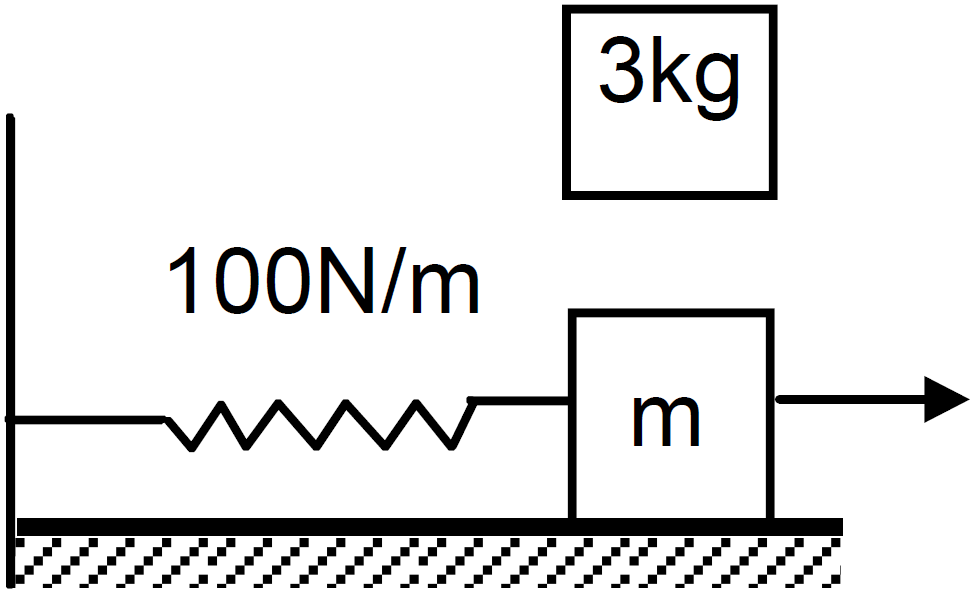
A 1kg block is executing simple harmonic motion of amplitude 0.1m on a smooth horizontal surface under the restoring force of a spring of spring constant 100N/m. A block of mass 3kg is gently placed on it at the instant it passes through the mean position. Assuming that the two blocks move together, find the frequency and the amplitude of the motion.
Answer
Amplitude = 0.1m Total mass = 3 + 1 = 4kg (when both the blocks are moving together)$\therefore\text{T}=2\pi\sqrt{\frac{\text{M}}{\text{k}}}=2\pi\sqrt{\frac{4}{100}}=\frac{2\pi}{5}\sec.$
$\therefore$ Frequency $=\frac{5}{2\pi}\text{Hz.}$
Again at the mean position, let 1kg block has velocity v.$\text{KE}.=\Big(\frac{1}{2}\Big){\text{mv}}^2=\Big(\frac{1}{2}\Big)\text{mx}^2$ where x → Amplitude = 0.1m
$\therefore\Big(\frac{1}{2}\Big)\times(1\times\text{v}^2)=\Big(\frac{1}{2}\Big)\times100(0.1)^2$
$\Rightarrow\text{v}=1\text{m/sec}\ ...(1)$
After the 3kg block is gently placed on the 1kg, then let, 1kg +3kg = 4kg block and the spring be one system. For this mass spring system, there is so external force. (when oscillation takes place). The momentum should be conserved. Let, 4kg block has velocity v.$\therefore$ Initial momentum = Final momentum
$\therefore1\times\text{v}=\text{4}\times\text{v}'$
$\Rightarrow\text{v}=\frac{1}{4}\text{m/s}$ (As v = 1m/s from equation (1)
Now the two blocks have velocity $\frac{1}{4}$ m/s at its mean poison.$\text{KE}_{\text{mass}}=\Big(\frac{1}{2}\Big)\text{m }'\text{v}'^2=\Big(\frac{1}{2}\Big)4\times\Big(\frac{1}{4}\Big)^2=\Big(\frac{1}{2}\Big)\times\Big(\frac{1}{4}\Big).$
When the blocks are going to the extreme position, there will be only potential energy.$\therefore\text{PE}=\Big(\frac{1}{2}\Big)\text{k}\delta^2=\Big(\frac{1}{2}\Big)\times\Big(\frac{1}{4}\Big)$ where $\delta\rightarrow$ new amplitude..
$\therefore\frac{1}{4}=100\delta^2\Rightarrow\delta=\sqrt{\frac{1}{400}}=0.05\text{m}=5\text{cm}$
So, Amplitude = 5cm.
View full question & answer
Question 165 Marks
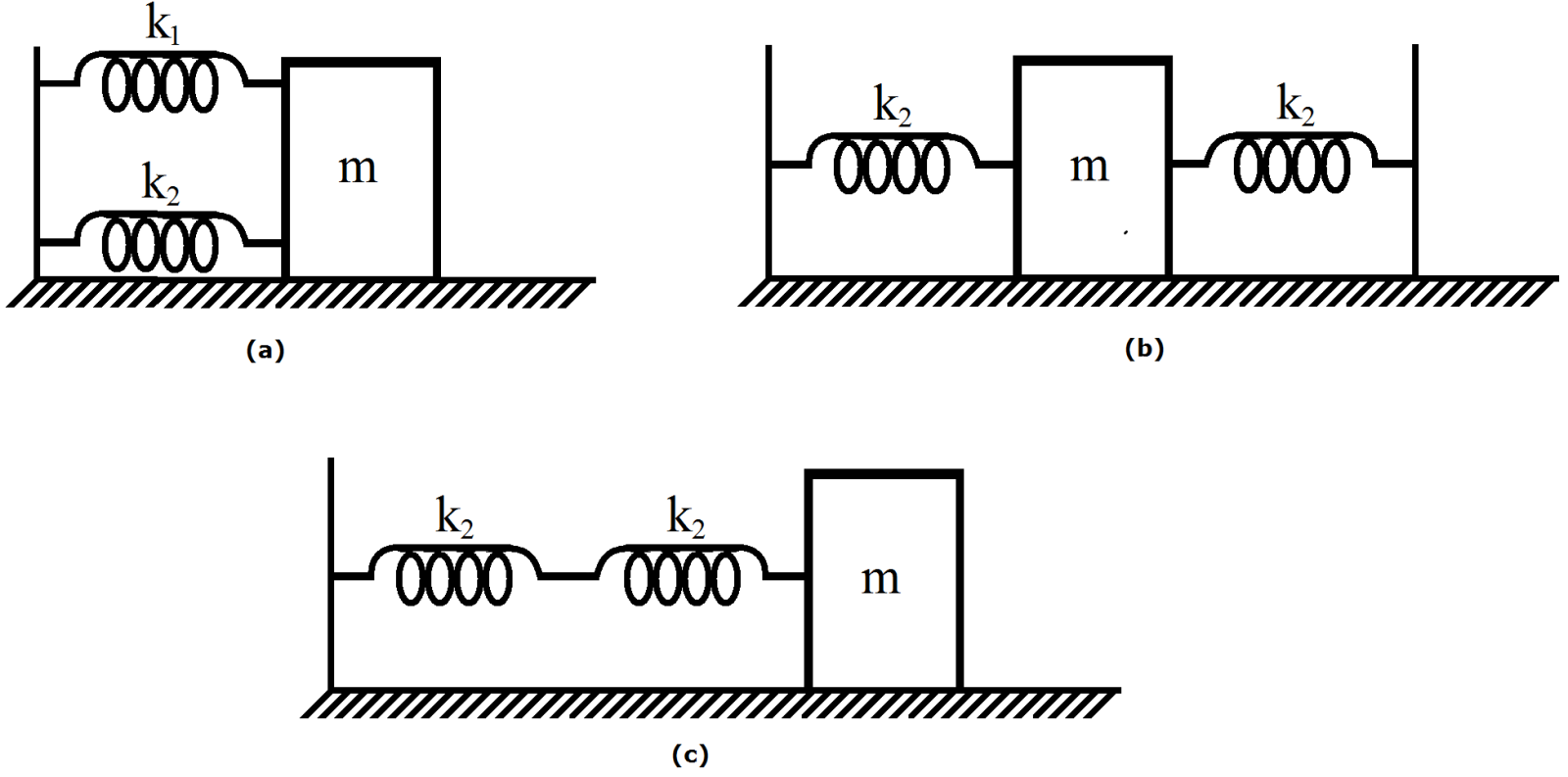
Find the time period of the oscillation of mass m in figure What is the equivalent spring constant of the pair of springs in each case?
View full question & answer
Question 175 Marks
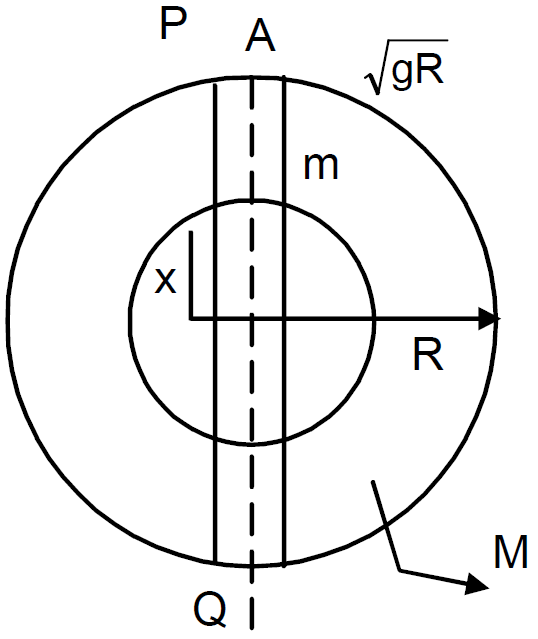
Assume that a tunnel is dug across the earth (radius = R) passing through its centre. Find the time a particle takes to cover the length of the tunnel if,
  1. It is projected into the tunnel with a speed of $\sqrt{\text{gR}}.$
  2. It is released from a height R above the tunnel.
  3. It is thrown vertically upward along the length of tunnel with a speed of $\sqrt{\text{gR}}.$
Answer
Let M be the total mass of the earth. At any position x,$\therefore\frac{\text{M}'}{\text{M}}=\frac{\rho\times\Big(\frac{4}{3}\Big)\pi\times\text{x}^3}{\rho\times\Big(\frac{4}{3}\Big)\pi\times\text{R}^3}=\frac{\text{x}^3}{\text{R}^3}$
$=\frac{\text{x}^3}{\text{R}^3}\Rightarrow\text{M}'=\frac{\text{Mx}^3}{\text{R}^3}$
So force on the particle is given by,$\therefore\text{F}_{\text{x}}=\frac{\text{GM}'\text{m}}{\text{x}^2}=\frac{\text{GMm}}{\text{R}^3}\text{x} \ ...(1)$
So, acceleration of the mass ‘M’ at that position is given by,$\text{a}_{\text{x}}=\frac{\text{GM}}{\text{R}^2}\text{x}$
$\Rightarrow\frac{\text{a}_\text{x}}{\text{x}}=\text{w}^2=\frac{\text{GM}}{\text{R}^3}=\frac{\text{g}}{\text{R}}$ $\Big(\because\text{g}=\frac{\text{GM}}{\text{R}^2}\Big)$
So, $\text{T}=2\pi\sqrt{\frac{\text{R}}{\text{g}}}=$ Time period of oscillation.
  1. Now, using velocity - displacement equation.
$\text{V}=\omega\sqrt{\text{A}^2-\text{R}^2}$ [Where, A = amplitude]
Given when, $\text{y}=\text{R},\ \text{v}{}=\sqrt{\text{gR}},\ \omega=\sqrt{\frac{\text{g}}{\text{R}}}$
$\Rightarrow\sqrt{\text{gR}}=\sqrt{\frac{\text{g}}{\text{R}}}\sqrt{(\text{A}^2-\text{R}^2)}$ $\Big[$ because $\omega=\sqrt{\frac{\text{g}}{\text{R}}}\Big]$
$\Rightarrow\text{R}^2=\text{A}^2-\text{R}^2$
$\Rightarrow\text{A}=\sqrt{2}\text{R}$
[Now, the phase of the particle at the point P is greater than $\frac{\pi}{2}$ but less than $\pi$ and at Q is greater than $\pi$ but less than $\frac{3\pi}{2}.$ Let the times taken by the particle to reach the positions P and Q be $t_1\ \&\  t_2$ respectively, then using displacement time equation]
$\text{y}=\text{r}\sin\omega\text{t}$
We have, $\text{R}=\sqrt{2}\text{R}\sin\omega\text{t}_1$
$\Rightarrow\omega\text{t}_1=\frac{3\pi}{4}$
$-\text{R}=\sqrt{2}\text{R}\sin\omega\text{t}_2$
$\Rightarrow\omega\text{t}_2=\frac{5\pi}{4}$
So, $\omega(\text{t}_2-\text{t}_1)=\frac{\pi}{2}$
$\Rightarrow\text{t}_2-\text{t}_1=\frac{\pi}{1\omega}=\frac{\pi}{2\sqrt{\Big(\frac{\text{R}}{\text{g}}\Big)}}$
Time taken by the particle to travel from P to Q is $\text{t}_2-\text{t}_1=\frac{\pi}{2\sqrt{\Big(\frac{\text{R}}{\text{g}}\Big)}}\sec.$
  1. When the body is dropped from a height R, then applying conservation of energy, change in P.E. = gain in K.E.
$\Rightarrow\frac{\text{GMm}}{\text{R}}-\frac{\text{Gmm}}{2\text{R}}=\frac{1}{2}\text{mv}^2$
$\Rightarrow\text{v}=\sqrt{\text{gR}}$
Since, the velocity is same at P, as in part (a) the body will take same time to travel PQ.
  1. When the body is projected vertically upward from P with a velocity $\sqrt{\text{gR}}$ its velocity will be Zero at the highest point.
The velocity of the body, when reaches P, again will be $\text{v}=\sqrt{\text{gR}}$ hence, the body will take same time $\frac{\pi}{2\sqrt{\Big(\frac{\text{R}}{\text{g}}\Big)}}$ to travel PQ.
View full question & answer
Question 185 Marks
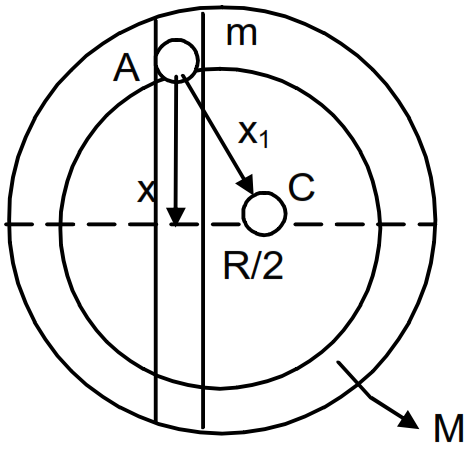
Assume that a tunnel is dug along a chord of the earth, at a perpendicular distance $\frac{\text{R}}{2}$ from the earth's centre where R is the radius of the earth. The wall of the tunnel is frictionless.
  1. Find the gravitational force exerted by the earth on a particle of mass m placed in the tunnel at a distance x from the centre of the tunnel.
  2. Find the component of this force along the tunnel and perpendicular to the tunnel.
  3. Find the normal force exerted by the wall on the particle.
  4. Find the resultant force on the particle.
  5. Show that the motion of the particle in the tunnel is simple harmonic and find the time period.
Answer
$\text{M}=\frac{4}{3}\pi\text{R}^3\rho.$$\text{M}^1=\frac{4}{3}\pi\text{x}_1^3\rho$
$\text{M}^1=\Big(\frac{\text{M}}{\text{R}^3}\Big)\text{x}_1^3$
  1. F = Gravitational force exerted by the earth on the particle of mass ‘x’ is,
$\text{F}=\frac{\text{GM}^1\text{m}}{\text{x}_1^2}=\frac{\text{GMm}}{\text{R}^3}\frac{\text{x}_1^3}{\text{x}_1^2}=\frac{\text{GMm}}{\text{R}^3}\text{x}_1$
$=\frac{\text{GMm}}{\text{R}_3}\sqrt{\text{x}^2+\Big(\frac{\text{R}^2}{4}\Big)}$
  1. $\text{F}_\text{y}=\text{F}\cos\theta=\frac{\text{GMmx}_1}{\text{R}_3}\frac{\text{x}}{\text{x}_1}=\frac{\text{GMmx}}{\text{R}^3}$
$\text{F}_\text{x}=\text{F}\sin\theta=\frac{\text{GMmx}_1}{\text{R}^3}\frac{\text{R}}{2\text{x}_1}=\frac{\text{GMm}}{2\text{R}^2}$
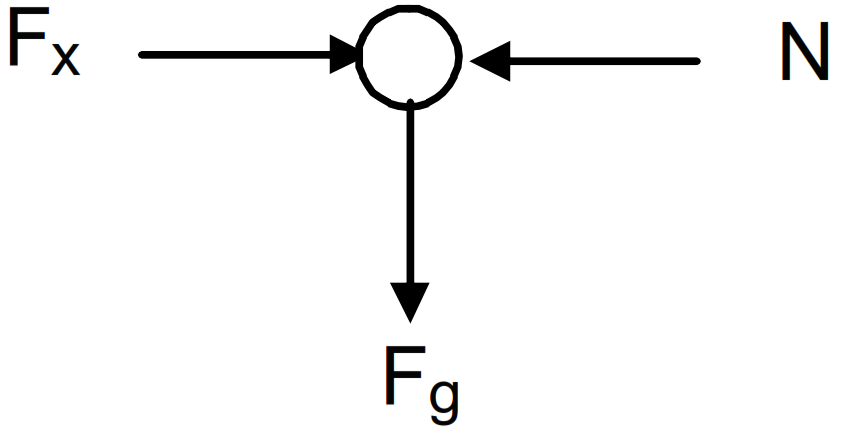
  1. $\text{F}_\text{x}=\frac{\text{GMm}}{2\text{R}^2}$ [since Normal force exerted by the wall N = Fx]
  2. Resultant force $=\frac{\text{GMmx}}{\text{R}^3}$
  3. Acceleration $=\frac{\text{Driving force}}{\text{mass}}=\frac{\text{GMmx}}{\text{R}^3\text{m}}=\frac{\text{GMm}}{\text{R}^3}$
So, a $\alpha$ x (The body makes SHM)
$\therefore\frac{\text{a}}{\text{x}}=\text{w}^2=\frac{\text{GM}}{\text{R}^3}$
$\Rightarrow\text{w}=\sqrt{\frac{\text{Gm}}{\text{R}^3}}$
$\Rightarrow\text{T}=2\pi\sqrt{\frac{\text{R}^3}{\text{GM}}}$

View full question & answer
Question 195 Marks
A uniform disc of radius r is to be suspended through a small hole made in the disc. Find the minimum possible time period of the disc for small oscillations. What should be the distance of the hole from the centre for it to have minimum time period?
Answer
Suppose that the point is ‘x’ distance from C.G. Let m = mass of the disc., Radius = r Here, $\ell$ = x$\text{M}=\text{l}_{\text{C.G.}}+\text{mx}^2=\frac{\text{mr}^2}{2}+\text{mx}^2=\text{m}\Big(\frac{\text{r}^2}{2}+\text{x}^2\Big)$
$\text{T}=2\pi\sqrt{\frac{\text{I}}{\text{mg}\ell}}=2\pi\sqrt{\frac{\text{m}\Big(\frac{\text{r}^2}{2}+\text{x}^2\Big)}{\text{mgx}}}$
$=2\pi\sqrt{\frac{\text{m}(\text{r}^2+2\text{x}^2)}{2\text{mgx}}}=2\pi\sqrt{\frac{\text{r}^2+2\text{x}^2}{2\text{gx}}}\ ...(1)$
For T is minimum $\frac{\text{dt}^2}{\text{dx}}=0$$\therefore\frac{\text{d}}{\text{dx}}\text{T}^2=\frac{\text{d}}{\text{dx}}\Big(\frac{4\pi^2\text{r}^2}{2\text{gx}}+\frac{4\pi^22\text{x}^2}{2\text{gx}}\Big)$
$\Rightarrow\frac{2\pi^2\text{r}^2}{\text{g}}\Big(-\frac{1}{\text{x}^2}\Big)+\frac{4\pi^2}{\text{g}}=0$
$\Rightarrow-\frac{\pi^2\text{r}^2}{\text{gx}^2}+\frac{2\pi^2}{\text{g}}=0$
$\Rightarrow\frac{\pi^2\text{r}^2}{\text{gx}^2}=\frac{2\pi^2}{\text{g}}$
$\Rightarrow2\text{x}^2=\text{r}^2$
$\Rightarrow\text{x}=\frac{\text{r}}{\sqrt{2}}$
So putting the value of equation (1)$\text{T}=2\pi\sqrt{\frac{\text{r}^2+2\Big(\frac{\text{r}^2}{2}\Big)}{2\text{gx}}}=2\pi\sqrt{\frac{2\text{r}^2}{2\text{gx}}}=2\pi\sqrt{\frac{\text{r}}{\text{g}\Big(\frac{\text{r}}{\sqrt{2}}\Big)}}\\=2\pi\sqrt{\frac{\sqrt{2}\text{r}^2}{\text{gr}}}=2\pi\sqrt{\frac{\sqrt{2\text{r}}}{\text{g}}}$
View full question & answer
Question 205 Marks
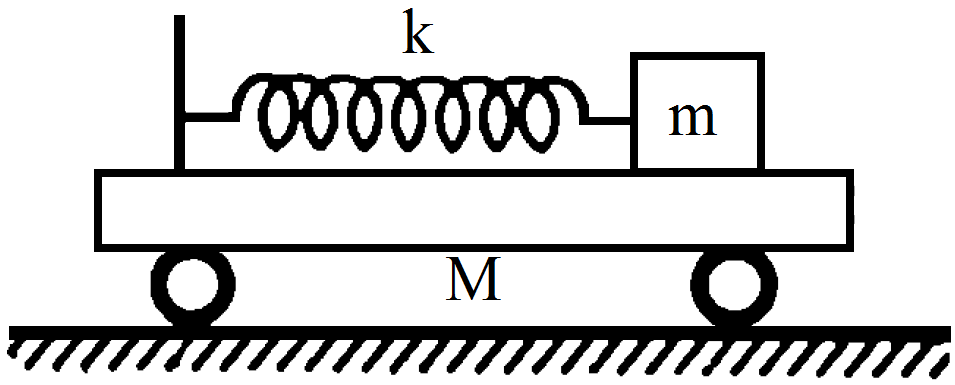
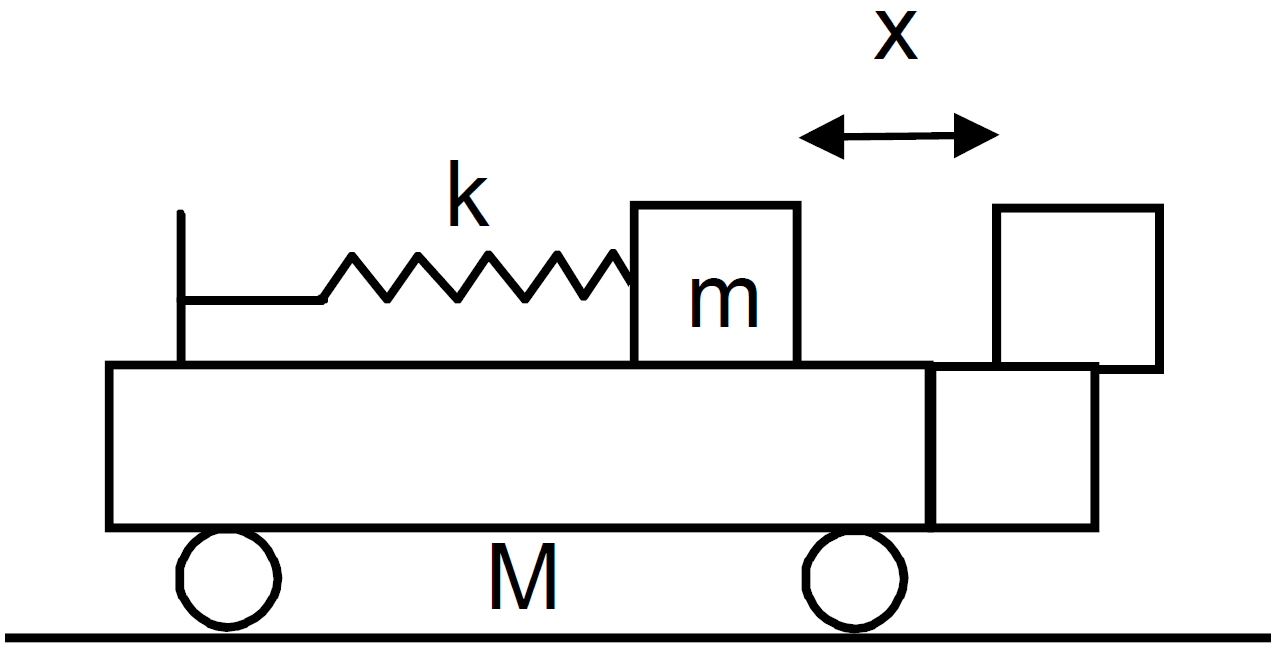
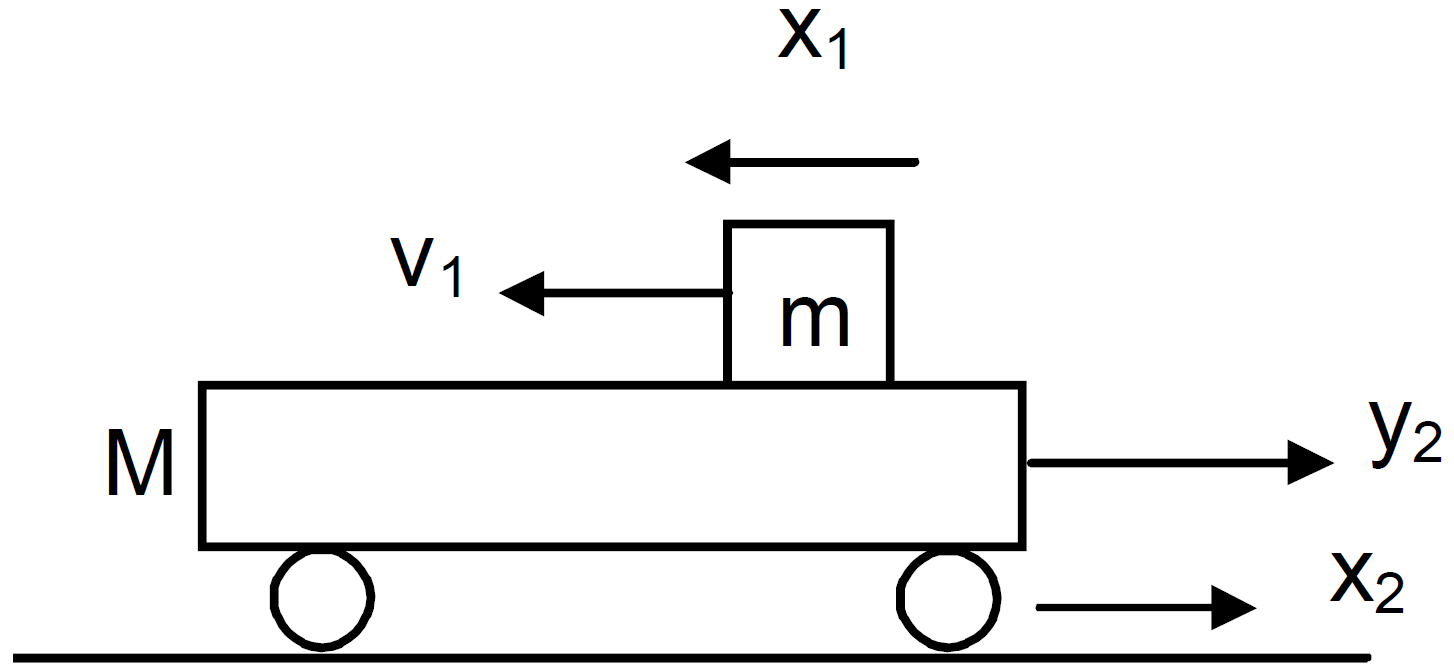
All the surfaces shown in are frictionless. The mass of the car is M, that of the block is m and the spring has spring constant k. Initially, the car and the block are at rest and the spring is stretched through a length x, when the system is released.
  1. Find the amplitudes of the simple harmonic motion of the block and of the car as seen from the road.
  2. Find the time period(s) of the two simple harmonic motions.
Answer
Let the amplitude of oscillation of ‘m’ and ‘M’ be $x_1$ and $x_2$ respectively.
  1. From law of conservation of momentum,
$\text{mx}_1=\text{Mx}_2\ ...(1)$ [because only internal forces are present]
Again, $\Big(\frac{1}{2}\Big)\text{kx}_0^2=\Big(\frac{1}{2}\Big)\text{k}(\text{x}_1+\text{x}_2)^2$
$\therefore\text{x}_0=\text{x}_1+\text{x}_2\ ...(2)$
[Block and mass oscillates in opposite direction. But x → stretched part]
From equation (1) and (2)
$\therefore\text{x}_0=\text{x}_1+\frac{\text{m}}{\text{M}}\text{x}_1=\Big(\frac{\text{M + m}}{\text{M}}\Big)\text{x}_1$
$\therefore\text{x}_1\frac{\text{Mx}_0}{\text{M}+\text{m}}$
So, $\text{x}_2=\text{x}_0-\text{x}_1=\text{x}_0\Big[1-\frac{\text{M}}{\text{M+m}}\Big]=\frac{\text{mx}_0}{\text{M}+\text{m}}$ respectively.
  1. At any position, let the velocities be $v_1$ and $v_2$ respectively.
Here, $v_1 =$ velocity of ‘m’ with respect to M.
By energy method
Total Energy = Constant
$\Big(\frac{1}{2}\Big)\text{Mv}^2+\Big(\frac{1}{2}\Big)\text{m}(\text{v}_1-\text{v}_2)^2+\Big(\frac{1}{2}\Big)\text{k}(\text{x}_1+\text{x}_2)^2=\text{}$ Constant .....(1)
$[v_1 - v_2 =$ Absolute velocity of mass ‘m’ as seen from the road.$]$
Again, from law of conservation of momentum,
$\text{mx}_2=\text{Mx}_2$
$\Rightarrow\text{x}_1=\frac{\text{M}}{\text{m}}\text{x}_2\ ...(1)$
$\text{Mv}_2=\text{m}(\text{v}_1-\text{v}_2)$
$\Rightarrow(\text{v}_1-\text{v}_2)=\frac{\text{M}}{\text{m}}\text{v}_2\ ...(2)$
Putting the above values in equation (1), we get
$\frac{1}{2}\text{M}\text{v}_2^2+\frac{1}{2}\text{m}\frac{\text{M}^2}{\text{m}^2}\text{v}_2^2+\frac{1}{2}\text{kx}_2^2\Big(1+\frac{\text{M}}{\text{m}{}}\Big)^2=$ constant.
$\therefore\text{M}\Big(1+\frac{\text{M}}{\text{m}}\Big)\text{v}_2+\text{k}\Big(1+\frac{\text{M}}{\text{m}}\Big)^2\text{x}_2^2=$ constant.
$\Rightarrow\text{mv}_2^2+\text{k}\Big(1+\frac{\text{M}}{\text{m}}\Big)\text{x}_2^2=$ Constant.
Taking derivative of both sides,
$\text{M}\times2\text{v}_2\frac{\text{dv}_2}{\text{dt}}+\text{k}\frac{(\text{M}+\text{m})}{\text{m}}-\text{ex}_2^2\frac{\text{dx}_2}{\text{dt}}=0$
$\Rightarrow\text{ma}_2+\text{k}\Big(\frac{\text{M}+\text{m}}{\text{m}}\Big)\text{x}_2=0$
$\Big[$because, $\text{v}_2=\frac{\text{dx}_2}{\text{dt}}\Big]$
$\Rightarrow\frac{\text{a}_2}{\text{x}_2}=-\frac{\text{k(}\text{M}+\text{m)}}{\text{Mm}}=\omega^2$
$\therefore\omega=\sqrt{\frac{\text{k}(\text{M}+\text{m})}{\text{Mm}}}$
So, Time period, $\text{T}=2\pi\sqrt{\frac{\text{Mm}}{\text{k}(\text{M}+\text{m})}}$
View full question & answer
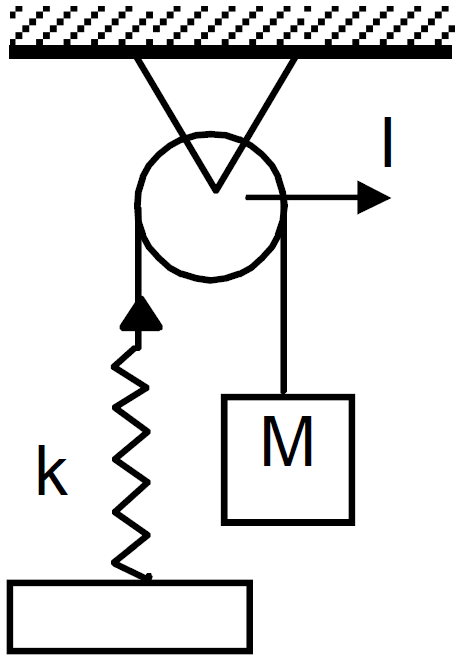
Question 215 Marks
Solve the previous problem if the pulley has a moment of inertia I about its axis and the string does not slip over it.
Answer
Let us solve the problem by ‘energy method’. Initial extension of the sprig in the mean position,$\delta=\frac{\text{mg}}{\text{k}}$
During oscillation, at any position ‘x’ below the equilibrium position, let the velocity of ‘m’ be v and angular velocity of the pulley be $\omega.$ If r is the radius of the pulley, then $\text{v}=\text{r}\omega.$ At any instant, Total Energy = constant (for SHM)$\therefore\Big(\frac{1}{2}\Big)\text{mv}^2+\Big(\frac{1}{2}\Big)\text{I}\omega^2+\Big(\frac{1}{2}\Big)\text{k}[(\text{x}+\delta)^2-\delta^2]-\text{mgx}=\text{Cosntant}$
$\Rightarrow\Big(\frac{1}{2}\Big)\text{mv}^2+\Big(\frac{1}{2}\Big)\text{I}\omega^2+\Big(\frac{1}{2}\Big)\text{kx}^2-\text{kx}\delta-\text{mgx}=\text{Cosntant}$
$\Rightarrow\Big(\frac{1}{2}\Big)\text{mv}^2+\Big(\frac{1}{2}\Big)\text{I}\Big(\frac{\text{v}^2}{\text{r}^2}\Big)+\Big(\frac{1}{2}\Big)\text{kx}^2=\text{Constant}$ $\Big(\delta=\frac{\text{mg}}{\text{k}}\Big)$
Taking derivative of both sides eith respect to ‘t’,$\text{mv}\frac{\text{dv}}{\text{dt}}+\frac{\text{I}}{\text{r}^2}\text{v}\frac{\text{dv}}{\text{dt}}+\text{k}\times\frac{\text{dv}}{\text{dt}}=0$
$\Rightarrow\text{a}\Big(\text{m}+\frac{1}{\text{r}^2}\Big)=\text{kx}$ $\Big(\therefore\text{x}=\frac{\text{dx}}{\text{dt}}\text{ and }\text{a}=\frac{\text{dx}}{\text{dt}}\Big)$
$\Rightarrow\frac{\text{a}}{\text{x}}=\frac{\text{k}}{\text{m}+\frac{\text{I}}{\text{r}^2}}=\omega^2$
$\Rightarrow\text{T}=2\pi\sqrt{\frac{\text{m}+\frac{\text{I}}{\text{r}^2}}{\text{k}}}$
View full question & answer
Question 225 Marks
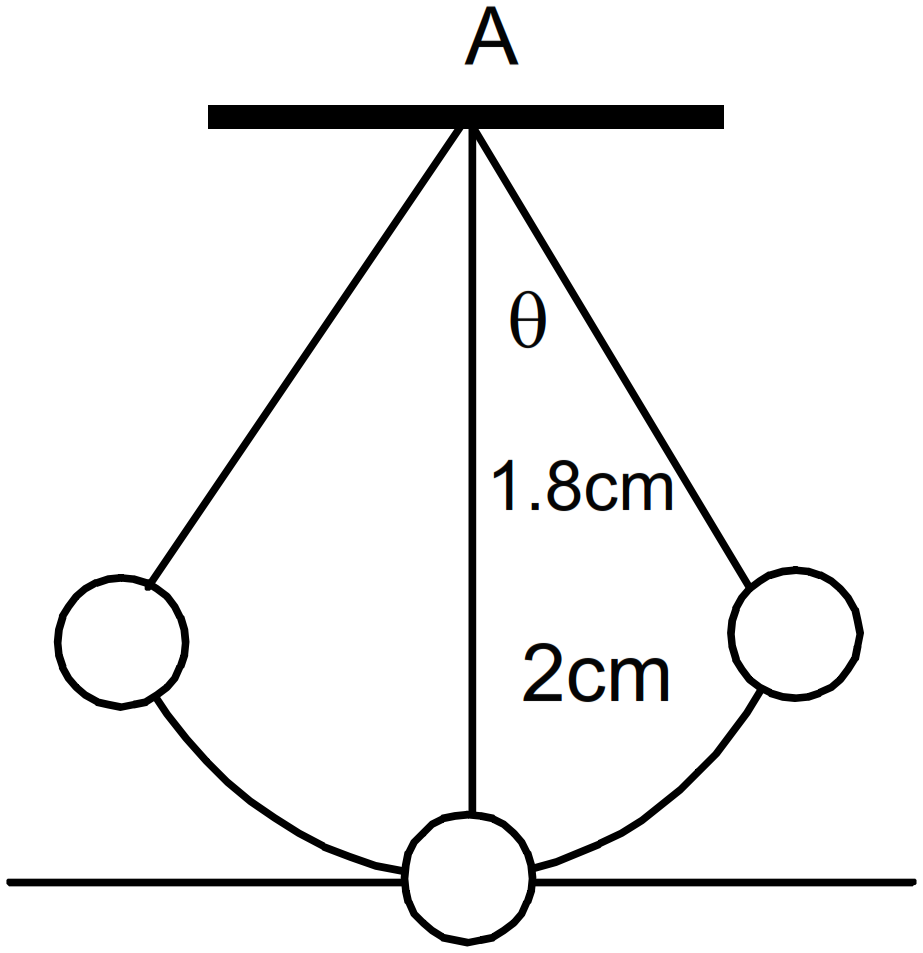
A hollow sphere of radius 2cm is attached to an 18cm long thread to make a pendulum. Find the time period of oscillation of this pendulum. How does it differ from the time period calculated using the formula for a simple pendulum?
Answer
According to Energy equation,$\text{mg}\ell(1-\cos\theta)+\Big(\frac{1}{2}\Big)\text{l}\omega^2=$ const.
$\text{mg}(0.2)(1-\cos\theta)+\Big(\frac{1}{2}\Big)\text{l}\omega^2=\text{C}.$
Again, $\text{l}=\frac{2}{3}\text{m}(0.2)^2+\text{m}(0.2)^2$
$=\text{m}\Big[\frac{0.008}{3}+0.04\Big]$
$=\text{m}\Big(\frac{0.1208}{3}\Big)\text{m.}$
Where l → Moment of Inertia about the pt of suspension A From equation Differenting and putting the value of I and 1 is$\frac{\text{d}}{\text{dt}}\Big[\text{mg}(0.2)(1-\cos\theta)+\frac{1}{2}\frac{0.1208}{3}\text{m}\omega^2\Big]=\frac{\text{d}}{\text{dt}}(\text{C})$
$\Rightarrow\text{mg}(0.2)\sin\theta\frac{\text{d}\theta}{\text{dt}}+\frac{1}{2}\Big(\frac{0.1208}{3}\Big)\text{m}2\omega\frac{\text{d}\omega}{\text{dt}}=0$
$\Rightarrow2\sin\theta=\frac{0.1208}{3}\alpha [$because, $g = 10m/s^2]$
$\Rightarrow\frac{\alpha}{\theta}=\frac{6}{0.1208}=\omega^2=58.36$
$\Rightarrow\omega=7.3.$
So, $\text{T}=\frac{2\pi}{\omega}=0.89\text{sec}.$
For simple pendulum $\text{T}=2\pi\sqrt{\frac{0.19}{10}}=0.86\sec.$ % more $=\frac{0.89-0.86}{0.89}=0.3$$\therefore$ It is about 0.3% larger than the calculated value.
View full question & answer
Question 235 Marks
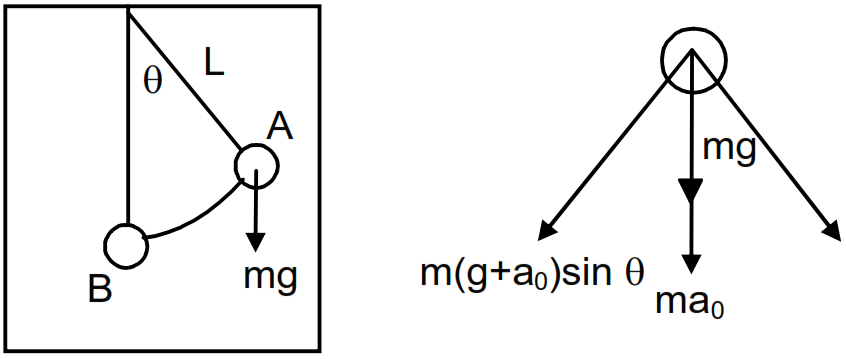
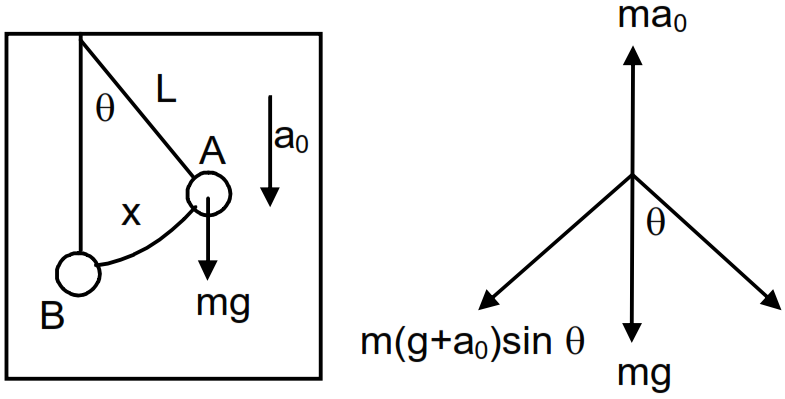
A simple pendulum of length I is suspended through the ceiling of an elevator. Find the time period of small oscillations if the elevator,
  1. Is going up with an acceleration $a_0$
  2. Is going down with an acceleration $a_0$.
  3. Is moving with a uniform velocity.
Answer
  1. Here driving force $\text{F}=\text{m}(\text{g}+\text{a}_0)\sin\theta\ ...(1)$
Acceleration $\text{a}=\frac{\text{F}}{\text{m}}=(\text{g}+\text{a}_0)\sin\theta=\frac{(\text{g}+\text{a}_0)\text{x}}{\ell}$
$\Big($Because when $\theta$ is small $\sin\theta\rightarrow\theta=\frac{\text{x}}{\ell}\Big)$
$\therefore\text{a}=\frac{(\text{g}+\text{a}_0)\text{x}}{\ell}$
$\therefore$ acceleration is proportional to displacement.
So, the motion is SHM.
Now, $\omega^2=\frac{(\text{g}+\text{a}_0)}{\ell}$
$\therefore\text{T}=2\pi\sqrt{\frac{\ell}{\text{g}+\text{a}_0}}$
  1. When the elevator is going downwards with acceleration $a_0.$
Driving force $=\text{F}=\text{m}(\text{g}-\text{a}_0)\sin\theta.$
Acceleration $=(\text{g}-\text{a}_0)\sin\theta=\frac{(\text{g}-\text{a}_0)\text{x}}{\ell}=\omega^2\text{x}$
$\text{T}=\frac{2\pi}{\omega}=2\pi\sqrt{\frac{\ell}{\text{g}-\text{a}_0}}$
  1. When moving with uniform velocity $a_0 = 0.$
For, the simple pendulum, driving force $=\frac{\text{mgx}}{\ell}$
$\Rightarrow\text{a}=\frac{\text{gx}}{\ell}$
$\Rightarrow\frac{\text{x}}{\text{a}}=\frac{\ell}{\text{g}}$
$\text{T}=2\pi\sqrt{\frac{\text{displacement}}{\text{acceleration}}}=2\pi\sqrt{\frac{\ell}{\text{g}}}$
View full question & answer
Question 245 Marks
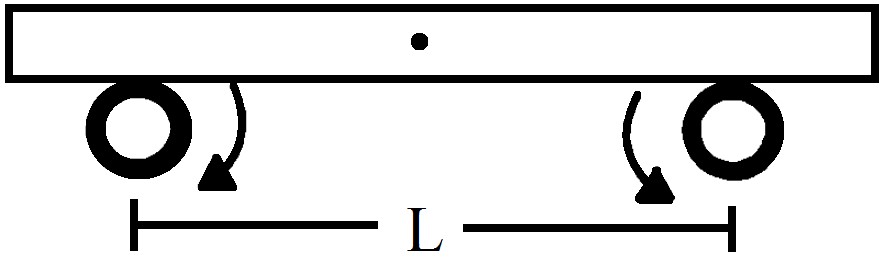
A uniform plate of mass M stays horizontally and symmetrically on two wheels rotating in opposite directions figure The separation between the wheels is L. The friction coefficient between each wheel and the plate is N. Find the time period of oscillation of the plate if it is slightly displayed along its length and released.
Answer
Let ‘x’ be the displacement of the plank towards left. Now the centre of gravity is also displaced through ‘x’ In displaced position $R_1 + R_2 = mg.$
Taking moment about G, we get
$\text{R}_1\Big(\frac{\ell}{2}-\text{x}\Big)=\text{R}_2\Big(\frac{\ell}{2}+\text{x}\Big)=(\text{mg}-\text{R}_1)\Big(\frac{\ell}{2}+\text{x}\Big)\ ...(1)$
So, $\text{R}_1\Big(\frac{\ell}{2}-\text{x}\Big)=(\text{mg}-\text{R}_1)\Big(\frac{\ell}{2}+\text{x}\Big)$
$\Rightarrow\text{R}_1\frac{\ell}{2}-\text{R}_1\text{x}=\text{mg}\frac{\ell}{2}-\text{R}_1\text{x}+\text{mgx}-\text{R}_1\frac{\ell}{2}$
$\Rightarrow\text{R}_1\frac{\ell}{2}+\text{R}_1\frac{\ell}{2}=\text{mg}\Big(\text{x}+\frac{\ell}{2}\Big)$
$\Rightarrow\text{R}_1\Big(\frac{\ell}{2}+\frac{\ell}{2}\Big)=\text{mg}\Big(\frac{2\text{x}+\ell}{\text{2}}\Big)$
$\Rightarrow\text{R}_1\ell=\frac{\text{mg}(2\text{x}+\ell)}{2}$
$\Rightarrow\text{R}_1=\frac{\text{mg(2x}+\ell)}{2\ell} \ ...(2)$
Now, $\text{F}_1=\mu\text{R}_1=\frac{\mu\text{mg}(\ell+2\text{x})}{2\ell}$
Simiarly $\text{F}_2=\mu\text{R}_2=\frac{\mu\text{mg}(\ell-2\text{x})}{2\ell}$
Since, $\text{F}_1>\text{F}_2$
$\Rightarrow\text{F}_1-\text{F}_2=\text{Ma}=\frac{2\mu\text{mg}}{\ell}\text{x}$
$\Rightarrow\frac{\text{a}}{\text{x}}=\frac{2\mu\text{g}}{\ell}=\omega^2$
$\Rightarrow\omega=\sqrt{\frac{2\mu\text{g}}{\ell}}$
$\therefore$ Time period $=2\pi\sqrt{\frac{\ell}{2\text{rg}}}$
View full question & answer
Question 255 Marks
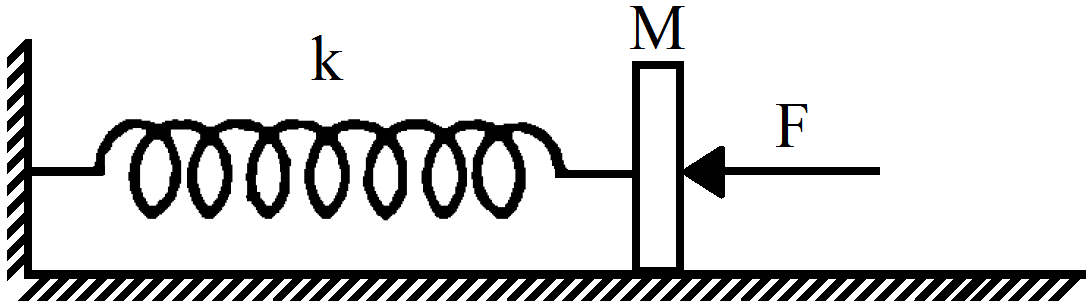
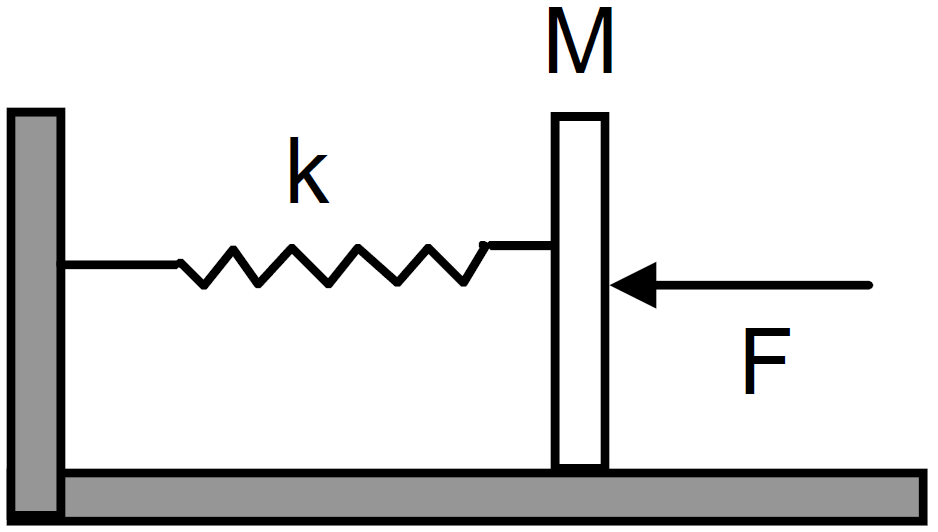
In figure k = 100N/m, M = 1kg and F = 10N,
  1. Find the compression of the spring in the equilibrium position.
  2. A sharp blow by some external agent imparts a speed of 2m/s to the block towards left. Find the sum of the potential energy of the spring and the kinetic energy of the block at this instant.
  3. Find the time period of the resulting simple harmonic motion.
  4. Find the amplitude.
  5. Write the potential energy of the spring when the block is at the left extreme.
  6. Write the potential energy of the spring when the block is at the right extreme.
The answers of (b), (e) and (f) are different. Explain why this does not violate the principle of conservation of energy.
Answer
Given, k = 100N/m, M = 1kg and F = 10N
  1. In the equilibrium position,
compression $\delta=\frac{\text{F}}{\text{k}}=\frac{10}{100}=0.1\text{m}=10\text{cm}$
  1. The blow imparts a speed of 2m/s to the block towards left.
$\therefore\text{P.E.}+\text{KE}=\frac{1}{2}\text{k}\delta^2+\frac{1}{2}\text{Mv}^2$
$=\big(\frac{1}{2}\big)\times100\times(0.1)^2+\big(\frac{1}{2}\big)\times1\times4$
$=0.5+2=2.5\text{J}$
  1. Time period $=2\pi\sqrt{\frac{\text{M}}{\text{k}}}=2\pi\sqrt{\frac{1}{100}}=\frac{\pi}{5}\sec$
  2. Let the amplitude be ‘x’ which means the distance between the mean position and the extreme position.
So, in the extreme position, compression of the spring is $(\text{x}+\delta).$
Since, in SHM, the total energy remains constant.
$=\big(\frac{1}{2}\big)\text{k}(\text{x}+\delta)^2$
$=\big(\frac{1}{2}\big)\text{k}\delta^2+\big(\frac{1}{2}\big)\text{mv}^2+\text{Fx}$
$=2.5+10\text{x}$
$\big[$ because $\big(\frac{1}{2}\big)\text{k}\delta^2+\big(\frac{1}{2}\big)\text{mv}^2=2.5\big]$
So, $50(\text{x}+0.1)^2=2.5+10\text{x}$
$\therefore50\text{x}^2+0.5+10\text{x}=2.5+10\text{x}$
$\therefore50\text{x}^2=2$
$\Rightarrow\text{x}^2=\frac{2}{50}=\frac{4}{100}$
$\Rightarrow\text{x}=\frac{2}{10}\text{m}=20\text{cm}.$
  1. Potential Energy at the left extreme is given by,
$\text{P.E.}=\big(\frac{1}{2}\big)\text{k}(\text{x}+\delta)^2$
$=\big(\frac{1}{2}\big)\times100(0.1+0.2)^2$
$=50\times0.09=4.5\text{J}$
  1. Potential Energy at the right extreme is given by,
$\text{P.E.}=\big(\frac{1}{2}\big)\text{k}(\text{x}+\delta)^2-\text{F}(2\text{x})$ [2x = distance between two extremes]
$=4.5-10(0.4)=0.5\text{J}$
The different values in (b) (e) and (f) do not violate law of conservation of energy as the work is done by the external force 10N.
View full question & answer
Question 265 Marks
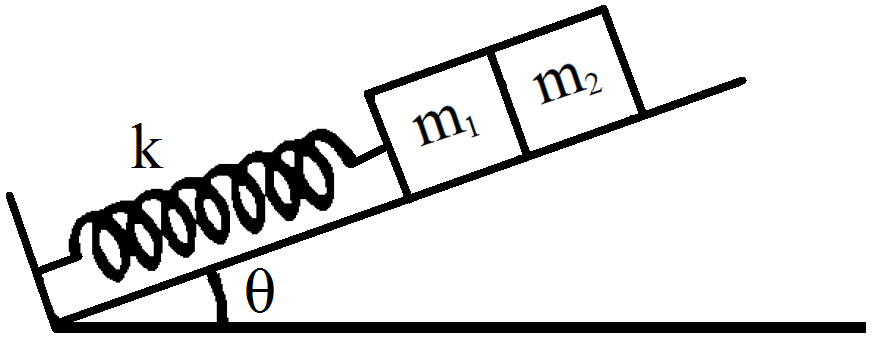
The block of mass $m_1$ shown in figure is fastened to the spring and the block of mass $m_2$ is placed against it.
  1. Find the compression of the spring in the equilibrium position.
  2. The blocks are pushed a further distance $\big(\frac{2}{\text{k}}\big)(\text{m}_1+\text{m}_2)\text{g}\sin\theta$ sine against the spring and released. Find the position where the two blocks separate.
  3. What is the common speed of blocks at the time of separation?
Answer


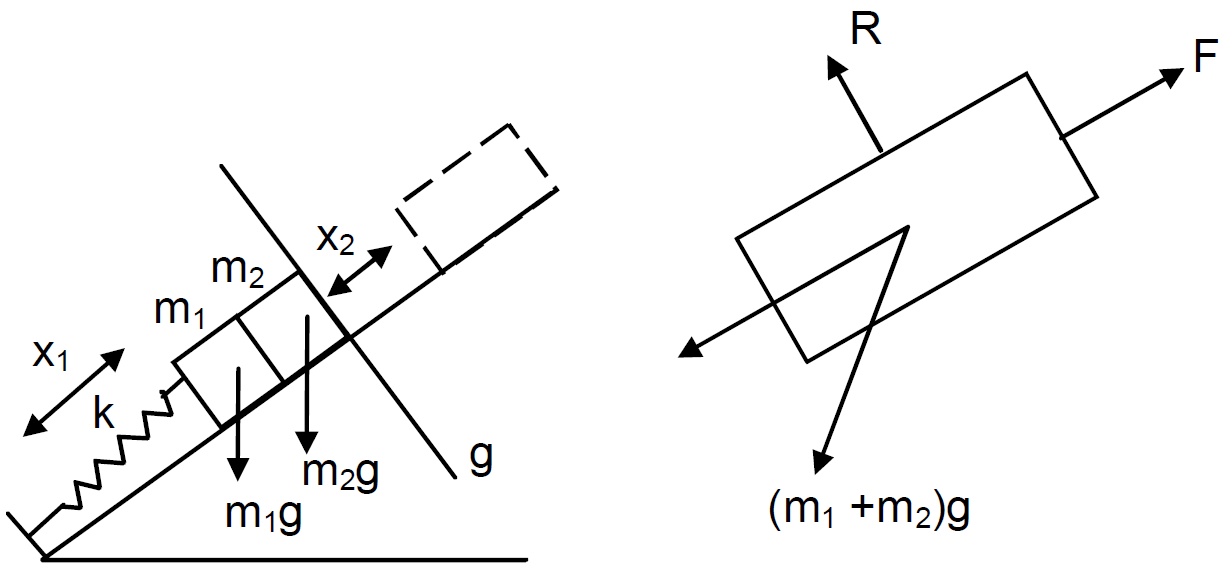
  1. At the equilibrium condition,
$\text{kx}=(\text{m}_1+\text{m}_2)\text{g}\sin\theta$
$\Rightarrow\text{x}=\frac{(\text{m}_1+\text{m}_2)\text{g}\sin\theta}{\text{k}}$
  1. $\text{x}_1=\frac{2}{\text{k}}(\text{m}_1+\text{m}_2)\text{g}\sin\theta$ Given
When the system is released, it will start to make SHM
where $\omega=\sqrt{\frac{\text{k}}{\text{m}_1+\text{m}_2}}$
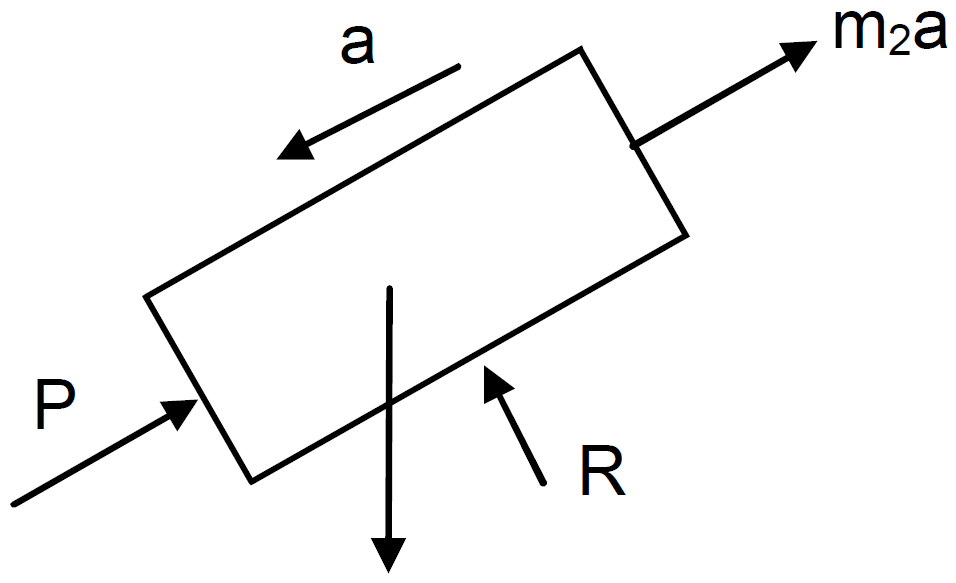
When the blocks lose contact, P = 0
So $\text{m}_2\text{ g}\sin\theta=\text{m}_2\text{x}_2\omega^2=\text{m}_2\text{x}_2\Big(\frac{\text{k}}{\text{m}_2 + \text{m}_2}\Big)$
$\Rightarrow\text{x}_2=\frac{(\text{m}_1+\text{m}_2)\text{g}\sin\theta}{\text{k}}$
So the blocks will lose contact with each other when the springs attain its natural length.
  1. Let the common speed attained by both the blocks be v.
$\frac{1}{2}(\text{m}_1+\text{m}_2)\text{v}^2-0$
$=\frac{1}{2}\text{k}(\text{x}_1+\text{x}_2)^2-(\text{m}_1+\text{m}_2)\text{g}\sin\theta(\text{x}+\text{x}_1)$ $[\text{x}+\text{x}_1=$ total compression $]$
$\Rightarrow\big(\frac{1}{2}\big)(\text{m}_1+\text{m}_2)\text{v}^2$
$=\big[\big(\frac{1}{2}\big)\text{k}\big(\frac{3}{\text{k}}\big)(\text{m}_1+\text{m}_2)\text{g}\sin\theta-(\text{m}_1+\text{m}_2)\text{g}\sin\theta\big](\text{x}+\text{x}_1)$
$\Rightarrow\big(\frac{1}{2}\big)(\text{m}_1+\text{m}_2)\text{v}^2$
$=\big(\frac{1}{2}\big)(\text{m}_1+\text{m}_2)\text{g}\sin\theta\times\big(\frac{3}{\text{k}}\big)(\text{m}_1+\text{m}_2)\text{g}\sin\theta$
$\Rightarrow\text{v}=\sqrt{\frac{3}{\text{k}(\text{m}_1+\text{m}_2)}}\text{g}\sin\theta.$
View full question & answer