$100\,mA$ current gives a full scale deflection in a galvanometer of $2\,\Omega $ resistance. The resistance connected with the galvanometer to convert it into a voltmeter to measure $5\,V$ is ............... $\Omega $
Medium
Download our app for free and get started
$R = \frac{V}{{{i_g}}} - G = \frac{5}{{100/{{10}^3}}} - 2$$ = \frac{{5000}}{{100}} - 2 = 48\,\Omega $

Download our appand get started for free
Experience the future of education. Simply download our apps or reach out to us for more information. Let's shape the future of learning together!No signup needed.*
Similar Questions
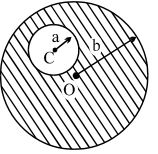
- 1A long straight metal rod has a very long hole of radius $‘a’$ drilled parallel to the rod axis as shown in the figure. If the rod carries a current $‘i’$ find the value of magnetic induction on the axis of the hole, where $OC = c$View Solution
- 2Two long parallel wires are at a distance of $1$ metre. Both of them carry one ampere of current. The force of attraction per unit length between the two wires isView Solution
- 3.......$A$ should be the current in a circular coil of radius $5\,cm$ to annul ${B_H} = 5 \times {10^{ - 5}}\,T$View Solution
- 4A particle is projected with a velocity ( $10\ m/s$ ) along $y-$ axis from point $(2, 3)$ . Magnetic field of $\left( {3\hat i + 4\hat j} \right)$ Tesla exist uniformly in the space. Its speed when particle passes through $y-$ axis for the third time is : (neglect gravity)View Solution
- 5Two very long, straight, parallel wires carry steady currents $I$ and $-I$ respectively. The distance etween the wires is $d$. At a certain instant of time, a point charge $q$ is at a point equidistant from the two wires, in the plane of the wires. Its instantaneous velocity $v$ is perpendicular to the plane of wires. The magnitude of the force due to the magnetic field acting on the charge at this instant isView Solution
- 6A parallel plate capacitor of area $60\, cm^2$ and separation $3\, mm$ is charged initially to $90\, \mu C$. If the medium between the plate gets slightly conducting and the plate loses the charge initially at the rate of $2.5\times10^{-8}\, C/s$, then what is the magnetic field between the plates ?View Solution
- 7A thin wire of length $l$ is carrying a constant current. The wire is bent to form a circular coil. If radius of the coil, thus formed, is equal to $R$ and number of turns in it is equal to $n$, then which of the following graphs represent $(s)$ variation of magnetic field induction $(b)$ at centre of the coilView Solution
- 8A charge moving with velocity $v$ in $X$-direction is subjected to a field of magnetic induction in the negative $X$-direction. As a result, the charge willView Solution
- 9Two similar coils of radius $R$ are lying concentrically with their planes at right angles to each other. The currents flowing in them are $I$ and $2I$, respectively. The resultant magnetic field induction at the centre will beView Solution
- 10A charged particle is moving with velocity $v$ in a magnetic field of induction $B$. The force on the particle will be maximum whenView Solution