.......$A$ should be the current in a circular coil of radius $5\,cm$ to annul ${B_H} = 5 \times {10^{ - 5}}\,T$
Medium
Download our app for free and get started
(b) $B = {10^{ - 7}}\frac{{2\pi i}}{r}$; according to question $B_H = B$
$ \Rightarrow 5 \times {10^{ - 5}} = {10^{ - 7}} \times \frac{{2 \times 3.14 \times i}}{{5 \times {{10}^{ - 2}}}} \Rightarrow i = 4\,A$
$ \Rightarrow 5 \times {10^{ - 5}} = {10^{ - 7}} \times \frac{{2 \times 3.14 \times i}}{{5 \times {{10}^{ - 2}}}} \Rightarrow i = 4\,A$

Download our appand get started for free
Experience the future of education. Simply download our apps or reach out to us for more information. Let's shape the future of learning together!No signup needed.*
Similar Questions
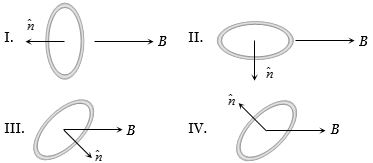
- 1A current carrying loop is placed in a uniform magnetic field in four different orientations, $I$, $II$, $III$ & $IV$ arrange them in the decreasing order of potential EnergyView Solution
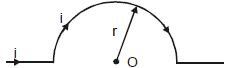
- 2A portion of a conductive wire is bent in the form of a semicircle of radius $r$ as shown below in fig. At the centre of semicircle, the magnetic induction will beView Solution
- 3The circular coil of a galvanometer has fifty turns. The coil has a radius of $1\ cm$. The coil is placed in a radial magnetic field of $0. 010\ T$. The torsion coefficent of the spring on which the coil hangs is $3 \times 10^{-7}\ N-m-rad^{-1}$. Determine the deviation of the galvanometer's hand if the current through the coil is $1.0\ mA$......$^o$View Solution
- 4View SolutionA particle moving in a magnetic field increases its velocity, then its radius of the circle
- 5Two long parallel copper wires carry currents of $5\,A$ each in opposite directions. If the wires are separated by a distance of $0.5\,m$, then the force between the two wires isView Solution
- 6View SolutionAssertion: To convert a galvanometer into an ammeter a small resistance is connected in parallel with it.
Reason: The small resistance increases the combined resistance of the combination.
- 7Two concentric circular coils of ten turns each are situated in the same plane. Their radii are $20$ and $40\, cm$ and they carry respectively $0.2$ and $0.3$ $ampere$ current in opposite direction. The magnetic field in $weber/{m^2}$ at the centre isView Solution
- 8View SolutionA magnetic field
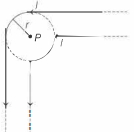
- 9Two infinitely long wires each carrying current $I$ along the same direction are made into the geometry as shown in the figure below. The magnetic field at the point $P$ isView Solution
- 10Two concentric coils each of radius equal to $2\pi \,{\rm{ }}cm$ are placed at right angles to each other. $3$ $ampere$ and $4$ $ampere$ are the currents flowing in each coil respectively. The magnetic induction in $Weber/{m^2}$ at the centre of the coils will be $({\mu _0} = 4\pi \times {10^{ - 7}}\,Wb/A.m)$View Solution