Question
10kg mass is attached to one end of a copper wire $3m$ long and $1mm$ in diameter. Calculate the lateral compression produced in it (Poisson's ratio is $0.25$ and Young's modulus of the material of the wire is $12.5 \times 10^{10}N/ m^2$).

Answer

Let Dl be the increase in length of the wire, $\therefore\text{Y}=\frac{\frac{\text{F}}{\text{A}}}{\frac{\Delta\text{l}}{\text{l}}}$
$\text{Y}=\frac{\text{F}.\text{l}}{\text{A.}\Delta\text{l}}$
$\text{Y}=\frac{\text{F}.\text{l}}{\pi\text{r}^2.\Delta\text{l}}$
$\therefore\Delta\text{l}=\frac{\text{F}.\text{l}}{\pi\text{r}^2.\text{Y}}=\frac{10\times9.8\times3}{3.14\times(0.5\times10^{-3})\times12.5\times10^{10}}$
$=0.2993\times10^{-2}\text{m}$ Now the Poisson's ratio $\sigma=-\frac{\Delta\text{D}}{\text{D}}\times\frac{\text{l}}{\Delta\text{l}}$
$\therefore\Delta\text{D}=\frac{\sigma.\text{D}.\Delta\text{l}}{\text{l}}=\frac{-0.2993\times10^{-3}\times0.25}{3}$
$=-2.5\times10^{-7}=-0.25\times10^{-6}=-0.25\mu\text{m}$ Here the lateral compression $=0.25\mu\text{m}$ (approx).

Need a full question paper?

Generate a complete, print-ready paper with questions like this in minutes — across 16+ boards, with answer keys.
Start Generating Free

Similar questions

A car starting from rest, accelerates uniformly with $5m/s^2$ for sometime and then decelerates to come to rest with $3m/s^2$. Find the maximum velocity attained during the motion and the distance covered in a total time of 6 seconds of the journey.
Using a screw gauge, the diameter of a metal rod was measured. The observation are given as follows: $0.39\ mm, 0.38\ mm, 0.37\ mm. 0.41\ mm, 0.38\ mm, 0.38\ mm, 0.37\ mm, 0.40\ mm, 0.39\ mm.$ Calculate
  1. The most accurate value of the diameter.
  2. The relative error.
  3. The percentage error in the measurement of the diameter.
A particle of mass m is kept on the top of a smooth sphere of radius R. It is given a sharp impulse which imparts it a horizontal speed v.
  1. Find the normal force between the sphere and the particle just after the impulse.
  2. What should be the minimum value of v for which the particle does not slip on the sphere?
  3. Assuming the velocity v to be half the minimum calculated in part.
  4. Find the angle made by the radius through the particle with the vertical when it leaves the sphere.
The work function of a photoelectric material is 4.0eV.
  1. What is the threshold wavelength?
  2. Find the wavelength of light for which the stopping potential is 2.5V.
A train starts from a station P with a uniform acceleration a, for some distance and then goes with the uniform retardation $a_1$ for some more distance to come to rest at the station Q. The distance between the stations P and Q is $4km$ and the train takes $4 minutes$ to complete this journey. If the accelerations are in km per $min^2$. Show that $\frac{1}{\text{a}_1}+\frac{1}{\text{a}_2}=2.$
An LR circuit having a time constant of 50ms is connected with an ideal battery of emf $\in.$ Find the time elapsed before:
  1. The current reaches half its maximum value.
  2. The power dissipated in heat reaches half its maximum value.
  3. The magnetic field energy stored in the circuit reaches half its maximum value.
A train passes a station A at $40kmh^{-1}$ and maintains its speed for 7km and is then uniformly retarded, stopping at B which is 8.5km from A. A second train starts from A at the instant the first train passes and being accelerated some part of the journey and uniformly retarded for the rest, stops at B at the same times as the first train. Calculate the maximum speed of the second train, use only the graphical method.
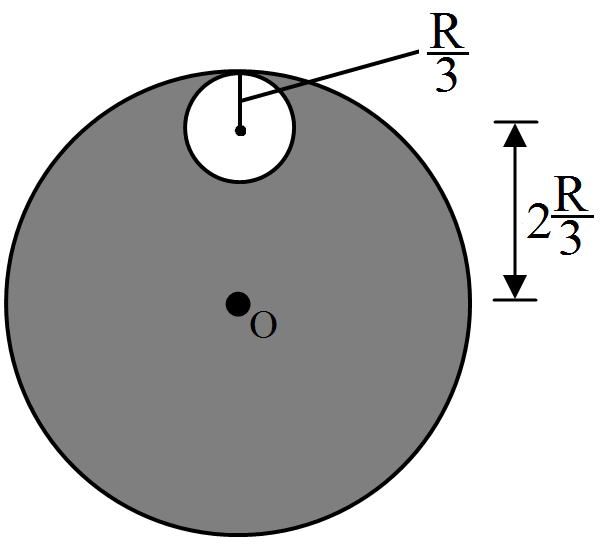
From a circular disc of radius R and mass 9M, a small disc of radius $\frac{\text{R}}{3}$ is removed as shown in Fig. Find the moment of inertia of the remaining disc about an axis perpendicular to the plane of the disc and passing through the point O.
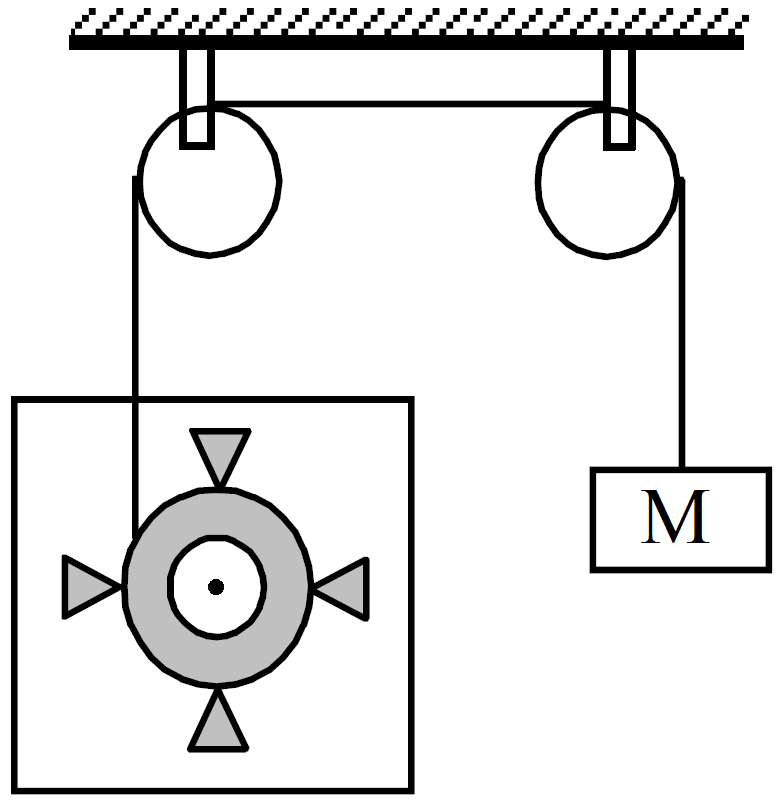
Figure, shows water in a container having $2.0mm$ thick walls made of a material of thermal conductivity $0.50\text{Wm}^{-1}{^{\circ}}\text{C}^{-1}.$ The container is kept in a melting-ice bath at $0^\circ C$. The total surface area in contact with water is $0.05m^2$. A wheel is clamped inside the water and is coupled to a block of mass M as shown in the figure. As the block goes down, the wheel rotates. It is found that after some time a steady state is reached in which the block goes down with a constant speed of $10cms^{-1}$ and the temperature of the water remains constant at $1.0^\circ C$. Find the mass M of the block. Assume that the heat flows out of the water only through the walls in contact. Take $g = 10ms^{-2}$.
A girl riding a bicycle with a speed of $5m/ s$ towards north direction, observes rain falling vertically down. If she increases her speed to $10m/ s$, rain appears to meet her at $45°$ to the vertical. What is the speed of the rain? In what direction does rain fall as observed by a ground based observer?
(Hint: Assume north to be $\hat{\text{i}}$ direction and vertically downward to be $-\hat{\text{j}}$. Let the rain velocity $\text{v}_\text{r}$ be $\text{a}\hat{\text{i}}+\text{b}\hat{\text{j}}.$ The velocity of rain as observed by the girl is always $V_r-V_{girl}$. Draw the vector diagram/s for the information given and find a and b. You may draw all vectors in the reference frame of ground based observer)