MCQ
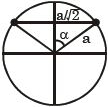
$2$ particles $p$ and $q$ describe $SHM$ of same amplitude $a$ and same frequency $f$ along straight line, the maximum distance between the two particle $a\sqrt 2 $ . The initial phase difference between particle is
  • A
    Zero
  • $\frac{\pi }{2}$
  • C
    $\frac{\pi }{6}$
  • D
    $\frac{\pi }{3}$

Answer

Correct option: B.
$\frac{\pi }{2}$
b
$\sin \alpha=\frac{a / \sqrt{2}}{a}$

$\alpha=45^{\circ}$

$\phi=2 \alpha=90^{\circ}$

Need a full question paper?

Generate a complete, print-ready paper with questions like this in minutes — across 16+ boards, with answer keys.

Start Generating Free

Similar questions

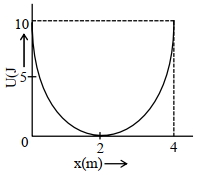
A mass of $5\, {kg}$ is connected to a spring. The potential energy curve of the simple harmonic motion executed by the system is shown in the figure. A simple pendulum of length $4\, {m}$ has the same period of oscillation as the spring system. What is the value of acceleration due to gravity on the planet where these experiments are performed? (In ${m} / {s}^{2}$)
A $10 g$ bullet moving at $200 \,m / s$ stops after penetrating $5 \,cm$ of wooden plank. The average force exerted on the bullet will be .......... $N$
A train starting from rest first accelerates uniformly up to a speed of $80 \mathrm{~km} / \mathrm{h}$ for time $t$, then it moves with a constant speed for time 3t. The average speed of the train for this duration of journey will be (in $\mathrm{km} / \mathrm{h}$ ) :
There is relationship between the mean free path of the molecules of a gas and its density.
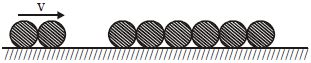
Six identical balls are lined in a straight groove made on a horizontal frictionless surface.  Two similar balls each moving with a velocity $v$ collide elastically with the row of $6\, balls$ from left. What will happen ?
Two bodies of different masses ${m_1}$ and ${m_2}$ have equal momenta. Their kinetic energies ${E_1}$ and ${E_2}$ are in the ratio
Mass density of a solid sphere is $\rho $ . Radius of the sphere is $R$. The gravitational field at a distance $r$ from the centre of the sphere inside it is
If the sun and the planets carried huge amounts of opposite charges,
  1. All three of Kepler’s laws would still be valid.
  2. Only the third law will be valid.
  3. The second law will not change.
  4. The first law will still be valid.
A refrigerator consumes an average $35\, {W}$ power to operate between temperature $-10^{\circ} {C}$ to $25^{\circ} {C}$. If there is no loss of energy then how much average heat per second does it transfer? (in ${J} / {s}$)
Water falls from a tap, down the streamline