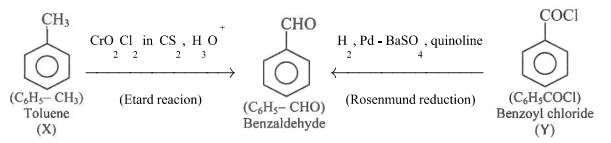
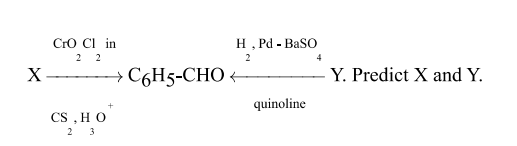
MCQ
Image
  • A
    $\begin{array}{l}X= C _6 H _5 CN \\ Y= C _6 H _5 COOCH _3\end{array}$
  • B
    $\begin{array}{l} X = C _6 H _5 CH _3 \\ Y = C _6 H _5 COCl \end{array}$
  • C
    $\begin{array}{l} X = C _6 H _5 CH _2 OH \\ Y= C _6 H _5 CH _2 CN \end{array}$
  • D
    $\begin{array}{l} X = C _6 H _5 COOH \\ Y = C _6 H _5 CH _2 CH _3\end{array}$

Need a full question paper?

Generate a complete, print-ready paper with questions like this in minutes — across 16+ boards, with answer keys.

Start Generating Free

Similar questions

A $10\,g$ effervescent tablet containing sodium bicarbonate and oxalic acid releases $0.25\,ml$ of $CO_2$ at $T = 298.15\,K$ and $p = 1\,bar$. If molar volume of $CO_2$ is $25.0\,L$ under such condition, what is the percentage of sodium bicarbonate in each tablet? [Molar mass of $NaHCO_3 = 84\,g\,mol^{-1}$ ]
On passing $HCl$ gas in saturated solution of $NaCl$, the solubility of $NaCl$ 
Bleaching powder and bleach solution are produced on a large scale and used in several house hold products.

The effectiveness of bleach solution is often measured by iodometry.

$1.$ $25 mL$ of household bleach solution was mixed with $30 \ mL$ of $0.50 \ M \ KI$ and $10 \ mL$ of $4 \ N$ acetic acid. In the titration of the liberated iodine, $48 \ mL$ of $0.25 \ N \ Na _2 S _2 O _3$ was used to reach the end point. The molarity of the household bleach solution is

$(A)$ $0.48 \ M$ $(B)$ $0.96 \ M$ $(C)$ $0.24 \ M$ $(D)$ $0.024 \ M$

$2.$ Bleaching powder contains a salt of an oxoacid as one of its components. The anhydride of that oxoacid is

$(A)$ $Cl _2 O$ $(B)$ $Cl _2 O _7$ $(C)$ $ClO _2$ $(D)$ $Cl _2 O _6$

Give the answer question $1$ and $2.$
Heterolytic bond dissociation energy of alkyl halides follows the sequence
Which has the highest bond energy
$CrO_ 3$ dissolves in aqueous $NaOH$ to give
Which of the following order is incorrect ?
Low oxidation state of metals in their complexes are common when ligands.
Most acidic alcohol out of following compounds is
Which of these species has a standard enthalpy of formation equal to zero?